Continuously Predicting and Processing Barge-in
During a Live Spoken Dialogue Task
Ethan O. Selfridge†, Iker Arizmendi‡, Peter A. Heeman†, and Jason D. Williams1
†Center for Spoken Language Understanding, Oregon Health & Science University, Portland, OR, USA ‡AT&T Labs – Research, Shannon Laboratory, Florham Park, NJ, USA
1Microsoft Research, Redmond, WA, USA
Abstract
Barge-in enables the user to provide input during system speech, facilitating a more natural and efficient interaction. Stan-dard methods generally focus on single-stage barge-in detection, applying the di-alogue policy irrespective of the barge-in context. Unfortunately, this approach per-forms poorly when used in challenging environments. We propose and evaluate a barge-in processing method that uses a prediction strategy to continuously decide whether to pause, continue, or resume the prompt. This model has greater task suc-cess and efficiency than the standard ap-proach when evaluated in a public spoken dialogue system.
Index Terms: spoken dialogue systems, barge-in 1 Introduction
Spoken dialogue systems (SDS) communicate with users with spoken natural language; the op-timal SDS being effective, efficient, and natural. Allowing input during system speech, known as
barge-in, is one approach that designers use to improve system performance. In the ideal use case, the system detects user speech, switches off the prompt, and then responds to the user’s utter-ance. Dialogue efficiency improves, as the sys-tem receives information prior to completing its prompt, and the interaction becomes more natu-ral, as the system demonstrates more human-like turn-taking behavior. However, barge-in poses a number of new challenges; the system must now recognize and process input during its prompt that may not be well-formed system directed speech. This is a difficult task and standard barge-in ap-proaches often stop the prompt for input that will not be understood, subsequently initiating a clari-fication sub-dialogue (“I’m sorry, I didn’t get that.
You can say...etc.”). This non-understood barge-in (NUBI) could be from environmental noise, non-system directed speech, poorly-formed non-system di-rected speech, legitimate speech recognition diffi-culties (such as acoustic model mismatch), or any combination thereof.
This paper proposes and evaluates a barge-in processing method that focuses on handling NU-BIs. Our Prediction-based Barge-in Response (PBR) model continuously predicts interpretation success by applying adaptive thresholds to incre-mental recognition results. In our view,predicting
whether the recognition will be understood has far more utility than detecting whether the barge-in is truly system directed speech as, for many do-mains, we feel only understandable input has more discourse importance than system speech. If the input is predicted to be understood, the prompt is paused. If it is predicted or found to be NUBI, the prompt is resumed. Using this method, the sys-tem may resume speaking before recognition is complete and will never initiate a clarifying sub-dialogue in response to a NUBI. The PBR model was implemented in a public Lets Go! statistical dialogue system (Raux et al., 2005), and we com-pare it with a system using standard barge-in meth-ods. We find the PBR model has a significantly better task success rate and efficiency.
Table 1 illustrates the NUBI responses produced by the standard barge-in (Baseline) and PBR mod-els. After both prompts are paused, the standard method initiates a clarifying sub-dialogue whereas PBR resumes the prompt.
We first provide background on Incremental Speech Recognition and describe the relevant re-lated work on barge-in. We then detail the Prediction-based Barge-in Response model’s op-eration and motivation before presenting a whole-call and component-wise analysis of the PBR
1Work done while at AT&T Labs - Research
Table 1:System response to Non-Understood Barge-In (NUBI)
Baseline Ok, sixty one<NUBI>Sorry, say a bus route like twenty eight x PBR Ok, sixty one<NUBI>sixty one c. Where are you leaving from?
model. The paper concludes with a discussion of our findings and implications for future SDS.
2 Background and Related Work
Incremental Speech Recognition: Incremental Speech Recognition (ISR) provides the real-time information critical to the PBR model’s continu-ous predictions. ISR produces partial recognition results (“partials”) until input ceases and the “fi-nal” recognition result is produced following some silence. As partials have a tendency to be revised as more audio is processed, stability measures are used to predict whether a given partial hypothe-sis will be present in the final recognition result (McGraw and Gruenstein, 2012; Selfridge et al., 2011). Here, we use Lattice-Aware ISR, which produces partials after a Voice Activity Detector (VAD) indicates speech and limits them to be a complete language model specified phrase or have guaranteed stability (Selfridge et al., 2011).
Barge-In: Using the standard barge-in model, the system stops the prompt if barge-in is detected and applies the dialogue logic to the final recogni-tion result. This approach assumes that the barge-in context should not barge-influence the dialogue pol-icy, and most previous work on barge-in has fo-cused on detection: distinguishing system directed speech from other environmental sounds. Cur-rently, these methods are either based on a VAD (e.g. (Str¨om and Seneff, 2000)), ISR hypothe-ses (Raux, 2008), or some combination (Rose and Kim, 2003). Both approaches can lead to detection errors: background speech will trigger the VAD, and partial hypotheses are unreliable (Baumann et al., 2009). To minimize this, many systems only enable barge-in at certain points in the dialogue.
One challenge with the standard barge-in model is that detection errors can initiate a clarifying sub-dialogue to non-system directed input, as it is un-likely that this input will be understood (Raux, 2008). Since this false barge-in, which in most cases is background speech (e.g. the television), is highly indicative of poor recognition performance overall, the system’s errant clarifying response can only further degrade user experience.
Strom and Seneff (2000) provide, to our
knowl-edge, the only mature work that proposed deviat-ing from the dialogue policy when responddeviat-ing to a barge-in recognition. Instead of initiating a clar-ifying sub-dialogue, the system produced a filled-pause disfluency (’umm’) and resumed the prompt at the phrase boundary closest to the prompt’s sus-pension point. However, this model only operated at the final recognition level (as opposed the incre-mental level) and, unfortunately, they provide no evaluation of their approach. An explicit compar-ison between the approaches described here and the PBR model is found in Section 3.5.
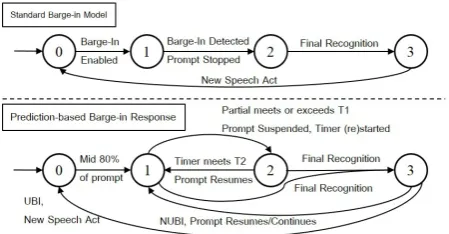
3 Prediction-based Barge-in Response The PBR model is characterized by three high-level states: State 1 (Speaking Prediction), whose goal is to pause the prompt if stability scores pre-dict understanding; State 2 (Silent Prepre-diction), whose goal is to resume the prompt if stability scores and the incremental recognition rate pre-dict non-understanding; and State 3 (Completion), which operates on the final recognition result, and resumes the prompt unless the recognition is un-derstood and the new speech act will advance the dialogue. Here, we define “advancing the dia-logue” to be any speech act that does not start a clarifying sub-dialogue indicating a NUBI. Tran-sitions between State 1 and 2 are governed by adaptive thresholds — repeated resumptions sug-gest the user is in a noisy environment, so each resumption increases the threshold required to ad-vance from State 1 to State 2 and decreases the threshold required to advance from State 2 to State 1. A high-level comparison of the standard model and our approach is shown in Figure 1; a complete PBR state diagram is provided in the Appendix.
3.1 State 1: Speaking Prediction
Table 2:Background noise and User Speech ISR
Background Noise User Utterance Partial Stab. Scr. Partial Stab. Scr.
one 0.134 six 0.396
two 0.193 sixty 0.542
six 0.127 fifty one 0.428 two 0.078 sixty one a 0.491
and stability scores for two example inputs: back-ground noise on the left, and the user saying “sixty one a” on the right.
State 1 relies on the internal threshold param-eter, T1. If a partial’s stability score falls below T1, control remains in State 1 and the partial re-sult is discarded. If a stability score meetsT1, the prompt is paused and control transitions to State 2. T1is initially set to 0 and is adapted as the dialogue progresses. The adaptation procedure is described below in Section 3.4. If afinalrecognition result is received, control transitions directly to State 3. Transitioning from State 1 to State 2 is only al-lowed during the middle 80% of the prompt; oth-erwise only transitions to State 3 are allowed.1
3.2 State 2: Silent Prediction
Upon entering State 2, Silent Prediction, the prompt is paused and a timer is started. State 2 re-quires continuous evidence (at least everyT2 ms) that the ISR is recognizing valid speech and each time a partial result that meetsT1 is received, the timer is reset. If the timer reaches the time thresh-oldT2, the prompt is resumed and control returns to State 1. T2 is initially set at 1.0 seconds and is adapted as the dialogue progresses. Final recogni-tion results trigger a transirecogni-tion to State 3.
The resumption prompt is constructed using the temporal position of the VAD specified speech start to find the percentage of the prompt that was played up to that point. This percentage is then reduced by 10% and used to create the resump-tion prompt by finding the word that is closest to, but not beyond, the modified percentage. White space characters and punctuation are used to deter-mine word boundaries for text-to-speech prompts, whereas automatically generated word-alignments are used for pre-recorded prompts.
[image:3.595.79.289.74.160.2]1We hypothesized that people will rarely respond to the current prompt during the first 10% of prompt time as over-laps at the beginning of utterances are commonly initiative conflicts (Yang and Heeman, 2010). Users may produce early-onset utterances during the last 10% that should not stop the prompt as it is not an “intentional” barge-in.
Figure 1:The Standard Barge-in and PBR Models
3.3 State 3: Completion
State 3, Completion, is entered when a final recog-nition result is received and determines whether the current dialogue policy will advance the dia-logue or not. Here, the PBR model relies on the ability of the dialogue manager (DM) to produce a speculative action without transitioning to the next dialogue state. If the new action will not advance the dialogue, it is discarded and the recognition is NUBI. However, if itwilladvance the dialogue then it is classified as an Understood Barge-In (UBI). In the NUBI case, the system either contin-ues speaking or resumes the current prompt (tran-sitioning to State 1). In the UBI case, the system initiates the new speech act after playing a short reaction sound and the DM transitions to the next dialogue state. This reaction sound precedes all
speech acts outside the barge-in context but isnot
used for resumption or timeout prompts. Note that by depending solely on the new speech act, our model does not require access to the DM’s internal understanding or confidence scoring components.
3.4 Threshold adjustments
environ-Figure 2:Example dialogue fragment of PBR Model
ments, a lower threshold allows the system to re-sume quickly as the NUBI likelihood is greater.
BothT1andT2are dependent on the number of system resumptions, as we view the action of re-suming the prompt as an indication that the thresh-old is not correct. With every resumption, the pa-rameterRis incremented by 1 and, to account for changing environments,R is decremented by 0.2 for every full prompt that is not paused until it reaches 0. UsingR,T1is computed byT1= 0.17· R, andT2byT2 =argmax(0.1,1−(0.1·R)).2
3.5 Method Discussion
The motivation behind the PBR model is both the-oretical and practical. According to Selfridge and Heeman (2010), turn-taking is best viewed as a collaborative process where the turn assignment should be determined by the importance of the utterance. During barge-in, the system is speak-ing and so should only yield the turn if the user’s speech is more important than its own. For many domains, we view non-understood input as less important than the system’s prompt and so, in this case, the system should not release the turn by stopping the prompt and initiating a clarifying sub-dialogue. On the practical side, there is a high likelihood that non-advancing input is not system directed, to which the system should neither con-sume, in terms of belief state updating, nor re-spond to, in terms of asking for clarification. In the rare case of non-understood system directed speech, the user can easily repeat their utterance. Here, we note that in the event that the user is backchanneling, the PBR model will behave cor-rectly and not release the turn.
The PBR approach differs from standard barge-in approaches barge-in several respects. First, standard barge-in stops the prompt (i.e., transitions from State 1 to State 2) if either the VAD or the partial hypothesis suggests that there is speech; our ap-proach — using acoustic, language model, and lat-tice features — predicts whether the input is likely to contain an interpretable recognition result. Sec-2The threshold update values were determined empiri-cally by the authors.
ond, standard barge-in uses a static threshold; our approach uses dynamic thresholds that adapt to the user’s acoustic environment. Parameter adjust-ments are straightforward since our method auto-matically classifies each barge-in as NUBI or UBI. In practice, the prompt will be paused incorrectly only a few times in a noisy environment, after which the adaptive thresholds will prevent incor-rect pauses at the expense of being less responsive to true user speech. If the noise level decreases, the thresholds will become more sensitive again, enabling swifter responses. Finally, with the ex-ception of Strom and Seneff, standard approaches always discard the prompt; our approach can re-sume the prompt if recognition is not understood or is proceeding poorly, enabling the system to resume speaking before recognition is complete. Moreover, resumption yields a natural user expe-rience as it often creates a repetition disfluency (“Ok, sixty - sixty one c”), which are rarely no-ticed by the listener (Martin and Strange, 1968).
An example dialogue fragment is shown in Fig-ure 2, with the state transitions shown above. Note the transition from State 2 to State 1, which is the system resuming speechduringrecognition. This recognition stream, produced by non-system di-rected user speech, does not end until the user says “repeat” for the last time.
4 Evaluation Results
[image:4.595.80.519.65.126.2]Figure 3:Estimated success rate for the PBR and Baseline systems. Stars indicate p<0.018 withχ2test.
a small number of dialogue states that appeared problematic during initial testing. The second sys-tem used the PBR model with an Incremental In-teraction Manager (Selfridge et al., 2012) to pro-duce speculative actions in State 3. The pub-lic called both systems during the final weeks of 2011 and the start of 2012. The DM applied a lo-gistic regression based confidence measure to de-termine whether the recognition was understood. Both systems used the AT&T WATSONSMspeech recognizer (Goffin et al., 2005) with the same sub-task specific rule-based language models and standard echo cancellation techniques. The beam width was set to maximize accuracy while still running faster than real-time. The PBR system used a WATSON modification to output lattice-aware partial results.
Call and barge-in statistics are shown in Table 3. Here, we define (potential) barge-in (some-what imprecisely) as a full recognition that at some point overlaps with the system prompt, as determined by the call logs. We show the calls with barge-inbeforethe bus schedule sub-task was reached (BI-BS) and the calls with barge-in during any point of the call (BI All). Since the Baseline system only enabled barge-in at specific points in the dialogue, it has fewer instances of barge-in (Total Barge-In) and fewer barge-in calls. Regret-fully, due to logging issues with the PBR system, recognition specific metrics such as Word Error Rate and true/false barge-in rates are unavailable.
4.1 Estimated Success Rate
We begin by comparing the success rate and efficiency between the Baseline and PBR
sys-Table 3:Baseline and PBR call/barge-in statistics.
Baseline PBR
Total Calls 1027 892
BI-BS 228 (23%) 345 (39%) BI All 281 (27%) 483 (54%) Total Barge-In 829 1388
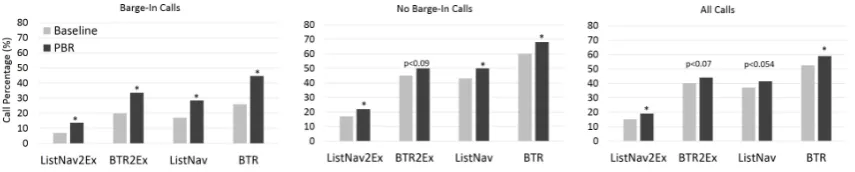
tems. Since task success can be quite difficult to measure, we use four increasingly stringent task success definitions: Bus Times Reached (BTR), where success is achieved if the call reaches the bus schedule sub-task; List Navigation (List Nav.), where success is achieved if the user says ‘’next”, “previous”, or “repeat” — the intuition being that if the user attempted to navigate the bus sched-ule sub-task they were somewhat satisfied with the system’s performance so far; and Immediate Exit (BTR2Ex and ListNav2Ex), which further constrains both of the previous definitions to only calls that finish directly after the initial visit to the bus times sub-task. Success rate for the defini-tions were automatically computed (not manually labeled). Figure 3 shows the success rate of the PBR and Baseline systems for all four definitions of success. It shows, from left to right, Barge-In, No Barge-In (NBI), and All calls. Here we restrict barge-in calls to those where barge-in occurred prior to the bus schedule task being reached.
For the calls with barge-in, aχ2 test finds sig-nificant differences between the PBR and Base-line for all four task success definitions. However, we also found significant differences in the NBI calls. This was surprising since, when barge-in is not triggered, both systems are ostensibly the same. We speculate this could be due to the Base-line’s barge-in enabling strategy: an environment that triggers barge-in in the Baseline would always trigger barge-in in the PBR model, whereas the converse is nottrue as the Baseline only enabled barge-in in some of the states. This means that there is a potential mismatch when separating the calls based on barge-in, and so the fairest compar-ison is usingAllthe calls. This is shown on the far right of Figure 3. We find that, while the effect is not as large, there are significant differences in the success rate for the PBR model for the most and least stringent success definition, and very strong trends for the middle two definitions (p <0.07for
BTR2Ex andp < 0.054for List Nav.). Taken as
Figure 4: Seconds from beginning of dialogue to reaching the Bus Schedule Information sub-task
that the PBR method is more effective: i.e. yields higher task completion.
Next, we turn our attention to task efficiency. For this, we report the amount of clock time from the beginning of the call to when the Bus Schedule sub-task was reached. Calls that do not reach this sub-task are obviously excluded, and PBR times are adjusted for the reaction sound (explained in Section 3.3). Task efficiency is reported by cu-mulative percentage in Figure 4. We find that, while the NBI call times are nearly identical for both systems, the PBR barge-in calls are much faster than the Baseline calls. Here, we do not feel the previously described mismatch is partic-ularly problematic as all the calls reached the goal state and the NBI are nearly identical. In fact, as more NUBI should actuallyreduceefficiency, the potential mismatch only strengthens the result.
Taken together, these results provide substantial evidence that the PBR model is more effective and more efficient than the Baseline. In order to ex-plain PBR’s performance, we explore the effect of prediction and resumption in isolation.
4.2 State 1: Speaking Prediction
State 1 is responsible for pausing the prompt, the goal being to pause the prompt for UBI input and not to pause the prompt for NUBI input. The prompt is paused if a partial’s stability score meets or exceeds the T1 threshold. We evaluate the ef-ficacy of State 1 and T1 by analyzing the statis-tics of NUBI/UBI input and Paused/Not Paused (hereafter Continued) prompts. Since resuming the prompt during recognition affects the nition outcome, we restrict our analysis to recog-nitions that do not transition from State 2 back to State 1. For comparison we show the overall UBI/NUBI percentages for the Baseline and PBR systems. This represents the recognition
distri-Table 4:Evaluation ofT1, off-line PBR, and
Base-line VAD. For T1 we respectively (‘-’ split) show
the UBI/NUBI % that are Paused/Continued, the Paused/Continued % that are UBI/NUBI, and the percentage over all recognitions
T1(%) VAD (%)
Paused Continued PBR BL UBI 72-40-26 28-29-10 36 54 NUBI 61-60-39 39-71-25 64 46
bution for the live Baseline VAD detection and off-line speculation for the PBR model. Recall PBRdoes have VAD activation preceding partial results and so the off-line PBR VAD shows how the modelwouldhave behaved if it only used the VAD for detection, as the Baseline does.
Table 4 provides a number of percentages, with three micro-columns separated by dashes (’-’) for T1. The first micro-column shows the percent-age of UBI/NUBI that either Paused or Contin-ued the prompt (sums to 100 horizontally). The second micro-column shows the percentage of Paused/Continued that are UBI/NUBI (sums to 100 vertically). The third micro-column shows the percentage of each combination (e.g. UBI and Paused) over all the barge-in recognitions. The VAD columns show the percentage of UBI/NUBI that (would) pause the prompt.
We first look at UBI/NUBI percentage that are Paused/Continued (first micro-column): We find that 72% of UBI are paused and 28% are Contin-ued versus 61% of NUBI that are Paused with 39% Continued. We now look at the Paused/Continued percentage that are UBI/NUBI (second micro-column): We find that 40% of Paused are UBI and 60% are NUBI, whereas 29% of Continued are UBI and 71% are NUBI. So, while T1 sus-pends the prompt for the majority of NUBI (not desirable, though expected since T1 starts at 0), it has high precision when continuing the prompt. This reduces the number of times that the prompt is paused erroneously for NUBI while minimizing incorrect (UBI) continues. This is clearly shown by considering all of the recognitions (third micro-column). We find that PBR erroneously paused the prompt for 39% of recognitions, as opposed to 64% for the off-line PBR and 46% for the Base-line. This came at the cost of reducing the number of correct (UBI) pauses to 26% from 36% (off-line PBR) and 54% (Baseline VAD).
[image:6.595.311.522.128.187.2]Figure 5:Secs from Speech Start to Final Result
modest success at discriminating UBI and NUBI; while continuing the prompt had quite a high precision for NUBI, the recall was substantially lower. We note that, since erroneous pauses lead to resumptions and erroneous continues still lead to a new speech act, there is minimal cost to these errors. Furthermore, in our view, reducing the per-centage of recognitions that pause and resume the prompt is more critical as these needlessly disrupt the prompt. In this,T1 is clearly effective, reduc-ing the percentage from 64% to 39%.
4.3 State 2: Silent Prediction
State 2 governs whether the prompt will remain paused or be resumedduringincremental recogni-tion. This decision depends on the time parameter T2, which should trigger resumptions for NUBIs. Since the act of resuming the prompt during recog-nition changes the outcome of the recogrecog-nition, it is impossible to evaluate how well T2 discrimi-nated recognition results. However, wecan evalu-ate the effect of that resumption by comparing UBI percentages between the PBR and Baseline sys-tems. We first present evidence thatT2is most ac-tive during longer recognitions, and then show that longer Baseline recognitions have a lower UBI percentage than longer PBR recognitions specif-ically because ofT2resumptions. “Recognitions” refer to speech recognition results, with “longer” or “shorter” referring to the clock time between speech detection and the final recognition result.
We first report the PBR and Baseline response and recognition time. We separate the PBR barge-in recognitions barge-into two groups: State 2→State 3, where the system never transitions from State 2 to State 1, and State 2→State 1, where the sys-tem resumes the promptduringrecognition, tran-sitioning from State 2 to State 1. The cumulative percentages of the time from speech detection to final recognition are shown in Figure 5. We find that the State 2→State 3 recognitions are far faster
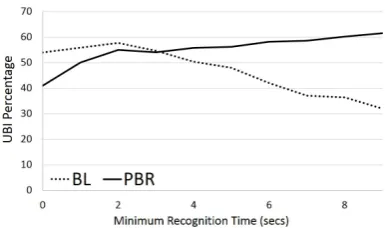
Figure 6:UBI % by minimum recognition time
than the Baseline recognitions, which in turn are far faster than the State 2→State 1 recognitions. The difference between PBR and Baseline recog-nitions implies thatT2 has greater activation dur-ing longer recognitions. Given this, the overall barge-in response time for PBR should be faster than the Baseline (as the PBR system is resum-ing where the Baseline is silent). Indeed this is the case: the PBR system’s overall mean/median response time is 1.58/1.53 seconds whereas Base-line has a mean/median response time of 2.61/1.8 seconds.
The goal ofT2is for the system to resume when recognition is proceeding poorly, and we have shown that it is primarily being activated during longer recognitions. IfT2 is functioning properly, recognition length should be inversely related to recognition performance, and longer recognitions should be less likely to be understood. Further-more, ifT2 resumption improves the user’s expe-rience then longer PBR recognitions should per-form better than Baseline recognitions of compa-rable length. Figure 6 presents the UBI percent-age by the minimum time for recognitions that reach State 2. We find that, when all recogni-tions are accounted for (0 second minimum), the Baseline has a higher rate of UBI. However, as recognition time increases the Baseline UBI per-centage decreases (suggesting successfulT2 func-tioning) whereas the PBR UBI percentage actu-ally increases. Since longer PBR recognitions are dominated by T2 resumptions, we speculate this improvement is driven by users repeating or initi-ating new speech that leads to understanding suc-cess, as the PBR system is responding where the Baseline system is silent.
4.4 Resumption
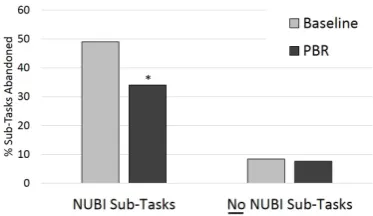
[image:7.595.79.285.64.183.2]Figure 7: Sub-Task Abandonment Rate. NUBI is different atp < 0.003
system initiates a clarifying sub-dialogue when a barge-in recognition is not understood. We com-pare these two behaviors using the call abandon-ment rate — the user hangs-up — of sub-tasks with and without NUBI. Here, we exclude the Bus Schedule sub-task as it is the goal state.
Figure 7 shows the call abandonment rate for sub-tasks that either have or do not have NUBI. We find that there is a significant difference in abandoned calls for NUBI sub-tasks between the two systems (33% vs 48%,p <0.003using aχ2 test), but that there is no difference for the calls that do not have NUBI (7.6% vs 8.4%). This re-sult shows that prompt resumption is viewed far more favorably by users than initiating a clarify-ing sub-dialogue.
5 Discussion and Conclusion
The above results offer strong evidence that the PBR model increases task success and efficiency, and we found that all three states contribute to the improved performance by creating a more ro-bust, responsive, and natural interaction. T1 pre-diction in State 1 reduced the number of spurious prompt suspensions,T2prediction in State 2 led to improved understanding performance, and prompt resumption (States 2 and 3) reduced the number of abandoned calls.
An important feature of the Prediction-based Barge-in Response model is that, while it lever-ages incremental speech processing for barge-in processing, it does not require an incremental di-alogue manager to drive its behavior. Since the model is also domain independent and does not require access to internal dialogue manager com-ponents, it can easily be incorporated into any ex-isting dialogue system. However, one limitation of the current model is that the prediction thresholds are hand-crafted. We also believe that
substan-tial improvements can be made by explicitly at-tempting to predict eventual understanding instead of using the stability score and partial production rate as a proxy. Furthermore, the PBR model does not distinguish between the causes of the non-understanding, specifically whether the input con-tained in-domain user speech, out-of-domain user speech, or background noise. This case is specifi-cally applicable in domains where system and user speech are in the same channel, such as interact-ing via speaker phone. In this context, the system
shouldbe able to initiate a clarifying sub-dialogue and release the turn, as the system must be more sensitive to the shared acoustic environment and so its current prompt may be less important than the user’s non-understood utterance.
The results challenge a potential assumption re-garding barge-in: that barge-in indicates greater user pro-activity and engagement with the task. One of the striking findings was that dialogues with barge-in are slower and less successful than dialogues without barge-in. This suggests that, for current systems, dialogues with barge-in are more indicative of environmental difficulty than user pro-activity. The superior performance of the PBR model, which is explicitly resistant to non-system directed speech, implies that domi-nant barge-in models will have increasingly lim-ited utility as spoken dialogue systems become more prevalent and are used in increasingly dif-ficult environments. Furthermore, within the con-text of overall dialogue systems, the PBR model’s performance emphasizes the importance of contin-uous processing for future systems.
This paper has proposed and evaluated the Prediction-based Barge-in Response model. This model’s behavior is driven by continuously pre-dicting whether a barge-in recognition will be un-derstood successfully, and combines incremental speech processing techniques with a prompt re-sumption procedure. Using a live dialogue task with real users, we evaluated this model against the standard barge-in model and found that it led to improved performance in both task success and efficiency.
Acknowledgments
References
T. Baumann, M. Atterer, and D. Schlangen. 2009. As-sessing and improving the performance of speech
recognition for incremental systems. In Proc.
NAACL: HLT, pages 380–388. Association for Com-putational Linguistics.
V. Goffin, C. Allauzen, E. Bocchieri, D. Hakkani-Tur, A. Ljolje, S. Parthasarathy, M. Rahim, G. Riccardi, and M. Saraclar. 2005. The AT&T WATSON speech recognizer. InProceedings of ICASSP, pages 1033–1036.
James G Martin and Winifred Strange. 1968. The per-ception of hesitation in spontaneous speech. Percep-tion & Psychophysics, 3(6):427–438.
Ian McGraw and Alexander Gruenstein. 2012. Es-timating word-stability during incremental speech recognition. Inin Proc. of Interspeech 2012.
A. Raux, B. Langner, D. Bohus, A.W. Black, and M. Eskenazi. 2005. Lets go public! taking a spo-ken dialog system to the real world. Inin Proc. of Interspeech 2005.
A. Raux. 2008. Flexible Turn-Taking for Spoken
Dia-log Systems. Ph.D. thesis, CMU.
Richard C Rose and Hong Kook Kim. 2003. A hybrid barge-in procedure for more reliable
turn-taking in human-machine dialog systems. In
Auto-matic Speech Recognition and Understanding, 2003. ASRU’03. 2003 IEEE Workshop on, pages 198–203. IEEE.
E.O. Selfridge and P.A. Heeman. 2010. Importance-Driven Turn-Bidding for spoken dialogue systems. In Proc. of ACL 2010, pages 177–185. Association for Computational Linguistics.
E.O. Selfridge, I. Arizmendi, P.A. Heeman, and J.D. Williams. 2011. Stability and accuracy in
incre-mental speech recognition. In Proceedings of the
SIGdial 2011.
E.O. Selfridge, I. Arizmendi, P.A. Heeman, and J.D. Williams. 2012. Integrating incremental speech recognition and pomdp-based dialogue systems. In
Proceedings of the SIGdial 2012.
Nikko Str¨om and Stephanie Seneff. 2000. Intelligent
barge-in in conversational systems. Procedings of
ICSLP.
Jason D Williams. 2012. A critical analysis of two sta-tistical spoken dialog systems in public use. In Spo-ken Language Technology Workshop (SLT), 2012
IEEE, pages 55–60. IEEE.
Fan Yang and Peter A. Heeman. 2010. Initiative
con-flicts in task-oriented dialogue”. Computer Speech
A Appendix