Fully Automatic Semantic MT Evaluation
Chi-kiu L
O, Anand Karthik T
UMULURUand
Dekai W
UHKUST
Human Language Technology Center
Department of Computer Science and Engineering
Hong Kong University of Science and Technology
{
jackielo,aktumuluru,dekai
}
@cs.ust.hk
Abstract
We introduce the first fully automatic, fully seman-tic frame based MT evaluation metric, MEANT, that outperforms all other commonly used auto-matic metrics in correlating with human judgment on translation adequacy. Recent work on HMEANT, which is a human metric, indicates that machine translation can be better evaluated via semantic frames than other evaluation paradigms, requiring only minimal effort from monolingual humans to an-notate and align semantic frames in the reference and machine translations. We propose a surprisingly ef-fective Occam’s razor automation of HMEANT that combines standard shallow semantic parsing with a simple maximum weighted bipartite matching al-gorithm for aligning semantic frames. The match-ing criterion is based on lexical similarity scormatch-ing of the semantic role fillers through a simple con-text vector model which can readily be trained us-ing any publicly available large monolus-ingual cor-pus. Sentence level correlation analysis, following standard NIST MetricsMATR protocol, shows that this fully automated version of HMEANT achieves significantly higher Kendall correlation with hu-man adequacy judgments than BLEU, NIST, ME-TEOR, PER, CDER, WER, or TER. Furthermore, we demonstrate that performing the semantic frame alignment automatically actually tends to be just as good as performing it manually. Despite its high performance, fully automated MEANT is still able to preserve HMEANT’s virtues of simplicity, repre-sentational transparency, and inexpensiveness.
1
Introduction
We introduce the first fully automatic semantic-frame-based MT evaluation metric capable of outperforming all other commonly used automatic metrics like BLEU, NIST, METEOR, PER, CDER, WER, and TER for eval-uating translation adequacy. This work, MEANT, can be seen as a fully automated version of HMEANT, which is a human metric, introduced by Lo and Wu (2011b).
De-spite its high performance, MEANT is still able to pre-serve HMEANT’s virtues of Occam’s razor simplicity, representational transparency, and inexpensiveness.
For the past decade, MT evaluation has relied heavily on inexpensive automatic metrics such as BLEU (Pap-ineniet al., 2002), NIST (Doddington, 2002), METEOR (Banerjee and Lavie, 2005), PER (Tillmannet al., 1997), CDER (Leuschet al., 2006), WER (Nießenet al., 2000), and TER (Snoveret al., 2006). In large part, this is be-cause automatic metrics significantly shorten the evalua-tion cycle by providing a fast, easy and cheap quantita-tive evaluation which can be effecquantita-tively incorporated into modern SMT training methods.
Despite the fact that HMEANT, a human metric re-cently proposed by Lo and Wu (2011b,c,d), was shown to reflect translation adequacy more accurately than all of these automatic metrics, it is unfortunately infeasible to incorporate the HMEANT metrics directly into SMT training methods, due to the non-automatic processes of (1) semantic parsing and (2) aligning semantic frames. In this paper we introduce an automatic metric in which both the semantic parsing and the alignment of semantic frames are fully automated. Our aim is to show that even with full automation, this new metric still outperforms all the previous automatic metrics mentioned, thus provid-ing a foundation for future incorporation into the trainprovid-ing of SMT to drive system improvements in providing more adequate translation output.
N-gram oriented automatic MT evaluation metrics like BLEU perform well at capturing translation fluency, and ranking overall systems with respect to each other when their scores are averaged over entire documents or cor-pora. However, they do not fare so well in ranking trans-lations of individual sentences. As MT systems improve, the n-gram based evaluation metrics have begun to show their limits. State-of-the-art MT systems are often able to output translations containing roughly the correct words, while failing to convey important aspects of the meaning of the input sentence. Cases where BLEU strongly dis-agrees with human judgment of translation quality were
reported in large scale MT evaluation tasks by Callison-Burchet al.(2006) and Koehn and Monz (2006).
Motivated by the goal of addressing the weaknesses of n-gram oriented automatic MT evaluation metrics at evaluating translation adequacy, the HMEANT metric assesses translation utility by matching the basic event structure—“who did what to whom, when, where and why” (Pradhan et al., 2004)—representing the central meaning conveyed by sentences. As mentioned above, however, HMEANT requires humans to manually anno-tate semantic frames in the reference and machine trans-lations, and then to align the semantic frames—making it difficult to incorporate HMEANT as an objective func-tion in the MT system training, evaluating, and optimiz-ing cycle.
We argue in this paper that both the human seman-tic parsing and the semanseman-tic frame alignment tasks per-formed within HMEANT can be successfully automated to produce a state-of-the-art automatic metric. Moreover, we show that the spirit of Occam’s razor can be preserved even for the semantic frame alignment, by demonstrating the effectiveness of a simple maximum weighted bipar-tite matching algorithm based on the lexical similarity be-tween semantic frames. In addition, we show empirically that performing this semantic frame alignment automati-cally tends to be just as good as performing it manually. Our results indicate that MEANT, the fully automatic version of HMEANT, achieves levels of correlation with human adequacy judgment (in our experiments, approx-imately 0.37) which significantly outperforms the com-monly used automatic metrics BLEU, NIST, METEOR, PER, CDER, WER, and TER (in our experiments, rang-ing between 0.20 and 0.29).
2
Related Work
2.1 Automatic lexical similarity based metrics
BLEU (Papineniet al., 2002) remains the most widely used MT evaluation metric despite the fact that a num-ber of large scale meta-evaluations (Callison-Burch et al., 2006; Koehn and Monz, 2006) report cases where it strongly disagrees with human judgments of translation accuracy. Other lexical similarity based automatic MT evaluation metrics, like NIST (Doddington, 2002), ME-TEOR (Banerjee and Lavie, 2005), PER (Tillmannet al., 1997), CDER (Leuschet al., 2006), WER (Nießenet al., 2000), and TER (Snoveret al., 2006), also perform well in capturing translation fluency, but share the same prob-lem that although evaluation with these metrics can be done very quickly at low cost, their underlying assump-tion that a good translation is one that shares the same lexical choices as the reference translation is not justified semantically. Lexical similarity does not ade-quately reflect similarity in meaning.
Generating a translation that contains roughly the cor-rect words may be necessary—but is far from sufficient— to preserve the essence of the meaning. We argue that a translation metric that reflects meaning similarity needs to be based on similarity of semantic structure, and not merely flat lexical similarity.
2.2 HMEANT (human SRL based metric)
As mentioned above, despite the fact that the semi-automatic HMEANT metric recently proposed by Lo and Wu (2011b,c,d) shows a higher correlation with human adequacy judgments than all commonly used automatic MT evaluation metrics, as with other human metrics like HTER (Snoveret al., 2006), it is unfortunately infeasible to incorporate the HMEANT metrics directly into SMT training methods. HMEANT requires non-automatic manual steps of (1) semantic parsing and (2) aligning semantic frames. Monolingual (or bilingual) annotators must label the semantic roles in both the reference and machine translations, and then to align the semantic pred-icates and role fillers in the MT output to the reference translations. These annotations allow HMEANT to then look at the aligned role fillers, and aggregate the trans-lation accuracy for each role. In the spirit of Occam’s razor and representational transparency, the HMEANT score is defined simply in terms of a weighted f-score over these aligned predicates and role fillers. More pre-cisely, HMEANT is defined as follows:
1. Human annotators annotate the shallow semantic structures of both the references and MT output.
2. Human judges align the semantic frames between the references and MT output by judging the cor-rectness of the predicates.
3. For each pair of aligned semantic frames,
(a) Human judges determine the translation cor-rectness of the semantic role fillers.
(b) Human judges align the semantic role fillers between the reference and MT output accord-ing to the correctness of the semantic role fillers.
4. Compute the weighted f-score over the matching role labels of these aligned predicates and role fillers.
𝑚𝑖 ≡
#tokens filled in aligned frame i of MT total #tokens in MT
𝑟𝑖 ≡
#tokens filled in aligned frame i of REF total #tokens in REF
𝑀𝑖,𝑗 ≡ total # ARG j of aligned frame i in MT
𝑅𝑖,𝑗 ≡ total # ARG j of aligned frame i in REF
𝐶𝑖,𝑗 ≡ # correct ARG j of aligned frame i in MT
Figure 1: Examples of human semantic frame annotation. Semantic parses of the Chinese input and the English reference trans-lation are from the Propbank gold standard. The MT output is semantically parsed by monolingual lay annotators according to the HMEANT guidelines. There are no semantic frames for MT3 because there is no predicate.
precision=
∑
𝑖𝑚𝑖
𝑤pred+∑𝑗𝑤𝑗(𝐶𝑖,𝑗+𝑤partial𝑃𝑖,𝑗) 𝑤pred+∑𝑗𝑤𝑗𝑀𝑖,𝑗
∑
𝑖𝑚𝑖
recall=
∑
𝑖𝑟𝑖
𝑤pred+∑𝑗𝑤𝑗(𝐶𝑖,𝑗+𝑤partial𝑃𝑖,𝑗) 𝑤pred+∑
𝑗𝑤𝑗𝑅𝑖,𝑗
∑
𝑖𝑟𝑖
where 𝑚i and 𝑟i are the weights for frame, 𝑖, in the
MT/REF respectively. These weights estimate the degree of contribution of each frame to the overall meaning of the sentence. 𝑀𝑖,𝑗and𝑅𝑖,𝑗 are the total counts of
argu-ment of type 𝑗 in frame𝑖in the MT and REF respec-tively. 𝐶𝑖,𝑗 and𝑃𝑖,𝑗 are the count of the correctly and
partial correctly translated argument of type 𝑗in frame𝑖 in the MT output. Figure 1 shows examples of human se-mantic frame annotation on reference and machine trans-lations as used in HMEANT. Table 1 shows examples of human judges’ decisions for semantic frame alignment and translation correctness for each semantic roles, for the “MT2” output from Figure 1.
Unlike HMEANT, MEANT is fully automatic; but nevertheless, it adheres to HMEANT’s principles of Oc-cam’s razor simplicity and representational transparency. These properties crucially facilitate error analysis and credit/blame assignment that are invaluable for MT sys-tem modeling.
Furthermore, being fully automatic, MEANT is even less expensive than HMEANT, which was already shown by Lo and Wu (2011b,c,d) to be significantly less ex-pensive than HTER. This makes MEANT a much bet-ter candidate than HMEANT for future incorporation into the automatic training of SMT systems to drive improve-ments in translation adequacy.
2.3 Semantic role labels as features in aggregate metrics
Table 1: Example of SRL annotation for the MT2 output from figure 1 along with the human judgements of translation correctness for each argument. *Notice that although the decision made by the human judge for “in mainland China” in the reference translation and “the mainland of China” in MT2 is “correct”, nevertheless the HMEANT computation will not count this as a match since their role labels do not match.
REF roles REF MT2 roles MT2 decision
PRED ceased Action stop match
ARG0 their sale — — incorrect
ARGM-LOC in mainland China Agent the mainland of China correct*
ARGM-TMP for almost two months Temporal nearly two months correct
— — Experiencer SK - 2 products incorrect
PRED resumed Action resume match
ARG0 sales of complete range of SK
- II products
Experiencer in the mainland of China to stop selling nearly two months of SK - 2 products sales
incorrect
ARGM-TMP Until after , their sales had ceased in mainland China for almost two months
Temporal So far partial
ARGM-TMP now — — incorrect
the ULC representation is based on flat semantic role label features that do not capture the structural rela-tionsin semantic frames, i.e., the predicate-argument re-lations. Also unlike HMEANT, which weights each se-mantic role type according to its empirically determined relative importance to the adequate preservation of mean-ing, ULC uses uniform weights. Although the automatic ULC metric shows an improved correlation with human judgment of translation quality (Callison-Burch et al., 2007; Gim´enez and M`arquez, 2007; Callison-Burch et al., 2008; Gim´enez and M`arquez, 2008), it is not com-monly used in large-scale MT evaluation campaigns, per-haps due to its high time cost and/or the difficulty of in-terpreting its score because of its highly complex combi-nation of many heterogeneous types of features.
Like system combination approaches, ULC is a vastly more complex aggregate metric compared to widely used metrics like BLEU. We believe it is important for auto-matic semantic MT evaluation metrics to provide rep-resentational transparency via simple, clear, and trans-parent scoring schemes that are (a) easily human read-able to support error analysis, and (b) potentially directly usable for automatic credit/blame assignment in tuning tree-structured SMT systems.
3
MEANT: A fully automatic semantic
MT evaluation metric
Like HMEANT, our guiding principle is that a good translation is one that is useful, in the sense that hu-man readers may successfully understand at least the ba-sic event structure who did what to whom, when, where
and why(Pradhanet al., 2004) representing the central
meaning of the source utterances. Whereas HMEANT
measures this using a f-score of correctly translated semantic roles in MT output that are annotated and compared by monolingual human annotators, MEANT
automates HMEANT as follows (the differences from
HMEANT are italicized):
1. Apply an automatic shallow semantic parseron both
the references and MT output.
2. Apply maximum weighted bipartite matching
algo-rithm toalign the semantic frames between the ref-erences and MT output by thelexical similarity of the predicates.
3. For each pair of aligned semantic frames,
(a) Lexical similarity scoresdetermine the similar-ityof the semantic role fillers.
(b) Apply maximum weighted bipartite matching
algorithm toalign the semantic role fillers be-tween the reference and MT output according to theirlexical similarity.
4. Compute the weighted f-score over the matching role labels of these aligned predicates and role fillers.
3.1 Automatic semantic parsing
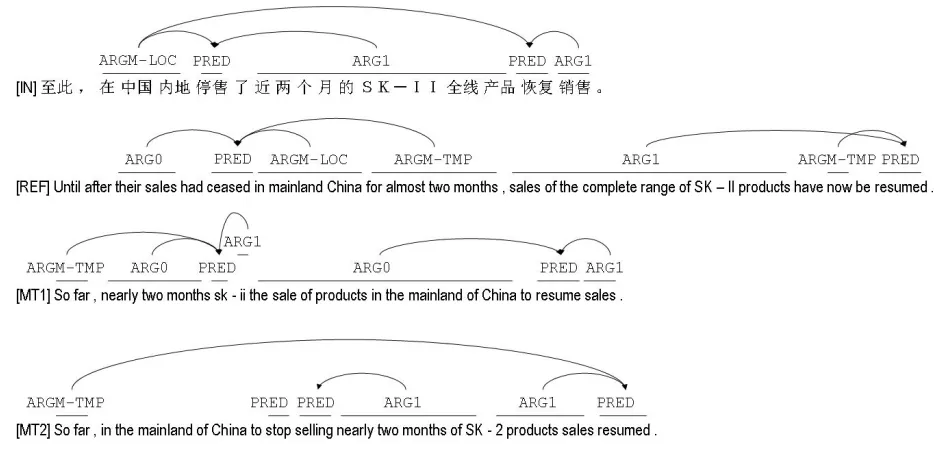
Figure 2: Examples of automatic shallow semantic parses. The Chinese input is parsed by a Chinese automatic shallow semantic parser. The English reference and machine translations are parsed by an English automatic shallow semantic parser. There are no semantic frames for mt3 since there is no predicate.
from the input, because it captures the raw meaning con-veyed in the translation rather than predicting the mean-ing conveyed in the translation from the input. Figure 2 shows examples of automatic shallow semantic parses on both reference and machine translations.
3.2 Automatic semantic frame alignment
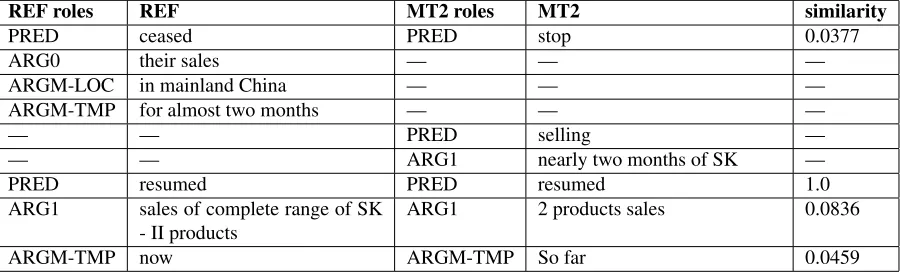
After reconstructing the shallow semantic parse, the man-ual semantic frame alignment process is automated by applying the maximum weighted bipartite matching algo-rithm where the weights of the edges represent the lexical similarity of the predicates. A wide range of lexical sim-ilarity measures are available to us, including for exam-ple BLEU, METEOR, cosine similarity based on context vector models (Dagan, 2000), and so forth. In Section 4, we will show the performance of the fully automatic semantic MT evaluation metric, MEANT ,couple with different lexical similarity metrics and other commonly used automatic MT evaluation metrics. In Section 6, we will discuss aligning the semantic frames according to all semantic role fillers, instead of the predicates only.
Then, for each pair of aligned semantic frames, we es-timate the similarity of the semantic role fillers by sum-ming all the lexical similarity of all the pairwise combi-nation of tokens between the references and MT output. After obtaining the similarity of the semantic role fillers, we again apply the maximum weighted bipartite match-ing algorithm to align the semantic role fillers between
the references and MT output. Table 2 shows examples of the human judges’ decisions on semantic frame align-ment and translation correctness for each semantic role in the “MT2” output from Figure 2.
3.3 Scoring the semantic similarity
After aligning the semantic frames automatically, the computation of the MEANT score is largely the same as stated in Lo and Wu (2011d), except that we now replace the counts of correctly and partially correctly translated semantic role fillers by the similarity scores of the predi-cates and arguments between the references and MT out-put.
𝑚𝑖 ≡
#tokens filled in aligned frame i of MT total #tokens in MT
𝑟𝑖 ≡
#tokens filled in aligned frame i of REF total #tokens in REF
𝑀𝑖,𝑗 ≡ total # ARG j of aligned frame i in MT
𝑅𝑖,𝑗 ≡ total # ARG j of aligned frame i in REF
𝑆𝑖,pred ≡ sim. of pred of REF and MT in aligned frame i
𝑆𝑖,𝑗 ≡ sim. of ARG j of REF and MT in aligned frame i
precision=
∑
𝑖𝑚𝑖
𝑤pred𝑆𝑖,pred+∑𝑗𝑤𝑗𝑆𝑖,𝑗 𝑤pred+∑𝑗𝑤𝑗𝑀𝑖,𝑗
∑
𝑖𝑚𝑖
recall=
∑
𝑖𝑟𝑖
𝑤pred𝑆𝑖,pred+∑
𝑗𝑤𝑗𝑆𝑖,𝑗 𝑤pred+∑𝑗𝑤𝑗𝑅𝑖,𝑗
∑
Table 2: Automatic semantic frame alignment of the MT2 output from figure 2, along with the automatic lexical similarity scoring on translation correctness for each argument.
REF roles REF MT2 roles MT2 similarity
PRED ceased PRED stop 0.0377
ARG0 their sales — — —
ARGM-LOC in mainland China — — —
ARGM-TMP for almost two months — — —
— — PRED selling —
— — ARG1 nearly two months of SK —
PRED resumed PRED resumed 1.0
ARG1 sales of complete range of SK
- II products
ARG1 2 products sales 0.0836
ARGM-TMP now ARGM-TMP So far 0.0459
where 𝑚i, 𝑟i, 𝑀i,j, 𝑅i,j are defined the same as in
HMEANT, and𝑆𝑖,predand𝑆𝑖,𝑗are the lexical similarities
(BLEU, METEOR, cosine similarity based on a context vector model, and so on, as discussed in the following section) of the predicates and arguments of type 𝑗 be-tween the reference translations and the MT output.
4
MEANT outperforms all automatic
metrics
We will first show that the fully automatic semantic MT evaluation metric, MEANT, outperforms all the other commonly used automatic metrics.
4.1 Experimental setup
For assessing lexical similarity, a wide range of lexi-cal similarity scoring models are available. We describe a representative subset of a wide range of experiments we have performed using all the most typical and com-monly used measures. On one hand, we report experi-ments with integrating two commonly used MT evalua-tion metrics, BLEU and METEOR, as the lexical simi-larity. On the other hand, we also report experiments on integrating two common similarity measures—cosine similarity measure and min/max with mutual information (Dagan, 2000)—that are based on context vector models, and trained from the Gigaword corpus with window sizes of 3 and 5.
The cosine similarity between two sequences of word tokens,−→𝑢 and−→𝑣, is defined as follows:
−→
𝑤𝑥 = context vector of word token x
𝑤𝑥𝑖 = attribute i of context vector −𝑤→𝑥
𝑓(𝑥, 𝑤𝑥𝑖) =
count(𝑥, 𝑤𝑥𝑖) count (𝑤𝑥𝑖)
cosine(𝑥, 𝑦) = Σ
𝑖𝑓(𝑥, 𝑤𝑥𝑖)×𝑓(𝑦, 𝑤𝑦 𝑖)
√
Σ
𝑖𝑓(𝑥, 𝑤𝑥𝑖) 2√
Σ
𝑖𝑓(𝑦, 𝑤𝑦 𝑖) 2
cosine(−→𝑢 ,−→𝑣) = Σ
𝑖Σ𝑗cosine(𝑢𝑖, 𝑣𝑗)
Using the same definition of 𝑤𝑥𝑖, the min/max with mutual information similarity between two sequences of word tokens,−→𝑢 and−→𝑣, is defined as follows:
𝑃(𝑤𝑥𝑖∣𝑥) =
count(𝑥, 𝑤𝑥𝑖)
∑
𝑖count(𝑥, 𝑤𝑥𝑖)
𝑃(𝑤𝑥𝑖) =
∑
𝑦count(𝑦, 𝑤𝑥𝑖)
∑
𝑦
∑
𝑗count(𝑦, 𝑤𝑥𝑗)
MI(𝑥, 𝑤𝑥𝑖) = log
(
𝑃(𝑤𝑥𝑖∣𝑥)
𝑃(𝑤𝑥𝑖)
)
MinMax-MI(𝑥, 𝑦) = Σ
𝑖 min (MI(𝑥, 𝑤𝑥𝑖),MI(𝑦, 𝑤𝑦 𝑖)) Σ
𝑖max (MI(𝑥, 𝑤𝑥𝑖),MI(𝑦, 𝑤𝑦 𝑖))
MinMax-MI(−→𝑢 ,−→𝑣) = Σ
𝑖Σ𝑗MinMax-MI(𝑢𝑖, 𝑣𝑗)
For our benchmark comparison, the evaluation data for our experiments is the same two sets of sentences, GALE-A and GALE-B that were used in Lo and Wu (2011d), where GALE-A is used for estimating the weight parameters of the metric by optimizing the cor-relation with human adequacy judgment, and then the learned weights are applied to testing on GALE-B.
For the automatic semantic role labeling, we used the publicly available off-the-shelf shallow semantic parser, ASSERT (Pradhanet al., 2004).
Table 3: Sentence-level correlation with human adequacy judgment on GALE-A (training) and GALE-B (testing) comparing all commonly used MT evaluation metrics against our proposed new fully automatic semantic frame based MT evaluation metric integrated with various lexical similarity scores between semantic role fillers: (a) BLEU, (b) METEOR, (c) cosine similarity and (d) MinMax with mutual information.
GALE-A (training) GALE-B (testing) Human metrics
HMEANT 0.49 0.27
HTER 0.43 0.20
Automatic metrics
MEANT — —
- with MinMax-MI on context vector model of window size 3 0.37 0.19
- with MinMax-MI on context vector model of window size 5 0.37 0.17
- with Cosine on context vector model of window size 3 0.32 0.13
- with Cosine on context vector model of window size 5 0.30 0.08
- with METEOR 0.17 —
- with BLEU 0.00 —
METEOR 0.20 0.21
NIST 0.29 0.09
TER 0.20 0.10
BLEU 0.20 0.12
PER 0.20 0.07
WER 0.10 0.11
CDER 0.12 0.10
4.2 Results
Table 3 shows that MEANT significantly outperforms all the other automatic MT evaluation metrics when inte-grated with a simple similarity measure based on word context vectors trained from a large monolingual corpus. We can also see that using min/max with mutual infor-mation is significantly better than using cosine similarity. Furthermore, context vector models using a window size of 3 appear to be as good or better than those using a window size of 5.
Although the human metrics, HMEANT and HTER, obviously remain superior, MEANT performs far better than almost all other automatic metrics. The only excep-tion is the GALE-B dataset, where METEOR performs marginally better than MEANT and even HTER. Data analysis shows that the marginally higher correlation of METEOR on the GALE-B dataset is a statistical outlier; it is quite rare for a lexically based automatic metric to outperform even thehuman-drivenHTER metric.
Interestingly and somewhat surprisingly, using the n-gram based MT evaluation metrics BLEU and METEOR as lexical similarity scores does not work well at all for this purpose, even on the training data (thus obviating the need to obtain results on the testing data). Analysis in-dicates that the reason for this is that variation between alternative paraphrasing of the role fillers makes the num-ber of matching n-grams quite small, since there are many synonyms and few exact consecutive n-gram matches.
Table 4: Sentence-level correlation with human adequacy judg-ment on GALE-A (training) and GALE-B (testing) for aligning sematnic frame automatically and manually.
Semantic frame alignment GALE-A GALE-B
Automatic 0.37 0.19
Manual 0.35 0.17
In the following sections, we turn to considering sev-eral questions that naturally arise following these strong results.
5
Don’t align semantic frames manually
One obvious question is whether the automatic alignment of semantic frames degrades MEANT’s accuracy, and if so, the extent to which it hurts.
5.1 Experimental setup
To test this question, we compare the best fully automatic results of the previous section against a semi-automatic variant of our proposed metric. In the semi-automatic variant, the semantic parsing is still performed automati-cally. However, the semantic frame alignment is instead done manually by human annotators.
5.2 Results
Table 4 shows that performing the alignment of semantic frames automatically is as good—or even better than— doing the alignment manually. We believe the success of automatic semantic frame alignment reflects the high de-gree of reliability of our chosen lexical similarity metric, when the candidates for role fillers are restricted to the fairly small set defined by the sentence pairs.
6
Look only at predicates when aligning
semantic frames
Given the positive results of the previous sections, it is worth asking a deeper question: would it further improve the correlation with human adequacy judgment of the metric if the semantic frames were aligned not only by matching predicates (as HMEANT did), but in addition by trying to also maximize the match of the semantic role fillers?
The reason to revisit this question is that even though Lo and Wu (2011a) showed that in the case of HMEANT it is effective for human annotators to align semantic frames according to the predicates only, this could eas-ily be due to the mental challenge for lay annotators to compare and keep in mind all the semantic role fillers at the same time. But in the case of a fully automatic metric, on the other hand, it is easy for an algorithm to compute the individual similarities between all the semantic role fillers and consider the aggregate similarity when opti-mizing the alignment of semantic frames.
Surprisingly, however, the results will show that even in the automated case, this still doesnothelp improve the correlation with human adequacy judgments.
6.1 Experimental setup
To align semantic frames using all semantic roles, we aggregate the lexical similarity of all the semantic role fillers into a semantic frame similarity score. We exper-iment on two variations of the aggregation function (1) simple linear average of the lexical similarity over the number of aligned semantic roles in the frames; or (2) the inverse of the sum of the negative log of the role fillers similarity.
The rest of the experimental setup is the same as that used in Section 4.
6.2 Results
Table 5 shows that to align semantic frames, using only the lexical similarity of the predicates between the frames in the reference translations and the MT output (0.37 Kendall in GALE-A and 0.19 Kendall in GALE-B) is more robust than either of the two natural ways of ag-gregating the lexical similarity of the aligned semantic role fillers. Aggregating by linear average yields a lower
Table 5: Sentence-level correlation with human adequacy judg-ments on GALE-A (training set) and GALE-B (testing set) for aligning semantic frames using predicate only vs. using all se-mantic role fillers aggregated by (1) the linear average of the lexical similarity vs. (2) the inverse of the sum of negative log of the lexical similarity.
Frame alignment GALE-A GALE-B
Predicate only 0.37 0.19
Linear average 0.35 0.10
Inverse of sum of neg. log 0.30 0.17
0.35 Kendall in GALE-A and 0.10 Kendall in GALE-B. Aggregating by the inverse of the sum of negative logs yields a lower 0.30 Kendall in GALE-A and 0.17 Kendall in GALE-B.
What might explain this perhaps surprising result? Our conjecture is that aggregating the lexical similarities of the semantic role fillers fails to help find better seman-tic frame alignments because the lexical similarities are aggregated with uniform weight across different types of role fillers. Therefore, the aggregation ignores the fact that different types of role types contribute to a widely varying degree to the meaning of an entire semantic frame—in reality, some role types are much more impor-tant than others. However, the complexity of the met-ric would be greatly increased if we added weights for each semantic roles type for semantic frame alignment process, and this would not be likely to be worthwhile given that automatic alignment is already performing as well as human alignment of semantic frames.
7
Don’t word align semantic role fillers
Another question that naturally arises from the positive results above is: when aligning the semantic frames, would word-aligning the tokens within role fillers help? Specifically, if we had word alignments for every candi-date pair of role filler strings, we could sum the lexical similarities only between the aligned tokens—instead of what we did above, which was to sum the lexical similar-ities ofallpairwise combinations of tokens.
However, experimental results will show that, surpris-ingly, to judge the similarity of semantic role fillers, summing the lexical similarities over only word-aligned tokens—instead of all pairwise combinations of tokens— doesnothelp to improve the correlation of the semantic MT evaluation with human adequacy judgment.
7.1 Experimental setup
Table 6: Sentence-level correlation with human adequacy judg-ments on GALE-A (training set) and GALE-B (testing set) for judging semantic role fillers similarity using pairwise tokens vs. only aligned tokens.
Semantic role filler similarity GALE-A GALE-B
All pairwise tokens 0.37 0.19
Only aligned tokens 0.36 0.17
The rest of the experimental setup is the same as that used in Section 4.
7.2 Results
Table 6 shows that, surprisingly, judging semantic role filler similarity using only the aligned tokens (selected by competitive linking word alignment algorithm) does nothelp the correlation with human adequacy judgment. This is surprising as, intuitively, using only the aligned tokens should avoid the introduction of noise in judg-ing the similarity between semantic role fillers because it avoids adding in similarities for words within semantic role fillers whose meanings are not close to each other.
How might this outcome be explained? We conjecture that the word alignments over-constrain the calculation of segment similarities. The individual lexical similari-ties are already weighted fairly accurately, so the lexical similarities between words that do not correspond do not hurt since they are already close to zero. On the other hand, in cases where the word alignment is ambiguous, it is better to aggregate over different possible pairwise alignments—strictly obeying a hard word alignment un-desirably forces dropping of some individual lexical sim-ilarity scores that are actually relevant.
8
Conclusion
We have introduced a new fully automatic semantic MT evaluation metric, MEANT, that is fundamentally based on semantic frames, that is the first such metric to out-perform all other commonly used automatic MT evalu-ation metrics. Experimental results following the stan-dard NIST MetricsMATR protocol indicate that our pro-posed metric achieves levels of correlation with human adequacy judgment (in our experiments, approximately 0.37) that significantly outperform BLEU, NIST, ME-TEOR, PER, CDER, WER, and TER (in our experiments, ranging between 0.20 and 0.29).
We have also shown in this paper that the spirit of Oc-cam’s razor of HMEANT can be preserved even under full automation by (1) replacing human semantic role an-notation with automatic shallow semantic parsing and (2) replacing human semantic frame alignment with a simple maximum weighted bipartite matching algorithm based on the lexical similarity between semantic frames. Under
analysis, we have further shown empirically that perform-ing this semantic frame alignment automatically tends to be just as good as performing it manually. Furthermore, we have shown surprisingly that (1) for aligning seman-tic frames, usingonlythe similarity of predicates is more accurate than also taking into account the similarity of mantic role fillers, and (2) to judge similarity between se-mantic role fillers, aggregating similarity ofallpairwise combination of word tokens is more accurate than con-sidering only the similarity of the tokens that obey word alignments.
Papineni et al. (2002) stated in their conclusion that “We believe that BLEU will accelerate the MT R&D cy-cle by allowing researchers to rapidly home in on effec-tive modeling ideas.” since fully automatic metrics allow inexpensive training and tuning of SMT systems. Devel-opments in the past decade have more than borne witness to this statement. However, SMT has progressed to the stage where simple metrics like BLEU are no longer ca-pable of driving progress toward preservation of meaning with respect to proper event structure. We believe that MEANT that rapidly and accurately reflects the transla-tion adequacy of MT output by directly assessingwho did
what to whom, when, where and whyis needed to bring
MT R&D to a new level of improvement in generating more meaningful MT output.
Acknowledgments
This material is based upon work supported in part by the Defense Advanced Research Projects Agency
(DARPA) under BOLT contract no.
HR0011-12-C-0016, and GALE contract nos. HR0011-06-C-0022
and HR0011-06-C-0023; by the European Union un-der the FP7 grant agreement no. 287658; and by the Hong Kong Research Grants Council (RGC) research
grants GRF621008, GRF612806, DAG03/04.EG09,
RGC6256/00E, and RGC6083/99E. Any opinions, find-ings and conclusions or recommendations expressed in this material are those of the authors and do not necessar-ily reflect the views of the RGC, EU, or DARPA.
References
Satanjeev Banerjee and Alon Lavie. METEOR: An Automatic Metric for MT Evaluation with Improved Correlation with Human Judgments. InProceedings of the 43th Annual Meet-ing of the Association of Computational LMeet-inguistics (ACL-05), pages 65–72, 2005.
Chris Callison-Burch, Miles Osborne, and Philipp Koehn. evaluating the role of BLEU in Machine Translation Re-search. InProceedings of the 13th Conference of the Eu-ropean Chapter of the Association for Computational Lin-guistics (EACL-06), pages 249–256, 2006.
Machine Translation. InProceedings of the 2nd Workshop on Statistical Machine Translation, pages 136–158, 2007. Chris Callison-Burch, Cameron Fordyce, Philipp Koehn,
Christof Monz, and Josh Schroeder. Further Meta-evaluation of Machine Translation. InProceedings of the 3rd Workshop on Statistical Machine Translation, pages 70–106, 2008. Chris Callison-Burch, Philipp Koehn, Christof Monz, Kay
Pe-terson, Mark Pryzbocki, and Omar Zaidan. Findings of the 2010 Joint Workshop on Statistical Machine Translation and Metrics for Machine Translation. InProceedings of the Joint 5th Workshop on Statistical Machine Translation and Met-ricsMATR, pages 17–53, Uppsala, Sweden, 15-16 July 2010. Ido Dagan. Contextual word similarity. In Robert Dale, Her-man Moisl, and Harold Somers, editors,Handbook of Nat-ural Language Processing, pages 459–476. Marcel Dekker, New York, 2000.
G. Doddington. Automatic Evaluation of Machine Translation Quality using N-gram Co-occurrence Statistics. In Proceed-ings of the 2nd International Conference on Human Lan-guage Technology Research (HLT-02), pages 138–145, San Francisco, CA, USA, 2002. Morgan Kaufmann Publishers Inc.
Jes´us Gim´enez and Llu´ıs M`arquez. Linguistic Features for Au-tomatic Evaluation of Heterogenous MT Systems. In Pro-ceedings of the 2nd Workshop on Statistical Machine Trans-lation, pages 256–264, Prague, Czech Republic, June 2007. Association for Computational Linguistics.
Jes´us Gim´enez and Llu´ıs M`arquez. A Smorgasbord of Features for Automatic MT Evaluation. In Proceedings of the 3rd Workshop on Statistical Machine Translation, pages 195– 198, Columbus, OH, June 2008. Association for Computa-tional Linguistics.
Philipp Koehn and Christof Monz. Manual and Automatic Evaluation of Machine Translation between European Lan-guages. InProceedings of the Workshop on Statistical Ma-chine Translation, pages 102–121, 2006.
Gregor Leusch, Nicola Ueffing, and Hermann Ney. CDer: Effi-cient MT Evaluation Using Block Movements. In Proceed-ings of the 13th Conference of the European Chapter of the Association for Computational Linguistics (EACL-06), 2006. Chi-kiu Lo and Dekai Wu. A Radically Simple, Effective An-notation and Alignment Methodology for Semantic Frame Based SMT and MT Evaluation. InProceedings of Interna-tional Workshop on Using Linguistic Information for Hybrid Machine Translation (LiHMT 2011), organized by OpenMT-2., 2011.
Chi-kiu Lo and Dekai Wu. MEANT: An Inexpensive, High-Accuracy, Semi-Automatic Metric for Evaluating Transla-tion Utility based on Semantic Roles. InProceedings of the Joint conference of the 49th Annual Meeting of the Associa-tion for ComputaAssocia-tional Linguistics : Human Language Tech-nologies (ACL-HLT-11), 2011.
Chi-kiu Lo and Dekai Wu. SMT vs. AI redux: How seman-tic frames evaluate MT more accurately. InProceedings of the 22nd International Joint Conference on Artificial Intelli-gence (IJCAI-11), 2011.
Chi-kiu Lo and Dekai Wu. Structured vs. Flat Semantic Role Representations for Machine Translation Evaluation. In Pro-ceedings of the 5th Workshop on Syntax and Structure in Sta-tistical Translation (SSST-5), 2011.
I. Dan Melamed. Automatic construction of clean broad-coverage translation lexicons. In Proceedings of the 2nd Conference of the Association for Machine Translation in the Americas (AMTA-1996), 1996.
Sonja Nießen, Franz Josef Och, Gregor Leusch, and Hermann Ney. A Evaluation Tool for Machine Translation: Fast Eval-uation for MT Research. InProceedings of the 2nd Inter-national Conference on Language Resources and Evaluation (LREC-2000), 2000.
Kishore Papineni, Salim Roukos, Todd Ward, and Wei-Jing Zhu. BLEU: A Method for Automatic Evaluation of Ma-chine Translation. InProceedings of the 40th Annual Meet-ing of the Association for Computational LMeet-inguistics (ACL-02), pages 311–318, 2002.
Sameer Pradhan, Wayne Ward, Kadri Hacioglu, James H. Mar-tin, and Dan Jurafsky. Shallow Semantic Parsing Using Sup-port Vector Machines. InProceedings of the 2004 Confer-ence on Human Language Technology and the North Amer-ican Chapter of the Association for Computational Linguis-tics (HLT-NAACL-04), 2004.
Matthew Snover, Bonnie J. Dorr, Richard Schwartz, Linnea Micciulla, and John Makhoul. A Study of Translation Edit Rate with Targeted Human Annotation. InProceedings of the 7th Conference of the Association for Machine Translation in the Americas (AMTA-06), pages 223–231, 2006.