AND SOCIAL
RESEARCH INSTITUTE
MEMORANDUM SERIES
No. 102
J m J IJ I
RESEARCH METHODOLOGY: SOME ILLUSTRATIVE STUDIES
E. E. DAVIS
Talk given to ESRI Research Assistants Wednesday, 30 October 1974
Confidential: N.ot to
until the permission of
and the-institute-is
b.e quoted
the Author
E.E. Davis
Talk given to ESRI Research Assistants
Wednesday, 30 October 1974
Introduction
The two previous speakers in this series,Dr. Kennedy
and Professor OvConnor, have covered both the practical and theoretical
aspects of Research Methodology extremely well. In my comments I will
focus on some illustrative studies which may help to exemplify some of
these points.
Dr. Kennedy, in his talk of two weeks ago, focussed
on the ’tNuts and Boltst’ of the organisation of research, without dealing
directly with questions such as objectivity, causality, creativity, inspiration,
induction, and deduction. We all know that he is quite capable of dealing
with these latter t’exciting intellectual questionsvl, as revealed in his Discourse
given to the Royal Irish Academy (Kennedy, 197~) and his other publications.
However, I could not agree m~re with Dr. Kennedy in stressing the importance
of the "Nuts and Bolts" of the organisation of research. I would definitely
agree with his statement that "far more people go astray because of ignorance
or neglect of the more mundane matters".
Dr. Kennedy made many valuable suggestions in his talk,
the importance of any one of which, or indeed all of which, I could reiterate and
re-emphas is e, I should just like to pick out one suggestion, because it is
so seemingly obvious on the one hand, and yet, on the other hand, I find it
so difficult to impress upon young Research Assistants and Post-Graduate
the first joint winner ~of the Nobel Prize in Economics, namely, to put a date on
every sheet of paper in your files particularly where you have recorded data".
This same point (along with many others) was impressed upon me by the eminent
philosopher - logician, Susan Langer, under whom I had the privilege of
studying. She, in turn, got it from her mentors, Alfred North Whitehead
and Bertram Russell. I might add that, in addition to a date, other indentifying
information should always be placed On any research materials. As I mentioned,
obvious though this point is, it seems difficult to impress its importance upon
young researchers. Frequently, for the young Research Assistant, the study
he or she is working on is the first (or at most second) major study with which
he or she has been involved. Thus, since there are only one or two studies
in his immediate field of vision, it seems obvious that it will be possible to
identify any piece of research material correctly a few months or even a year
later. The researcher with 10-20 years or so of research experience; who
has conducted perhaps a couple of dozen or more studies, comes to appreciate
fully the importance of this procedure. But I cannot impress upon you too
strongly the necessity for learning these habits at the very beginning of your
research career: otherwise, you will become hopelessly disorganised after
three or four years and, your ability to benefit in your current research from
your previous research experience will be greatly diminished.
Professor O’Connor, in his talk to you last week, dwelt
on the "excRing intellectual matters of objectivity, causality, creatfvity,
inspiration, induction and deduction". He gave a very useful example of
the practical application of the scientific method in a field study, namely
the National Farm Survey with which he was involved, I think that presenting
concrete examples of studies is one of the best ways of illustrating the
pro-eedures involved in general research methodology. What I should like to
and deduction and their relationship to the scientific method and then present
some selected studies from my own discipline, that of social psychology,
which may, I hope, provide some further examples which will illustrate
the use of induction, deduction and the scientific method.
Induction vs. Deduction and the Scientific Method
As Professor O’Connor pointed out in his talk, the
central concern of the modern scientific method has to do with hypotheses
and the testing of hypotheses. Although, as Professor O’Connor points out, some
kinds of research (e. g. more descriptive research) do not seem to fit into the
classical mould of what has come to be accepted as the modern scientific method,
such research basically involves hypothesis testing, even if the hypotheses
are implicit in nature.
As I see it, the inductive method and the deductive method,
which Professor O’Connor has described so well, are merely two alternative
approaches to the formulation of scientifically testable hypotheses. Although
I think that the differentiation between inductive and deductive processes is a
useful heuristic distinction, it would be quite wrong to consider these two
approaches as in any way mutually exclusive. On the contrary, I feel that,
although different researchers (or different research problems) may emphasise
the one approach more than the other, in practice no useful hypothesis is
arrived at without involving both approaches, either explicitly or implicitly.
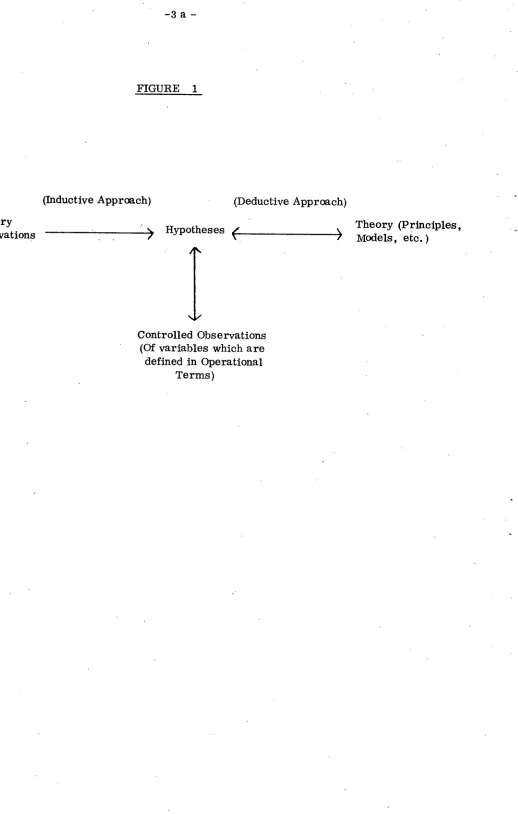
Figure 1 may serve to illustrate, in a very simplistic
way, the relationship that I see between induction, deduction, and hypothesis
formulation.
In the inductive approach one starts off with a series of
3 a
-FIGURE 1
Primary Obs e rvations
(Inductive Approach) (Deductive Approach)
) Hypotheses (
~f
Controlled Observations (Of variables which are
defined in Operational
Terms)
[image:5.576.44.562.69.883.2]into some kind, of formulations which, in the terminology of the modern
scientific method, are referred to as hypotheses. According to Kerlinger
(1973) these are two criteria for "good" hypotheses: "One, hypotheses are
statements about the relations between variables.
clear implications for testing the stated relations.
Two, hypotheses carry
These criteria mean,
then, that hypothesis statements contain two or more variables that are
measurable or potentially measurable and that they specify how the variables
are related. A statement that lacks either or both these characteristics is no
hypothesis in the scientific sense of the word (p. 18)". In order to test the
statements about the relations between variables contained in hypotheses it
is necessary to engage in controlled (as opposed to informal or primary)
observations of the variables, whereby it is essential that the variables be
carefully defined in operational terms, that is to say,the means by which
the variables are to be measured must be explicitly specified in terms of
observable operations. The observations must also be controlled so as to
ensure that the observed relationships are explainable in terms of the stated
hypotheses, as opposed to being possibly determined by extraneous factors
(cf. Campbell and Stanley, 1963).
The inductive approach, although it did not originate
with Sir Francis Bacon, is frequently associated with Bacon’s name, because
he was one of the advocates of this approach and is regarded as the founder
of what has become known in the history of science as the school of British
Empiricism. In 20th Century psychology this approach is prominently
exemplified by the work of B. F. Skinner (1940).
Scientific research is basically empirical in nature,
in the sense that hypotheses are tested by means of controlled observations.
sense of merely making large numbers of primary observations (e. g.
collec-ting a lot of data without guidelines), without any clear view of hypothesis
formulation or testing, this procedure is often referred to as empiricistic,
a term which has a rather negative connotation. However, the use of the
inductive method alone is rather pointless from the viewpoint of modern scientific
method. As Cohen (1956) has stated "there is ... no genuine progress in
scientific insight through the Baconian method of accumulating empirical
facts without hypotheses or anticipation of nature. Without some guiding idea
we do not know what facts to gather.., we cannot determine what is relevant
and what is irrelevant (p. 148)".
There is nothing wrong with a predominantly inductive
approach as long as it is associated with the modern scientific method of
hypothesis formulation and testing. However, even the researcher who does
take this approach usually ends up, over time, testing a number of related
j
hypotheses. There is a natural tendency, then, to think in terms of certain
generalisations which might give a kind of cohesion to the inter-related hypotheses
which have been tested. Such generalisations may result in the development
of principles, models, etc. - in other words some form of theory, whether
highly complex and formal, or rather simple and general in nature. Kerlinger
(1973) gives a following general definition of theory: "a theory is a set of
inter-related constructs (concepts), definitions, and propositions that present a
systematic view of phenomena by specifying relations among variables, with
the purpose of explaining and predicting the phenomena (p. 9)". Thus, even
when one starts with an inductive approach and proceeds through the stage of
hypothesis formulation and testing, one usually arrives at some kind of theory.
However, although the building of formal theories and models may be an
ultimate aim in science, one must be wary of the premature development of
formalised theories and models. No theory or model is "correct" for all
the theory or models which can be tested against empirical reality. Dr.
Kennedy, in his paper earlier in this series, correctly warned against the
"excessive emphasis on formal theorising to the neglect of the empirical
foundation". He goes on to state that "far too much effort goes into derivation
of the formal properties of models, based on assumptions that have not been
validated, rather than first establishing the empirical validity of the
assump-tions (p. 12)". However, this criticism may apply more to the field of
economics than to some of the other social sciences. In particular, social
psychology is often criticised forbeing too empirical and paying too little
attention to the building of more systematic theories and models. I shall
return to this point later when I attempt to illustrate the relationship between
theory, hypotheses, and empirical data, on the basis of some illustrative
studies.
The deductive approach starts with theory (principles,
models, etc. ) and deduces hypotheses, which are then empirically tested.
One will note, however, that this still involves empirical (though not empiricistie)
research, since the hypotheses which are deduced from the theory must be
empirically validated. Depending upon whether the hypotheses are confirmed
or disconfirmed, the theory may be modified, new hypotheses derived and
tested, and this process continues, as is illustrated by the two-way
direc-tionality of the connecting arrows in Figure 1. In psychology, this type of
deductive method is most prominently associated with the work of C.L. Hull
(1943) and is referred to as the hypothetico - deductive approach.
Of course, just as there is no such thing as a purely
inductive approach, in the sense that any observations which we make are
made within the framework of some general view of reality (or implicit theoxw),
Obviously, we never s tart off with full blown theories, principles, models,
etc. ; rather, we arrive at these through some sort of observations, no matter
how casual.
In summary then, the distinction between the inductive
and the deductive approach may be a useful heuristic distinction, but in practise
we all use some combination of these two approaches, even though our basic
orientation may lean somewhat more in the one rather than the other direction.
Some Illustrative Studies
I should now like to end this more abstract discussion
of research methodology and devote the remainder of my talk to a presentation
of some research findings from a series of inter-related studies by myself
and colleagues which will, I hope, illustrate the relationships and complex
interplay between the processes of induction, deduction and hypothesis testing.
Of necessity, I will have to present some actual findings (which may or may
not be of intrinsic interest to you), but my main purpose is to illustrate the
thought processes and research processes which I and my colleagues went
through in carrying out these studies.
First of all, I shall have to give you a brief background
to the development of a problem which we sought to resolve. Contrary to a
great deal of past research findings, showing that white American subjects
(Ss), in general, manifested a rather large degree of racial prejudice, Rokeach,
Smith and Evans (1960) presented findings from which they concluded that social
acceptance or rejection was largely determined by the perceived similarity or
dissimilarity of the beliefs of the other persons, rather than by their racial
or ethnic membership. A number of other researchers of the Rokeach school
(e. g. Rokeach, 1961; Byrne and Wong, 1962; Byrne and McGraw, 1964; Stein,
Hardyck and Smith, 1965) presented data supporting this proposition. Apart
of racial prejudice for white American $s, Triandis and his colleagues
(e. g. Triandis and Triandis, 1960; Davis, 1964; Triandis, Davis and Takezawa,
1965; Davis and Triandis, 1965), in research conducted around the same time,
and utilizing completely similar subject populations (i. e. white American
student Ss), consistently found an overwhelming race effect as the determinant
of social acceptance or rejection. In particular, Triandis (1961) and Rokeach
(1961) both manipulated race and belief simultaneously and arrived at seemingly
contradictory results (although there was a far from perfect consistency in the
manner in which they operationalised their variables).
Obviously a problem existed. How could two responsible
¯ groups of researchers come up with such seemingly contradictory findings in
a large number of studies ? In terms of Figure 1 it seemed time to shift from
left to right, as it were. That is, we had collected a lot of empirical data
(observations); the problem was that these data seemed to lead to contradictory
interpretations. It seemed time to look at the theory, or implicit models,
involved, with a view toward developing a more adequate model. We therefore
resolved to develop a model which would satisfactorily explain the seemingly
contradictory empirical evidence, then derive appropriate testable hypotheses
from the model (deduction), and then collect the data necessary to confirm or
disconfirm these hypotheses and, thus, test the model:
To begin with, we had to ask ourselves the question of
what implicit model was involved in the research about which there was this
controversy. To our surprise, we realised that all that had really been
asked was the simple question of what characteristics of the stimulus (that
is the person being responded to) was determining a given response (e. g.
social acceptance or rejection). Put in this way, we realised that we were
of the early behaviourist school of the 1920Ts. Thinking about the matter
further, we were surprised to realise how much psychological research,
including social psychology research, relied upon this simplistic model.
Those familiar with the history of psychology will recall that this early S - R
model was soon replaced by taking into consideration characteristics of the
Organism, in what is known in the field as the S-O-R model (e. g. Tolman
1958). However, even this model seemed to us to be too simplistic. In
particular, our knowledge of the multi-dimensionality of attitudes of acceptance
or rejection led us to consider the importance of the nature of the response
continuum on which the subject is responding to the stimulus. For example,
Triandis and Triandis (1962) had white student Ss rate the stimulus "Negro
Physician" on a number of scales. In their ratings of this stimulus on Semantic
Differential Evaluation Scales (e. g. good-bad), roughly 9070 of the Ss rated the
stimulus on the positive side of the neutral point; on the other hand, approximately
7570 of the same Ss rated the same stimulus on the negative (or rejecting) side
of the neutral point on statements measuring the behavioural component of
attitudes, such as "would exclude from my neighbourhood". _ Thus, we decided
that at the very least any given response was a function of the characteristics of
the subject (S), the characteristics of the stimulus (St.) and the nature of the
response continuum (R. C. ). Or, put in symbolic form:
R =f (S,St, R.C.)
Exhibit A illustrates this relationship in terms of a
cube of data upon which any given response is dependent. Thus, although
the characteristics of the stimulus person being responded to certainly constitutes
an important class of independent variables, the other two parameters of subject
characteristics and response continua also constitute sets of independent variables
upon which the response will be dependent. We could easily measure the effect
of various stimulus characteristics, such as race and belief, by simply having
of these stimulus characteristics, .thus forming a factorial design permitting
the use of analysis of variance as a means of determining the extent to which
various stimulus characteristics determine the responses. However, what
hypotheses could be made about subject characteristics and .response continua
which would allow the model to explain seemingly contradictory findings
con-cerning the amount of variance controlled for by various stimulus characteristics
in different studies ?
Based on a great deal of evidence which we had from a
number of studies (essentially an inductive process) we formulated the following
two hypotheses, which, if they could be independently verified, would allow the
model to explain the seemingly contradictory findings. First, we hypothesised
that there were two kinds of subjects, namely those who would, in general, respond
primarily on the basis of race, and those who would, in general, respond primarily
on the basis of belief. Of course, we saw these as idealised subject types and
realised that there would be mixed types as well. Second, we hypothesised that,
if a number of response continua were ranked on a dimension from less intimate
to more intimate, for all subject types, race would assume more importance in
determining the variance in the response, as the response continuum became
more intimate.
Just about this time we were preparing a large pre-test
of attitudes towards a broad spectrum of racial and other issues ,in preparation
for a series of ~tudies on black-white negotiations (Davis and Triandis, 1965;
1971). We decided, therefore, to collect this data in such a manner as to
permit us to test these hypotheses and, thus, the viability of the model which
we had put forth. However, in addition to the conventional statistical
St tn~luJ ?erJoas
|(kavLorat |ntent |one (It~e~onle ont lnuJ)
~
ubJecthiracte~lsticB
Fro. 1. Schematic rcprcseatation of tile
relation-ship between subjects, stimulus pcrso.s, and bchav.-ioral inteatiqns.
idealised subject types to test our first hypothesis. We were familiar with
the then recent work by Tucker and Messick (1963) for factor analysing an
individual differences matrix. We also knew that Professor Tucker was
working on more advanced factor analytic techniques for isolating idealised
subject types. With his assistance we were able to develop the programme
which we needed - a programme which has since come to be known as
two--mode factor analysis.
In the tradition suggested to you earlier by Professor
O’Connor,we prepared in advance a complete blank table before collecting
our data, to ensure that we would have all the results which we needed to
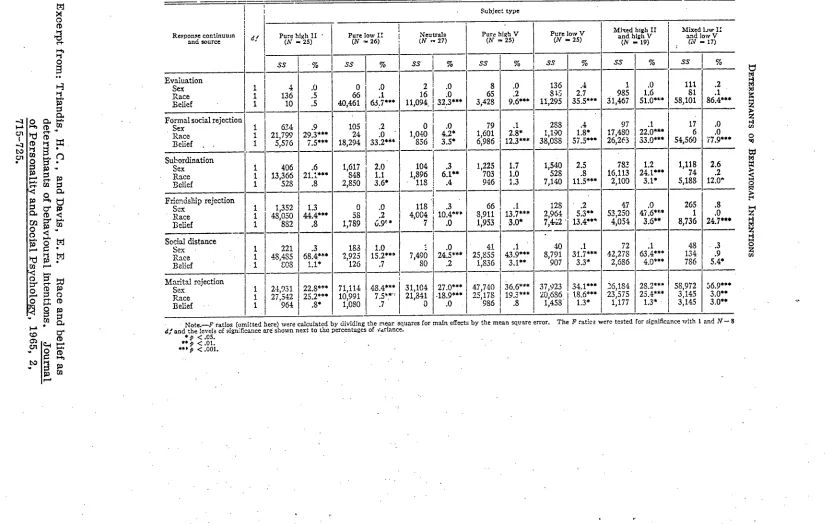
adequately test our hypotheses. This table is represented in Exhibit B.
(Triandis and Davis, 1965). A careful inspection of this table would reveal
that our hypotheses were, indeed, confirmed and the model which we had put
forth was capable of encompassing the otherwise seemingly contradictory
findings. However, since this table, containing complete results, is a bit
difficult to read we prepared simplified excerpts which are presented in
Tables 3a and 3b in Exhibit C.
Table 3a is designed to illustrate the differential effects
of race and belief for different subject types. For Ss who are High on Factor
II (Race Rejectors), race controls almost four times as much variance as
belief on the least intimate response continuum of Formal Social Rejection.
This ratio increases dramatically as one moves to the intermediate response
continuum of Friendship Rejection and then to the more intimate response
continuum of Social Distance. For Ss who are High on Factor V (Belief
Rejectors) on the other hand,belief controls more than four times as much
variance as race on Formal Social Rejection. In line with the tendency for
Subject type
Response continuum df Pure high II " Neutrals Pure h’:gh V Pure low V
and source (N ~ 25) (N" ~ 27) (N ~ 25) (N ~ 25)
Evaluation Sex Race Belief
Formal social rejcctiou . Sex Race Belief Subordination Sex Race Belief FricndsNp rejection Sex Race Belief Sodal distance Sex Race Bet/el Marital rejection Sex Race Belief ¯
SS ¯ %
--~1 4
136.o
.5I0 .5
6~4 .9 21,799 [ 29.3*** 1 5,576 [ 7.5***
I 406 .6
13,366 21A***
528 .8
1 1,352 1.3
i 48,050 44 4***
1 882 18
1
,t 221 .3
1 _8,485 68.4"** i
, 808 !.1"
t
2-’1.,93122.8*** 27,542 25.2*** 1 964 .8"
Pure low II
(N ~ 26)
SS % SS i % SS % SS
t
0 .0 2 .0 8 .0 136
66 .1 16 [ .0 l 65 .2 81-5
40,461 63:7*** 11,094 32.3*** 3,428 9.6*** 11,295
1
105 .2 0 I .0 79 .1 288
24 .0 " 1,0".-!0 I4.2* 1,601 2.8* ~ I,I’X) 18,294 33.2"1" 856[ 3.5" " 6;986 12.3"** 138,088
i
.3 1,225 1.7 1,540
1,617 ) 2.0 104 [
848 1.I 1,896 [ 6.1"* 703 1.0 528
2,850 3.6* - !18 .4 946 1.3 ] 7,140
I
0 t .0 [ 118 .3 " . 66 .1 128
58 .2 I 4,004 10.4"** 8 911 13.7"** 2 964
1,789 6.9*’* 7 .0 1,953 I 3.0* 7,442
1 .0 l u I ".’ .0 41 .1 " 40
.7 80
24.5*** 25,855 43.9*** 8,791
.,925 15.2.**
7,490
1’83___21
3"1"___i_*
9°___!
71,11.4 48.4*** 31,104 27.0*** 47,740 36.6"** ¯37,923 10,991 7 5"*" 21,84! 18.9*~’* 25,178 19.~*** [ 20,686
1,o8o
:7’ o
.oI 986.8 I 1,458
% .4 2.7 35.5*** ---’---’7" .4 1.8" 57.5***
2.~
11"5"** ’ .2 5.3** 13.4"** .1 31.7*** 3.3* 34.1"** 18.6"** 1.3"Mixed high II Mixed I,~ II and high V and low V
(N - 19) (N - t7)
ss % ss I %
J.
1 .0 11.1 ~2
985
1.6 81
31,467 51.0"** [ 58,101 86.4**"
,,---]
97
.1 171 .o
17;480 122.0"** 6 I .0
26,263 33.0*** 54,560 [ 77.9***
¯
1,118
782 1.2 2.6
16.113
241... 2
2;I00 3:1" 12.0"
47 .0 265 .8
4~ 6*** 53,250
316"*
1 .0
4,05-1 8,736 24.7***
72 A 48 .3
63 4*** 42.278
410’**
134 .9
2~686 786 5.4*
26,184 28.2*** 58,972 56.9*** 23,575 25.4*** 3,I45 3.0**
1,177 1.3" 3,145 3.0**
Notc.--F ratios (om£tted here) were calculated by dividing the meat squares for main effects by the mean square error. The g reties were tested for significance with I and Y-- 8
df and r.he levels of sign’ficanee ~rd shown next to the percentages of ¢,xriance.
* p < .05.
** p < .Or. **)p < .001.
!
~o
[image:15.917.13.838.40.564.2]Exhibit C
TABLE 3
~ERCE]NTAGES 0~" VARIANCE FOR ]~ ACE AND BI’~LIEF AS A I:UNCTION OF SUI)II£C’f TYPF,
~,ubject
type Formal socialrejection
Response contIiHla nl
Neutral 4.2 [ 3.5 HighV [ 2.8 [ 12.3
Friendship rejection
Ra__ ce B el ie.____ff
44.4K .8
lo.~1 .o
13.7 [ 3.0Social di.qance
Race Belief
i68.4 l~t 24.5 .2 ,t3.9 3.1
Response continuum
Evaluation . Formal social rejection Suhordln,~_fion Friendsldp rejection Sodal dlstance Marital rejectior~
Subject type
Mixed hirhs Neutrals
Race Belk:f
1.6
-5l-~--22.0 33.0
24.! 3.1 47.6 3.6 63.4 4.0 25.4 1.3
Race Belief
i--2- 32.3
4.2 3.5 6.1 .4 10.4 .0 24.5 .2 18.9 .0
(moving from left to right), race controls very significant amounts of variance
even for Belief Rejectors. However, it will be noted that on each dimension
race controls more variance for Ss’ High on Factor H (Race Rejectors) than for Ss’
High on Factor V (Belief Rejectors), thus confirming our first hypothesis. A
more complete inspection of Table 2 (Exhibit B) reveals that this pattern is quite
consis tent.
Table 3b is designed to illustrate the effect of the increasing
intimacy of the response continuum in determining the amount of variance
con-trolled for by race. For purposes of illustration we have taken as examples
of subject types Mixed High’s (i. e. Ss who were high on both factors) and
Neutrals (i. e. Ss who were neither high nor low on either of the two factors).
When the six response continua are ordered from least intimate to most intimate,
it can be seen that, for both of these subject types, the per cent variance
con-trolled for by race increases in a direct linear fashion. The effect of race in
determining Marital Acceptance v_ss. Rejection is much higher thatn it appears
here; since the stimulus persons were described also in terms of sex, sex
obviously determined most of the variance of this response continuum. However,
when sex is partialled out, race controls almost all of the remaining variance
on this continuum. These findings would seem to confirm rather clearly our
second hypothesis.
To make sure that these findings were not artifacts of
some kind, Goldstein and Davis (1972) replicated and extended these findings
some years later, using Ss from a different part of the country, somewhat
different response continua and different belief variables. Table 1 from this
study (Exhibit D} shows a very similar pattern. As may be seen from this
Table, when one moves from the least intimate response continuum (Factor 1)
Exhibit D
ssI %
Factor ] : ACtlliliillt,<,.llel.¯ accel)tllllei-’-rciectilill
Unitt:d Niltloiis issue .fill .11.1 11.5(I .t,09 hiCOlll(2 i~iilO e 1 27.40 10,15*’1 I .fl3 1.42
lractor If: Frieildsllill i, ccelii~ltlci!-rejectloli
R~lce
1
3,33 1.0.I 13.1.71 i 35"5’2"*"I’ Unit.ell Natioils issue .63 .19 S, IB 2.17 lilCOiik’ issue I 33.43 10.,I 1’* 6.53 1.74
Factor Ill : Social distance
I
I
i 36.29 13.2.’,’t’* 3~)6.05 "76.t).1~i~ Utlltt.dk’~,tlo,ls issue I .3It 11 11,21) 2, IS:i: hlcollle issue l 30.67 l t~ IS*~: 1.3.t .26
Excerpt from Goldstein, M. and Davis, E.E. Race and belief: A further analysis of the social determinants of behavioural intentions. Journal of Personality
amounts of variance, especially for Race Rejectors. Similarly, on any
given response continuum, race controls more variance for Race Rejectors
and belief controls more variance for Belief Rejectors. In addition to
replicating the earlier findings by Triandis and Davis (1965), the Goldstein
and Davis (1972) study investigated other factors which I will not go into here.
The foregoing has been an attempt to illustrate the complex
interplay between inductive and deductive approaches to hypothesis formulation.
However, whether arrived at inductively or deductively, it is the formulation
and empirical testing of hypotheses which is the cornerstone of the modern
scientific method.
The question of when it is better to focus on the collection
of more data in order to arrive at the formulation of the hypotheses to be tested,
or whether to focus on models or theories from which to deduce hypotheses, is
a difficult one and requires a great deal of judgement. Obviously, it depends
very much on the problem one wishes to solve. For instance, in the situation
with which Triandis and I were faced, where we had numerous published studies,
and even more numerous unpublished sets of data, all pointing in the direction of
the importance of race as a determinant of social acceptance or
rejection on the part of white Americans, it seemed rather pointless to just go
on collecting more data. When one group of researchers is repeatedly coming
up with findings which seem to contradict those of ~nother group of researchers it
is not very likely that one ~rill convince either the colleagues with whom one
I
disagrees, or one’s colleagues in general, by arguing that, whereas they may
have x number of publications supporting their point of view, w__e have x + 3
publications supporting our point of view. The "weight of evidence" should not
It was obviously necessary to have a fresh look at the implicit
models underlying the conflicting data. When we did this, we found that the
simple S - R model was inadequate, and that a more complex model was
necessary in order to explain the data. On the other hand, while the model
was moderately complex,we did not attempt a grandiose theory to explain all
possible social psychological phenomena. In the later study (Goldstein and
Davis, 1972), replicating the original study, we recognised the possibility of
more complex models when we stated that "dimensions other than the three
just mentioned should be considered (e. g. situational variables, the effects
of social norms, etc. ). Thus, a more complete model would involve an
n-dimensional space with each ’dimension’ being, in turn, multi-dimensional.
However, in the context of the present discussion, the three-dimensional
model suggested in Figure 1 would seem to be the minimal level of complexity
required, given available information, to deal with the questions raised by
the Rokeach - Triandis controversy. Any attempt to state flatly that either
race or belief is ’the’ most important determinant of social acceptance or
rejection, thus taking into account only the characteristics of the stimulus
person - but ignoring the other two parameters - would seem to be a
mis-leading and unnecessary oversimplification (p. 348)". Later we stated simply
that "the model presented by Triandis and Davis and the present authors while
not claiming to constitute a theory in any strict sense, does permit the explanation
of the more generalised set of behaviours (p. 354)".
A related question which is difficult to answer in any blanket
fashion, but one which, rather, requires judgement, has to do with the complexity
of analytical techniques which one should use. Again, this obviously varies
from situation to situation, depending upon the problem with which one is faced.
I would agree with Dr. Kennedy that one should not be "enamoured of techniques
nut". However, in the case which I have been describing, it was only the
availability of rather sophisticated and newly developed statistical techniques
which made possible the development and testing of a model capable of explaining
and encompassing otherwise seemingly contradictory findings:
On the other hand, there are many examples where important
advances can be made by the use of rather simple techniques. I would just like
to illustrate this by briefly describing one further study relating to the
race-belief controversy in which a simple analysis of variance design was used.
Goldstein and I noted that most of the later studies supporting
the belief hypothesis followed the basic paradigm of the Stein, Hardyck and
Smith (1965) study. Thus, we decided to look at this study more carefully.~
It immediately became quite obvious that their operationalisation of ’~elief"
was quite different from the one which we used. Whereas we had defined
’~elief" in terms of the stand on a particular controversial issue which
was attributed to the stimulus person, Stein, Hardyck and Smith (1965) equated
"belief" with "values". Some of these values included such items as ’~e
intelligent... ", ’be concerned about other people... ", ’be honest and
trust-worthy", etc. As we later noted (Davis and Goldstein, 1974) "such items and,
to a greater or lesser extent, the remaining items; suggest something very
much like attributed personality characteristics (cf. Anderson, 1968) rather than
belief variables. The question that arises then is whether these authors’ Ss
were responding to attributed personality characteristics or belief characteristics,
in addition to the attributed race characteristics. It was the purpose of the
present study to seek to clarify this question (p. 2)". Specifically we had
postulated that when Ss were presented with information concerning race, belief,
an__dd personality characteristics of stimulus pers ons, the following hypotheses
over-riding amount of the variance; (b) of the remaining variance, the attributed
race of the stimulus person would be of significantly greater importance than
would attributed belief; and (c) race would become more important as the
response continuum became more intimate. The means for testing this
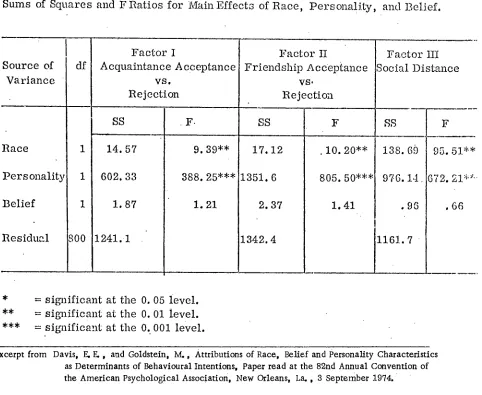
hypothesis was, as mentioned before, the use of a simple 2 x 2 x 2 analysis
of variance design. Results obtained are contained in Exhibit E, which reproduces
Table 1 from Davis and Goldstein (1974). As may be seen by an inspection of
the F ratios in this table, the hypotheses put forward were verified. Thus, it
was possible to make a further contribution to the resolution of this controversy
by the use of rather simple statistics.
Finally, I should like to just mention one further study,
currently under way in Ireland, which illustrates not only methodological
issues, but the relationship between applied research and theoretical implications.
The research directs itself to the very applied problem of ’Some Determinants
of Middle- Management Attitudes and Behavioural Intentions Relevant to Joint
Management-Worker Decision-Making Boards" (Davis and Lydon, in preparation).
The applied relevance of such a study is apparent to anyone familiar with the
general problems of industrial democracy, but takes on even greater salience
in the light of the recent announcement by the Minister for Labour, Mr O’Leary
concerning the establishment of such joint management-worker boards in
semi-State bodies and the imminent emergence of such developments in
indus-trial organisati0ns. Though this development is well advanced in most EEC
countries, it is a relatively new phenomenon in Ireland, but one which will
probably develop rapidly in the very near future. Although the topic of this
study is highly applied in nature, it also has some theoretical implications.
In particular, Davis (1975, in press) has shown that status is by far the most
important determinant of social acceptance or rejection in an Irish sample
Exhibit E
Table I.
Summary of Analysis of Variance Results for 3 BD Factors
Sums of Squares and FRatios for Main Effects of Race, Personality, and Belief.
Source of Variance Race Pers onalit Belief Residual
I
Factor I Acquaintance Acceptance VS. Rejection SS 9.39** 14.57 602.33 1.87 1241..1 388.25*** I. 21 Factor II Friendship Acceptance SS 17.12 1351.6 2.37 1342.4 F ¯ I0.20** 805.50*** I. 41 Factor III Social Distance SS VS. Rejection13s. 6b
976.14. .96 ! 1161.7 F 95.51"* 372.2].*~’’ ,66* = significant at the 0.05 level.
** = sig]lificant at the 0.01 ievel. *** = significant at the 0. 001 level.
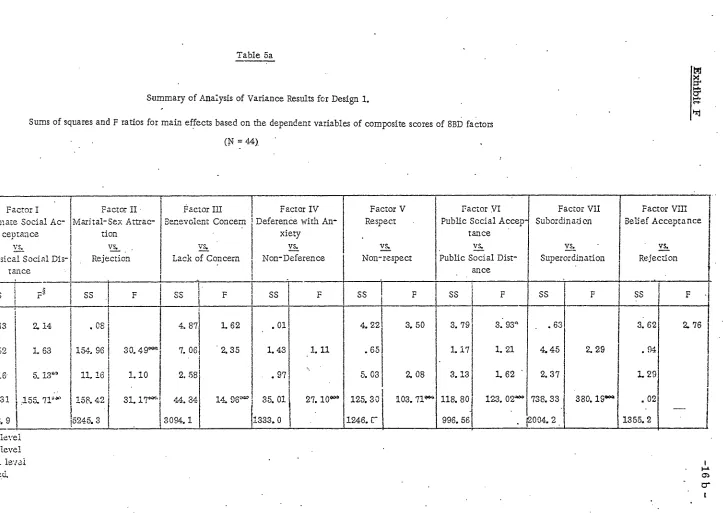
Sammary of ~malysis of Variance Results for Design I.
Sums of squares and F ratios for main effects based on the dependent variables of composite scores of 8BD factors (.N = 44)
i
Factor I Factor il
-.
l~actor IH
I
Factor IV Factor V Factor VI Factor VII Factor VIII !I
i Lndmate Social Ac- Public Social Accep- Subozdinad on Belief Acceptance I Marital-Sex Attrac- !Benevolent Colicem I DefereliCe with An- Respect
Sourceof
,I II ceptance vs_~,!
tion i I lance
v& VS. VS.
Rejection i
v I
xiety
Lack of Concern
.i.
Variance i I Classical Social Dis- Non-Deference Non-respect Public Social Dist- Superordiliation Rejection
I
!
I
ta~ce
ssi
alice
1
i
i~f I ss j
SS I F 8S ! F SS F F S8 i F SS F S$ l Fi
’
’
I
ii
.OSj
~.87i
L62 .01 4. 22 3, 50 3. 791 3. 93"~ .63 3.62 2. ’762.35 1.43 1.11 ¯ 65 I. 17 I. 21 4. 45 2, 29
Religion i 2 129.2. ig" 1 5. 13"*
!, 1
!,10 ¯ 97 5. 03 2,083. 131
L 62 2. 37 1.29i
d
2.
I
I
I
.
i
!58. 42i
31.1~"i 44. 84 14. 98~’= 35. 01 27.10~’~ 125. 80 ~03. 7i~* 118. 80 123. 02~’~ 738. 33 380. 19~’~! ¯ 02
Residual
, 1082 i2228.9
i~-~.~ I
t
.~°~-~
1333.0 998. 58 ¯ ~004. 2 1855. 2¯ ...
-* = s-<lizlzcant at the O. 05 level
" " " "" O. Oi
:x,-. = s~snlficant at .,,e level ~,4:-. = signi~icm~.t at :he O. 00! lev.~i § F ratios leas than 1. 00 omitted..
I
O~
[image:24.917.142.865.43.556.2]as a determinant of the behavioural intentions in an Irish sample as race
does rather consistently in white American samples which we have studied.
i
Furthermore, this study was so designed as to directly test the hypotheses
which were Confirmed by Davis and Goldstein (1974), with the difference that
we were using an Irish sample and using status instead of race. Thus, a
study which is of a very applied nature can also have important theoretical
implications.
Summary
I have tried, briefly, to review some of the basic principles
involved in research methodology, in terms of what has come to be known as
the modern scientific method. Obviously, a more complete treatment of this
very complex and intriguing area would require much more space than is
available here. I can only refer you back again to some of the more standard
texts (e.g. Cohen and Nagle, 1934; Kerlinger, 1973).
In addition, I have tried to illustrate the manner in which the
processes of induction, deduction and hypothesis testing interact in a complex
interplay in actual research by trying to retrace for you the thought processes
and research processes which I and some of my colleagues went through in
conceptualising and carrying out a series of interrelated studies on a particular
issue which bears on one of the fundamental questions of social psychology,
namely the bases "on which human beings express social acceptance or rejection
of their fellows" (Goldstein and Davis, 1972, p. 355). Finally, I have tried to
illustrate the difficulties in deciding on research strategies and statistical
tech-niques and have also sought to show the very close relationship between applied
research and the theoretical implications which such research can have for
Byrne, D. and McGraw, C. Interpersonal attraction toward Negroes.
Human Relations. 1964, 17, 201-213.
Byrne, D. and Wong, T.J. Racial prejudice, interpersonal attraction,
and assumed dissimilarity of attitudes. Journal of Abnormal and
Social Psychology, 1962, 65, 246-253.
Cohen, M. A Preface to Logic. New York:Meridian, 1956.
Cohen, M.R. and Nagle, E. Logic and the Scientific Method. Routledge and Kegan Paul Ltd. 1934.
L ond on:
Campbell, D.T. and Stanley, J.C. Experimental and Quasi-Experimental Designs for Research. Chicago: Rand McNally and Co. 1966.
Davis, E.E. Validity studies of the behavioural differential: Negotiations between white and Negro students on civil rights issues. Paper read at the American Psychological Association Meetings, Los Angeles, California, 1964.
Davis, E.E. A Study of the Structure and Determinants of the Behavioural Component of Social Attitudes in Ireland. Dublin: Economic and Social Research Institute, Paper No. 83, September 1975.
Davis, E.E. and Goldstein, M. Attributions of Race, Belief and Personality Characteristics as Determinants of Behavioural Intentions, Paper read at the 82nd Annual Convention of the American Psychological Association, New Orleans, La., 3 September 1974.
Davis, E.E. and Lydon, D. Some Determinants of Middle-Management Attitudes and Behavioural Intentions Relevant to Joint Management -Worker Decision-Making Boards. (in preparation)
Davis, E.E. and Triandis, H.C. An exploratory study of intercultural negotiations. (Technical Report %/ 26, ONR Contract ~ 177-472, Nonr-1824 (~6)). Urbana: University of illinois, 1965.
Davis, E.E. and Triandis, H.C. An experimental study of black-white negotiations. Journal of Applied Social Psychology, 1971, _1, 240-262.
Goldstein, M. and Davis, E.E. Race and belief: A further analysis of the
social determinants of behavioural intentions. Journal of Personality and Social Psychology, 1972, 22, 346-~55.
Hull, C.L. Princ i~)les of Behaviour.
1943.
New York: Appleton-Century Crofts,
Kennedy, K.A. The Role of Social Science in Relation to Public Policy. Proceedings of the Royal Irish Academy, 73, C, 12, 1973, 647-668.
Kerlinger, F.N. Foundations of Behavioural Research. New York: Holt,
Rinehart and Winston, 1973, (2nd ed. ).
Rokeach, M. Beliefs versus race as determinants of social distance: Comments on Triandis’ paper. Journal of Abnormal and Social
Rokeach, M., Smith, P.W., and Evans, R.I. Two kinds of prejudice
or one9 In M. Rokeach, The oven and closed mind. New York: Basic Books, 1960.
Skinner, B.F. 1940.
Behaviour of Or Tanisms. New York: Appleton-Century,
Stein, D.D., Hardyck, J.E., and Smith, M.B. Race and belief: An
open and shut case. Journal of Personality and Social Psychology,
1965, 1__, 281-290.
Tolman, E. Behavior and Psychological Man. Berkeley, California: University of California Press, 1958.
Triandis, H.C. A note on Rokeach’s theory of prejudice. Journal of Abnormal and Social Psychology, 1961, 62, 184-186.
Triandis, H.C. and Davis, E.E. Race and belief as determinants of
behavioural intentions. Journal of Personality and Social Psychology, 1965, 2, 715:725.
Triandis, H.C. and Triandis, L.M. Race, social class, religion and nationality as determinants of social distance. Journal of Abnormal and Social Psychology, 1960, 6_!, 110-118.
Triandis, H.C., Davis, E.E., and Takezawa, S. Some determinants of social distance among American, German and Japanese students.
Journal of Personality and Social Psychology, 1965, 2, 540-551.
![TABLE 3~ERCE]NTAGES 0~" VARIANCE FOR ]~ ACE AND BI’~LIEF](https://thumb-us.123doks.com/thumbv2/123dok_us/1525244.695403/16.576.111.368.58.367/table-erce-ntages-variance-ace-bi-lief.webp)