Precision Isn’t Everything:
A Hybrid Approach to Grammatical Error Detection
Michael Heilman and Aoife Cahill and Joel Tetreault
Educational Testing Service 660 Rosedale Road Princeton, NJ 08541, USA
{mheilman,acahill,jtetreault}@ets.org
Abstract
Some grammatical error detection methods, including the ones currently used by the Edu-cational Testing Service’s e-rater system (At-tali and Burstein, 2006), are tuned for pre-cision because of the perceived high cost of false positives (i.e., marking fluent En-glish as ungrammatical). Precision, however, is not optimal for all tasks, particularly the HOO 2012 Shared Task on grammatical er-rors, which uses F-score for evaluation. In this paper, we extend e-rater’s preposition and de-terminer error detection modules with a large-scalen-gram method (Bergsma et al., 2009) that complements the existing rule-based and classifier-based methods. On the HOO 2012 Shared Task, the hybrid method performed better than its component methods in terms of F-score, and it was competitive with submis-sions from other HOO 2012 participants.
1 Introduction
The detection of grammatical errors is a challenging problem that, arguably, requires the use of both lin-guistic knowledge (e.g., in the form of rules or com-plex features) and large corpora for statistical learn-ing. Additionally, grammatical error detection can be applied in various scenarios (e.g., automated es-say scoring, writing assistance, language learning), many of which may benefit from task-specific adap-tation or tuning. For example, one might want to take a different approach when detecting errors for the purpose of providing feedback than when de-tecting errors to evaluate the quality of writing in an essay. Thus, it seems desirable to take a flexible
approach to grammatical error detection that incor-porates multiple, complementary techniques.
In this paper, we extend the preposition and de-terminer error detection modules currently used in the Educational Testing Service’s e-rater automated essay scoring system (Attali and Burstein, 2006) for the HOO 2012 Shared Task on grammatical errors (§2). We refer to this set of modules from e-rater as our “base system” (§3). While the base system uses statistical methods to learn models of grammatical English, it also leverages substantial amounts of lin-guistic knowledge in the form of various hand-coded filters and complex syntactic features. The base sys-tem is also tuned for high precision at the expense of recall in order to avoid a high rate of potentially costly false positives (i.e., frequent marking of cor-rect English sentences as ungrammatical).
We apply the pre-existing base system without modifications but complement it with a large-scale
n-gram method (§5) based on work by Bergsma et al. (2009). Then-gram method employs very little linguistic knowledge and instead relies almost ex-clusively upon corpus statistics. We also tune the resulting hybrid system with labeled training data in order to maximize the primary evaluation met-ric used in the HOO 2012 Shared Task: balanced F-score, orF1 (§6). We find that the tuned hybrid
system improves upon the recall and F-score of the base system. Also, in the HOO 2012 Shared Task, the hybrid system achieved results that were com-petitive with other submitted grammatical error de-tection systems (§7).
2 Task Definition
In this section, we provide a brief overview of the HOO 2012 Shared Task (Dale et al., 2012). The task focuses on prepositions and determiners only, distinguishing the following error types: preposition selection errors (coded “RT” in the data), extraneous prepositions (“UT”), missing prepositions (“MT”), determiner selection errors (“RD”), extraneous de-terminers (“UD”), and missing dede-terminers (“MD”).
For training and testing data, the shared task uses short essays from an examination for speakers of En-glish as a foreign language. The data includes gold standard human annotations identifying preposition and determiner errors. These errors are represented as edits that transform an ungrammatical text into a grammatical one. Edits consist of start and end offsets into the original text and a correction string that should replace the original text at the speci-fied offsets. The offsets differ by error type: word selection errors include just the word, extraneous word errors include an extra space after the word so that a blank will result in an appropriate amount of whitespace, and missing word errors specify spans of length zero.1
There are three subtasks: detection, recognition, and correction. Each is evaluated according to pre-cision, recall, and F-score according to a set of gold standard edits produced by human annotation. While the correction subtask requires both correct character offsets and appropriate corrections, the de-tection and recognition subtasks only consider the offsets. Detection and recognition are essentially the same, except that detection allows for loose match-ing of offsets, which permits mismatches between the extraneous use (e.g., UT) and word selection (e.g., RT) error types. For our submission to the shared task, we chose to tune for the detection sub-task, and we also chose to avoid the correction task entirely since the interface to the pre-existing base system did not give us access to possible corrections.
1
The offsets for extraneous word errors prior to punctuation, a relatively rare occurrence, include a space before the word rather than after it. Our script for converting our system’s output into the HOO 2012 format did not account for this, which may have decreased recognition performance slightly.
3 Base System
As our base system, we repurpose a complex sys-tem designed to automatically score student essays (both native and non-native and across a wide range of competency levels). The system is also used to give feedback to essay writers, so precision is fa-vored over recall. There are three main modules in the essay-scoring system whose purpose it is to de-tect preposition and determiner errors (as they are defined in that system). Many of the details have been reported previously (Chodorow and Leacock, 2000; Han et al., 2004; Han et al., 2006; Chodorow et al., 2007; Tetreault and Chodorow, 2008), so here we will only give brief summaries of these modules. It is important to note that this system was run without modification. That is, no training of new models or tuning was carried out specifically for the shared task. In addition, for the two statistical mod-ules, we only had access to the final, boolean deci-sions about whether an error is present or not at a particular location in text. That is, we did not have access to confidence scores, and so task-specific tun-ing for F-score was not an option.
3.1 Preposition Error Detection
The base system detects incorrect and extraneous prepositions (Chodorow et al., 2007; Tetreault and Chodorow, 2008). Tetreault and Chodorow (2008) reports approximately 84% precision and 19% re-call on both error types combined when evaluating the system on manually annotated non-native text.
3.1.1 Incorrect Prepositions
A pre-filter prevents any contexts that contain spelling errors from being submitted to the logistic regression model. The motivation for this is that the NLP components that provide the features for the model are unreliable on such data, and since the sys-tems favors precision over recall, no attempt is made to correct prepositions where the system cannot rely on the accuracy of those features.
The logistic regression model of correct preposi-tion usage is trained on approximately 82 million words from the San Jose Mercury News2and texts for 11th to 12th grade reading levels from the Meta-Metrics Lexile corpus, resulting in 7 million prepo-sition contexts. The model uses 25 types of features: words and part-of-speech tags around the existing preposition, head verb (or noun) in the preceding VP (or NP), head noun in the following NP, among others. NPs and VPs were detected using chunking rather than full parsing, as the performance of statis-tical parsers on erroneous text was deemed to be too poor.
A post-filter rules out certain candidates based on the following heuristics: (1) if the suggested correc-tion is an antonym of the original preposicorrec-tion (e.g.,
fromvsto), it is discarded; (2) any correction of the benefactiveforis discarded when the head noun of the following NP is human (detected as a WordNet hyponym ofpersonorgroup).
3.1.2 Extraneous Prepositions
Heuristics are applied to detect common occur-rences of extraneous prepositions in two scenar-ios: (1) accidentally repeated prepositions (e.g.,with with) and (2) insertion of unnecessary prepositions in plural quantifier constructions (e.g.,someof peo-ple).
3.2 Determiner Error Detection
There are two separate components that detect er-rors related to determiners. The first is a filter-based model that detects determiner errors involving num-ber and person agreement. The second is a statistical system that supplements the rule-based system and detects article errors.
2The San Jose Mercury News is available from the Linguis-tic Data Consortium (catalog number LDC93T3A).
3.2.1 Filter-based system
The filter-based system combines unsupervised detection of a set of possible errors (Chodorow and Leacock, 2000) with hand-crafted filters designed to reduce this set to the largest subset of correctly flagged errors and the smallest possible number of false positives. Chodorow and Leacock (2000) found that low-frequency bigrams (sequences of two lexical categories with a negative log-likelihood) are quite reliable predictors of grammatical errors. Text is tagged and chunked, and filters that detect likely cases of NP-internal agreement violations are ap-plied. These filters will mark, for example, a sin-gular determiner followed by a plural noun head and vice versa, or a number disagreement between a nu-meral and the noun it modifies. This system has the ability to take advantage of linguistic knowledge, which contributes to its ability to detect errors with high precision.
3.2.2 Statistical model
In addition to the hand-crafted filters described above, there is a statistical component that detects incorrect, missing and extraneous articles (Han et al., 2004; Han et al., 2006). This component con-sists of a multiclass logistic regression that selects an appropriate article for every NP froma, an, the, or . This model is trained on 31.5 million words of diverse genres from the MetaMetrics Lexile cor-pus (from 10th to 12th grade reading levels), or 8 million NP contexts. Again, NPs were determined by chunking. The model includes various features: words and POS tags around and within the NP, NP head information including the countability of the head noun (estimated automatically from large cor-pora), etc.
In a cross-validation experiment, the model achieved approximately 83% accuracy on well-edited text. In an experiment evaluated on non-native learner text, the model achieved approxi-mately 85% agreement with human annotators.
4 Task-Specific Heuristic Filtering
errors involvingevery,manyand other quantifiers as determiner errors, while these are not marked in the current HOO 2012 Shared Task data.
To ensure that our system was aligned with the HOO 2012 Shared Task, we automatically extracted lists of the most frequently occurring determiners and prepositions in the HOO training data. Any RT, UT, RD or UD edit predicted for a word not in those lists is automatically discarded. In the training data, this resulted in the removal of 4 of the 463 RT errors and 98 of the 361 RD errors detected by the base system.
5 Large-scalen-Gram Models
In order to complement the high-precision base sys-tem and increase recall, we incorporate a large scale n-gram model into our full system. Specifi-cally, we adapt the SUMLM method from Bergsma et al. (2009). SUMLM creates confusion sets for each preposition token in an input text and uses the Google Web 1T 5-gram Corpus to score each item in the confusion set.3 We extend SUMLM to sup-port determiners, extraneous use errors, and missing word errors.
Consider the case of preposition selection errors. For a preposition token at positioniin an input sen-tencew, we compute the following score for each possible alternativev, using Eq. 1.4
s(w, i, v) =
P
n=2...5
P
x∈G(w,i,n,v)
log(count(x))
|G(w, i, n, v)|
(1)
The function G(w, i, n, v) returns the set of n -grams inw that include the word at position iand
3
The Google Web 1T 5-gram Corpus is available from the Linguistic Data Consortium (catalog number LDC2006T13). We plan to test other corpora forn-gram counts in future work.
4
Then-gram approach considers all of the following words to be prepositions:to,of,in,for,on,with,at,by,as,from,about, up, over, into, down, between, off, during, under, through, around,among,until,without,along,within,outside,toward, inside,upon,except,onto,towards,besides,beside, and under-neath. It considers all of the following words to be determiners: a,an, andthe. The sets of possible prepositions and determiners for the base system are not exactly the same. Part of speech tags are not used in then-gram system except to identify insertion points for missing prepositions and determiners.
replace that word,wi, withv. For example, ifw =
Mary and John went at the store to buy milk,n= 4,
i = 4, and v = to, thenG(w, i, n, v) returns the following 4-grams:
• and John went to
• John went to the
• went to the store
• to the store to
The expressionlog(count(x))is the natural loga-rithm of the number of times then-gramxoccurred in the corpus.5 |G(w, i, n, v)|is the number ofn -gram count lookups, used to normalize the scores. Note that this normalization factor is not included in the original SumLM. Whenvis an alternative prepo-sition not near the beginning or end of a sentence,
|G(w, i, n, v)|= 14since there are 14n-gram count lookups in the numerator. Or, for example, ifi= 0, indicating that the preposition occurs at the begin-ning of the sentence,|G(w, i, n, v)|= 4.6
Next, we compute the ratio of the score of each alternative to the score for the original, using Eq. 2.
r(w, i, v) = s(w, i, v) s(w, i, wi)
(2)
We then identify the best scoring alternative, re-quiring that its score be higher than the original (i.e.,
r(w, i, v)>1). The procedure is the same for deter-miners, except, of course, that the set of alternatives includes determiners rather than prepositions.
To extend the method from Bergsma et al. (2009) for extraneous prepositions and determiners, we simply setvto be a blank and sum overj = 3. . .5
instead.|G(w, i, n, v)|will then be 12 instead of 14, since bigrams from the original sentence, which be-come unigrams when replacingwiwith a blank, are excluded.
To identify positions at which to flag selection or extraneous use errors, we simply scan for words that match an item in our sets of possible prepositions and determiners. To extend the method for missing
5We use the TrendStream system (Flor, 2012) to retrieven -gram counts efficiently.
6
Algorithm 1tune(W,y,ˆyα,αmin):
The hill-climbing algorithm for optimizing the n -gram method’s penalty parameters q. W consists of the training set texts.yˆis a set of candidate edits.
yis a set of gold standard edits. αis an initial step size, andαminis a minimum step size.
qallbest←0
scoreallbest←eval(qallbest,W,y,ˆy) whileα > αmindo
scorebest← −∞ qbest←qallbest
forqtmp∈perturb(qbest, α)do scoretmp ←eval(qtmp,W,y,yˆ) ifscoretmp >scorebestthen
qbest←qtmp
scorebest←scoretmp end if
end for
ifscorebest>scoreallbestthen qallbest←qbest
scoreallbest ←scorebest else
α←0.5∗α
end if end while returnqallbest
word errors, however, we apply a set of heuristics to identify potential insertion points.7
6 Tuning
Then-gram approach in§5 generates a large num-ber of possible edits of different types. In this sec-tion, we describe how we filter edits using their scores and how we combine them with edits from the base system (§3).
As described above, for an alternativevto be con-sidered as a candidate edit, the value ofr(w, i, v)in Eq. 2 must be greater than a threshold of 1, indicat-ing that the alternative scores higher than the origi-nal word. However, we observed low precision dur-ing development when includdur-ing all candidate ed-its and decided to penalize the ratios. Bergsma et al. (2009) discuss raising the threshold, which has
7The heuristics are based on those used in Gamon (2010) (personal communication).
a similar effect. Preliminary experiments indicated that different edits (e.g., extraneous preposition edits and preposition selection edits) should have differ-ent penalties, and we also want to avoid edits with overlapping spans. Thus, for each location with one or more candidate edits, we select the best according to Equation 3 and filter out the rest.
v∗ = arg max v
r(w, i, v)−penalty(wi, v) (3)
penalty(wi, v)is a function that takes the current wordwi and the alternative vand returns one of 6
values:qRT for preposition selection,qU T for
extra-neous prepositions, qM T for missing prepositions,
qRD for determiner selection, qU D for extraneous
determiners, andqM Dfor missing determiners. If the value forr(w, i, v∗)−penalty(wi, v∗)does not exceed 1, we exclude it from the output.
We tune the vector q of all the penalties to op-timize our objective function (F-score, see §7) on the training set using the hill-climbing approach de-scribed in Algorithm 1. The algorithm initializes the parameter vector to all zeros, and then itera-tively evaluates candidate parameter vectors that re-sult from taking positive and negative steps of size
α in each direction (steps with negative penalties are skipped). The best step is taken if it improves the current score, according to theevalfunction, which returns the training set F-score after filtering based on the current parameters.8 This process pro-ceeds until there is no improvement. Then, the step sizeαis halved, and the whole process is repeated. The algorithm proceeds as such until the step size becomes lower than a specified minimumαmin.
When merging edits from the base system and the
n-gram approach, the hybrid system always prefers edits from the base system if any edit spans overlap, equivalent to including them in Eq. 3 and assigning them a penalty of −∞.9 Note that the set of pre-dicted editsypassed as input to thetunealgorithm
8Our implementation of the tuning algorithm uses the HOO 2012 Shared Task’sevalfrag.pymodule to evaluate the F-score for the error detection subtask.
9
texts
edits
edits
edits parameters
parameters gold edits
base system n-gram system
filtering tuning
heuristic filtering
training testing
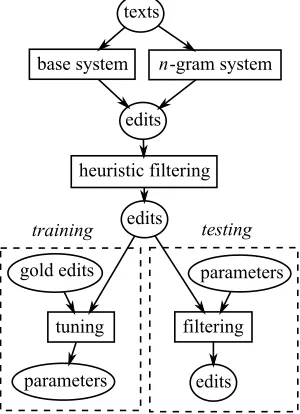
Figure 1: The architecture of the hybrid system. Different steps are discussed in different parts of the paper: “base system” in§3, “n-gram system” in§5, “heuristic filter-ing” in§4, and “tuning” and “filtering” in§6.
includes edits from both the base andn-gram meth-ods.
Figure 1 illustrates the processes of training and of producing test output from the hybrid system.
[image:6.612.325.526.57.141.2]7 Results
Table 1 presents results for the HOO 2012 detec-tion subtask, including errors of all types. The re-sults here, reproduced from Dale et al. (2012), are prior to applying participant-suggested revisions to the set of gold standard edits.10 We include four variations of our approach: the base system (§3, la-beled “base”); the n-gram system (§5, labeled “n -gram”) by itself, tuned without edits from the base system; the hybrid system, tuned with edits from the base system (“hybrid”); and a variation of the
hy-10
After submitting our predictions for the shared task, we noticed a few minor implementation mistakes in our code re-lated to the conversion of edits from the base system (§3) and the task-specific heuristic filtering (§4). We corrected them and retrained our system. The detection F-scores for the original and corrected implementations were as follows:26.45% (orig-inal) versus26.23%(corrected) for the base system,30.70% (original) versus30.45% (corrected) for then-gram system, 35.65%(original) versus35.24%(corrected) for the hybrid sys-tem, and31.82%(original) versus31.45%(corrected) for the hybridindepsystem. Except for this footnote, all results in this paper are for the original system.
run P R F
base 0 52.63 17.66 26.45
n-gram – 25.87 37.75 30.70
hybrid 1 33.59 37.97 35.65
hybridindep 2 24.88 44.15 31.82
[image:6.612.112.262.61.268.2]UI 8 37.22 43.71 40.20
Table 1: Precision, recall, and F-score for the combined preposition and determiner error detection subtask for various methods, before participant-suggested revisions to the gold standard were applied. All values are percent-ages. Official run numbers are shown in the “run” col-umn. The “n-gram” run was not part of our official sub-mission. For comparison, “UI” is the submission, from another team, that achieved the highest detection F-score in the HOO 2012 Shared Task.
brid system (“hybridindep”) with the penalties tuned independently, rather than jointly, to maximize F-score for detection of each error type. For compari-son, we also include the best performing run for the detection subtask in terms of F-score (labeled “UI”).
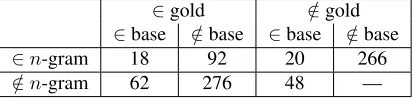
We observe that the base andn-gram systems ap-pear to complement each other well for this task: the base system achieved 26.45% F-score, and the n -gram system achieved30.70%, while the hybrid sys-tem, with penalties tuned jointly, achieved35.65%. Table 2 shows further evidence that the two systems have complementary performance. We calculate the overlap between each system’s edits and the gold standard. We see that only a small number of edits are predicted by both systems (38 in total, 18 cor-rect and 20 incorcor-rect), and that the base system pre-dicts 62 correct edits that then-gram method does not predict, and similarly the n-gram method pre-dicts 92 correct edits that the base system does not predict. The table also verifies that the base system exhibits high precision (only 68 false positives in to-tal) while then-gram system is tuned for higher re-call (286 false positives).
Not surprisingly, when the n-gram method’s penalties were tuned independently (“hybridindep”)
rather than jointly, the overall score was lower, at
31.82% F-score. However, tuning independently might be desirable if one were concerned with performance on specific error types or if macro-averaged F-score were the objective.
(1) All models had aUDvery strange long shoes made from black skin . . .
(2) I think it is a great idea to organise this sort of festival because most ofUTpeople enjoy it.
Figure 2: Examples of errors detected by the base system and missed by then-gram models.
(3) We have to buy forUTsome thing.
[image:7.612.84.293.258.308.2](4) I am MDgood diffender.
Figure 3: Examples of errors detected by then-gram system and missed by the base model.
∈gold ∈/gold
∈base ∈/base ∈base ∈/base
∈n-gram 18 92 20 266
/
∈n-gram 62 276 48 —
Table 2: The numbers of edits that overlap in the hybrid system’s output and the gold standard for the test set. The hybrid system’s output is broken down by whether edits came from the base system (§3) or then-gram method (§5). The empty cell corresponds to hypothetical edits that were in neither the gold standard or the system’s out-put (e.g., edits missed by annotators), which we cannot count.
compared to the other HOO 2012 submissions, achieving the 3rd best results out of 14 teams for the detection and recognition subtasks. The per-formance of the “UI” system was somewhat higher, however, at40.20%F-score compared to the hybrid system’s35.65%. We speculate that our hybrid sys-tem’s performance could be improved somewhat if we also tuned the base system for the task.
8 Error Analysis
It is illustrative to look at some examples of edits that the base system correctly detects but then-gram model does not, and vice versa. Figure 2 shows ex-amples of errors detected by the base system, but missed by the n-gram system. Example (1) illus-trates that then-gram model has no concept of syn-tactic structure. The base system, on the other hand, carries out simple processing including POS tagging and chunking, and is therefore aware of at least some longer-distance dependencies (e.g.,a . . . shoes).
Ex-ample (2) shows the effectiveness of the heuris-tics based on quantifier constructions mentioned in
§3.1.2. These heuristics were developed by devel-opers familiar with the kinds of errors that language learners frequently make, and are therefore more tar-geted than the generaln-gram method.
Figure 3 shows examples of errors detected by the
n-gram system but missed by the base system. Ex-ample (3) shows an exEx-ample of where the base sys-tem does not detect the extraneous preposition be-cause it only searches for these in certain quantifier constructions. Example (4) contains a spelling error, which confuses the determiner error detection sys-tem. It has not seen the misspelling often enough to be able to reliably judge whether it needs an article or not before it, and so errs on the side of caution. Whendiffenderis correctly spelled asdefender, the base system does detect that there is a missing article in the sentence.
There were a small number of cases where dialect caused a mismatch between our system’s error pre-dictions and the gold standard. For example,an ho-tel is not marked as an error in the gold standard since it is correct in many dialects. However, it was always corrected toa hotelby our system. Our sys-tem also often corrected determiners before the noun
camp, since in American Standard English it is more usual to talk about going to Summer Camp rather thangoing to a/the Summer Camp.
with multiple errors, it was sometimes possible to correct it in multiple ways, not all of which involved preposition or determiner errors. For example, you could correct the phrasea womenby either chang-ing theatothe, deleting theaentirely or replacing
womenwithwoman. The last change would not fall under the category of determiner error, and so there was sometimes a mismatch between the corrections predicted by the system and the gold standard cor-rections. Secondly, the presence of multiple errors impacted the task when a gold standard correction depended on another error in the same sentence be-ing corrected in a particular way. For example, you could correctI’m really excited to read the book. as
I’m really excited about reading the book., however if you add the prepositionaboutwithout correcting
to readthis correction results in the sentence becom-ing even more ungrammatical than the original.11
9 Conclusion
In this paper, we have described a hybrid system for grammatical error detection that combines a pre-existing base system, which leverages detailed lin-guistic knowledge and produces high-precision out-put, with a large-scalen-gram approach, which re-lies almost exclusively on simple counting of n -grams in a massive corpus. Though the base system was not tuned at all for the HOO 2012 Shared Task, it performed well in the official evaluation. The two methods also complemented each other well: many of the predictions from one did not appear in the out-put of the other, and the F-score of the hybrid system was considerably higher than the scores for the indi-vidual methods.
Acknowledgments
We thank Martin Chodorow for discussions about the base system, Daniel Blanchard for help with run-ning the base system, Nitin Madnani for discussions about the paper and for its title, and Michael Flor for the TrendStream system.
11
Many of these cases were addressed in the revised version of the gold standard data, however we feel that the issue is a more general one and deserves consideration in the design of future tasks.
References
Yigal Attali and Jill Burstein. 2006. Automated Es-say Scoring with e-rater V.2. Journal of Technol-ogy, Learning, and Assessment, 4(3). Available from http://www.jtla.org.
Shane Bergsma, Dekang Lin, and Randy Goebel. 2009. Web-Scale N-gram Models for Lexical Disambigua-tion. In Proceedings of the 21st international joint conference on Artifical intelligence, IJCAI’09, pages 1507–1512, Pasadena, California. Morgan Kaufmann Publishers Inc.
Martin Chodorow and Claudia Leacock. 2000. An Un-supervised Method for Detecting Grammatical Errors. InProceedings of the First Meeting of the North Amer-ican Chapter of the Association for Computational Linguistics (NAACL), pages 140–147, Seattle, Wash-ington. Association for Computational Linguistics. Martin Chodorow, Joel Tetreault, and Na-Rae Han. 2007.
Detection of Grammatical Errors Involving Preposi-tions. In Proceedings of the Fourth ACL-SIGSEM Workshop on Prepositions, pages 25–30, Prague, Czech Republic. Association for Computational Lin-guistics.
Robert Dale, Ilya Anisimoff, and George Narroway. 2012. HOO 2012: A Report on the Preposition and Determiner Error Correction Shared Task. In Proceed-ings of the Seventh Workshop on Innovative Use of NLP for Building Educational Applications, Montreal, Canada. Association for Computational Linguistics. Michael Flor. 2012. A fast and flexible
archi-tecture for very large word n-gram datasets. Natural Language Engineering, pages 1–33. doi:10.1017/S135132491100034.
Michael Gamon. 2010. Using Mostly Native Data to Correct Errors in Learners’ Writing. InHuman Lan-guage Technologies: The 2010 Annual Conference of the North American Chapter of the Association for Computational Linguistics, pages 163–171, Los An-geles, California. Association for Computational Lin-guistics.
Na-Rae Han, Martin Chodorow, and Claudia Leacock. 2004. Detecting Errors in English Article Usage with a Maximum Entropy Classifier Trained on a Large, Di-verse Corpus. InProceedings of the 4th International Conference on Language Resources and Evaluation (LREC 2004), pages 1625–1628, Lisbon, Portugal. Na-Rae Han, Martin Chodorow, and Claudia Leacock.
2006. Detecting errors in English article usage by non-native speakers. Natural Language Engineering, 12:115–129. doi:10.1017/S1351324906004190. Joel R. Tetreault and Martin Chodorow. 2008. The