Proceedings of the 2012 Workshop on Biomedical Natural Language Processing (BioNLP 2012), pages 140–145,
MedLingMap: A growing resource mapping the Bio-Medical NLP field
Marie Meteer, Bensiin Borukhov, Michael Crivaro,
Michael Shafir, Attapol Thamrongrattanarit
{mmeteer, bborukhov, mcrivaro, mshafir, tet}@brandeis.edu
Department of Computer Science
Brandeis University
Waltham, MA 02453, USA
Abstract
The application of natural language process-ing (NLP) in the biology and medical domain crosses many fields from Healthcare Informa-tion to Bioinformatics to NLP itself. In order to make sense of how these fields relate and intersect, we have created “MedLingMap” (www.medlingmap.org) which is a compila-tion of references with a multi-faceted index. The initial focus has been creating the infra-structure and populating it with references an-notated with facets such as topic, resources used (ontologies, tools, corpora), and organi-zations. Simultaneously we are applying NLP techniques to the text to find clusters, key terms and other relationships. The goal for this paper is to introduce MedLingMap to the community and show how it can be a power-ful tool for research and exploration in the field.
1
Introduction
In any field, understanding the scope of the field as well as finding materials relevant to a particular project paradoxically gets more difficult as the field gets larger. This is even more difficult in a field such as Bio-Medical NLP, since it is at the crossroads of multiple disciplines. The drawbacks of keyword search, even using a specific engine such as Google Scholar, are well documented (Stoica et. al 2007) and recent trends in content aggregation and content curation have emerged to attempt to address the problem. Uses of curation range from those in library science to ensure mate-rial remain accessible as format and electronic readers change and to make that information more findable (e.g. Peer and Green 2012) to those in marketing to increase revenue by providing more relevant content (Beaulaurier 2012).
However, these approaches still have chal-lenges. Automatic aggregation over a large body of content still provides too many results without ad-ditional filtering mechanism. Content curation, which filters content by value and annotates it to ensure higher quality returns, is expensive since annotating large collections of content with the metadata needed to support faceted search and navigation is a huge challenge.
The goal of the work described in this paper is to provide a framework for creating a useful re-source tool bounded by the interests of a specific community which can take advantage of automated clustering and keyword extraction techniques and the use of community based annotation through crowd sourcing and social tatting to provide valu-able curation. What is an impossible task for a sin-gle team because doable when we successfully harness and empower the community.
The MedLingMap site is available at
www.medlingmap.org. Currently MedLingMap has over 300 references many of which are anno-tated according to a set of “contextual” facets (de-scribed below). We first provide some use cases for the system and then go into more detail on the content, infrastructure and origins of the system.
We welcome members of the field to join MedLingMap as a curator to help extend the re-source. Just email [email protected] to get an account. Please include your affiliation.
2
Use Cases
MedLingMap was started as a class project in a Brandeis graduate course on NLP in the Medical Domain to provide a means of finding and organiz-ing the publications in the field and as a data source for exploring trends in topics and
ships among researchers. While there are many use cases for such a resource, three stand out.
The first is simply the ability to find material that meets very specific criteria. for example, to find papers using “MetaMap” for named entity extraction over clinical data. MedLingMap’s grow-ing collection of references and the necessary meta-data to make it useful is well suited to this task.
The second is to support the exploration of an area. If I’m interested in clinical coding, I can se-lect that subject area and am presented with a number of papers. I notice that Phil Resnik is on a number of papers and may want to follow up on his work. I also see many of the papers are tagged with AHIMA, including an entire proceedings that is worth exploring. I select a paper and see the
abstract mentions a particular challenge that is also worth following up on. We are in the process of developing a personal “workspace” that will let researchers record searches, annotate findings, and keep a queue of the “next directions” that might be worth following up.
[image:2.612.90.529.312.604.2]The third use case gets back to one of the origi-nal premises of the work, which is that a “map” of a field goes beyond a collection of materials, it also provides context and can be used to see “hot spots” and trends. In order to provide this information and visualization, we have developed a set of tools applying a variety of NLP techniques, such as clus-tering, topic identification and tf-idf to the content of the papers. This work is described in more de-tail in (Thamrongrattanarit, et al, 2012).
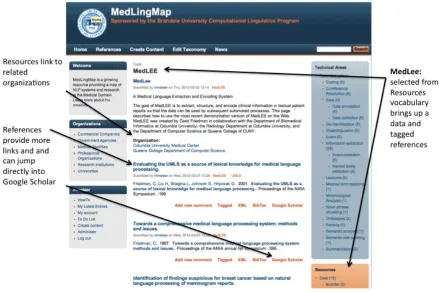
Figure 1: MedLingMap site: www.medlingmap.org
3
Content and Context
The core content in MedLingMap are the refer-ences themselves. The underlying representation is based on bibtex and references can be added by either pasting in a single bibtex item or uploading
an entire file. A reference can be added through a form interface as well.
with a short description and links for each. These elements are entered by hand. The assumption is that there are a limited number of them and edito-rial control is more important than speed of entry.
3.1
Examples of the interfaceThe MedLingMap interface is shown in Figure 1. All references, resources and organizations are linked through a set of “taxonomies” (described below), which have been developed bottom up based on the material tagged to date. Selecting any item from the taxonomies will select content anno-tated by that tag. So selecting a “Technical area” from the box on the right brings in all the papers annotated by that topic. A similar box of “re-sources” allows the user to select all papers that have been annotated as using a particular resource.
[image:3.612.314.544.244.459.2]For example, in Figure 1 the user has selected MedLEE from the “Resources” taxonomy and is shown the information on MedLee as well as refer-ences that have been annotated as discussing MedLEE. In addition to the basic bibliographic information, the user can export the reference in bibtex or xml or jump directly to it Google scholar, which can provide multiple ways of accessing the resource. Alternative views show all of the refer-ences by year, author or title.
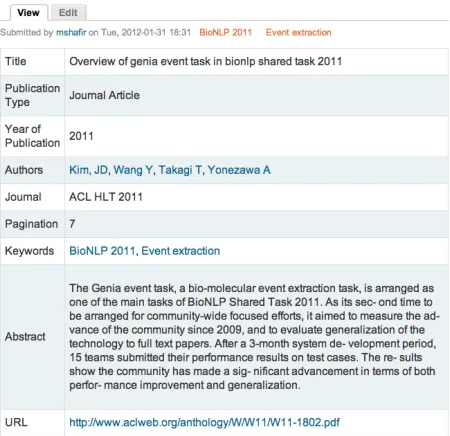
Figure 2: Information on a particular reference
By selecting a reference in MedLingMap, addi-tional information is available, as shown in Figure
2. By selecting any of the key terms from the tax-onomy at the top of the “view”, the user can go to more papers tagged with that term. By selecting any of the authors, the user is shown other papers by that author. Those with a “curator” account (described below) can select “edit” and make changes or provide additional tags.
[image:3.612.75.300.444.662.2]In addition, there is a standard search mecha-nism, as shown in Figure 3. We are in the process of implementing true faceted search, similar to “advanced search” for recipes, where you can se-lect one or more item from each taxonomy to con-strain the search.
Figure 3: Open search
3.2
Faceted indexingIndexing content along multiple dimensions or “facets” is not new to search (Alan 1995) and sig-nificant work has gone into creating effective inter-faces for faceted search (Hearst 2006). When searching for research materials, the context the work was done can be a significant contributor to being able to find related materials. “Necessity is the mother of invention” implies that if you want to find similar solutions, look for similar needs.
To try to capture this kind of information, MedLingMap has facets organized into taxono-mies:
• Technical area or topic of the work (shown in the screen shot above)
• Data: Corpora such as Genia, CRAFT, i2B2, BioInfer
• Lexical Resources, which are organized into dictionaries, and ontologies and include UMLS, PubMEd, MedLine, MeSH, and Medical Wordnet
• Tools, such as parsers, taggers, annotation toolkits and more complete systems, such as MedLee, GATE, and MIST
• Shared tasks, such as the BioNLP 2009 and 2011 shared tasks, BioCreative, and i2b2
• Institution the work was done in or is associated with in some way (e.g. funding, providing re-sources, etc)
As the project continues, these facets will grow and new ones will be added. Additional facets un-der consiun-deration include the program (e.g. across multiple institutions, generally associated with a single funding source), target data (e.g. medical literature or clinical records).
4
Origins of MedLingMap
As mentioned above, MedLingMap was started as a class project in a graduate course NLP in the Medical Domain and the creation of the taxono-mies and population of the material was done as part of the class. However, the underlying architec-ture itself is based on a system that has been under development for speech recognition for the past two years (www.stcspeechmap.org) by author Marie Meteer as part of the Speech Technology Consortium’s effort to improve prior art research in non-patent literature.
The driving principle is that the “art” in any field (the papers, documentation, product descrip-tions, etc) can only be understood in terms of the context in which they were produced, contexts which show relations between them that is usually not available in the individual documents. For ex-ample, much of the early work in speech recogni-tion addressed the challenges of multimodal interfaces well before we had sophisticated mobile devices. Solutions are being reinvented and pat-ents applied for that would not considered novel if the original research were more readily available. Similar issues arise in multidisciplinary fields such as Bio-Medical NLP where different groups come
together who do not have the same historical con-text and may not know about previous research.
5
Infrastructure
MedLingMap and SpeechMap are built on Dru-pal1 an open architecture Content Management System (CMS), which underlies many web sites ranging from www.whitehouse.gov to BestBuy.
Using Drupal ensures that MedLingMap can be a living, growing resource. Drupal provides the following functionality:
• A database to store, retrieve, and maintain large documents sets and web pages, provid-ing multiple views into the contents.
• Specific content types for resources, organi-zations, authors, and references, all linked though a set of taxonomies.
• The capability to load in references in bibtex format either in a group or individually and annotate them with terms from the taxono-mies.
• Maintenance facilities, such as suggesting when multiple authors may be the same per-son and merging them.
• User profiles with different permission lev-els to accommodate viewers, contributors, social tagging, and private workspaces with the appropriate levels of security.
• The ability to integrate powerful search components, such as SOLR2, as well as
spe-cific modules, such as the Bibliography module which provides automatic links to Google Scholar to retrieve those documents. • Web-based to allow easy outside access and
be more compatible with other systems. • Extensibility both for more content, more
content types, and more functionality. For example while there is a module that pro-duces a warning if a possible duplicate ref-erence, we are still looking for one that would search out potential duplicates and propose merges. If none exists, such a mod-ule can be written and easily integrated.
1 http://drupal.org/
6
Value for Stakeholders
The value of MedLingMap varies with the audi-ence. We first talk about the value to the current community and contrast MedLingMap to similar resources already available. We then look at stakeholders outside or entering the community and the value MedLingMap brings to them.
6.1
BioMedical NLP communityFor members of the community, a central reposi-tory for papers in the field is a “nice to have”. There is information that is surfaced by seeing the organization of the information and links to re-sources in one place, but if you have been attend-ing conferences and workshops regularly, this is not new information. You know the players and already follow the work you are interested in.
In addition, similar information is available elsewhere, though in a more distributed form. ACL has made all of the proceedings to confer-ences and workshops available3. Similarly ACM
and IEEE Xplore provide access to all of the pa-pers they control. The significant difference is that in these collections even the advance search is re-lying on standard bibliographic elements, such as author and title, and keyword search and there is no segmentation of the material by field, which introduces significant ambiguity as the same term can mean different things in different fields. Simi-larly PubMed and GoPubMed offer documents and advanced search on a huge body of literature, but focused on biology and medicine, not the applica-tion of NLP techniques to those fields. MedLing-Map is designed to be focused on a smaller community with more like interests.
It is also important to note that MedLingMap is providing links to papers, not the actual papers, which are controlled by the publishers. While many papers are readily available using the links provided or can be found through the Google Scholar link for each reference, if you need a sub-scription to see the entire paper such as for IEEE, you still need to go through your standard method to get those papers.
LREC’s Resource Map is more similar in that it provides more in depth information that the aggre-gations described above, however the focus is on
3http://aclweb.org/anthology-new/
mapping the resources themselves, not necessarily all of the publications that have taken advantage of those resources, though some of that information may be available by following the links. LREC is also using a crowd sourcing method for growing the resource by asking those who submit papers also submit the information about the resources they used. This is an interesting model in that it assures that those contributing have a stake in the result since they are members of the community by virtue of submitting a paper.
Organizations such as BioNLP.org and Sig-BioMed are also important resource aggregators for the community. Neither are focused on publi-cations and we hope that MedLingMap willl be-come one more resource they would point to.
6.2
From the outsideFor students or those who come to the field from a neighboring field, the aggregation of the material in MedLingMap can save considerable time and provide overview or “map” of the field. Queries that are ambiguous in Google Scholar are more precise when the domain is limited. <example>
This increase in the ability of newcomers in the field to find what they are looking for actual turns into benefits for those in the field in two ways: First, one’s own papers become more findable, increasing citations and potential collaborations. Second, for those who teach, MedLingMap pro-vides a great environment for the students to do targeted research. Letting them loose in a con-strained search environment increases the likeli-hood they will find a rich body of material to learn from and build on without having to always hand select the papers.
7
Growing the resource
The real challenge for a community resource such as MedLingMap is how to grow it to be compre-hensive and keep it up to date, specifically how to: • grow the number of references and resources • increase high quality annotations that go
be-yond what can be extracted automatically. • provide visualizations that bring to light the
connections in the material.
ensuring information about resources and organizations is up to data.
The two choices for growing are automatic tech-niques and human annotation. We discuss the former in a related paper (Thamrongrattanarit 2012). Here we describe how manual annotation can be feasible.
7.1
Distributed PowerThe key to high quality documents and tagging is community involvement. There are two comple-mentary approaches that are key to the MedLing-Map project: crowd sourcing and social tagging. Crowd sourcing involves the community in finding relevant resources, particularly those that are fairly obscure and predate the internet. The second is social tagging which lets individuals check on their own materials or materials in areas related to their own work and adding or adjusting the tags to make the content more searchable.
The key to making these tactics work is setting up the right support in the underlying system. For-tunately, the MedLingMap infrastructure allows for easy signup for those volunteering to contrib-ute. These technique have been used successfully in patent prior art search by Article One, Inc.4 which puts out a call to researchers to find art on a particular patent. If the client selects that art to support their case, the contributor is paid. The pat-ent office itself attempted something similar in the Peer to Patent program5, which depended on
peo-ple’s desire to improve the quality of patents by letting them contribute art. It was moderately suc-cessful, but without the kind of specific reward the Article One provides, they did not get nearly as much material as they would have liked.
MedLingMap, SpeechMap and other efforts of its kind have the same problem: no one has enough time. So how do we address it? How do we create a convincing value proposition? Here are a couple suggestions:
Teaching: MedLingMap is a great teaching tool. Not only can students use it to do research on the material that’s in it, we as educators can enlist them to both tag material and go out on the web to find additional material to tag and add. In just one semester we have made considerable progress. If
4 http://www.articleonepartners.com/
5 http://peertopatent.org/
everyone teaching a similar course enlisted their students, the students would gain and the resource would grow.
Research support: With the implementation of the personal workspace described above, the sys-tem will provide a unique service not available from other aggregators or content owners.
Funded project: Being able to hire student an-notators would accelerate the process. For the SpeechMap project we have a proposal into the US Patent Office for funding. We are open to sugges-tions about funding sources for MedLingMap.
Conclusion
With MedLingMap’s infrastructure in place and enough content to provide an exemplar of how it can grow, the challenge now is engaging the com-munity in what we see as an exiting experiment in harnessing the resources of the internet through crowd sourcing and social tagging to create a liv-ing resource that will benefit both the current and future members of the field. MedLingMap also provides a resource for exploring automated ways of annotating and organizing research materials. We also hope that this can be a map itself, to build similar “maps” in other subfields.
References
Allen, RB. 1995. Retrieval from Facet Spaces, Elec-tronic Publishing Chichester, Vol. 8(2 & 3), 247– 257.
Beaulaurier, Joe. 2012. Content Curating for Fun and Profit, http://whatcommarketing.com/content-curating-for-fun-and-profit/.
Hearst, Marti. 2006. Design Recommendations for Hi-erarchical Faceted Search Interfaces. ACM SIGIR Workshop on Faceted Search, August, 2006
Peer, L. Green, A. 2012. Building an Open Data Reposi-tory for a Specialized Research Community: Process, Challenges and Lessons, International Journal of Digital Curation, Vol 7, No 1.
E. Stoica, M.A. Hearst, and M. Richardson. 2007. Au- tomating Creation of Hierarchical Faceted Metadata Structures. In Human Language Technologies: The Annual Conference of the North American Chapter of the Association for Computational Linguistics (NAACL-HLT 2007), pages 244–251.