Overview of the Cancer Genetics (CG) task of BioNLP Shared Task 2013
Sampo Pyysalo Tomoko Ohta Sophia Ananiadou
National Centre for Text Mining and School of Computer Science, University of Manchester [email protected], [email protected],
Abstract
We present the design, preparation, results and analysis of the Cancer Genetics (CG) event extraction task, a main task of the BioNLP Shared Task (ST) 2013. The CG task is an information extraction task tar-geting the recognition of events in text, represented as structured n-ary associa-tions of given physical entities. In addition to addressing the cancer domain, the CG task is differentiated from previous event extraction tasks in the BioNLP ST series in addressing a wide range of pathological processes and multiple levels of biological organization, ranging from the molecular through the cellular and organ levels up to whole organisms. Final test set submis-sions were accepted from six teams. The highest-performing system achieved an F-score of 55.4%. This level of performance is broadly comparable with the state of the art for established molecular-level traction tasks, demonstrating that event ex-traction resources and methods generalize well to higher levels of biological orga-nization and are applicable to the analy-sis of scientific texts on cancer. The CG task continues as an open challenge to all interested parties, with tools and re-sources available from http://2013. bionlp-st.org/.
1 Introduction
Despite decades of focused research efforts, can-cer remains one of the leading causes of death worldwide. It is now well understood that cancer is a broad class of diseases with a complex genetic basis, involving changes in multiple molecular pathways (Hanahan and Weinberg, 2000; Haber et al., 2011). The scientific literature on cancer is
enormous, and our understanding of cancer is de-veloping rapidly: a query of the PubMed literature database for cancer returns 2.7 million scien-tific article citations, with 140,000 citations from 2012. To build and maintain comprehensive, up-to-date knowledge bases on cancer genetics, auto-matic support for managing the literature is thus required.
The BioNLP Shared Task (ST) series has been instrumental in encouraging the development of methods and resources for the automatic extrac-tion of bio-processes from text, but efforts within this framework have been almost exclusively fo-cused on normal physiological processes and on molecular-level entities and events (Kim et al., 2011a; Kim et al., 2011b). To be relevant to can-cer biology, event extraction technology must be generalized to be able to address also pathologi-cal processes as well as physipathologi-cal entities and pro-cesses at higher levels of biological organization, including e.g. mutation, cell proliferation, apop-tosis, blood vessel development, and metastasis. The CG task aims to advance the development of such event extraction methods and the capacity for automatic analysis of texts on cancer biology.
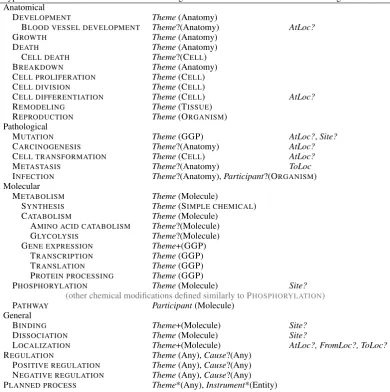
The CG task introduces a novel corpus cover-ing multiple subdomains of cancer biology, based in part on a previously introduced angiogenesis subdomain resource (Pyysalo et al., 2012a). To extend event extraction to upper levels of biolog-ical organization and pathologbiolog-ical processes, the task defines a set of 18 entity and 40 event types based on domain ontologies such as the Com-mon Anatomy Reference Ontology and Gene On-tology, more than doubling the number of entity and event types from those considered in previous BioNLP ST extraction tasks.
This paper presents the design of the CG task, introduces the groups and systems taking part in the task, and presents evaluation results and anal-ysis.
Gene or gene product Theme Gene expression Cause Positive regulation Theme Carcinogenesis
treatment with L-NAME inhibited growth of adenocarcinoma
Planned process Instrument Simple chemical Negative regulation Theme Growth Theme Cancer
[image:2.595.118.481.63.126.2]Cause
Figure 1: Examples of CG task entities and event structures. Visualizations generated using theBRAT tool (Stenetorp et al., 2012).
2 Task definition
The CG task goal is the automatic extraction of events (Ananiadou et al., 2010) from text. The applied representation and task setting extend on those first established in the BioNLP ST 2009 (Kim et al., 2011a). Each event has a type such as GROWTH or METASTASIS and is associated with a specific span of characters expressing the event, termed the event trigger. Events can take any num-ber of arguments, each of which is identified as participating in the event in a specific role (e.g. ThemeorCause). Event arguments may be either (physical) entities or other events, allowing com-plex event structures that capture e.g. one event causing or preventing another. Finally, events may be marked by flags identifying extra-propositional aspects such as occurrence in a speculative or neg-ative context. Examples of CG task extraction tar-gets are shown in Figure 1.
The following sections present the categories of annotation and the specific annotated types in-volved in the CG task: entities, relations, events, and event modifications. To focus efforts on novel challenges, the CG task follows the general con-vention of the BioNLP ST series of only requiring participants to extract events and their modifica-tions. For other categories of annotation, correct (gold standard) annotations are provided also for test data.
2.1 Entities
The entity types defined in the CG task are shown in Table 1. The molecular level entity types largely match the scope of types such as PROTEIN and CHEMICALincluded in previous ST tasks (Kim et al., 2012; Pyysalo et al., 2012b). However, the CG types are more fine grained, and the types PRO -TEIN DOMAIN OR REGIONand DNADOMAIN OR REGION are used in favor of the non-specific type ENTITY, applied in a number of previous tasks for additional event arguments (see Section 2.3). The definitions of the anatomical entity types are
Type ORGANISM Anatomical entity
ORGANISM SUBDIVISION
ANATOMICAL SYSTEM
ORGAN
MULTI-TISSUE STRUCTURE
TISSUE
DEVELOPING ANATOMICAL STRUCTURE
CELL
CELLULAR COMPONENT
ORGANISM SUBSTANCE
IMMATERIAL ANATOMICAL ENTITY
PATHOLOGICAL FORMATION
CANCER Molecular entity
GENE OR GENE PRODUCT
PROTEIN DOMAIN OR REGION
DNADOMAIN OR REGION
SIMPLE CHEMICAL
AMINO ACID
Table 1: Entity types. Indentation corresponds to is-astructure. Labels in gray identify groupings defined for organization only, not annotated types.
progression of chronic myeloid leukemia (CML) Development Theme Cancer Equiv Cancer
Figure 2: ExampleEquivrelation.
drawn primarily from the Common Anatomy Ref-erence Ontology (Haendel et al., 2008), a small, species-independent upper-level ontology based on the Foundational Model of Anatomy (Rosse and Mejino Jr, 2003). We refer to Ohta et al. (2012) for more detailed discussion of the anatom-ical entity type definitions.
2.2 Relations
Type Core arguments Additional arguments Anatomical
DEVELOPMENT Theme(Anatomy)
BLOOD VESSEL DEVELOPMENT Theme?(Anatomy) AtLoc?
GROWTH Theme(Anatomy)
DEATH Theme(Anatomy)
CELL DEATH Theme?(CELL)
BREAKDOWN Theme(Anatomy)
CELL PROLIFERATION Theme(CELL)
CELL DIVISION Theme(CELL)
CELL DIFFERENTIATION Theme(CELL) AtLoc?
REMODELING Theme(TISSUE)
REPRODUCTION Theme(ORGANISM)
Pathological
MUTATION Theme(GGP) AtLoc?,Site?
CARCINOGENESIS Theme?(Anatomy) AtLoc?
CELL TRANSFORMATION Theme(CELL) AtLoc?
METASTASIS Theme?(Anatomy) ToLoc
INFECTION Theme?(Anatomy),Participant?(ORGANISM)
Molecular
METABOLISM Theme(Molecule)
SYNTHESIS Theme(SIMPLE CHEMICAL)
CATABOLISM Theme(Molecule)
AMINO ACID CATABOLISM Theme?(Molecule)
GLYCOLYSIS Theme?(Molecule)
GENE EXPRESSION Theme+(GGP)
TRANSCRIPTION Theme(GGP)
TRANSLATION Theme(GGP)
PROTEIN PROCESSING Theme(GGP)
PHOSPHORYLATION Theme(Molecule) Site?
(other chemical modifications defined similarly to PHOSPHORYLATION)
PATHWAY Participant(Molecule)
General
BINDING Theme+(Molecule) Site?
DISSOCIATION Theme(Molecule) Site?
LOCALIZATION Theme+(Molecule) AtLoc?, FromLoc?, ToLoc?
REGULATION Theme(Any),Cause?(Any)
[image:3.595.103.494.70.463.2]POSITIVE REGULATION Theme(Any),Cause?(Any) NEGATIVE REGULATION Theme(Any),Cause?(Any) PLANNED PROCESS Theme*(Any),Instrument*(Entity)
Table 2: Event types and their arguments. Nesting corresponds to ontological structure (is-a/part-of). The affixes?,*, and+denote zero or one, zero or more, and one or more, respectively. GGP abbreviates for GENE OR GENE PRODUCT. For brevity, additional argument types are not shown in table: Loc arguments take an anatomical entity type, andSitePROTEIN/DNADOMAIN OR REGION.
differences in references to equivalent entities are ignored, so that e.g. an event referring to CML as itsThemeinstead ofchronic myeloid leukemia would be considered to match the event shown in Figure 2.
2.3 Events
Table 2 summarizes the event types defined in the CG task. As in most previous BioNLP ST task settings, the event types are defined primarily with reference to the Gene Ontology (GO) (Ashburner et al., 2000). However, GO explicitly excludes from its scope pathological processes, which are critically important to the CG task. To capture pathological processes, we systematically expand the scope GO-based event types to include also
analogous processes involving pathological enti-ties. For example, statements such as “cancer growth” are annotated with GROWTH events by analogy to processes such as “organ growth”. Sec-ond, we introduce a number of event types ex-plicitly accounting for pathological processes with no analogous normal physiological process, such as METASTASIS. Finally, many important effects are discussed in the literature through statements involving experimenter action such as transfect and treat (Figure 1). To capture such state-ments, we introduce the general PLANNED PRO -CESS type, defined with reference to the Ontol-ogy for Biomedical Investigations (Brinkman et al., 2010).
Domain Documents Query terms
Carcinogenesis 150 cell transformation, neoplastic AND (proteins OR genes) Metastasis 100 neoplasm metastasis AND (proteins OR genes)
Apoptosis 50 apoptosis AND (proteins OR genes)
Glucose metabolism 50 (glucose/metabolism OR glycolysis) AND neoplasms
Table 3: Queries for document selection. All query terms were restricted to MeSH Term matches only (e.g."apoptosis"[MeSH Terms])
established in previous BioNLP ST tasks (Kim et al., 2012; Pyysalo et al., 2012b):Themeidentifies the arguments undergoing the primary effects of the event,Causethose that are responsible for its occurrence, and Participant those whose precise role is not stated. Siteis used to identify specific parts of Theme entities affected (e.g. phosphory-lated residues) and theLocroles entities where the event takes place (AtLoc) and start and end points of movement (FromLocandToLoc).
2.4 Event modifications
The CG task follows many previous BioNLP ST tasks in including the event modification types NEGATION and SPECULATION in its extraction targets. These modifications apply to events, marking them as explicitly negated and specula-tively stated, respecspecula-tively (Kim et al., 2011a).
2.5 Evaluation
The CG task evaluation follows the criteria orig-inally defined in the BioNLP ST’09, requiring events extracted by systems to otherwise match gold standard events exactly, but allowing trigger spans to differ from gold spans by single words (approximate span matching) and not requiring matching of additional arguments (see Table 2) for events referred from other events (approximate re-cursive matching). These criteria are discussed in detail by Kim et al. (2011a).
3 Corpus
3.1 Document selection
The corpus texts are the titles and abstracts of pub-lications from the PubMed literature database, se-lected on the basis of relevance to cancer genet-ics, specifically with respect to major subdomains relating to established hallmarks of cancer (Hana-han and Weinberg, 2000). Of the 600 documents forming the CG task corpus, 250 were previously released as part of the MLEE corpus (Pyysalo et al., 2012a) involving the angiogenesis subdo-main. The remaining 350 were selected by
iter-Item Train Devel Test Total
Documents 300 100 200 600
Words 66 082 21 732 42 064 129 878 Entities 11 034 3 665 6 984 21 683
Relations 466 176 275 917
[image:4.595.124.480.62.113.2]Events 8 803 2 915 5 530 17 248 Modifications 670 214 442 1 326
Table 4: Corpus statistics
atively formulating PubMed queries consisting of MeSH terms relevant to subdomains such as apop-tosis and metastasis (Table 3). Following initial query formulation, random sets of abstracts were selected from each domain and manually exam-ined to select a final set of documents that specifi-cally discuss both the target process and its molec-ular foundations.
3.2 Annotation process
The corpus annotation was created using theBRAT annotation tool (Stenetorp et al., 2012) by a single PhD biologist with extensive experience in event annotation (Tomoko Ohta). For the entity anno-tation, we created preliminary annotation using the following automatic named entity and entity mention taggers: BANNER (Leaman and Gonza-lez, 2008) trained on the GENETAG corpus (Tan-abe et al., 2005) for GENE OR GENE PRODUCT entities, Oscar4 (Jessop et al., 2011) for SIMPLE CHEMICALand AMINO ACIDentities, NERsuite1 trained on the AnEM corpus (Ohta et al., 2012) for anatomical entities, and LINNAEUS (Gerner et al., 2010) for ORGANISM mentions. Process-ing was performed on a custom pipeline originally developed for the BioNLP ST’11 (Stenetorp et al., 2011). Following preliminary automatic annota-tion, all entity annotations were manually revised to create the final entity annotation.
By contrast to entity annotation, no automatic preprocessing was applied for event annotation to avoid any possibility of bias introduced by ini-tial application of automatic methods. The event annotation extended the guidelines and manual
Team Institution Members
TEES-2.1 University of Turku 1 BI (Bj¨orne and Salakoski, 2013) NaCTeM National Centre for Text Mining 1 NLP (Miwa and Ananiadou, 2013) NCBI National Center for Biotechnology Information 3 BI (Liu et al., 2013)
RelAgent RelAgent Private Ltd. 1 LI, 1 CS (Ramanan and Nathan, 2013) UET-NII University of Engineering and Technology, Vietnam 6 CS (Tran et al., 2013)
and National Institute of Informatics, Japan
ISI Indian Statistical Institute 2 ML, 2 NLP
-Table 5: Participating teams and references to system descriptions. Abbreviations: BI=Bioinformatician, NLP=Natural Language Processing researcher, CS=Computer Scientist, LI=Linguist, ML=Machine Learning researcher.
NLP methods Events Resources
Team Lexical Syntactic Trigger Arg Group Modif. Corpora Other
TEES-2.1 Porter McCCJ + SD SVM SVM SVM SVM GE hedge words
NaCTeM Snowball Enju, GDep SVM SVM SVM SVM - triggers
NCBI MedPost, BLem McCCJ + SD Joint, subgraph matching - GE, EPI
-RelAgent Brill fnTBL, custom rules rules rules rules -
-UET-NII Porter Enju SVM MaxEnt Earley - - triggers
ISI CoreNLP CoreNLP NERsuite Joint, MaltParser - -
-Table 6: Summary of system architectures. Abbreviations: CoreNLP=Stanford CoreNLP, Porter=Porter stemmer, BLem=BioLemmatizer, Snowball=Snowball stemmer, McCCJ=McClosky-Charniak-Johnson parser, Charniak=Charniak parser, SD=Stanford Dependency conversion
annotation process introduced by Pyysalo et al. (2012a). Following the initial annotation, a num-ber of revision passes were made to further im-prove the consistency of the annotation using a va-riety of automatically supported methods.2
[image:5.595.89.514.62.145.2]3.3 Corpus statistics
Table 4 summarizes the corpus statistics for the training, development and test sets, representing 50%, 17%, and 33% of the documents, respec-tively. The CG task corpus is the largest of the BioNLP ST 2013 corpora by most measures, in-cluding the number of annotated events.
4 Participation
Final results to the CG task were successfully sub-mitted by six teams, from six different academic groups and one company, representing a broad range of expertise ranging from biology to ma-chine learning, natural language processing, and linguistics (Table 5).
The characteristics of the participating systems are summarized in Table 6. There is an interesting spread of extraction approaches, with two systems applying SVM-based pipeline architectures shown
2
There was no opportunity to train a second annotator in order to evaluate IAA specifically for the new CG corpus an-notation. However, based on our previous evaluation using the same protocol (Pyysalo et al., 2012a), we expect the con-sistency of the final annotation to fall in the 70-80% F-score range (primary task evaluation criteria).
successful in previous BioNLP ST events, one applying a joint pattern matching approach, one a rule-based approach, and two systems parsing-based approaches to event extraction. Together, these systems represent all broad classes of ap-proaches applied to event extraction in previous BioNLP ST events. Three of the six systems ad-dressed also the event modification (negation and speculation) extraction aspects of the task.
Although all systems perform syntactic analy-sis of input texts, there is a fair amount of vari-ety in the applied parsers, which include the parser of Charniak and Johnson (2005) with the biomed-ical domain model of McClosky (2009) and the Stanford Dependency conversion (de Marneffe et al., 2006) – the choice in many systems in BioNLP ST’11 – as well as Enju (Miyao and Tsu-jii, 2008), GDep (Sagae and TsuTsu-jii, 2007), Stan-ford CoreNLP3, and a custom parser by RelAgent (Ramanan and Nathan, 2013). Simple stemming algorithms such as that of Porter (1980) remain popular for word-level processing, with just the NCBI system using a dedicated biomedical do-main lemmatizer (Liu et al., 2012).
The task setting explicitly allows the use of any external resources, including other corpora, and previously released event resources contain sig-nificant numbers of annotations that are relevant
3http://nlp.stanford.edu/software/
[image:5.595.79.520.205.282.2]Team recall prec. F-score TEES-2.1 48.76 64.17 55.41
[image:6.595.93.269.64.157.2]NaCTeM 48.83 55.82 52.09 NCBI 38.28 58.84 46.38 RelAgent 41.73 49.58 45.32 UET-NII 19.66 62.73 29.94 ISI 16.44 47.83 24.47
Table 7: Primary evaluation results
to the molecular level events annotated in the CG task. Nevertheless, only the TEES and NCBI teams made use of corpora other than the task data, both using the GE corpus (Kim et al., 2012) and NCBI using also the EPI corpus (Pyysalo et al., 2012b). In addition to corpora annotated for events, lexical resources derived from such cor-pora, containing trigger and hedge expressions, were applied by three teams.
We refer to the descriptions presented by each of the participating teams (see Table 5) for further detail on the systems and their implementations.
5 Results
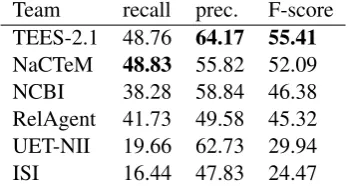
The primary evaluation results are summarized in Table 7. The highest performance is achieved by the established machine learning-based TEES sys-tem, with an F-score of 55%. Previous versions of the same system achieved the highest perfor-mance in the BioNLP ST’09 (52% F-score) and in four out of eight tasks in BioNLP ST’11 (53% F-score for the comparable GE task) (Bj¨orne and Salakoski, 2011). The performance of the system ranked second, EventMine (Miwa et al., 2012), is likewise broadly comparable to the results for the same system on the GE task considered in BioNLP ST’09 and ’11. The NCBI submis-sion also extends a system that participated in the ST’11 GE task, then achieving a somewhat lower F-score of 41.13% (Liu et al., 2011). By con-trast, the RelAgent, UET-NII and ISI submissions involve systems that were not previously applied in BioNLP ST events. Thus, in each case where system performance for previously proposed event extraction tasks is known, the results indicate that the systems generalize to CG task extraction tar-gets without loss in performance.
These parallels with results for previously intro-duced tasks involving molecular-level events are interesting, in particular considering that the CG task involves more than twice the number of en-tity and event types included in previously
con-sidered BioNLP ST tasks. The results suggest not only that event extraction methods generalize well to higher levels of biological organization, but also that overall performance is not primar-ily limited by the number of targeted types. It is also notable that the complexity of the task set-ting does not exclude rule-based systems such as that of RelAgent, which scores within 10% points of the highest-ranking system. While the parser-based systems of UET-NII and ISI perform be-low others here, it should be noted that related ap-proaches have achieved competitive performance in previous BioNLP ST tasks (McClosky et al., 2011), suggesting that further development could lead to improvements for systems based on these architectures. As is characteristic for event extrac-tion systems in general, all systems show notably higher precision than recall, with the performance of the UET-NII and ISI systems in particular pri-marily limited by low recall.
The F-score results are shown separately for each event type in Table 8. As suggested by the overall results, the novel categories of events in-volving anatomical and pathological entities are not particularly challenging for most systems, with results roughly mirroring performance for molecular level events; the best results by event category are 77% F-score for anatomical, 68% for pathological, and 73% for molecular. Of the newly introduced CG event categories, only planned processes involving intentional human in-tervention appear to represent difficulties, with the best-performing system for PLANNED PROCESS reaching only 41% F-score. Two previously es-tablished categories of events remain challenging: general events – best 53% F-score – including BINDING (often taking multiple arguments) and LOCALIZATION (frequent additional arguments), andregulationcategory events, which often form complex event structures by involving events as ar-guments. Event modifications, addressed by three of the six participating teams, show comparatively low levels of extraction performance, with a best result of 40% F-score for NEGATION and 30% for SPECULATION. However, as in previous tasks (Kim et al., 2011a), this is in part due to the com-pound nature of the problem: for an event modifi-cation attribute to be extracted correctly, the event that it attaches to must also be correct.
Event TEES-2.1 NaCTeM NCBI RelAgent UET-NII ISI
DEVELOPMENT 71.43 64.77 67.33 66.31 61.72 53.66
BLOOD VESSEL DEVELOPM 85.28 78.82 81.92 79.60 21.49 13.56
GROWTH 75.97 59.85 66.67 76.92 70.87 65.52
DEATH 81.74 73.17 74.07 64.71 77.78 63.16
CELL DEATH 73.30 75.18 78.05 66.98 25.17 7.35
CELL PROLIFERATION 80.00 78.33 72.73 64.39 71.43 57.40
CELL DIVISION 0.00 0.00 0.00 0.00 0.00 0.00
CELL DIFFERENTIATION 56.34 48.48 48.98 54.55 59.26 24.14
REMODELING 30.00 22.22 21.05 40.00 20.00 23.53
REPRODUCTION 100.00 100.00 100.00 100.00 100.00 100.00
Anatomical total 77.20 71.31 73.68 70.82 50.04 38.86
MUTATION 38.00 41.05 25.11 27.36 27.91 9.52
CARCINOGENESIS 77.94 72.18 67.14 64.12 35.96 24.72
CELL TRANSFORMATION 81.56 82.54 71.13 67.07 57.14 32.39
BREAKDOWN 76.74 70.13 76.54 42.42 58.67 50.70
METASTASIS 70.91 51.05 52.69 47.79 56.41 26.20
INFECTION 69.57 76.92 69.23 33.33 11.76 0.00
Pathological total 67.51 59.78 54.19 48.14 46.90 25.17
METABOLISM 83.87 70.27 74.29 80.00 68.75 71.43
SYNTHESIS 78.26 71.11 78.26 53.57 64.71 48.65
CATABOLISM 63.64 36.36 38.10 23.08 20.00 36.36
GLYCOLYSIS 0.00 100.00 95.45 97.78 0.00 0.00
AMINO ACID CATABOLISM 0.00 66.67 66.67 66.67 0.00 0.00
GENE EXPRESSION 78.21 79.96 73.69 69.45 58.01 53.28
TRANSCRIPTION 37.33 42.86 51.55 28.12 32.00 20.93
TRANSLATION 40.00 22.22 0.00 0.00 0.00 0.00
PROTEIN PROCESSING 100.00 100.00 100.00 0.00 100.00 100.00
ACETYLATION 100.00 100.00 66.67 100.00 66.67 66.67
GLYCOSYLATION 100.00 100.00 100.00 100.00 100.00 100.00
PHOSPHORYLATION 63.33 70.37 53.12 64.15 58.33 50.00
UBIQUITINATION 100.00 100.00 0.00 100.00 0.00 100.00
DEPHOSPHORYLATION 0.00 80.00 100.00 100.00 0.00 0.00
DNAMETHYLATION 66.67 66.67 30.30 42.11 32.43 33.33
DNADEMETHYLATION 0.00 0.00 0.00 0.00 0.00 0.00
PATHWAY 71.30 59.07 51.14 34.29 18.31 35.64
Molecular total 72.60 72.77 67.33 60.72 49.35 46.70
BINDING 45.35 43.93 37.89 32.69 33.94 11.92
DISSOCIATION 0.00 0.00 0.00 0.00 0.00 0.00
LOCALIZATION 54.83 57.20 47.58 45.22 44.94 35.94
General total 52.20 53.08 44.70 40.89 41.76 29.59
REGULATION 32.66 28.73 14.19 26.48 5.51 4.57
POSITIVE REGULATION 45.89 44.18 34.70 38.40 13.00 12.33
NEGATIVE REGULATION 47.79 43.17 33.20 40.47 10.30 12.16
Regulation total 43.08 39.79 29.21 35.58 10.30 10.29
PLANNED PROCESS 39.43 40.51 34.28 28.57 22.74 21.22
Sub-total 56.75 53.50 48.56 46.37 31.72 25.90
NEGATION 40.00 29.55 0.00 34.64 0.00 0.00
SPECULATION 27.14 30.35 0.00 25.90 0.00 0.00
Modification total 34.66 29.95 0.00 30.88 0.00 0.00
[image:7.595.111.480.61.576.2]Total 55.41 52.09 46.38 45.32 29.94 24.47
Table 8: Primary evaluation F-scores by event type
6 Discussion and conclusions
We have presented the Cancer Genetics (CG) task, an information extraction task introduced as a main task of the BioNLP Shared Task (ST) 2013. The task is motivated by the needs of maintain-ing up-to-date knowledge bases of the enormous and fast-growing literature on cancer genetics, and extends previously proposed BioNLP ST tasks in several aspects, including the inclusion of enti-ties and events at levels of biological
organiza-tion above the molecular and the explicit inclusion of pathological and planned processes among ex-traction targets. To address these exex-traction goals, we introduced a new corpus covering various sub-domains of cancer genetics, annotated for 18 en-tity and 40 event types and marking over 17,000 manually annotated events in 600 publication ab-stracts.
clas-sifier pipelines, parsing-based approaches, and pattern- and rule-based systems. The best-performing system achieved an F-score of 55.4%, a level of performance comparable to the state of the art in established molecular level event tion tasks. The results indicate that event extrac-tion methods generalize well across the novel as-pects introduced in the CG task and that event ex-traction is applicable to the automatic processing of the cancer literature.
Following convention in the BioNLP Shared Task series, the Cancer Genetics task will con-tinue as an open challenge available to all inter-ested participants. The CG task corpus, supporting resources and evaluation tools are available from http://2013.bionlp-st.org/.
Acknowledgments
We wish to thank the BioNLP ST 2013 CG task participants and supporting resource providers for their invaluable contributions to making this task a success. This work was supported by the Biotech-nology and Biological Sciences Research Council (BBSRC) [BB/G53025X/1].
References
Sophia Ananiadou, Sampo Pyysalo, Jun’ichi Tsujii, and Douglas B. Kell. 2010. Event extraction for systems biology by text mining the literature.
Trends in Biotechnology, 28(7):381–390.
Michael Ashburner, Catherine A Ball, Judith A Blake, David Botstein, et al. 2000. Gene ontology: tool for the unification of biology. Nature genetics, 25(1):25–29.
Jari Bj¨orne and Tapio Salakoski. 2011. Generaliz-ing biomedical event extraction. InProceedings of BioNLP’11, pages 183–191.
Jari Bj¨orne and Tapio Salakoski. 2013. TEES 2.1: Au-tomated annotation scheme learning in the bioNLP 2013 shared task. InProceedings of BioNLP Shared Task 2013.
Ryan R Brinkman, M´elanie Courtot, Dirk Derom, Jen-nifer M Fostel, et al. 2010. Modeling biomedical experimental processes with OBI.J Biomed Seman-tics, 1(Suppl 1):S7.
Eugene Charniak and Mark Johnson. 2005. Coarse-to-Fine n-Best Parsing and MaxEnt Discriminative Reranking. InProceedings of ACL’05, pages 173– 180.
Marie-Catherine de Marneffe, Bill MacCartney, and Christopher D Manning. 2006. Generating typed
dependency parses from phrase structure parses. In
Proceedings of LREC, volume 6, pages 449–454.
Martin Gerner, Goran Nenadic, and Casey M Bergman. 2010. Linnaeus: a species name identification sys-tem for biomedical literature. BMC bioinformatics, 11(1):85.
Daniel A Haber, Nathanael S Gray, and Jose Baselga. 2011. The evolving war on cancer. Cell, 145(1):19– 24.
Melissa A Haendel, Fabian Neuhaus, David Osumi-Sutherland, Paula M Mabee, Jos LV Mejino Jr, Chris J Mungall, and Barry Smith. 2008. CARO– the common anatomy reference ontology. pages 327–349.
Douglas Hanahan and Robert A Weinberg. 2000. The hallmarks of cancer.Cell, 100(1):57–70.
David M Jessop, Sam E Adams, Egon L Willigha-gen, Lezan Hawizy, and Peter Murray-Rust. 2011. Oscar4: a flexible architecture for chemical text-mining. Journal of Cheminformatics, 3(1):1–12.
Jin-Dong Kim, Tomoko Ohta, Sampo Pyysalo, Yoshi-nobu Kano, and Jun’ichi Tsujii. 2011a. Ex-tracting bio-molecular events from literature - the BioNLP’09 shared task. Computational Intelli-gence, 27(4):513–540.
Jin-Dong Kim, Sampo Pyysalo, Tomoko Ohta, Robert Bossy, and Jun’ichi Tsujii. 2011b. Overview of BioNLP Shared Task 2011. In Proceedings of BioNLP’11.
Jin-Dong Kim, Ngan Nguyen, Yue Wang, Jun’ichi Tsu-jii, Toshihisa Takagi, and Akinori Yonezawa. 2012. The genia event and protein coreference tasks of the bionlp shared task 2011. BMC bioinformatics, 13(Suppl 11):S1.
Robert Leaman and Graciela Gonzalez. 2008. BAN-NER: an executable survey of advances in biomedi-cal named entity recognition. Proceedings of the Pa-cific Symposium on Biocomputing (PSB’08), pages 652–663.
Haibin Liu, Ravikumar Komandur, and Karin Ver-spoor. 2011. From graphs to events: A subgraph matching approach for information extraction from biomedical text. In Proceedings of BioNLP’11, pages 164–172.
Haibin Liu, Tom Christiansen, William A Baumgart-ner Jr, Karin Verspoor, et al. 2012. Biolemmatizer: a lemmatization tool for morphological processing of biomedical text. Journal of biomedical seman-tics, 3(3).
David McClosky, Mihai Surdeanu, and Christopher D Manning. 2011. Event extraction as depen-dency parsing for bionlp 2011. In Proceedings BioNLP’11, pages 41–45.
David McClosky. 2009. Any Domain Parsing: Au-tomatic Domain Adaptation for Natural Language Parsing. Ph.D. thesis, Department of Computer Sci-ence, Brown University.
Makoto Miwa and Sophia Ananiadou. 2013. NaCTeM EventMine for bioNLP 2013 CG and PC tasks. In
Proceedings of BioNLP Shared Task 2013 Work-shop.
Makoto Miwa, Paul Thompson, and Sophia Ana-niadou. 2012. Boosting automatic event ex-traction from the literature using domain adapta-tion and coreference resoluadapta-tion. Bioinformatics, 28(13):1759–1765.
Yusuke Miyao and Jun’ichi Tsujii. 2008. Feature for-est models for probabilistic hpsg parsing. Computa-tional Linguistics, 34(1):35–80.
Tomoko Ohta, Sampo Pyysalo, Jun’ichi Tsujii, and Sophia Ananiadou. 2012. Open-domain anatomical entity mention detection. InProceedings of DSSD 2012, pages 27–36.
Martin F Porter. 1980. An algorithm for suffix strip-ping. Program: electronic library and information systems, 14(3):130–137.
Sampo Pyysalo, Tomoko Ohta, Makoto Miwa, Han-Cheol Cho, Jun’ichi Tsujii, and Sophia Ananiadou. 2012a. Event extraction across multiple levels of bi-ological organization. Bioinformatics, 28(18):i575– i581.
Sampo Pyysalo, Tomoko Ohta, Rafal Rak, Dan Sul-livan, Chunhong Mao, Chunxia Wang, Bruno So-bral, Jun’ichi Tsujii, and Sophia Ananiadou. 2012b. Overview of the ID, EPI and REL tasks of BioNLP Shared Task 2011. BMC bioinformatics, 13(Suppl 11):S2.
SV Ramanan and P. Senthil Nathan. 2013. Perfor-mance and limitations of the linguistically motivated cocoa/peaberry system in a broad biological domain. InProceedings of BioNLP Shared Task 2013 Work-shop.
Cornelius Rosse and Jos´e LV Mejino Jr. 2003. A refer-ence ontology for biomedical informatics: the foun-dational model of anatomy. Journal of biomedical informatics, 36(6):478–500.
Kenji Sagae and Jun’ichi Tsujii. 2007. Dependency parsing and domain adaptation with lr models and parser ensembles. In Proceedings of the CoNLL Shared Task Session of EMNLP-CoNLL 2007, pages 1044–1050.
Pontus Stenetorp, Goran Topi´c, Sampo Pyysalo, Tomoko Ohta, Jin-Dong Kim, and Jun’ichi Tsujii. 2011. BioNLP Shared Task 2011: Supporting Re-sources. InProceedings of BioNLP’11.
Pontus Stenetorp, Sampo Pyysalo, Goran Topi´c, Tomoko Ohta, Sophia Ananiadou, and Jun’ichi Tsu-jii. 2012. Brat: a web-based tool for nlp-assisted text annotation. In Proceedings of EACL 2012, pages 102–107.
Lorraine Tanabe, Natalie Xie, Lynne Thom, Wayne Matten, and John Wilbur. 2005. GENETAG: a tagged corpus for gene/protein named entity recog-nition.BMC Bioinformatics, 6(Suppl 1):S3.