CUni Multilingual Matrix in the WMT 2013 Shared Task
Karel Bílek Daniel Zeman
Charles University in Prague, Faculty of Mathematics and Physics, Institute of Formal and Applied Linguistics
Malostranské náměstí 25, CZ-11800 Praha, Czechia [email protected], [email protected]
Abstract
We describe our experiments with phrase-based machine translation for the WMT 2013 Shared Task. We trained one system for 18 translation directions between English or Czech on one side and English, Czech, Ger-man, Spanish, French or Russian on the other side. We describe a set of re-sults with different training data sizes and subsets. For the pairs containing Russian, we describe a set of indepen-dent experiments with slightly different translation models.
1 Introduction
With so many official languages, Europe is a paradise for machine translation research. One of the largest bodies of electronically available parallel texts is being nowadays gen-erated by the European Union and its insti-tutions. At the same time, the EU also pro-vides motivation and boosts potential market for machine translation outcomes.
Most of the major European languages be-long to one of three branches of the Indo-European language family: Germanic, Ro-mance or Slavic. Such relatedness is respon-sible for many structural similarities in Eu-ropean languages, although significant differ-ences still exist. Within the language portfo-lio selected for the WMT shared task, English, French and Spanish seem to be closer to each other than to the rest.
German, despite being genetically related to English, differs in many properties. Its word order rules, shifting verbs from one
end of the sentence to the other, easily cre-ate long-distance dependencies. Long Ger-man compound words are notorious for in-creasing out-of-vocabulary rate, which has led many researchers to devising unsupervised compound-splitting techniques. Also, upper-case/lowercase distinction is more important because all German nouns start with an up-percase letter by the rule.
Czech is a language with rich morphology (both inflectional and derivational) and rela-tively free word order. In fact, the predicate-argument structure, often encoded by fixed word order in English, is usually captured by inflection (especially the system of 7 grammat-ical cases) in Czech. While the free word order of Czech is a problem when translating to En-glish (the text should be parsed first in order to determine the syntactic functions and the English word order), generating correct inflec-tional affixes is indeed a challenge for English-to-Czech systems. Furthermore, the multitude of possible Czech word forms (at least order of magnitude higher than in English) makes the data sparseness problem really severe, hinder-ing both directions.
Most of the above characteristics of Czech also apply to Russian, another Slavic language. Similar issues have to be expected when trans-lating between Russian and English. Still, there are also interesting divergences between Russian and Czech, especially on the syntactic level. Russian sentences typically omit cop-ula in the present tense and there is also no direct equivalent of the verb “to have”. Pe-riphrastic constructions such as “there is XXX by him” are used instead. These differences make the Czech-Russian translation
ing as well. Interestingly enough, results of machine translation between Czech and Rus-sian has so far been worse than between En-glish and any of the two languages, language relatedness notwithstanding.
Our goal is to run one system under as similar conditions as possible to all eighteen translation directions, to compare their trans-lation accuracies and see why some directions are easier than others. The current version of the system does not include really language-specific techniques: we neither split German compounds, nor do we address the peculiari-ties of Czech and Russian mentioned above.
In an independent set of experiments, we tried to deal with the data sparseness of Rus-sian language with the addition of a backoff model with a simple stemming and some ad-ditional data; those experiments were done for Russian and Czech|English combinations.
2 The Translation System
Both sets of experiments use the same ba-sic framework. The translation system is built around Moses1 (Koehn et al., 2007). Two-way word alignment was computed us-ing GIZA++2 (Och and Ney, 2003), and alignment symmetrization using the grow-diag-final-and heuristic (Koehn et al., 2003). Weights of the system were optimized using MERT (Och, 2003). No lexical reordering model was trained.
For language modeling we use the SRILM toolkit3 (Stolcke, 2002) with modified Kneser-Ney smoothing (Kneser and Kneser-Ney, 1995; Chen and Goodman, 1998).
3 General experiments
In the first set of experiments we wanted to use the same setting for all language pairs.
3.1 Data and Pre-processing Pipeline
We applied our system to all the ten official language pairs. In addition, we also exper-imented with translation between Czech on one side and German, Spanish, French or Rus-sian on the other side. Training data for these additional language pairs were obtained
1http://www.statmt.org/moses/ 2http://code.google.com/p/giza-pp/
3http://www-speech.sri.com/projects/srilm/
by combining parallel corpora of the officially supported pairs. For instance, to create the Czech-German parallel corpus, we identified the intersection of the English sides of Czech-English and Czech-English-German corpora, respec-tively; then we combined the corresponding Czech and German sentences.
We took part in the constrained task. Un-less explicitly stated otherwise, the transla-tion model in our experiments was trained on the combined News-Commentary v8 and Eu-roparl v7 corpora.4 Note that there is only News Commentary and no Europarl for Rus-sian. We were also able to evaluate several combinations with large parallel corpora: the UN corpus (English, French and Spanish), the Giga French-English corpus and CzEng (Czech-English). We did not use any large corpus for Russian-English. Table 1 shows the sizes of the training data.
Corpus SentPairs Tkns lng1 Tkns lng2 cs-en 786,929 18,196,080 21,184,881 de-en 2,098,430 55,791,641 58,403,756 es-en 2,140,175 62,444,507 59,811,355 fr-en 2,164,891 70,363,304 60,583,967 ru-en 150,217 3,889,215 4,100,148 de-cs 657,539 18,160,857 17,788,600 es-cs 697,898 19,577,329 18,926,839 fr-cs 693,093 19,717,885 18,849,244 ru-cs 103,931 2,642,772 2,319,611 Czeng
cs-en 14,833,358 204,837,216 235,177,231 UN
es-en 11,196,913 368,154,702 328,840,003 fr-en 12,886,831 449,279,647 372,627,886 Giga
fr-en 22,520,400 854,353,231 694,394,577
Table 1: Number of sentence pairs and tokens for every language pair in the parallel training corpus. Languages are identified by their ISO 639 codes: cs = Czech, de = German, en = English, es = Spanish, fr = French, ru = Rus-sian. Every line corresponds to the respective version of EuroParl + News Commentary; the second part presents the extra corpora.
The News Test 2010 (2489 sentences in each language) and 2012 (3003 sentences) data sets5 were used as development data for MERT. BLEU scores reported in this paper were computed on the News Test 2013 set
(3000 sentences each language). We do not use the News Tests 2008, 2009 and 2011.
All parallel and monolingual corpora un-derwent the same preprocessing. They were tokenized and some characters normalized or cleaned. A set of language-dependent heuristics was applied in an attempt to re-store the opening/closing quotation marks (i.e. "quoted"→ “quoted”) (Zeman, 2012).
The data are then tagged and lemmatized. We used the Featurama tagger for Czech and English lemmatization and TreeTagger for German, Spanish, French and Russian lemma-tization. All these tools are embedded in the Treex analysis framework (Žabokrtský et al., 2008).
The lemmas are used later to compute word alignment. Besides, they are needed to ap-ply “supervised truecasing” to the data: we cast the case of the lemma to the form, rely-ing on our morphological analyzers and tag-gers to identify proper names, all other words are lowercased. Note that guessing of the true case is only needed for the sentence-initial to-ken. Other words can typically be left in their original form, unless they are uppercased as a form of HIGHLIGHTING.
3.2 Experiments
BLEU scores were computed by our sys-tem, comparing truecased tokenized hypoth-esis with truecased tokenized reference trans-lation. Such scores must differ from the official evaluation—see Section 3.2.4 for discussion of the final results.
The confidence interval for most of the scores lies between ±0.5 and ±0.6 BLEU % points.
3.2.1 Baseline Experiments
The set of baseline experiments were trained on the supervised truecased combination of News Commentary and Europarl. As we had lemmatizers for the languages, word alignment was computed on lemmas. (But our previous experiments showed that there was little dif-ference between using lemmas and lowercased 4-character “stems”.) A hexagram language model was trained on the monolingual version of the News Commentary + Europarl corpus (typically a slightly larger superset of the tar-get side of the parallel corpus).
3.2.2 Larger Monolingual Data
Besides the monolingual halves of the par-allel corpora, additional monolingual data were provided / permitted. Our experiments in previous years clearly showed that the Crawled News corpus (2007–2012), in-domain and large, contributed significantly to better BLEU scores. This year we included it in our baseline experiments for all language pairs: translation model on News Commentary + Europarl, language model on monolingual part of the two, plus Crawled News.
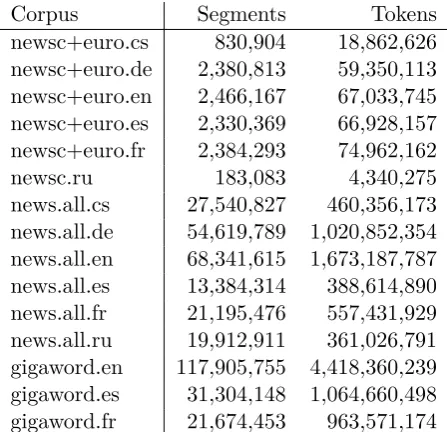
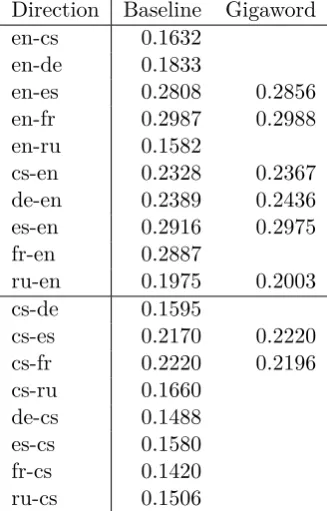
In addition there are the Gigaword corpora published by the Linguistic Data Consortium, available only for English (5th edition), Span-ish (3rd) and French (3rd). Table 2 gives the sizes and Table 3 compares BLEU scores with Gigaword against the baseline. Gigaword mainly contains texts from news agencies and as such it should be also in-domain. Neverthe-less, the crawled news are already so large that the improvement contributed by Gigaword is rarely significant.
Corpus Segments Tokens newsc+euro.cs 830,904 18,862,626 newsc+euro.de 2,380,813 59,350,113 newsc+euro.en 2,466,167 67,033,745 newsc+euro.es 2,330,369 66,928,157 newsc+euro.fr 2,384,293 74,962,162 newsc.ru 183,083 4,340,275 news.all.cs 27,540,827 460,356,173 news.all.de 54,619,789 1,020,852,354 news.all.en 68,341,615 1,673,187,787 news.all.es 13,384,314 388,614,890 news.all.fr 21,195,476 557,431,929 news.all.ru 19,912,911 361,026,791 gigaword.en 117,905,755 4,418,360,239 gigaword.es 31,304,148 1,064,660,498 gigaword.fr 21,674,453 963,571,174
[image:3.595.308.532.419.635.2]Direction Baseline Gigaword en-cs 0.1632
en-de 0.1833
en-es 0.2808 0.2856 en-fr 0.2987 0.2988 en-ru 0.1582
cs-en 0.2328 0.2367 de-en 0.2389 0.2436 es-en 0.2916 0.2975 fr-en 0.2887
ru-en 0.1975 0.2003 cs-de 0.1595
cs-es 0.2170 0.2220 cs-fr 0.2220 0.2196 cs-ru 0.1660
[image:4.595.99.263.64.320.2]de-cs 0.1488 es-cs 0.1580 fr-cs 0.1420 ru-cs 0.1506
Table 3: BLEU scores of the baseline experi-ments (left column) on News Test 2013 data, computed by the system on tokenized data, versus similar setup with Gigaword. The dif-ference was typically not significant.
3.2.3 Larger Parallel Data
Various combinations with larger parallel cor-pora were also tested. We do not have results for all combinations because these experiments needed a lot of time and resources and not all of them finished in time successfully.
In general the UN corpus seems to be of low quality or too much off-domain. It may help a little if used in combination with news-euro. If used separately, it always hurts the results. The Giga French-English corpus gave the best results for English-French as expected, even without the core news-euro data. How-ever, training the model on data of this size is extremely demanding on memory and time.
Finally, Czeng undoubtedly improves Czech-English translation in both directions. The news-euro dataset is smaller for this language pair, which makes Czeng stand out even more. See Table 4 for details.
3.2.4 Final Results
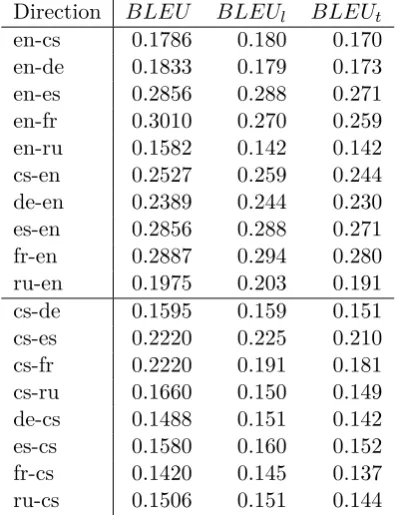
Table 5 compares our BLEU scores with those computed atmatrix.statmt.org.
BLEU (without flag) denotes BLEU score
Dir Parallel Mono BLEU en-es news-euro +gigaword 0.2856 en-es news-euro-un +gigaword 0.2844 en-es un un+gigaw. 0.2016 en-fr giga +gigaword 0.3106 en-fr giga +newsall 0.3037 en-fr news-euro-un +gigaword 0.3010 en-fr news-euro +gigaword 0.2988
en-fr un un 0.2933
es-en news-euro +gigaword 0.2975 es-en news-euro-un baseline 0.2845 es-en un un+news 0.2067 fr-en news-euro-un +gigaword 0.2914 fr-en news-euro baseline 0.2887 fr-en un un+news 0.2737
Table 4: BLEU scores with different parallel corpora.
computed by our system, comparing truecased tokenized hypothesis with truecased tokenized reference translation.
The official evaluation by matrix.statmt. org gives typically lower numbers, reflecting the loss caused by detokenization and new (different) tokenization.
3.2.5 Efficiency
The baseline experiments were conducted mostly on 64bit AMD Opteron quad-core 2.8 GHz CPUs with 32 GB RAM (decoding run on 15 machines in parallel) and the whole pipeline typically required between a half and a whole day.
However, we used machines with up to 500 GB RAM to train the large language mod-els and translation modmod-els. Aligning the UN corpora with Giza++ took around 5 days. Giga French-English corpus was even worse and required several weeks to complete. Us-ing such a large corpus without prunUs-ing is not practical.
4 Extra Experiments with Russian
In a separate set of experiments, we tried to take a basic Moses framework and change the setup a little for better results on morpholog-ically rich languages.
[image:4.595.305.526.65.270.2]Direction BLEU BLEUl BLEUt
[image:5.595.82.282.63.321.2]en-cs 0.1786 0.180 0.170 en-de 0.1833 0.179 0.173 en-es 0.2856 0.288 0.271 en-fr 0.3010 0.270 0.259 en-ru 0.1582 0.142 0.142 cs-en 0.2527 0.259 0.244 de-en 0.2389 0.244 0.230 es-en 0.2856 0.288 0.271 fr-en 0.2887 0.294 0.280 ru-en 0.1975 0.203 0.191 cs-de 0.1595 0.159 0.151 cs-es 0.2220 0.225 0.210 cs-fr 0.2220 0.191 0.181 cs-ru 0.1660 0.150 0.149 de-cs 0.1488 0.151 0.142 es-cs 0.1580 0.160 0.152 fr-cs 0.1420 0.145 0.137 ru-cs 0.1506 0.151 0.144
Table 5: Final BLEU scores. BLEU is true-cased computed by the system, BLEUl is
the official lowercased evaluation by matrix. statmt.org. BLEUtis official truecased
eval-uation. Although lower official scores are ex-pected, notice the larger gap in en-fr and cs-fr translation. There seems to be a problem in our French detokenization procedure.
4.1 Data
For the additional Russian-to-Czech systems, we used following parallel data:
• UMC 0.1 (Klyueva and Bojar, 2008) – tri-parallel set, consisting of news articles – 93,432 sentences
• data mined from movie subtitles (de-scribed in further detail below) – 2,324,373 sentences
• Czech-Russian part of InterCorp – a cor-pus from translation of fiction books (Čer-mák and Rosen, 2012) – 148,847 sentences
For Russian-to-English translation, we used combination of
• UMC 0.1 – 95,540 sentences
• subtitles – 1,790,209 sentences
• Yandex English-Russian parallel corpus 6 – 1,000,000 sentences
• wiki headlines from WMT website 7 – 514,859 sentences
• common crawl from WMT website – 878,386 sentences
Added together, Russian-Czech parallel data consisted of 2,566,615 sentences and English-Czech parallel data consisted of 4,275,961 sentences8.
We also used 765 sentences from UMC003 as a devset for MERT training.
We used the following monolingual corpora to train language models. Russian:
• Russian sides of all the parallel data – 4,275,961 sentences
• News commentary from WMT website – 150,217 sentences
• News crawl 2012 – 9,789,861 sentences
For Czech:
• Czech sides of all the parallel data – 2,566,615 sentences
• Data downloaded from Czech news arti-cles9 – 1,531,403 sentences
• WebColl (Spoustová et al., 2010) – 4,053,223 sentences
• PDT 10– 115,844 sentences
• Complete Czech Wikipedia – 3,695,172 sentences
• Sentences scraped from Czech social server okoun.cz – 580,249 sentences
For English:
• English sides of all the paralel data – 4,275,961 sentences
• News commentary from WMT website – 150,217 sentences
Table 6 and Table 7 shows the sizes of the training data.
6https://translate.yandex.ru/corpus?lang=en 7http://www.statmt.org/wmt13/
translation-task.html
8some sentences had to be removed for technical reasons
Corpus SentPairs Tok lng1 Tok lng2 cs-ru 2,566,615 19,680,239 20,031,688 en-ru 4,275,961 64,619,964 58,671,725
Table 6: Number of sentence pairs and tokens for every language pair.
Corpus Sentences Tokens en mono 13,426,211 278,199,832 ru mono 13,701,213 231,076,387 cs mono 12,542,506 202,510,993
Table 7: Number of sentences and tokens for every language.
4.1.1 Tokenization, tagging
Czech and English data was tokenized and tagged using Morče tagger; Russian was to-kenized and tagged using TreeTagger. Tree-Tagger also does lemmatization; however, we didn’t use lemmas for alignment or translation models, since our experiments showed that primitive stemming got better results.
However, what is important to mention is that TreeTagger had problems with some cor-pora, mostly Common Crawl. For some rea-son, Russian TreeTagger has problems with “dirty” data—sentences in English, French or random non-unicode noise. It either slows down significantly or stops working at all. For this reason, we wrapped TreeTagger in a script that detected those hangs and replaced the erroneous Russian sentences with bogus, one-letter Russian sentences (we can’t delete those, since the lines already exist in the opposite lan-guages; but since the pair doesn’t really make sense in the first place, it doesn’t matter as much).
All the data are lowercased for all the mod-els and we recase the letters only at the very end.
4.1.2 Subtitle data
For an unrelated project dealing with movie subtitles translation, we obtained data from OpenSubtitles.org for Czech and English sub-titles. However, those data were not aligned on sentence level and were less structured—we had thousands of .srt files with some sort of metadata.
When exploiting the data from the subtitles,
we made several observations:
• language used in subtitles is very different from the language used in news articles
• one of the easiest and most accurate sen-tence alignments in movie subtitles is the one based purely on the time stamps
• allowing bigger differences in the time stamps in the alignment produced more data, but less accurate
• the subtitles are terribly out of domain (as experiments with using only the subtitle data showed us), but adding the corpus mined from the subtitles still increases the accuracy of the translation
• allowing bigger differences in the time stamps and, therefore, more (albeit less accurate) data always led to better results in our tests.
In the end, we decided to pair as much sub-titles as possible, even with the risk of some being misaligned, because we found out that this helped the most.
4.2 Translation model, language model
For alignment, we used primitive stemming that takes just first 6 letters from a word. We found out that using this “brute force” stemming—for reasons that will have to be explored in a further research—return better results than regular lemmatization, for both alignment and translation model, as described further.
For each language pair, we used a transla-tion model with two translatransla-tion tables, one of them as backoff model. More exactly, the pri-mary translation is from a form to a combina-tion of (lower case) form and tag, and the sec-ondary backoff translation is from a “stem” de-scribed above to a combination of (lower case) form and tag.
We built two language models—one for tags and one for lower case forms.
4.3 Final Results
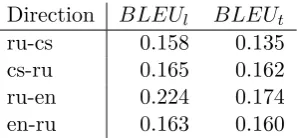
The final results frommatrix.statmt.orgare in the table Table 8. You might notice a sharp difference between lowercased and truecased BLEU—that is due to a technical error that we didn’t notice before the deadline.
Direction BLEUl BLEUt
[image:7.595.108.257.159.228.2]ru-cs 0.158 0.135 cs-ru 0.165 0.162 ru-en 0.224 0.174 en-ru 0.163 0.160
Table 8: Lowercased and cased BLEU scores
5 Conclusion
We have described two independent Moses-based SMT systems we used for the WMT 2013 shared task. We discussed experiments with large data for many language pairs from the point of view of both the translation accu-racy and efficiency.
Acknowledgements
The work on this project was supported by the grant P406/11/1499 of the Czech Science Foundation (GAČR), and by the grant 639012 of the Grant Agency of Charles University (GAUK).
References
František Čermák and Alexandr Rosen. 2012. The case of InterCorp, a multilingual parallel cor-pus. International Journal of Corpus Linguis-tics, 13(3):411–427.
Stanley F. Chen and Joshua Goodman. 1998. An empirical study of smoothing techniques for lan-guage modeling. InTechnical report TR-10-98, Computer Science Group, Harvard, MA, USA, August. Harvard University.
Natalia Klyueva and Ondřej Bojar. 2008. UMC 0.1: Czech-Russian-english multilingual corpus. InInternational Conference Corpus Linguistics.
Reinhard Kneser and Hermann Ney. 1995. Im-proved backing-off for m-gram language mod-eling. InProceedings of the IEEE International Conference on Acoustics, Speech and Signal Pro-cessing, pages 181–184, Los Alamitos, Califor-nia, USA. IEEE Computer Society Press.
Philipp Koehn, Franz Josef Och, and Daniel Marcu. 2003. Statistical phrase-based transla-tion. In NAACL ’03: Proceedings of the 2003 Conference of the North American Chapter of the Association for Computational Linguistics on Human Language Technology, pages 48–54, Morristown, NJ, USA. Association for Compu-tational Linguistics.
Philipp Koehn, Hieu Hoang, Alexandra Birch, Chris Callison-Burch, Marcello Federico, Nicola Bertoldi, Brooke Cowan, Wade Shen, Christine Moran, Richard Zens, Chris Dyer, Ondřej Bojar, Alexandra Constantin, and Evan Herbst. 2007. Moses: Open Source Toolkit for Statistical Ma-chine Translation. In Proceedings of the 45th Annual Meeting of the Association for Computa-tional Linguistics Companion Volume Proceed-ings of the Demo and Poster Sessions, pages 177–180, Praha, Czechia, June. Association for Computational Linguistics.
Franz Josef Och and Hermann Ney. 2003. A systematic comparison of various statistical alignment models. Computational Linguistics, 29(1):19–51.
Franz Josef Och. 2003. Minimum error rate train-ing in statistical machine translation. In ACL ’03: Proceedings of the 41st Annual Meeting on Association for Computational Linguistics, pages 160–167, Morristown, NJ, USA. Associa-tion for ComputaAssocia-tional Linguistics.
Johanka Spoustová, Miroslav Spousta, and Pavel Pecina. 2010. Building a web corpus of czech. InProceedings of the Seventh International Con-ference on Language Resources and Evaluation (LREC’10), Valletta, Malta, may. European Language Resources Association (ELRA).
Andreas Stolcke. 2002. Srilm – an extensible lan-guage modeling toolkit. InProceedings of Inter-national Conference on Spoken Language Pro-cessing, Denver, Colorado, USA.
Zdeněk Žabokrtský, Jan Ptáček, and Petr Pa-jas. 2008. TectoMT: Highly modular MT sys-tem with tectogrammatics used as transfer layer. In ACL 2008 WMT: Proceedings of the Third Workshop on Statistical Machine Translation, pages 167–170, Columbus, OH, USA. Associa-tion for ComputaAssocia-tional Linguistics.