Instance Selection for Machine Translation using Feature Decay
Algorithms
Ergun Biçici
Koç University
34450 Sariyer, Istanbul, Turkey
[email protected]
Deniz Yuret
Koç University
34450 Sariyer, Istanbul, Turkey
[email protected]
Abstract
We present an empirical study of instance se-lection techniques for machine translation. In an active learning setting, instance selection minimizes the human effort by identifying the most informative sentences for transla-tion. In a transductive learning setting, se-lection of training instances relevant to the test set improves the final translation qual-ity. After reviewing the state of the art in the field, we generalize the main ideas in a class of instance selection algorithms that use feature decay. Feature decay algorithms in-crease diversity of the training set by devalu-ing features that are already included. We show that the feature decay rate has a very strong effect on the final translation quality whereas the initial feature values, inclusion of higher order features, or sentence length normalizations do not. We evaluate the best instance selection methods using a standard Moses baseline using the whole 1.6 million sentence English-German section of the Eu-roparl corpus. We show that selecting the best 3000 training sentences for a specific test sentence is sufficient to obtain a score within 1 BLEU of the baseline, using 5% of the training data is sufficient to exceed the baseline, and a∼2BLEU improvement over the baseline is possible by optimally selected subset of the training data. In out-of-domain translation, we are able to reduce the train-ing set size to about7%and achieve a similar performance with the baseline.
1
Introduction
Statistical machine translation (SMT) makes use of a large number of parallel sentences, sentences whose translations are known in the target lan-guage, to derive translation tables, estimate param-eters, and generate the actual translation. Not all of the parallel corpus nor the translation table that is generated is used during decoding a given set of test sentences and filtering is usually performed for computational advantage (Koehn et al., 2007). Some recent regression-based statistical machine translation systems rely on a small sized training data to learn the mappings between source and tar-get features (Wang and Shawe-Taylor, 2008; Ser-rano et al., 2009; Bicici and Yuret, 2010). Regres-sion has some computational disadvantages when scaling to large number of training instances.
the diversity of the training set.
Transduction uses test instances, which can sometimes be accessible at training time, to learn specific models tailored towards the test set which also reduces computation by not using the full training set. Transductive retrieval selects train-ing data close to the test set given a parallel corpus and a test set. This work shows that transductive retrievalof the training set for statistical machine translation allows us to achieve a performance bet-ter than using all of the parallel corpus. When se-lecting training data, we seek to maximize the cov-erage or the percentage of test source and target features (i.e.n-grams) found in the training set us-ing minimal number of target trainus-ing features and a fixed number of training instances. Diversifying the set of training sentences can help us increase the coverage. We show that target coverage bounds the achievable BLEU score with a given training set and small increases can result in large increases on this BLEU bound.
We develop the feature decay algorithms (FDA) that aim to maximize the coverage of the target language features and achieve significant gains in translation performance. We find that decaying feature weights has significant effect on the per-formance. We achieve improvements of∼2BLEU points using about 20% of the available training data in terms of target words and∼1BLEU points with only about5%. We show that selecting3000 instances for a test sentence is sufficient to obtain a score within 1 BLEU of the baseline. In the out-of-domain translation task, we are able to reduce the training set size to its7%to achieve a similar performance with the baseline.
The next section reviews related previous work. We discuss the FDA in section 3. Section 4 presents our coverage and translation results both in and out-of-domain and includes an instance se-lection method also designed for improving word alignment results. We list our contributions in the last section.
2
Related Work
Transductive learningmakes use of test instances, which can sometimes be accessible at training time, to learn specific models tailored towards the test set. Selection of training instances relevant to the test set improves the final translation quality as
in transductive learning and decreases human ef-fort by identifying the most informative sentences for translation as in active learning. Instance lection in a transductive learning framework se-lects the best instances for a given test set (Lü et al., 2007).Active learningselects training samples that will benefit the learning algorithm the most over the unlabeled datasetU from a labeled train-ing setLor fromUitself after labeling (Banko and Brill, 2001). Active learning in SMT selects which instances to add to the training set to improve the performance of a baseline system (Haffari et al., 2009; Ananthakrishnan et al., 2010). Recent work involves selecting sentence or phrase translation tasks for external human effort (Bloodgood and Callison-Burch, 2010). Below we present exam-ples of both with a label indicating whether they follow an approach close to active learning [AL] or transductive learning [TL] and in our experiments we use the transductive framework.
TF-IDF[TL]: Lü et al. (2007) use tf-idf infor-mation retrieval technique based cosine score to se-lect a subset of the parallel corpus close to the test set for SMT training. They outperform the baseline system when the top500training instances per test sentence are selected. The terms used in their tf-idf measure correspond to words where this work fo-cuses on bigram feature coverage. When the com-bination of the topN selected sentences are used as the training set, they show increase in the per-formance at the beginning and decrease when2000 sentences are selected for each test sentence.
N-gram coverage [AL]: Eck et al. (2005) use
n-gram feature coverage to sort and select training instances using the following score:
φN GRAM(S) =
Pn
i=1
P
unseenx∈Xi(S)C(x)
|S| ,
(1) for sentence S with Xi(S) storing the i-grams
found inS andC(x)returning the count ofxin the parallel corpus.φN GRAM score sums over
system’s BLEU score, which is using all of the par-allel corpus, but they achieve close performance by using about15%of the parallel corpus.
DWDS [AL]: Density weighted diversity sam-pling (DWDS) (Ambati et al., 2010) score tries to select sentences containing then-gram features in the unlabeled dataset U while increasing the di-versity among the sentences selected,L(labeled).
DWDS increases the score of a sentence with in-creasing frequency of itsn-grams found inU and decreases with increasing frequency in the already selected set of sentences, L, in favor of diversity. LetPU(x)denote the probability of featurexinU
andCL(x)denote its count inL. Then:
d(S) = P
x∈X(S)PU(x)e −λCL(x)
|X(S)| (2)
u(S) = P
x∈X(S)I(x6∈X(L))
|X(S)| (3)
φDW DS(S) =
2d(S)u(S)
d(S) +u(S), (4)
where X(S) stores the features of S and λ is a decay parameter. d(S) denotes the density ofS
proportional to the probability of its features inU
and inversely proportional to their counts inLand
u(S)its uncertainty, measuring the percentage of new features inS. These two scores are combined using harmonic mean. DWDS tries to select sen-tences containing similar features in U with high diversity. In their active learning experiments, they selected 1000 training instances in each iteration and retrained the SMT system.
Log-probability ratios [AL]: Haffari et al. (2009) develop sentence selection scores using feature counts inLandU, increasing for frequent features in U and decreasing for frequent features inL. They use geometric and arithmetic averages of log-probability ratios in an active learning setting where 200 sentences from U are selected and added to L with their translations for 25 iterations (Haffari et al., 2009). Later, Haffari et al. (2009) distinguish between features found in the phrase table, xreg, and features not found,
xoov. OOV features are segmented into subfeatures (i.e. feature “go to school” is segmented as: (go to school), (go)(to school), (go to)(school), (go)(to)(school)). Expected log probability ratio
(ELPR)score is used:
φELP R(S) =|X0.4
reg(S)|
X
x∈Xreg(S)
logPU(x)
PL(x)
+|Xoov(0.6S)| X
x∈Xoov(S)
X
h∈H(x)
1
|H(x)|
X
y∈Yh(x)
logPU(y)
PL(y)
,
(5) where H(x) return the segmentations of x and
Yh(x) return the features found in segment h.
φELP Rperforms better than geometric average in
their experiments (Haffari and Sarkar, 2009).
Perplexity[AL & TL]: Perplexity of the train-ing instance as well as inter-SMT-system disagree-ment are also used to select training data for trans-lation models (Mandal et al., 2008). The increased difficulty in translating a parallel sentence or its novelty as found by the perplexity adds to its im-portance for improving the SMT model’s perfor-mance. A sentence having high perplexity (a rare sentence) inLand low perplexity (a common sen-tence) inU is considered as a candidate for addi-tion. They are able to improve the performance of a baseline system trained on some initial corpus together with additional parallel corpora using the initial corpus and part of the additional data.
Alignment [TL]: Uszkoreit et al. (2010) mine parallel text to improve the performance of a base-line translation model on some initial document translation tasks. They retrieve similar documents using inverse document frequency weighted cosine similarity. Then, they filter nonparallel sentences using their word alignment performance, which is estimated using the following score:
score(A) = X
(s,t)∈A
ln p(s, t)
p(s)p(t), (6) whereAstands for an alignment between source and target words and the probabilities are estimated using a word aligned corpus. The produced paral-lel data is used to expand a baseline paralparal-lel corpus and shown to improve the translation performance of machine translation systems.
3
Instance Selection with Feature
Decay
use feature decay, i.e. increase the diversity of the training set by devaluing features that have already been included. Our abstraction makes three com-ponents of such algorithms explicit permitting ex-perimentation with their alternatives:
• The value of a candidate training sentence as a function of its features.
• The initial value of a feature.
• The update of the feature value as instances are added to the training set.
A feature decay algorithm (FDA) aims to max-imize the coverage of the target language features (such as words, bigrams, and phrases) for the test set. A target language feature that does not ap-pear in the selected training instances will be dif-ficult to produce regardless of the decoding algo-rithm (impossible for unigram features). In gen-eral we do not know the target language features, only the source language side of the test set is avail-able. Unfortunately, selecting a training instance with a particular source language feature does not guarantee the coverage of the desired target lan-guage feature. There may be multiple translations of a feature appropriate for different senses or dif-ferent contexts. For each source language feature in the test set, FDA tries to find as many train-ing instances as possible to increase the chances of covering the appropriate target language feature. It does this by reducing the value of the features that are already included after picking each train-ing instance. Algorithm 1 gives the pseudo-code for FDA.
The input to the algorithm is a parallel corpus, the number of desired training instances, and the source language features of the test set. We use unigram and bigram features; adding trigram fea-tures does not seem to significantly affect the re-sults. The user has the option of running the algo-rithm for each test sentence separately, then possi-bly combining the resulting training sets. We will present results with these variations in Section 4.
The first foreach loop initializes the value of each test set feature. We experimented with ini-tial feature values that are constant, proportional to the length of the n-gram, or log-inverse of the corpus frequency. We have observed that the ini-tial value does not have a significant effect on the
Algorithm 1: The Feature Decay Algorithm
Input: Bilingual corpusU, test set featuresF, and desired number of training instancesN.
Data: A priority queueQ, sentence scores
score, feature valuesfvalue.
Output: Subset of the corpus to be used as the training dataL ⊆ U.
foreachf ∈ Fdo
1
fvalue(f)←init(f,U)
2
foreachS∈ U do
3
score(S)←P
f∈features(S)fvalue(f)
4
push(Q, S,score(S))
5
while|L|< Ndo
6
S←pop(Q) 7
score(S)←P
f∈features(S)fvalue(f)
8
ifscore(S)≥topval(Q)then
9
L ← L ∪ {S} 10
foreachf ∈features(S)do
11
fvalue(f)←decay(f,U,L)
12
else
13
push(Q, S,score(S))
14
quality of training instances selected. The feature decay rule dominates the behavior of the algorithm after the first few iterations. However, we prefer the log-inverse values because they lead to fewer score ties among candidate instances and result in faster running times.
The second foreach loop initializes the score for each candidate training sentence and pushes them onto a priority queue. The score is calculated as the sum of the feature values. Note that as we change the feature values, the sentence scores in the prior-ity queue will no longer be correct. However they will still be valid upper bounds because the fea-ture values only get smaller. Feafea-tures that do not appear in the test set are considered to have zero value. This observation can be used to speed up the initialization by using a feature index and only iterating over the sentences that have features in common with the test set.
of its features may have changed. We compare the recalculated score ofS with the score of the next best candidate. If the score ofSis equal or better we are sure that it is the top candidate because the scores in the priority queue are upper bounds. In this case we placeS in our training set and decay the values of its features. Otherwise we push S
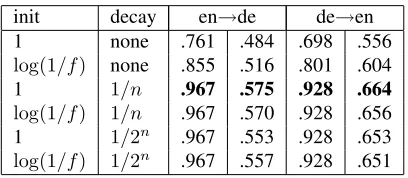
back on the priority queue with its updated score. The feature decay function on Line 12 is the heart of the algorithm. Unlike the choice of fea-tures (bigram vs trigram) or their initial values (constant vs log–inverse–frequency) the rate of de-cay has a significant effect on the performance. We found it is optimal to reduce feature values at a rate of 1/n wheren is the current training set count of the feature. The results get significantly worse with no feature decay. They also get worse with faster, exponential feature decay, e.g. 1/2n. Ta-ble 1 presents the experimental results that support these conclusions. We use the following settings for the experiments in Section 4:
init(f,U) = 1 or log(|U |/cnt(f,U))
decay(f,U,L) = init(f,U)
1 +cnt(f,L) or
init(f,U) 1 + 2cnt(f,L)
init decay en→de de→en 1 none .761 .484 .698 .556 log(1/f) none .855 .516 .801 .604 1 1/n .967 .575 .928 .664
log(1/f) 1/n .967 .570 .928 .656 1 1/2n .967 .553 .928 .653
[image:5.612.97.301.418.507.2]log(1/f) 1/2n .967 .557 .928 .651
Table 1: FDA experiments. The first two columns give the initial value and decay formula used for features. f is the corpus frequency of a feature andnis its count in selected instances. The next four columns give the expected coverage of the source and target language bigrams of a test sen-tence when 100 training sensen-tences are selected.
4
Experiments
We perform translation experiments on the English-German language pair using the parallel
corpus provided in WMT’10 (Callison-Burch et al., 2010). The English-German section of the Eu-roparl corpus contains about1.6million sentences. We performin-domainexperiments to discriminate among different instance selection techniques bet-ter in a setting with low out-of-vocabulary rate. We randomly select the test set test with 2,588 tar-get words and separate development setdevwith 26,178target words. We use the language model corpus provided in WMT’10 (Callison-Burch et al., 2010) to build a5-gram model.
We use target languagebigramcoverage,tcov, as a quality measure for a given training set, which measures the percentage of the target bigram fea-tures of the test sentence found in a given training set. We comparetcov and the translation perfor-mance of FDA with related work. We also perform small scale SMT experiments where only a couple of thousand training instances are used for each test sentence.
4.1 The Effect of Coverage on Translation
BLEU (Papineni et al., 2001) is a precision based measure and usesn-gram match counts up to or-dernto determine the quality of a given transla-tion. The absence of a given word or translating it as another word interrupts the continuity of the translation and decreases the BLEU score even if the order among the words is determined correctly. Therefore, the target coverage of an out-of-domain test set whose translation features are not found in the training set bounds the translation performance of an SMT system.
We estimate this translation performance bound from target coverage by assuming that the miss-ing tokens can appear randomly at any location of a given sentence where sentence lengths are nor-mally distributed with mean25.6and standard de-viation14.1. This is close to the sentence length statistics of the German side Europarl corpus used in WMT’10 (WMT, 2010). We replace all un-known words found with an UNK token and calcu-late the BLEU score. We perform this experiment for10,000instances and repeat for 10 times.
0.0 0.2 0.4 0.6 0.8 1.0 tcov
0.0 0.2 0.4 0.6 0.8 1.0 1.2
BLEU
BLEU vs. tcov estimate
[image:6.612.102.304.77.232.2]f(x)=ax^3 + bx^2 + cx + d
Figure 1: Effect of coverage on translation perfor-mance. BLEU bound is a third-order function of target coverage. High coverage→High BLEU.
BLEU scores bound estimated, whose parameters are found to be [0.56,0.53,−0.09,0.003] with a least-squares fit. Figure 1 shows that the BLEU score bound obtained has a third-order polyno-mial relationship with target coverage and small increases in the target coverage can result in large increases on this BLEU bound.
4.2 Coverage Results
We select N training instances per test sentence using FDA (Algorithm 1), TF-IDF with bigram features, NGRAM scoring (Equation 1), DWDS
(Equation 4), and ELPR (Equation 5) techniques from previous work. For the active learning algo-rithms, source side test corpus becomesU and the selected training setL. For all the techniques, we compute1-grams and2-grams as the features used in calculating the scores and add only one sentence to the training set at each iteration except for TF-IDF. We set λparameter of DWDSto1as given in their paper. We adaptively select the top scor-ing instance at each step from the set of possible sentences U with a given scorerφ(.)and add the instance to the training set,L, until the size ofL
reachesNfor the related work other thanTF-IDF. We test all algorithms in this transductive setting.
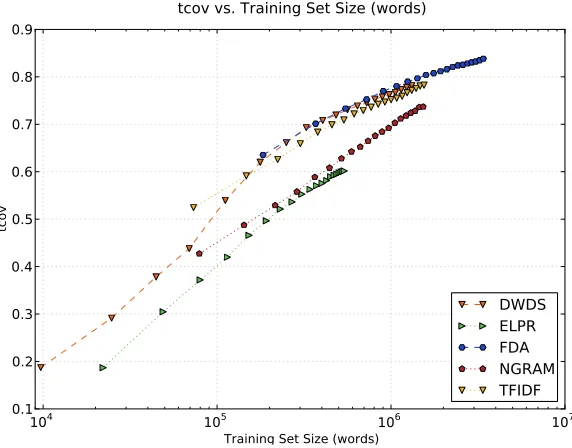
We measure the bigram coverage when all of the training sentences selected for each test sen-tence are combined. The results are presented in Figure 2 where thex-axis is the number of words
of the training set andy-axis is the target cover-age obtained. FDA has a steep slope in its increase and it is able to reach target coverage of∼0.84.
DWDSperforms worse initially but its target cov-erage improve after a number of instances are se-lected due to its exponential feature decay proce-dure. TF-IDF performs worse thanDWDSand it provides a fast alternative to FDA instance selec-tion but with some decrease in coverage. ELPR
and NGRAM instance selection techniques per-form worse. NGRAM achieves better coverage thanELPR, although it lacks a decay procedure.
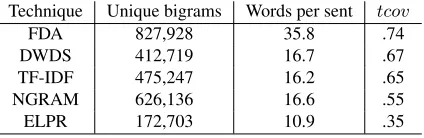
When we compare the sentences selected, we observe that FDA prefers longer sentences due to summing feature weights and it achieves larger tar-get coverage value.NGRAMis not able to discrim-inate between sentences well and a lot of sentences of the same length get the same score when the un-seenn-grams belong to the same frequency class. The statistics ofLobtained with the instance se-lection techniques differ from each other as given in Table 2, whereN = 1000training instances se-lected per test sentence. We observe that DWDS
has fewer unique target bigram features than TF-IDF although it selects longer target sentences.
NGRAM obtains a large number of unique target bigrams although its selected target sentences have similar lengths withDWDSandELPRprefers short sentences.
Technique Unique bigrams Words per sent tcov
FDA 827,928 35.8 .74
DWDS 412,719 16.7 .67
TF-IDF 475,247 16.2 .65
NGRAM 626,136 16.6 .55
ELPR 172,703 10.9 .35
Table 2: Statistics of the obtained targetLforN = 1000.
4.3 Translation Results
[image:6.612.315.527.444.513.2]10
410
510
610
7 Training Set Size (words)0.1
0.2
0.3
0.4
0.5
0.6
0.7
0.8
0.9
tcov
tcov vs. Training Set Size (words)
[image:7.612.156.442.77.301.2]DWDS
ELPR
FDA
NGRAM
TFIDF
Figure 2: Target coverage curve comparison with previous work. Figure shows the rate of increase in
tcovas the size ofLincrease.
three learning settings:
L∪ Lis the union of the instances selected for
each test sentence.
L∪F Lis selected using all of the features found in the test set.
LI Lis the set of instances selected for each test
sentence.
We develop separate Moses systems with each training set and LI corresponds to developing a
Moses system for each test sentence. L∪ results
are plot in Figure 3 where we increasingly select
N ∈ {100, 200, 500, 1000, 2000, 3000, 5000,
10000}instances for each test sentence for train-ing. The improvements over the baseline are sta-tistically significant with paired bootstrap resam-pling using 1000 samples (Koehn, 2004). As we select more instances, the performance of the SMT system increases as expected and we start to see a decrease in the performance after selecting ∼107
target words. We obtain comparable results for the
de-endirection. The performance increase is likely to be due to the reduction in the number of noisy or irrelevant training instances and the increased pre-cision in the probability estimates in the generated
phrase tables.
105 106 107 108
Training Set Size (words) 0.30
0.31 0.32 0.33 0.34 0.35 0.36 0.37 0.38
BLEU
0.3058 0.3318
0.341
0.36450.3697 0.3758
0.36220.3653 0.3577 BLEU vs. Training Set Size (words)
Figure 3: BLEU vs. the number of target words in
L∪.
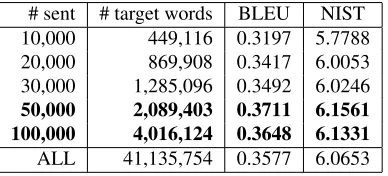
L∪F results given in Table 3 show that we can achieve within 1 BLEU performance using about 3%of the parallel corpus target words (30,000 in-stances) and better performance using only about 5%(50,000 instances).
The results withLI when building an
[image:7.612.303.516.384.544.2]# sent # target words BLEU NIST 10,000 449,116 0.3197 5.7788 20,000 869,908 0.3417 6.0053 30,000 1,285,096 0.3492 6.0246
50,000 2,089,403 0.3711 6.1561 100,000 4,016,124 0.3648 6.1331
ALL 41,135,754 0.3577 6.0653
Table 3: Performance foren-deusingL∪F. ALL corresponds to the baseline system using all of the parallel corpus. bold correspond to statistically significant improvement over the baseline result.
ual Moses model for each test sentence are given in Table 4. Individual SMT training and transla-tion can be preferable due to smaller computatransla-tional costs and high parallelizability. As we translate a single sentence with each SMT system, tuning weights becomes important. We experiment three settings: (1) using 100 sentences for tuning, which are randomly selected fromdev.1000, (2) using the mean of the weights obtained in (1), and (3) us-ing the weights obtained in the union learnus-ing set-ting (L∪). We observe that we can obtain a
perfor-mance within 2 BLEU difference to the baseline system by training on3000instances per sentence (underlined) using the mean weights and 1 BLEU difference using the union weights. We also exper-imented with increasing theN-best list size used during MERT optimization (Hasan et al., 2007), with increased computational cost, and observed some increase in the performance.
N 100dev sents Mean Union
1000 0.3149 0.3242 0.3354
2000 0.3258 0.3352 0.3395
3000 0.3270 0.3374 0.3501
[image:8.612.103.297.75.163.2]5000 0.3217 0.3303 0.3458
Table 4: LI performance foren-deusing100
sen-tences for tuning or mean of the weights or dev weights obtained with the union setting.
Comparison with related work: Table 5 presents the translation results compared with pre-vious work selecting 1000instances per test sen-tence. We observe that coverage and translation performance are correlated. Although the cover-age increase of DWDS and FDA appear similar,
due to the third-order polynomial growth of BLEU with respect to coverage, we achieve large BLEU gains in translation. We observe increased BLEU gains when compared with the results ofTF-IDF,
NGRAM, andELPRin order.
FDA DWDS TF-IDF NGRAM ELPR
0.3645 0.3547 0.3405 0.2572 0.2268
Table 5: BLEU results using different techniques withN = 1000. High coverage→High BLEU.
We note thatDWDSoriginally selects instances using the whole test corpus to estimatePU(x)and
selects1000instances at each iteration. We exper-imented with both of these settings and obtained 0.3058 and 0.3029 BLEU respectively. Lower performance suggest the importance of updating weights after each instance selection step.
4.4 Instance Selection for Alignment
We have shown that high coverage is an integral part of training sets for achieving high BLEU per-formance. SMT systems also heavily rely on the word alignment of the parallel corpus to derive a phrase table that can be used for translation. GIZA++ (Och and Ney, 2003) is commonly used for word alignment and phrase table generation, which is prone to making more errors as the length of the training sentence increase (Ravi and Knight, 2010). Therefore, we analyze instance selection techniques that optimize coverage and word align-ment performance and at the same time do not produce very long sentences. Too few words per sentence may miss the phrasal structure, whereas too many words per sentence may miss the actual word alignment for the features we are interested. We are also trying to retrieve relevant training sen-tences for a given test sentence to increase the fea-ture alignment performance.
Shortest:A baseline strategy that can minimize the training feature set’s size involves selecting the shortest translations containing each feature.
[image:8.612.113.284.480.537.2]We define Dice’s coefficient score as:
dice(x, y) = 2C(x, y)
C(x)C(y), (7) whereC(x, y)is the number of timesxandy co-occur andC(x)is the count of observingxin the selected training set. Given a test source sentence,
SU, we can estimate the goodness of a training
sentence pair,(S, T), by the sum of the alignment scores:
φdice(SU, S, T) = X
x∈X(SU)
|T| X
j=1 X
y∈Y(x)
dice(y, Tj)
|T|log|S| , (8)
whereX(SU)stores the features ofSU andY(x)
lists the tokens in featurex. The difficulty of word aligning a pair of training sentences,(S, T), can be approximated by|S||T|. We use a normalization
factor proportional to|T|log|S|.
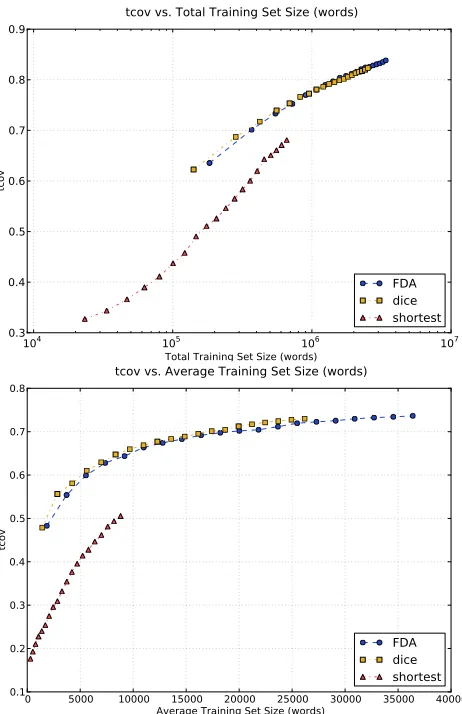
The average target words per sentence using
φdice drops to 26.2 compared to 36.3 of FDA.
We still obtain a better performance than the base-line en-de system with the union of 1000 train-ing instances per sentence with0.3635BLEU and 6.1676 NIST scores. Coverage comparison with FDA shows slight improvement with lower number of target bigrams and similar trend for others (Fig-ure 4). We note that shortest strategy achieves bet-ter performance than bothELPRandNGRAM. We obtain 0.3144BLEU and5.5 NIST scores in the individual translation task with 1000training in-stances per sentence and0.3171BLEU and5.4662 NIST scores when the mean of the weights is used.
4.5 Out-of-domain Translation Results
We have used FDA and dicealgorithms to select training sets for the out-of-domain challenge test sets used in (Callison-Burch et al., 2011). The parallel corpus contains about1.9million training sentences and the test set contain3003sentences. We built separate Moses systems using all of the parallel corpus for the language pairsen-de,de-en,
en-es, andes-en. We created training sets using all of the features of the test set to select train-ing instances. The results given in Table 6 show that we can achieve similar BLEU performance us-ing about 7%of the parallel corpus target words (200,000 instances) usingdiceand about16% us-ing FDA. In the out-of-domain translation task, we
are able to reduce the training set size to achieve a performance close to the baseline. The sample points presented in the table is chosen proportional to the relative sizes of the parallel corpus sizes of WMT’10 and WMT’11 datasets and the training set size of the peak in Figure 3. We may be able to achieve better performance in the out-of-domain task as well. The sample points in Table 6 may be on either side of the peak.
5
Contributions
We have introduced the feature decay algorithms (FDA), a class of instance selection algorithms that use feature decay, which achieves better target cov-erage than previous work and achieves significant gains in translation performance. We find that de-caying feature weights has significant effect on the performance. We demonstrate that target coverage and translation performance are correlated, show-ing that target coverage is also a good indicator of BLEU performance. We have shown that target coverage provides an upper bound on the transla-tion performance with a given training set.
We achieve improvements of∼2BLEU points using about20%of the available training data in terms of target words with FDA and∼1 BLEU points with only about5%. We have also shown that by training on only 3000 instances per sen-tence we can reach within 1 BLEU difference to the baseline system. In the out-of-domain transla-tion task, we are able to reduce the training set size to achieve a similar performance with the baseline. Our results demonstrate that SMT systems can improve their performance by transductive traing set selection. We have shown how to select in-stances and achieved significant performance im-provements.
References
Vamshi Ambati, Stephan Vogel, and Jaime Carbonell. 2010. Active learning and crowd-sourcing for ma-chine translation. In Nicoletta Calzolari (Conference Chair), Khalid Choukri, Bente Maegaard, Joseph Mariani, Jan Odijk, Stelios Piperidis, Mike Rosner, and Daniel Tapias, editors,Proceedings of the Seventh conference on International Language Resources and Evaluation (LREC’10), Valletta, Malta, May. Euro-pean Language Resources Association (ELRA).
104 105 106 107 Total Training Set Size (words)
0.3 0.4 0.5 0.6 0.7 0.8 0.9
tcov
tcov vs. Total Training Set Size (words)
FDA dice shortest
0 5000 10000 15000 20000 25000 30000 35000 40000 Average Training Set Size (words)
0.1 0.2 0.3 0.4 0.5 0.6 0.7 0.8
tcov
tcov vs. Average Training Set Size (words)
[image:10.612.190.421.74.431.2]FDA dice shortest
Figure 4: Target coverage per target words comparison. Figure shows the rate of increase in tcov as the size ofLincrease. Target coverage curves for total training set size is given on the left plot and for average training set size per test sentence on the right plot.
en-de de-en en-es es-en
BLEU
ALL 0.1376 0.2074 0.2829 0.2919 FDA 0.1363 0.2055 0.2824 0.2892
dice 0.1374 0.2061 0.2834 0.2857
# target words×106
ALL 47.4 49.6 52.8 50.4 FDA 7.9 8.0 8.7 8.2
dice 6.9 7.0 3.9 3.6
%of ALL FDA 17 16 16 16
dice 14 14 7.4 7.1
Table 6: Performance for the out-of-domain task of (Callison-Burch et al., 2011). ALL corresponds to the baseline system using all of the parallel corpus.
[image:10.612.165.449.495.607.2]Sankaranarayanan Ananthakrishnan, Rohit Prasad, David Stallard, and Prem Natarajan. 2010. Dis-criminative sample selection for statistical machine translation. InProceedings of the 2010 Conference on Empirical Methods in Natural Language Pro-cessing, pages 626–635, Cambridge, MA, October. Association for Computational Linguistics.
Michele Banko and Eric Brill. 2001. Scaling to very very large corpora for natural language disambigua-tion. InProceedings of 39th Annual Meeting of the Association for Computational Linguistics, pages 26– 33, Toulouse, France, July. Association for Computa-tional Linguistics.
Ergun Bicici and Deniz Yuret. 2010. L1 regularized regression for reranking and system combination in machine translation. InProceedings of the ACL 2010 Joint Fifth Workshop on Statistical Machine Transla-tion and Metrics MATR, Uppsala, Sweden, July. As-sociation for Computational Linguistics.
Michael Bloodgood and Chris Callison-Burch. 2010. Bucking the trend: Large-scale cost-focused active learning for statistical machine translation. In Pro-ceedings of the 48th Annual Meeting of the Asso-ciation for Computational Linguistics, pages 854– 864, Uppsala, Sweden, July. Association for Compu-tational Linguistics.
Chris Callison-Burch, Philipp Koehn, Christof Monz, Kay Peterson, and Omar Zaidan, editors. 2010. Pro-ceedings of the Joint Fifth Workshop on Statistical Machine Translation and MetricsMATR. Associa-tion for ComputaAssocia-tional Linguistics, Uppsala, Sweden, July.
Chris Callison-Burch, Philipp Koehn, Christof Monz, Kay Peterson, and Omar Zaidan, editors. 2011. Pro-ceedings of the Sixth Workshop on Statistical Machine Translation. Edinburgh, England, July.
Lee R. Dice. 1945. Measures of the amount of ecologic association between species. Ecology, 26(3):297– 302.
Matthias Eck, Stephan Vogel, and Alex Waibel. 2005. Low cost portability for statistical machine transla-tion based on n-gram coverage. In Proceedings of the 10th Machine Translation Summit, MT Summit X, pages 227–234, Phuket, Thailand, September. Gholamreza Haffari and Anoop Sarkar. 2009. Active
learning for multilingual statistical machine transla-tion. InProceedings of the Joint Conference of the 47th Annual Meeting of the ACL and the 4th Inter-national Joint Conference on Natural Language Pro-cessing of the AFNLP, pages 181–189, Suntec, Sin-gapore, August. Association for Computational Lin-guistics.
Gholamreza Haffari, Maxim Roy, and Anoop Sarkar. 2009. Active learning for statistical phrase-based
ma-chine translation. In Proceedings of Human Lan-guage Technologies: The 2009 Annual Conference of the North American Chapter of the Association for Computational Linguistics, pages 415–423, Boulder, Colorado, June. Association for Computational Lin-guistics.
Saša Hasan, Richard Zens, and Hermann Ney. 2007. Are very large N-best lists useful for SMT? InHuman Language Technologies 2007: The Conference of the North American Chapter of the Association for Com-putational Linguistics; Companion Volume, Short Pa-pers, pages 57–60, Rochester, New York, April. As-sociation for Computational Linguistics.
Philipp Koehn and Kevin Knight. 2001. Knowledge sources for word-level translation models. In Pro-ceedings of the 2001 Conference on Empirical Meth-ods in Natural Language Processing.
Philipp Koehn, Hieu Hoang, Alexandra Birch, Chris Callison-Burch, Marcello Federico, Nicola Bertoldi, Brooke Cowan, Wade Shen, Christine Moran, Richard Zens, Chris Dyer, Ondrej Bojar, Alexandra Constantin, and Evan Herbst. 2007. Moses: Open source toolkit for statistical machine translation. In Annual Meeting of the Assoc. for Computational Lin-guistics, pages 177–180, Prague, Czech Republic, June.
Philipp Koehn. 2004. Statistical significance tests for machine translation evaluation. In Dekang Lin and Dekai Wu, editors, Proceedings of EMNLP 2004, pages 388–395, Barcelona, Spain, July. Association for Computational Linguistics.
Philipp Koehn. 2006. Statistical machine translation: the basic, the novel, and the speculative. Tutorial at EACL 2006.
Yajuan Lü, Jin Huang, and Qun Liu. 2007. Improving statistical machine translation performance by train-ing data selection and optimization. InProceedings of the 2007 Joint Conference on Empirical Methods in Natural Language Processing and Computational Natural Language Learning (EMNLP-CoNLL), pages 343–350, Prague, Czech Republic, June. Association for Computational Linguistics.
A. Mandal, D. Vergyri, W. Wang, J. Zheng, A. Stol-cke, G. Tur, D. Hakkani-Tur, and N.F. Ayan. 2008. Efficient data selection for machine translation. In Spoken Language Technology Workshop, 2008. SLT 2008. IEEE, pages 261 –264.
Franz Josef Och and Hermann Ney. 2003. A systematic comparison of various statistical alignment models. Computational Linguistics, 29(1):19–51.
Kishore Papineni, Salim Roukos, Todd Ward, and Wei-Jing Zhu. 2001. BLEU: a method for automatic eval-uation of machine translation. InACL ’02: Proceed-ings of the 40th Annual Meeting on Association for
Computational Linguistics, pages 311–318, Morris-town, NJ, USA. Association for Computational Lin-guistics.
Sujith Ravi and Kevin Knight. 2010. Does giza++ make search errors? Computational Linguistics, 36(3):295–302.
Nicolas Serrano, Jesus Andres-Ferrer, and Francisco Casacuberta. 2009. On a kernel regression approach to machine translation. InIberian Conference on Pat-tern Recognition and Image Analysis, pages 394–401. Jakob Uszkoreit, Jay Ponte, Ashok Popat, and Moshe Dubiner. 2010. Large scale parallel document mining for machine translation. InProceedings of the 23rd International Conference on Computational Linguis-tics (Coling 2010), pages 1101–1109, Beijing, China, August. Coling 2010 Organizing Committee. Zhuoran Wang and John Shawe-Taylor. 2008. Kernel
regression framework for machine translation: UCL system description for WMT 2008 shared translation task. InProceedings of the Third Workshop on Sta-tistical Machine Translation, pages 155–158, Colum-bus, Ohio, June. Association for Computational Lin-guistics.
WMT. 2010. ACL Workshop: Joint Fifth Workshop on Statistical Machine Translation and Metrics MATR, July.