Generalizing Biomedical Event Extraction
Jari Bj¨orne and Tapio Salakoski
Department of Information Technology, University of Turku Turku Centre for Computer Science (TUCS)
Joukahaisenkatu 3-5, 20520 Turku, Finland [email protected]
Abstract
We present a system for extracting biomedical events (detailed descriptions of biomolecular interactions) from research articles. This sys-tem was developed for the BioNLP’11 Shared Task and extends our BioNLP’09 Shared Task winning Turku Event Extraction System. It uses support vector machines to first detect event-defining words, followed by detection
of their relationships. The theme of the
BioNLP’11 Shared Task is generalization, ex-tending event extraction to varied biomedical domains. Our current system successfully pre-dicts events for every domain case introduced in the BioNLP’11 Shared Task, being the only system to participate in all eight tasks and all of their subtasks, with best performance in four tasks.
1 Introduction
Biomedical event extraction is the process of auto-matically detecting statements of molecular interac-tions in research articles. Using natural language processing techniques, an event extraction system predicts relations between proteins/genes and the processes they take part in. Manually annotated cor-pora are used to evaluate event extraction techniques and to train machine-learning based systems.
Event extraction was popularised by the BioNLP’09 Shared Task on Event Extraction (Kim et al., 2009), providing a more detailed alternative for the older approach of binary inter-action detection, where each pair of protein names co-occurring in the text is classified as interacting or
not. Events extend this formalism by adding to the relationsdirection,type andnesting. Events define the type of interaction, such as phosphorylation, and commonly mark in the text a trigger word
(e.g. “phosphorylates”) describing the interaction. Directed events can define the role of their protein or gene arguments as e.g.causeortheme, the agent or the target of the biological process. Finally, events can act as arguments of other events, creating complex nested structures that accurately describe the biological interactions stated in the text. For example, in the case of a sentence stating “Stat3 phosphorylation is regulated by Vav”, a phospho-rylation-event would itself be the argument of a
regulation-event.
We developed for the BioNLP’09 Shared Task the Turku Event Extraction System, achieving the best performance at 51.95% F-score (Bj¨orne et al., 2009). This system separated event extraction into multiple classification tasks, detecting individually the trig-ger words defining events, and the arguments that describe which proteins or genes take part in these events. Other approaches used in the Shared Task in-cluded e.g. joint inference (Riedel et al., 2009). An overall notable trend was the use of full dependency parsing (Buyko et al., 2009; Van Landeghem et al., 2009; Kilicoglu and Bergler, 2009).
In the following years, event extraction has been the subject of continuous development. In 2009, af-ter the BioNLP’09 Shared Task, we extended our system and improved its performance to 52.85% (Bj¨orne et al., 2011). In 2010, the system introduced by Miwa et. al. reached a new record performance of 56.00% (Miwa et al., 2010a).
Regulation
NN NN VB NN CC .
conj_and> <nn dobj> <nsubj NN Protein STAT3 Phosphorylation phosphorylation Regulation involve Protein Vav and Protein Rac-1 . Cause> Cause> <Theme unmerging D C E edge detection trigger detection B A dobj> parsing Protein STAT3 Phosphorylation phosphorylation Regulation involve Protein Vav and Protein Rac-1 . <Theme Cause> Cause> Protein STAT3 Phosphorylation phosphorylation Regulation involve Protein Vav and Protein Rac-1 . Protein
STAT3 phosphorylation involve
Protein
Vav and
Protein
Rac-1 .
STAT3 Ser(727)NN phosphorylation may involve Vav and Rac-1 .
appos> <aux VB Ser(727) may Ser(727) may Ser(727) may Ser(727) may Entity <Site Entity Entity <Theme <Theme <Site <Theme Regulation Protein STAT3 Phosphorylation phosphorylation involve Protein Vav and Protein Rac-1 . Cause> Cause> <Theme
[image:2.612.71.300.55.319.2]speculation and negation detection F Ser(727) may Entity <Theme <Site <Theme Regulation Spec Spec
Figure 1: Event extraction. In most tasks named entities are given (A). Sentences are parsed (B) to produce a de-pendency parse. Entities not given are predicted through trigger detection (C). Edge detection predicts event argu-ments between entities (D) and unmerging creates events (E). Finally, event modality is predicted (F). When the graph is converted to the Shared Task format, site argu-ments are paired with core arguargu-ments that have the same target protein.
In 2010, we applied the Turku Event Extrac-tion System to detecting events in all 18 million PubMed abstracts, showing its scalability and gener-alizability into real-world data beyond domain cor-pora (Bj¨orne et al., 2010). In the current BioNLP’11 Shared Task1(Kim et al., 2011), we demonstrate its generalizability to different event extraction tasks by applying what is, to a large extent, the same system to every single task and subtask.
2 System Overview
Our system divides event extraction into three main steps (Figure 1 C, D and E). First, entities are predicted for each word in a sentence. Then, ar-guments are predicted between entities. Finally, entity/argument sets are separated into individual events. 1 http://sites.google.com/site/bionlpst/ Protein STAT3 Phosphorylation phosphorylation
A: Primary representation
Ser(727)
Entity
<Site <Theme
B: EPI representation
[image:2.612.370.484.56.189.2]Protein STAT3 Phosphorylation phosphorylation Ser(727) Entity <Site <Theme Protein STAT3 Phosphorylation phosphorylation Ser(727) Entity <Site <Theme C: Hypothetical
Figure 2: Site argument representation. Site arguments
add detail to core arguments. (A) In most tasks we
link both core and site arguments to given protein nodes. This minimizes the number of outgoing edges per trigger node, simplifying unmerging, but loses the connection between site and core arguments. (B) In the EPI task, all events with site-arguments have a single core argument, so linking sites to the trigger node preserves the site/core connection. (C) To both limit number of arguments in trigger nodes and preserve site information, event argu-ments using sites could be linked to protein nodes through the site entity. However, in this approach the core argu-ment would remain undetected if the site wasn’t detected.
2.1 Graph Representation
The BioNLP’11 Shared Task consists of eight sep-arate tasks. Most of these follow the BioNLP’09 Shared Task annotation scheme, which defines events as having a trigger entity and one or more ar-guments that link to other events or protein/gene en-tities. This annotation can be represented as a graph, with trigger and protein/gene entities as nodes, and arguments (e.g.theme) as edges. In our graph repre-sentation, an event is defined implicitly as a trigger node and its outgoing edges (see Figure 1 F).
Most of the BioNLP’11 Shared Task tasks define task-specific annotation terminology, but largely fol-low the BioNLP’09 definition of events. Some new annotation schemes, such as the bracket notation in the CO-task can be viewed simply as alternative rep-resentations of arguments. The major new feature isrelations ortriggerless events, used in the REL, REN, BB and BI tasks. In our graph representation, this type of event is a single, directed edge.
most tasks we link site arguments directly to pro-teins (Figure 2 A). This maximises extraction per-formance on core events, but losing the connection between site and core arguments limits performance on site arguments.
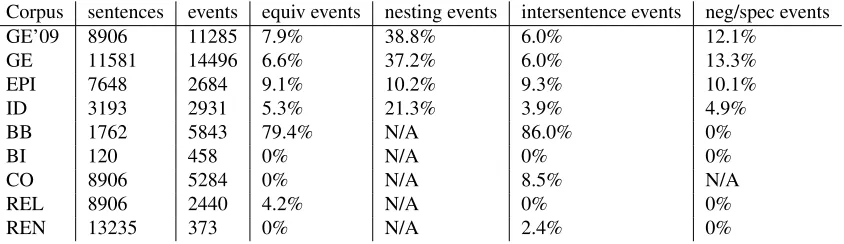
To further simplify event extraction all sentences are processed in isolation, so events crossing sen-tence boundaries (intersensen-tence events, Table 2) can-not be detected. This also limits the theoretical max-imum performance of the system (see Figure 3).
In the provided data an event is annotated only once for a set of equivalent proteins. For example, in the sentence “Ubiquitination of caspase 8 (casp8)” a ubiquitinationevent would be annotated only for “caspase 8”, “casp8” being marked as equivalent to “caspase 8”. To improve training data consis-tency, our system fully resolves these equivalences into new events, also recursively when a duplicated event is nested in another event (Table 2). Resolved equivalences were used for event extraction in the BioNLP’11 GE, ID, EPI and BB tasks, although based on tests with the GE dataset their impact on performance was negligible.
2.2 Machine Learning
The machine learning based event detection com-ponents classify examples into one of the positive classes or as negatives, based on a feature vector representation of the data. To make these classifi-cations, we use the SVMmulticlass support vector machine2 (Tsochantaridis et al., 2005) with a linear kernel. An SVM must be optimized for each classi-fication task by experimentally determining the reg-ularization parameter C. This is done by training the system on a training dataset, and testing a number of C values on a development dataset. When producing predictions for the test set, the classifier is retrained with combined training and development sets, and the test data is classified with the previously deter-mined optimal value of C.
Unlike in the BioNLP’09 Shared Task where the three main parameters (trigger-detector, recall-adjustment and edge-detector) were optimized in an exhaustive grid search against the final metric, in the new system only the recall-adjustment
param-2http://svmlight.joachims.org/svm_
multiclass.html
eter (see Section 2.5) is optimized against the final metric, edge and trigger detector parameters being optimized in isolation to speed up experiments.
2.3 Syntactic Analyses
The machine learning features that are used in event detection are mostly derived from the syntac-tic parses of the sentences. Parsing links together related words that may be distant in their linear or-der, creating a parse tree (see Figure 1 B).
We used the Charniak-Johnson parser (Char-niak and Johnson, 2005) with David McClosky’s biomodel (McClosky, 2010) trained on the GENIA corpus and unlabeled PubMed articles. The parse trees produced by the Charniak-Johnson parser were further processed with the Stanford conversion tool (de Marneffe et al., 2006), creating a dependency parse (de Marneffe and Manning, 2008).
In the supporting tasks (REL, REN and CO) this parsing was done by us, but in the main tasks the organizers provided official parses which were used. All parses for tasks where named entities were given as gold data were further processed with a pro-tein name splitterthat divides at punctuation tokens which contain named entities, such as “p50/p65” or “GATA3-binding”.
2.4 Feature Groups
To convert text into features understood by the clas-sifier, a number of analyses are performed on the sentences, mostly resulting in binary features stating the presence or absence of some feature. Applica-ble combinations of these features are then used by the trigger detection, edge detection and unmerging steps of the event extraction system.
Token features can be generated for each word
token, and they define the text of the token, its Porter-stem (Porter, 1980), its Penn treebank part-of-speech-tag, character bi- and trigrams, presence of punctuation or numeric characters etc.
Sentence features define the number of named
entities in the sentence as well as bag-of-words counts for all words.
Dependency chains follow the syntactic
Dependency path N-grams, are built from the shortest undirected path of tokens and dependencies linking together two entities, and are used in edge detection.N-grams join together a token with its two flanking dependencies as well as each dependency with its two flanking tokens. While theseN-grams follow the direction of the entire path, the governor-dependent directions of individual dependencies are used to define token bigrams.
Trigger featurescan be built in cases where
trig-gers are already present, such as edge detection and event construction. These features include the types and supertypes of the trigger nodes, and combina-tions thereof.
External features are additional features based
on data external to the corpus being processed. Such features can include e.g. the presence of a word in a list of key terms, Wordnet hypernyms, or other resources that enhance performance on a particular task. These are described in detail in Section 3.
2.5 Trigger Detection
Trigger words are detected by classifying each token as negative or as one of the positive trigger classes. Sometimes several triggers overlap, in which case a merged class (e.g.phosphorylation–regulation) is used. After trigger prediction, triggers of merged classes are split into their component classes.
Most tasks evaluate trigger detection using ap-proximate span, so detecting a single token is enough. However, this token must be chosen consis-tently for the classifier to be able to make accurate predictions. For multi-token triggers, we select as the trigger word thesyntactic head, the root token of the dependency parse subtree covering the entity.
When optimizing the SVM C-parameter for trig-ger and edge detection, it is optimized in isolation, maximizing the F-score for that classification task. Edges can be predicted for an event only if its trig-ger has been detected, but often the C-parameter that maximizes trigger detection F-score has too low re-call for optimal edge detection. Arecall adjustment
step is used to fit together the trigger and edge de-tectors. For each example, the classifier gives a con-fidence score for each potential class, and picks as the predicted class the one with the highest score. In recall adjustment, the confidence score of each neg-ative example is multiplied with a multiplier, and if
the result falls below the score of another class, that class becomes the new classification. This multiplier is determined experimentally by optimizing against overall system performance, using the official task metric for cases where a downloadable evaluator is available (GE and BB).
2.6 Edge Detection
Edge detection is used to predict event arguments or triggerless events and relations, all of which are de-fined as edges in the graph representation. The edge detector defines one example per direction for each pair of entities in the sentence, and uses the SVM classifier to classify the examples as negatives or as belonging to one of the positive classes. As with the trigger detector, overlapping positive classes are pre-dicted through merged classes (e.g. cause–theme). Task-specific rules defining valid argument types for each entity type are used to considerably reduce the number of examples that can only be negatives.
2.7 Unmerging
In the graph representation, events are defined through their trigger word node, resulting in over-lapping nodes for overover-lapping events. The trigger detector can however predict a maximum of one trig-ger node per type for each token. When edges are predicted between these nodes, the result is amerged graph where overlapping events are merged into a single node and its set of outgoing edges. Taking into account the limits of trigger prediction, the edge detector is also trained on a merged graph version of the gold data.
GE1 GE2 GE3 EPI ID BB BI CO REL REN Task
0 20 40 60 80 100
[image:5.612.355.500.59.216.2]F-score
Figure 3: Ranking of the systems participating in the BioNLP’11 Shared Task. Our system is marked with black dots and the dotted line shows its theoretical maxi-mum performance (see Section 2.1) with all correct clas-sifications.
tasks. The unmerging step is not required for trig-gerless eventswhich are defined by a single edge.
All of the tasks define varied, detailed limits on valid event type and argument combinations. A final validation step based on task-specific rules is used to remove structurally incorrect events left over from preceding machine learning steps.
2.8 Modality Detection
Speculation and negation are detected indepen-dently, with binary classification of trigger nodes. The features used are mostly the same as for trigger detection, with the addition of a list of speculation-related words based on the BioNLP’09 ST corpus.
3 Tasks and Results
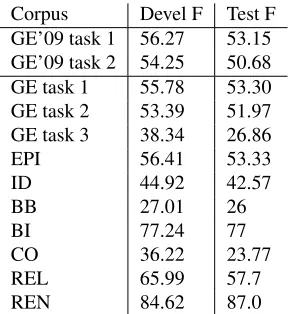
The BioNLP’11 Shared Task consists of five main tasks and three supporting tasks. Additionally, many of these tasks specify separate subtasks. Except for the GE-task, which defines three main tion criteria, all tasks have a single primary evalua-tion criterion. All evaluaevalua-tions are based on F-score, the harmonic mean of precision and recall. Perfor-mance of all systems participating in the BioNLP’11 Shared Task is shown in Figure 3. Our system’s per-formance on both development and test sets of all tasks is shown in Table 1.
Corpus Devel F Test F
GE’09 task 1 56.27 53.15
GE’09 task 2 54.25 50.68
GE task 1 55.78 53.30
GE task 2 53.39 51.97
GE task 3 38.34 26.86
EPI 56.41 53.33
ID 44.92 42.57
BB 27.01 26
BI 77.24 77
CO 36.22 23.77
REL 65.99 57.7
[image:5.612.78.297.62.231.2]REN 84.62 87.0
Table 1: Devel and test results for all tasks. The perfor-mance of our new system on the BioNLP’09 ST GENIA dataset is shown for reference, with task 3 omitted due to a changed metric. For GE-tasks, the Approximate Span & Recursive matching criterion is used.
3.1 GENIA (GE)
The GENIA task is the direct continuation of the BioNLP’09 Shared Task. The BioNLP’09 ST cor-pus consisted only of abstracts. The new version ex-tends this data by 30% with full text PubMed Central articles.
Our system applied to the GE task is the most similar to the one we developed for the BioNLP’09 Shared Task. The major difference is the replace-ment of the rule-based unmerging component with an SVM based one.
The GE task has three subtasks, task 1 is detection of events with their main arguments, task 2 extends this to detection of sites defining the exact molecu-lar location of interactions, and task 3 adds the de-tection of whether events are stated in a negated or speculative context.
For task 3, speculation and negation detection, we considered the GE, EPI and ID task corpora simi-lar enough to train a single model on. Compared to training on GE alone, example classification F-score decreased for negation by 8 pp and increased for speculation by 4 pp. Overall task 3 processing was considerably simplified.
Corpus sentences events equiv events nesting events intersentence events neg/spec events
GE’09 8906 11285 7.9% 38.8% 6.0% 12.1%
GE 11581 14496 6.6% 37.2% 6.0% 13.3%
EPI 7648 2684 9.1% 10.2% 9.3% 10.1%
ID 3193 2931 5.3% 21.3% 3.9% 4.9%
BB 1762 5843 79.4% N/A 86.0% 0%
BI 120 458 0% N/A 0% 0%
CO 8906 5284 0% N/A 8.5% N/A
REL 8906 2440 4.2% N/A 0% 0%
[image:6.612.97.519.60.182.2]REN 13235 373 0% N/A 2.4% 0%
Table 2: Corpus statistics. Numbers are for all available annotated data, i.e. the merged training and development sets.
team FAUST), indicating that our chosen event de-tection approach still remains competitive. For ref-erence, we ran our system also on the BioNLP’09 data, reaching an F-score of 53.15%, a slight in-crease over the 52.85% we previously reported in Bj¨orne et al. (2011).
3.2 Epigenetics and Post-translational
Modifications (EPI)
All events in the EPI task that have additional argu-ments (comparable to the site-arguargu-ments in the GE-task) have a single core argument. We therefore use for this task a slightly modified graph representation, where all additional arguments are treated as core ar-guments, linking directly to the event node (Figure 2 B). The number of argument combinations per pre-dicted event node remains manageable for the un-merging system and full recovery of additional ar-guments is possible.
Eight of the EPI event types have correspond-ing reverse events, such asphosphorylationand de-phosphorylation. Many of these reverse events are quite rare, resulting in too little training data for the trigger detector to find them. Therefore we merge each reverse event type into its corresponding for-ward event type. After trigger detection, an addi-tional rule-based step separates them again. Most of the reverse classes are characterized by a “de”-prefix in their trigger word. On the EPI training dataset, the rule-based step determined correctly whether an event was reversed in 99.6% of cases (1698 out of 1704 events). Using this approach, primary criterion F-score on the development set increased 1.33 per-centage points from 55.08% to 56.41%. Several pre-viously undetectable small reverse classes became detectable, with e.g.deubiquitination(8 instances in
the development set) detected at 77.78% F-score. Our system ranked first on the EPI task, outper-forming the next-best system (team FAUST) by over 18 percentage points. On the alternative core metric our system was also the first, but the FAUST system was very close with only a 0.27 percentage point dif-ference. Since the core metric disregards additional arguments, it may be that our alternative approach for representing these arguments (Figure 2 B) was important for the primary criterion difference.
3.3 Infectious Diseases (ID)
The annotation scheme for the ID task closely fol-lows the GE task, except for an additional process
event type that may have no arguments, and for five different entity types in place of the protein type. Our approach for the ID task was identical to the GE task, but performance relative to the other teams was considerably lower. Primary evaluation metric F-score was 42.57% vs. 43.44% for the core metric which disregards additional arguments, indicating that these are not the reason for low performance.
3.4 Bacteria Biotopes (BB)
The BB task considers detection of events describ-ing bacteria and their habitats. The task defines only two event types but a large number of entity types which fall into five supertypes. All entities must be predicted and all events are triggerless.
Unlike in the other main tasks, in the BB task ex-act spans are required for Bacterium-type entities, which usually consist of more than one token (e.g.
tokens, this step produced the correct span for 91% (399 out of 440) ofBacterium-type entities.
To aid in detecting Bacterium-entities a list of bacteria names from the List of Prokaryotic names with Standing in Nomenclature3was used (Euz´eby, 1997) as external features. To help in detecting the heterogeneous habitat-entities, synonyms and hy-pernyms from Wordnet were used (Fellbaum, 1998). The development set lacked some event classes, so we moved some documents from the training set to the development set to include these.
Our F-score was the lowest of the three partici-pating systems, and detailed results show a consis-tently lower performance in detecting the entities. The large number of intersentence events (Table 2) also considerably limited performance (Figure 3).
3.5 Bacteria Gene Interactions (BI)
The BI-task considers events related to genetic pro-cesses of the bacteriumBacillus subtilis. This task defines a large number of both entity and event types, but all entities are given as gold-standard data, therefore we start from edge detection (Figure 1 D). All BI events are triggerless.
In this task manually curated syntactic parses are provided. As also automated parses were available, we tested them as an alternative. With the Charniak-Johnson/McClosky parses overall performance was only 0.65 percentage points lower (76.59% vs. 77.24%). As with the BB task, we moved some doc-uments from the training set to the development set to include missing classes.
Despite this task being very straightforward com-pared to the other tasks we were the only participant. Therefore, too many conclusions shouldn’t be drawn from the performance, except to note that a rather high F-score is to be expected with all the entities being given as gold data.
3.6 Protein/Gene Coreference (CO)
In the CO supporting task the goal is to extract anaphoric expressions. Even though our event ex-traction system was not developed with corefer-ence resolution in mind, the graph representation can be used for the coreference annotation, making coreference detection possible. Anaphorasand
An-3
http://www.bacterio.cict.fr/
tecedentsare both represented asExp-type entities, withCoref-type edges linkingAnaphora-entities to
Antecedent-entities and Target-type edges linking
Protein-type entities toAntecedent-entities.
In the CO-task, character spans for detected enti-ties must be in the range of a full span and minimum span. Therefore in this task we used an alternative trigger detector. Instead of predicting one trigger per token, this component predicted one trigger per each syntactic phrase created by the Charniak-Johnson parser. Since these phrases don’t cover most of the CO-task triggers, they were further subdivided into additional phrases, e.g. by cutting away determiners and creating an extra phrase for each noun-token, with the aim of maximizing the number of included triggers and minimizing the number of candidates.
Our system placed fourth out of six, reaching an F-score of 23.77%. Coreference resolution being a new subject for us and our system not being devel-oped for this domain, we consider this an encour-aging result, but conclude that in general dedicated systems should be used for coreference resolution.
3.7 Entity Relations (REL)
The REL supporting task concerns the detection of static relationships, Subunit-Complex relations be-tween individual proteins and protein complexes and
Protein-Componentrelations between a gene or pro-tein and its component, such as a propro-tein domain or gene promoter. In the graph representation these re-lations are defined as edges that link together given protein/gene names andEntity-type entities that are detected by the trigger detector.
To improve entity detection, additional features are used. Derived from the REL annotation, these features highlight structures typical for biomolecular components, such as aminoacids and their shorthand forms, domains, motifs, loci, termini and promot-ers. Many of the REL entities span multiple tokens. Since the trigger detector predicts one entity per to-ken, additional features are defined to mark whether a token is part of a known multi-token name.
3.8 Bacteria Gene Renaming (REN)
The REN supporting task is aimed at detecting state-ments of B. Subtilis gene renaming where a syn-onym is introduced for a gene. The REL task defines a single relation type,Renaming, and a single entity type,Gene. All entities are given, so only edge de-tection is required. Unlike the other tasks, the main evaluation criterion ignores the direction of the rela-tions, so they are processed as undirected edgesin the graph representation.
Edge detection performance was improved with external features based on two sources defining known B. Subtilis synonym pairs: The Uniprot B. Subtilis gene list “bacsu”4 and SubtiWiki5, the B. Subtilisresearch community annotation wiki.
For the 300 renaming relations in the REN train-ing data, the synonym pair was found from the Uniprot list in 66% (199 cases), from SubtiWiki in 79% (237 cases) and from either resource in 81.3% (244 cases). For the corresponding negative edge examples, Uniprot orSubtiWiki synonym pairs ap-peared in only 2.1% (351 out of 16640 examples).
At 87.0% F-score our system had the highest per-formance out of the three participants, exceeding the next highest system by 17.1 percentage points. If Uniprot andSubtiWiki features are not used, perfor-mance on the development set is still 67.85%, close to the second highest performing system on the task.
4 Conclusions
We have developed a system that addresses all tasks and subtasks in the BioNLP’11 Shared Task, with top performance in several tasks. With the modular design of the system, all tasks could be implemented with relatively small modifications to the processing pipeline. The graph representation which covered naturally all different task annotations was a key fea-ture in enabling fast system development and test-ing. As with the Turku Event Extraction System de-veloped for the BioNLP’09 Shared Task, we release this improved system for the BioNLP community under an open source license atbionlp.utu.fi. Of all the tasks, the GE-task, which extends the BioNLP’09 corpus, is best suited for evaluating ad-vances in event extraction in the past two years.
4
http://www.uniprot.org/docs/bacsu
5
http://subtiwiki.uni-goettingen.de/
Comparing our system’s performance on the GE’09 corpus with the current one, we can assume that the two corpora are of roughly equal difficulty. There-fore we can reason that overall event extraction performance has increased about three percentage points, the highest performance on the current GE-task being 56.04% by team FAUST. It appears that event extraction is a hard problem, and that the im-mediate easy performance increases have already been found. We hope the BioNLP’11 Shared Task has focused more interest in the field, hopefully eventually leading to breakthroughs in event extrac-tion and bringing performance closer to established fields of BioNLP such as syntactic parsing or named entity recognition.
That our system could be generalized to work on all tasks and subtasks, indicates that the event extrac-tion approach can offer working soluextrac-tions for several biomedical domains. A potential limiting factor cur-rently is that most task-specific corpora annotate a non-overlapping set of sentences, necessitating the development of task-specific machine learning mod-els. Training on multiple datasets could mean that positives of one task would be unannotated on text from the other task, confusing the classifier. On the other hand, multiple overlapping task annotations on the same text would permit the system to learn from the interactions and delineations of different annota-tions. System generalization has been successfully shown in the BioNLP’11 Shared Task, but has re-sulted in a number of separate extraction systems. It could well be that the future of event extraction re-quires also the generalization of corpus annotations.
As future directions, we intend to further improve the scope and usability of our event extraction sys-tem. We will also continue our work on PubMed-scale event extraction, possibly applying some of the new extraction targets introduced by the BioNLP’11 Shared Task.
Acknowledgments
References
Jari Bj¨orne, Juho Heimonen, Filip Ginter, Antti Airola, Tapio Pahikkala, and Tapio Salakoski. 2009. Extract-ing complex biological events with rich graph-based
feature sets. InProceedings of the BioNLP 2009
Work-shop Companion Volume for Shared Task, pages 10– 18, Boulder, Colorado. Association for Computational Linguistics.
Jari Bj¨orne, Filip Ginter, Sampo Pyysalo, Jun’ichi Tsu-jii, and Tapio Salakoski. 2010. Scaling up
biomed-ical event extraction to the entire PubMed. In
Pro-ceedings of the 2010 Workshop on Biomedical Natural Language Processing, pages 28–36, Uppsala, Sweden, July. Association for Computational Linguistics. Jari Bj¨orne, Juho Heimonen, Filip Ginter, Antti Airola,
Tapio Pahikkala, and Tapio Salakoski. 2011. Extract-ing contextualized complex biological events with rich
graph-based feature sets. Computational Intelligence,
Special issue on Extracting Bio-molecular Events from Literature. To appear, accepted in 2009.
Ekaterina Buyko, Erik Faessler, Joachim Wermter, and Udo Hahn. 2009. Event extraction from trimmed
de-pendency graphs. InProceedings of the BioNLP 2009
Workshop Companion Volume for Shared Task, pages 19–27. ACL.
Eugene Charniak and Mark Johnson. 2005. Coarse-to-fine n-best parsing and maxent discriminative
rerank-ing. InProceedings of the 43rd Annual Meeting of the
Association for Computational Linguistics (ACL’05), pages 173–180. Association for Computational Lin-guistics.
Marie-Catherine de Marneffe, Bill MacCartney, and Christopher Manning. 2006. Generating typed
depen-dency parses from phrase structure parses. In
Proceed-ings of LREC-06, pages 449–454.
J. P. Euz´eby. 1997. List of bacterial names with standing
in nomenclature: a folder available on the internet. Int
J Syst Bacteriol, 47(2):590–592.
Christiane Fellbaum, editor. 1998. WordNet: an
elec-tronic lexical database. MIT Press.
Juho Heimonen, Jari Bj¨orne, and Tapio Salakoski. 2010. Reconstruction of semantic relationships from their
projections in biomolecular domain. InProceedings of
the 2010 Workshop on Biomedical Natural Language Processing, pages 108–116, Uppsala, Sweden, July. Association for Computational Linguistics.
Halil Kilicoglu and Sabine Bergler. 2009. Syntactic de-pendency based heuristics for biological event
extrac-tion. In Proceedings of the BioNLP 2009 Workshop
Companion Volume for Shared Task, pages 119–127. ACL.
Jin-Dong Kim, Tomoko Ohta, Sampo Pyysalo,
Yoshi-nobu Kano, and Jun’ichi Tsujii. 2009. Overview
of BioNLP’09 Shared Task on Event Extraction. In
Proceedings of the BioNLP 2009 Workshop Compan-ion Volume for Shared Task, pages 1–9, Boulder, Col-orado, June. Association for Computational Linguis-tics.
Jin-Dong Kim, Sampo Pyysalo, Tomoko Ohta, Robert
Bossy, and Jun’ichi Tsujii. 2011. Overview of
BioNLP Shared Task 2011. In Proceedings of
the BioNLP 2011 Workshop Companion Volume for Shared Task, Portland, Oregon, June. Association for Computational Linguistics.
Marie-Catherine de Marneffe and Christopher Manning. 2008. The Stanford typed dependencies
representa-tion. InCOLING Workshop on Cross-framework and
Cross-domain Parser Evaluation.
David McClosky. 2010. Any Domain Parsing:
Auto-matic Domain Adaptation for Natural Language
Pars-ing. Ph.D. thesis, Department of Computer Science,
Brown University.
Makoto Miwa, Sampo Pyysalo, Tadayoshi Hara, and Jun’ichi Tsujii. 2010a. A comparative study of
syn-tactic parsers for event extraction. InProceedings of
the 2010 Workshop on Biomedical Natural Language Processing, BioNLP ’10, pages 37–45, Stroudsburg, PA, USA. Association for Computational Linguistics. Makoto Miwa, Rune Sætre, Jin-Dong Kim, and Jun’ichi
Tsujii. 2010b. Event extraction with complex event
classification using rich features. J Bioinform Comput
Biol, 8:131–146.
Martin F. Porter. 1980. An algorithm for suffix stripping.
Program, 14(3):130–137.
Sebastian Riedel, Hong-Woo Chun, Toshihisa Takagi, and Jun’ichi Tsujii. 2009. A markov logic approach
to bio-molecular event extraction. InProceedings of
the Workshop on Current Trends in Biomedical Natu-ral Language Processing: Shared Task, BioNLP ’09, pages 41–49, Stroudsburg, PA, USA. Association for Computational Linguistics.
Ioannis Tsochantaridis, Thorsten Joachims, Thomas
Hof-mann, and Yasemin Altun. 2005. Large margin
methods for structured and interdependent output
vari-ables. Journal of Machine Learning Research (JMLR),
6(Sep):1453–1484.
Sofie Van Landeghem, Yvan Saeys, Bernard De Baets, and Yves Van de Peer. 2009. Analyzing text in search of bio-molecular events: a high-precision machine
learning framework. In Proceedings of the BioNLP