TEXT2TABLE:
Medical Text Summarization System based on Named Entity
Recognition and Modality Identification
Eiji ARAMAKI
Yasuhide MIURA Masatsugu
TONOIKE
The university of Tokyo Fuji Xerox Fuji Xerox
[email protected] [email protected] [email protected]
Tomoko OHKUMA
Hiroshi MASHUICHI
Kazuhiko OHE
Fuji Xerox Fuji Xerox The university of Tokyo Hospital [email protected] [email protected] [email protected]
Abstract
With the rapidly growing use of electronic health records, the possibility of large-scale clinical information extraction has drawn much attention. It is not, however, easy to ex-tract information because these reports are written in natural language. To address this problem, this paper presents a system that converts a medical text into a table structure. This system’s core technologies are (1) medi-cal event recognition modules and (2) a nega-tive event identification module that judges whether an event actually occurred or not. Regarding the latter module, this paper also proposes an SVM-based classifier using syn-tactic information. Experimental results dem-onstrate empirically that syntactic information can contribute to the method’s accuracy.
1
Introduction
The use of electronic texts in hospitals is increas-ing rapidly everywhere. This study specifically examines discharge summaries, which are reports generated by medical personnel at the end of a pa-tient’s hospital stay. They include massive clinical information about a patient’s health, such as the frequency of drug usage, related side-effects, and correlation between a disease and a patient’s ac-tions (e.g., smoking, drinking), which enables
un-precedented large-scale research, engendering promising findings.
N
A
(1 (2 (3
evertheless, it is not easy to extract clinical in-formation from the reports because these reports are written in natural language. An example of a discharge summary is presented in Table 1. The table shows records that are full of medical jargon, acronyms, shorthand notation, misspellings, and sentence fragments (Tawanda et al., 2006).
To address this problem, this paper presents a proposal of a system that extracts medical events and date times from a text. It then converts them into a table structure. We designate this system
TEXT2TABLE, which is available from a web
site1. The extraction method, which achieves a high accuracy extraction, is based on Conditional Random Fields (CRFs) (Lafferty et al., 2001).
nother problem is posed by events that do not actually occur, i.e., future scheduled events, events that are merely intended to take place, or hypo-thetical events. As described herein, we call such non-actual events negative events. Negative
events are frequently mentioned in medical re-cords; actually, in our corpus, 12% of medical events are negative. Several examples of negative events (in italic letters) are presented below:
) no headache
) keep appointment of radiotherapy
) .. will have intravenous fluids
(4 (4' (5 th (6
ac
A
B
T
T
A ) .. came forradiotherapy
) .. came forheadache
) Every week radiation therapy and chemical
erapy are scheduled
) Please call Dr. Smith with worsening head-he or back pain, or any other concern.
Negative events have two characteristics. First, various words and phrases indicate that an event is negative. For this study, such a word or phrase that makes an event negative is called a negative trig-ger. For instance, a negation word “no” is a
nega-tive trigger in (1). A noun “appointment” in (2) is a
negative trigger. Similarly, the auxiliary “will” in
(3) signals negation. More complex phenomena are presented in (4) and (4'). For instance, “ radiother-apy” in (4) is a negative event because the therapy
will be held in the future. In contrast, “headache”
in (4') is not negative because a patient actually has a “headache”. These indicate that a simple
rule-based approach (such as a list of triggers) can only imply classification of whether an event is negative or not, and that information of the event category (e.g., a therapy or symptom) is required.
nother characteristic is a long scope of a nega-tive trigger. Although neganega-tive triggers are near the descriptive words of events in (1)–(4), there could alternatively be a great distance of separation, as portrayed in (5) and (6). In (5), a noun coordina-tion separates a negative trigger from the event. In (6), the trigger “please” renders all events in that
sentence negative. These indicate that neighboring words are insufficient to determine whether an event is negative or not. To deal with (5), syntactic information is helpful because the trigger and the event are neighboring in the dependency structure, as portrayed in Fig. 2. To deal with (6), bag-of-word (BOW) information is desired.
ecause of the observation described above, this paper presents a proposal of a classifier: whether an event is negative or not. The proposed classifier uses various information, the event category, neighboring words, BOW, and dependent phrases.
he point of this paper is two-fold: (1) We pro-pose a new type of text-summarizing system (TEXT2TABLE) that requires a technique for a negative event identification. (2) We investigate what kind of information is helpful for negative event identification.
he experiment results revealed that, in spite of the risk of parsing error, syntactic information can
contribute to performance, demonstrating the fea-sibility of the proposed approach.
lthough experiments described in this paper are related to Japanese medical reports, the proposed method does not depend on specific languages or domains.
Table 1: A Health Record Sample. BRIEF RESUME OF HOSPITAL COURSE : 57 yo with NSCLCa with back pain and headache . Trans-ferred from neurosurgery for additional mgmt with palliative XRT to head . Pt initially presented with cough and hemoptysis to his primary MD . On CXR he was found to have a upper left lobe mass . He subsequently un-derwent bronchoscopy and bx revealed non-small cell adeno CA. STaging revealed multi-ple bony mets including skull, spine with MRI revealing mild compression of vertebral bodies at T9, T11, T12 . T9 with encroach-ment of spinal cord underwent urgent XRT with no response so he was referred to neu-rosurgery for intervention . MRI-rt. fron-tal, left temporal, rt cerebellar
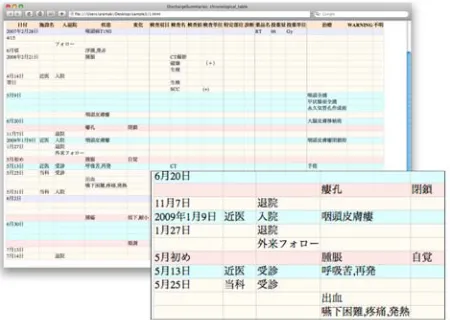
Figure 1: Visualization result (Left), magnified (Right).
Figure 2: Negative Triggers and Events on a Depend-ency Structure.
Table 2: Corpora and Modalities
CORPUS MODALITY
ACE asserted, or other
TIMEML must, may, should, would, or could
Prasad et al.,
2006 assertion, belief, facts or eventu-alities Saurí et al., 2007 certain, probable, possible, or
other
Inui et al., 2008 affirm, infer, doubt, hear, intend, ask, recommend, hypothesize, or other
[image:3.612.72.302.387.693.2]THIS STUDY S/O, necessity, hope, possible, recommend, intend
Table 3: Markup Scheme (Tags and Definitions) Tag Definition (Examples)
R Remedy, Medical operation (e.g. radiotherapy)
T Medical test, Medical examination (e.g., CT, MRI)
D Deasese, Symptom
(e.g., Endometrial cancer, headache) M Medication, administration of a drug
(e.g., Levofloxacin, Flexeril) A patient action
(e.g., admitted to a hospital) V Other verb
(e.g., cancer spread to ...)
2
Related Works
2.1 Previous Markup Schemes
In the NLP field, fact identification has not been studied well to date. Nevertheless, similar analyses can be found in studies of sentence modality.
The Automatic Content Extraction (ACE)2
in-formation extraction program deals with event ex-traction, by which each event is annotated with temporal and modal markers.
A
S
A
T
similar effort is made in the TimeML project (Pustejovsky et al., 2003). This project specifically examines temporal expressions, but several modal expressions are also covered.
Prasad et al. (2006) propose four factuality clas-sifications (certain, probable...etc.) for the Penn Discourse TreeBank (PDTB) 3.
aurí et al. (2007) propose three modal categories for text entailment tasks.
mong various markup schemes, the most recent one is Experience Mining (Inui et al., 2008), which
collects personal experiences from the web. They also distinguish whether an experience is an actual one or not, which is a similar problem to that con-fronting us.
able 2 portrays a markup scheme adopted by each project. Our purpose is similar to that of Ex-perience Mining. Consequently, we fundamentally adopt its markup scheme. However, we modify the label to suit medical mannerisms. For example, “doubt” is modified into “(S/O) suspicion of”. Rare modalities such as “hear” are removed.
2.2 Previous Algorithms
Negation is a traditional topic in medical fields. Therefore, we can find many previous studies of the topic in the relevant literature.
An algorithm, NegEx4 was proposed by
Chap-man et al. (ChapChap-man et al., 2001a; ChapChap-man et al., 2001b). It outputs an inference of whether a term is positive or negative. The original algorithm is based on a list of negation expressions. Goldin et al. (2003) incorporate machine learning techniques (Naïve Bayes and decision trees) into the algorithm. The extended version (ConText) was also proposed (Chapman et al., 2007).
Elkin et al. (2005) use a list of negation words and a list of negation scope-ending words to
iden-2 http://projects.ldc.upenn.edu/ace/ 3 http://www.seas.upenn.edu/~pdtb/
tify negated statements and their scope. Their tech-nique was used in The MAYO Clinic Vocabulary Server (MCVS)5, which encodes clinical expres-sions into medical ontology (SNOMED-CT) and identifies whether the event is positive or negative.
M
H
T
A
utalik et al. (2001) earlier developed Negfinder
to recognize negated patterns in medical texts. Their system uses regular expressions to identify words indicating negation. Then it passes them as special tokens to the parser, which makes use of the single-token look-ahead strategy.
uang and Lowe (2007) implemented a hybrid approach to automated negation detection. They combined regular expression matching with grammatical parsing: negations are classified based on syntactic categories. In fact, they are located in parse trees. Their hybrid approach can identify ne-gated concepts in radiology reports even when they are located distantly from the negative term.
he Medical Language Extraction and Encoding (MedLEE) system was developed as a general natural language processor to encode clinical doc-uments in a structured form (Friedman et al., 1994). Negated concepts and certainty modifiers are also encoded within the system.
Veronika et al. (2008) published a negation scope corpus6 in which both negation and
uncer-tainty are addressed.
lthough their motivations are identical to ours, two important differences are apparent. (1) Previ-ous (except for Veronika et al., 2008) methods deal with the two-way problem (positive or negative), whereas the analyses proposed herein tackle more fine-grained modalities. (2) Previous studies (ex-cept for Huang et al., 2007) are based on BOW approaches, whereas we use syntactic information.
3
Medical Text Summarization System:
TEXT2TABLE
Because the core problem of this paper is to iden-tify negative events, this section briefly presents a description of the entire system, which consists of four steps. The detailed algorithm of negative iden-tification is explained in Section 4.
STEP 1: Event Identification
First, we define the event discussed in this paper. We deal with events of six types, as presented in
5
http://mayoclinproc.highwire.org/content/81/6/741.figures-only
6 www.inf.u-szeged.hu/rgai/bioscope
Table 3. Two of the four are Verb Phrases (base VPs); the others are noun phrases (base-NPs). Be-cause this task is similar to Named Entity Recogni-tion (NER), we use the state-of-the art NER method, which is based on the IOB2 representation and Conditional Random Fields (CRFs). In learn-ing, we use standard features, as shown in Table 4.
Table 4: Features for Event Identification
Lexicon and Stem
Current target word (and its stem) and its surrounding words (and stem). The win-dow size is five words (-2, -1, 0, 1, 2).
POS Part of speech of current target word and
its surrounding words (-2, -1, 0, 1, 2). The part of speech is analyzed using a POS tagger7.
DIC A fragment for the target word appears in
the medical dictionary (Ito et al., 2003).
STEP 2: Normalization
As described in Section 1, a term in a record is sometimes an acronym: shorthand notation. Such abbreviations are converted into standard notation through (1) date time normalization or (2) event normalization.
(1) Date Time Normalization
As for date time expressions, relative date expres-sions are converted into YYYY/MM/DD as fol-lows.
On Dec Last year → 2007/12/XX 10 Dec 2008 → 2008/12/10
These conversions are based on heuristic rules.
(2) Event Normalization
Medical terms are converted into standard notation (dictionary entry terms) using orthographic disam-biguation (Aramaki et al., 2008).
STEP 3: TIME–EVENT Relation Identification
Then, each event is tied with a date time. The cur-rent system relies on a simple rule (i.e., an event is tied with the latest date time).
STEP 4: Negative Identification
The proposed SVM classifier distinguishes nega-tive events from other events. The detailed algo-rithm is described in the next section.
4
Modality Identification Algorithm
First, we define the negative. We classify modality events into eight types (Table 5). These classifica-tions are motivated by those used in previous
ies (Inui et al., 2008). However, we simplify their scheme because several categories are rare in this domain.
T
U
hese classes are not exclusive. For that reason, they sometimes lead to multiple class events. For example, given “No chemotherapy is planned”, an
event “chemotherapy” belongs to two classes,
which are “NEGATION” and “FUTURE”.
Training Phase
sing a corpus with modality annotation, we train a SVM classifier for each category. The training
features come from four parts:
(1) Current phrases: words included in a current
event. We also regard their STEMs, POSs, and the current event category as features.
(2) Surrounding phrases: words included in the
current event phrase and its surrounding two phrases (p1, p2, n1, n2, as depicted in Fig. 3). The unit of the phrase is base-NP/VP, which is pro-duced by the Japanese parser (Kurohashi et al., 1994). Its window size is two in the neighboring phrase (p1, p2, c, n1, n2). We also deal with their STEMs and POSs.
(3) Dependent phrases: words included in the
parent phrase of the current phrase (d1 in Fig. 3), and grandparent phrases (d2 in Fig. 3). We also deal with their STEMs and POSs.
(4) Previous Event: words (with STEMs and
POSs) included in the previous (left side) events. Additionally, we deal with the previous event cate-gory and the modality class.
(5) Bag-of-words: all words (with STEMs and
POSs) in the sentence.
TEST Phrase
During the test, each SVM classifier runs.
Although this task is multiclass labeling, several class combinations are unnatural, such as FUTURE and S/O. We list up possible label com-binations (that have at least one occurrence in the corpora); if such a combination appears in a text, we adapt a high confidence label (using a marginal distance).
5
Experiments
[image:5.612.313.540.67.397.2]We investigate what kind of information contrib-utes to the performance in various machine learn-ing algorithms.
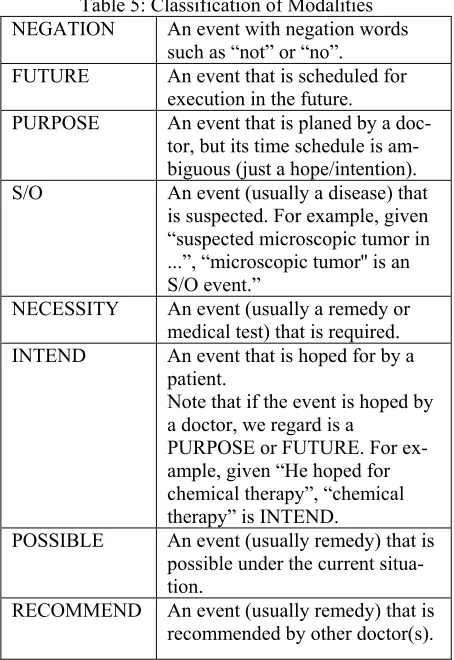
Table 5: Classification of Modalities NEGATION An event with negation words
such as “not” or “no”. FUTURE An event that is scheduled for
execution in the future.
PURPOSE An event that is planed by a doc-tor, but its time schedule is am-biguous (just a hope/intention). S/O An event (usually a disease) that
is suspected. For example, given “suspected microscopic tumor in ...”, “microscopic tumor'' is an S/O event.”
NECESSITY An event (usually a remedy or medical test) that is required. INTEND An event that is hoped for by a
patient.
Note that if the event is hoped by a doctor, we regard is a
PURPOSE or FUTURE. For ex-ample, given “He hoped for chemical therapy”, “chemical therapy” is INTEND.
POSSIBLE An event (usually remedy) that is possible under the current situa-tion.
RECOMMEND An event (usually remedy) that is recommended by other doctor(s).
5.1 Corpus and Setting
We collected 435 Japanese discharge summaries in which events and the modality are annotated. For training, we used the CRF toolkit8 with standard parameters. In this experiment setting, the input is an event with its contexts. The output is an event modality class (positive of negative in two-way) (or more detailed modality class in nine-way).
T
he core problem addressed in this paper is mo-dality classification. Therefore, this task setting assumes that all events are identified correctly. Table 6 presents the event identification accuracy. Except for the rare class V (the other verb), we got more than 80% F-scores. It is true that the
accu-racy is not perfect. Nevertheless, most of the re-maining problems in this step will be solved using a larger corpus.
5.2 Comparable Methods
We conducted experiments in the 10-fold cross validation manner. We investigated the
ance in various feature combinations and the fol-lowing machine learning methods.
Figure 3: Features
Table 6: Event Identification Result. Tag precision re-call F-score.
# P R F
[image:6.612.71.300.206.458.2]A (ACTION) 1,556 94.63 91.04 92.80 V (VERB) 1,047 84.64 74.89 79.47 D (DISEASE) 3,601 85.56 80.24 82.82 M (MEDICINE) 1,045 86.99 81.34 84.07 R (REMEDY) 1,699 84.50 76.36 80.22 T (TEST) 2,077 84.74 76.68 80.51 ALL 11,025 84.74 76.68 80.51
Table 7: Various Machine Learning Method
SVM Support Vector Machine (Vapnik, 1999). We used TinySVM9 with a polynomial kernel (degree=2). AP Averaged Perceptron (Collins, 2002) PA1 Passive Aggressive I (Crammer et
al., 2006)*
PA2 Passive Aggressive II (Crammer et al., 2006)*
CW Confidence Weighted (Dredze et al., 2008)*
* The online learning library10 is used for AP PA1,2
CW .
5.3 Evaluation Metrics
We adopt evaluation of two types:
(1) Two-way: positive or negative:
(2) Nine-way: positive or one of eight modality
categories.
Recall and F-measure are investigated in both for
evaluation precision.
5.4 Results
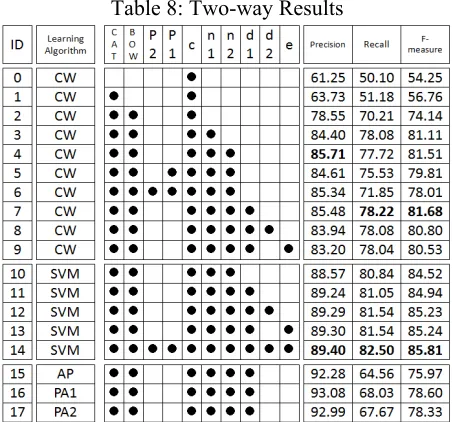
The results are shown in Table 8 (Two-Way) and in Table 9 (Nine-Way).
Current Event Category
The results in ID0–ID1 indicate that the current event category (CAT) is useful. However, events are sometimes misestimated in real settings. We
In
R
A
A
H
9 http://chasen.org/ taku/software/TinySVM/ 10 http://code.google.com/p/oll
must check more practical performance in the fu-ture.
Bag-of-words (BOW) Information
Results in ID1–ID2 indicate that BOW is impor-tant.
Surrounding Phrase Contribution
The results appearing in ID2–ID9 represent the contribution of each feature position. From ID3, ID4, and ID7 results, next phrases (n1, n2) and parent phrases (d1) were able to boost the accuracy. Despite the risk of parsing errors, parent phrases (d1) are helpful, which is an insight of this study.
contrast, we can say that the following features had little contribution: previous phrases (p1, p2 from ID5 and ID6), grandparent phrases (d2 from ID8), and previous events (e from ID9).
egarding p1 and p2, these modalities are rarely expressed in the previous parts in Japanese.
s for d2, the grandparent phrases might be too removed from the target events.
s for e, because texts in health records are frag-mented, each event might have little relation.
owever, the above features are also helpful in cases with a stronger learning algorithm.
[image:6.612.313.539.420.631.2]In fact, among ID10–ID14, the SVM-based classifier achieved the best accuracy with all fea-tures (ID14).
Table 8: Two-way Results
● indicates the used feature. c are features from the cur-rent phrase. p1, p2, n1, n2 are features from surrounding phrases. e are features from a previous event. BOW is a
bag-of-words using features from an entire sentence.
Learning Methods
Regarding the learning algorithms, all online learn-ing methods (ID7 and ID15–17) showed lower ac-curacies than SVM (ID11), indicating that this task requires heavy learning.
Nine-way Results
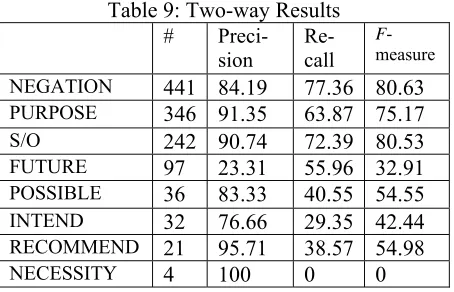
[image:7.612.73.300.242.388.2]Table 9 presents the accuracies of each class. Fun-damentally, we can obtain high performance in the frequent classes (such as NEGATION, PURPOSE, and S/O). In contrast, the classifier suffers from low frequent classes (such as FUTURE). How to handle such examples is a subject of future study.
Table 9: Two-way Results
# Preci-sion
Re-call
F-measure
NEGATION 441 84.19 77.36 80.63
PURPOSE 346 91.35 63.87 75.17
S/O 242 90.74 72.39 80.53
FUTURE 97 23.31 55.96 32.91
POSSIBLE 36 83.33 40.55 54.55
INTEND 32 76.66 29.35 42.44
RECOMMEND 21 95.71 38.57 54.98
NECESSITY 4 100 0 0
4.5 Future Works
In this section, we will discuss several remaining problems. First, as described, the classifier suffers from low frequent modality classes. To give more examples for such classes is an important problem.
Our final goal is to realize precise information ex-traction from health records. Our IE systems are already available at the web site (http://lab0.com). Comprehensive evaluation of those systems is re-quired.
6 Conclusions
This paper presented a classifier that identified whether an event has actually occurred or not. The proposed SVM-based classifier uses both BOW information and dependency parsing results. The experimental results demonstrated 85.8 F
-measure% accuracy and revealed that syntactic information can contribute to the method’s accu-racy. In the future, a method of handling low-frequency events is strongly desired.
Acknowledgments
Part of this research is supported by Grant-in-Aid for Scientific Research (A) of Japan Society for the Promotion of Science Project Number: 20680006
F.Y.2008-20011 and the Research Collaboration Project with Fuji Xerox Co. Ltd.
References
Wendy Chapman, Will Bridewell, Paul Hanbury, Greg-ory F. Cooper, and Bruce Buchanan. 2001a. Evalua-tion of negaEvalua-tion phrases in narrative clinical reports. In Proceedings of AMIA Symp, pages 105-109. Wendy Chapman, Will Bridewell, Paul Hanbury,
Greg-ory F. Cooper, and Bruce Buchanan. 2001b. A sim-ple algorithm for identifying negated findings and diseases in discharge summaries. Journal of Bio-medical Informatics, 5:301-310.
Wendy Chapman, John Dowling and David Chu. 2007. ConText: An algorithm for identifying contextual features from clinical text. Biological, translational, and clinical language processing (BioNLP2007), pp. 81–88.
Eiji Aramaki, Takeshi Imai, Kengo Miyo, and Kazuhiko Ohe: Orthographic Disambiguation Incorporating Transliterated Probability International Joint Confer-ence on Natural Language Processing (IJCNLP2008), pp.48-55, 2008.
Peter L. Elkin, Steven H. Brown, Brent A. Bauer, Casey S. Husser, William Carruth, Larry R. Bergstrom, and Dietlind L. Wahner Roedler. A controlled trial of au-tomated classification of negation from clinical notes. BMC Medical Informatics and Decision Making 5:13.
C. Friedman, P.O. Alderson, J.H. Austin, J.J. Cimino, and S.B. Johnson. 1994. A general natural language text processor for clinical radiology. Journal of the American Medical Informatics Association, 1(2):161-174.
L. Gillick and S.J. Cox. 1989. Some statistical issues in the comparison of speech recognition algorithms. In Proceedings of IEEE International Conference on Acoustics, Speech, and Signal Processing, pages 532-535.
Ilya M. Goldin and Wendy Chapman. 2003. Learning to detect negation with not in medical texts. In Work-shop at the 26th ACM SIGIR Conference.
Kentaro Inui, Shuya Abe, Hiraku Morita, Megumi Egu-chi, Asuka Sumida, Chitose Sao, Kazuo Hara, Koji Murakami, and Suguru Matsuyoshi. 2008. Experi-ence mining: Building a large-scale database of per-sonal experiences and opinions from web documents. In Proceedings of the 2008 IEEE/WIC/ACM Interna-tional Conference on Web Intelligence, pages 314-321.
M. Ito, H. Imura, and H. Takahisa. 2003. Igaku- Shoin’s Medical Dictionary. Igakusyoin.
Sadao Kurohashi and Makoto Nagao. 1994. A syntactic analysis method of long Japanese sentences based on the detection of conjunctive structures. Computa-tional Linguistics, 20(4).
Pradeep G. Mutalik, Aniruddha Deshpande, and Pra-kash M. Nadkarni. 2001. Use of general purpose ne-gation detection to augment concept indexing of medical documents: A quantitative study using the umls. Journal of the American Medical Informatics Association, 8(6):598-609.
J. Lafferty, A. McCallum, and F. Pereira: Conditional random fields: Probabilistic models for segmenting and labeling sequence data, In Proceedings of the In-ternational Conference on Machine Learning (ICML2001), pp.282-289, 2001.
R. Prasad, N. Dinesh, A. Lee, A. Joshi and B. Webber: Annotating Attribution in the Penn Discourse Tree-Bank, In Proceedings of the International Conference on Computational Linguistics and the Annual Con-ference of the Association for Computational Lin-guistics (COLING/ACL2006) Workshop on Sentiment and Subjectivity in Text, pp.31-38 (2006). R. Saurí, and J. Pustejovsky: Determining Modality and
Factuality for Text Entailment, Proceedings of ICSC2007, pp. 509-516 (2007).
Gaizauskas, A. Setzer, G. Katz, and D.R. Radev. 2003. New Directions in Question Answering: Timeml: Robust specification of event and temporal expres-sions in text. AAAI Press.
SNOMED-CT. 2002. SNOMED Clinical Terms Guide. College of American Pathologists.
Sibanda Tawanda, Tian He, Peter Szolovits, and Uzuner Ozlem. 2006. Syntactically informed semantic cate-gory recognizer for discharge summaries. In Proceed-ings of the Fall Symposium of the American Medical Informatics Association (AMIA 2006), pages 11-15. Sibanda Tawanda and Uzuner Ozlem. 2006. Role of
local context in automatic deidentification of un- grammatical, fragmented text. In Proceedings of the Human Language Technology conference and the North American chapter of the Association for
Com-putational Linguistics (HLT-NAACL2006), pages 65-73.