Open Source WFST tools for LVCSR cascade development
Josef R. Novak, Nobuaki Minematsu, Keikichi Hirose Graduate School of Information
Science and Technology The University of Tokyo
{novakj,mine,hirose}@gavo.t.u-tokyo.ac.jp
Abstract
This paper introduces the Transducersaurus toolkit which provides a set of classes for gen-erating each of the fundamental components of a typical WFST-based ASR cascade, in-cluding HMM, Context-dependency, Lexicon, and Grammar transducers, as well as an op-tional silence class WFST. The toolkit fur-ther implements a small scripting language in order to facilitate the construction of cas-cades via a variety of popular combination and optimization methods and provides inte-grated support for the T3 and Juicer WFST decoders, and both Sphinx and HTK format acoustic models. New results for two standard WSJ tasks are also provided, and the toolkit is used to compare a variety of construction and optimization algorithms. These results illus-trate the flexibility of the toolkit as well as the tradeoffs of various build algorithms.
1 Introduction
In recent years the Weighted Finite-State Transducer (WFST) paradigm has gained considerable popular-ity as a platform for Automatic Speech Recogni-tion (ASR). The WFST approach provides an ele-gant, unified mathematical framework that can be utilized to train, generate, combine and optimize the many heterogenous knowledge sources that typ-ically make up a modern Large Vocabulary Continu-ous Speech Recognition (LVCSR) system. This has lead to the development of several excellent general purpose software libraries devoted to the construc-tion and manipulaconstruc-tion of WFSTs, including the pop-ular open source OpenFst C++ toolkit. Much
re-search has also been conducted on the theoretical construction, integration and optimization of WFST models for ASR (Mohri, 1997; Mohri, 1999; Mohri, 2002; Allauzen, 2004; Mohri, 2008). Nevertheless to our knowledge at present there is no open source toolkit devoted to the construction of ASR-specific WFST models.
This lack of available tools represents an obstacle to the wider dissemination and adoption of WFST-based methods. In response to this, the current work introduces the Transducersaurus WFST toolkit (No-vak, 2011), which aims to provide a unified, flexi-ble and transparent approach to the construction of integrated WFST-based ASR cascades, while incor-porating recent research results on this important topic. It includes a set of classes for constructing component models as well as a simple Domain Spe-cific Language (DSL) suitable for specifying cas-cade integration and optimization commands. It pro-vides integrated support for HTK (Young, 2006) and Sphinx (Walker, 2004) acoustic models and cascade
construction support for both the T3(Dixon, 20007)
and Juicer (Moore, 2005) WFST decoders. Where in past complicated development was required, with this toolkit input knowledge sources and a single command are sufficient to build a high-performance system. In addition to introducing the toolkit, this work contributes new experimental results for two LVCSR tasks from the Wall Street Journal (Paul, 1992) (WSJ) corpus, and provides discussion of al-ternative cascade build chains.
The remainder of the paper is structured as fol-lows. Section 2 describes the main component mod-els of a typical WFST-based ASR cascade. Section 3
[image:2.612.99.518.57.199.2]
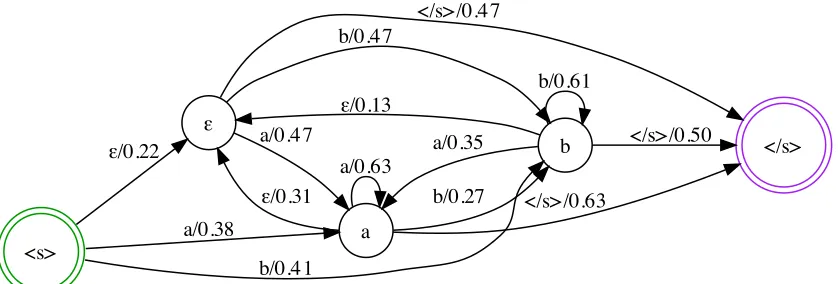
Figure 1: Detail of a bi-gram model for a simple two word LM.
describes the cascade integration tool and its capa-bilities. Section 4 describes new experimental re-sults that explore the flexibility of the Transducer-saurus toolkit. Section 5 provides additional anal-ysis and explores the practical implications of vari-ous construction techniques. Finally, Section 6 con-cludes the paper.
2 Integrated LVCSR Cascades
The construction of WFST-based cascades for LVCSR tasks typically involves two major steps. The first step is to construct WFST-based represen-tations of each of the component knowledge sources, and the second step is to integrate these components into either a single static cascade or, in the case of on-the-fly composition a smaller subset of integrated models. The most common component knowledge sources involved in the first step include a
gram-marG, in the form of a statistical language model, a
pronunciation lexiconL, that maps monophone
se-quences to words, and a context-dependency
trans-ducer C,that maps context-dependent triphone
se-quences to corresponding monophone sese-quences. In addition to these three fundamental components, an
HMM-level model H, that maps HMM state
se-quences to context-dependent triphone sese-quences is frequently utilized, and class-based silence models are also popular. The Transducersaurus toolkit
pro-vides integrated support for each of the H, C, L,
G, andTcomponent transducers, and these
compo-nents are described in detail in the following subsec-tions.
2.1 Grammar acceptor
The grammar component G, encodes information
about word sequences, and typically represents a
standard ARPA format statistical N-gram model.
Several different approaches to transforming anN
-gram model into an equivalent Weighted Finite-State Acceptor (WFSA) have been proposed in the liter-ature (Allauzen, 2003). The simplest approach uti-lizes a single historyless back-off state, and uses
nor-mal-transitions to encode back-off arcs and
asso-ciated back-off weights. This is the approach uti-lized currently in the Transducersaurus toolkit, and a small example of such a model is depicted in Fig-ure 1.
The use of normal-transitions however, can lead
to situations where back-offN-gram sequences may
be less costly than the equivalentN-gram sequence.
Strictly speaking this is incorrect, and (Allauzen, 2003) discusses two strategies for dealing with this problem. The first involves the use of special
“fail-ure” or φ-transitions for the back-off arcs. These
φ-transitions encode the idea that the back-off arc
should only be utilized in the event that an
equiv-alent normal N-gram arc does not exist. The
sec-ond strategy involves mutating the baseline
-back-off configuration, adding additional back--back-off states and manipulating the back-off arcs so as to elimi-nate instances of path ambiguity. Transducersaurus
utilizes the-transition approach mainly for the sake
of simplicity, but support for the alternative strate-gies is planned for future work. The toolkit provides
[image:3.612.332.532.55.263.2]
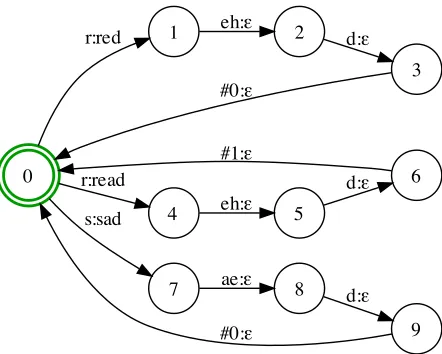
Figure 2: Example of a three-word lexicon transducer,L.
to transform a standard ARPA format LM into an equivalent WFSA. The tool also generates symbol tables as needed.
2.2 Lexicon transducer
The lexicon transducer L, maps monophone
se-quences or pronunciations to words. An example of a trivial lexicon transducer is described in Fig-ure 2. In order to ensFig-ure that the lexicon can de-scribe not just isolated words, but also word se-quences, it is necessary to perform the closure of the resulting WFST prior to downstream composi-tion. Furthermore, in order to handle the occurrence of homophones in the lexicon, it is necessary to aug-ment the construction with auxiliary symbols as de-scribed in (Allauzen, 2004). If this step is not taken, the lexicon as well as any downstream cascades may become non-determinizable. The toolkit
pro-vides a lexicon generation tool in the form of
lexi-con2fst.py, and this tool supports closure, and
auxil-iary symbol generation natively.lexicon2fst.py
pro-vides support for generating HTK as well as Sphinx format lexicons, the latter of which typically utilizes positional triphones. The tool further generates nec-essary symbol tables, a list of monophones, and a list of any auxiliary symbols that are added during construction.
2.3 Context-dependency transducer
The Context-dependency WFST C, maps
context-dependent triphone sequences to corresponding
Figure 3: AnN-word silence class model,T.
Figure 4: Example of a deterministic three-state HMM model for the triphonea-b+c.
context-independent monophone sequences. There are several methods of building this component as well, which are described and illustrated in detail in (Allauzen, 2004). The Transducersaurus toolkit implements a deterministic construction algorithm
which results in a C transducer where the output
symbols are delayed. There are two separate tools
for building theCtransducer,cd2wfstHTK.pyand
cd2wfstSphinx.py and as the names indicate, the first tool provides native support for the HTK for-mat acoustic models, and the second provides native
support for Sphinx format models. TheCtools take
as input a list of monophones, an optional list of auxiliary symbols, and an optional acoustic-model specific tied-list. The output consists of the text-format WFST and associated symbol tables. Both tools also provide support for an additional auxil-iary WFST which can be used to replace auxilauxil-iary symbols or translate logical triphones to physical triphones found in the input acoustic model. This is important in situations where the user wishes to
perform further optimizations on aCLGorHCLG
cascade.
2.4 Silence class transducer
[image:3.612.76.297.56.233.2]Transducer-saurus toolkit supports a special silence class trans-ducer that can be utilized to transform a grammar by augmenting it with silence or filler arcs. Other al-ternatives include adding additional silence-trailing entries to the lexicon or utilizing forced-alignment to insert silences into existing speech transcripts. In the latter case the aligned transcripts can then be used
directly to build anN-gram model with silence
to-kens. In the toolkit, thesilclass2fst.pyprogram can
be used to generate a silence class transducer from a list of words. An example of the silence class trans-ducer is depicted in Figure 3. Unlike the
lexicon-based approach, the T approach permits long
si-lences, and unlike the N-gram based approach, it
encodes the idea that silences may follow any word without a context-sensitive penalty or boost. The
trade-off between the silence loop and return -arc
may be specified by the user but the toolkit sup-plies default values that were estimated from several hundred hours of spontaneous English conversation transcripts.
2.5 HMM level
The HMM-level transducer H, maps HMM state
sequences from an acoustic model to context-dependent triphones. The toolkit currently focuses on a 3-state HMM configuration, although there are plans to extend this in future to more flexible config-urations. An example of a deterministic, three-state
HWFST for a single triphone,a-b+cis depicted in
Figure 4. In practice the fullHtransducer describes
the closure of the union of all triphones and mono-phones in the acoustic model. The structure is simi-lar to the lexicon transducer, however the phonemes are replaced with HMM states, the words are repre-sented by monophone and triphone labels, and the length of each entry is fixed to the number of HMM states used to train the models. In most acoustic models such as those produced by HTK and Sphinx, state-tying is used to share HMM states for under-represented models. With the above approach this can lead to non-determinism due to some triphones sharing the same underlying state sequences. This problem is handled by Transducersaurus by adding
a second level of auxiliary symbols to theH
trans-ducer in order to guarantee determinizability. At
present theHconstruction tool,hmm2wfst.py
pro-vides native support for Sphinx format mdef files,
as well as support for the native AT&T text format.
Native support for the HTKhmmdefsfile format is
also underway. Finally, the T3decoder provides
on-line simulation of the HMM state self-loops, which eliminates the need to explicitly generate these dur-ing construction. Self-loop arc generation is how-ever supported as an option.
3 Cascade integration with Transducersaurus
In most cases it is necessary to first combine the individual models described in the previous sec-tions before they can be utilized for speech recog-nition. Much work has been done in the past in re-gards to theoretically optimal cascade optimization and compression methods, for example (Allauzen, 2004) describes several effective composition and optimization schemes and the impact that these have on WACC and decoding speed. Nevertheless the behavior of different construction and optimization schemes can vary considerably based on the size and complexity of the input models. The proposed
toolkit provides a cascade integration tool,
trans-ducersaurus.py the aim of which is to facilitate learning and speed up the potentially tedious and time-consuming process of cascade generation. This tool calls the individual model construction classes described in Section 2 and automatically performs all required generation, compilation, integration and optimization algorithms. The tool further supports a wide selection of common features of WFST cas-cade generation including semiring selection, auxil-iary symbol support, and fundamental WFST
opera-tions such ascomposition, determinization, and
minimization via the OpenFst library. The tool
further provides integrated support for both HTK and Sphinx acoustic models. The flagship contri-bution of this toolkit however, is a simple WFST-oriented DSL which aims to streamline the specifi-cation of build algorithms and optimization proce-dures. This DSL is described in detail in the follow-ing section.
3.1 Cascade construction DSL
algo-Table 1: A trivial cascade build command demonstrating several of the options available.
$ ./transducersaurus.py --tiedlist tiedlist --hmmdefs hmmdefs --grammar my.lm --lexicon my.lex --amtype htk --convert tj --command "min(det(H*det((C*det(L)).(G*T))))"
rithms, as well as shorthand for the component mod-els described earlier. The user need only specify a simple chain for example,
--command "min(det(C*det(L*(G*T))))", --command "(C*det(L)).(G*T)"
and the build tool will automatically tokenize and parse the command into the appropriate series of OpenFst commands, generating intermediate results as necessary along the way. At present the DSL is
quite limited, but supports themin,det,◦(specified
“∗” on the command line) and “.” operations as well
as the construction of theH,C,L,G, andT
compo-nent transducers. Heredetrefers to determinization,
minto minimization, “∗” to standard composition,
and “.” to Static Look-Ahead (SLA) composition,
which was released in a recent version of OpenFst, and which implements the Look-Ahead composition algorithm proposed in (Allauzen, 2009). Auxiliary symbol replacement is handled automatically in a manner dependent on the set of build commands is-sued by the user.
The advantage of the DSL approach is that it per-mits very simple specification of the build chain, which in turn encourages experimentation and learn-ing, and lends itself easily to further extension through the future addition of other standard oper-ations. Thus the user only needs to prepare the com-ponent knowledge sources, and specify a build algo-rithm. For example the command in Table 1 will au-tomatically construct an integrated recognition net-work utilizing a silence class model, SLA composi-tion and an HTK-format acoustic model, and output
an optimizedHCLGT cascade suitable for use in
both Juicer and T3.
4 Experiments
The proposed toolkit can be used to generate recog-nition networks for a variety of different tasks and inputs. In order to showcase this flexibility, several different experiments were carried out making use of different build chains and two test sets from the
WSJ corpus. A selection of recent results are re-ported for HTK and Sphinx acoustic models and bot
the Juicer and T3 decoder. These results illustrate
the correctness of the toolkit in reproducing previ-ous baselines, and also confirm separate results en-couraging the SLA-based build chains.
4.1 Experimental setup
All experiments for this work were performed on an 8 core Intel Xeon based machine running at 3GHz with a 6MB cache and 64GBs of main system mem-ory running the RHEL OS. As with our previous results from (Novak, 2010), the experiments cov-ered two popular tasks from the WSJ corpus. The
first task,nov92-5k, focuses on the November 1992
ARPA WSJ test set which comprises 330 sentences, and was evaluated using the WSJ 5k non-verbalized vocabulary and the standard WSJ 5k closed bigram
language model. The second task,si dt s2-20k,
fo-cuses on a subset of the WSJ1 Hub2 test set which
comprises 207 sentences. The si dt s2-20k task,
which is somewhat more difficult, was evaluated us-ing a 64k vocabulary an a large 3-gram LM trained on 222M words from the CSR LM-1 corpus (Dod-dington, 1992). In order to help ensure the repeata-bility of our experiments, open source Sphinx and HTK acoustic models described in (Vertanen, 2006) were used throughout, and auxiliary parameter
val-ues for the T3 and Juicer decoders were specified as
in (Novak, 2010). Unless otherwise specified the log semiring was used for all constructions.
4.2 Nov92-5kLVCSR Experiments
The first set of experiments focused on the
stan-dard WSJNov92-5k test set, the default closed
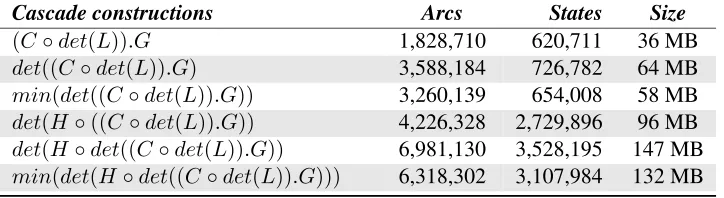
Table 2: WSJ-based WFST cascade characteristics for Sphinx acoustic models. Heremin refers to minimization,
detrefers to determinization, the “◦” operator refers to standard composition, and the “.” operator refers to static look-ahead composition.
Cascade constructions Arcs States Size
(C◦det(L)).G 1,828,710 620,711 36 MB
det((C◦det(L)).G) 3,588,184 726,782 64 MB
min(det((C◦det(L)).G)) 3,260,139 654,008 58 MB
det(H◦((C◦det(L)).G)) 4,226,328 2,729,896 96 MB
det(H◦det((C◦det(L)).G)) 6,981,130 3,528,195 147 MB
min(det(H◦det((C◦det(L)).G))) 6,318,302 3,107,984 132 MB
H-level transducer was utilized in the cascade. Re-cent work such as (Allauzen, 2010) as well as our own recent experiments have shown that SLA
com-position, which omits the det(LG) operation,
per-forms equally well, thus SLA composition was uti-lized in all six cascade constructions.
The command used to generate these cascades was specified as
$ ./transducersaurus.py --tiedlist mdef --amtype sphinx --grammar bcb05cnp-2g.arpa --lexicon bcb05cnp.dic --convert t
--base auto --prefix bcb05s --command "(C*det(L)).G"
and the value of the --command parameter was
simply modified to generate each of the six differ-ent variations. The properties of each of the re-sulting cascades are described in detail in Table 2. The variation in terms of the number of arcs, states and total size clearly indicates the relative effects of applying different optimization operations to the construction process. The simplest construction,
(C ◦det(L)).G results in the smallest cascade in
this case. Subsequent application of determiniza-tion increases the initial size of the cascade, while miniminization again reduces the overall size. This pattern is repeated with the addition of the HMM-level WFST. The set of Sphinx format cascades
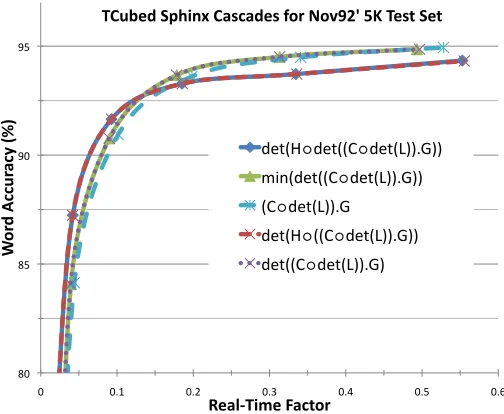
gen-erated with thetransducersaurus.pytool were
sub-sequently evaluated inside of the T3decoder and the
results of these evaluations are described in Figure 5. Although small in this simple task, the effect of optimization techniques can nonetheless still be
clearly seen in the difference between the (C ◦
det(L)).G construction and the determinized and
minimized variants. In general the impact of these optimizations is increased for larger and more
com-plicated models. Nevertheless the gains are not achieved without a cost. In particular each addi-tional call to the determinization and minimization algorithms consumes significant additional comput-ing resources and time. These requirements grow rapidly as the size and complexity of the input mod-els increases. Thus it is pragmatic to strike a bal-ance between development time, resource require-ments and achievable RTF versus WACC. In order to help illustrate this trade-off we also looked at the memory consumption versus time characteristics of
thedet(LG)determinization operation, the standard
C◦(LG) composition, and the SLA composition,
CL.G. The results for the bcb05 cascade used to
evaluate theNov92-5k test set are depicted in
Fig-ure 6, and unequivocally show that the determiniza-tion operadeterminiza-tion is by far the most costly, but also in-dicate the advantages of SLA composition over the standard variant.
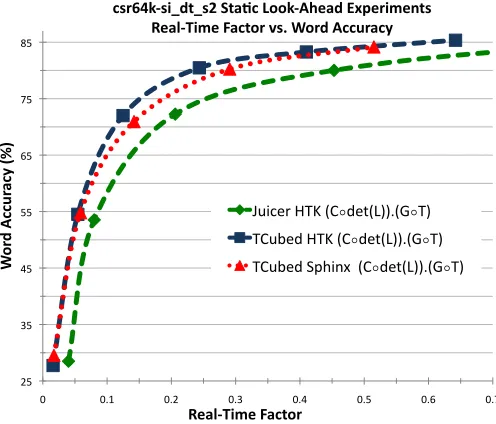
4.3 si dt s2-20kLVCSR Experiments
The second set of experiments involved thesi dt s2
test set, and a much larger 3-gram language model based on the CSR corpus. These experiments were carried out to show that the toolkit is a viable choice not just for small models, but can be used in a straightforward manner to also build very large, ef-ficient cascades. This experiment also illustrates the ability of the toolkit to generate both HTK, and Sphinx based recognition networks and to construct
working cascades for both Juicer and the T3
de-coder. In this case experiments focused on a sin-gle construction scheme; the simple yet effective
(C◦det(L)).Gand the commands utilized to build
informa-!"# !$# %"# %$#
"# "&'# "&(# "&)# "&*# "&$# "&+#
!
"#
$%
&'
'(
#)
'*
%+,-%
./)01234/%5)'6"#%
27(8/$%9:;3<=%7)>')$/>%?"#%@"ABCD%EF%2/>6%9/6%
,-./0⚪,-.//1⚪,-./233&433#
567/,-.//1⚪,-./233&433#
/1⚪,-./233&4#
,-./0⚪//1⚪,-./233&433#
[image:7.612.179.431.59.266.2],-.//1⚪,-./233&43#
Figure 5: Cascade build comparison for the Nov92-5k task using the T3and Sphinx format acoustic models.
!" #!" $!!" $#!" %!!" %#!" &!!" &#!" '!!"
!" #" $!" $#" %!" %#"
!"
#
$%
&'
($
)*
+#
,-$)
'.!/
0'
12#"'.*"($)3*0'
!"#$%&'($)*+#,-$)'.!/0'4*5'12#"'.*"($)3*0'
()(!#"*+,-./0" ()(!#1)23"-4⚪./0" ()(!#15671)23"-4.8/0"
Figure 6: Memory consumption versus time comparison of thedet(LG)operation and SLA versus standard com-position for the bcb05 CLG cascade.
tion regarding arc and state counts as well as overall size is described in Table 3 while RTF versus WACC results for the three tests are illustrated in Figure 7.
5 Discussion
The results from the two experiments provide new empirical evidence supporting previous research re-sults in this area. Rere-sults from Subsection 4.2 show that the toolkit can be utilized to quickly and sim-ply develop a variety of different LVCSR cascades and that build results accurately and reliably
re-Table 3: CSR-based WFST cascade characteristics for HTK and Sphinx models. Both cascades employed a (C◦det(L)).(G◦T)construction scheme.
Cascade Arcs States Size
CSR-64k-HTK 146.4M 92.4M 3.3GB
CSR-64k-Sphinx 143.8M 88.8M 3.2GB
flect previously reported findings. We note that the
HCLG builds converge more slowly, but achieve
the same best WACC at approximately 2x real-time. The SLA composition algorithm is an improve-ment over standard composition (Allauzen, 2010), but the most substantial gains from the alternative
(C ◦det(L)).G build chain result from the ability
to avoid the otherwise costlydet(LG)
determiniza-tion operadeterminiza-tion in a simpleCLGconstruction. In the
[image:7.612.74.300.317.482.2] [image:7.612.315.539.364.408.2]mod-Table 4: Cascade build commands for the si dt s2-20k LVCSR experiments.
$ ./transducersaurus.py --tiedlist mdef --amtype sphinx --grammar lm_csr_64k_nvp_3gram.arpa --base auto --lexicon lm_csr_64k_nvp.dic --prefix bcb05s --convert t --command "(C*det(L)).G"
$ ./transducersaurus.py --tiedlist tiedlist --hmmdefs hmmdefs --amtype htk --grammar lm_csr_64k_nvp_3gram.arpa --base auto --lexicon lm_csr_64k_nvp_3gp-htk.dic --prefix csr64kh
--convert t --command "(C*det(L)).G"
els, which permit a smaller degree of sharing, thus resulting in a larger increase in size following
deter-minization in theC◦det(L◦G)construction. The
small performance variation among the AM types
and T3 versus Juicer again suggest that there is not
much technical motivation to overtly favor any par-ticular combination. Rather the availability of re-sources and existing expertise should guide devel-opment choices.
Finally, the T3 decoder also supports GPU-based
computation of acoustic likelihood scores, and these results have been reported in several previous works. We note however, that application of GPU-based acoustic scoring, when available tends to provide the strongest single speedup, and that use of the
more computationally intensive logsum operation
versus the standardlogmaxalso tends to boost
max-imum accuracy. This implies that SLA composition, combined with GPU-based acoustic scoring and a
comparatively simple (C ◦det(L)).G build chain
provides highly competitive results. This strikes a strong balance between RTF, WACC, memory and storage requirements and overall build time. Further savings in terms of memory requirements, storage and build time can be gained from performing the lookahead composition on-the-fly at decoding time.
6 Conclusion and Future Work
In this work we have introduced Transducersaurus, a new open source software toolkit for building and manipulating WFST-based ASR cascades. The
toolkit provides integrated support for the T3 and
Juicer WFST decoders and both HTK and Sphinx acoustic models, and supports construction of the
H,C,L,G, andTcomponent WFSTs. We showed
the effectiveness of the toolkit on a variety of differ-ent tasks, looking at both construction variants on a simple set of inputs, and performing a decoder and
acoustic model cross comparison on a much larger task. Furthermore we have provided a detailed ex-planation of the SLA build process as it is supported by the toolkit along with its merits. The ASR ap-plication development process is often iterative, and these results reinforce the idea that by utilizing a simplified build chain and the SLA composition ap-proach, overall efficiency can be greatly improved at little or no cost to either the RTF or WACC of a particular recognition network.
In future we plan to further expand the range of available operations, and expand the current lim-ited DSL build syntax, provide integrated support for out-of-vocabulary words, and introduce parallel support for the AT&T fsmtools. Experiments look-ing at a much wider variety of languages and model inputs currently in the planning phase. Although the toolkit is still in the early stage of development we hope that it will facilitate learning as well as more efficient work in this area, and promote further dis-cussion.
At present the Transducersaurus toolkit can be downloaded freely from the location listed in (No-vak, 2011), and is available under the terms of the liberal BSD license.
References
Mehryrar Mohri 1997. Finite-State Transducers in Lan-guage and Speech Processing, in Computational Lin-guistics, Vol. 23, Issue 2.
Mehryar Mohri and Michael Riley. 1999. Network op-timizations for large-vocabulary speech recognition, Speech Communication, Vol. 28, Issue 1.
Mehryar Mohri, Fernando Pereira and Michael Riley. 2002. Weighted finite-state transducers in speech recognition, Computer Speech and Language, Vol. 16, Issue 1.
!"# $"# %"# ""# &"# '"# ("#
)# )*+# )*!# )*$# )*%# )*"# )*&# )*'#
!
"#
$%
&'
'(
#)
'*
%+,-%
./)01234/%5)'6"#%
'7#89:173;$6;7<%=6)>'%?"":1&@/)$%ABC/#34/D67% ./)01234/%5)'6"#%E7F%!"#$%&''(#)'*%
[image:9.612.181.429.58.270.2],-./01#234#56⚬70859::*5;⚬3:# 36-<07#234#56⚬70859::*5;⚬3:# 36-<07#=>?.@A##56⚬70859::*5;⚬3:#
Figure 7: Cross comparison for the si dt s2-20k task using the T3 and Juicer decoders, Sphinx and HTK format acoustic models on the 3-gram CSR LM-1 language model.
Roark. 2004. A Generalized Construction of In-tegrated Speech Recognition Transducers, in Proc. ICASSP, pp. 761-764.
Mehryar Mohri, Fernando Pereira and Michael Riley. 2008. Speech recognition with weighted finite-state transducers, Springer Handbook of Speech Process-ing, pp. 1-31.
Josef Novak. 2011.
code.google.com/p/transducersaurus/
Steve Young, Gunnar Evermann, Dan Kershaw, Gareth Moore, Julian Odell, Dave Ollason, Valtcho Valtchev and Phil Woodland. 2006. The HTK Book (for HTK Version 3.2),” Cambridge University Engineering De-partment.
Willie Walker, Paul Lamere, Philip Kwok, Bhiksha Raj, Rita Singh, Evandro Gouvea, Peter Wolf and Joe Woelfel. 2004. Sphinx-4: A flexible open source framework for speech recognition, Sun Microsystems Technical Report, TR-2004-139.
Paul Dixon, Diamantino Caseiro, Tasuka Oonishi and Sadaoki Furui. 2007. The Titech Large Vocabulary WFST Speech Recognition System, in Proc. ASRU, pp. 1301-1304.
Darren Moore, John Dines, Mathew Magimai Doss, Jithendra Vepa, Octavian Cheng and Thomas Hain. 2005. Juicer: A Weighted Finite State Transducer Speech Decoder, in Proc. Interspeech, pp. 241-244. Douglas Paul and James Baker. 1992. The Design for
the Wall Street Journal-based CSR Corpus, in Proc. ICSLP 92, pp. 357-362.
Cyril Allauzen, Mehryar Mohri and Brian Roark. 2003.
Generalized Algorithms for Constructing Language Models, in Proc. ACL, pp.40-47.
Josef Novak, Paul Dixon and Sadaoki Furui. 2010. An Empirical Comparison of the T3, Juicer, HDecode
and Sphinx3 Decoders, in Proc. InterSpeech 2010, pp. 1890-1893.
Cyril Allauzen, Michael Riley and Johan Schalkwyk. 2009. A Generalized Composition Algorithm for Weighted Finite-State Transducers, InterSpeech 2009, pp. 1203-1206.
George Doddington. 1992. CSR Corpus Development, DARPA SLS Workshop,” pp. 363-366.
Keith Vertanen. 2006. Baseline WSJ Acoustic Models for HTK and Sphinx: Training Recipes and Recogni-tion Experiments, Cavendish Laboratory, University of Cambridge.