
A Proposal for a Spanish Surface Realization Shared Task
Pablo Gerv´as and Miguel Ballesteros
Departamento de Ingenier´ıa del Software e Inteligencia Artificial Universidad Complutense de Madrid
Madrid, 28040 Spain
[email protected], [email protected]
Abstract
We propose a competitive shared evalua-tion task for Surface Realizaevalua-tion in Span-ish. The task would be carried out in 2012. It would involve the generation of text in Spanish from a common ground input shared by all systems. Separate corpora for train-ing/development (composed of pairs of com-mon ground input and expected string result) and testing (only common ground input) will be provided. Automatic evaluation procedures will be provided. Submitted results will also be subject to human evaluation. The present proposal is tentative in two different ways. First, the authors intend to revise the proposal in view of the experience and feedback of the Surface Realization Pilot Task currently in process for English, once its results are made public (due in September, 2011). Second, the authors are willing to colaborate both with organizers of equivalent tasks for other lan-guages or more researchers interested in sur-face realization for Spanish.
1 Background
Two main arguments motivate this proposal: the generally accepted need of establishing comparative forms of evaluation for NLG, and the overarching trend in NLP to extend tools and resources to lan-guages other than English. In the context of the present call for proposals it should not be necessary to argue in favour of the first motivation. Interested readers can be referred to (Belz et al., 2010) and to the call for proposals itself for cogent argumentation on this point.
Regarding the second motivation, it can be de-fended by analogy with observed trends in Natural Language Analysis (NLA). The field of NLA has experienced a significant boom as a result of the suc-cess of statistical approaches. Crucial to this effort was the development of annotated corpora suscepti-ble of being used for training. The existence of these corpora has made it possible to develop a large num-ber of applications based on machine-learning. But this effort has been restricted to the languages for which corpora were available. This restriction has led to imbalances in the coverage that these tools provide across different languages, with a prolif-eration of tools for English and scarcity for many other languages. A large number of research efforts have been devoted in recent times to correct this im-balance, with researchers, universities, governments and international institutions focused on extending coverage to other languages. It would be a pity if a similar situation is allowed to arise in the field of NLG. The present call for proposals is designed to contribute to the development of a consensus in the use of comparative forms of evaluation in NLG. As such, it should include as soon as possible an effort to address the issue of extension of these methods to other languages.
Another argument in favour of extending these exploratory efforts to other languages can be found in the proliferation of statistical approaches to Sur-face Realization. Statistical approaches, in contrast to more knowledge-based approaches, should al-low rapid development of solutions for alternative languages with little effort, provided the necessary training corpora are available.
Finally, once comparative forms of evaluation start being available, generic observations concern-ing relative the merit of different approaches are likely to arise, such as for instance, empirical ob-servations on whether statistical or rule-based ap-proaches perform better. For the sake of complete-ness, it becomes important that any such observa-tions be well founded on comparative studies across different languages. As an example, constituent-based parsing was prevalent for many years in com-putational approaches to languages while English was the primary object, and yet lost ground very quickly to dependency-based analyses once lan-guages with more complex word order started to be considered. An effort should be made to avoid any similar oversight in Surface Realization.
Spanish is a good candidate as an alternative lan-guage for several reasons. First, it is widely used in the world, so any development efforts are likely to have potential application and a large market. Sec-ond, it differs from English sufficiently enough to provide a comparative view point. Issues that may introduce difficulties from the surface realization point of view include: long-range agreement in gen-der, more complex morphology of verbs, pronouns, nouns and adjectives. Gender agreement is particu-larly significant in languages were words have lexi-cal gender as well as conceptual gender. In Spanish, different synomyms that refer to the same concept can be masculine or femenine, irrespective of the gender of the concept (which may even be neuter in gender). Spanish requires gender agreement be-tween nouns and any accompanying adjectives, and between subjects and attributes in copulative sen-tences. Third, resources exist in Spanish that can be used as source for the development of a surface re-alization corpus. Finally, surface realizers have been developed for Spanish in the past, so it should be possible to compare modern approaches with earlier knowledge-based ones.
On the availability of surface realizers for Span-ish, two classic surface realizers – FUF (Elhadad and Robin, 1992) and KPML (Bateman, 1995) – have a version for Spanish. These realizers have been deployed in applied contexts. A version of Surge adapted for Spanish was used for story narration (Callaway et al., 1999) although the coverage is in-ferior to the English original version. A Spanish
ver-sion of KPML was applied in a chemistry querying system (Aguado et al., 1998). Melero (2006) com-bined rule–based approaches and machine–learning approaches for Spanish syntactic generation. This system was developed for a commercial machine– translation, the input was a deep syntactic represen-tation and the output was grammatically aceptable text written in Spanish language.
Section 2 outline specifically our proposal con-sidering the organization, data, evaluation and input/output representations. Finally, Section 3 presents some conclusions.
2 Our Shared Task Proposal
Surface realization normally requires an important quantity of knowledge about the structure of the tar-get language, usually represented as a set of gram-mar rules or other linguistic constraints. Taking all of this into account and in order to continue provid-ing a common forum for these activities, we propose the tools to include Spanish in a Surface Realization Task. In this Section we discuss specifically our pro-posal considering the organization, data, evaluation and input/output representations.
2.1 Data to be used
The data sets will be based on the Spanish An-Cora corpus that was provided as training set for the CoNLL–2009 shared task. We will process this cor-pus to obtain a format suitable for the surface real-ization task.
2.1.1 AnCora Corpus: CoNLL 2009 Shared Task Data
source the Cast3lb constituency treebank (Civit et al., 2006). It is the Spanish corpus provided for the CoNLL–2009 shared task1on “Syntactic and
Se-mantic Dependencies in Multiple Languages” (Hajiˇc et al., 2009).
We have contacted the Clic research group and we have their approval for carrying out the present pro-posal. They have suggested we may be able to use a forthcoming revised version of the AnCora corpus.
2.1.2 Our Future Data
Our future SR Task data will be derived from the CoNLL 09 AnCora corpus. We will process and adapt the treebank to make it useful for the gener-ation task. It is expected that the actual format taken by this data wil depend largely on the insights ob-tained from the Surface Realization Pilot Task for English currently taking place during 2011.
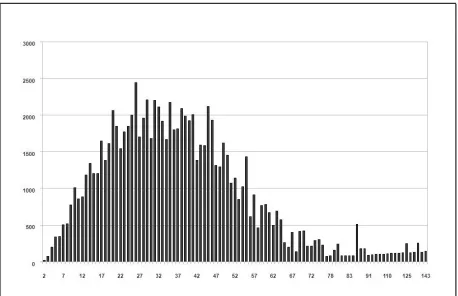
[image:3.612.72.301.460.608.2]It is worth to emphasize that AnCora contains a wide range of sentence lengths, though most of them are between 20 and 50 wordforms. This provides a good benchmark for a surface realization task, with realizations over a broad range of lengths. More-over, as it is shown in (Gardent and Kow, 2006) sur-face realization is exponential in the length of the input. This makes the AnCora corpus very suitable for this proposal. Figure 1 shows the distribution of sentences in the AnCora corpus according to their length.
Figure 1: Distribution of sentences in the AnCora corpus according to their length. The x axis represents length and the y axis the approximate number of sentences.
We hope to produce two types of input represen-tations, following the guidelines presented in (Belz
1http://ufal.mff.cuni.cz/conll2009-st/task-description.html
et al., 2010), one shallow and one deep. For both shallow and deep representations relations will be randomly sorted and sentences will have single sen-tence roots.
• Shallow Dependency Input
The shallow representation will include the de-pendency syntactic tree for every piece of text that is included in the CoNLL’09 data format. The information at each node will consist of a word’s lemma, a number and a tense feature, and a coarse–grained POS-tag derived from the AnCora annotation. The edges between nodes will be labeled with the syntactic dependency annotations in the AnCora corpus.
We have manually developed a transformation to the CoNLL’09 data format into the shallow representation, following the guidelines of the Surface Realisation Shared Task currently tak-ing place in 2011. Figure 2 shows the output of our transformation for the sentence example:
Y, en la mesa, se acab´o eso de usar los palillos una sola vez y tirarlos [And, at the table, no more using the toothpicks once and throw them out], the representation follows the same struc-ture as the release of the current English Shared Task. It contains only lemmas and shallow de-pendency relations between nodes.
If the forthcoming version of the AnCora cor-pus has a different data format and we decide to use it, we would have to modify the transfor-mation or adapt the data to the expected output.
• Deep Semantic InputThe deeper representa-tion will be constructed by adding to the Shal-low representation the semantic annotation in-cluded in the CoNLL’09 data format. There-fore, the information at each node will con-sist of a word’s lemma, a number and a tense feature, and the sense tag (semantic tag). An, as done in (Belz et al., 2010), there will be no POS–tag information. The edges between nodes will be labeled with semantic labels derived from the AnCora annotation for the CoNLL’09 Shared Task.
Figure 2: Shallow transformation of the following AnCora sentence:Y, en la mesa, se acab´o eso de usar los palillos una sola vez y tirarlos [And, at the table, no more using the toothpicks once and throw them out]
the syntactic level (around 60 syntactic tags), and introduce temporary semantic tags in or-der to facilitate the mapping to the deeper levels (shallow and deep semantics) (Mille and Wan-ner, 2010). In this way, with their work and the forthcoming version of AnCora (Mariona’s work) we should have a robust corpus that will be suitable for the generation task.
2.2 Evaluation
Evaluating surface realization is intrinsically diffi-cult, due to the fact that there is usually no a single correct answer, but rather a range of possible correct answers, some of them better than others. To address this problem, based on the data resources described above we intend to develop evaluation techniques based on Fluency, Clarity and Appropriateness that take this difficulty into account. To this end, outputs will be evaluated by a variety of automatic metrics and human–assessed quality criteria.
We intend to revise this aspect of the proposal based on feedback from the SR pilot task for En-glish. In principle, the evaluation techniques and methodology developed for English should be ap-plicable to Spanish with little or no modification.
3 Conclusion
In this paper, we have proposed a Shared Task for Surface Realization of Spanish, as done in (Belz et
al., 2010). The aim of the proposal is to extend the resources and techniques developed this year for the English Surface Realization Shared Task 2011 to a different language. This should test the techniques beyond the scope for which they were developed and provide resources for the development of surface re-alizers in a different language.
This proposal could be undertaken as a stand alone task, in tandem with the second iteration of the surface realization task for English, or as part of a multilingual shared task for surface realization. In general terms, the spirit of this proposal is that the use of languages, other than English, in NLG should be promoted. The authors are willing and qualified to provide or recruit the knowledge nec-essary to build the Spanish data and to evaluate the different participant systems.
We have developed a webpage2, in which we
ex-plain our proposal and we invite people to collab-orate in the task. In response to a recent call for expression of interest in this task we have received replies from research groups interested both in sub-mitting and in colaborating in the development of the task.
Acknowledgments
This research is funded by the Spanish Ministry of Education and Science (TIN2009-14659-C03-01
Project), Universidad Complutense de Madrid and Banco Santander Central Hispano (GR58/08 Re-search Group Grant). We also want to thank Anja Belz, Bernd Bohnet, Simon Mille, Mariona Taul´e, Leo Wanner and Michael White for their help, col-laboration and availability.
References
G. Aguado, J. Bateman, S. Bernardos, M. Fern´andez, A. G´omez-P´erez, E. Nieto, A. Olalla, and A. S´anchez. 1998. Ontogeneration: Reusing domain and linguistic ontologies for spanish text generation. InProc. ECAI. Workshop on Applications of Ontologies and Problem Solving Methods.
John A. Bateman. 1995. Basic technology for multilin-gual theory and practise: the kpml development envi-roment. InProc. IJCAI-95 Workshop on MULTILIN-GUAL TEXT GENERATION, pages 1–12.
Anja Belz, Mike White, Josef van Genabith, Deirdre Hogan, and Amanda Stent. 2010. Finding com-mon ground: towards a surface realisation shared task. In Proceedings of the 6th International Natural Lan-guage Generation Conference, INLG ’10, pages 268– 272, Stroudsburg, PA, USA. Association for Compu-tational Linguistics.
Charles B. Callaway, Brent H. Daniel, and James C. Lester. 1999. Multilingual natural language genera-tion for 3d learning environments. InIn Proceedings of the 1999 Argentine Symposium on Artificial Intelli-gence, pages 177190, Buenos Aires, pages 177–190. Montserrat Civit, Maria Ant`onia Mart´ı, and N´uria Buf´ı.
2006. Cat3lb and cast3lb: From constituents to de-pendencies. InFinTAL, pages 141–152.
Michael Elhadad and Jacques Robin. 1992. Controlling content realization with functional unification gram-mars. In Proceedings of the 6th International Work-shop on Natural Language Generation: Aspects of Au-tomated Natural Language Generation, pages 89–104, London, UK. Springer-Verlag.
Claire Gardent and Eric Kow. 2006. Three reasons to adopt tag-based surface realisation. InProceedings of the Eighth International Workshop on Tree Adjoining Grammar and Related Formalisms, TAGRF ’06, pages 97–102, Stroudsburg, PA, USA. Association for Com-putational Linguistics.
Jan Hajiˇc, Massimiliano Ciaramita, Richard Johans-son, Daisuke Kawahara, Maria Ant`onia Mart´ı, Llu´ıs M`arquez, Adam Meyers, Joakim Nivre, Sebastian Pad´o, Jan ˇStˇep´anek, Pavel Straˇn´ak, Mihai Surdeanu, Nianwen Xue, and Yi Zhang. 2009. The CoNLL-2009 shared task: Syntactic and semantic depen-dencies in multiple languages. In Proceedings of
the 13th Conference on Computational Natural Lan-guage Learning (CoNLL-2009), June 4-5, Boulder, Colorado, USA.
Maria Teresa Melero Nogu´es. 2006.Combining machine learning and rule-based approaches in Spanish syn-tactic generation. Ph.D. thesis.
Simon Mille and Leo Wanner. 2010. Syntactic depen-dencies for multilingual and multilevel corpus annota-tion. Valletta (Malta), 05/2010.
![Figure 2: Shallow transformation of the following AnCora sentence: Y, en la mesa, se acab´o eso de usar los palillosuna sola vez y tirarlos [And, at the table, no more using the toothpicks once and throw them out]](https://thumb-us.123doks.com/thumbv2/123dok_us/1537646.697765/4.612.106.506.61.231/figure-shallow-transformation-following-sentence-palillosuna-tirarlos-toothpicks.webp)