Minimally Supervised Domain-Adaptive Parse Reranking for
Relation Extraction
Feiyu Xu, Hong Li, Yi Zhang, Hans Uszkoreit, Sebastian Krause
DFKI, LT-Lab, Germany
{feiyu,lihong,Yi.Zhang,uszkoreit,sebastian.krause}@dfki.de
Abstract
The paper demonstrates how the generic parser of a minimally supervised informa-tion extracinforma-tion framework can be adapted to a given task and domain for relation ex-traction (RE). For the experiments a generic deep-linguistic parser was employed that works with a largely hand-crafted head-driven phrase structure grammar (HPSG) for English. The output of this parser is a
list ofnbest parses selected and ranked by
a MaxEnt parse-ranking component, which had been trained on a more or less generic HPSG treebank. It will be shown how the estimated confidence of RE rules learned
from the n best parses can be exploited
for parse reranking. The acquired rerank-ing model improves the performance of RE in both training and test phases with the
newfirst parses. The obtained significant
boost of recall does not come from an over-all gain in parsing performance but from an application-driven selection of parses that are best suited for the RE task. Since the readings best suited for successful rule ex-traction and instance exex-traction are often not the readings favored by a regular parser evaluation, generic parsing accuracy actu-ally decreases. The novel method for task-specific parse reranking does not require any annotated data beyond the semantic seed, which is needed anyway for the RE task.
1 Introduction
Domain adaptation is a central research topic for many language technologies including informa-tion extracinforma-tion (IE) and parsing (e.g., (Grishman and Sundheim, 1996; Muslea, 1999; Hara et al., 2005; McClosky et al., 2010; Miwa et al., 2010)). The largest challenge is to develop methods that
exploit domain knowledge with minimal human effort.
Many IE systems benefit from combining generic NLP components with task-specific ex-traction methods. Various machine learning ap-proaches have been employed for adapting the IE methods to new domains and extraction tasks (e.g., (Yangarber, 2001; Sudo et al., 2003; Greenwood and Stevenson, 2006)). The IE framework ex-tended in this paper utilizes minimally supervised learning of extraction rules for the detection of re-lation instances (Xu et al., 2007). Since the min-imally supervised learning starts its bootstrapping from a few semantic examples, no treebanking or any other annotation is required for new domains. In addition to this inherently domain-adaptable rule-learning component, the framework also em-ploys two language analysis modules: a named-entity (NE) recognizer (Drozdzynski et al., 2004) and a parser (Lin, 1998; de Marneffe and Man-ning, 2008). NE recognizers are adapted to new domains–if needed–by adding rules for new NE types and extending the gazetteers. The employed generic data-driven dependency parsers or deep-linguistic handcrafted parsers have not yet been adapted to IE domains and tasks.
The new work presented here concerns the adaptation of a generic parser to a given relation extraction (RE) task and domain without actually changing the parser itself. For the experiments a generic deep-linguistic parser was used together with a hand-crafted HPSG (Pollard and Sag, 1994) grammar for English (ERG) (Flickinger, 2000). The output of this parser is a list ofnbest parses selected and ranked by a MaxEnt parse-ranking component (Toutanova et al., 2005b), which had been trained on a generic HPSG treebank (Oepen et al., 2002). The parse ranking had attracted our
attention because the first RE tests with the hand-crafted grammar revealed recall problems even for the parsable relation mentions. Our suspicion to partially blame the generic parse selection was confirmed by our experiments.
In this paper we will show how the estimated confidence of rules learned from thenbest parses can be exploited for task-specific parse reranking. The acquired reranking model improves the per-formance of RE both in training and test phases. The task-driven reranking leads to significantly better RE recall by boosting readings that are bet-ter suited for RE rule extraction and rule appli-cation. The beneficial reranking does not im-prove the quality of parsing measured by task-independent performance criteria, not even for the IE domain. The validation of the adapted parser using a hand-checked HPSG treebank of in-domain texts rather shows a deterioration of pars-ing accuracy. But often the incorrect parses se-lected over less faulty parses support the correct detection of instance mentions.
The novel method for task-specific parse reranking does not require any annotated data be-yond the semantic seed, needed anyway for the RE task. Thus it does not require a domain-specific treebank.
The paper is organized as follows. Section 2 describes the grammar and the associated parse se-lection model. Section 3 introduces the RE frame-work. Section 4 explains the new task/domain-oriented reranking approach. Section 5 presents the experiments and evaluations. Special empha-sis is placed on the role of reranking for the per-formance of the RE system. Section 6 discusses related work. Finally, Section 7 summarizes the results and suggests directions for further research.
2 HPSG and Parse Selection Model
Recent progress in parsing has several sources. The most noticeable trend is the shift from pure symbolic rule-based approaches toward statistical parsing. The availability of large-scale treebanks has enabled the training of powerful data-driven parsers, some based on constituency others on de-pendency. Meanwhile, existing hand-crafted pre-cision oriented linguistic grammars have also ben-efitted from empirical methods through new dis-ambiguation models trained on treebanks.
Among the available deep linguistic grammars, ERG is a good representative of the state of the art. Its lexicon contains ∼35K entries. The 1004
re-lease of the grammar we use is accompanied by a maximum-entropy-based parse disambiguation model trained on the Redwoods Treebank (Oepen et al., 2002), a treebank of∼20K sentences with mixed genre texts (dialogs, tourist information, emails, etc). The discriminative log-linear disam-biguation model scores each parse by the follow-ing (Toutanova et al., 2005b),
P(t|w) = exp
Pn
i=1λifi(t, w)
P
t0∈T(w)exp
Pn
i=1λifi(t0, w) (1)
where w is the given input sentence and t is the HPSG reading; T(w) is the set of all possible readings for a given sentence w licensed by the grammar; hf1, . . . , fni andhλ1, . . . , λni are fea-ture functions and their corresponding weights. In practice, the effective features are defined on the HPSG derivation trees (without details from the feature structures), and the best readings are de-coded efficiently from a packed parse forest with dynamic programming (Zhang et al., 2007).
Although there are indications that parsers with hand-written grammars usually suffer less from the shift of domain than statistical parsers (Zhang and Wang, 2009; Plank and van Noord, 2010), the effect can still be observed, say in the preference of lexical selection. The issue is not that the cor-rect analysis would be ruled out by the constraints in the treebank-induced grammar, but rather that it is not favored by the statistical ranking model, since the statistical distribution of the syntactic structures in the training corpus is different from the target application domain. This issue is re-cently acknowledged in most parsing systems and known as the domain adaptation task.
3 DARE and Confidence Estimation
further iterations. The confidence values of the newly acquired rules and instances are calculated in the spirit of the ”Duality principle” (Brin, 1998; Agichtein and Gravano, 2000; Yangarber, 2001), i.e., the confidence values of the rules are de-pendent on the truth value of their extracted in-stances and on the seed inin-stances from which they stem. The confidence value of an extracted in-stance makes use of the confidence value of its ancestor seed instances. The core system architec-ture of DARE is depicted in Figure 1. The entire bootstrapping stops when no new rules or new in-stances can be detected.
Figure 1: DARE core architecture
Relying entirely on semantic seeds as domain knowledge, DARE can accommodate new relation types and domains with minimal effort. Since we had already reported on experiments applying the framework to different relation types and corpora including MUC-6 data in the cited papers, includ-ing comparisons with other ML approaches to RE (Xu, 2007; Uszkoreit et al., 2009), we omit a com-parative discussion here.
For confidence estimation, the method proposed by Xu et al. (2010) is adopted.1 Actually, in (2) we propose an extended version of the rule scor-ing, since the rule scoring in (Xu et al., 2010) did not consider the case when a learned rule does not extract any new instances. Thus, given the scoring of instances, the confidence value of a rule is the average score of all instances (Iextracted) extracted
by this rule or the average score of seed instances (Irule) from which they are learned. Through the
factorδ we reduce the score of rules that have not proven yet their potential for extracting instances.
1The actual confidence estimation is slightly more
com-plex because it further improves the scoring by utilizing im-plicit negative evidence provided by closed-world seeds, a method proposed by (Xu et al., 2010). As this mechanism is not relevant in the context of this paper, we omit a descrip-tion.
confidence(rule) =
P
i∈Iextractedscore(i)
|Iextracted| ifIextracted 6=φ
P
j∈Irulescore(j)
|Irule| ×δ ifIextracted =φ
where Iextracted =getInstances(rule),
Irule =getMotherInstancesOf(rule),
δ= 0.5
(2)
This method allows DARE to estimate the con-fidence value of a rule according to its extraction performance or the confidence value of its origin.
4 Domain Adaptive Parse Reranking
4.1 Basic Idea
In our research, we observe that there is a strong connection between the RE task and the parser via the learned extraction rules, because these rules are derived from the parse readings. The confi-dence values of the extraction rules imply the do-main appropriateness of the parse readings. There-fore, the confidence values can be utilized as feed-back to the parser to help it to rerank its readings.
[image:3.595.74.284.253.370.2]4.2 Reranking Architecture and Method
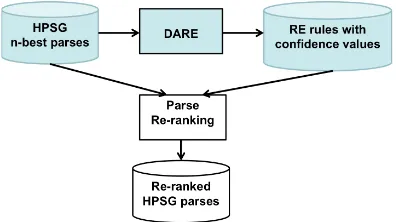
Figure 2 depicts the overall architecture of our experimental system. We utilize the HPSG to parse our experimental corpus and keep the first
nreadings of each sentence (e.g., 256) delivered by the parser. During bootstrapping DARE tries to learn extraction rules from all readings of sen-tences containing a seed instance or newly de-tected instances. At each iteration the extracted rules are applied to all readings of all sentences. When bootstrapping has terminated, the obtained rules are assigned confidence values based on the DARE ranking method described in Section 3.
[image:3.595.316.514.614.725.2]The parse reranking component scores the alter-native parses of each sentence based on the confi-dence values of the rules matching these parses, i.e., all rules that could have been extracted from a parse or successfully applied to it.
For each reading from the HPSG parser, the reranking model assigns a numeric score by the following formula:
S(t) =
P
r∈R(t)(confidence(r)−φconfidence)
if R(t)6=φ,
0
if R(t) =φ. (3)
R(t) is the set of RE rules matching parse read-ingt, andφconfidenceis the average confidence score among all rules. The score of the read-ing will be increased if the matchread-ing rule has an above-average confidence score. And the match-ing of low-confidence rules will decrease the read-ing’s reranking score. If a reading has no matching DARE rule, it will be assigned the lowest score 0, for no potential relation can be extracted from that reading.
After the calculation, the top-n readings are sorted in descending order. In case two or more readings received the same reranking score (e.g. by matching the same set of DARE rules), the original maximum entropy-based disambiguation scores are used as a tie-breaker. The sort compari-son function is shown below:
Algorithm 1compare readings(ri,rj)
ifcompare(S(ri),S(rj))6= 0then
return compare(S(ri),S(rj))
else# Tie-breaking with MaxEnt scores
return compare(M axEnt(ri),M axEnt(rj))
end if
In practice, most readings will have no more than two matching DARE rules. And many read-ings from the HPSG parser do not affect the RE task. A consequence is that the reranking model can only partially disambiguate and have an effect only on particular subsets of the readings. As we are only evaluating RE performance, the remain-ing ambiguity is not an issue.
5 Experiments and Evaluation
5.1 Experiment and Evaluation Setup
Data For several reasons we decided to conduct our experiments on the Nobel Prize award corpus used also in (Xu et al., 2007). Previous results have shown that
1. not every data collection is suited for the minimally supervised approach to RE (Xu, 2007);
2. freely available Nobel Prize award corpus ac-tually has the required properties (Uszkoreit et al., 2009).
Moreover, the availability of a version of the corpus in which all relation mentions are labelled and a treebank for a subset of the corpus have greatly facilitated the evaluation.
The target relation is prize-awarding event, namely, a relation among four arguments: WIN
-NER, PRIZE NAME, PRIZE AREA and YEAR. We take the same seed example as utilized in (Xu et al., 2007), namely, the 1999 Nobel Chemistry win-ner Ahmed H Zewail in our experiments2. The seed looks like an database recond:
hAhmed H Zewail, N obel, Chemistry, 1999i
The corpus contains 2864 documents from BBC, CNN and NYT, together 143289 sentences. ERG covers around 70% sentences of the total cor-pus. For our experiments we randomly divide the parsable corpus into two parts: training and test corpus, each containing the same number of sen-tences. The average sentence length of the to-tal corpus is around 20 words. If we look at the domain relevant sentences, namely, those contain both person name mentions and prize name men-tions, they have an average length of around 30. Among those relevant ones, the average length of the sentences parsable by ERG is around 25.
Experiments Two phases of experiments are conducted. In the training phase, we show that reranking improves RE performance. The test
phase applies the reranking model resulting from the training phase to the test corpus. In both phases, two different experiments are conducted
1) Baseline: without reranking;2) reranking: with
parse reranking. In the baseline experiment, we
2
keep the first n readings of all sentences and run DARE for rule learning and RE on top of these readings. The aim is to observe whether correct relation instances can also be detected in lower-ranked readings. In the second experiments, we aim to investigate whether reranking based on task-feedback and domain knowledge is use-ful for better extraction performance. These ex-periments are conducted only with the best read-ing after rerankread-ing, i. e. the normal settread-ing of RE application. In none of the experiments, confi-dence thresholds are employed for improving pre-cision by filtering out less confident rules or in-stances. As we are mainly interested in the ef-fects of reranking on RE recall, we are trying to avoid any other factors that may influence the re-call. Thus in our experiments confidence estima-tion scores are only used for reranking.
Qualitative Analysis Given the experimental results, we carry out various qualitative analysis on the results of both parsing and RE. With respect to parsing, we evaluate the results against the gold-standard treebank before and after reranking. In addition we evaluate the quality of the extraction rules before and after the reranking.
5.2 Experiments
5.2.1 Training
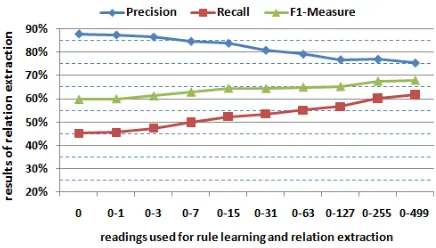
Baseline Figure 4 shows the baseline evaluation results. In this case, no confidence thresholds are applied, therefore we have neither reranking nor filtering. In order to monitor the contribution of lower-ranked parses to RE, we add readings in log-arithmic increments. We start with one reading, namely the best reading proposed by the parser and then in steps go up to 500. From each read-ing, DARE tries to learn rules and to extract rela-tion instances. When DARE only works with the best reading, the precision is very high, namely, 87.83%, but with a very low recall of 45.18%. When we increase the number of readings, we ob-serve that precision drops while recall increases. This confirms our suspicion that many good read-ings are among the lower ranked ones in the cur-rent maximum entropy-based parse model. There-fore, reranking is important for lifting the good readings to the top.
Reranking In the training phase, we learn DARE rules from all 500 readings from all sen-tences in the training corpus. Given the rules and their confidence values, we rerank the 500
read-Figure 4: Training phase (baseline): RE perfor-mance w.r.t. the increase of readings
ings of each sentence in this corpus.
Reading 0 Precision Recall F1-Measure Baseline (no reranking) 87.83% 45.18% 59.66% After reranking 83.87% 56.19% 67.29%
Table 1: Training phase: Comparison of RE per-formance before and after reranking.
Table 1 compares the RE performance with just the first reading before reranking (baseline experiment) and after reranking. As indicated, the reranking strongly improves the recall value (56.19% vs. 45.18%) and also yields a signifi-cantly better F-measure (67.29% vs. 59.66%).
[image:5.595.306.524.62.186.2]Figure 5 illustrates the behavior of parse read-ings with respect to the respective frequencies of matches with extraction rules (indicating their use-fulness for rule or instance extraction). After reranking, the number of the higher ranked read-ings that match with the RE rules is increased sig-nificantly. This indicates that the higher ranked readings after reranking are better suited for the RE task.
[image:5.595.307.523.582.705.2]egyp%an
egyp%an_a1 scien%st_n1 scien%st generic_proper_ne Ahmed generic_proper_ne Zewail win_v1 won the_1 the generic_year_ne 1999 nobel_n1 nobel for for chemistry_n1 chemistry
aj-hdn_norm_c
np_hdn_ttl-cpd_c
np_hdn_nme-cpd_c sb-hd_mc_c
prize
prize_n1
np-hdn_cpd_c np-hdn_cpd_c sp-hd_n_c hd_cmp_u_c hd_aj_int-unsl_c
hd_cmp_u_c
reading r0
reading r2
egyp%an
egyp%an_a1
hd_cmp_u_c
scien%st
scien%st_n1 generic_proper_ne Ahmed generic_proper_ne Zewail win_v1 won the_1 the generic_year_ne 1999 nobel_n1 nobel for for chemistry_n1 chemistry
aj-hdn_norm_c
np_hdn_ttl-cpd_c
np_hdn_nme-cpd_c sb-hd_mc_c
prize
prize_n1
np-hdn_cpd_c np-hdn_cpd_c sp-hd_n_c
[image:6.595.73.528.68.214.2]hd_cmp_u_c hd_cmp_u_c
Figure 3: An example of ambiguous parses with PP attachment
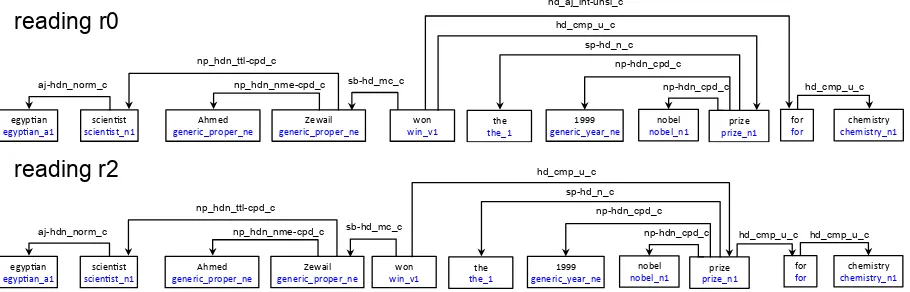
reranking Examples In our experiment, we uti-lize the syntactic derivation tree of the HPSG anal-ysis. Figure 3 shows two derivation trees of a sen-tence (4) from the experimental domain corpus.
(4) Egyptian scientist Ahmed Zewail won the 1999
Nobel Prize for Chemistry
In Figure 3, in the first readingr0the PP“for
chemistry”is wrongly attached to the verb“win”,
while r2 (the third reading) is more appropriate since the PP here modifies the noun“prize”. The DARE rule in Figure 6 is presented as a typed fea-ture strucfea-ture, which is learned from HPSG parses. The value of its feature PATTERN contains the derivation tree structures relevant for the target re-lation, while the value of the feature OUTPUT
represents the co-indexing between the semantic arguments of the target relation and the linguistic arguments inPATTERN. Since this rule has a high confidence value and it matches the readingr2,r2
is pushed to the top after reranking.
rule_30
PATTERN pattern
HEAD (“win_v1”)
SB-HD_MC_C sb-hd_mc_c
HEAD 0 <person>
HD-CMP_U_C
hd-cmp_u_c
HEAD 1 <prize>
HD-CMP_U_C HEAD hd-cmp_u_c_2 (“for_prtcl”)
HD-CMP_U_C
hd-cmp_u_c_3
HEAD 2 <area>
OUTPUT relation
area winner prize
2 0 1
Figure 6: An example DARE rule derived from HPSG derivation trees
5.2.2 Testing
In the test phase, we apply the reranking model trained in the training phase to the parsing of the
test corpus when performing RE. The reranking model consists of RE rules with their respective confidence values. These rules work as classi-fiers that add their confidence values to the ranking scores of matching readings.
[image:6.595.310.521.464.581.2]Baseline First, we evaluate the performance of the baseline system, i.e., parsing the test corpus without reranking. Similar to the experiments on the training corpus, we first examine the perfor-mance of RE on different reading sets. The re-sults are shown in Figure 7. Similar to the training phase results, the recall and F-measure values in-crease when more readings are taken into account.
Figure 7: Test phase (baseline): RE performance with respect to the increase of readings.
[image:6.595.73.290.547.670.2]Reading 0 Precision Recall F1-Measure Baseline (no reranking) 82.93% 45.37% 58.56% after reranking 80.33% 53.41% 64.16%
Table 2: Test phase: Comparison of RE perfor-mance before and after reranking.
5.3 Qualitative Analysis
Experiments in both training and test phases con-firm that our reranking improves RE recall and F-measure. A further observation is that the re-ranked best readings are much more compatible with the learned extraction rules. Naturally, the question arises whether reranking also improves overall parsing accuracy.
5.3.1 Parsing before and after Reranking
Finally, we evaluate the general parsing accu-racy before and after reranking. More specifi-cally, we compare the syntactic structures against a high-quality gold-standard treebank annotated by the ERG grammar developer Dan Flickinger. This evaluation indicates the general correctness of the parser (or in particular the disambiguation model).3
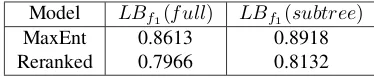
Table 3 reveals that the general parsing perfor-mance suffers from reranking both with respect to full trees and subtrees. To further narrow down the effect of reranking, we manually marked the re-gions (sub-strings in sentences) most relevant for the target relations and calculated the parser scores within those subtrees.4 The degradation of parser performance (against gold annotation) is more sig-nificant within these local regions.
Further error analyses show the breakdown of the differences: Of the 113 test sentences, 68 show a difference w.r.t. reranking. The labeled bracket-ing accuracy (on relevant subtrees) increased for 13 sentences. Among these, 3 are due to better
3
Since manual treebanking of HPSG derivation trees is very expensive, the gold-standard treebank only contains 500 randomly selected domain relevant sentences in which both persons and prizes are mentioned. Among these 500 sen-tences, 113 are in the test corpus. Although this treebank was developed independent from our research approach, the 113 sentences turn out to be useful because they are potential candidates for RE rules and thus their readings can be more effected by reranking than sentences which are irrelevant for the target relation.
4We also evaluated the parsing performance on the
sub-trees selected by the relation extraction rules, whose results are consistent with the above findings.
Model LBf1(f ull) LBf1(subtree)
MaxEnt 0.8613 0.8918
[image:7.595.321.508.62.101.2]Reranked 0.7966 0.8132
Table 3: Labeled bracketing f-score
appositions, 2 to better selection of verb subcat
frames, 6 to better PP attachments. Of the 55
cases of degradation, main causes are: incorrect
compounding in NPs (24 cases), bad
coordina-tions(7 cases), wronglexical categories(2 cases).
“good” for RE
Before reranking 50%
[image:7.595.341.494.263.302.2]After reranking 85%
Table 4: “Good” readings for RE among 68 re-ranked sentences
A careful study has been conducted on these 68 cases with respect to their effect on RE per-formance. It turns out that after reranking more of the parses are “good” for RE, i.e., leading to good rules. A “good” rule is defined by us as a rule which extracts correct instances. Table 4 shows that after reranking 85% of the 68 have good parses as opposed to 50% before reranking.
An explanation for the drop of linguistic qual-ity is that linguistically “wrong” analyses nev-ertheless lead to consistent extraction of rules and instances. For example, the gold-standard bracketing of the compound noun “Nobel Peace Prize laureate” is ((Nobel (Peace Prize)) laure-ate). The reranking reading is ((Nobel Peace)
(Prize laureate)), which is wrong. However,
the rule derived from this wrong reading can be applied to all equally incorrect readings of similar compound nouns such as “Nobel Chem-istry/Physics/Economics Prize laureate” to suc-cessfully extract two arguments of the target rela-tion, namely,PRIZE NAMEandPRIZE AREA. Thus the increased consistency in the re-ranked parses does help improve the RE process.
5.3.2 Extraction Rules after Reranking
lin-guistic parse selection but the improvement of se-lection of good readings for RE tasks.
Table 5 shows a comparison of the distribution of the good readings before and after reranking in test corpus. Bad readings are readings where bad rules are learned, namely, rules which extract only incorrect instances. Useless readings are readings from which useless rules are learned. Useless rules are rules which do not extract any instance. Ta-ble 5 clearly demonstrates that the porportion of good readings increases significantly after rerank-ing, while the number of bad readings and useless readings drop.
Good Reading Bad Reading Useless Reading before reranking 29.2% 1.3% 69.5%
after reranking 42.4% 0.8% 56.8%
Table 5: Test corpus: distribution of good readings before and after reranking
We also compare the number of the learned good rules and their extraction productivity. Af-ter reranking, not only the number of good rules increases, but also the average number of the in-stances extracted by each good rule is grown to 4.3 in comparison to 3.5 before reranking. The growth of good readings and rules and the produc-tivity of rule extraction performance explains the recall improvement after the parse reranking.
6 Related Work
Various attempts have been made to improve the cross-domain performance of statistical parsing models. McClosky et al. (2006) uses self-training to improve Charniak’s parser by feeding large amount of unannotated texts to the parser. Plank (2009) utilize structural-correspondence learning to improve the accuracy of the Dutch Alpino parser on the Wikipedia texts. Rimell and Clark (2008) show that a small set of annotated in-domain data can significantly improve the CCG parser’s performance. Hara et al. (2007) im-proves the Enju HPSG parser performance in the biomedical domain by a low-cost retraining of the lexical disambiguation model. Nearly all ap-proaches evaluate the parsing quality against a “gold-standard” treebank. Miwa et al. (2010) compares five parsers for bio-molecular event ex-traction to investigate the correlation between the performance on a gold-stand treebank and the usefulness in real-world applications. All four domain-adapted parsers achieve similar IE
perfor-mance and are better than the one not adapted. The idea of reranking parses for better dis-ambiguation is not new. Charniak and Johnson (2005) presents a discriminative model for captur-ing the lcaptur-inguistically motivated global properties of the candidate parses proposed by the first-stage generative parser. As the reranking model operates on a relatively small set of candidates, it is able to more accurately find the best reading. In the same spirit, several applications such as named-entity extraction (Collins, 2002), semantic pars-ing (Toutanova et al., 2005a) and semantic label-ing (Ge and Mooney, 2006) have taken advantage of reranking approaches based on discriminative models.
In contrast to the above proposals, our approach does not need the annotated “gold-standard” data for domain adaptation or training of the reranking model. Our system exploits application feedback for reranking. In a sense, the approach is akin in spirit to the joint learning of multiple types of linguistic structures with non-jointly labeled data (Finkel and Manning, 2010), although in our case the emphasis is entirely put on the application per-formance.
7 Conclusion and Future Work
The main contribution of our work is a method for adapting generic parsers to the tasks and do-mains of relation extraction by parse reranking. Our reranking is based on feedback from the ap-plication. We could show that for one generic parser/grammar, recall and f-measure could be considerably improved and hope that this effect can also be obtained for other generic parsers. We do not worry much about the collateral de-crease in precision, because precision will be tightened again when we employ confidence es-timation thresholds for filtering out less promising rules and instances.
than parsing accuracy, we consider worth sharing. The presented results may also be viewed as a step forward toward making deep linguistic gram-mars useful for relation extraction, whereas up to now most minimally supervised approaches to RE have employed shallower robust parsers. The hope behind these attempts is to improve precision without losing too much recall. After reclaiming recall through our parse reranking, next steps in this line of research will be dedicated to balanc-ing off the deficits in coverage by data-driven lex-icon extension in the spirit of (Zhang et al., 2010) and by exploiting the chart for partial parses in-volving the relevant types of named entities. Fur-thermore, the approach of (Dridan and Baldwin, 2010) to learning a parse selection model in an unsupervised way by utilizing the constraints of HSPG grammars might also be interesting for do-main adaptive parse selection for relation extrac-tion. At some point we may then be in a position to conduct a fair empirical comparison between deep-linguistic parsing with hand-crafted gram-mars on the one hand and purely statistical parsing on the other. An error analysis may then indicate the chances for hybrid approaches. However, be-fore targeting these medium-term goals we plan to investigate whether our approach can also be ap-plied to other parsers with inherent generic parse ranking and whether the set of learned RE rules with their confidence values can be directly used as features in the statistical parse disambiguation models instead of in the post-processing step by a separate re-ranker.
Acknowledgements
This research was conducted in the context of the German DFG Cluster of Excellence on Multimodal Computing and Interaction (M2CI), projects Theseus Alexandria and Alexandria for Media (funded by the German Federal Ministry of Economy and Technology, contract 01MQ07016), and project TAKE (funded by the German Fed-eral Ministry of Education and Research, contract 01IW08003). Many thanks go to Peter Adolphs and Dan Flickinger for providing us the treebank of the Nobel Prize award corpus.
References
Eugene Agichtein and Luis Gravano. 2000. Snowball: Extracting relations from large plain-text collections. InProceedings of the 5th ACM
International Conference DL’00, San Antonio,
TX, June.
Sergey Brin. 1998. Extracting patterns and re-lations from the world wide web. In WebDB
Workshop at EDBT 98.
Eugene Charniak and Mark Johnson. 2005. Coarse-to-fine n-best parsing and maxent dis-criminative reranking. In Proceedings of ACL 05, pages 173–180, Ann Arbor, Michigan, June. Association for Computational Linguistics.
Michael Collins. 2002. Ranking algorithms for named-entity extraction: Boosting and the voted perceptron. InProceedings of ACL ’02.
Marie-Catherine de Marneffe and Christopher D. Manning. 2008. The stanford typed dependen-cies representation. InProceedings of the work-shop on Cross-Framework and Cross-Domain
Parser Evaluation at COLING08, Manchester,
UK.
Rebecca Dridan and Timothy Baldwin. 2010. Un-supervised parse selection for hpsg. In Pro-ceedings of the 2010 Conference on
Empiri-cal Methods in Natural Language Processing,
EMNLP ’10, pages 694–704, Stroudsburg, PA, USA. Association for Computational Linguis-tics.
Witold Drozdzynski, Hans-Ulrich Krieger, Jakub Piskorski, Ulrich Sch¨afer, and Feiyu Xu. 2004. Shallow processing with unification and typed feature structures — foundations and applica-tions. K¨unstliche Intelligenz, 1.
Jenny Rose Finkel and Christopher D. Manning. 2010. Hierarchical joint learning: Improving joint parsing and named entity recognition with non-jointly labeled data. InProceedings of ACL ’10, pages 720–728, Uppsala, Sweden.
Dan Flickinger. 2000. On building a more ef-ficient grammar by exploiting types. Natural
Language Engineering, 6(1):15–28.
Proceedings of COLING and ACL 06), pages 263–270. Association for Computational Lin-guistics.
Mark A. Greenwood and Mark Stevenson. 2006. Improving semi-supervised acquisition of rela-tion extracrela-tion patterns. In Proceedings of the Workshop on Information Extraction Beyond
The Document, pages 29–35, Sydney, Australia,
July. Association for Computational Linguis-tics.
Ralph Grishman and Beth Sundheim. 1996. Mes-sage understanding conference - 6: A brief his-tory. In Proceedings of COLING 96, Copen-hagen, June.
Tadayoshi Hara, Yusuke Miyao, and Jun’ichi Tsu-jii. 2005. Adapting a probabilistic disambigua-tion model of an HPSG parser to a new domain.
InProceedings of IJCNLP 05.
Tadayoshi Hara, Yusuke Miyao, and Jun’ichi Tsu-jii. 2007. Evaluating impact of re-training a lexical disambiguation model on domain adap-tation of an hpsg parser. In Proceedings of the Tenth International Conference on
Pars-ing Technologies, pages 11–22, Prague, Czech
Republic, June. Association for Computational Linguistics.
Dekan Lin. 1998. Dependency-based evaluation of MINIPAR. Workshop on the Evaluation of
Parsing Systems.
David McClosky, Eugene Charniak, and Mark Johnson. 2006. Reranking and self-training for parser adaptation. In Proceedings of COLING
and ACL 06, pages 337–344, Sydney, Australia.
David McClosky, Eugene Charniak, and Mark Johnson. 2010. Automatic domain adapta-tion for parsing. In Proceedings of HLT and
NAACL ’10, pages 28–36, Los Angeles,
Cal-ifornia, June. Association for Computational Linguistics.
Makoto Miwa, Sampo Pyysalo, Tadayoshi Hara, and Jun’ichi Tsujii. 2010. A comparative study of syntactic parsers for event extraction. In
Proceedings of the 2010 Workshop on
Biomedi-cal Natural Language Processing, pages 37–45,
Uppsala, Sweden, July. Association for Compu-tational Linguistics.
Ion Muslea. 1999. Extraction patterns for infor-mation extraction tasks: A survey. In AAAI Workshop on Machine Learning for Informa-tion ExtracInforma-tion, Orlando, Florida, July.
Stephan Oepen, Kristina Toutanova, Stuart Shieber, Christopher Manning, Dan Flickinger, and Thorsten Brants. 2002. The LinGO Red-woods treebank: motivation and preliminary applications. InProceedings of COLING 2002: The 17th International Conference on
Compu-tational Linguistics: Project Notes, Taipei,
Tai-wan.
Barbara Plank and Gertjan van Noord. 2010. Grammar-driven versus data-driven: Which parsing system is more affected by domain shifts? InProceedings of the 2010 Workshop on NLP and Linguistics: Finding the Common
Ground, Uppsala, Sweden, July.
Barbara Plank. 2009. A comparison of structural correspondence learning and self-training for discriminative parse selection. InProceedings of the NAACL HLT 2009 Workshop on Semi-supervised Learning for Natural Language
Pro-cessing, pages 37–42, Boulder, Colorado, June.
Association for Computational Linguistics.
Carl J. Pollard and Ivan A. Sag. 1994.
Head-Driven Phrase Structure Grammar. University
of Chicago Press, Chicago, USA.
Laura Rimell and Stephen Clark. 2008. Adapt-ing a lexicalized-grammar parser to contrastAdapt-ing domains. In Proceedings of EMNLP 08, pages 475–484, Honolulu, Hawaii, October. Associa-tion for ComputaAssocia-tional Linguistics.
K. Sudo, S. Sekine, and R. Grishman. 2003. An improved extraction pattern representation model for automatic IE pattern acquisition.
Proceedings of ACL 2003.
Kristina Toutanova, Aria Haghighi, and Christo-pher D. Manning. 2005a. Joint learning im-proves semantic role labeling. In Proceedings
of ACL 05, page 589 596. Association for
Com-putational Linguistics.
Kristina Toutanova, Christoper D. Manning, Dan Flickinger, and Stephan Oepen. 2005b. Stochastic HPSG parse selection using the Red-woods corpus. Journal of Research on
Hans Uszkoreit, Feiyu Xu, and Hong Li. 2009. Analysis and improvement of minimally super-vised machine learning for relation extraction.
In 14th International Conference on
Applica-tions of Natural Language to Information Sys-tems. Springer.
Feiyu Xu, Hans Uszkoreit, and Hong Li. 2007. A seed-driven bottom-up machine learning frame-work for extracting relations of various com-plexity. In Proceedings of ACL 2007, Prague, Czech Republic, 6.
Feiyu Xu, Hans Uszkoreit, Sebastian Krause, and Hong Li. 2010. Boosting relation extraction with limited closed-world knowledge. In
Pro-ceedings of COLING ’10, Poster Session.
Asso-ciation for Computational Linguistics.
Feiyu Xu. 2007. Bootstrapping Relation
Extrac-tion from Semantic Seeds. Phd-thesis, Saarland
University.
Roman Yangarber. 2001. Scenarion
Customiza-tion for InformaCustomiza-tion ExtracCustomiza-tion. Dissertation,
Department of Computer Science, New York University, New York, USA.
Yi Zhang and Rui Wang. 2009. Cross-domain de-pendency parsing using a deep linguistic gram-mar. In Proceedings of the Joint Conference
ACL and AFNLP 09, Suntec, Singapore,
Au-gust.
Yi Zhang, Stephan Oepen, and John Carroll. 2007. Efficiency in unification-based N-best parsing. In Proceedings of the 10th Inter-national Conference on Parsing Technologies
(IWPT 2007), pages 48–59, Prague, Czech.