Types of Aspect Terms in Aspect-Oriented Sentiment Labeling
Natalia Loukachevitch
Lomonosov Moscow State University
Moscow, Russia
louk [email protected]
Evgeny Kotelnikov, Pavel Blinov
Vyatka State Humanities University Kirov, Russia
[email protected] [email protected]
Abstract
The paper studies the diversity of ways to express entity aspects in users’ reviews. Besides explicit aspect terms, it is possi-ble to distinguish implicit aspect terms and sentiment facts. These subtypes of aspect terms were annotated during SentiRuEval evaluation of Russian sentiment analysis systems organized in 2014–2015. The cre-ated annotation gives the possibility to an-alyze the contribution of non-explicit as-pects to the overall sentiment of a review, their main patterns, and possible use.
1 Introduction
When the authors of texts express their opinions about some entities, they often indicate specific properties (or aspects) of the entity that evoke pos-itive or negative sentiments. Revealing these as-pects and related sentiment is very important for various directions of automatic sentiment analy-sis, including analysis of user reviews, reputa-tion monitoring, or social mood analysis because such analysis helps to find problems or strong points of the discussed entities. Therefore, so-called Aspect-Based Sentiment Analysis (ABSA) becomes more popular (Liu and Zhang, 2012; Bagheri et al., 2013; Popescu and Etzioni, 2005; Feldman, 2013; Poria et al., 2014).
Entity aspects are expressed in texts with aspect terms and can usually be classified into categories. For example,Serviceaspect category in restaurant reviews can be expressed in such terms as staff, waiter, waitress, server, and etc. Aspect-based sentiment analysis includes several stages, such as revealing aspect terms and their categories, extrac-tion of sentiments expressed toward found aspects, and visualization of extracted information.
It is usually supposed that an aspect of an en-tity is conveyed by a noun or a noun group that
explicitly denotes a property of an entity and does not contain sentiment within itself, so called ex-plicit aspects. So, in aspect-based sentiment anal-ysis evaluations organized in the framework of Se-mEval conference, only explicit aspects were an-notated (Pontiki et al., 2014; Pontiki et al., 2015). However, aspects can be expressed in an implicit way. For example, the phrase ready to help ex-presses positive sentiment toward restaurant ser-vice, without mentioning aspects explicitly.
In SentiRuEval evaluation of aspect-based sen-timent analysis of Russian texts (Loukachevitch et al., 2015), besides explicit aspects, so-called implicit aspects (sentiment words with implied as-pects) and sentiment facts (phrases with implicit sentiments and aspects such asanswered all ques-tions) were labeled. These annotations give a new possibility to study the contribution of vari-ous types of aspects into the overall sentiment of users’ reviews and their possible use in sentiment-oriented summaries. This evaluation is the sec-ond Russian sentiment analysis evaluation event after ROMIP sentiment analysis tracks in 2011-2013 (Chetviorkin and Loukachevitch, 2011-2013).
In this paper, we consider subtypes of aspect terms and principles of aspect labeling in the framework of SentiRuEval evaluation. Also, we present the analysis of manually labeled aspect terms expressed implicitly and show their useful-ness for generating sentiment-oriented summaries. 2 Related Work
For studying aspect-oriented sentiment analysis, several datasets were created. The restaurant re-view dataset created by Ganu et al. (2009) uses six coarse-grained aspect categories (e.g., FOOD, PRICE, SERVICE) and four overall sentence polarity labels (positive, negative, conflict, neutral). Each sentence is assigned to one or more aspect gories together with a polarity label for each cate-gory.
Hu and Liu (2004) created the product review dataset containing 100 reviews for each of five electronics products. They labeled terms nam-ing aspects (e.g., voice dialnam-ing) together with their sentiment strength scores. They found that aspects can be expressed explicitly or implicitly, as the size aspect in the sentenceit fits in a pocket nicely. Zhang and Liu (2011) argue that there are many types of expressions that do not bear sentiments on their own, but they imply sentiment in specific contexts. One such type of expressions involves resources, which are important for many applica-tion domains. For example, money is a resource in probably every domain, gas is a resource in the car domain, and ink is a resource in the printer domain. An expression containing a quantifier (some, more, large, small, etc.) in combination with a resource term may often look like a refer-ence to an objective fact but, in practice, it often implies a specific sentiment.
In (Gupta, 2013; Tutubalina and Ivanov, 2014; Zhang et al., 2012), extraction of so-called tech-nical problems mentioned by users in reviews was discussed. Technical problems can also be considered as specific types of sentiment-oriented facts. Besides, some non-opinionated words can have negative or positive associations (connota-tions (Feng et al., 2013)) that their appearance in a text can imply relevant sentiment, e.g., wordhair has usually the negative connotation in the restau-rant domain (hair on the plate).
The dataset created by Ganu et al. (2009) was used as a basis for aspect-based review anal-ysis evaluation at SemEval in 2014 (Pontiki et al., 2014). The dataset included isolated, out of context sentences in two domains: restaurants and laptops. The set of aspect categories for restau-rants included: FOOD, SERVICE, PRICE, AMBIENCE, ANECDOTES/MISCELLANEOUS.
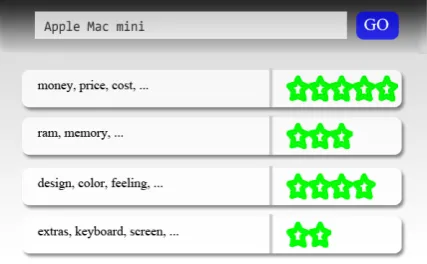
[image:2.595.310.524.63.195.2]In 2015 SemEval evaluations of the aspect-based sentiment analysis of reviews was focused on entire reviews (Pontiki et al., 2015). Aspect categories of terms became more complicated and now consist of Entity-Attribute pairs (E-A), for ex-ampleFOOD-PRICE, FOOD-QUALITY. In both cases, only explicit aspects (comprising named entities, common nouns, or multiword noun groups) were labeled and used for systems testing. The ultimate goal of the ABSA was formulated as generation of summaries enumerating all the aspects and their overall polarity (Figure 1).
Figure 1: Sentiment-aspect summary as a goal for aspect-based sentiment analysis (Pontiki et al., 2015).
3 SentiRuEval Testing of Russian Sentiment Analysis Systems
The SentiRuEval evaluation organized in 2014– 2015 was focused on entity-oriented sentiment analysis of Twitter and aspect-oriented analysis of users reviews in Russian. For evaluation of aspect-oriented sentiment analysis systems, two domains (restaurant reviews and automobile reviews) were chosen (Loukachevitch et al., 2015).
During the annotation phase, not only explicit aspects but also aspects expressed implicitly (see Section 4) were marked up. To each labeled as-pect, its sentiment (positive, negative, neutral, or both) and aspect category should be assigned to. For restaurant reviews, aspect categories included: FOOD, SERVICE, INTERIOR (including ambience), PRICE, GENERAL. For automobiles, aspect cate-gories were:DRIVEABILITY, RELIABILITY, SAFETY, APPEARANCE, COMFORT, COSTS, GENERAL.
The aspect categories with their sentiment scores (positive, negative, both, or absent) were also attached to the whole review.
The participants were to solve one or more of the following tasks in two domains: automatic ex-traction of explicit aspects, automatic exex-traction of all aspect terms, extraction of sentiments towards explicit aspects, automatic categorization of ex-plicit aspects into aspect categories, and sentiment analysis of the whole review according to aspect categories.
several specialized procedures were implemented. So, some accidental mistakes were found and cor-rected (Loukachevitch et al., 2015).
Altogether, about 200 reviews were prepared for each domain as a training collection and addi-tional 200 reviews in each domain served as a test collection. Table 1 shows labeled data statistics in two domains.
Nine Russian groups and individual researchers were participants of SentiRuEval–2015. The results of the participants are described in (Loukachevitch et al., 2015). All data and results are publicly available.1 In this paper, we analyze
the aspect labeling carried out in the framework of SentiRuEval.
Restaurants Automobiles Train / Test Train / Test Number of 201 / 203 217 / 201 reviews
Number of 2,822 / 3,506 3,152 / 3,109 explicit aspects
Number of 636 / 657 638 / 576 implicit aspects
[image:3.595.326.503.111.256.2]Number of 523 / 656 668 / 685 sentiment facts
Table 1: Number of aspect terms found in reviews.
4 Labeling Types of Aspects in SentiRuEval
In contrast to SemEval ABSA labeling, the ulti-mate goal of aspect labeling at SentiRuEval is to generate summaries in form of informative key-words expressing both aspect and related senti-ment. It was supposed that such summaries can better convey the mood of users’ opinions than tra-ditional star-oriented summaries. Keyword-based interfaces are appropriate not only for desktop computers, but also for mobile devices.
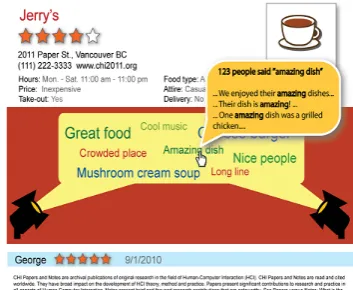
The similar approach is described in (Yatani et al., 2011). However, in that work, only sentiment-oriented adjective-noun word pairs were extracted (see Figure 2). Besides, extraction of implicit sentiment and aspects was not considered. The SentiRuEval labeling was directed to study vari-ous forms of aspect-sentiment tags that can be uti-lized for visualization of users’ opinions. From this point of view, it was found that the labeling of
1http://goo.gl/Wqsqit
[image:3.595.73.292.276.415.2]several types of aspect-related expressions is use-ful including explicit aspects, implicit aspects, and sentiment facts.
Figure 2: Example of the aspect-oriented review summary as a set of sentiment-aspect keywords (Yatani et al., 2011).
As in previous works,explicit aspect terms de-note some parts of an entity (such as an engine, a compartment, or a trunk of a car) or its charac-teristics (appearance of a car). They can also de-note produced products (pasta, desserts), related services (staff, personnel), or surrounding condi-tions (music, noise, smell, and etc.). The cost (price) related aspect is present in most domains. To form sentiment-oriented keywords, explicit as-pects should be combined with sentiment words.
Explicit aspects are usually expressed by nouns or noun groups, but in some aspect categories, it is possible to encounter explicit aspects expressed as verbs or verb groups. For example, in restau-rant reviews, such verbs as eat,drink(FOOD cat-egory); greet(SERVICE) are often used to express explicit aspects. In the car domain, frequent exam-ples of such verbs and verb groups arelook ( AP-PEARANCE),speed up,park,hold the road( DRIV-ABILITY).2
Verbs expressing explicit aspects can be met in constructions with sentiment-oriented adverbs such asate very well,greeted well, etc. Keywords in such forms (greeted well) can be presented to users in sentiment-oriented summaries.
Therefore, in the SentiRuEval data, verbs may also be labeled as explicit aspect terms. The pres-ence of verbs in aspect categories varies.
Implicit aspect terms are evident sentiment words having appraisal as a sense component but,
2These and all further examples are translated from
in the current domain, these words also imply a specific aspect category. Frequent examples of implicit aspect terms in the restaurant domain are tasty (positive+FOOD),polite (positive+SERVICE),
comfortable (positive+INTERIOR), cosy (posi-tive+INTERIOR),expensive(negative+PRICE).
In the car domain, frequently men-tioned implicit aspects are beautiful (positive+APPEARANCE), mighty (pos-itive+DRIVABILITY), spacious (posi-tive+COMFORT), comfortable (posi-tive+COMFORT),reliable (positive+RELIABILITY), safe (positive+SAFETY), economical (posi-tive+PRICE). Phrases that included an implicit aspect term and a negation or intensifier were also considered as implicit aspect terms (not comfortable(negative+INTERIOR)).
The importance of these words for automatic sentiment analysis is in that implicit aspects allow a sentiment system to reveal the implied opinion about entity characteristics even if an explicit as-pect term is unknown, written with an error, or referred to in a complicated way. In a keyword-oriented interface, implicit aspects can be pre-sented alone (tasty), or with the corresponding cat-egory (tasty food). In Russian, implicit aspects can be shown in an adverb form:vkusno(tastily).
Sentiment factsare single words or short, syn-tactically correct phrases that do not mention the user sentiment directly but inform about user’s opinion via mentioning facts. In the restaurant domain, frequent sentiment facts include such ex-pressions as:large portions,large choice of dishes (FOOD);waited for a long time,forgot,didn’t bring (SERVICE);dim lights,plenty of space(INTERIOR);
come again,come back (GENERAL). In sentiment facts, aspects are also often implicit.
Sentiment facts express the specificity of an ob-ject under review and can be directly depicted (in an appropriate form) as sentiment keywords.
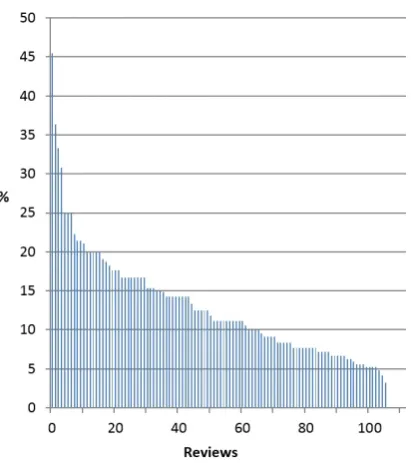
In the SentiRuEval data, the amount of reviews with more than 10% of implicit sentences (con-taining only implicit aspects or sentiment facts without mentioning explicit aspects) ranges from 15 to 30% across training and test collections. For some reviews, the amount of such sentences con-stitutes up to 40%. Figure 3 shows that more than a half of the reviews in the SentiRuEval restaurant training collection (106 of 201) contains sentences with implicitly expressed aspects.
If we compare the SentiRuEval aspect
annota-Figure 3: The distribution of sentences with only implicitly expressed aspects in the SentiRuEval restaurant training collection (201 reviews).
tion with labeling in the framework of SemEval ABSA-2015 then it can be seen that the ABSA dataset also contains sentences with implicit as-pects and sentiment facts but such sentences are marked with the labeltarget=NULL(Pontiki et al., 2014; Pontiki et al., 2015) what means an absent (null) target.
In the NULL-labeled ABSA examples, it is of-ten possible to mark-up sentiment facts. For ex-ample, in the following sentence from the ABSA guidelines marked with NULL target “They never brought us complimentary noodles, ignored re-peated requests for sugar, and threw our dishes on the table”, three sentiment facts could be anno-tated: never brought, ignored repeated requests, andthrew our dishes.
5 Syntactic Patterns and Semantic Subtypes of Sentiment Facts
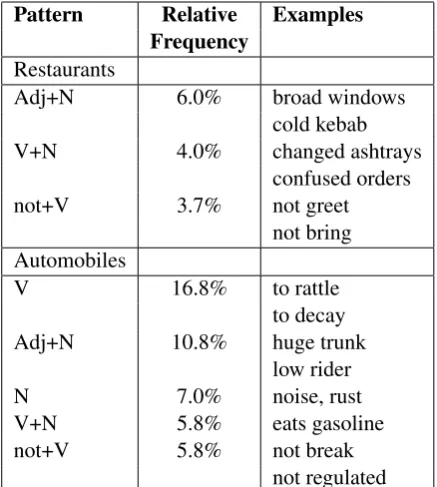
Extraction of sentiment facts is not a simple task because syntactic structures of sentiment facts are quite diverse. Their most frequent syntactic pat-terns are different in two domains (Table 2). It is important to note that in Verb+Noun patterns, a noun can be in function of a subject or an object because of free word order in Russian.
[image:4.595.316.522.59.291.2]them-Pattern Relative Examples Frequency
Restaurants
Adj+N 6.0% broad windows
cold kebab
V+N 4.0% changed ashtrays
confused orders
not+V 3.7% not greet
not bring Automobiles
V 16.8% to rattle
to decay
Adj+N 10.8% huge trunk
low rider
N 7.0% noise, rust
V+N 5.8% eats gasoline
not+V 5.8% not break
[image:5.595.72.291.62.306.2]not regulated
Table 2: Most frequent patterns of sentiment facts in restaurant and automobile domains ordered by frequency in each domain.
selves but currently this requirement was not fully observed. Therefore, we can see that in the restau-rant domain, syntactic patterns seem to be more diverse and the frequency of the most frequent pat-terns is lower.
From the lexico-semantic point of view, mul-tiple cases of RESOURCE-BASED FACTS contain-ing resource terms described in (Zhang and Liu, 2011) can be revealed among sentiment facts. In the restaurant domain, one can find the following kinds of resource terms: time of a restaurant guest; attention of waiters; three food-oriented resources including food on a plate, choice in a menu, and availability of a specific dish; space in a restaurant room and free tables; and money of visitors.
In the automobile domain, there are such re-source terms as space in a compartment or trunk; fuel; and money for purchase, fuel, or mainte-nance of a car. In both domains, the resource terms are often mentioned in phrases together with quan-tifiers (many,small,large, and etc.).
The particle not in a phrase with a not-opinionated verb often denotes the deviation from a normal state of affairs (FAILURE FACTS). A sim-ilar effect appears from the usage of words ab-sence,absent.
Gradable adjectives, which are a priori not cor-related with a specific sentiment, in phrases with
explicit aspects often become sentiment facts (cold kebab,broad windows)(GRADABILITY FACTS).
Words denoting sounds or noises (loud,crackle, and etc.) can express positive or negative sen-timent facts in various domains (NOISE FACTS). They are met in both domains under analysis.
Thus, for automatic extraction of sentiment facts and utilizing them in sentiment-oriented in-terfaces, it is useful to extract at least: phrases with negation particles not containing sentiment words; phrases with gradual adjectives, and phrases with quantifiers. A vocabulary with noise- and failure-meaning words and phrases can be also useful for extraction of sentiment facts in various domains.
If extracted correctly, a keyword-based senti-ment summary about a restaurant can include vari-ous types of aspect terms and look as follows:nice dessert, broad windows, waited for a long time, politely, will come again. Each keyword conveys information about both an aspect and related sen-timent.
6 Conclusion
The paper studies the diversity of ways to express entity aspects in users’ reviews and considers sub-types of aspect terms in aspect-oriented sentiment analysis. Besides explicit aspect terms, it is pos-sible to distinguish implicit aspects and sentiment facts.
These subtypes of aspects were annotated dur-ing SentiRuEval evaluation of Russian sentiment analysis systems organized in 2014–2015. The created annotation allowed us to analyze the con-tribution of non-explicit aspects to the overall sen-timent of a review, their frequent patterns and their possible use in sentiment-oriented interfaces.
The analysis of labeled sentiment facts in the SentiRuEval data revealed such types of fre-quent sentiment facts asRESOURCE-BASED FACTS, FAILURE FACTS, GRADABILITY FACTS, and NOISE FACTS.
Acknowledgments
References
Ayoub Bagheri, Mohamad Saraee, and Franciska de Jong. 2013. An unsupervised aspect detection model for sentiment analysis of reviews.
Natu-ral Language Processing and Information Systems,
Springer, Berlin, Heidelberg: 140–151.
Ilia Chetviorkin and Natalia Loukachevich. 2013. Evaluating sentiment analysis systems in Russian.
Proceedings of BSNLP Workshop, ACL-2013: 12–
16.
Ronen Feldman. 2013. Techniques and applications for sentiment analysis.Communications of the ACM
56.4: 82–89.
Song Feng, Jun S. Kang, Polina Kuznetsova, and Yejin Choi. 2013. Connotation lexicon: a dash of sen-timent beneath the surface meaning.Proceedings of
ACL-2013: 1774–1784.
Gayatree Ganu, Noemie Elhadad, and Amelie Marian. 2009. Beyond the stars: improving rating predic-tions using review text content.Twelfth International
Workshop on the Web and Databases WebDB-2009:
1–6.
Narendra Gupta. 2013. Extracting phrases describ-ing problems with products and services from twit-ter messages.Computacion y Sistemas. 17 (2): 197– 206.
Bing Liu and Lei Zhang. 2012. A survey of opinion mining and sentiment analysis. Mining Text Data: Springer US. 415–463.
Minquing Hu and Bing Liu. 2004. Mining and sum-marizing customer reviews.Proceedings of the 10th ACM SIGKDD International Conference on
Knowl-edge Discovery and Data Mining KDD-2004: 168–
177.
Natalia Loukachevitch, Pavel Blinov, Evgeny Kotel-nikov, Yulia Rubtsova, Vladimir Ivanov, and Elena Tutubalina. 2015. SentiRuEval: testing object-oriented sentiment analysis systems in Russian.
Pro-ceedings of International Conference Dialog-2015:
3–9.
Maria Pontiki, Haris Papageorgiou, Dimitrios Galanis, Ion Androutsopoulos, John Pavlopoulos, and Suresh Manandhar. 2014. Semeval-2014 task 4: aspect based sentiment analysis.Proceedings of the 8th In-ternational Workshop on Semantic Evaluation
(Se-mEval 2014): 27–35.
Maria Pontiki, Dimitrios Galanis, Haris Papageorgiou, Suresh Manandhar, and Ion Androutsopoulos. 2015. Semeval-2015 task 12: aspect based sentiment anal-ysis.Proceedings of the 9th International Workshop
on Semantic Evaluation (SemEval 2015), Denver,
Colorado.
Ana-Maria Popescu and Oren Etzioni. 2007. Ex-tracting product features and opinions from reviews.
Natural Language Pprocessing and Text Mining.
Springer London: 9–28.
Soujanya Poria, Nir Ofek, Alexander Gelbukh, Amir Hussain, and Lior Rokach. 2014. Sentic Demo: A hybrid concept-level aspect-based sentiment analy-sis toolkit.Proceedings of ESWC-2014.
Pontus Stenetorp, Sampo Pyysalo, Goran Topi, Tomoko Ohta, Sophia Ananiadou, Junichi Tsujii J. 2012. BRAT: a Web-based tool for NLP-assisted text annotation.Demonstrations at the 13th Confer-ence of the European Chapter of the Association for
Computational Linguistics, Avignon: 102–107.
Elena Tutubalina and Vladimir Ivanov. 2014. Un-supervised approach to extracting problem phrases from user reviews of products. Proceedings of the
Aha! Workshop on Information Discovery in Texts,
Coling-2014: 48–53.
Koji Yatani, Michael Novati, Andrew Trusty, and Khai N. Truong. 2011. Analysis of adjective-noun word pair extraction methods for online review summa-rization.Proceedings of International Joint Confer-ence on Artificial IntelligConfer-ence (IJCAI-2011). Lei Zhang and Bing Liu. 2011. Extracting
re-source terms for sentiment analysis.Proceedings of
IJCNLP-2011.
Wenhao Zhang, Xu Hua, and Wan Wei. 2012. Weak-ness Finder: find product weakWeak-ness from Chinese reviews by using aspects based sentiment analysis.
Expert Systems with Applications 39 (11): 10283–