Exploiting Timegraphs in Temporal Relation Classification
Natsuda Laokulrat†, Makoto Miwa‡, and Yoshimasa Tsuruoka† †The University of Tokyo, 3-7-1 Hongo, Bunkyo-ku, Tokyo, Japan
{natsuda,tsuruoka}@logos.t.u-tokyo.ac.jp
‡Toyota Technological Institute, 2-12-1 Hisakata, Tempaku-ku, Nagoya, Japan [email protected]
Abstract
Most of the recent work on machine learning-based temporal relation classifi-cation has been done by considering only a given pair of temporal entities (events or temporal expressions) at a time. Entities that have temporal connections to the pair of temporal entities under inspection are not considered even though they provide valuable clues to the prediction. In this paper, we present a new approach for ex-ploiting knowledge obtained from nearby entities by making use of timegraphs and applying the stacked learning method to the temporal relation classification task. By performing 10-fold cross validation on the Timebank corpus, we achieved an F1 score of 59.61% based on the graph-based evaluation, which is 0.16 percent-age points higher than that of the local approach. Our system outperformed the state-of-the-art system that utilizes global information and achieved about 1.4 per-centage points higher accuracy.
1 Introduction
Temporal relationships between entities, namely temporal expressions and events, are regarded as important information for deep understanding of documents. Being able to predict temporal re-lations between events and temporal expressions within a piece of text can support various NLP ap-plications such as textual entailment (Bos et al., 2005), multi-document summarization (Bollegala et al., 2010), and question answering (Ravichan-dran and Hovy, 2002).
Temporal relation classification, which is one of the subtasks TempEval-3 (UzZaman et al., 2013), aims to classify temporal relationships between pairs of temporal entities into one of the 14
re-lation types according to the TimeML specifica-tion (Pustejovsky et al., 2005), e.g., BEFORE, AF-TER, DURING,andBEGINS.
The Timebank corpus introduced by Puste-jovsky et al. (2003) has enabled the machine learning-based classification of temporal relation-ship. By learning from the annotated relation types in the documents, it is possible to predict the temporal relation of a given pair of temporal entities (Mani et al., 2006).
However, most of the existing machine learning-based systems use local information alone, i.e., they consider only a given pair of poral entities at a time. Entities that have tem-poral connections to the entities in the given pair are not considered at all even though they provide valuable clues to the prediction. Hence, the lo-cal approach often produces contradictions. For instance, the system may predict that A happens before B, that B happens before C, and that A hap-pens after C, which are mutually contradictory.
In order to tackle the contradiction problem, global approaches have been proposed by Cham-bers and Jurafsky (2008) and Yoshikawa et al. (2009). Chamber and Jurafsky proposed a global model based on Integer Linear Programming that combines the output of local classifiers and max-imizes the global confidence scores. While they focused only on the temporal relations between events, Yoshikawa et al. proposed a Markov Logic model to jointly predict the temporal relations be-tween events and time expressions.
In this paper, we propose an approach that utilizes timegraphs (Miller and Schubert, 1999), which represent temporal connectivity of all tem-poral entities in each document, for the relation classification. Our method differs from the pre-vious work in that their methods used transition rules to enforce consistency within each triplet of relations, but our method can also work with a set consisting of more than three relations. Moreover,
Figure 1: An example from the Timebank corpus
in our work, the full set of temporal relations spec-ified in TimeML are used, rather than the reduced set used in the previous work.
We evaluate our method on the TempEval-3’s Task C-relation-only data, which provides a sys-tem with all the appropriate sys-temporal links and only needs the system to classify the relation types. The result shows that by exploiting the timegraph features in the stacked learning ap-proach, the classification performance improves significantly. By performing 10-fold cross valida-tion on the Timebank corpus, we can achieve an F1 score of 59.61% based on the graph-based evalu-ation, which is 0.16 percentage points (pp) higher than that of the local approach. We compared the results of our system to those of Yoshikawa et al. (2009) and achieved about 1.4pphigher accuracy. The remainder of the paper is organized as fol-lows. Section 2 explains the temporal relation classification task and the pairwise classifier. Sec-tion 3 and SecSec-tion 4 describe our proposed time-graph features and the application to the stacked learning approach. Section 5 shows the experi-ment setup and presents the results. Finally, we discuss the results in 6 and conclude with direc-tions for future work in Section 7.
2 Temporal Relation Classification According to TempEval-3, a temporal annotation task consists of several subtasks, including tempo-ral expression extraction (Task A), event extrac-tion (Task B), and temporal link identificaextrac-tion and relation classification (Task C). Our work, as with the previous work mentioned in Section 1, only focuses on the relation classification task (Task C-relation only). The system does not extract events and temporal expressions automatically.
A pair of temporal entities, including events and temporal expressions, that is annotated as a tem-poral relation is called a TLINK. Temtem-poral rela-tion classificarela-tion is a task to classify TLINKs into
temporal relation types.
Following TempEval-3, all possible TLINKs are between:
• Event and Document Creation Time (DCT)
• Events in the same sentence
• Event and temporal expression in the same sentence
• Events in consecutive sentences 2.1 The Timebank corpus
The Timebank corpus is a human-annotated cor-pus commonly used in training and evaluating a temporal relation classifier. It is annotated follow-ing the TimeML specification to indicate events, temporal expressions, and temporal relations. It also provides five attributes, namely,class, tense, aspect, modality, and polarity, associated with each event (EVENT), and four attributes, namely, type, value, functionInDocument, and temporal-Function, associated with each temporal expres-sion(TIMEX3). An example of the annotated event and temporal expression is shown in Figure 1. The sentence is brought from wsj 0292.tml in the Timebank corpus.
There is no modal word in the sentence, so the attributemodalitydoes not appear.
We use the complete set of the TimeML rela-tions, which has 14 types of temporal relations in-cludingBEFORE, AFTER, IMMEDIATELY BEFORE, IM-MEDIATELY AFTER, INCLUDES, IS INCLUDED, DUR-ING, DURING INVERSE, SIMULTANEOUS, IDENTITY, BEGINS, BEGUN BY, END,and ENDED BY. However, in TempEval-3, SIMULTANEOUS andIDENTITY are regarded as the same relation type, so we change allIDENTITY relations intoSIMULTANEOUS.
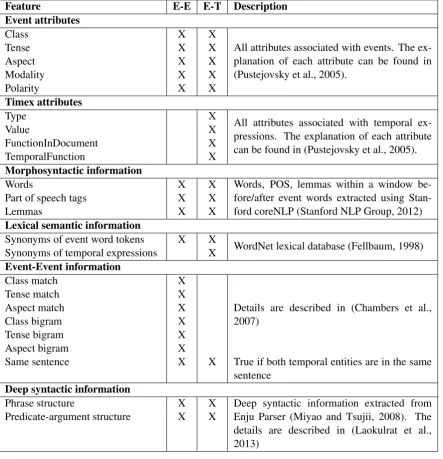
Feature E-E E-T Description Event attributes
Class X X
All attributes associated with events. The ex-planation of each attribute can be found in (Pustejovsky et al., 2005).
Tense X X
Aspect X X
Modality X X
Polarity X X
Timex attributes
Type X All attributes associated with temporal
ex-pressions. The explanation of each attribute can be found in (Pustejovsky et al., 2005).
Value X
FunctionInDocument X
TemporalFunction X
Morphosyntactic information
Words X X Words, POS, lemmas within a window
be-fore/after event words extracted using Stan-ford coreNLP (StanStan-ford NLP Group, 2012)
Part of speech tags X X
Lemmas X X
Lexical semantic information
Synonyms of event word tokens X X WordNet lexical database (Fellbaum, 1998) Synonyms of temporal expressions X
Event-Event information
Class match X
Details are described in (Chambers et al., 2007)
Tense match X
Aspect match X
Class bigram X
Tense bigram X
Aspect bigram X
Same sentence X X True if both temporal entities are in the same sentence
Deep syntactic information
Phrase structure X X Deep syntactic information extracted from Enju Parser (Miyao and Tsujii, 2008). The details are described in (Laokulrat et al., 2013)
Predicate-argument structure X X
Table 1: Local features
Feature E-E E-T Description
Adjacent nodes and links X X
The details are described in Subsection 3.2
Other paths X X
Generalized paths X X
(E,V,E) tuples X X
[image:3.595.80.524.88.548.2](V,E,V) tuples X X
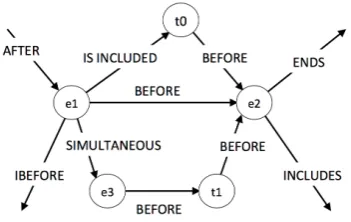
Figure 2: path length≤2
Figure 3: path length≤3
3 Proposed method
Rather than using only local information on two entities in a TLINK, our goal is to exploit more global information which can be extracted from a document’s timegraph. Our motivation is that temporal relations of nearby TLINKs in a timegraph provide very useful information for predicting the relation type of a given TLINK. For instance, consider the following sentence and the temporal connectivity shown in Figure 2.
About 500 people attended (e1) a Sunday night memorial for the Buffalo-area physician who performed abortions,one year (t1)after he waskilled (e2)by a sniper’s bullet.
It can be seen that the relation betweene1 and
t1 and the relation between t1 and e2 are useful for predicting the relation betweene1ande2.
Another more-complicated example is shown below with temporal connectivity in Figure 3.
“The Congress of the United States is
af-fording(e1) Elian Gonzalez what INS and this
administration has not, which is his legal right and his right to due process,” said(e2) Jorge Mas Santos, chairman of the Cuban American National Foundation. “This gives(e3) him the protection that he will not berepatriated(e4)to Cuba between now and Feb. 10.”
Figure 5: Local pairwise classification. Each TLINK is classified separately.
Figure 6: Timegraph constructed from a docu-ment’s TLINKs
Again, the relation between e4 and e3
can be inferred from the nearby relations, i.e., (1) e4 AFTER e2 and e2 AFTER e1
imply e4 AFTER e1, (2) e4 AFTER e1 and
e1 SIMULTANEOUS e3implye4 AFTER e3.
3.1 Overview of our framework
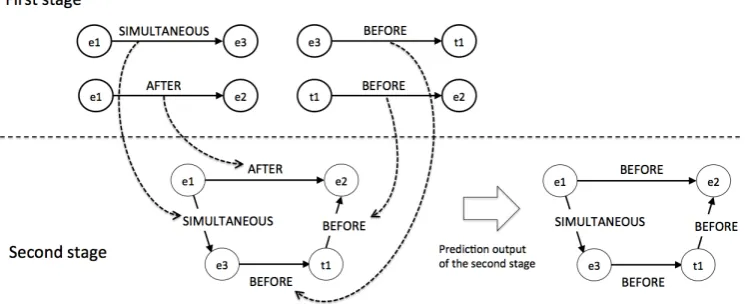
Our framework is based on the stacked learn-ing method (Wolpert, 1992), which employs two stages of classification as illustrated in Figure 4. 3.1.1 Local pairwise model
In a local pairwise model, temporal relation clas-sification is done by considering only a given pair of temporal entities at a time as illustrated in Fig-ure 5. We use a supervised machine learning ap-proach and employ the basic feature set that can be easily extracted from the document’s text and the set of features proposed in our previous work (Laokulrat et al., 2013), which utilizes deep syn-tactic information, as baselines. The local features at different linguistic levels are listed in Table 1.
Two classifiers are used: one for Event-Event TLINKs (E-E), and the other for Event-Time TLINKs (E-T).
3.1.2 Stacked learning
[image:4.595.319.495.191.302.2]Figure 4: Stacked learning. The output from the first stage is treated as features for the second stage. The final output is predicted using label information of nearby TLINKs.
The first stage, as shown in Figure 5, uses the local classifiers and predicts the relation types of all TLINKs. In the second stage, the document’s timegraph is constructed and the output from the first stage is associated with TLINKs in the graph. The classifiers in the second stage use the infor-mation from the nearby TLINKs and predict the final output. We exploit features extracted from the documents’ timegraphs, as listed in Section 3.2 in the second stage of the stacked learning.
An example of a document’s timegraph is shown in Figure 6.
3.2 Timegraph features
We treat timegraphs as directed graphs and double the number of edges by adding new edges with opposite relation types/directions to every existing edge. For example, if the graph contains an edge
e1 BEFORE e2, we add a new edgee2 AFTER e1. Our proposed timegraph features are described below.
• Adjacent nodes and links
The features are the concatenation of the di-rections to the adjacent links to the pair of en-tities, the relation types of the links, and the information on the adjacent nodes, i.e., word tokens, part of speech tags, lemmas. For ex-ample, the features for predicting the relation betweene1ande2 in Figure 6 areSRC OUT-IS INCLUDED-(Type of t0), DEST IN-BEFORE-(Type oft0), and so on.
In this work, only Type of temporal expres-sion (an attribute given in the Timebank
cor-pus), Tense and Part-of-speech tag are ap-plied but other attributes could also be used.
• Other paths
Paths with certain path lengths (in this work, 2 ≤path length≤ 4) between the temporal entities are used as features. The paths must not contain cycles. For example, the path features of the relation between e1 and e2
areIS INCLUDED-BEFOREand SIMULTANEOUS-BEFORE-BEFORE.
• Generalized paths
A generalized version of the path features, e.g., the IS INCLUDED-BEFOREpath is gener-alized to*-BEFOREandIS INCLUDED-*.
• (E,V,E) tuples
The (E,V,E) tuples of the edges and ver-tices on the path are used as features, e.g., IS INCLUDED (Type oft0) BEFORE.
• (V,E,V) tuples
The (V,E,V) tuples of the edges and vertices on the path are used as features, e.g., (Tense ofe1) IS INCLUDED(Type oft0) and (Type of
t0) BEFORE (Tense ofe2).
The summary of the timegraph features is shown in Table 2.
4 Relation inference and time-time connection
the Timebank corpus create loosely connected timegraphs as we can see from the table that only 5.65% of all the annotated TLINKs have multiple paths between given pairs of temporal entities.
Since most of the timegraph features are only applicable for multi-path TLINKs, it is important to have dense timegraphs. In order to increase the numbers of connections, we employ two ap-proaches: relation inference and time-time con-nection.
4.1 Relation inference
We create new E-E and E-T connections between entities in a timegraph by following a set of infer-ence rules. For example, ife1 happensAFTER e2 ande2 happensIMMEDIATELY AFTER e3, then we infer a new temporal relation “e1 happensAFTER
e3”. In this paper, we add a new connection only when the inference gives only one type of tem-poral relation as a result from the relation infer-ence. Figure 7b shows the timegraph after adding new inference relations to the original timegraph in Figure 7a.
4.2 Time-time connection
As with Chambers et al. (2007) and Tatu and Srikanth (2008), we also create new connections between time entities in a timegraph by applying some rules to normalized values of time entities provided in the corpus.
Figure 7c shows the timegraph after adding a time-time link and new inference relations to the original timegraph in Figure 7a. When the nor-malized value oft2 is more than the value of t1, a TLINK with the relation type AFTER is added between them. After that, as introduced in Sub-section 4.2, new inference relations (e1-e2,e1-e3,
e2-e3) are added.
As the number of relations grows too large af-ter performing time-time connection and infer-ence relation recursively, we limited the number of TLINKs for each document’s timegraph to 10,000 relations. The total number of TLINKs for all doc-uments in the corpus is presented in Table 4. The first row is the number of the human-annotated re-lations. The second and third rows show the to-tal number after performing relation inference and time-time connection.
(a) Original timegraph
(b) After relation inference. Two relations (e1-e2, e1-e3) are added.
after after
[image:6.595.353.488.84.386.2](c) After time-time connection (t1-t2) and relation inference. Three relations (e1-e2, e1-e3, e2-e3) are added.
Figure 7: Increasing number of TLINKs
No. of TLINKs E-E E-T Total All TLINKs 2,520 2,463 4,983 Multi-path TLINKs 119 163 282
Percentage 4.72 6.62 5.65
[image:6.595.354.496.432.568.2]Approach Graph-based evaluationF1(%) P(%) R(%)
Local - baseline features 58.15 58.17 58.13
Local - baseline + deep features 59.45 59.48 59.42
Stacked - baseline features 58.33 58.37 58.29
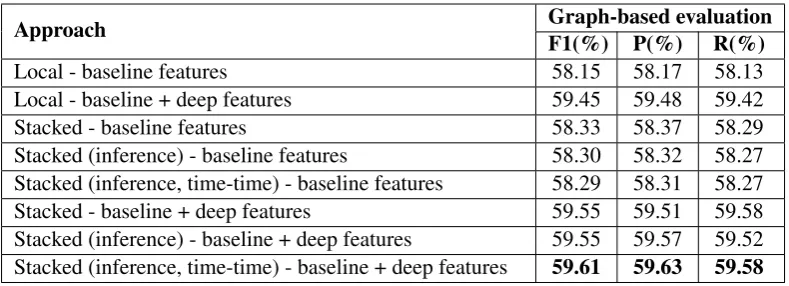
[image:7.595.102.497.61.204.2]Stacked (inference) - baseline features 58.30 58.32 58.27 Stacked (inference, time-time) - baseline features 58.29 58.31 58.27 Stacked - baseline + deep features 59.55 59.51 59.58 Stacked (inference) - baseline + deep features 59.55 59.57 59.52 Stacked (inference, time-time) - baseline + deep features 59.61 59.63 59.58
Table 5: Ten-fold cross validation results on the training set
No. of TLINKs Total
Annotated 4,983
+Inference 24,788
[image:7.595.79.286.245.302.2]+Inference + time-time connection 87,992
Table 4: Number of TLINKs in the Timebank cor-pus
5 Evaluation
For the baselines and both stages of the stacked learning, we have used the LIBLINEAR (Fan et al., 2008) and configured it to work as L2-regularized logistic regression classifiers.
We trained our models on the Timebank corpus, introduced in Subsection 2.1, which was provided by the TempEval-3 organiser. The corpus contains 183 newswire articles in total.
5.1 Results on the training data
The performance analysis is performed based on 10-fold cross validation over the training data. The classification F1 score improves by 0.18 pp and 0.16 pp compared to the local pairwise models with/without deep syntactic features.
We evaluated the system using a graph-based evaluation metric proposed by UzZaman and Allen (2011). Table 5 shows the classification accuracy over the training set using graph-based evaluation.
The stacked model affected the relation classi-fication output of the local model, changing the relation types of 390 (out of 2520) E-E TLINKs and 169 (out of 2463) E-T TLINKs.
5.2 Comparison with the state of the art We compared our system to that of Yoshikawa et al. (2009) which uses global information to
improve the accuracy of temporal relation clas-sification. Their system was evaluated based on TempEval-2’s rules and data set (Verhagen et al., 2007), in which the relation types were reduced to six relations: BEFORE, OVERLAP, AFTER, BEFORE-OR-OVERLAP,OVERLAP-OR-AFTER, andVAGUE. The evaluation was done using 10-fold cross validation over the same data set as that of their reported re-sults.
According to TempEval-2’s rules, there are three tasks as follows:
• Task A: Temporal relations between events and all time expressions appearing in the same sentence.
• Task B: Temporal relations between events and the DCT.
• Task C: Temporal relations betweeen main verbs of adjacent sentences.
The number of TLINKs annotated by the orga-nizer, after relation inference, and after time-time connection for each task is summarized in Table 7. Table 8 shows the number of TLINKs after per-forming relation inference and time-time connec-tion.
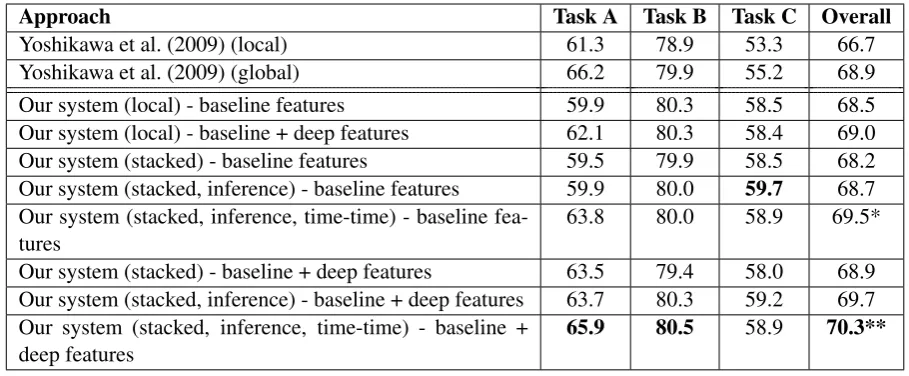
As shown in Table 6, our system can achieve better results in task B and C even without deep syntactic features but performs worse than their system in task A. Compared to the baselines, the overall improvement is statistically significant* (p
Approach Task A Task B Task C Overall
Yoshikawa et al. (2009) (local) 61.3 78.9 53.3 66.7
Yoshikawa et al. (2009) (global) 66.2 79.9 55.2 68.9
Our system (local) - baseline features 59.9 80.3 58.5 68.5 Our system (local) - baseline + deep features 62.1 80.3 58.4 69.0 Our system (stacked) - baseline features 59.5 79.9 58.5 68.2 Our system (stacked, inference) - baseline features 59.9 80.0 59.7 68.7 Our system (stacked, inference, time-time) - baseline
fea-tures 63.8 80.0 58.9 69.5*
Our system (stacked) - baseline + deep features 63.5 79.4 58.0 68.9 Our system (stacked, inference) - baseline + deep features 63.7 80.3 59.2 69.7 Our system (stacked, inference, time-time) - baseline +
[image:8.595.71.526.61.249.2]deep features 65.9 80.5 58.9 70.3**
Table 6: Comparison of the stacked model to the state of the art and to our local model (F1 score(%))
No. of TLINKs Task A Task B Task C Annotated 1,490 2,556 1,744
Table 7: TempEval-2 data set
No. of TLINKs Total
Annotated 5,970
+Inference 156,654
+Inference + time-time connection 167,875
Table 8: Number of relations in TempEval-2 data set
The stacked model enhances the classification accuracy of task A when timegraphs are dense enough. Deep syntactic features can be extracted only when temporal entities are in the same sen-tences so they improve the model for task A (event-time pairs in the same sentences) but these features clearly lower the accuracy of task C, since there are very few event-event pairs that appear in the same sentences (and break the definition of task C). This is probably because the sparse-ness of the deep features degrades the performance in task C. Moreover, these features do not help task B in the local model because we cannot ex-tract any deep syntactic features from TLINKs be-tween events and DCT. However, they contribute slightly to the improvement in the stacked model since deep syntactic features increase the accuracy of the prediction of task A in the first stage of the stacked model. As a result, timegraph features ex-tracted from the output of the first stage are better than those extracted from the local model trained
on only baseline features.
6 Discussion
As we can see from Table 5 and 6, although deep syntactic features can improve the classifi-cation accuracy significantly, some additional pre-processing is required. Moreover, deep parsers are not able to parse sentences in some specific domains. Thus, sometimes it is not practical to use this kind of features in real-world temporal relation classification problems. By applying the stacked learning approach to the temporal relation classification task, the system with only baseline features is able to achieve good classification re-sults compared to the system with deep syntactic features.
Again, from Table 5 and 6, the inference and time-time connection, described in Section 4, sometimes degrade the performance. This is pre-sumably because the number of features increases severely as the number of TLINKs increased.
The stacked model also has another advantage that it is easy to build and does not consume too much training time compared to MLNs used by Yoshikawa et al. (2009), which are, in general, computationally expensive and infeasible for large training sets.
7 Conclusion
show that our system can outperform the state-of-the-art system and achieve good accuracy by us-ing only baseline features. We also apply the rela-tion inference rules and the time-time connecrela-tion to tackle the timegraphs’ sparseness problem.
In future work, we hope to improve the classi-fication performance by making use of probability values of prediction results obtained from the first stage of the stacked learning and applying the full set of inference relations to the system.
Acknowledgement
The authors would like to thank the anonymous re-viewers for their insightful comments and sugges-tions, which were helpful in improving the quality of the paper.
References
Danushka Bollegala, Naoaki Okazaki, and Mitsuru Ishizuka. 2010. A bottom-up approach to sentence ordering for multi-document summarization. In In-formation Processing & Management, Volume 46, Issue 1, January 2010, pages 89–109.
Johan Bos and Katja Markert. 2005. Recognis-ing textual entailment with logical inference. In HLT/EMNLP 2005, pages 628–635.
Nathanael Chambers, Shan Wang and Dan Juraf-sky. 2007. Classifying temporal relations between events. InACL 2007, pages 173–176.
Nathanael Chambers and Dan Jurafsky. 2008. Jointly combining implicit constraints improves temporal ordering. InEMNLP 2008, pages 698–706.
Rong-En Fan, Kai-Wei Chang, Cho-Jui Hsieh, Xiang-Rui Wang, and Chih-Jen Lin. 2008. LIBLINEAR: A library for large linear classification.
Christiane Fellbaum. 1998. WordNet: An Electronic Lexical Database. Cambridge, MA: MIT Press. Natsuda Laokulrat, Makoto Miwa, Yoshimasa
Tsu-ruoka and Takashi Chikayama. 2013. UTTime: Temporal relation classification using deep syntac-tic features. InSemEval 2013, pages 89–92. Inderjeet Mani, Marc Verhagen, Ben Wellner, Chong
Min Lee and James Pustejovsky. 2006. Machine Learning of Temporal Relations. In ACL 2006, pages 753–760.
Stephanie A. Miller and Lenhart K. Schubert. 1999. Time revisited. In Computational Intelligence 6, pages 108–118.
Yusuke Miyao and Jun’ichi Tsujii. 2008. Feature for-est models for probabilistic HPSG parsing. In Com-putational Linguistics. 34(1). pages 35–80, MIT Press.
James Pustejovsky, Patrick Hanks, Roser Saur´ı, An-dew See, Rob Gaizauskas, Andrea Setzer, Dragomir Radev, Beth Sundheim, David Day, Lisa Ferro and Marcia Lazo. 2003. The TIMEBANK Corpus. In Proceedings of Corpus Linguistics 2003 (March 2003), pages 545–557.
James Pustejovsky, Robert Ingria, Roser Saur´ı, Jos´e Casta˜no, Jessica Littman, Rob Gaizauskas, Andrea Setzer, Graham Katz and Inderjeet Mani. 2005. The specification language TimeML. InThe Language of Time: A reader, pages 545–557.
Deepak Ravichandran and Eduard Hovy. 2002. Learn-ing surface text patterns for a question answerLearn-ing system. InACL 2002, pages 41–47.
Stanford Natural Language Processing Group. 2012. Stanford CoreNLP.
Marta Tatu and Munirathnam Srikanth. 2008. Experi-ments with reasoning for temporal relations between events. InCOLING 2008, pages 857–864.
Naushad UzZaman and James F. Allen. 2011. Tempo-ral evaluation. InACL 2011, pages 351–356. Naushad UzZaman, Hector Llorens, Leon
Derczyn-ski, Marc Verhagen, James Allen and James Puste-jovsky. 2013. SemEval-2013 Task 1: TempEval-3: Evaluating time expressions, events, and temporal relations. InSemEval 2013, pages 2–9.
Marc Verhagen, Robert Gaizauskas, Frank Schilder, Mark Hepple, Graham Katz and James Pustejovsky. 2007. SemEval-2007 task 15: TempEval temporal relation identification. InSemEval 2007, pages 75– 80.
David H. Wolpert. 1992. Stacked generalization. In Neural Networks, volume 5, pages 241–259. Katsumasa Yoshikawa, Sebastian Riedel ,Masayuki