A Thesis Submitted for the Degree of PhD at the University of Warwick
http://go.warwick.ac.uk/wrap/56205
This thesis is made available online and is protected by original copyright. Please scroll down to view the document itself.
by
Naoko Yamazaki
A thesis submitted in partial fulfilment of the requirements for the degree
of
Doctor of Philosophy in Continuing Education
University of Warwick, Department of Continuing Education
;,)''(Tii;.·, ~.. r,~"
September
iQO
1
!i''w ~ -j~~; ,'": .~tY~ I
c:
~ '<"·.t·.;!..>'i.~ ~;'Table of Contents
List of Figures and Tables ... 4
Acknowledgements ... 5
Declaration ... 6
Summary ... 7
Abbreviations ... 8
Chapter I Introduction
1-1 Introduction ... 91-2 The System of Higher Education in the UK ... 10
1-3 The System of Higher Education in Japan ... 16
1-4 Key Questions ... 23
1-5 Outline of This Research ... 24
Chapter 2 Methodology
2-1 Introduction ... 262-2 Potential and Limitations of Cross-National Studies ... 26
2-3 Discernible Gaps between Western and Japanese Perceptions ... 32
2-4 Approaches towards Anglo-Japanese Studies ... 39
2-5 Methods of This Research ... 45
Chapter 3 Development of National Policy on the Evaluation of
Research in the UK
3-1 Introduction ... 573-2 Background to the Issue ... 57
3-3 Political Development of the Evaluation of Research ... 63
3-4 Academic Debates ... 72
3-5 Views of the Funding Councils ... 80
3-6 Summary and Observation ... 98
Chapter 4 Case Study of Warwick University
4-1 Introduction ... 1 01 4-2 Brief Outline of Warwick University ... 1014-3 Institutional Reaction to the Government's Proposal ... 110
4-4 Departmental Reaction: The Case of Scientific Department X ... 119
4-5 Departmental Reaction: The Case of Non-Scientific Department Y ... .123
4-6 Individual Reaction: The Case of Scientific Department X ... 129
4-7 Individual Reaction: The Case of Non-Scientific Department Y ... 140
Chapter 5 Development of National Policy on the Evaluation of
Research in Japan
5-1 Introduction ... 155
5-2 Background to the Issue ... 155
5-3 Political Development of the Evaluation of Research ... 163
5-4 Academic Debates ... 177
5-5 Views of the Academic Committee ... 193
5-6 Summary and Observation ... 201
Chapter 6 Case Study of Nagoya University
6-1 Introduction ... 2056-2 Brief Outline of Nagoya University ... 205
6-3 Institutional Reaction to the Government' s Proposal.. ... 217
6-4 Departmental Reaction: The Case of Scientific Department at ... 225
6-5 Departmental Reaction: The Case of Non-Scientific Department
f3 ...
2316-6 Individual Reaction: The Case of Scientific Department at ... 236
6-7 Individual Reaction: The Case of Non-Scientific Department
f3 ...
2456-8 Summary and Observation ... 251
Chapter 7 Comparative Analysis of the Evaluation of Research in
the UK and Japan
7-1 Introduction ... 2557-2 Comparative Analysis of Background Factors ... 255
7-3 Comparative Analysis of Development of National Policies on the Evaluation of Research ... 259
7-4 Comparative Analysis of Systems of Evaluation at the National Level.. ... 262
7-5 Comparative Analysis of Systems of Evaluation at the Organisational Level .... 282
7-6 Comparative Analysis of Current Influences at the National Level.. ... 288
7-7 Comparative Analysis of Current Influences at the Organisational Level ... 292
7-8 Summary and Observation ... 295
Chapter 8 Conclusion
8-1 Summary of This Research ... .3038-2 Recommendations for the UK and Japan ... 310
8-3 Limitations of This Research ... 322
8-4 Suggestions for Further Research ... 325
8-5 Concluding Remarks ... 328
List of Figures
&
Tables
1-1 Number of REIs in the UK by Type and Domicile ... 11
1-2 Age Participation Indices (API) by Domicile in the UK and Japan ... 13
1-3 Numbers of Japanese REIs by Type ... 17
1-4 Full-time Equivalent Student Numbers in Japan ... 20
3-1 Factors affecting the Emergence of Quality Assurance in the UK ... 58
3-2 Development of the System of Research Assessment in the UK ... 71
4-1 Incomes of Warwick University (1965-1990) Figures in Million Pounds ... 106
4-2 Basic Facts and Figures of Warwick University ... 107
4-3 The Outcomes of the RAE 1992 and 1996 at Warwick ... 113
4-4 Institutional Reaction to the Government's Proposal at Warwick ... 116
5-1 Factors affecting the Emergence of Assessment Systems in Japan ... 156
5-2 Numbers of REIs which have introduced Monitoring' and 'Self-Evaluation' by 1996 ... 172
5-3 Percentages of HEIs conducted 'Self-Monitoring' and 'Self-Evaluation' by Years and Types ... 173
5-4 Percentages of REIs conducted 'External Evaluation' by Years and Types ... 174
5-5 Main Legislative Changes with regard to Research Assessment in Japan ... 195
6-1 Development of Nagoya University ... 208
6-2 Location of Nagoya University ... 210
6-3 Organisational Structure of Nagoya University ... 212
6-4 Details of Internal Revenue of Nagoya University ... 213
6-5 Details of Expenditures of Nagoya University ... 214
Acknowledgements
I would like to express my sincere gratitude to my supervisor, Professor Malcolm Tight, for providing lots of guidance and for showing the understanding and patience throughout this arduous journey.
At the same time, I would not have been able to fulfil my goal without the support of Professor Hideyuki Shinkai, Professor of Continuing Education, Nagoya University.
I would also like to warmly thank Ms Ruth Coles for encouraging me a lot throughout the period of writing up.
My thanks also go to Mr Howard Fisher, who originally suggested Warwick for my study.
I would also like to note that this research was partly funded by the Japan Foundation Endowment Committee in Sheffield.
Declaration
This thesis is presented in accordance with the regulations for the degree of Doctor of
Philosophy (Ph.D.). The work described is entirely original and my own, unless
otherwise stated. None of the material contained hereafter has been submitted for a
Summary
Most industrial countries have introduced a system of evaluation in the HE
sector during the last two decades. Although the experience in each country is different,
recent studies show that many countries have faced similar confusion and problems
with regard to the application of evaluation.
This study examines the validity of the present systems of evaluation for
research in the UK and Japan, based on in-depth consideration of the factors behind the
emergence of evaluation, political developments, policymakers' views, academic
debates and institutional reactions in both nations. As an example of a response to the
government's initiative, one case study in each country is undertaken, Warwick
University in Britain and Nagoya University in Japan. Each case is analysed at three
levels: institutional, departmental and individual. Some elements of the systems are
then recontexualised in a comparative perspective, involving the analysis of background
factors, development of the systems, details of the mechanisms and their impacts. An
improved system of evaluation is suggested for each country.
It is argued that evaluation intrinsically is an unseen but extremely powerful
instrument. It has the dynamic force to be able to alter the original nature of all of those
involved. When it is applied to academic research in the university, therefore, its effects
could be immeasurable. Hence, it should be treated with prudent deliberation before
implementation. It is pointed out that the current systems of research assessment in the
UK and Japan have both produced a number of unintended effects, and both nations
have not yet been successful in establishing a system which can judge quality
appropriatel y.
The study suggests that more serious consideration of the nature of 'evaluation'
and its application to research will be required before developing further the present
systems adopted in both countries. This should be backed by sufficient research studies
ABRC ACARD CVCP DENI DES DlliE DFES EPSRC FCs FHE Act GR funds HE HEFCE HEFCW HEIs JUAA NACSIS NIAD PIs QAA QR funds RAE RIHE SERC SHEFC SRC UFC UCAS UGC US
wwn
Abbreviations
Advisory Board for the Research Councils
Advisory Council for Applied Research and Development Committees of Vice Chancellors and Principals
Department of Education, Northern Ireland Department of Education and Science Department for Education and Employment Department for Education and Skills
Engineering and Physical Science Research Council Funding Councils
Further and Higher Education Act 1992 Generic Research Funds
Higher Education
Higher Education Funding Council for England Higher Education Funding Council for Wales Higher Education Institutions
Japanese University Accreditation Association National Centre for Science Information Systems National Institution for University Evaluation and
Academic Degrees (Formerly called National Institution for Academic Degrees)
Performance Indicators Quality Assurance Agency Quality-related Research Funds Research Assessment Exercise
Research Institute for Higher Education Science and Engineering Research Council Scottish Higher Education Funding Council Science Research Council
University Funding Council
Universities and Colleges Admission Service University Grants Committee
Chapter 1 Introduction
1-1 Introduction
1-2 The System of Higher Education in the UK 1-3 The System of Higher Education in Japan 1-4 Key Questions
1-5 Outline of this research
1·1 Introduction
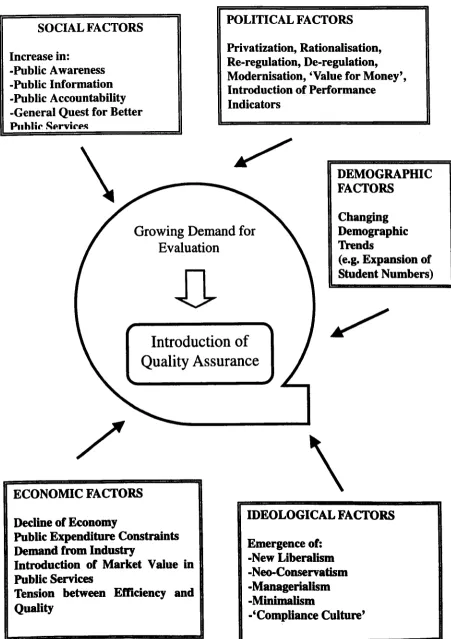
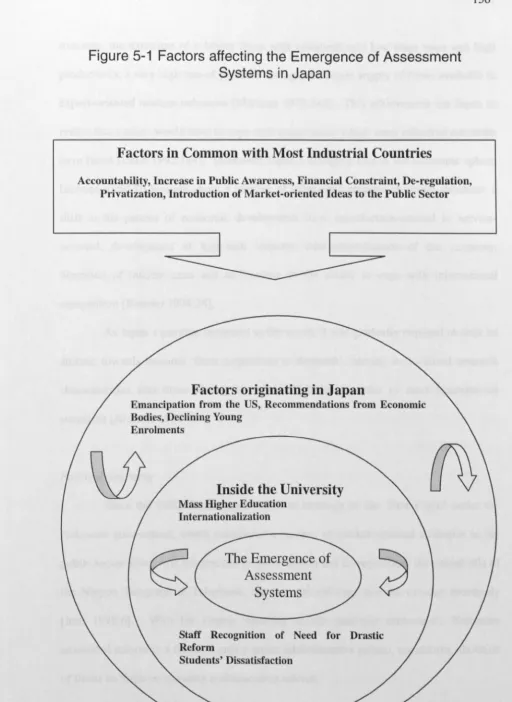
Evaluation is a powerful instrument which evokes strong discourses. Its
demand arises from a multitude of factors in society. It has the possibility of changing
the original nature of all involved and the context which applies. When it relates to
academic research in the university, its effects can be immense, not only on the nature of
academic research itself, but also on the whole higher education sector and beyond.
Hence, it has to be treated with deliberate consideration before implementation.
Most industrial countries have introduced a system of evaluation in the Higher
Education (HE) sector during the last two decades (though it was introduced much
earlier in the case of countries in North America). Although each country had its own
reasons for introducing the system, recent studies show that many countries have faced
similar confusion and problems with regard to its application, regardless of differences
of the details in their systems. This is because, while the demand for evaluation
increasingly rises, most nations have not fully realised its powerful nature which could
influence a variety of elements surrounding the system. A number of researchers have
begun to focus on this issue in recent years. However, none of them has reached any
definite conclusion, due to its complex features.
This study intends to elucidate the effectiveness of the present systems of
evaluation for research by examining the British and Japanese systems introduced in
developments, policymakers' views and academics' reactions in both nations. In the
end, an improved system of evaluation is suggested for each country. As a matter of
fact, the two countries have a variety of different social norms and practices which could
be a hindrance in making the comparison. Nevertheless, it is worthwhile comparing
them, since there are some interesting elements which the two nations share, such as the
fact that both are based on small islands which are of similar size and population.
The rest of this chapter briefly illustrates the general background to the issues in
both countries in order to clarify the circumstances in which the quest for evaluation has
emerged, followed by key questions and an outline of the thesis.
1-2 The System of Higher Education in the UK
THE NATURE OF THE RESPONSIBLE SECTOR
The UK universities are diverse, ranging in size, mission, subject mix and
history. Their structures of governance have evolved in many ways, reflecting these
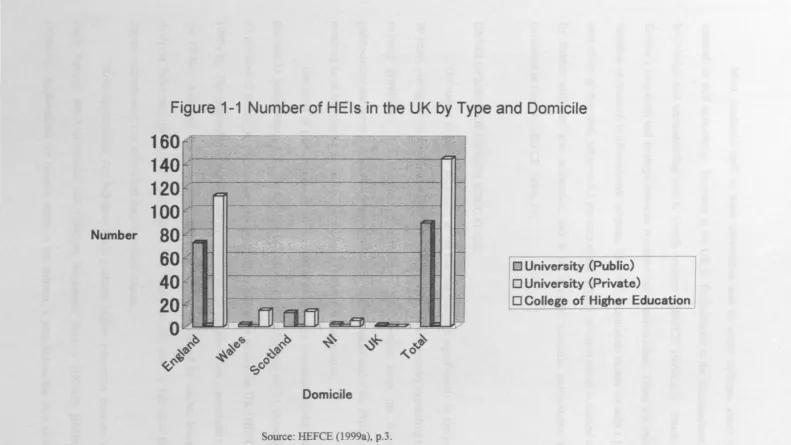
backgrounds. There are 111 university institutions in the UK (England 87, Wales 9,
Scotland 13, Northern Ireland 2) and 60 higher education colleges (England 47, Wales 4,
Scotland 7, Northern Ireland 2) [Figure 1-1]. All UK universities with the exception of
Buckingham (a private institution) are legally independent corporate institutions and
receive significant public funding [CVCP 1998a: 1].
The most important constitutional difference is between those universities
created before and those after, the Further and Higher Education Act of 1992 (FHE Act).
In England, the older universities were established by Royal Charter or statute [HEFCE
1999a:3]. The Privy Council has the power to grant university status to an institution
which has the necessary characteristics, and universities have their own degree-awarding
160
140
0<-
,,""
120
100
Number
80
'
60
Pi.c40
20
m;
.%l
0
"
~
";:o..'f)~
~<::-~
13 University (Public)
o
University (Private)o
College of Higher Education~
~'*-
v,,0
"!v~
~~flJ~
~'b
""," ~ttjC:JcP
Domicile
[image:12.804.0.792.42.487.2]Most academic staff in most universities and in some colleges, carry out
research as well as teaching. Research in the UK is 'fundamental to the development of
knowledge and understanding and to wealth creation' [HEFCE 1999a: 12]. Much of
Britain's long-term and strategic research is carried out in universities. There is a strong
tradition of research in all academic subjects. The UK's population makes up only I per
cent of the global total, yet over 5.5 per cent of the world's research effort is carried out
by British scientists and academics, and 8 per cent of scientific publications are
published in the UK [HEFCE 1999a: 12].
DEVELOPMENT OF HIGHER EDUCATION
The nature of higher education in the UK has changed significantly in the past
30 years, during which the nation has begun to widen HE opportunities by expanding the
existing provision. The number of universities has doubled since the former
polytechnics and some colleges were given the status of universities under the FHE Act,
resulting in an increase in the number of students studying at universities.
The level of participation in HE by school leavers has increased rapidly over
the past 15 years [Figure 1-2]. At the time of writing, by the time they are 21 years old,
33 per cent of young people will have entered higher education across the UK [HEFCE
1999a:8]. The proportion of mature and part-time students has also risen dramatically in
the 1990s. Although undergraduates used to be largely dominated by school leavers
studying full-time, the current figure shows that nearly 30 per cent of full-time first
degree students are 21 or over when they start their course.
Most applications for full-time undergraduate higher education courses are
made through the Universities and Colleges Admission Service (UCAS) [HEFCE
70
60
50
40
%
30
20
10
0
1979 1985 1988 1989
Year
Source: Government Statistical Service (1993), p.76.
RlliE (I 995), p.19.
1990 1992
- . - England and Wales _Scotland
---...- Northen Ireland --iE-Japan(HE as a whole) _ Japan (University)
[image:14.784.172.769.15.465.2]course. Applications for postgraduate and part-time study are made directly to the
university or college. First degree courses generally take three years in England, Wales
and Northern Ireland. In Scotland, undergraduate programmes are offered both on a
three-year basis, leading to a general degree, and on a four-year basis, leading to an
Honours degree, and schoolleavers enter universities at 17 rather than 18.
The UK is one of the major destinations for students from around the world. As
well as the cultural enrichment and understanding they bring, international students
annually contribute well over a billion pounds to the UK economy. They come from
over 180 countries and forty-four per cent of these students come from EU countries
[CVCP 1998b: 1].
FUNDING
Public research funds are provided under a dual support system, by the Higher
Education Funding Councils and by the Research Councils [HEFCE 1998:9-10]. The
Funding Councils (FCs) provide funding towards the cost of the salaries of permanent
academic staff, premises and central computing costs, while the Research Councils
provide for direct project costs and contribute to indirect project costs. The general
funds provided by the FCs also support basic research in institutions and contribute to
the cost of research training.
The four UK funding bodies - the Higher Education Funding Council for
England (HEFCE), the Higher Education Funding Council for Wales (HEFCW), the
Department of Education, Northern Ireland (DENn and the Scottish Higher Education
Funding Council (SHEFC) - allocate most of their funds by formulae for teaching and
research [HEFCE 1999a:6]. Although guidance and priorities are given by the
specific institutions. With the exception of DENI, the FCs act as intermediaries between
the government and higher education institutions (HEIs). As well as allocating funds to
institutions, they provide advice and guidance to the government and promote good
practice in the HE sector.
With regard to research, nearly all funding for research is related directly to the
quality and volume of research. For instance, the HEFCE's funding for research in
1998/99 is 824 million pounds and is allocated to two main headings: quality-related
research (QR) funds which account for 804M pounds and generic research (GR) funds
for 20M pounds [HEFCE 1998: 10]. In allocating the QR money, the total funds are
divided between 68 subject areas (in the case of the RAE 200 1). Each subject is
assigned to one of three cost weights (high cost laboratory and clinical subjects 1.7,
intermediate cost subjects 1.3, others 1.0) and each of them is multiplied by the volume
of research to work out the total funding for that subject.
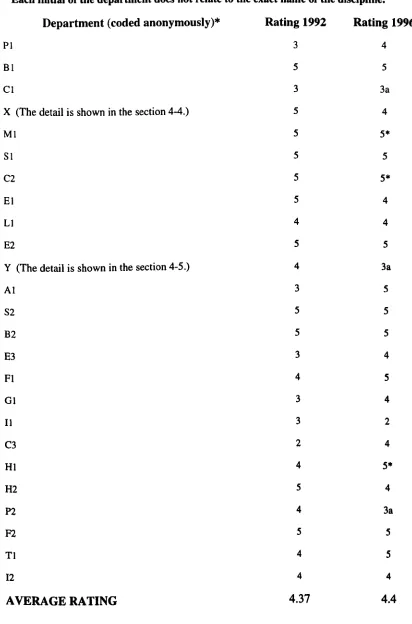
The quality of research is assessed by peer review in a periodic Research
Assessment Exercise (RAE) [HEFCE 1998:15]. By this system, most HEFCE research
funds are distributed selectively to HEIs that have demonstrated their strength in
research by reference to national and international standards. According to measurement
scales described through grades 5* (highest) to 1 (lowest), institutions conducting the
best research receive a larger proportion of the grant.
Universities and colleges also generate funds from a wide variety of private
sources, such as sponsorship, fee-paying students, conferences and donations, while
being funded by industry and charity. In recent years, the government has shifted the
balance of funding into competitive money. With this trend, it is predicted that HEIs
RECENT TRENDS
The main issues currently discussed in the UK include the question of 'Who
should pay?'. Due to continuous financial stringency, the government announced in
1997 that new UK and EU undergraduate students on full-time higher education would
make a means-tested contribution to university tuition fees from 1998 as part of a new
student funding package [CVCP 1998c: I]. In this scheme, while maintenance grants
were abolished, students will have access to a new loans scheme, repaid after graduation,
depending on their earnings. One of the criticisms of this scheme is that the
unprecedented expansion in student numbers over the last decade has not been matched
with increased funding by the government.
1-3 The System of Higher Education in Japan
THE NATURE OF THE RESPONSmLE SECTOR
Japanese higher education varies quite significantly, depending on the
constitutional type (national, local and private) and on the nature of the institutions
(general universities, single-subject based universities, junior colleges, colleges of
technology and special training schools). Their structures of governance are diverse,
reflecting these backgrounds, sizes and mission statements. According to the recent
statistics [Research Institute for Higher Education 1995: 148], there were 552 university
institutions (national 98, local 48, private 406), 593 junior colleges (national 36, local
56, private 501), 62 colleges of technology (national 54, local 5, private 3) and 3431
special training schools (national 161, local 198, private 3072) in Japan in 1994 [Figure
1-3]. Since the end of World War Second (WW
n ),
all universities have been accreditedby the Japanese University Accreditation Association (JUAA) and each of the
Number
500
'
-
~··F:: : ~~----·..
~ve:a
CC1';-
f:11
.
..
V
I
. ",.
",0'&o
~
CJ'lf.,.l,~
.
o~'lf
vO~("
~
~~
Type
Source: RIHE (1995), p.149.
o
University• Junior College
• College of Technology
[3 Special Training Schoo- ---.---Jj
[image:18.803.132.787.31.511.2]National Institution for University Evaluation and Academic Degrees (NIAD) has taken
a role in degree-awarding since 1991 [NIAD 2000].
Academic staff in most institutions are engaged in both research and teaching.
Research in Japan is regarded as 'essential to the pursuit of knowledge' [The Academic
Committee 1999: 1-1-1]. However, due to language barriers and the nature of research,
academic research in the social sciences and humanities in Japan tends to be closed to
outside nations despite the fact that it is a rich resource inside the country, though this is
less the case for science.
Although the system of Japan's higher education had been largely influenced by
the United States (US) since WW
n ,
the nature of the sector is not identical. Accordingto Geiger [1988:699], the nature and forms of private higher education vary depending
on the country. He suggests three basic structural divisions between private and public
sectors of higher education: 'mass private and restricted public sector', 'parallel public
and private sectors' and 'comprehensive public and peripheral private sectors'. Apart
from these three models, Geiger also identifies the type called 'the United States private
sector', since the American private sector deserves separate consideration due to its size
and nature, e.g. large-scale government funding of scientific research in private
universities. Above all, American private colleges and universities have a tacit
obligation to provide advantages of academic quality, services, or cultural/pedagogical
style that are not readily available in state institutions.
In this categorisation, Japan's HE sector can be placed as 'mass private sector
and restricted public sector'. Private institutions in mass private sectors are most heavily
dependent upon student tuition. Students have been expected to pay something close to
the full cost of their education, though the advent of government subsidies in Japan
capacity of the educational services that private universities can provide. For instance,
Japan's large-scale scientific research is mostly conducted in national universities
(alongside private companies' research institutes), not in private ones. Consequently,
though 'the bulk of higher education is catered for privately, the prestige institutions tend
to be public ones' [EI-Agraa & Ichii 1985:1]. In this sense, the Japanese public sector
provides education that is functionally equivalent to that offered in the private sector in
the US.
DEVELOPMENT OF HIGHER EDUCATION
In Asia, the impact of Western academic models and institutions has been
significant from the beginning and it remains important even at present [Altbach 1994].
Japan was influenced by a variety of foreign ideas after the Meiji Restoration in 1868.
The German impact had been the greatest until the US mission restructured the whole
Japanese educational system after WWII [Osaki 1997:151]. Though Japanese
universities emerged in the late 19th century, which was far later than any other Western
country, the rate of participation in HE rapidly increased with the growth of HEls
post-war. Consequently, the nation has suddenly become one of the countries which has mass
HE provision [Figure 1-4]. For instance, the level of participation of full-time
equivalent students in HE is nearly 45.2% across Japan in 1995. This is also supported
by the fact that more than 95% of the age cohort between 15-18 go through
upper-secondary education. Although the nation encountered a sharp decline of the 18-year
old population, this has not affected the enrolment rates as yet. It is now anticipated that
the student participation rate in universities will be 50% within the early 2000s [Hosoi
1999:6].
3,000,000
2,500,000
~
l
'
--+-Tota'
-National
2, 000,000
I
~- . -.-Local
~
...
~
.
~
I
~J'r
ivate
e,'
~v~ 1,500,000
1, 000, 000
500,000
a
~~~~~~~~~~~~~~~~~~~~~w~~~
~~~~~~~~~~~~~~~~~~~~~~~~~
Year
Source: Ichikawa (1995a), pp.15-16.
N
[image:21.815.163.803.27.518.2]to each of the HEIs, a few months before the start of the courses and they are mainly
judged by entrance examinations, though students' school records are also taken into
account. First degree courses generally take four years in all types of institutions except
medical schools which normally require a six-year studying period.
Until quite recently, undergraduates largely came from schoolleavers studying
full-time. However, the proportion of mature and part-time students has risen
dramatically since the 1990s through the government's initiative [e.g. The University
Council 1993]. In addition, with the increased economic strength of the country, Japan
is becoming one of the major destinations for overseas students, particularly from Asia
over the last two decades [Umakoshi 1997].
FUNDING
Unlike the UK, there is no intermediate funding body between the government
and the HEIs. It is therefore the government itself that is responsible for allocating HE
funds. At the same time, universities and colleges also generate funds from private
sources, such as fee-paying students and donations.
The proportion of public funds in HE varies depending on the institution, but it
would account for approximately 60% in national institutions and for 10% in private
institutions (through subsidies) [RIHE 1995:231]. Up to the present, most of the public
funds for research have not been separated from those for teaching. From the central
government, 77.2% of the total money comes as 'general funds for teaching & research'
as a part of a block grant (in the case of national institutions in 1993). It is therefore up
to each of the institutions, departments and individuals to allocate these amounts. Apart
from this, there is a fund towards the direct cost for special research projects called
provided depending on the originality of the individual's or the group's theme and the
prior research performance [Kobayashi 1997:45]. Until the mid-1980s, 'Grants-in-aid'
had been relatively small, and there was hardly any external income in most REIs
[Kobayashi 1997:45]. However, they have been encouraged to seek external sources in
recent years.
Latterly, due to financial constraints, selective distribution of research money
through quality assurance has become a particular focus of the nation [e.g. The
University Council 1998; The Academic Committee 1999]. Although under the current
system, HE funding has not been linked to the quality of research (nor teaching) as yet, it
is expected that, with the new nationwide third party system which is currently under
preparation, the outcome will partly result in selective funding.
RECENT TRENDS
These include an increase in mature students' enrolment, the abolition of
general education, the introduction of quality assurance, the introduction of independent
graduate schools, the expansion of existing graduate schools, an increase in
collaboration in cross-over subject areas and further focus on 'centres of excellence'
through the introduction of selective funding.
With regard to national universities, all institutions are expected to be given an
incorporated status under a new regulation within a few years, with a view to an increase
of state funds to HE, an expansion of institutional autonomy, and more disclosure of
internal information to the public [Asahi Newspaper 2119/01]. In the new system, the
national universities will have more freedom in their activities, released from the
existing rigid control by the government. In accordance, a further cut in general staff is
of the tuition fees. Currently, detailed proposals on the incorporation of national
universities have been announced by the National University Committee which consists
of representatives of each of the national universities, covering issues such as the
introduction of competency-based salary for staff, more flexible management in each of
the HEIs through the rationalisation of existing administration and through the invitation
of external viewers [Asahi Newspaper 116/01].
1·4 Key Questions
A more specific description of the HE sector in Britain and Japan would find a
number of different elements which can be obstacles to a comparative analysis.
However, both nations have undoubtedly experienced the emergence of quality
assurance over the last two decades in their own contexts. Therefore, it can be
envisaged that there are some possibilities for a comparative study which are worth
tackling.
Among all the issues of quality assurance debated in both nations, this study
particularly focuses on the evaluation of research. The reasons for this are:
a) space for the thesis is limited;
b) teaching assessment is more controversial in many respects under the present
circumstances; and
c) the nature of academic research intrinsically embodies a number of universal values
across national borders.
With this in mind, the study intends to answer the following questions:
• Why have the systems of research assessment been required and how have those been
• What are the characteristics of the methodologies adopted in both nations, and what
are their implications?
• How have the systems of research assessment in the UK and Japan impacted on the
HE sector and beyond?
• How should the university identify its role in response to social changes?
• What can be deduced from the UK and Japan in order to suggest an improved system
of research assessment for each country?
1·5 Outline of This Research
Chapter 2 clarifies some possibilities and limitations of comparative analysis of
higher education in the UK and Japan in general. It discusses methodological issues in
comparative higher education, followed by a literature review of Anglo-Japanese
comparative studies, analysis of the gap between Western perceptions of Japanese
education and Japanese perceptions of Western education, and consideration of the
possibilities for comparison at the present stage. The methods adopted in this research
are also discussed.
Chapter 3 illustrates the evolution of the system of research assessment in the
UK in connection with background issues and recent political debates. It examines the
view of the Funding Councils and academic debates.
Chapter 4 depicts the practice of one UK university as an example of
institutional reaction to the introduction of a system of research assessment and its
implications. Reactions at Warwick University are analysed at three different levels:
institutional, departmental and individual. After discussing the experience of
institutional management, two selected departments' experiences are illustrated, one
individual level.
Chapter 5 explores the evolution of national policy on research assessment in
Japan in association with the recent political debates and the implementation of
assessment systems. It will review academic discussions as well as the views of a
Japanese government official in order to clarify current concerns on the issue both in the
government and the academic community.
Chapter 6 describes the practice of Nagoya University as an example of an
institutional reaction to the government policies on university assessment in Japan. As
in the previous chapter, this is examined at three levels: institutional, departmental and
individual, covering both science and non-science disciplines.
Chapter 7 conducts a comparative analysis on the systems of research
assessment in the UK and Japan, whilst discussing the issue in a wider context. The
analysis involves various aspects of the topic such as background factors, development
of the systems, details of the mechanisms and their impacts, so that the characteristics
can be more distinctly drawn.
Chapter 8 concludes this study, suggesting an improved system of research
assessment for each country, whilst referring to the limitations of this research as well as
Chapter 2 Methodology
2-1 Introduction
2-2 Potential and Limitations of Cross-National Studies
2-3 Discernible Gaps between Western and Japanese Perceptions 2-4 Approaches towards Anglo-Japanese Studies
2-5 Methods of This Research
2·1 Introduction
As briefly shown in the previous Chapter, the systems of higher education in
Britain and Japan vary to a large extent. This chapter attempts to clarify some of the
possibilities and limitations of comparative analysis of higher education in the UK and
Japan. It discusses methodological issues in comparative higher education, followed by
a literature review of Anglo-Japanese comparative studies, and analysis of the gap
between Western perceptions of Japanese education and Japanese perceptions of Western
education, in order to draw out the possibilities for comparison. It concludes by
describing the methods adopted in this research, while considering their limitations.
2·2 Potential and Limitations of Cross·National Studies
The demand for making comparisons between nations has been dramatically
increasing, as globalization and regional co-operation among nations grows [Harris
1991: 154]. It originates in different kinds of both external and internal forces, including
'the export and import of social, cultural and economic manifestations across national
borders' [0yen 1990:1]. It is usually motivated by 'the need to borrow, advise, evaluate
and the curiosity-motivated need to find out and describe practices from other cultures'
[Evans, Behrens, Hoffmann, Saxby-Smith & Rudd 2000:1]. According to Crossley &
Broadfoot [1992: 106], there is considerable agreement in the literature over the purposes
of comparative and international studies:
2) identifying and analysing similarities and differences in educational systems,
processes and outcomes with a view to assisting in the solution of identified
problems and/or in the future development of educational policy and practice; and
3) helping to better understand the nature of the relationships between education and
the broader social, political and economic sectors of society.
In addition, Teune [1990:38] says that companng countries can be a way of
understanding the best forms of political organisation to realise 'general values' across
the globe.
In practice, however, cross-national analysis has experienced a period of
stagnation [Dogan & Kazancigil 1994:41]. The most conspicuous problem concerns the
issue of equivalence. According to Neuman [1991 :411-412], this can be divided into
four subtypes:
1) lexicon equivalence (the correct translation of words and phrases);
2) contextual equivalence (the correct application of terms or concepts in different
social or historical contexts);
3) conceptual equivalence (the ability to use the same concept across divergent cultures
or historical eras); and
4) measurement equivalence (measuring the same concept in different settings).
One needs also to be aware of Galton's problem which concerns the question of how
much of the characteristics of a specific culture are due to its own autonomous dynamics
and how much to diffusion from other cultures [Goedegebuure & Van Vught 1996:379].
Generally speaking, it is broadly agreed among social scientists in the West that
and formalises that cognitive process' [Bechhofer & Paterson 2000:3]. In this sense, 'all
empirical social research involves comparison of some sort' [Ragin 1987:1] and most
problems that arise in cross-national comparisons are by no means peculiar to
international research.
However, what is specific to comparative studies at the international level is
that the gap between those compared is much wider and more deeply rooted in different
social, cultural and political contexts. On this point, Hantrais & Mangen write that
'additional difficulties arise, which may be absent from single-nation studies, due to
differences in research traditions and administrative structures' [1996:5] and as a result,
it 'demands greater compromises in methods than a single country focus' [1996: 10].
Himmelstrand [1977:437] also notes that cross-national comparisons have to intersect
'the lines between different schools of thought, different sociological traditions' and
require 'a much broader range of competence and technological equipment' than one
will usually find within one country. In addition, cross-national comparative researchers
will need to consider 'the use and application of the data collected which are much less
often encountered in academic research within one country where the scientific
community has attained a certain level of autonomy which makes it possible to carry out
so-called pure research for its own sake without too disturbing questions about
applications' [Himmel strand 1977:437]. Focusing on the relationship of those
compared, Samuel [1985:8] explains that 'the comparative method consists essentially
of observing the relationship - based either on similarities and differences - between two
or more societal processes in the field of social sciences, and in hypothesising that this
relationship can be observed between other social processes, known to a varying extent
to be taking place at different times and/or in different places'. Therefore, without
bias both in research focus and execution, since 'each culture has its own assumptions,
modes of thought, orientation toward time and fundamental values about human life and
all these influence their thinking and social relations' [Neuman 1991 :409].
Furthermore, a few technical limitations can be pointed out. First, the limited
number of sampling cases caused by empirical constraints can create 'doubts about
representation and validity' [Holt & Turner 1970: 19]. Second, comparative studies are
more costly and more time consuming. Consequently, there is a tendency that
preference is given to 'available data and methodological tools, and the leaning towards
accessible networks and easy funding' [0yen 1990: 15].
In order to avoid all these possibilities, it is suggested by some authors that
comparative studies should be conducted by an international collaborative research
team, as this allows discourse on cases and variables to develop into extended dialogues
between ideas and evidence. However, this approach tends to be vulnerable due to,
among other things, 'a heterogeneity of schools of thoughts, spiralling costs and
different work styles' [Teichler 1996:431].
On the whole, despite the common denominator of 'comparative', comparisons
very often are 'a second-order element at best', and the vast majority of studies do not
go beyond the descriptive stage, or at best do so only marginally [Goedegebuure & Van
Vught 1996:390]. Hence, it is suggested that researchers need to acknowledge such bias
derived from comparative studies and constantly combat it by being aware of how their
own culture influences thinking, and by becoming familiar with a diverse range of
cultures.
With regard to higher education, some authors have discussed the validity of
comparative studies. It is often said that research on higher education is an
individual discipline with its own theories [Holt & Turner 1970; Teune 1990]. Indeed, it
is undertaken not only by HE researchers but also by academics and practitioners in
various fields. This means that 'their disciplinary contribution tend to be that of field
knowledge not that of constituting the theories and methods of higher education
research' [Teichler 1996:439]. Due to this diverse nature and lack of settled
methodologies, comparative studies in higher education often become 'stuck in the
collection of curious, minute details', tend to provide 'sketchy, incomplete knowledge,
and seems to lack theoretical and methodological rigour' [Teichler 1996:432]. In
contrast, if 'projects seem to be theoretically and methodologically well prepared, there
is a tendency to limit their views to so few phenomena that they do not pay sufficient
attention to the complexity of the different national systems addressed' [Teichler
1996:432]. Consequently, comparative studies in higher education are 'always being
attacked for, or are self-defensive about, their inadequacies' [Kogan 1996:395].
Is it then possible to do more than provide a descriptive review of similarities
and differences? Teichler [1996:462-463] writes that 'information on other higher
education systems is most fruitful in destroying conceptual thinking and reasoning based
on narrow experience; comparative research is a gold mine for the early stage of
conceptual restructuring'. He concludes that 'comparative research projects seem to be
theoretically and methodologically most promising if they are based on a
semi-structured research design'. A group led by Kogan [1996:395-402], for instance, has
conducted a comparative study in a British-Norwegian-Swedish project which involved
empirical work into the relationship of policies to the impacts on academics by
examining in-depth the working life of academics in the three countries. Their project is
based on an assumption that the comparative method does not only consist of testing
phenomenon as yet insufficiently understood'.
Holt & Turner [1970:20], on the other hand, write that scholars have to focus
more explicitly on the rules of interpretation and the criteria for admissible explanation,
then they will have a more solid intellectual base for developing more sophisticated
conceptual schemes and more appropriate data-processing routines. In practice, for
example, Andorka [1990:205] suggests that comparative studies require social indicators
derived from social statistics and from repeated sociological surveys such as those
focusing on economic development, income differences by socio-economic strata,
income inequality, social mobility and the openness of society, time, budget and way of
life, and mortality.
More specifically, a recent study [Evans, Behrens, Hoffmann, Saxby-Smith &
Rudd [2000:3-4] proposes a 'layered approach', which involves 'matching' of cases and
categories at different levels, with data collection and analysis. It is assumed that by
using this approach, together with the consideration of labour market features and
cultural dimensions, there is a possibility that comparative studies could go beyond
investigation of hypothesised similarities and differences to develop deeper
understanding of how and why systems and policies operate in the ways they do.
Thus, if all these elements are carefully considered, hopefully by acquiring
appropriate 'training and some understanding of the sensitive characteristics of
cross-national studies' [Crossley & Broadfoot 1992:110], it is then possible to 'gain a greater
awareness and a deeper understanding of social reality' [Hantrais & Mangen 1996:2].
Adopting some of the suggestions discussed above, the following sections will
examine the possibilities of conducting a comparative study in the UK and Japan. They
will deal with more specific issues arising from each of the national contexts in order to
2·3 Discernible Gaps between Western and Japanese Perceptions
Before discussing practical comparability between Britain and Japan, this
section illustrates noticeable differences between Western perspectives of Japanese
higher education and vice versa. Though some scholars in both nations try to understand
each other, some discernible gaps between their perspectives are still observed. The
section includes four different views: Western perspectives on Japanese materials
available in Japan, Western perspectives on Japanese higher education available in
English, Japanese perspectives on Japanese higher education available in English and
Japanese, and Japanese perspectives on UK higher education available in Japanese.
WESTERN PERSPECTNES ON JAPANESE MATERIALS AVAILABLE IN JAPAN
In general terms, Japanese materials only reachable in Japan are often
characterised by their 'exclusivity'. For instance, the French documentalist on Japanese
information, Haon [1999:59] expresses enormous difficulties in approaching the society,
since she has to understand 'not only the language but also the Japanese way of
thinking'. She explains by drawing an example of her experience in working within the
Ministere de la Defense:
My relations with NACSIS (National Centre for Science Information Systems in
Tokyo) has been my biggest failure in Japan. I have tried so many times to show my
great interest, and the importance of having access to this database in France. I have
even been officially asked by the French 'Ministere de la Recherche' to introduce the
NACSIS database in France after evaluation. None of my arguments seemed to have
just regret that right from the beginning it was not said "This is not for you, don't touch
it" just as is said to a kid who wants a candy. Because the only explanation for me, if
this can be a sort of an explanation, is that "The policy of NACSIS was no exportation
of the documentation" at that time. But they did not want it to be so clear.
The difficulty she encounters in this example, later explained in detail, is caused by
different ways of showing 'politeness' in communication between France and Japan.
Referring to the Japanese academic world in particular, the American journalist, Hall
[1998:1] has pointed out its character:
It is one of the great anomalies about present-day Japan that having learned so much
from the outside world, its intellectual institutions - including media, universities, law
and scientific laboratories - remain so closed to meaningful participation by
non-Japanese... In the case of universities, although Japan is filled with copious
enrichment of their academic disciplines, it excludes most academic materials from
overseas.
As for academic materials written in Japanese, however, Phillifent [1999: 147], the
British librarian within the Library of Japanese Science and Technology in
Northumberland shows scepticism on their qualities and necessities:
At the end of the 20th century, Japan stands as one of the world's largest producers of
sci-tech publications, especially periodicals. These materials represent a very important
corpus of scientific knowledge, but unfortunately because of its great complexity it is
still not fully recognized or utilized in the West... Japanese scientific periodicals can
language. It was claimed in the past - and some maintain it is still so - that Japanese
sci-tech publications were hard or impossible to acquire ... are they all necessary?
Format/size, foreign 'entryists', re-publishing... Are many Japanese technical
periodicals 'real' periodicals or something else?
As a solution, what he suggests is:
1) Learned societies need to publish journals which have less 'waste paper' .
2) Societies should try to refrain from publishing 'journals within journals'.
3) Fewer 'memorial' publications unless such items can be really justified.
4) Eliminating or at least reducing page charges.
5) Making it absolutely clear exactly what the publication is.
Focusing on the characteristics of Japanese academics in general, Altbach
[1994:2-3] attributes these characters of exclusivity to the fact that almost all the work
produced in Japanese institutions is written in Japanese not in English. He also
questions Japanese academics' proficiency in English and its frequent use among the
community. He suggests that Japan, as one of the largest producers of the world
knowledge on science and technology, should contribute to the world network of
creating 'knowledge' by presenting their work directly in English more, as well as
speeding up translating their work into English.
WESTERN PERSPECTNES ON JAPANESE HIGHER EDUCATION
Generally speaking, studies on Japanese higher education in the West have been
treated as a part of Japanese Studies. Most descriptions of Japanese higher education
universities [Cummings 1980:280; Duke 1986:177; Howarth 1991:12; Stephens
1991:147; Whitburn 1995:347], value of educational background [Lynn 1988:47;
Teichler 1992:289; Cummings 1980:281], the relationships between higher education
and employment [Rohlen 1998:28; Burn 1971:233; Teichler 1992:285-286; Howarth
1991:14; Duke 1986:185; Joseph 1993:218; Cummings 1980:281; Kerr 1986], purpose
of university studies [Rohlen 1998:28; Joseph 1993:218], the range of quality in
teaching and research including the issues of 'lack of creativity' [Lewis & Ramon 1992;
HMI 1991:15; Duke 1986:175; Cummings 1980:280], excellence in achievement [Tobin
1986:62; Whitburn 1995:348; Stephens 1991:159]. On the other hand, limitations in
comparing Japan with other Western countries are pointed out, due to substantive lack of
the amount of information on Japan [Tobin 1986:272]. Consequently, most parts of their
work cannot fail to include culture-bound assumptions and a narrowness of focus, and
cannot fail to be of 'a polemical nature' [Goodman 1989:8].
In recent years, however, several scholars have dealt with Japan in their
comparative higher education studies in detail [Clark 1983; Cummings 1994; Teichler
1997], as Japanese education is focused on by the rest of the world. Teichler, for
example, discusses whether the existing picture of Japanese HE is too old-fashioned and
too much of a stereotype. He gives three reasons for reconsideration [1997:276]:
1) the number of publications in Western languages aiming to provide a broad overview
remained small, and of the many interesting comprehensive books on Japanese
higher education few written by Japanese scholars have been translated into Western
languages;
2) there is an abundance of occasional observations on Japanese higher education
which might be thorough and intriguing. but are often sketchy and occasional; and
decades ago, therefore, one should ask whether these characteristics have remained
more or less stable over time or whether there is a tendency to overlook major
dynamics and recent issues.
With regard to British works on Japanese education in particular, Goodman
[1989: 10] indicates that there is a tendency that they 'have always seemed to reflect
more closely the political views of individual authors':
Lynn's book (1988), for example, is clearly a creed for Thatcherite reforms. He picks
out and concentrates on those elements of the 'successful' Japanese system that concur
with his ideas on what needs to be instituted in Britain. It is no coincidence that his
book was co-published by a Conservative 'think tank'. In similar vein, Howarth (1990)
uses as a model the 'successful' Japanese system in order to highlight what he believes
are the weaknesses and failures of these same Thatcherite educational reforms. While
Lynn and Howarth clearly come from opposite ends of the political spectrum, both are
indulging in the same intellectual process of setting up the Japanese educational system
as a 'strawman' or 'idealised model' off which to bounce their own ideas and beliefs
[Goodman 1991:165].
Therefore, Goodman says that there is no necessity for them to examine the Japanese
educational system thoroughly because of the 'merits' they perceive in it. In his view,
'the Japanese system is only used as a straw man and not as a serious model from which
the West could learn ' [Goodman 1991: 166].
On the whole, the amount of information on Japanese higher education
presented by Western authors has not comprehensively covered all the issues and tended
JAPANESE PERSPECTNES OF JAPANESE HIGHER EDUCATION AVAILABLE
IN ENGLISH AND JAPANESE
Some Japanese authors have contributed to the Western academic world by
publishing their work in English. In terms of higher education, their work can most
noticeably be found in Higher Education, and the current focuses include: the
comprehensive study of the University of the Air in Japan [Muta 1985; Muta &
Sakamoto 1989; Saito & Muta 1994; Saito & Muta 1998]; policy issues [Muta 1988;
Kitamura 1997], gender issues [Amano, M 1997; Habu 2000] and technical revolution
[Kobayashi 1980]. However, there is a tendency that most of the topics chosen in their
articles are relatively marginal within the society and not widely argued at present. Its
edition Vo1.34, N02, September 1997, for example, completely focuses on Japanese HE
written mostly by Japanese authors, except for Teichler's article giving a view from
outside.
Although this recent publication covers a variety of topics, some of which are
very topical even within the society (e.g. research functions, university administration),
it still tends to ignore some controversial issues within the country. This is because all
of these articles are written simply as an introduction to Japanese HE, rather than
interpreting internal controversial issues. On the whole, it is said that 'very little
research has been published on Japanese higher education in the West, so that literature
on which to build is sparse, and explanations for why, what they experience and how
they react are few and far between' [Habu 2000:46].
More specifically, there are two tendencies in the English materials on Japanese
education written by Japanese authors. One is that Japanese authors who live outside
materials written in Japanese as well, since it is difficult to gain access to Japanese
materials. The other is that those who belong to Japanese institutions frequently use
Japanese materials written by Japanese authors, whilst not comprehensively examining
English materials written by English and Japanese authors who live outside the country.
As a consequence, what is available on Japanese education written by Japanese authors
in the West is confined to particular aspects of all the issues discussed within the
country, and each piece of work available in English tends to disregard some heated
discussions taking place at a distance. What is missing in those materials written in
English but widely discussed within Japan includes: contemporary drastic university
reform, incorporation of national universities and new requirements in their
management, effectiveness of the present systems of evaluation, co-operation between
institutions and so forth. Meanwhile, from a Western viewpoint, Teichler expresses his
view on recent studies on Japanese higher education conducted by Japanese authors,
'efforts directed towards reforming higher education have been spread over many issues,
rather than focussing on single major issues such as steering, governance and evaluation
as one observes in Europe during the last ten years or so' [1997:275].
JAPANESE PERSPECTIVES OF UK HIGHER EDUCATION AVAILABLE IN
JAPANESE
Generally speaking, Japanese scholars have a great interest in the British
educational system, and a number of researchers have tried to interpret some aspects of
UK education for the Japanese academic communities. However, despite their great
efforts to interpret the UK education system in Japan, mis-perceptions of UK education
can from time to time be seen in some Japanese materials written by Japanese authors,
resulting in sketchy and narrative descriptions. For instance, IDE Contemporary Higher
Education, a monthly journal of higher education available in Japan devotes its 1997
No.385 edition entirely to UK higher education. However, most of their work is
confined to political aspects of the issue, and not all the discussions by British
researchers have been introduced.
As to the issue of research assessment, a few articles have introduced the
British mechanism in detail and discussed some of its implications [Murata 1997;
Yasuhara 1998; Tachi 1998], though most articles describe only the RAE guideline, and
do not give sufficient attention to its implications.
Considering all these aspects, there are still discernible gaps between Western
perspectives of Japanese education and vice versa, and no serious attempts have been
made to fill the gap in perceptions, though Ichikawa [1986], for instance, has examined
the validity of American perspectives of Japanese education from a Japanese viewpoint,
clarifying distinctive features of US views of Japanese education and the accuracy of
their perceptions.
2-4 Approaches towards Anglo-Japanese Studies
In achieving an appropriate comparison between Britain and Japan, the basic
ground has to be clarified. With regard to this, Ishida [1974: 139], for instance, writes
that both nations 'should study each other's civilisations, considering all the data they
possess' which are publicly available. Goodman [1991:166] also reminds us that
'accounts of other education systems are not produced in an intellectual vacuum but in
an historical, political and cultural context'. This section, therefore, explores the
and political perspectives, including an examination of Anglo-Japanese comparative
works attempted by British and Japanese scholars. Some cultural considerations follow
in the next section.
HISTORICAL CONTEXT
Historically, Britain went through 'modernisation' in the late 19th century,
much earlier than Japan. In fact, the UK had long been one of the model Western
countries from which Japan had earnestly acquired ideas for their own practical lessons.
In order to become a 'modern' nation, for example, a mission was dispatched to Britain,
while various British experts were invited to Japan during the Meiji Era (1868-1912).
Yet, this attitude was later shifted by an upsurge of national consciousness,
self-realisation and cultural pride [Jansen 1965:88].
Several authors focus on this aspect, particularly showing an interest in the fact
that Japan could modernise without losing its national identity under the flood of
headlong Westernization [Shively 1970:3]. Not only in education, but also in many
other public and private services, Japan carefully looked at British systems as well as
other Western systems in many respects. This phenomenon, even after the nation had
economically reached the level of industrial countries by the 1970s, can still be widely
seen in contemporary Japan, particularly among Japanese academics and government
officials. For example, missions have been sent to a number of Western countries in the
process of policymaking of all kinds even at the present day. This passionate Japanese
attitude has eventually resulted in the fact that the attempt of comparison between
Western countries and Japan in general has been more widely conducted by the Japanese
side.
end of WW II, a number of American-Japanese collaborations have been undertaken
between the two nations. Examples include a joint study set up by Prime Minister
Nakasone and President Reagan for a comparison of Japanese and American education
systems [Goodman 1991:164]. In general, compared to the US-Japanese comparative
studies [e.g. Kitamura 1986], less Anglo-Japanese comparative work can be found. Yet,
some noticeable work has been undertaken by both British and Japanese researchers on
their contemporary educational reforms [e.g. Horio & Simon 1987; The Daiwa
Anglo-Japanese Foundation 2000]. In respect of higher education, for instance, 'the UK-Japan
Education Forum' was held by both scholars in Kyoto in September 1999, focusing on
the role of the university in the 21 st century. However, these interactions tend to be
confined to the introduction of their own systems and the exchange of their views and
ideas, though some implications derived from them might be useful for future
comparisons of the two countries.
SOCIAL CONTEXT
According to the statistics presented by the World Bank [2001], in 1999, Britain
had a population of 59.5 millions in an area of 241.6 square km. In the same year, Japan
had a population of 126.6 millions and its land size was about 376.5 square km.
Obviously, Britain is approximately two-thirds the size of Japan, and the population
density per square km is 246.2 thousands in the UK and 336.2 thousands in Japan.
In
both countries, urban areas are densely populated (% of the total population: 89% inBritain and 79% in Japan), and life expectancies at birth are relatively high (77 in Britain
and 81 in Japan). Both countries' poverty rates are nearly zero and there are no external
debts or resources flows from any international agencies.