Investigating the link between timing of supplier
integration in new product development
processes and development speed: An
exploratory study
Author: Xiao-Miao Zhou
University of Twente
P.O. Box 217, 7500AE Enschede
The Netherlands
Purpose – The purpose of this paper is to investigate the theoretical and practical link between timing
of supplier integration and new product development speed. More specifically, it aims to show that
certain conditions characterizing the point of integration must be in place to allow for shorter new
product development cycle times.
Design/Method/Approach –
An interview-based cross-sectional research design is employed to
capture data on the relationship of interest. Data were collected among industrial companies in the
Netherlands and Germany.
Findings –
This research reveals that a buyer-supplier relationship, knowledge exchange, time
scheduling and genuine engagement are factors impacting on where in the new product development
process the integration of a supplier has highest potential to accelerate development speed.
Research limitations –
The data for this research were captured at one moment in time from a
relatively small sample size, which may affect the generalizability of the present study’s findings.
Practical implications – The main managerial lesson is that buyer-supplier relationships must exhibit
engagement, trust, and openness in order to facilitate supplier integration and eventually speed up joint
processes and projects.
Originality/value –
This study helps better understand the linkages between supplier integration and
speed in a new product development context. Additionally, it investigates conditions that potentially
determine that link.
Paper type – Bachelor thesis
Supervisors: Dr. Matthias de Visser, Dr. Michel Ehrenhard
Keywords: Supplier integration, NPD process, NPD speed, timing, NPD cycle time
Permission to make digital or hard copies of all or part of this work for personal or classroom use is granted without fee pr ovided that copies are not made or distributed for profit or commercial advantage and that copies bear this notice and the full citation on the first page. To copy otherwise, or republish, to post on servers or to redistribute to lists, requires prior specific permission and/or a fee.
5th IBA Bachelor Thesis Conference, July 2nd, 2015, Enschede, The Netherlands.
1.
INTEGRATING SUPPLIERS IN
DEVELOPMENT ACTIVITIES:
DETERMINING THE RIGHT TIMING
Starting with the last turn of the century, the process of internationalizing supply chains has been covered extensively by scientific literature (Taylor, 1997; Dornier et al., 1998; Meixell & Gargeya, 2005), suggesting increasing importance for actors in the business world to find strategies to cope with fast-developing trends and tastes. With internationalization comes the process of globalization, which represents a driver for businesses to direct and redirect their corporate strategies (Bowen et al., 2015). Potentially positive effects resulting from a more open-minded, wider approach to doing business in a global marketplace can take the form of intensified interconnectedness between parties through more accessible communication channels and advanced infrastructure, stimulating companies to be evermore on the lookout for external sources of supply (Quintens et al., 2006). This occurs for diverse reasons ranging from cost efficiency to exploiting absorptive capacities of the buying company, all with the purpose of creating sustainable competitive advantage vis-à-vis competitors (Kakabadse & Kakabadse, 2002). With companies choosing to outsource non-core activities and therefore delegating the production of peripheral yet important parts of a product to external suppliers, the challenge of successful supplier management gained attention on managers’ agendas (Prajogo & Olhager, 2012; Borah & Tellis, 2014). Buying companies often view the mutual benefits of buyer-supplier collaborations in creating positive-sum cooperations for both parties involved (Prajogo & Olhager, 2012). More concisely, benefits of this type of partnership can take the form of ‘reduced costs and improved quality of utilized materials, reduced product development time, and improved access to and application of technology’ as well as decrease cycle time and improvement of the overall design effort (Ragatz, Handfield & Scannell, 1997). Suppliers usually have specialized product and process capabilities, which the buying company can exploit, especially in the case of developing new and sophisticated products (Johnsen, 2009).Merely knowing that integrating suppliers is important to achieve new product development (NPD) success, however, is not a guarantee for the latter. Instead, fruitful NPD goes hand in hand with understanding the dynamics that facilitate successful supplier management. In this sense, previous research highlighted the need for effective buyer-supplier collaboration in NPD (Hartley, Zirger, & Kamath, 1997; Primo & Amundson, 2002; Van Echtelt, Wynstra, & Van Weele, 2007). One of the main concerns is to find the most appropriate and effective timing of integrating the supplier into the NPD efforts by the buyer, not least because close buyer-supplier interactions do not always turn out to be effective (Yan & Dooley, 2013). Despite the prominence of NPD speed and formal NPD process steps in extant literature, the NPD literature lacks a theoretical framework that links the two concepts.
A more thorough understanding of when exactly in the NPD process the involvement of suppliers can speed up the overall NPD project cycle time not only helps buying companies to achieve higher profit, but also enables cost reduction, greater market segment coverage, and a leading first mover role in the marketplace (Menon, Chowdhury & Lukas, 2001). Thus, the link between NPD cycle time and the stages in which suppliers are integrated into the whole NPD process helps examine how, on a project level collaboration can yield maximum success of the newly developed product.
In order to address these knowledge gaps, this study aims at answering the following question:
How does supplier involvement in different stages of the new product development process influence product development speed?
For a more thorough understanding, the following sub-question will be posed and researched.
Which possible moderating factors influence this link?
In the following sections, I develop the NPD construct as well as the NPD speed construct with special attention to supplier integration, and use interview results to investigate the link between the two variables. I also discuss antecedents of successful NPD. In the subsequent sections, I will state the results, their implications and, finally, present conclusions of the present study and provide recommendations for future research directions.
2.
UNDERSTANDING
SUPPLIER
INTEGRATION IN NPD STAGES AND
NPD SPEED
The investigation of this research concentrates on the link between two main variables - supplier involvement in different stages of the NPD process and NPD speed. In order to understand the meaning, with which these constructs are referred to in this study, a conceptualization and in the following section will clarify.
customer requirements’. Moreover, not emphasizing cooperation between the supplier and customer too much but rather stressing direct benefits for both the buyer and supplier, a more recent research by Salvador & Villena (2013, p. 88) suggests that supplier integration in NPD projects signifies ‘providing information and participating in decision making during the development of new products, processes, or services’. Since this study at hand embeds supplier integration in the context of NPD where partnering is crucial to reaching mutual objectives, supplier integration in NPD is treated as a strategic collaboration between a customer and a supplier, in which both parties contribute resources and align processes to jointly develop a new product. This definition includes several important aspects. First, strategic collaboration is emphasized since it must be in place to ‘achieve mutually beneficial goals’ (Flynn et al., 2010, p. 59). Cooperating on a strategic level further supports the joint effort by providing the partnership ‘with cohesiveness and focus in organizing its NPD activities’ (Acur et al., 2012, p. 306). Second, mutual contribution of intellectual, human, technological, and financial resources are of vital significance to successfully develop and commercialize a new product (Bolumole et al., 2015). Third, aligning processes between partners was found to facilitate project success (Snow et al., 2011).
2.1.2
T
heoretical Foundation and the Role of
Supplier Integration in NPD Stages in
Organizations
Supplier integration builds upon multiple theoretical premises, which help understand the concept from different perspectives. All of these theories share the common underlying rationale that mechanisms of safeguarding and coordination must precede supplier integration efforts in order for these to be fruitful for the collaboration between the buying and the supplying organization. According to Hillman et al. (2009), Koufteros, et al. (2007) as well as Petersen et al. (2005), the following three theoretical perspectives can be examined in relation to supplier integration in NPD projects. First, the theory of transaction cost economics (TCE) centers around the governance structures which trading partners employ to protect themselves from hazards that accompany their exchange relationships, determining continuity or breakdown of the latter (Williamson, 2010). This theoretical concept is grounded on the assumption that, with all business complexities, contracts between business partners tend to be incomplete, which may incite one party to expropriate rents from specific, joint assets when business circumstances take an unforeseen turn that is unfavorable for one party (Shelanski & Klein, 1995). In those situations, integration efforts of one partner towards the other by undertaking joint activities can be a way of preventing or even eliminating adversarial interests. The integration of suppliers in NPD processes is described by TCE theory as a way of achieving positive synergy on the basis of trust, although both parties prepare themselves for the occurrence of transaction-related conflicts by employing certain governance mechanisms. Second, the resource dependence theory (RDT) proposes that organizational behavior is influenced by external factors but managers can reduce uncertainty of and dependence on the environment. In the act of doing so, the concepts of power imbalance, i.e. unequal control over vital resources, and mutual dependence play a central role (Hillman et al., 2009). Supplier integration in NPD projects and the RDT can be linked by the need of buying organizations for intellectual and technological resources on the one hand, and by the need of supplying companies for purchase orders, financial resources and market knowledge of buyers on the other hand. Since the survival of
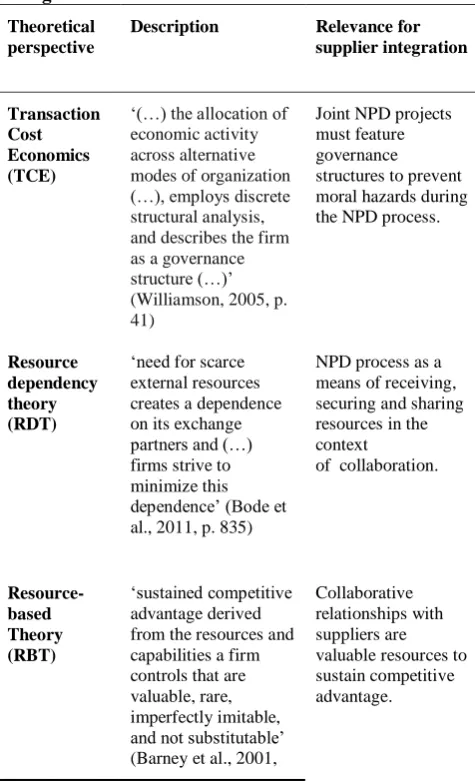
[image:3.595.306.544.374.765.2]organizations is contingent upon their ability to gain critical resources to kick-start operations and to keep these going, integrating suppliers in the process of creating new products becomes an essential part of strategic approaches to advancing firms’ performance (Bode, Wagner, Petersen & Ellram, 2011). Third, the central proposition of the resource-based view (RBV) is that some organizations have capabilities that are heterogeneous and firm specific, valuable, rare, inimitable and non-substitutable, hence difficult to copy for external organizations and potentially providing that organization with a competitive edge vis-à-vis rivals (Wu et al., 2006; Porter, 2008). Given that those capabilities and characteristics are unique and take time to attain, they have the power to catalyze the resources related to integrating suppliers into higher value for the firm (Wu et al., 2006). In terms of supplier integration in NPD processes, the RBV is supportive of joint development projects because it helps build strong relationships, which is one form of intangible resources (Wu et al., 2006; Porter, 2008). Together, physical and non-physical resources can be merged and shared without fearing interrupted supply (Chen & Lin, 2004; Rungtusanatham et al., 2003). This state of trust and open communication helps guard against competitive moves and is more easily reached by partners whose relationship is built on a healthy basis in the first place (Chen & Paulraj, 2004; Koufteros et al., 2005). An overview of these theoretical premises is provided with Table 1.
Table 1: Theoretical Foundation of Supplier
Integration
Theoretical perspective
Description Relevance for supplier integration
Transaction Cost Economics (TCE)
‘(…) the allocation of economic activity across alternative modes of organization (…), employs discrete structural analysis, and describes the firm as a governance structure (…)’ (Williamson, 2005, p. 41)
Joint NPD projects must feature governance structures to prevent moral hazards during the NPD process.
Resource dependency theory (RDT)
‘need for scarce external resources creates a dependence on its exchange partners and (…) firms strive to minimize this dependence’ (Bode et al., 2011, p. 835)
NPD process as a means of receiving, securing and sharing resources in the context
of collaboration.
Resource-based Theory (RBT)
‘sustained competitive advantage derived from the resources and capabilities a firm controls that are valuable, rare, imperfectly imitable, and not substitutable’ (Barney et al., 2001,
p. 625)
2.1.3
Process Steps of Supplier Integration in NPD
Stages and Implications of Timing
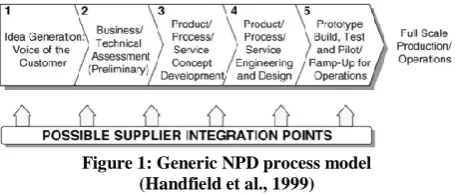
Elaborating on the NPD process itself, which Acur et al. (2012, p. 305) define as ‘the process of initiating, coordinating, and accomplishing the product and related production process development activities’, Wagner (2012) suggests that a NPD process can be separated into two parts. The first part is often characterized by ad-hoc decisions and ill-defined processes and the second part features more structured approaches. From this follows that it is not uncommon for NPD projects to take a turn in how they can contribute to performance, where managing the so-called fuzzy front end phase, the commonly unstructured initial phase, can help achieve successful completion of a NPD process (Zhang & Doll, 2001). The disagreement in the body of NPD literature on the effects of supplier integration on organizational performance is emphasized by the findings of studies, some of which revealed no relationship (Koufteros et al., 2005) or even a negative relationship (von Corswant & Tunälv, 2002). NPD in general is widely viewed as a resource which, when conducted successfully, can help organizations achieve accelerated business performance (Das et al., 2006; Schiele, 2006; Rodríguez-Pinto et al., 2011; Bunduchi, 2013). In this regard, it is not relevant whether an organization generates profit from manufacturing or from service activities; NPD plays a vital role in both cases since it is often considered a key driver of continuous improvement (Gonzales & Palacios, 2002). The NPD construct is complex and has dimensions on operational, financial and human levels (Kleinschmidt et al., 2007), all operating in every single stage of the NPD process, hence NPD provides research opportunities in many directions. The NPD process itself consists of several distinct stages; each with their individual characteristics but the debate on the specific number of stages and to what degree organizations have to adhere to these stages remains ongoing (Cooper, 1983; Cooper & Kleinschmidt, 1986; Kleinschmidt et al., 2007; Reid & Brady, 2012). In an early research conducted by Handfield et al. (1999, p. 62), the NPD process construct is treated as ‘a series of interdependent and often overlapping stages during which a new product (or process or service) is brought from the ‘idea’ stage to readiness for full-scale production or service delivery’. This same study created the widely adopted, generic NPD process model, consisting of five process steps: (1) Idea generation, (2) Business/technical assessment, (3) Product/process/service concept development, (4) Product/process/service engineering and design, and (5) Prototype building, test and pilot for operations. At the beginning of each stage throughout the process, suppliers can may involved and can take on their stage-specific roles and responsibilities. In the first stage, the supplier comes into play after the buying firm had assessed and specified the market need. In considering appropriate technologies for the development effort, the buyer typically turns to its suppliers for input, not only because the suppliers possess potentially interesting technologies but at the same time because they can better assess the price of the product based on experience on use of technologies. In the second stage, the customer identifies technical solutions to solve the end customer’s problem while the supplier has a major say in developing technical specifications to address customer requirements. In stage three, the concept around the product, process, or service to be developed goes through final discussions and its final specifications are set. In the fourth stage, the product, process,
[image:4.595.312.540.424.521.2]or service undergoes engineering and design activities, where prototypes are created by the supplier in case the NPD process centers around a new product, and not a process or service. In the last stage, early blueprints are created and design specifications refined and determined. Given that the new product passes all tests, the supplier is asked to start production activities and to increase production volume. This model by Handfield et al. (1999) is much more compact compared to the model created earlier by Cooper and Kleinschmidt (1986), who developed a NPD process model composed of 13 stages, namely (1) initial screening, (2) preliminary market assessment, (3) preliminary technical assessment, (4) detailed market/study research, (5) business/financial analysis, (6) product development, (7) in-house product testing, (8) focus group tests of product, (9) test market/trial sell, (10) trial production, (11) pre-commercialization business analysis, (12) production start-up and (13) the market launch. With numerous NPD process models available to scientists and practitioners in extant literature, there is no definite agreement to date on the ‘right’ NPD process model, implying that a NPD project must be tailored to the new product’s specifications as well as to the capacities and capabilities of the supplier and customer involved. One inherent characteristic of NPD processes is their risky nature, expressed in the need for developing prototypes and focus group testing next to widespread market research. Although risk in this context is relatively difficult to control, one of Cooper’s (1983) studies on NPD reveals that emphasizing the individual NPD process stages can constitute a way to decrease NPD risk. In this study, the generic NPD process model by Handfield et al. (1999, Figure 1) is used as a reference since it reveals the typical yet adaptable process, which underlies most existing, more elaborated NPD process models in existing literature.
Figure 1: Generic NPD process model (Handfield et al., 1999)
The many possible integration points during a NPD process as suggested by Handfield et al. (1999) raise the question of when, during the NPD process, it is most appropriate to involve suppliers in NPD activities. While reviewing existing scientific studies on this topic, there is strong agreement amongst researchers that involving a supplier early yields the highest performance results (Klioutch & Leker, 2011). Petersen et al. (2005) expand on this view by suggesting that giving suppliers responsibilities at an early stage of a NPD development project brings the potential advantage of elaborated and speedier decision-making on issues related to process and product design. Overall, integrating suppliers in NPD processes can occur at various stages depending on a project’s specific requirements, while the majority of NPD literature reveals that ESI brings most benefits related to the stage of involvement. There is no distinct agreement amongst researchers on exact process steps during NPD, a finding that calls for a contingency approach to NPD.
engineering stages has an especially high impact on the total cost of the end product, its quality and cycle time.
2.1.4
Antecedents
of
Successful
Supplier
Integration in NPD Stages
Antecedents of supplier integration in development activities can be largely separated into a structural and relational dimension. The following section will provide an overview thereof. As an answer to the lack in literature of which integration practices are more supportive of performance (Kulp, Lee, & Ofek, 2004), Das et al. (2006) conducted a cross-sectional study and revealed that the composition of integration initiatives impacts performance on a higher level compared to the selection of specific integration practices themselves. During the act of combining, Petersen et al. (2007) propose that buying organizations pay attention to the following three factors: (1) understanding the supplier’s contribution potential, (2) keeping the flow of information on technology and cost, and (3) giving the supplier an active role on the design team. Moreover, supplier embeddedness and supply base rationalization are found to be determine success of supplier integration, where reducing the number of suppliers can incite the latter to take part in NPD activities and enjoy higher sales volumes (Koufteros et al., 2007). In the course of selecting the remaining suppliers, a thorough evaluation should lead to approaching trusted suppliers with proven track records (Handfield & Nichols, 2004). Furthermore, having and using a systematic process for lowering technology risk can support supplier integration in NPD processes (Ragatz et al., 2002) Since involving suppliers in a NPD process entails close collaboration on a constant basis and since the product to be developed might represent a critical contributor to sales figures, a supplier can engage on a strategic level while accepting major responsibility (Handfield et al., 1999; Perols et al., 2013). This type of cooperation is preceded by long-term commitment by both the customer and the supplier, open communication, mutual trust as well as by the attitude of creating a positive synergy (Koufteris et al., 2005). In turn, next to commitment and motivation, trust was found by a study involving foreign automotive companies having operations in China (Lockström et al., 2010) to be determined by the leadership efforts on the part of the buyer. The factors trust and commitment as antecedents to supplier integration, have been confirmed by Vijayasarathy (2010), who added the relational antecedents of dependence asymmetry and mutual dependence. In their study, Petersen et al. (2003) emphasize the aspect of two-way communication by suggesting that close discussions lead to increased information sharing which is especially important if it is on technology and cost drivers. In addition to that, the same study found that overall supplier integration management should be carried out in an empathetic way, making sure not only to involve the supplier in decision-making on the surface but to really consider their contributions. On the whole, a variety of structural and relational antecedents are in place which support supplier integration in the context of NPD.
2.2 NPD Speed
2.2.1 NPD Speed Defined
An increasingly appearing topic of interest in extant literature, NPD speed gains attention in the field of scholars. Also for managers holding a leading position in a dynamic business environment, time is often regarded as a scarce resource (Kessler & Chakrabarti, 1999) and competition might outpace operations in times when business activities get stuck or even fail (Chen et al., 2010). Managers have to make decisions in a
quick yet reasoned manner so that organizations can get ahead of competitors in the long run by outperforming the latter in terms of decreased time-to-market of new products. Paying attention to and dedicating resources to improving NPD speed was found to be a critical manner in achieving time advantages in the form of first or second-mover advantages (Chen et al., 2010). The NPD speed construct is prevalently defined by extant literature as the elapsed time between developing the idea over manufacturing the product and implementing and commercializing the product (Griffin, 1997; Ittner & Larcker, 1997; Kessler & Chakrabarti, 1999; Lukas et al., 2001; Menon et al., 2002; Lukas & Menon, 2004). In a study by Chen et al. (2005), the researchers add to the timing aspect of the definition by referring to the level of team play and propose that NPD speed is a measure for a NPD team’s competence to quickly work up and introduce a newly developed product to the market. Moreover, they state that the term of NPD speed is often used in literature analogously to innovation speed, time-to-market and speed-time-to-market. Similarly, Menon et al. (2002) found that time-to-market and cycle time are used interchangeably in reference to NPD speed. This inconsistency in definitions for NPD can be explained by the ‘difference in notions of what an appropriate starting and end point is for the development of a new product (Chen et al., 2005, p. 199). This study uses the term NPD speed on a project level and therefore defines it as the speed of time with which participants involved in a NPD process can complete every single phase of that process.
3.
METHODOLOGY
3.1
Sample
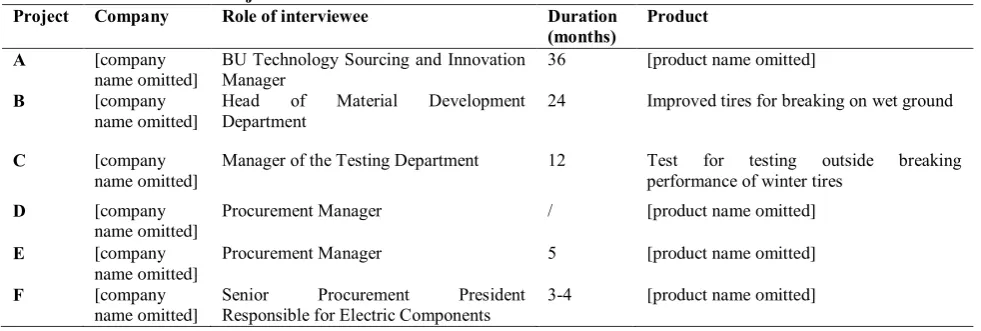
The sample is constituted of five manufacturing companies of industrial products in Germany and the Netherlands. These companies are active in various industries, encompassing chemicals, coatings, electronics, semiconductor, and tires. At each company, one person who guided or partially led a specific NPD project is chosen as interviewee and major source of information to be used for the analysis later on. In total, this study involves interviewees of five companies, which agreed on contributing to this project. Of the six interviews conducted in total two are based on independent NPD projects at the same company with two different interviewees. In all six cases, information was obtained from the viewpoint of the buying company, the data per interview are based on one specific NPD project of that company, and the projects themselves are independent from each other. There are certain basic criteria, on which the companies are chosen to contribute to this study: (1) Innovative nature, in a way that the company regularly conducts NPD projects, (2) Absorptive capacity at a certain level, which is a prerequisite for companies to not only draw on internal capabilities but also to be receptive to external ideas, e.g. from suppliers, and proactively searches for these, (3) Completed NPD project, i.e. the project lies in the past for at least twelve months, for the purpose of having certainty of data availability, and (4) the supplier must have played a significant role in the NPD process. In order to get a quick insight into the different projects, the next section provides a compact overview on these and their main characteristics.
companies operating the vessels. It took three years in total to bring this product to the market and, retrospectively, the product proved to be a big success. In this specific project, more than one supplier was involved but the collected data stem from one specific supplier for one of the 12 ingredients for the production of this product. The second NPD project, project B, was conducted at the headquarters of [company name omitted] The company with its roots in the Netherlands has been interviewed twice for two independent NPD projects, thus each interview is treated separately. The first NPD project at this company took one year to complete and centers around the development of improved tires for breaking on wet ground. One of the involved suppliers manufactures rubber especially made for tires breaking on wet surfaces. Although [company name omitted] was new to this kind of material, the NPD process was successful with the multifaceted contributions of the supplier. The other NPD project at [company name omitted], project C, was not about developing a product but a process. Creating a test, which can test and measure the performance of an outdoor winter tire, was the concern to the company and involved several suppliers. The NPD project’s cycle time is approximately one year and the project turned out to be a successful one. Project D took place at [company name omitted], a manufacturing company for mass flow and pressure meters as well as controllers for gas and low flow, liquid applications. The NPD project aimed at producing [product name omitted] but the project turned out to be a failure, where deadlines could not be met and customer demand not satisfied in the end. Next, project E includes the supplier involved in the development efforts of [company name omitted] to create [company product name omitted]. [Company name omitted] is a company known for producing mission-critical sensors and controls, serving customers from a wide range of industries. In this specific NPD project, the supplier was asked for a cooperation to produce product samples of [product name omitted]. Having a strict time frame of 20 weeks imposed by the customer, [company name omitted] had to put a great amount of confidence and responsibility in its suppliers. The fact that this time restriction was met and that the product was received positively, indicates the success of this project. In this case, strategic supplier integration was crucial to the objectives of this project.Finally, project F is a NPD project at [company name omitted] and focuses on the timely production of [product name omitted], polychlorinated biphenyl, for industrial use. It took the parties involved in to development effort around three to four months to complete this project, which proved successful. For the purpose of clarity, Table 2 portrays an overview on the project details.
3.2
Data Collection
In the present study, data on supplier integration in NPD stages as well as on NPD speed is required to investigate the relationship under discussion. To this end, a cross-sectional case study research design is implemented, where interviews are the agreed method of collecting data for the analysis. There are five people in this research group and all investigate the topic of supplier involvement in NPD teams. Although working under the same overarching topic, everyone is free to choose individual variables for their individual research. Five of the six interviews were conducted on a face-to-face basis while one interview ([company name omitted]) took place via a call by reason of physical distance between the interviewee and the interviewers. In groups of two, a total number of six interviews was conducted at one and a half hours each, with the interviewee providing information from the buyer’s side in all six cases. All notes from the interviews were typed and afterwards transcribed for the analyses. Each interview started with an introduction to the research topic in order to establish the research context and to make sure to convey that to the interviewee. The actual inquiry begins with a description of the respective NPD process by the interviewee and the subsequent interview questions are based on the underlying interview template, which comprises the same set of questions to be used for every interview. Prior to the latter, questions were divided into five sections with each section containing at least one question on every individual variable of interest (see Appendix A for the questions and answers of this specific study), i.e. stage of supplier integration, ESI, development cost, product development cycle time, communication, and culture. The goal of these interviews is to explore characteristics of NPD processes and to ascertain interactions between the buyer and supplier, all on a project level.
3.3
Measures
3.3.1 Independent variable: Measuring Supplier
Integration in NPD Process
Supplier integration was measured by point of integration and motivations to integrate the supplier at that specific stage of a NPD process model. During the interviews, respondents were asked to provide an answer to the following questions:
‘Do you make use of a company-specific NPD process model of supplier integration? If yes, what are the individual stages?’
Project Company Role of interviewee Duration (months)
Product
A [company
name omitted]
BU Technology Sourcing and Innovation
Manager 36 [product name omitted]
B [company
name omitted]
Head of Material Development
Department 24 Improved tires for breaking on wet ground
C [company
name omitted]
Manager of the Testing Department 12 Test for testing outside breaking performance of winter tires
D [company
name omitted]
Procurement Manager / [product name omitted]
E [company
name omitted]
Procurement Manager 5 [product name omitted]
F [company
name omitted]
Senior Procurement President Responsible for Electric Components
[image:6.595.53.544.592.757.2]‘If the answer to the previous question was ‘yes’, at which point did you integrate the supplier in this project? If the answer to the previous question was ‘no’, given the generic NPC process model (Handfield et al., 1999), where did you integrate the supplier?’
‘What are your motivations to integrate the supplier in that specific stage of this project?’
‘In a future NPD project, would you integrate the supplier at another stage? If yes, when and why?’
The interviewees were asked to provide an answer to these open questions.
3.3.2 Dependent Variable: NPD Speed
In a study conducted by Chen et al. (2005), the researchers discussed the construct of NPD speed and propose following measurements for it: (1) developed and launched faster than major competitors, (2) completed in less than was considered normal and customary for our industry, and (3) launched on or ahead of the original schedule developed at initial project. The present study did not ask about the first two suggestions because the sample size is not variable enough in terms of size and also regarding types of industry. In order to make a comparison, at least two companies should act in the same industry. Therefore, the questions asked in terms of the dependent variable NPD speed are adapted slightly:
‘How did you structure your time plan for this particular project? Was the supplier involved in time scheduling? If yes, which activities did the supplier take over?
‘How did you measure the adherence to this time plan?’
‘In which NPD process stages did the activities work out most smoothly in this project?’
‘Overall, for this project, did the supplier speed up the NPD cycle time? If yes, what were supporting factors? If no, what were limiting factors?’
‘How do you think the involvement of the supplier affected the overall new product development cycle time in this project?’
‘In a future NPD project, what would you do to increase NPD speed?’
‘Which three main factors, according to you, affected the new product development cycle time in this project?’
3.4
Data Analysis Method
The present study employs inductive coding as qualitative research technique and as a way of analyzing qualitative data captured from the conducted interviews since 'the actual process of coding is an integral part of the interview data analysis process’ (DeCuir-Gunby, Marshall, & McCulloch, 2011, p. 138). This technique is based on creating a set of codes with the purpose of transforming verbal data into more manageable data, which allows for identification of patterns and structure (Thomas, 2006). Codes are defined as ‘a process of capturing dimensions or content that has already been more precisely defined and labeled’ (Ritchie, 2013, p. 208) and may either be developed a priori inferred from theory or they may emerge from the raw interview data (Ryan & Bernard, 2003). A major
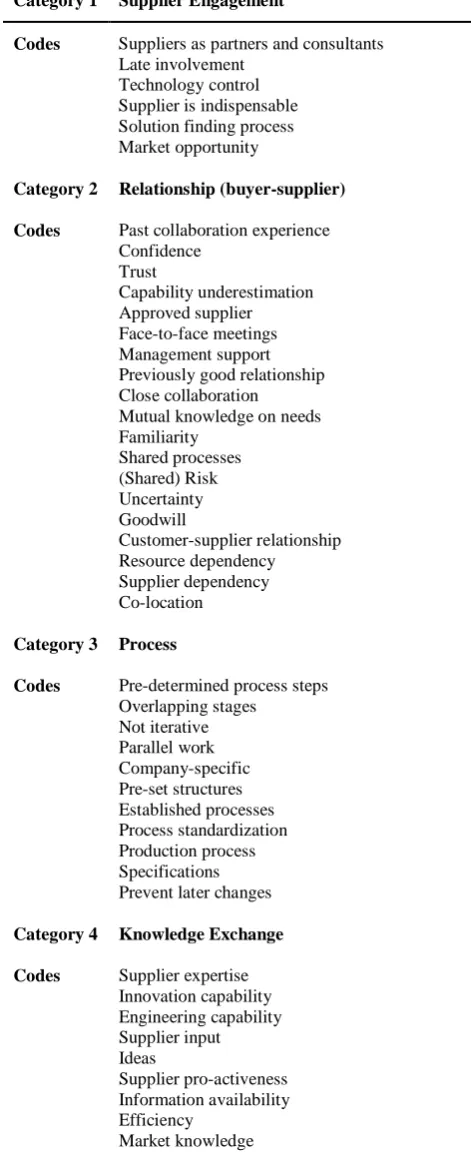
[image:7.595.303.539.187.764.2]advantage of coding in general is that it allows researchers to link data to their research questions by drawing patterns and contradictory links (DeCuir-Gunby et al., 2011). On the whole, coding enables the development of categories from raw data into a framework or model, portraying key themes and processes found in the evaluation process (Thomas, 2006). To this end, the code categories, their description and codes are displayed in Table 3.
Table 3: Categories Derived from Coding Process Category 1 Supplier Engagement
Codes Suppliers as partners and consultants Late involvement
Technology control Supplier is indispensable Solution finding process Market opportunity
Category 2 Relationship (buyer-supplier)
Codes Past collaboration experience Confidence
Trust
Capability underestimation Approved supplier Face-to-face meetings Management support Previously good relationship Close collaboration Mutual knowledge on needs Familiarity
Shared processes (Shared) Risk Uncertainty Goodwill
Customer-supplier relationship Resource dependency Supplier dependency Co-location
Category 3 Process
Codes Pre-determined process steps Overlapping stages
Not iterative Parallel work Company-specific Pre-set structures Established processes Process standardization Production process Specifications Prevent later changes
Category 4 Knowledge Exchange
Codes Supplier expertise Innovation capability Engineering capability Supplier input Ideas
Supplier pro-activeness Information availability Efficiency
Quality improvement Cost saving
External innovation Absorptive capacity Quick information exchange Previous dialogue
Objectives communication Strategic supplier communication Start dialogue earlier
Category 5 Time Scheduling
Codes Loose schedule Deadlines
Mutually agreed deadlines Set time schedule Supplier not much say Joint time scheduling Supplier support/input Realistic time estimation Planning
Deadline by customer Follow up
Reporting hierarchy Adherence to schedule Time pressure by customer Time pressure by management Time-to-market
Cycle time reduction Time reward
4.
RESULTS
Project A was conducted at [company name omitted], a Dutch multinational company with set matrix organizational structures, which has a large R&D department. It conducts NPD projects regularly regardless of its market segments, where the development of a new product typically follows a specified procedure with rough steps as guidelines to follow. The process model comes in the form of a stage-gate model, composed of seven distinct stages: (1) Exploration, (2) Exploratory design, (3) Selection of technology and materials, (4) Formulation selection, (5) Technical sign off, (6) Launch, and (7) Review of product introduction. This process can be separated into the research phase (stages 1-3) and the development phase (stages 4-7), whereby the interviewee stressed the difficulty of handing over the data from one phase to the other; this eventually caused a 12 months delay in this specific project. [Company name omitted] and the supplier involved maintained dialogue for more than 15 years already, implying an existing long-term relationship. Over the years, both have developed trust and confidence in each other’s capabilities and work ethics, which is evidenced by the supplier agreeing to cooperate on this NPD project without having major knowledge of the new product’s target market. This familiar bond between the two parties contributed a great part to facilitating supplier integration and enabled full supplier engagement starting from the very first stage of the process. One main reason for [company name omitted] to start the integration efforts at an early stage was to gain access to the supplier’s scientific and practical knowledge on how to produce the molecules needed in the paint formulation, critical information that [company name omitted] was lacking in. The other major motivation for ESI was the specialized production capacities and capabilities of the supplier, which would allow for economies of scale after time.
Looking back to this project, [company name omitted] would not change the point of supplier integration in any future NPD projects, if, such as in this specific project, [company name omitted] highly depends on the intellectual and technological resources of the supplier. However, project managers are not averse to later involvement in cases where [company name omitted] has the knowledge to assemble ingredients with the internally available R&D background. In some cases of ESI, [company name omitted] files patents together with suppliers where both have rights of use. However, if circumstances allow it, [company name omitted] tries to file the patent itself to have greater control over that specific technology and to gain more commercial benefits through licensing agreements. In order to get information on the dependent variable speed of development, [company name omitted] was asked about its way of structuring a time schedule for the project and whether the supplier was involved already in this scheduling phase. This NPD project is build upon a loose time schedule because of the high level of uncertainty involved and the resulting difficulty of scheduling time frames for certain activities. The customer might give a rough time indication and the supplier does his best to fulfill his tasks during that time period, thus no strict measurement on adherence to a time plan was in place in this case. In a context of opportunity but also high uncertainty, [company name omitted] shares risk of NPD failure and gave the supplier a lot of freedom in the NPD, which retracts back to their well-going long-term relationship with constant communication. Throughout the whole project, collaborative activities went on with no major disruptions to the operations, since the two parties agreed in the beginning on mutual objectives, how to specifically engage the supplier and how that supplier can take most advantage of working with [company name omitted] as a steppingstone to taping into this new market. Since the supplier was indispensible to the production of the molecule, and at the same time provided critical knowledge, the supplier accelerated NPD speed with its contributions to up to 30 percent. At that point, the interviewee pointed that this is not taken for granted since there are buyer-supplier relationships where legal issues or issues regarding supplier management can slow down the NPD process cycle time.
case, the supplier did not noticeably speed up the NPD process but neither did he decelerate pace. Overall, [company name omitted] puts much confidence in long-term partners on the supplier side and is very strict about performance, i.e. if a supplier fails to deliver satisfying results, he will be exchanged for another supplier in future projects. Main factors for [company name omitted] to select the supplier at hand were high levels of expertise and familiarity with working collaboratively.
Project C at [company name omitted] did not follow a specific development model not least because the NPD project aimed at developing a process and not a product. Therefore, given the generic NPD process model (Figure 1 by Handfield et a., 1999), [company name omitted] indicated stage one, idea generation, as the point in the process where the supplier got involved in this NPD project. The reason for ESI in this case was the explicit request by the customer that [company name omitted] works with that supplier, drawing on positive collaboration experiences with that supplier in the past. For time scheduling, [company name omitted] and the supplier worked out together a detailed plan with deadlines, considering the special requests by the customer. The supplier could better estimate the duration of specific steps compared to [company name omitted] and therefore played a significant role in time scheduling. As an advantage to close cooperation, the two parties were able to exchange information quickly. According the interviewee, the frequent face-to-face meetings and co-location of employees fostered the completion of this project before the expected final deadline to a strong degree.
Moreover, project D led by [company name omitted] draws on its company-specific NPD process model which has seven stages: (1) PRISM, (2) Pre-study, (3) Realization, (4) Improvement, (5) Serial production, and (6) Market-production. Other than the other projects in this study, [company name omitted] decided to integrate the supplier not at the beginning of the process but at stage 4, when the basic research around the new product and the determination of its specifications has been widely finished. The final product design is handed to the supplier who is requested to produce it, without having had much communication on processes and procedures, without aligning goals and strategies and without knowing about the supplier’s development capabilities. This proved to be a pitfall since the supplier did not have access to the technologies needed for production and hence could not align. Retrospectively, the project leader would integrate the supplier at the beginning of the process when product specifications are set. A change thereof later in the process caused delay and additional costs which very much burdened the parties involved in this NPD project. Integrating the supplier in the middle of the project implies that time scheduling had been done by the buyer without contributions of the supplier, who possesses the knowledge on its development capabilities and on how fast the individual production steps can be executed. In addition, the buyer did not follow up progress of the production, which added to the project management coming under control. Overall, unstructured and one-sided procedures seem to have caused the ill success of this NPD project.
Project E at [company name omitted] is based on the following NPD process model: (1) New business opportunity, (2) Concept, (3) Development, (4) Pilot, (5) Prelaunch, and (6) Production. According to the interviewee on this project, the first two stages are the ones where supplier involvement brings most benefits; in this project, the supplier got integrated in the second stage, which is co-developing the product. Reasons for ESI are restricted time frame of 20 weeks, additional time pressure from management and the supplier’s expertise. With this context, the supplier proactively created the time schedule
within only one week of time. The supplier was very engaged and delivered results ahead of time, making this project very successful. [Company name omitted] learned from this project that trust and open communication and the supplier’s levels of expertise as well as access to technology are important determinants of the outcomes of a project.
Finally, Project F at [company name omitted] was not built upon a company-specific NPD process model but the interviewee indicated stage one and stage two of the generic NPD process model (Figure 1) as integration points. The reason for ESI was a lack of technical capabilities thus [company name omitted] turned to a supplier who can support the NPD process. Since no time pressure influenced a timely project completion, a loose time schedule was in place but it was created by [company name omitted] without the supplier and the supplier had to stick to it. In order to measure adherence, the supplier frequently reported to a [company name omitted] project leader. Based on an existing good relationship with that supplier, no major disruptions occurred in the NPD project.
5.
DISCUSSION
In the course of merging the data and looking at the interview results on a more abstract level, several interesting patterns can be identified in relation to timing of supplier integration and speed of NPD execution. First, the data revealed that there is no relationship between having a company-specific NPD model, which implies structured guidance through a process, and integrating the supplier at an early stage of the process. [Company name omitted], [company name omitted] (1), [company name omitted] and [company name omitted] use their self-developed NPD process model, while [company name omitted] (2) and [company name omitted] take a more flexible approach and tailor process steps to the needs of the customer. All companies involved in this project integrated the supplier at the very beginning of the NPD projects, except for [company name omitted] who integrated the supplier after the design phase but still could not make their project a success. The finding that having a structured, company-specific NPD model is unrelated to an integration of the supplier in the early phase might be explained in a way that it is not only about having preset structures in place but to put emphasis on the execution of the various steps and the management of thereof (Trkman, 2010). Second, also no direct relationship was found between an
specifically demanded that the buyer work with that supplier and in project D because [company name omitted] simply did not have previous business encounters with that supplier, evidenced by [company name omitted] not knowing about the supplier’s production capabilities. Fourth, relating previous collaboration experience to NPD speed, only projects C and E indicated project completion before the pre-calculated deadline. In project C, importance from the customer’s side was placed on close cooperation in the form of frequent face-to-face meetings, co-location of employees and quick information exchange, which helped complete the project ahead of schedule. In project E, constant time pressure led to close teamwork between [company name omitted] and the involved supplier, who was very proactive in managing tasks while being pushed for time, leading to successful project completion ahead of time. In the latter case, the supplier contributed a lot of expertise not only concerning the practical execution of NPD but prior to that, he used experience and knowledge to reach the deadline. Fifth, creating a link between knowledge exchange and its implications for supplier integration timing, interview results indicate that communication between the buyer and the supplier before the start of the project provided a reason to involve the supplier early in the NPD process, e.g. in project A at [company name omitted]. In those cases, the buyer knows about expertise and capabilities of the supplier on the one hand and the supplier can better estimate the needs of the buyer. Neither having communicated with the supplier before the project nor starting conversations at an early stage turn out to be detrimental to NPD performance as illustrated by project D. Therefore communication knowledge appears to be positively related to ESI. Sixth, referring to the relationship between knowledge exchange and NPD speed, especially in projects C and E, the buyer and the supplier had a lot of personal contact points throughout the NPD process during which knowledge exchange was intense. The fact that these two projects have been completed ahead of expected schedule provides evidence for the positive effect of regular and personal exchange of information on speed. For instance, the supplier of project C explained the parts of the process where problems typically occur and hence helped the buyer plan activities more realistically. In this regard, NPD speed was accelerated and that could be traced back strongly to frequent discussions and the resulting flow of knowledge. Seventh, the act of time scheduling related to the timing of supplier integration provides mixed evidence. On the one hand the collected data of projects B and E reveal that a time plan needs to be constructed jointly with the supplier in cases of project uncertainty and in case pressure is exerted by the customer to meet the deadlines. In order to tap on the supplier’s knowledge, the data additionally reveal that suppliers are included at the very beginning of the projects in these cases. This is in contrast to the remaining projects A, C, D, and F, where a rather loose schedule sets time boundaries to certain NPD process steps. Scheduling certain time slots for NPD activities does speed up development processes, especially when the supplier was actively involved in the process of scheduling, whereby he got the opportunity to give realistic estimations based on previous project experience. Lastly, engaging the supplier by actively integrating them in the solution finding process increases the event of supplier integration at an early stage where concepts are built and technical possibilities assessed such as projects A and E. On the contrary, the case of [company name omitted] shows that late involvement, when concepts are determined and specifications set, engaging the supplier occurs more on the surface and is proof that non-involvement in the early stages increases likelihood of project failure. In the context of NPD speed, supplier engagement seems to have a positive effect. In all cases
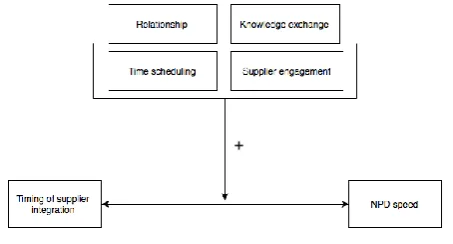
[image:10.595.313.540.158.280.2]except for B and D, actively integrating the supplier had a favorable effect on the time needed to finish the NPD project. In project B, the interviewee stated that NPD was strongly supported by the working structured processes in the company and in project D, not engaging the supplier was proof of disadvantage towards quick project completion. The relationships just discussed are illustrated in Figure 2:
Figure 2: Theoretical framework
On the whole, the analysis shows new insights into the moderators for point of supplier integration and the effect on NPD speed. Based on the six cases which this study bases its data on, the four categories identified in the coding step, i.e. relationship, knowledge exchange, time scheduling and supplier engagement, have been identified as influencing factors for the relationship between timing of supplier integration and NPD speed. The coding category ‘process’ is not included in the framework because, on the basis of the present analysis, no relationship was found in this regard. At this point, it is worth mentioning that the data analysis did not reveal information on which exact stages can best accelerate speed because the sample at hand did not show enough variety towards the points in NPD projects in which the supplier was integrated. However, what the analysis does suggest is that integrating suppliers as early as possible proved to be supportive of NPD performance success (projects A, B, C, E, F). In all of these five cases, the supplier has been involved in either the first or the second NPD process stage characterized by tasks of finding a solution to a problem, creating the concept of the solution, assessing technical opportunities and making the new product’s specifications. Only project D turned out to be unsuccessful and only in that case, the supplier has been involved in the production phase, not having had many insights into how the product was assembled, therefore neither the supplier nor the buyer knew in advance that the capabilities of the supplier and the production needs of the product did not match.
Overall, the analysis reveals that a working (previous) relationship between the buyer and the supplier, suitable communication channels for continuous information exchange, joint time scheduling and planning, as well as showing willingness to include the supplier into the NPD process can support the process of supplier integration which finally contributes to accelerating NPD speed.
6.
CONCLUSION
6.1
Managerial Implications
channels should be agreed on and specific contact persons from each side determined. Managers are recommended to have as many personal points of contact as possible, e.g. in the form of site visits, face-to-face meetings, or at best, co-location of employees. The latter can contribute to faster problem identification and problem solving. Moreover, scheduling tasks and assigning time frames is an effort, which the buyer and supplier of a NPD project may consider to fulfill jointly, in a way that experience can help create more feasible deadlines even in a context of uncertainty. Finally, equally important as the other three factors, showing genuine engagement towards each other and be willing to listen and learn from each other are believed to facilitate collaboration. Given these prerequisites, timing of supplier integration will naturally tend to be at the beginning of any NPD project. In the end, of the mentioned factors are in place, the NPD projects can be carried out with less changes and corrections, eventually resulting in a speedier development project.
7.
LIMITATIONS &
RECOMMENDATIONS
Although this study provides valuable insights to literature and to firms, there are some limitations to this research of which, at the same time, interesting avenues for future research can be concluded.
The cross-sectional design research method is a limitation in itself, since it provides the framework for capturing data from one moment in time only. It is likely that a measurement later in time will yield different results, implying the necessity of a longitudinal study to achieve more objective results for the analysis. Also, the causality relationship has to be used with caution since it draws on a sample, the small size of which diminishes its representativeness among the whole population. In this regard, a larger sample size with data from more successful and unsuccessful NPD projects can help increase generalizability of the findings on the one hand and lead to more insights into the topic under discussion on the other hand. Moreover, in order to assess the interview answers with more depth, in order to gain a larger spectrum of
perspectives, the suppliers of the respective NPD projects can be asked to provide answers to the posed questions from their point of view. This may not only lead to interesting, possibly congruent or dissenting answers but also to more background information to why integration of the supplier slowed down or accelerated new product development cycle time. As a means of increasing reliability of the data, the same study can be used as a starting point from which it can be carried out on a larger scale with a strong increase in number of interviews conducted at companies.
The findings of this study support the notion of ESI being a reference point for buying organizations to involve the supplier. However, in order to make this finding more precise as to which stages in particular benefit most from supplier involvement in terms of NPD speed, NPD projects with more variation in the stage of involvement will be useful.
8.
ACKNOWLEDGEMENTS
9. APPENDIX
Appendix A: Interview Protocol
Interview Questions and Answers on Supplier Integration in NPD and on NPD Speed
Project A B C D E F
Company [Company name
omitted]
[Company name omitted] (1)
[Company name omitted] (2)
[Company name omitted]
[Company name omitted]
[Company name omitted]
Do you make use of a company-specific NPD process model of supplier integration? If yes, what are the individual stages?
Yes, a basic stage gate process developed about 10 years ago
(1) Exploration (2) Exploratory product
design (3) Selection of
technology and materials (4) Formulation
selection: (5) Technical sign off (6) Launch
(7) Review of product introduction
Steps are sequential but they sometimes overlap, e.g. formulation with the testing phase, conscious decision involving higher risk, plus side: introduce product earlier, sometimes parallel work, sometimes go back, this is often the case.
Yes,
(1) Change request (2) Report on how to achieve objectives (3) Quality review (4) Laboratory trials (10-15)
(5) Prototype phase, how performing in production – large trial (1000-10000) (6) Additional checks during production (7) Release for final production
It is not a company-specific model but employees from the material development department try to stick to those steps
No. It depends on the project and the demand of our customers.
Yes,
(1) PRISM (2) Pre-study (3) Realization (4) Improvement (5) Serial production (6) Market-production
Yes,
(1) New business opportunity
(2) Concept (3) Development (4) Pilot (5) Prelaunch (6) Production
In the first two stages is where suppliers become important and co-partners later would become consultants
No.
If the answer to the previous question was ‘yes’, at which point did you integrate the supplier in this project?
If the answer to previous question was no, given the generic NPD process model (Handfield et al., 1999), when did you integrate the supplier?
Stage 1 (discussions with supplier even before research started)
As early as possible. Here, during change request from customer (stage 1).
At stage 1, the idea generation.
Stage 4, Improvement Stage 1-2, more 2 (co-developing the product)
At stage 1 until the beginning of stage 2
motivations to integrate the supplier(s) in that specific stage of this project?
make the molecule chosen and integrated because of good previous experience and low costs of production.
For such projects for a huge customer it is always good to work together with known suppliers because one can evaluate their performance and [company name omitted] does not want to loose those big customers
motivation was that the customer had a close relationship with this supplier and wanted [company name omitted] to work with this supplier in order to develop a new test.
type of instrument and then the supplier is chosen to supply the instrument in larger volume. However, this caused problems as the supplier could not produce the instrument because the production process was not possible.
We needed access to innovation and engineering capabilities, which we had lacked.
expertise to meet demand of customer and lead times -> changes later are more difficult because the customer has reviewed the approach already. How to meet lead time and solve business problem was in this project not clear -> additional support was crucial -> but also pressure from upper management to involve suppliers early – this project was also seen as test -> ‘let suppliers do what they do best and we do what we do best’ -> management perspective was, that the early integration could lead to: cost saving, cut down on quality issues, post production cost reduction, financial discipline to stay competitive -> to start directly with the supplier together -> enables you to cut costs earlier, makes it right from the beginning -> cut out a lot of ‘mess’ which would occur due to changes in a later stage
In the very beginning, because [company name omitted]´s customer demanded a new test due to a new tire which requires different measurements. The customer demanded that [company name omitted] works close with that certain German supplier. (Names were not allowed to be mentioned), -> first stage
needed access to innovation and engineering capabilities, which it lacked.
In a future NPD project, would you integrate the supplier(s) at another stage?
If yes, where and why?
Very early stage, b/c (1) [company name omitted] depends on the supplier for developing material it cannot develop
/ Yes, at the first stage. [company name omitted] made wrong assumptions about specifications. Thus when the supplier was
No, it is essential to integrate suppliers right from the start with NPD projects.
itself. BUT sometimes [company name omitted] wants to include the supplier later (not in this specific NPD project). Why? IP! [company name omitted] sometimes file patents before talking to a supplier. Early
involvement: often filing patents owned by both parties or make agreements about which areas of IP [company name omitted] will have the right and where not
(2) Have more control on technology, get greater benefit from
commercialization. Collaboration project with supplier = agreeing to licensing the IP they’ve developed. They can license their IP to others as well ([company name omitted]‘s competitors!). (3) Here: no formal collaboration: the supplier did not know the market and still produced it for [company name omitted] . [Company name omitted] filed it around 2002. [company name omitted] did not have to agree to license technology, overall very good for [company name omitted] !
involved at the third stage, the specifications had to be changed. This tool long and cost a lot of money. Getting suppliers involved at stage one will help shorten the time-to-market and reduce costs. Suppliers will know what is possible and what no, and will help recognize problems earlier. 90% of the price is determined in the first stage.
How did you structure your time plan for this particular project? Was the supplier(s) involved in time scheduling? If yes, which activities did the supplier(s) take over?
No, although the supplier agreed to do some things. They have a loose schedule (can you manufacture a molecule that looks like this, 3 months later they come back with suggestions), no strict schedule b/c it is about goodwill/shared risk, cannot schedule the supplier to supply at a strict
Time: Depends on the project, but mostly we want to stick to schedule, when we have to deliver tires to car manufacturer then we have to follow the exact time schedule.
The supplier follows our orders.
We set certain deadlines, [company name omitted] and the supplier agreed on reaching a certain stage after a certain amount of weeks (mostly 3). We had a lot of face-to-face meetings, and [company name omitted] was able to send employees to the test location for almost two weeks in order to work
[Company name omitted] made the planning by itself, thus the supplier was not involved and did not take responsibilities.
Time schedule was set since kick-off. They knew they only had 20 weeks to finish -> the overall schedule is always managed by the project manager. For this project, the purchasing perspective/experience predicted/showed that we cannot do it with our normal procedure/method.