University of Warwick institutional repository: http://go.warwick.ac.uk/wrap
A Thesis Submitted for the Degree of PhD at the University of Warwick
http://go.warwick.ac.uk/wrap/2240
This thesis is made available online and is protected by original copyright. Please scroll down to view the document itself.
The Micro-Evolution and Transfer of
Conceptual Knowledge about Negative
Numbers
by
Amanda Ruth Simpson
A thesis submitted in partial fulfilment of the
requirements for the degree of Doctor of
Philosophy in Education
Institute of Education
University of Warwick
Table of Contents
LIST OF TABLES ... VI
LIST OF FIGURES ... VII
LIST OF APPENDICES ... IX
ACKNOWLEDGEMENTS ... X
DECLARATION ... XI
ABSTRACT ... 1
CHAPTER 1: INTRODUCTION ... 2
1.1 Motivation ... 2
CHAPTER 2: LITERATURE REVIEW ... 12
2.1 Disparity in the focus of previous research ... 12
Level 1: Grand Theory ... 12
Level 2: Subject-focused theories... 14
Level 3: Micro-level theories ... 15
Initial research questions ... 16
Why should I focus on concept development? ... 16
2.2 Historical changes in focus ... 20
2.3 How is mathematics learned? A focus on abstraction ... 25
2.4 What is involved in the learning of mathematics? ... 26
A new imperative for education research about learning and transfer ... 30
Do these ideas apply to learning in all areas of mathematics? ... 33
2.5 An alternative focus ... 34
Evolving research questions ... 36
2.6 “Micro-level” approach... 37
The human aspect ... 39
Memory ... 40
Situated cognition ... 40
Recognition of similarity ... 42
2.7 Relationships between knowledge, learning and transfer. ... 51
Mutual bootstrapping of conceptual knowledge ... 51
How does abstraction relate to transfer? ... 54
Why is evidence of transfer so elusive to researchers? ... 55
2.8 Partial states of knowledge construction:... 60
Schemas, models – where do they fit in? ... 60
Partial states; grey areas ... 63
2.9 Summary of Chapter 2: Reflections on the literature ... 67
CHAPTER 3: AIMS OF THIS STUDY: NEGATIVE NUMBERS AS A WINDOW ON TRANSFER ... 72
3.1 Core themes ... 72
3.2 Negative numbers as a window for observing micro-evolution of knowledge 72 3.2.1 Review of the literature relating to teaching and learning about negative numbers ... 72
3.2.2 Implications for my study ... 81
3.3 How do issues arising from negative numbers research relate to what I have learned about broader learning issues considered in Chapter 2: Literature Review? ... 82
3.4 Research questions revisited ... 83
3.5 Key constructs for analysis of core themes ... 84
CHAPTER 4: METHODOLOGY ... 88
4.1.1 Introduction to methodology ... 88
4.1.2 Research questions ... 89
4.2 Case study research ... 90
4.3 Iterative design ... 91
4.4 The research setting ... 94
4.4.1 The researcher ... 94
4.4.2 The school ... 95
4.4.3 Class ... 95
4.4.4 Children... 96
4.5 Researcher as facilitating observer ... 97
4.6 Ethics... 99
4.7 Task design ... 101
4.7.1 Curriculum analysis ... 101
4.7.2 The nature and range of the tasks ... 104
4.7.3 The tasks ... 107
4.8 Data Collection ... 116
Recordings ... 118
Write-ups ... 119
Accounts ... 120
4.9 Trustworthiness of the data and of the research ... 122
Transferability ... 122
Confirmability ... 122
Credibility ... 123
Triangulation contributes to dependability as well as credibility of research ... 123
4.10 Data analysis ... 125
4.10.1 Primary analysis ... 125
4.10.2 Specific analyses ... 128
Retrospective note ... 131
4.11 Concluding thoughts ... 132
CHAPTER 5: ANALYSIS OF FINDINGS ... 133
5.1 Introduction to analysis... 133
5.2 Case studies ... 135
Case study 1: “C” ... 135
C’s story ... 177
Case study 2: “G” ... 179
5.4 Concluding remarks for Chapter 5: Analysis of findings ... 220
CHAPTER 6: DISCUSSION OF FINDINGS ... 222
6.1 Re-use of existing knowledge ... 222
6.1.1 Re-use of well-established knowledge ... 223
6.1.2 Re-use of more recent learning ... 225
6.1.3 Different types of transfer ... 227
6.1.4 Failure to re-use existing knowledge ... 231
6.1.5 Perception of similarity ... 233
6.2 Improving span and alignment ... 234
6.2.1 C’s conceptual resources: development of span and alignment ... 234
6.2.2 G’s conceptual resources: development of span and alignment ... 238
6.3 What is similar? ... 242
6.3.1 Effective re-use of knowledge... 243
6.3.2 Knowledge not re-used effectively ... 244
6.4 Beginning to learn about negative numbers ... 245
6.4.1 What do children do/say that suggests or illuminates the trajectory of growth of their specific conceptual knowledge? ... 245
6.4.2 What did the boys find difficult? ... 249
6.4.3 Does the literature predict these trajectories for conceptual growth about negative numbers? ... 254
6.5 Resources ... 258
6.5.1 What internal and external resources do children use to support their work in this area? How are they used? ... 258
6.5.2 Abstractions as resources ... 261
6.5.3 Other resources ... 263
6.6 Affective factors ... 265
6.6.1 Mindfulness ... 265
6.6.2 Confidence, confusion and conflict ... 266
CHAPTER 7: CONCLUSION ... 275
7.1 Overview – the big picture ... 275
7.2 Re-use of knowledge ... 275
7.2.2 G’s development of his concept of negative numbers ... 277
7.2.3 Relationships between conceptual growth, abstraction and transfer ... 284
7.3 Resources ... 285
7.4 Perception of similarity ... 287
7.5 Beginning to learn about negative numbers ... 288
7.6 Reflections ... 289
7.7 Towards a theoretical framework ... 293
7.8 Limitations ... 296
7.8.1. Resources provided ... 296
7.8.2. Age of children ... 296
7.8.3 Complexity of processes... 298
7.8.4 Attention to social influences ... 298
7.9 Implications for the future ... 298
7.9.1 For future research ... 298
7.9.2 For teaching and learning ... 300
7.10 Moving forward ... 302
7.11 Summary of this final chapter ... 304
What resources shape the nature of transfer and the growth of knowledge about negative numbers? ... 304
What is the role of the interplay of resources in the micro-transfer of knowledge about negative numbers? ... 304
What is the relationship between abstracting and transferring knowledge about negative numbers? ... 305
BIBLIOGRAPHY ... 306
List of Tables
Table 1 Catalogue of key constructs 84 - 86
Table 2 Information used to create Task 2 “Cards” 111
Table 3 Occurrences of different types of transfer for both boys in all tasks
228
Table 4a Brief summary of selected events in C’s learning trajectory 246
List of Figures
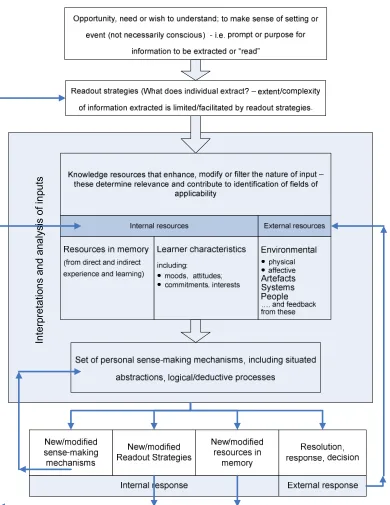
Figure 3 An interpretation of a model of the micro-evolution of knowledge suggested by the literature
87
Figure 4.7.3.1a Photograph of the map and Father Christmas figure being used in Webkit
108
Figure 4.7.3.1b Examples of information pages in database 109
Figure 4.7.3.1c Father Christmas in various states of undress 110
Figure 4.7.3.3a Quiz home page 113
Figure 4.7.3.3b Samples of different types of questions in “Quiz” 113
Figure 4.7.3.3c Photographs of Thermometer in use 114
Figure 4.7.3.4a Photograph of “Primary Games 4” contents screen 114
Figure 4.7.3.4b Numbers revealed as balloons burst 115
Figure 4.7.3.4c Checking the answer 115
Figure 4.10 Key to determine Transfer Class 130
Figure 5.2 C’s “piles of snow” 156
Figure 5.3 G’s “clonk” 186
Figure 6.1a Classes of transfer evident in C’s transfer events
229
Figure 6.1b Classes of transfer evident in G’s transfer events
229
Figure 6.4(C) C’s successful transferences between dimensions for negative numbers
Figure 6.4(G) G’s successful transferences between dimensions for negative numbers
257
Figure 7a G’s contextual neighbourhood. A representation of concepts that he uses as he begins his work with “Journey”
280
Figure 7b G’s contextual neighbourhood. A representation of concepts that he uses in his work with “Journey”. New associations have been constructed between
resources. Sometimes, new associations introduce tension
281
Figure 7c G’s contextual neighbourhood. A representation of concepts that he uses in his work with “Journey”. As there are now several associations between
resources relating to negative numbers, G might now be seen to have constructed a concept of negative numbers
282
Figure 7d Overview of Figs 7a-c illustrating formation and strengthening of associations and emergence of a new concept – “Negative numbers”
283
Figure 7e Model of the micro-evolution of knowledge, amended in response to analysis and discussion of my findings
List of Appendices
Appendix 1: Letter to parents 319
Appendix 2: Schedule for interview with class teacher prior to 320 commencing research sessions with children.
Appendix 3a: Write-up for Session 1 H, R, W 321
Appendix 3b: Write-up for Session 2 H, R and W 325
Appendix 3c: Write-up for Session 3 H, R and W 328
Appendix 4a: Write-up for Session 1 C, S and N 330
Appendix 4b: Write-up for Session 2 C, S and N 334
Appendix 4c: Write-up for Session 3 C, S and N 338
Appendix 4d: Write-up for Session 4 C, S and N 343
Appendix 5a: Write-up for Session 1 L, M & G 346
Appendix 5b: Write-up for Session 2 L, M & G 349
Acknowledgements
I must, firstly, extend a huge vote of thanks to my supervisor, Dave Pratt, without whose support and guidance this thesis would not have been possible. I am particularly grateful for his faith in me and his commitment to seeing things through, even when changing circumstances made this more difficult for him than it was ever intended to be.
I should also thank colleagues and pupils from the first primary school in which I taught, where I first became interested in wanting to understand how children’s mathematical knowledge grows – a question that
continues to fascinate me.
Of course, without the children who took part in the study, Hazel, their teacher, and other staff at the school, there would have been no study so huge thanks go to them.
Declaration
Previous relevant publications:
Pratt, D. & Simpson, A. (2004a). McDonald’s vs Father Christmas. Australian Primary Mathematics Classroom. 9 (3). pp 4-10.
Pratt, D. & Simpson, A. (2004b) Numbers and Maps: The Dynamic Interaction of Internal Meanings and External Resources in Use.
http://www.merga.net.au/documents/RP562004.pdf [Accessed 20.09.08]
Stringer, M., Rode, J. A., Toye, E., Blackwell, A. & Simpson, A. (2005) "Webkit: A Case Study of Iterative Prototyping of a Tangible User Interface." IEEE Pervasive Computing. Special issue on Rapid
Prototyping for Ubiquitous Computing - Oct-Dec 2005, 4 (4), pp 35-41
The above publications reported on a study carried out in 2002-2004, a European project “Webkit: Intuitive physical interfaces to the WWW” (IST-2001-341 171). I was involved as one of a team of researchers working across Europe. I contributed (as second and fifth author respectively) to the above papers. I acknowledge (and briefly describe) Webkit within this thesis as an experience which prompted my wish to undertake deep study into children’s conceptual development. However, the research focus for Webkit was not the same as for my thesis and Webkit data is not included as data for this thesis. Any ideas for which Webkit may have been a resource are acknowledged within the thesis.
Abstract
Children’s failure to re-use knowledge will continue to be problematic until processes that contribute to conceptual growth are better understood. The notion that conceptual knowledge, soundly constructed and reinforced, forms the basis of future learning, as the learner uses it unproblematically to make sense of new situations in related areas, is appealing. This thesis will show this to be an overly simplistic view of learning, failing to take sufficient account of fine-grained processes that contribute to the micro-evolution of knowledge and of connections between cognition and other factors.
Much previous research focused on abstraction as key to learning. This thesis examines the role of abstraction in the development of
mathematics concepts by children aged 8-9 years, using negative numbers as a window on their development of knowledge in a new domain. The assumption, prevalent in the literature, that abstraction is a requirement for transfer of knowledge is questioned.
Three research questions are explored:
1. What resources shape the nature of transfer and the growth of knowledge about negative numbers?
2. What is the role of the interplay of resources in the micro-transfer of knowledge about negative numbers?
3. What is the relationship between abstracting and transferring knowledge about negative numbers?
Methodology is based on a case study approach, initially recording the work of 3 small groups of children throughout a series of tasks and using progressive focusing techniques to create two case studies which are analysed in depth.
The thesis reports how the extent of conceptual development about negative numbers was influenced by interpersonal and intrapersonal learner characteristics, and describes a complex interplay between cognitive and affective factors. Micro-transfer and intermediate
Chapter 1: Introduction
1.1 Motivation
My motivation for conducting research in this area arose from my experience as a primary teacher. I like to think that I was an effective teacher; one who strived to develop my pedagogical and subject
knowledge in order to maximise the potential for children to “learn” what I want them to learn. And yet, even where careful assessments informed me that “success criteria” had been met, and that children had learned what I had wanted them to learn, it often became clear, later, that they did not apply that learning in other relevant situations. For example, when I was a classteacher, Shaun had successfully measured a number of pencils and had been able to record their lengths in order; he knew that 21.4cm was longer than 21.25cm. However, in another lesson later in the same week, he was ordering a list of numbers and stated that 13.65 was bigger than 13.7. This exemplifies a phenomenon commonly described by teachers; that when faced with similar problems in other situations, children do not realise that they can use knowledge that had been effective in another situation previously to solve the problem: the new problem is regarded as novel, rather than a variation of one already encountered.
knowledge – that is, they fail to transfer knowledge developed in one situation, to a new situation. Of course, such a description is a
simplification of what we are actually asking children to do, as I shall show.
The mathematics curriculum in UK primary schools is presented as a spiral curriculum, whereby pupils are exposed to the same ideas many times, each time in a slightly different guise, intended to facilitate understanding that grows in depth and complexity. Prevalent within the curriculum are Piagetian principles relating to learning through
experience, starting with what pupils already know, and to knowledge being a product of the way that individuals respond to and reflect on their experience. It is something of a paradox, therefore, that “The Primary Framework for Literacy and Mathematics” (DfES 2008) sets out a
programme of teaching that is provided in each year of primary schooling. Mathematics education in UK primary schools is, therefore, currently based on a set of assumptions about what children need to learn according to their age.
I believe that the UK primary mathematics curriculum presents an overly simplistic view of the development of mathematical knowledge. It is portrayed as a stage process in which attainment of one level prepares the learner for the next and in which development occurs in a particular sequence. This model suggests that knowledge exists in different forms at different stages, and that it is perceived and experienced passively, as something that is possessed by the learner. This assumption – that knowledge is something to be possessed; that it can be given or acquired or lost – is, I believe, highly questionable; I question whether the learning pathway for individuals is so predictable. I also am unconvinced that children are able to revisit ideas often enough or in appropriate ways to facilitate effective conceptual growth and change.
Previous research in education has led to the development of a variety of theories and perspectives on learning. The roots of the curriculum are in research and theory. It is interesting to relate some of the dominant theories to concept development in mathematics and to consider whether the model for learning described above, that dominates our classrooms and curricula, actually coincides with, and is appropriate to, the
development of mathematical concepts. If not, it may not be an appropriate way to be teaching primary children.
Constructivist principles underpin many of the ideals implicit in our
modern curriculum. Although there are many variations of constructivism, a common focus, on learning by doing, and on building from existing knowledge, is apparent. von Glaserfeld (1983, cited in Lerman 1993) states that,
“We come to see knowledge and competence as products of the
individual’s conceptual organisation of the individual’s experience.”
(p66)
Confrey (1999) points out that Piagetian learning theory leads to a focus on the operational aspects of mathematical concepts. She notes that symmetry is therefore understandable through the action of folding and a circle is “defined in relation to the action by which they are made” (p6)
There are many examples in the UK primary curriculum of the facilitation of concept development from operational foundations such as: young children begin to learn about position and direction through physical activities involving movement and rotation of their own bodies; counting and calculating begins with movements on a number track.
The constructivist view does, however, emphasise the role of the learner and of the learner’s experience as being crucial in shaping the learning that occurs. I agree that this is central to any understanding about the cognitive mechanisms which are in play during learning. Constructivism does not satisfactorily illuminate the processes that enable boundaries between contexts to be overcome when similarities are not clear.
Having noted a few examples from my experience as a primary class teacher of children failing to re-use knowledge appropriately, it is also interesting to consider that in my current role as a senior lecturer in initial teacher training I now work with young adults who frequently demonstrate that they too have developed poor understanding of many mathematical concepts and skills. They are often not able to solve problems or even to perform elementary mathematics processes because they are unable to remember procedures and routines on which they had depended for their previous success in examinations at the end of their secondary
education. One example is Rosemary who gave the answer 380 when asked to multiply 26 by 45. She explained that she didn’t know how to “do long multiplication” and showed that she worked it out this way:
26 x 345
380
She explained, “I did 6 times 5, that’s 30 so put zero here and a little 3 up there. Then, 2 times 4, that’s 8. Bring the 3 back in so it’s three hundred and eighty? It’s probably wrong ‘coz I can’t remember how to do it.” Rosemary not only failed to use an appropriate algorithm, she also failed to realise that the answer should be a much larger number.
but never understood it; that they just guessed the answers and
sometimes got them right. Some students remember rules such as “ two minuses make a plus” but can’t explain what that means; why the rule “works”. The young adults who I teach are the outputs of the education system and the mathematics curriculum in the UK.
It would appear that it is not only my students who have difficulties with negative numbers; in November 2007, a National Lottery scratchcard was withdrawn because the public did not understand how to order negative numbers. A report in the Manchester Evening News (Leeming 2007) explained:
“The Cool Cash game - launched on Monday - was taken out of
shops yesterday after some players failed to grasp whether or not
they had won.
To qualify for a prize, users had to scratch away a window to
reveal a temperature lower than the figure displayed on each card.
As the game had a winter theme, the temperature was usually
below freezing.
But the concept of comparing negative numbers proved too difficult
for some. Camelot received dozens of complaints on the first day
from players who could not understand how, for example, -5 is
higher than -6.
Tina Farrell, from Levenshulme, called Camelot after failing to win
with several cards.
The 23-year-old, who said she had left school without a maths
GCSE, said: "On one of my cards it said I had to find temperatures
lower than -8. The numbers I uncovered were -6 and -7 so I
thought I had won, and so did the woman in the shop. But when
"I phoned Camelot and they fobbed me off with some story that -6
is higher - not lower - than -8 but I'm not having it.
"I think Camelot are giving people the wrong impression - the card
doesn't say to look for a colder or warmer temperature, it says to
look for a higher or lower number. Six is a lower number than 8.
Imagine how many people have been misled."
A Camelot spokeswoman said the game was withdrawn after
reports that some players had not understood the concept.
She said: "The instructions for playing the Cool Cash scratchcard
are clear - and are printed on each individual card and in the game
procedures available at each retailer. However, because of the
potential for player confusion we have decided to withdraw the
game."
It would seem that many young adults have been failed by the
mathematics curriculum in the UK since, for many, it does not appear to enable the development of good conceptual knowledge.
As well as teaching young adults at university and children in primary schools I have also worked with children in schools where I was not employed as a teacher but worked as an education researcher. For two years I worked with children in primary and secondary schools and
My research focus, on the finest grain processes that are involved in learning, has therefore evolved out of my experience as a teacher, manager and researcher in different contexts. The “Webkit” project 1 was a 2 year study which explored a potential application for novel
technological user interfaces (“TUI”s) in schools. It considered
affordances of real-world and virtual environments and evaluated the effect of using tangible interfaces across the 2 settings on the likelihood of knowledge learned, through one task or experience, being re-used in another (i.e. application or transfer). In the lifespan of the project it was not possible to evaluate re-usability with any confidence. However, what did emerge, that was of interest to me, was evidence of robust and
flexible learning that related to some difficult concepts (using a TUI). This was an interesting outcome because the quality of children’s learning evident on completion of their tasks was higher than I would “normally” have expected to see, based on my own primary mathematics teaching experience. This prompted me to consider features of the research sessions that might have contributed to improved effectiveness of teaching and learning.
An aspect that inspired particular interest for me was the insight that the research trials provided into the ways children developed understanding and new knowledge by linking it with experiences and “old” knowledge and with other new knowledge. Analysis of trials data provided insight into ways that children used a wide range of resources available to them. I was intrigued to note that children’s existing knowledge included
knowledge in many different stages of construction. Pre-existing pieces of knowledge had been processed in some way and were available as resources to help children make sense of their task.
It was also possible to infer different ways in which the children were able to make links “in-action” – i.e. whilst actually engaged with the task given, they were becoming aware of connections with other aspects of the task and of their own thinking. Such thinking-in-change was also evident in
1
children’s responses to each others’ contributions. Marie, for example, whilst subtracting using a number line, suddenly remarked, “So, adding a minus 3 is the same as taking away 3. Hang on ... that’s 2 lots of minus 3 is minus 6, 2 times minus 3 is minus 6! Hey! When Father Christmas goes somewhere 3 degrees colder its like taking away 3 degrees and its like adding minus degrees, adding coldness. So they’re the same??!!”
So, the focus for my research, emerging out of a longstanding interest in the pedagogy of mathematics, and out of my Webkit experience, is on learning, and particularly on factors and processes (both real-world and cognitive) that affect the re-usability of knowledge. I want to understand more about the mechanisms by which children process knowledge and experience and understanding in order to create new knowledge; changing and reshaping old knowledge and incorporating new knowledge. I want to understand better what it is that enables or
facilitates (and, by implication, inhibits or limits) the re-use of knowledge in new situations.
In order to be able to learn about the way children use and re-use resources (to develop knowledge) and knowledge (as a resource) we must create the conditions where this might occur and can be observed. These, and other key methodological and research design issues will be fully addressed in Chapter 4.
Learning is complex; in acknowledging that complexity, I imply that complexity is also required in order to observe and understand what is involved. I would argue that, until more is known about re-use of
knowledge in a range of tasks and environments, the potential for those tasks that are used in empirical research studies to illuminate the
light of current understanding and is therefore a tentative dipping of a toe into the water. I would, therefore, expect my research to generate more questions than answers.
What I have set out to do is to shed some light on cognitive processes - relating to learning, to conceptual growth, and to the application or transfer of knowledge - that will contribute to a deeper understanding of those processes. A valuable outcome of my research would be that it informs an increasingly appropriate and relevant methodology for
subsequent studies. Those studies might, thereby, be enabled to discern and describe cognitive processes leading to conceptual development more precisely and more certainly than I am able to. It is only when we know more about how children learn mathematics that studies can be designed to optimise tasks and conditions in order to maximise the scope to be able to see their learning.
In the next chapter, I shall explore a range of literature in the field of learning in mathematics, particularly about conceptual growth and change and the re-use or “transfer” of knowledge. Through an analysis of relevant literature, I shall state my own position and develop and clarify my
research questions.
My research focus is on learning and conceptual change and transfer; I need to observe those processes in some detail as they occur if I am to be able to elucidate them. Therefore, I need to select an area within mathematics where these processes are likely to be invoked. I have already identified negative numbers as an area within mathematics that my pupils and students find difficult. I shall therefore, in Chapter 3, review research findings about learning about negative numbers and consider why this might be an appropriate domain to use as a window through which I might observe learning processes and sub-processes.
knowledge and then extending the range of contexts in which children may or may not re-use their new knowledge.
In my analysis of my findings, in Chapter 5, I shall focus on the work of two individuaI children and detail the cognitive changes that I am able to infer from the data. In Chapter 6, I shall discuss my findings in a more thematic way, considering factors, identified in my review of the literature, that might influence learning and reflecting on patterns and peculiarities that emerged.
Chapter 2: Literature Review
2.1 Disparity in the focus of previous research
I must consider the theoretical frameworks and perspectives that
underpin research in this field and try to highlight the commonalities and shared understandings that exist, even though the labels that are used for them may vary. I will go on to present my view that apparent confusion and disagreement within the literature is not actually that; rather, it is simply the result of a differential focus – brought about by differences in perspective, leading to differences in the grain size of the processes selected for investigation in the development of a range of theories about learning and knowledge transfer. There are at least 3 different levels at which development can be observed and described; 2 at what might be described a macro-level, and a third at a micro-level:
Level 1: Grand Theory
provides hope and purpose and direction. However, at the classroom level, the experience of teaching and learning does not always follow the rules that educational grand theory would predict. For teachers and
pupils, there are variations and deviations from the expected path that are often complex and convoluted. Very often, the learning pathway diverges from that which grand theory would have predicted and never re-joins the original expected route or attains the “normal” outcome. Educational grand theory, has, thus far, been unable to unify the diverse theories that have been developed to describe aspects of learning. It does not
accommodate the messiness and noise that characterises the real world. This messiness and noise often leads to distortion and disturbance of the directions and outcomes of learners’ experience. Grand theory cannot and should not, therefore, be used to predict the learning pathway of individuals and small groups within the whole population.
diSessa & Cobb (2004) describe what might be seen as a taxonomy of theories. Their focus of interest is design research; in my opinion, that is not to say that their observations are not applicable to a wider audience than those who consider themselves design researchers. diSessa & Cobb begin by acknowledging the importance of research being related to theory but go on to state that, unlike theories in the physical sciences,
“Theories concerning educational matters seem to replace one
another, rather than subsume, extend, or complement other
theories. While the state of the art constantly changes, it is often
difficult to tell that progress is being made.”(p79)
diSessa & Cobb point out that the difficulties with grand theory are typically due to,
“ … some combination of being, as yet, immature (e.g. false as
categorical prescriptions of cognitive or social processes),
imprecise (so that implications at the level of design decisions are
unsure), or simply too high-level to inform the vast majority of
consequential decisions in creating good instruction. To take a
epistemological issues that concern the nature and growth of
knowledge. Nonetheless, his work had a strong educational
influence from the 1960s at least through the early 90s. We feel,
as many others do, that Piaget’s ideas were overextended into
education.” (p80)
Burkhardt & Schoenfield (2003) agree,
“Most of the theories that have been applied to education are quite
broad. They lack what might be called “engineering power”. To put
it a different way, they lack the specificity that helps to guide
design, to take good ideas and make sure that they work in
practice. ….. Education lags far behind in the range and reliability
of its theories. By overestimating theories’ strength (or perhaps
better, by not constraining their application appropriately) damage
has been done. ….. The harm comes from overestimating their
generality and power, and underestimating the need to specify the
contexts in which they are effective and the steps necessary to
implement them successfully.” (p10).
This concurs with my own view, previously stated, that grand theory should not be expected to explain or predict the ways that learning occurs at the level of the individual or classroom.
Level 2: Subject-focused theories
Other theories, whilst emerging from a subject-specific base have,
detail for me to evaluate, or sometimes even recognise, them in my classroom. Sfard, for example, describes the journey towards
achievement of what she calls “abstract objects” through three steps: interiorisation, condensation and reification. She emphasises that this is a difficult process and that reification is a complex phenomenon. Dubinsky also considers the transition from processes and actions to the
conceptualisation of those processes as mathematical objects; he calls this “encapsulation”, part of the process of reflective abstraction. Lave was concerned that what is learned in school does not appear to be utilised in the real world; that knowledge did not transfer across school-real world boundaries. She concluded that knowledge was situated in the context in which it had been learned and that educators need to
acknowledge the weakness of a system for education that assumes relatively unproblematic transfer of knowledge across different contexts and settings.
Any attempt by me to apply such theory to individual children in my primary classes was largely unsuccessful. I discovered that I didn’t actually know what reification or encapsulation looked like: I didn’t understand what the indicators might be that would show that it had, or had not, occurred. The notion that knowledge was unlikely to be used in situations away from school simply because they were outside school was a prospect that I, as a classteacher, found frustrating and unhelpful. It is apparent that these theories, though finer-grained than grand theory are still too “grand” to be useful at the classroom and individual level.
Later in this chapter, I shall briefly review theories of learning that are helpful, in some way, at the macro level and I shall also go on to consider those that have focused on more subject-specific learning, particularly on the development of concepts relating to mathematics and science.
Level 3: Micro-level theories
most promise for developing my own understanding about learning. It is the work of researchers such as diSessa (1993); diSessa & Wagner (2005); Pratt & Noss (2002) that provides greatest insight and scope for development of a deeper understanding. I shall therefore consider the work of these contributors in more depth.
Initial research questions
So far, I have described a taxonomy of types of theories and ways in which they vary in terms of their generality. I have suggested that the level of generality is directly associated with their lack of applicability and usefulness for teachers and others working with individual learners. I have explained that I shall review theories at 3 levels of generality: grand theory crossing all subjects; subject-focused theories that aim to describe and predict, in some detail, general learning pathways and behaviours for the whole population; and fine-grained theories that focus on
understanding particular learning experiences for individuals, i.e. “micro-level” theories.
My initial research questions are fairly general:
• How do children learn?
• How do new concepts develop?
• Do all children construct new knowledge in the same way?
• Why do children so often fail to transfer knowledge from one setting to another?
Why should I focus on concept development?
the development of theory is not, therefore, transfer itself, but must be the broader concept of learning, i.e. of concept development or conceptual change.
It is interesting, at this point, to consider the impact that research in education has had on policy and practice. Commitment to pedagogical transformation is notoriously difficult to achieve and even more difficult to sustain at the classroom level (Bishop et al 1993; Harries & Spooner, 2000). So, has educational research, historically, succeeded in
illuminating the flaws and needs within the system? Furthermore, has it succeeded in developing theories that ultimately inform and improve practice? It might be argued that the lack of clarity and consensus that characterises research in this field to date means that the impact of research on policy and its influence on children’s learning outcomes must be questionable.
Sfard (1998) contrasts 2 metaphors for learning which are evident in contemporary education research: acquisition and participation. She begins by acknowledging a consensus put forward by “all theoreticians of intellectual development” , that “new knowledge germinates in old
knowledge” (p4). She implies that there is a conflict or tension within
education systems generally, relating to knowledge about what actually constitutes learning and what learning requires. She believes that the “acquisition metaphor” and the “participation metaphor” are implicit or explicit in a wide range of educational research. She points out that the acquisition metaphor is a more old-fashioned focus than the participation metaphor which (she finds) dominates more recent studies. It is, after all, a more modern idea to emphasise the social, apprenticeship, activity-based aspects of learning that have formed the basis of whole fields of study within the education arena. Nevertheless, I would point out that, in the prevailing statutory and non-statutory requirements and
calculation strategies is highly prescriptive: the “Primary Framework” (DfES 2008) sets out a portfolio of mental and written strategies that should be taught in each year group. There is little scope within this for children to discover or invent strategies for themselves. Also, although group work is a feature of one segment of mathematics lessons, such work is usually highly structured and adult- (or text book-) led. It could be argued that the UK primary mathematics curriculum is, almost literally, “delivered” by a prescriptive programme of teaching to a pupil population who are expected to take on board concepts and skills as possessions that are acquired, rather than as understandings that are developed through participatory experience of them.
Moreover, I would suggest that, in developing the notion of apprenticeship, it is important to realise that, if authenticity of the
environment, (including the task and its purpose) is crucial, opportunities for learning are limited to those experiences in the real world that offer authentic purposes, contexts and outcomes. However, such opportunities are not usually available to teachers and learners in educational settings. As Sfard (1998) points out, “ … real-life situations which would be rich enough in mathematical content to become for mathematics students what craftsman’s workshop is for the apprentice are extremely difficult to
find “ (p10) (I would add that Sfard’s reference to “rich”-ness of
mathematical content is an interesting notion in itself since in the real world, content would lead to open-ended and unpredictable outcomes. It is extremely difficult, if at all possible, to plan (as good teachers often strive to) for the unpredictable. I would argue that authenticity is not achievable in classrooms since any activity that is conducted in the classroom is not authentic practice from any other setting. The metaphor of the learner as apprentice is not, in my opinion, reconcilable with the school setting.
Sfard describes a shift in the language used by “the new researcher” and concludes that, “The talk about states has been replaced with attention to activities …. the permanence of having gives way to the constant flux of
In recommending ways forward for educational research, Sfard stresses that,
“Educational research can only do its job properly if it makes room
for both Acquisition and Participation Metaphors” (p7);
that,
“The relative advantages of each of the two metaphors make it
difficult to give up either of them: Each has something to offer that
the other cannot provide. The basic tension between seemingly
conflicting metaphors is our protection against theoretical
excesses, and is a source of power.” (p10).
She warns of dire consequences for the acceptance of one metaphor rather than the other in guiding research in education:
“When a theory is translated into an instructional prescription,
exclusivity becomes the worst enemy of success. Educational
practices have an overpowering propensity for extreme, one-for-all
practical recipes…. Because no two students have the same
needs and no two teachers arrived at their best performance in the
same way, theoretical exclusivity and didactic single-mindedness
can be trusted to make even the best of educational ideas fail.” (p11).
This is what diSessa & Cobb (2004) and Burkhardt & Schoenfield (2003) were referring to when they highlighted the potential for harm caused by the over-extension of grand theory into instructional practice.
So, learning is the development of concepts, whether by acquisition or participation or both. Perhaps there is a connection between these ideas in that one or other is more appropriate to either “grand” or micro-level theoretical frameworks?
between grand theory and classroom practice (diSessa & Cobb 2004) is a challenge for contemporary theory development. Having established that it is necessary to consider learning in order to be able to understand transfer, that they are both elements of conceptual growth and
development, it is vital to acknowledge that learning is, in itself a
problematic concept. It is pertinent, at this point, to consider how some of the key theories in this field have attempted to describe learning and the mechanisms by which it is achieved.
2.2 Historical changes in focus
In the first part of the twentieth century, mathematics education was influenced by theories about learning based on notions of conditioning and behaviourism. Thorndike & Woodworth (1901) considered a range of what they called “functions”; these might be thought of as abilities or competencies (e.g. estimating magnitude such as estimating the length of a line on a page). Thorndike and Woodworth studied the effects of
training aimed at improving performance in those functions. They were particularly interested in the range of situations in which trained functions appeared to be applied.
In the 1930s, Skinner (1938) found that the efficacy of reinforcement of behaviours was dependant on factors such as its frequency and the length of time between the behaviour and the reinforcement.
Clearly, the impact of behaviourism meant that it was the teacher/trainer, or, more correctly, the programme of rewards and punishments that was considered to be the key to learning; no real consideration was paid to the learner. However, such stimulus-response theories left too many aspects of learning unaccounted for; for example, Steffe 1983 (citing Brownell 1935) points out that,
“Only 40% of the responses given by 32 third grade children to 16
addition combinations were taken as memorized associations in
combinations on the basis of drill theory. The rest were taken as
either counting or indirect responses (37%) or guesses (24%).”
Stimulus-Response theories were, evidently, limited in their scope for describing, and helping us to understand, learning since so much of what is known could not be attributed to what has been taught.
Dewey (1938/1998) changed the focus: he acknowledged that the
learner, and the learner’s experience, shaped his/her response to stimuli, to tasks and to learning. Dewey was interested in motivation and the notion that stimuli come from the learner, not from external sources.
From the middle of the twentieth century, more learner-focused research became the catalyst for change in education. The work of Piaget in the 1950s has evolved into a particularly well-known tradition in education. It is interesting to note that, implicit in Piaget’s focus on staged
development (Piaget & Inhelder 1969), is a belief that there is a limit to the learning that can be achieved, according to the development stage of the learner and that, while it might be possible for learning to be
accelerated within a development stage, it is not possible to accelerate development. The concept of cognitive structures is key to Piaget’s theory. He believed that there are 4 principle structures, or development stages, and that these change through 3 processes of adaptation. The first of these processes is assimilation, in which new experiences “fit in” with existing knowledge. Accommodation occurs when existing mental structures or concepts have to change or expand in order to make sense of the new knowledge. Where new experience conflicts with existing concepts, equilibration must occur for cognitive harmony to be achieved. Piaget’s approach may be described as cognitive constructivism.
was a key influence in their own learning, but also embraced the significance of the teacher and of communication and attempted to
explore and describe how they fitted into the whole learning process. One point on which Piaget and Bruner disagreed was regarding the potential effect of teaching on learning. Bruner (2006) wrote, “ .. any subject can be taught effectively in some intellectually honest form to any child at any
stage of development…. It is a bold hypothesis and an essential one in
thinking about the nature of a curriculum.” Piaget, on the other hand,
maintained that potential learning was limited by the developmental stage attained by the learner. Bruner holds that there are “three systems of processing information by which human beings construct models in their
world, through action, through imagery and through language” (2006;
p68)
Bruner’s view is that the mode of presentation of new knowledge must be such that it can be grasped readily by the learner. He describes 3 modes: the enactive mode; the iconic mode and the symbolic mode. Bruner believes that the development of these three modes of representation, “for how we move, perceive and think” (p68), “is in that order, each depending upon the previous one for its development, yet all of them remaining more or less intact throughout life.” (p69).
Vygotsky’s work came to the attention of the western world in “Thought and Language (1962), though it had been conducted in Russia in the 1920s. He fundamentally believed that learning is an interactive process between the learner and his/her environment, including people, which of course, in some contexts, includes teachers. Vygotsky framed his ideas about learning on the notion of 2 levels of performance – assisted and unassisted. The unassisted level may be equated with Piaget’s
developmental level. The assisted level is that which is achievable with good teaching, sometimes referred to as the learning level. Quite simply, the gap between these 2 levels is what is perhaps the best-known
Vygotskian construct; the Zone of Proximal Development (ZPD).
reached the limits of his/her unassisted performance. Vygotsky stresses that learning is therefore dependent on meaningful social interaction. Clearly, a skilful teacher may have a powerful influence on a child’s learning.
A more advanced stage in learning is when the child becomes his/her “own assistant” (Vygotsky 1962). In this, control of learning is being taken up by the child him/herself. This suggests, to me, that the child might be aware of his/her own learning; that meta-cognition is suggested, even for young learners.
This brief overview of some of the major contributors to grand theory in education reveals some themes that are recognisable in education policy and practice in the UK today, such as: the idea that development occurs through stages in some way; that learners’ experience has an effect on their learning; that social interaction and language are important elements of learning, including high quality teaching; ultimately, independence in continuing learning is attainable and desirable.
As well as such theories that illuminate processes and features of the development of knowledge and understanding in the broadest sense, there are other theorists who have concerned themselves more with certain aspects of learning and cognitive growth (e.g. van Hiele 1986; Sfard 1991). These often propose a hierarchical framework of concepts whereby knowledge of particular concepts at a particular level of
sophistication is pre-requisite for beginning to develop similar or related concepts at a higher level of sophistication.
Pegg & Tall (2002) identify what they call “a fundamental cycle of growth in the learning of specific concepts” – a sequence of changing cognitive
structures that evolve and develop to become necessary tools or
(i.e. not necessarily concept-specific) long term growth of the individual, including some of those previously mentioned, and suggest that,
“What stands out from such theories is the gradual biological
development of the individual, growing from dependence on
sensory perception through physical interaction and on, through
the use of language and symbols, to increasingly sophisticated
modes of thought” (p42).
Mason & Spence (1999) recognise that a belief that knowledge is built on previous knowledge in hierarchies is evident in the current framework for teaching primary mathematics in the UK, the National Numeracy Strategy (DfEE 1999). Current educational policy and practice in UK would appear to have been strongly influenced by research-based beliefs about how children learn; for example, our system acknowledges, and is dominated by, a notion of hierarchical knowledge.
To recap, research throughout 20th century has revealed that there are many influences on learning and on the quality of learning outcomes. Although, in the first half of the century, the focus was on external (to the learner) factors, more recent research found that the impact of the learner him/herself (and of his/her experience) were far more significant
influences, on the way new experiences are perceived and understood, than had previously been realised or acknowledged. Moreover, I believe that to focus exclusively on the child’s part in the process would be to limit the potential for him/her to learn; I believe that the teacher also influences the child’s learning outcomes, through the design of programmes of learning, tasks and experiences and through skilful provision of
2.3 How is mathematics learned? A focus on abstraction
Some researchers in the domain of mathematics education, and specifically in the area of conceptual growth in mathematics have developed theoretical frameworks describing how concepts are developed to a level at which they are likely to be re-used in new situations, through a process of abstraction. This might be seen as a logical focus since mathematics, particularly that which might be
described as “advanced” is not directly accessible through our senses but exists only in some kind of abstract form.
Workers in this area include Dubinsky (1991), Sfard (1991) and Davis (1986). They present mathematics learning as a hierarchical process, progressing through a series of stages. They believe that children begin with physical, enactive experiences through which they are introduced to a process which (it is intended) will come to be understood and used as a condensed form of the original sequence of actions. The next stage is reached when condensed procedures come to be understood as tools and objects themselves which can be called upon in order to “tame” (Dienes, 1960) other processes. The researchers who uphold these theories accept that there are certain similarities and parallels cutting across their theoretical frameworks. Pegg & Tall (2002) and Barnard & Tall (2001) explicitly set out to identify and understand the similarities and commonalities across different theories (Davis 1984, Dubinsky 1991, Gray & Tall 1994 & 2001, Biggs & Collis 1982 - all cited in Pegg & Tall 2002) by contrasting themes and artefacts within them and mapping structurally similar elements across theories. They highlight similarities in stages in development of conceptual growth within the different theories in terms of actions, object, procedures, processes, schemas and entities, implying that although the terminology might be different they are simply different labels for the same (or similar) things.
qualitatively different to earlier concepts; if they are, they move the
learner towards a more abstract understanding of that concept. If the new concept is no more sophisticated or abstract than the existing one, it simply enriches the concept already held, acting as potential to trigger a more abstract version in its next construction. Pegg & Tall (2002) also state that there are “different kinds of learning” (p45), depending on whether the focus of the learner’s attention is on the “base objects” or on the actions. There are similarities, here with the distinction between “figurative” and “operative” schemes drawn by Steffe 1983.
However, I would suggest that there are two major shortcomings of these theories, for those concerned with improving the potential for every child to learn in school: firstly, the theories do not describe what it is that makes a new concept qualitatively better, more sophisticated than the previous one – what is it that leads to abstraction; and secondly, there is a lack of clarity about the definition of “abstraction” – specifically, whether the term is being used as noun or verb – outcome or process.
2.4 What is involved in the learning of mathematics?
I now turn to research that is more specifically focussed on students’ and children’s learning of mathematics to discover whether they can offer
any further insight.
Pegg & Tall (2002) suggest that learning that develops from a focus on the “base objects”, itself focuses on “the nature and properties of those objects”. Similarly, where the learner has focused on the actions on the objects, the concept that then develops is one that is concerned with the nature and properties of the actions, the use of symbols to represent the actions, and the sequencing of actions to form procedures and,
ultimately, processes.
Perhaps children’s difficulties with “abstracting” mathematics from teaching activities arise because children develop an object-based
the nature of common teaching activities that enables the development of objects-based knowledge more readily than of actions-based knowledge.
Whilst it might be interesting to consider that there are different types of learning processes, leading to different types of knowledge, it is also interesting to explore the idea that there are different types of learner. In particular, I question whether there is potentially a bifurcation in the process for children who are more or less successful in their
mathematics: a point (or multiple points) along the journey at which learners may continue along the same path or may begin to move along another path. Certainly, it seems to me logical to compare the knowledge of high and low attaining children in mathematics in order to illuminate the differences in the nature and quality of their knowledge.
If we can uncover what it is that successful learners are able to do, cognitively, that their less successful peers cannot, we might infer aspects of cognitive development that might lead to the development of understanding and superior performance. A particular aspect of that cognitive development is where there is a change from instrumental to relational understanding (Skemp 1976). If research can illuminate the nature of the gap or difference between the learning that more and less able children are able to achieve, then logically it might be possible for teachers to assist the less able more effectively and enable transfer and the development of knowledge to occur for more learners, more often, more readily.
Gray, Pitta & Tall (2000) focused on the role of imagery in children’s development of understanding about number. They concluded that qualitative differences arise between children who concentrate on different aspects of images: that high-achievers tend to describe visual prompts at an impersonal level (“It is …”) as well as by relating them to personal, specific and action-based episodes (e.g. “I have five fingers”). Gray et al labelled these 2 types of images “episodic” and “semantic”,
“to draw a distinction between images arising from memory
events, and images associated with organised knowledge, having
meaning and relationships.” (p408).
They found that low-achievers did not offer “semantic” responses – that their images were only, or mainly, episodic, action-based, concretised. Gray et al believe that this is evidence that low achievers’ thinking is tied up with access to previous experience and that high achievers have detached (at least in some part) that experience from their thinking.
Gray et al also report that,
“Though they initially focused on core concepts, the high-achievers
could traverse, at will, a hierarchical network of knowledge from
which they abstracted these notions or representational features.”
(p407).
Steffe (1983) also looked at qualitatively different modes for working mathematically. He was interested in the “observed difficulties of primary and secondary school students in developing the “proper” mathematical
methods” (p109). He was keen to discover how children make the
transition from using operative schemes (e.g. counting) to using figurative schemes (e.g. written algorithm for addition), a transition which, he
stresses, occurs through their own construction.
Pegg & Tall (2002) state that knowledge is objects-based or actions-based, but I would suggest that it is also interesting to consider that possession of both types of knowledge might confer an advantage for learners. Gray 1991 (focusing on differences between high and low ability children) considered the alternative strategies used to obtain solutions to basic arithmetical problems. He notes that,
“… divergence between the strategies available to the less able
and the more able children is revealed. The alternative strategies
used are based either on counting, procedural strategies or on the
use of selected known knowledge – deductive strategies. Above
average children have both available as alternatives; evidence of
child appears to build up a growing body of known facts from
which new known facts are deduced. Less able children – relying
mainly on procedural strategies – do not appear to have this
feedback loop available to them.” (p551).
In other words, Gray feels that there are some things that low achievers do not or cannot do – i.e. that high achievers have a much wider range of knowledge and strategies at their disposal.
Askew, Bibby & Brown (2001) believe that,
“traditional models of remedial programmes in numeracy (that)
tend to concentrate on the inculcation of arithmetical “facts” (are)
inadequate” (p3).
This is a logical conclusion if we consider that remedial programmes that are designed this way require low achieving children to work in ways that they have already shown they cannot do. Askew et al feel that it is the children who are able to make links between known and derived facts who are able to expand not only their knowledge of number facts but also their range of strategies for deriving new facts. They found that it is not necessary to “wait for children to be “ready” to be taught new strategies”; that, “through carefully targeted teaching, pupils who have not developed these strategies for themselves can indeed learn them” (p9). This might be seen to be at odds with Piagetian notions of developmental stages being determinant of readiness; however, Piagetian principles would predict that, as long as learners are in a particular developmental stage, their learning can be accelerated within that stage, though not beyond it. Also, this supports the findings of Gray 1991 and supports my own
contention that teachers are vital influences on the quality of learning that can be facilitated.
understanding in mathematics: Askew et al (2001) note that there are many children at the end of primary school who rely on procedures such as counting to carry out calculations, rather than use known or derived number facts. This is in line with Brownell’s (1935; cited in Steffe 1983) findings more than 60 years earlier in that children who “failed” to use “standard computational methods” used “either counting or indirect
strategies … ” i.e. they would seem to be “stuck” in an operative mode of thinking, have not moved on to a figurative knowledge (Steffe 1983). We see then that researchers and theorists have been identifying the same issues for a long time; however, this does not mean that we are any closer to understanding those issues well enough to enable us to “teach” mathematics better, so that more learners can develop better quality knowledge and understanding. We know that children often fail to re-use knowledge about concepts that they have learned (or, at least, that
teachers think they have taught,) in primary school; that children revert to, or fail to develop from, earlier, more naïve strategies. I want to find out how to help children to learn; how to move on from that naïve knowledge and to avoid the development of an inadequate cognitive toolkit – i.e. one that contains predominantly procedural/instrumental approaches.
A new imperative for education research about learning and transfer
Grand theory does not, in my view, furnish educators, who work at the chalkface, with knowledge that enables them to design or engineer more effective teaching and learning. In other words, as previously stated, grand theory lacks explanatory or engineering power. If mathematics-focused learning theories (e.g. Sfard 1991; Gray and Tall 1994; 2001) are considered, it is clear that a common theme evident within this work is a focus on abstraction as key to the development of higher levels of thinking. These workers see abstraction of concepts as the key to
between this and “abstracting” in a less “grand” fashion, as part of the process of concept formation and development. Sfard (1991) sets out her understanding that mathematical concepts are developed through 3 stages: interiorisation, condensation and reification. She explores in some depth the reification phase of the process and points out that there are degrees of abstraction and of integration. She states that abstract notions can be conceived in “two fundamentally different ways: structurally – as objects, and operationally – as processes.” (p1) (There are similarities
here with Pegg & Tall’s (2002) comments about learning being objects-based or actions objects-based.) Sfard points out,
“the crucial, qualitative, difference between the two modes of
thinking lies in the basic, usually implicit, beliefs about the nature
of mathematical entities. In other words, there is a deep ontological
gap between operational and structural conceptions.” (p4)
It is worth noting, at this point, that Sfard uses the terms “object” and “structural” in a particular way: when she refers to objects, she means “mathematical objects” – i.e. abstract objects that are often, themselves, the result of some process. Indeed, Sfard believes that concepts are hierarchical, moving from operational to structural.
Sfard notes that there have been many accounts of knowledge as
dichotomies, such as relational or instrumental (Skemp 1976), conceptual or procedural (e.g. Lesh & Landau 1983; Hiebert & Lefevre 1986).
However, she stresses that the 2 types of knowledge that she discusses, structural (focused on mathematical objects) and operational (focused on actions and processes) do not represent a dichotomy but, rather, a
duality. There are clear parallels here with the ideas of Pegg &Tall (2002); Steffe(1983). Sfard notes that,
“ … These two approaches, although ostensibly incompatible, are
in fact complementary. It will be shown that the processes of
learning and of problem-solving consist in an intricate interplay
between operational and structural conceptions of the same
Sfard goes on to state,
“ ….. what is conceived purely operationally at one level should be
conceived structurally at a higher level. Such hierarchy emerges in
a long series of reifications, each one of them starting where the
former ends, each one of them adding a new layer to the complex
system of abstract notions.” (p16)
It seems that Sfard’s description of mathematics knowledge as a
hierarchical system is rather simplistic and, therefore, difficult to reconcile with her suggestion of “intricate interplay”. I also feel that her explanation is, from a micro-perspective, at least, incomplete and therefore
unsatisfactory. I feel that Sfard, like other theorists who concern
themselves with a broad view, does not make clear exactly what it is that happens in reification that marks the point at which it occurs. How can the teachers or the learners know when it has occurred; when they have “understood”? Even if a learner is confident that it has happened, it is often not until that new knowledge is tested that it becomes apparent that it is not secure after all.
Gray & Tall (1994) do not believe that abstraction is always brought about in the same rigid sequence. They focus on the differential mathematical success experienced by individuals and propose that the underlying mental structures that enable some children to think flexibly and solve problems more efficiently are bound up with development of a
“proceptual” system. That is to say, those who are most successful in their mathematics are those who are able to deal with different