warwick.ac.uk/lib-publications
Permanent WRAP URL:http://wrap.warwick.ac.uk/78612
Copyright and reuse:
This thesis is made available online and is protected by original copyright. Please scroll down to view the document itself.
Please refer to the repository record for this item for information to help you to cite it. Our policy information is available from the repository home page.
by
William Richard Goodall
Submitted for the Degree of Ph.D.
at
The University of Warwick
in
The Department of Engineering
Boston Spa, Wetherby
West Yorkshire, LS23 7BQ www.bl,uk
CONTAINS
Page
Chapter 1 Introduction 1
1.0. Area of Research 1
1.1. The Semi-continuous Batch Process Industry 1
1.1.1. Process Plant Structure 2
1.2. Production Planning and Control 3
1.2.1. The Importance of Short Term Scheduling 7
1.3. Approaches to Short Term Scheduling 8
1.4. Objectives of the Research 9
Chapter 2 Analytical Approaches to Batch Plant Scheduling 10
2.0. Introduction 10
2.1. Classification of Batch Process Plant Structure
and Problem Structure 11
2.1.1. Plant Configuration 11
2.1.2. Problem Structure 14
2.2. Approaches Described in the literature 16
2.3. Discussion 20
Chapter 3 Simulation Based Scheduling and Control 23
3.0. Introduction 23
3.1. Simulation for Analysis and Design 24
3.1.1. Objectives 24
3.1.2. Building a Simulation for Design and Analysis 25
3.1.3. Experimentation with a Model 26
3.2. The Objectives and use of Simulation for Scheduling 27
3.2.1. Objectives 27
3.2.2. Building a Simulation for Scheduling 28
3.2.3. Use of Simulation for Scheduling 31
3.3. Generic Modelling for Scheduling 37
3.4.2. The Suitability of Simulation for Scheduling 40 3.4.3. Features Required in a Simulation Model for
Scheduling of Batch Plants 41
Chapter 4 The Application of Artificial Intelligence Research to
Scheduling and Modelling 42
4.0. Introduction 42
4.1. Approaches to Scheduling 42
4.1.1. Rule-based Systems 43
4.1.3. Heuristically Guided Search 43
4.2. Knowledge Representation 45
4.3. Frames and Related Structures 48
4.4. Representing Relations, Entity Characteristics and Preferences 49
4.5. Data Abstraction 52
4.6. Schedule Development in Rule-based and Heuristic
Search Approaches 52
4.7. Knowledge Maintenance 56
4.8. Knowledge-based Configuration of Interconnected Systems 57
Chapter 5 Hybrid Knowledge-based Simulation 63
5.0. Introduction 63
5.1. A Comparison of Simulation and AI Based Models 63
5.1.1. The Use of Simulation and AI 63
5.1.2. Knowledge Representation 65
5.1.3. Structure and Execution 66
5.2. Restrictions of Procedural Simulation Languages 66
5.3. Knowledge-based Simulation 68
5.3.1. Approaches to Knowledege-based Simulation 69 5.3.2. Advantages of Knowledge-based Simulation Approaches 71 5.3.3. Problems with Declarative Languages and Knowledge-based
5.4.1. Difficulties with Developing a Mixed Architecture 77
5.5. Discussion 79
Chapter 6 Current Approaches to Simulation and
AI Modelling of Batch Process Plants 81
6.0. Introduction 81
6.1. The Use of Simulation and AI Tools for
Modelling Batch Process Plants 81
6.2. Modelling of Unit Activity 82
6.2.1. Continuous Activities and Discrete Events 83
6.2.2. Vessel Threshold Levels 86
6.3. Modelling of Plant Layout and Constraints on
Product Routing 87
6.3.1. Dynamic Connectivity 88
6.4. Production Recipes and Process Routing 90
6.5. Product Representation 92
6.6. Plant Scheduling and Configuration 94
6.6.1. Scheduling Approaches 94
6.6.2. Configuration of Process Routes 96
6.7. Batch Transfer, Plant Item Co-ordination
and Material Balance 98
6.8. Modelling of CIP Routes 99
6.9. Discussion 100
Chapter 7 The Modelling of Batch Process Plants for
Short Term Scheduling and Batch Management 102
7.0. Introduction 102
7.1. A Generic Specification for Batch! Unit Level
Modelling 104
Production Activities Subject to Physical Constraints 106
7.2.1. Batch Plant Production Activity Classification 106
7.2.2. Plant Unit Classification 109
7.2.3. Plant Structure 111
7.3. An AND/ OR Structure for Network representation 113
7.3.1. The Importance of a Plant Items Perspective 115
7.4. Specification of Resources for Production Activities 117
7.4.1. Specification of Resources for Batch reaction Activities 117
7.4.2. Product Routing Specification for
Semi-continuous! Transfer Activities 118
7.4.3. Cleaning Activity Cleaning In Place (CIP) Routing Specification 121 7.5. Availability of Plant Items for use in Production Activities 122
7.5.1. Availability Based on Activity State 123
7.5.2. Determination of Plant item Availability
for Process and CIP Routes 123
7.5.3. Additional Complexity in Routing 136
7.6. Preferential Considerations 137
7.6.1. Dynamic Rule-based Configuration for
Carrying out Production Activities 139
7.7. Maintenance of Plant Model Status over Time 141
7.7.1. Physical Product Representation 142
7.7.2. Co-ordination ofPIant Item Activity in the Plant Model 143
7.7.3. Finite Capacity of Vessels and Material Balance 146
7.7.4. The Effects of Finite Capacity Storage on Process Routes 149
7.8. An Example of the Dynamic Configuration Process 152
7.8.2. Preferential Element Selection 153
7.9. Discussion 158
Chapter 8 Activity Scheduling Using the Configuration Model 162
for Activity Scheduling 163
8.2. Production Recipes 164
8.3. Product Representation 166
8.3.1. Updating the Status of a Batch 168
8.4. Reasoning about Scheduling Restrictions on Activities 169
8.5. Preferential Considerations 170
8.6. Resource Allocation to Activities 171
8.6.1. Production Activity Batch Size 172
8.7. Discussion 174
Chapter 9 Implementation of a Generic Hybrid Batch Process Scheduler 176
9.0. Introduction 176
9.1. Tools for System Implementation 178
9.2. The Hybrid Structure and Split Between the
Declarative and Procedural Parts of the BPS 179
9.2.1. System Execution Structure 179
9.3. BPS Operation 185
9.3.1. Building a Specific Plant Model 186
9.3.2. Control Module Execution 186
9.3.3. Simulation Model Execution 194
9.3.4. Recording Simulation Execution Information for Scheduling 200
9.3.5. The Control Module 'B' Phase 200
9.4. Module Integration 202
9.4.1. Development of the Communications Link 203 9.4.2. Data Transfer and Module Co-ordination 204 9.5. Current BPS Implementation and Testing 205 9.5.1. Plant Structure and Routing Representation 206 9.5.2. Route Configuration and Co-ordination of Module Execution 207
9.6. Use of the BPS in a Real Environment 213
9.6.3.
9.7.
Schedule Monitoring and Dynamic Rescheduling
Discussion
Chapter 10 Conclusions and Further Work
10.1. Conclusions
10.2. Further Work REFERENCES
BmLIOGRAPHY
ABBREVIATIONS USED
APPENDICES
A Batch Plant Schematic Representations
B Example of Rule Development
C Example of Configuration Procedure Output
D Paper published in INTERNATIONAL OPERATIONS,
(eds. R.H.Hollier, R.J.Boaden, S.J.New), Elsevier, 1992.
215
216
219
219
222
224
233
Page
Figure
1.1. Example Process Flow Diagram 2
1.2. Production Planning and Control hierarchy 3
2.1. Multiproduct Configuration 12
2.2. Multipurpose Configuration 12
3.1. Model Building Approaches 29
7.1. Minsterley Process Flow 108
7.1.h. Minsterley Flow Diagram Key 108
7.2.a. Simple Plant Network 115
7.2.h. Output Connections from A and B 115
7.2.c. Input Connections to C 115
7.3. Generic Entity Configuration 116
7A.a. Milk to Separators 116
7A.h. Separators and Skim Outputs 116
7.4.c. Skim Line to Skim Storage 116
7A.d. Evaporator Skim Storage Lines and Silos 116
7.5 Generic Activity Route Structure 119
7.6.a Separate Milk for Evaporators Route 1 119
7.6.h. Separate Milk for Evaporators Route 2 119
7.7. Generic CIP CircuitJ Route Structure 121
7.8. Single Pass Binary Constraint Check 128
7.9.a. Example test of CAN-CONNECT-TO Case 2a 130
7.9.h. Example test of CAN-CONNECT-TO Case 2h 130
7.10.a. Sep-milk-ev-skim including Cream Output 136
7.10.h. Separator Cream Output Configuration 137
7.11. Example Configuration Rules 140
7.12. Basic Configuration Cycle 140
7.15. Choices Remaining after Initial Constraint Check 153
7.16. Partially Configured Route Milk Silo and Separator Chosen 156
7.17. Final Configuration of Route 1a for seo-milk-ev-skim 157
7.18. Partial Configuration of sep-milk-cc-skim 158
8.1. Temporal Relations Between Activities 164
8.2. Example Recipe for Skimmed Milk Concentrate 165
8.3. Variation in Product Batch Size 166
8.4. Intermediate and Final Product Representation 167
8.5. Precedence Relation Table 169
9.1. Basic Hybrid Three Phase Structure 181
9.2. Frames in FOOPS 184
9.3. Rules in FOOPS 185
9.4. Control Module Cycle of Operation 187
9.5. Simulation Module Cycle of Operation 195
9.6. Use ofINPT and OUTP Entities 197
9.7. Basic Data Transfer Predicates and Routines 204
9.8. Control Module Data Transfer and Status Co-ordination 204
9.9. Sequence Update Protocol 204
Mr.R.Roy for his supervision and support of this work
Mr.T.Chadwick and the staff of Eden Vale Minsterley for their co-operation and help.
Mr.and Mrs.R.W.Goodall and my wife Annette for their support during the whole period of this work.
DECLARATION
This thesis relates to the area of short term scheduling and control in batch process plants. A batch process plant consists of individual plant items linked by a pipe network through which product is routed. The structure of the network and the valve arrangements which control the routing severely constrains the availability of plant items for configuration in routes when a FI~t is operating. Current approaches to short term scheduling contain simplitying assumptions which ignore these constraints and this leads to unrealistic and infeasible schedules. The work undertaken investigates the use of techniCl!les from the areas of Artificial Intelligence (AI) and Discrete Event Simulation (DES) in order to overcome these simplifying assumptions and develop good schedules which can be implemented in a plant.
The main divisions of work cover a number of areas. The development of a representation scheme for batch plant networks, and procedures for reasoning about the constraints imposed by their structure to infer the actual availability of plant items for routing purposes at any time. The development of a dynamic rule-based route configuration procedure which takes into account the constraints on plant item availability. The development of an activity scheduling framework for batch plants based on this. The development of a dynamic simulation model to take account of finite capacity constraints in a batch plant. The integration of these elements in a hybrid structure to make best use of the techniques available from the areas of AI and DES.
CHAPTER 1 INTRODUCTION
l.Q.THE
AREA OF RESEARCHThis research was initiated to investigate the use of hybrid systems based on
procedural Discrete Event Simulation (DES) and declarative knowledge based
programming techniques from the area of Artificial Intelligence (AI) for the
purpose of short term scheduling and control in the batch process industry.
The aim of the research was to demonstrate that the use of a hybrid approach
could produce a tool for this that overcomes particular difficulties with respect
to the constraints introduced through the typical network structure of batch
process plants. This thesis is therefore written for a reader who has some
familiarity with the batch process industry, and the principles and techniques
used in DES and AI.
The rest of this chapter will briefly describe a number of areas as an
introduction to the remainder of the thesis. These areas are:
I.The characteristics of the batch process industry and batch process plants
which give rise to the particular scheduling problems which have been
addressed.
2.0verall production planning and control of batch plants and the
importance of short term scheduling and control within this.
3.The application of techniques from Operations Research, DES, and AI to
short term scheduling and control.
1.1.THE SEMI-CONTINUOUS BATCH PROCESS INDUSTRY
This area of manufacturing encompasses industries such as dairy processing,
pharmaceuticals, food, and brewing. It is generally characterised by the
materials, often in liquid or powder form, which are processed in batches of varying size at one or more stages to produce the final product. In many cases the final product processing stage consists of filling and packing a bulk product into large numbers of discrete units such as packs of yoghurt. A processing stage could involve a chemical reaction which occurs in a batch reaction vessel, or it could involve moving the product through a plant item which carries out the process. This second type of processing may involve splitting of a product into one or more components or the blending of one or more component into a single product. Processing of this type tends to be intermittent in that one or more intermediate product batches will be processed through a plant item with gaps in between the batches. Therefore it is termed semi-continuous processing. Because of these characteristics short term scheduling and control effort is aimed at carrying out the production of intermediates at each stage in a timely manner to supply the requirements of all following stages in a process.
1,1.1,Process Plant Structure
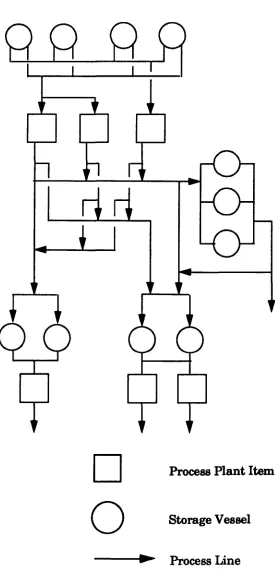
D
o
Storage Vessel [image:16.546.150.426.86.666.2]---.~ Process Line
There is a high capital investment in the equipment and process control
systems which means there is often a requirement for a large degree of
operational flexibility and high utilisation from it even though individual
product requirements may be small so that long production runs of a single
product are not possible. In order to achieve high levels of utilisation the
efficient scheduling and management of the production of batches within the
plant is taking on progressively more importance as discussed by Simmons [1].
The development of techniques for scheduling and automation of the
management function is therefore the subject of a lot of recent research.
However, the effects of the plant network structure and the constraints on
product routing have not so far been properly addressed in this context.
1.2.PROPUCTION PLANNING
AND
CONTROLThe production planning and control process can be split into an integrated
hierarchy of functions which address different levels of detail and have a
correspondingly suitable time horizon. In 1981 the American Production and Inventory Control Society CAPleS) published a report containing a framework
for such a hierarchy for the process industry [2]. This consisted of three levels
of Resource Requirements Planning, Production Planning, and Production
Scheduling. To this can be added two lower levels of Batch Management and
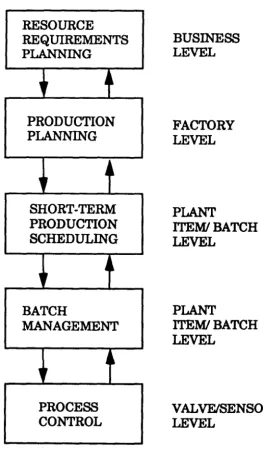
Process Control to give the hierarchy as shown in Figure 1.2.
Resource Regyirements Plannilli
The APICS report described Resource Requirements Planning as concerned
with long term decision making using long range forecasts based on
aggregated information to develop ' .. acquisition plans for facilities, workforce,
PLANNING
,r
~lPRODUCTION PLANNING
'r
~aSHORT-TERM PRODUCTION SCHEDULING
~~ 4~
BATCH
MANAGEMENT
u
"
PROCESS CONTROL
LEVEL
FACTORY LEVEL
PLANT
ITEM/BATCH LEVEL
PLANT
ITEM/BATCH
LEVEL
[image:18.555.166.429.71.537.2]VALVFJSENSOR LEVEL
level of planning can result in constraints on lower levels through the
resources which are available to meet production demands.
Production Planning
The Production Planning function is concerned with the development of
' . .intermediate range operating plans in response to demand forecasts so as to
optimize the utilisation of resources.' Typical time horizons for this sort of
planning are measured in months, and the outputs are operating plans
associated with annual and quarterly operating budgets. The results of this
sort of planning result in aggregate production levels and production
campaigns to optimize factories and departmental output over the medium
term planning horizon. This type of planning is often carried out using
analytical techniques such as Linear Programming. For example Benseman
[3] describes the use of a Linear Programming model to help a large New
Zealand dairy company allocate available milk supplies to its various
production sites. Mauderli and Rippin [4] describe a system called
BATCHMAN to derive an optimal production plan of production campaigns
for a batch plant to meet a particular demand pattern. A campaign is defined
as the production of one or more products simultaneosly and refers to the
whole plant. It uses a technique of enumerating alternative production
campaigns which could be carried out in the plant coupled with a screening
procedure to eliminate inefficient ones before using a Linear Programming
procedure to assign campaigns to a production plan.
Production Scheduling
Production scheduling is concerned with meeting specific production demands.
This consists of a number of sub-modules according to the APICS report
including finished product scheduling of packing of finished products, master
production schedule for specific finished products, blend stocks, intermediate
products or components to be produced in specific time periods at a particular
manufacturing facility.', material plannning which is used to calculate when
intermediate products should be manufactured and raw materials ordered,
and material control which includes final scheduling of production at a finer
level of detail to meet the requirements of material plan and the master
production schedule. Short term scheduling for material control is carried out
for a scheduling horizon ranging from a few shifts to a few days and involves
the determination of when production activities should be carried out to meet
product demands and how resources and materials should be allocated to
them. Demand over these short time periods is usually fluctuating so the
ability to meet demand may be constrained by plant capacity and raw
material availablity fixed at a higher level based on an aggregate demand
forecast. The actual production process and the relationships between
production activities to be carried out for an individual product must be
considered at this level. In determining how to allocate plant items to
activities the suitability and availability of individual plant items must be
considered in conjunction with both the static network structure of the plant
and how the feasible connectivity of plant items changes as routes are set up
in it. In addition the requirement to carry out cleaning activities between
different processes should also be considered. This can be a severe constraint
on production scheduling both in terms of the time available for scheduling
and the availability of resources. Cleaning is typically carried out using a
Cleaning In Place (CIP) system which is part of the plant network structure
and will therefore have an effect on the availability of routing within the
plant. Other factors which must be considered include operating policies
related to product quality such as whether storage vessels can be filled and
emptied at the same time or must be filled, emptied and then cleaned before
Batch Management
The implementation of the schedule must be managed which is the next level
of the Production Planning and Control hierarchy and requires some kind of
supervisory control of the plant. This is typically carried out in a completely
manual fashion with a plant operator or supervisor deciding when to start
production activities listed in the schedule and setting appropriate process
parameters for the process control system to work to. However there has been
recent work on the automation of this function. Cott and Machietto [5]
describe work carried out to develop a batch management system for batch
plants with a flow shop structure which is situated at a level between the
production scheduling system and the process control system. In this case the
batch management system monitors the status of production in the plant and
determines when to start a production activity subject to rules about
precedence between activities and the availability of resources. The actual
rates or durations of a process when the schedule is implemented may well
differ from those used at the scheduling stage. The system described by Cott
and Machietto includes an on-line schedule algorithm called Projected
Operation Modification Algorithm (POMA) which ' .. monitors the equipment
allocations specified by the production plan and attempts to deal with
processing time variablities by modifying the time element of the schedule.' In
addition unforseen interruptions such as plant breakdown or delays in supply
of raw material may occur, so that after a period of time the variance between
the original schedule and the actual situation may be considerable. Therefore
this stage must also include decision making about whether to simply adjust
the current schedule or re-schedule the plant taking into account its new
status, for example using procedures put forward by Bhattacharyya, Roy and
Process Control
Process control is the lowest level in the hierarchy operating over a short time
horizon ranging from milliseconds to minutes. It is concerned with individual
processes, for example the maintenance of the product temperature level
through a heat exchanger, and also the co-ordination of several plant items
together to carry out particular production activities scheduled at the
scheduling level and initiated at the batch management level. For many years
the process industries have accomplished this through plant automation.
Automation was originally "hardwired" into banks of relays, and since the
1950s has been accomplished using mini and micro-computers, and
programmable controllers, programmed with timed sequences controlling
on/off activation of pumps and valves associated with particular product
routes. Many sequences may be required to operate in parallel, with
interlocks, either in hardware or software, between the plant items to ensure
that they operate in synchronisation as described by Simmons [1].
1.2.1.Tbe importance of Short Tenn Schedulin~
It can be seen that, as described by Dempster et al. [7], carrying out the
activities at each level of the hierarchy depends to an extent on the output
from the previous level in the hierarchy which will impose some constraints
on it. If the activities carried out at one level do not consider the practicalities
of implementation at the next level then the hierarchy may not function very
well. In the case of the production scheduling function it is particularly
important that it fully takes into account the constraints that exist in a plant
or it will not be possible to implement the schedule on-line and any effort put
into the development of a batch management system will be wasted. The
material control sub-module is the one addressed by the work described in this
thesis because the related issues of plant representation and allocation have
literature, and without doing this the remaining levels in the hierarchy of
batch management and process control cannot function properly.
l.a.APPROACHES TO SHORT TERM SCHEDULING
There has been a considerable amount of research undertaken on sequencing
and scheduling in both the batch process industry and manufacturing
generally through the application of techniques from Operations Research
(OR), AI and DES. OR approaches use analytical techniques which attempt to
optimise the performance of a plant with respect to some criterion such as the
minimisation of the flow time of batches through the plant. However, this type
of goal is un-related to the real concern of production management which is to
meet demand for products by their due dates while meeting quality
requirements and minimising cost. Also, in order to make the scheduling
problem fit the solution method analytical approaches use simplifying
assumptions which make the schedules produced infeasible under real
conditions. AI and DES based approaches are much more concerned with
meeting real constraints and producing realistic feasible schedules. The
strength of AI based approaches lies in the use of declarative programming
languages and representation schemes which enables a system developer to
concentrate on the representation of constraints, and the development of
procedures to reason about the constraints and take them into account during
the scheduling process. DES systems have efficient event scheduling
mechanisms which can co-ordinate the activities of large numbers of entities
over time. On this basis they can form part of an efficient forward scheduling tool as described by Roy [8]. However both approaches have weaknesses. The
representational power of the procedural languages used for DES is not as
great as that of declarative AI languages and AI based approaches tend to be
less well developed than DES systems for carrying out the procedural time
1.4.0BJECTIVES OF THE RESEARCH
As stated earlier, unless the short term scheduling function in the Production
Planning and Control hierarchy can properly take account of the constraints
which are inherent in a batch process plant it will not be possible to carry out
the batch management and operation of the plant properly. On this basis, the
objectives of the work carried out and described in this thesis were:
I. To investigate what features are necessary in a short term scheduling tool
to take account of these constraints and produce good feasible schedules.
2.The development of a system structure to implement a short term scheduling tool incorporating these features.
The remainder of the thesis is organised to review the areas of OR, DES and AI as they relate to the work which has been carried out, and then describe
the representation scheme and procedures for short term scheduling which
have been developed and implemented in a hybrid knowledge based system to
CHAPTER 2 ANALYTICAL APPROACHES TO BATCH
PLANT
SCHEDULING
2.0.INTRODUCTION
The purpose of this chapter is to briefly describe the research reported in
Chemical Engineering literature on the use of Operations Research (OR)
techniques to carry out short term scheduling and their applicability to the
real requirements of batch plant operations. In a review of batch process
operations scheduling Reklaitis [9] defines short term scheduling as ' .. the
methodology according to which the order in which products are to be processed in each of the units of a plant is determined so as to optimize some
suitable economic or systems performance criterion. Scheduling is always
required whenever a processing system is used to produce multiple products
by sharing the available production time between products.' Reklaitis [9]
describes a number of factors which must be taken into account by a
scheduling technique. 'The solution of the scheduling problem will be critically
affected by the structure of the processing network, the processing times
required for each product, the presence or absence of intermediate storage, the
lost production time or cost associated with product changeovers, the cost or
performance criterion used to rank schedules, as well as any due dates which
are assigned to individual products.'
Because of the range of factors which affect the scheduling problem there is no
general analytical method which can be applied to any particular plant
configuration, product mix and performance criterion. Therefore, researchers
classify problems and their solution method on the basis of the plant
configurations which it can handle subject to specific assumptions made to
further simplify the problem. Most of the approaches to the short term
scheduling problem described in the Chemical Engineering literature
discrete manufacturing. A classification scheme for the representation of plant
structure and problem structure, and solution procedures are typically
adapted from this to the batch process industry as described by Reklaitis [9],
Rippin [10], and Ku, Rajagopalan and Karimi [11]. The remainder of this
chapter will describe the assumptions made in the classification scheme, the
approaches which have been put forward, and their applicability to real
scheduling situations.
2,1,CLASSIFICATION OF BATCH PROCESS PLANT STRUCTURE
AND
PROBLEM
STRUCTURE
The classification scheme used for batch process plants is based on adapting
the classifications used for job-shops and flow-shops as described by French
[12]. According to French the assumptions made are often quite restrictive
and inappropriate to real scheduling problems. Their purpose is to allow a
mathematical theory of scheduling to be developed based on assumptions
which might be made rather than to solve practically occuring problems. On
this basis it is likely that a similar classification scheme will be innapropriate
to real scheduling problems in batch process plants.
2.1,I,Plant ConfiM"ation
Under this scheme a batch plant can be described by its configuration and the
classes of plant items in it. A configuration is described in terms of the stages
through which a batch of product passes during its manufacture. The plant
items which make up a particular stage are described as units. The
configuration scheme used is as follows:
I.Single stage in which the product is manufactured in a single stage.
The multistage classification is further subdivided as follows:
1.Multiproduct (Figure 2.1.) in which all products manufactured on the
plant follow the same basic sequence of processing steps. This is typically
equated to the flow shop from discrete manufacturing literature.
2.Multipurpose (Figure 2.2.) in which different products follow different
paths through the plant. This is typically equated to the job-shop from
discrete manufacturing literature.
A production stage can be divided into two subclasses; one with a single unit
at each stage, and one with multiple parallel units at each stage. Multiple
parallel unit stages can also be classified according to the properties of the
units:
l.Identical units where all units at a given stage are the same in their
properties.
2.Non-identical units where all units at a given stage are not the same in
their properties.
This classification scheme represents a significant simplification of the
situation in a real plant, because it does not attempt a proper representation
of the network structure and feasible connections between plant items. It
appears to have been taken primarily to allow the OR approaches for
scheduling job-shops and flow-shops to be adopted based on perceived
similarities with batch plants rather than to allow an independent theory of scheduling to be developed for batch plants based on their own specific
Figure 2.1. Multiproduct Configuration
All products go through all
stages
Product A
ProductB
1 - - - Product C
Figure 2.2. Multipurpose Configuration
The plant items which constitute the different stages are classified by their
properties as:
I.Serni-continuous units which process product at a fixed rate as it is moved
through them, for example a heat exchange unit, but do not run
continuously throughout the production period.
2.Batch units, for example an incubation vessel, in which a static batch of
product undergoes some reaction process.
3.Storage units which are used to decouple the production stages and
simply provide temporary storage for the product between intermediate
stages during the production process.
The availability of intermediate storage between production stages in a
system is further classified as follows:
I.Unlimited Intermediate Storage (UIS), in which there is deemed to be no capacity restriction on the number of batches of product which can be
stored at a particular stage.
2.Finite Intermediate Storage (FIS), in which the number of batches that
can be stored at a particular stage is subject to a capacity restriction.
3.No Intermediate Storage (NIS), in which there is no intermediate storage
between stages so they are directly coupled However, a batch may be
stored in the batch vessel in which it was processed or is going to be
processed at the next stage.
4.Zero Wait (ZW), or No Wait (NW). In this mode there is also no storage
between stages and the batch cannot be held in the batch vessel in which
it was just processed, it must be moved directly to the next production stage.
Most batch plants have a combination of these interstage storage categories in
systems. The category of UIS is very unlikely to exist in reality although the
categories of FIS, NIS, ZW and MIS are all reasonable. However, it is usually
assumed that an interstage storage unit in the FIS category or a reaction
vessel at an NIS production stage can hold a batch of any size which is not a
reasonable assumption to make. In this case the finite nature of the storage
simply represents the number of batches which can be in process at any time.
Semi-continuous processor units are also classified according to their processing rate:
1. Uniform units have a distinct processing rate which applies to all
products for which they are used.
2.Unrelated units have different processing rates for different products.
2.1.2.Problem structure
In order to derive a particular problem structure for which analytical solutions
can be formulated a number of assumptions are made which can include some
or all of the following:
1. The plant is usually assumed to have a multiproduct configuration (a
flow-shop) with a combination of multiple and single processing units at
each stage.
2.The problem is usually viewed as non-passing, so that once a batch is in
the system it cannot be bypassed by another batch introduced later, and
the sequence of batches at each stage is always the same. Schedules
produced on this basis are known as permutation schedules.
3.There is no pre-emption so that a batch cannot be interrupted by another
batch once it has commenced processing on a unit.
4.The problem is usually assumed to be deterministic, so that all problem
5.The problem is static, so that the production requirement remains
unchanged for the duration of the scheduling period.
6.Batch transfer times between stages are negligible.
7.Unit set-up times are negligible.
B.A single interstage storage policy is used for the whole plant.
Some of these assumptions are highly unrealistic in the context of scheduling
real plants. It is difficult to match the structure of a real plant against a
simple flow-shop representation. Batch transfer times are a significant factor
in the operation of many plants such as dairies in which a lot of
semi-continuous processing is carried out. The problem is typically not static or
deterministic, because additional orders may be received during the
scheduling period and the plant items may be subject to variation in their
processing times, and subject to random breakdowns.
The scheduling problem structure which is adapted from the literature on
job-shop and flow-job-shop scheduling is viewed as one of producing a schedule which
is optimal with respect to a particular performance criterion under some or all
of the simplifying assumptions just described. A particular scheduling
problem can be classified according to a set of parameters which are typically
presented as follows:
1.A set of N product batches to be produced.
2.A set of M available processing units.
3.A performance criterion for which the schedule is to be optimised. In most cases the minimisation of makespan for all products is used, although
other criteria, such as minimisation of mean tardiness, are also
considered in some approaches.
4.A matrix of production times (Tij) associated with each product i and unit
5.A matrix of changeover times/costs associated with each ordered product
pair.
6.A set of rules for the production process including:
a)The order in which the operations for each product must be carried out.
b)The manner in which intermediate storage between processing units is
regulated.
c)The allowances which are made for subdividing product runs.
This is not a particularly useful problem structure for developing schedules for
real plants. The representation of batches as discrete entities which move
from stage to stage is unrealistic in many cases where batches of intermediate
products are produced at one stage to act as a generic product to feed a
number of later stages and do not move through the plant from start to finish.
The representation of available production units is a significant simplification
on the real situation where availability is severely constrained by the
structure of the network and the way that product routing is controlled
through the plant valve arrangement. The criteria by which a schedule is
judged are not those by which real schedules are judged. In a recent survey of
batch process manufacturers conducted by Musier and Evans [13] it was
confirmed that the main pre-occupation of production management is in
meeting production demand and customer due-date rather than optimising
some performance measure of the plant.
2.2. APPROACHES DESCRIBED IN
THE
LITERATUREThe earlier approaches described in the literature present methods for
scheduling based on the most simplified and restricted plant configuration
classification and problem formulation as described above. Later work has
built on this by attempting to overcome some simplifications and assumptions
The most common plant configuration for which scheduling approaches are
described is the multiproduct plant or flow-shop although some researchers
have also developed approaches for the multipurpose or job-shop
configuration. Approaches described include Mixed Integer Linear
Programming (MILP), heuristic algorithms, heuristic search using branch and
bound, and complete enumeration of all feasible schedules.
Birewar and Grossman [14], Rich and Prokapakis [15] and Kondili,
Pantelides, and Sargent [16] describe MILP approaches in which the problem
is put into a suitable formulation such that it can be solved by a MILP search
procedure. The formulation involves the specification of an objective function
representing the performance criterion and the variables for which values are
sought such as batch start times. In addition the constraints, such as
precedence between operations, on the values that can be taken by the
variables in the objective function must be specified. The approach of Kondili,
Pantelides and Sargent [16] attempts to address some of the simplifications
and assumptions of other models and describes a structure called a State Task
Network (STN) to define the process structure of the plant in the formulation.
However, the STN only implicitly represents the configuration of the actual
plant network in that each task in a given process has a set of units associated
with it which can perform the task. In addition, as described by Machietto [17]
practical use of the model requires that the resolution of time used is fairly
coarse, for example discretised to half hour intervals, and a scheduling
problem formulation may still involve several thousand variables.
Approaches which use heuristic algorithms are described by Kuriyan and
Reklaitis [18] and [19], Rajagopalan and Karimi [20] and [21], Hasebe,
Hashimoto and Takamatsu [22] and Daugherty and Felder [23]. Such
approaches are generally carried out in two stages in which an initial starting
sequence of batches to be processed through a plant configuration is generated
through a recursive technique such as neighbourhood search. Daugherty and
Felder [23] describe an approach which uses a heuristic search for schedule
improvement in conjunction with an expert system for choosing the initial
scheduling heuristic based on an analysis of the problem characteristics. The
definition of these characteristics appears to be restricted to a plant
configuration as a flow-shop or job-shop and a performance criterion such as
minimise makespan, so the approach does not appear to try and overcome the
simplifying assumptions described previously. The approach described by
Kuriyan and Reklaitis [19] and [20] develops sequencing heuristics and
recurrence relations for scheduling the network flow-shop configuration in
which there can be multiple parallel units at each stage. However, this
flexibility is restricted because a series of stages with parallel units is treated
as a set of parallel serial flow-shops with no crossovers of batches allowed
between flow-shops "mid-stream" so the true network structure of a plant
cannot be properly represented. Also the flexibility of the representation is
restricted by the single storage policy which must be used, either UIS or ZW.
Rajagopalan and Karimi [20] and [21] describe an approach called Idle Matrix
Search (IMS) which generates an initial sequence using a modified Rapid
Access procedure and then uses a neigbourhood search technique and
recurrence relations for sequence improvement and evaluation. The aim in
this approach is to move away from the representation of the plant as one
with a UIS policy with negligible batch transfer times and setup times to one
with a MIS policy with transfer times and setup times for batches. However,
the plant is still restricted to being a serial flow-shop with a single batch unit
or semi-continuous subtrain at each stage and the performance criterion is
still minimise makespan.
Heuristic search using branch and bound is described by Knopf [24] and Ku
and Karimi [25] for scheduling multiproduct plants, and by Felder, Kester and
Moldin [26] for multipurpose plants. A branch and bound procedure is a
procedure to remove the requirement to explore all branches through a bound
calculation. This calculation gives an estimate of whether it is worth exploring
a branch further in comparison with the best sequence developed so far. Knopf
[24] is concerned with scheduling of a two stage flow-shop representation of a
dairy in which batch transfer times are significant because of the
semi-continuous processing carried out and in which the effects of finite
intermediate storage must also be taken into account. He comments that these
factors mean that there will be both discrete and continuous changes in the
values of system variables, for example the continuous rate of a processor will
undergo a discrete change when a storage vessel becomes full, and that
'Because of these inherent difficulties, an analytic solution to the generalised
FIS problem is not expected.' The approach uses a combined discrete!
continuous simulation model in order to take these factors into account. The
simulation is first used to evaluate the completion time of an initial sequence
generated using Johnson's algorithm which serves as an intial upper bound. It
then uses a branch and bound procedure in conjunction with the simulation
which stops the evaluation of a potential sequence once its simulation
execution time exceeds that of the current upper bound. This approach uses a
representation which is much closer to a realistic situation because the factors
of transfer time and the effect of finite capacity on plant operation are taken
into account. However, the problem formulation still assumes that the plant is
structured as a flow-shop in which only permutation, non pre-emptive
schedules are considered and the performance criterion is to minimise
makespan.
Egli and Rippin [27] describe an approach which involves complete
enumeration of all possible schedules. The approach is directed towards
multipurpose plants and allows the user to specify a number of realistic
constraints about the problem such as the specific assignment of process tasks
to plant items, the stability of product intermediates, maximum levels of
minimum and buffer stock levels for intermediate and final products. Each
feasible schedule of batches which satisfies product demands subject to these
constraints is generated and evaluated on a least cost basis, with the lowest
cost schedule retained at the end of the search. However, it still relies on some
unrealistic simplifying assumptions. For example, the stock levels for products
are specified as simplified aggregate values, and because the approach relies
on complete enumeration of feasible sequences the size of the problem must be necessarily restricted.
It is commonly recognised that algorithmic approaches are restricted in their
applicability because the real world situation will include additional factors
that make it more complex than any single one of these approaches can cope
with. As well as the classification scheme for intermediate storage, the policy
used for it's operation can have a marked effect on the performance of the
plant, for example whether a vessel is operated according to a fill and empty
policy, effectively as a balance! surge tank, or whether a policy of fill then
empty is adopted. The necessity to clean the plant in between batches or after
a period of operation of the plant is also a factor which must be considered,
particularly in sections of the industry such as the food industry where
hygiene and quality cannot be ignored. The size of intermediate storage units, and batches does not necessarily correspond one to one as is usually assumed
if finite storage is taken into account. The choice of which plant item to use in
a given process route is often situation specific and cannot be generalised in
an algorithm.
Wiede [28] discusses problems with the use of algorithmic approaches for
scheduling as follows; ' .. the solution algorithms available for various forms of
the scheduling problem are quite diverse and specific to problem structure.
it is clear which algorithm is appropriate .... Moreover, specialised constraints,
schedule interruptions and other non-ideal problem constraints may make it
difficult to force the resulting scheduling problem to conform to any of the
standard forms.'
The approach put forward in by Wiede [28], and Musier and Evans [29] among
others to overcome these limitations is to integrate the algorithmic approaches
into an interactive system, so that the scheduler can either manipulate the
way that the schedule is generated by the algorithm, or adjust the schedule
after generation by the algorithm. Ventker, Baker and Neville [30] describe
the use of PROSIT (PROcess Scheduling with Interactive Technology) which
was introduced for use in the process industry with these types of facilities.
They comment that the manual scheduling facilities were well used, but there
was a resistance to the use of the algorithms through lack of understanding
and a lack of control over schedule development when they were used. In
addition, the representations of the plant and the problem assumptions used
in these approaches are still limited by the algorithms used, which means that
the schedule feasibility must still be questionable.
For any short term scheduling technique to be of practical use in a batch
process plant it must take all relevant factors into account and produce a
schedule which is feasible as well as meeting the required performance
criteria. It is no use having a sophisticated process control and batch
management system if the schedule driving it is poorly formulated and cannot
be implemented. For example, some recent research which has been described
by Cott and Machietto [5] on the Computer Aided Operation (CAO) of batch
plants includes on-line modification of a schedule to account for process
variations. However, this type of system requires a scheduler which can
correctly take the real plant constraints into account in order for it to function
well. Therefore, the pre-requisite for application of scheduling and control in a
accurately represent the constraints within the plant and allow the generation
of feasible schedules for the plant which can then be implemented.
It seems unlikely that general algorithmic approaches to the modelling of
batch process plants will be able to incorporate the complexities in a typical
plant sufficiently well to produce schedules which can actually be
implemented. The use of Discrete Event Simulation (DES) and Artificial
Intelligence (AI) techniques enables these complexities to be represented.
Knopf [24] recognises this and uses a simulation model to more accurately
represent a batch plant as part of his procedure. The remainder of this thesis
will concentrate on the application of appropriate techniques from these areas
CHAPTER 3: SIMULATION BASED SCHEDULING AND CONTROL
3.Q.INTRODUCTION
There has been a considerable amount of research into the use of Discrete
Event Simulation (DES) based systems for scheduling and on-line control in
manufacturing systems generally, because it can co-ordinate the activities of a
large number of entities in a complex finite capacity system over time. This
has resulted in a number of products such as PROVISA [31] which are now
available commercially and in use for this purpose. However, there is a certain
amount of debate about the validity of simulation for scheduling because it
uses deterministic data. Its suitability is also questioned considering it's
traditional role as a descriptive rather than a prescriptive technique. In this
traditional role simulation has been used for the analysis of the operating
characteristics of existing manufacturing systems and the design of new ones.
Pegden [32] comments on the two uses of simulation 'Although the basic
manufacturing modelling requirements are the same in both design and
control applications, there are some basic differences in the requirements on
the simulation tools needed in these applications.' In addition to these
differences in the requirements, there are also marked differences between
the way simulation is used in these applications. This is because the objectives
of the two uses are different, so the characteristics of a particular system
being modelled are viewed differently, and given different emphasis in their
relative importance in terms of modelling and experimentation.
This chapter will briefly describe the objectives, features and use of simulation
for analysis and design purposes. The use of simulation for scheduling and
control will then be described to indicate differences from its analysis and
design role and the requirements for a simulation tool developed for this
purpose. The validity and suitability of using simulation for scheduling will be
3.1.SIMULATION FOR ANALYSIS
AND
DESIGN 3. 1. 1.0bjectiyesThe objectives of simulation in this role are descriptive, to illustrate the
behaviour of a system, rather than to indicate how to arrive at a particular
solution (prescription). Systems are characterised and classified by their time
dependent behaviour and the behaviour of the entities in them. Most systems
have at least some entities which are subject to stochastic variation and
random occurrences such as breakdowns. In this role it is concerned with
estimating values for response variables (outputs) of interest, such as the
makespan of batches! jobs in a system, for a given set of inputs. Each input
which can be controlled by the user is called a factor and can be set at a
particular level for a specific run of the simulation. It has three main modes of
use with respect to the type of objectives which could be defined as described
by Davies and O'Keefe [33]:
1.Prediction of output variable values from a single system configuration, to
determine ' .. average results and confidence limits of a simulation run
which has specific factor levels.'
2.Compari80n of system configurations ' .. to determine whether one option
is better than another .. '
a.Investigation of one or more system configurations, typically using VIS, to
' .. indicate the major factors which affect the flow of entities in a system,
but is not required to provide precise answers.'
Determining the objectives according to one of the above criteria will indicate
which output response variables are of interest, how accurately they need to
be estimated, and which input factors! levels are thought to affect them. The
[34] sum up the traditional use of simulation and say that ' .. a simulation is a
computer based statistical sampling experiment.'
3.1.2.BuUding a Simulation for Design and Analysis
A simulation model which is used in this role is typically built for a "one-oft"
study of system behaviour. It must be built so that the input factors and levels
can be varied as required, but the ability to easily update the model structure
apart from this is not necessarily a high priority, so the data structures,
behaviour, and control rules may all be coded in the simulation program itself.
A typical approach to this type of requirement is the Simulation Programming
Language (SPL) SIMAN [34], where the behavioural model is built separately
from the experimental "frame", so that the changes to input factors and levels
can be made easily without altering the model code. In such a simulation the
control logic will typically be based on simple probabilities that an entity will
take one path or another as described by O'Keefe and Roach [35], or the use of
simple dispatching rules which choose entities from queues based on the value
of an attribute associated with that entity.
Because of the emphasis on modelling stochastic behaviour and the occurrence
of random events an important part of building a simulation model is choosing
the correct discrete and continuous probability distributions and defining
their parameters for the entities in the system. Discrete distributions are used
to model things such as random branching in the possible behaviour choices of
entities, and the setting of values for entity characteristics when they enter
the model. Continuous distributions are used to model such things as the
duration of an activity, and the time between random occurences such as
plant breakdowns. Simulation tools usually contain comprehensive features
for defining these distributions and sampling from them as a simulation run
3.1.3.Experimentation with a Model
Assuming that a model has been built incorporating the correct control logic,
distributions, and other data, and has been properly validated using an
appropriate technique it can be used for experimentation. When using a
simulation for analysis and design purposes measuring response variable
values from the typical behaviour of the system in relation to the defined
objectives is usually the reason for running the simulation. In some cases
accurate estimation of response variable values is required because of the
stochastic nature of the system and this requires careful experimental design
and analysis. In some other cases the observation of trends in results or
comparison of difference in magnitude between results are more important
than accuracy although this still requires careful experimental design and
analysis.
In designing the experiments to be carried out and analysing the results the
simulation userl analyst must take into account the purpose of the study, and
the number of input factors and levels involved. Techniques which can be
applied so that statistical analysis of the results can be carried out are described by authors such as Law and Kelton [34] and Pidd [36]. It is often
important to get rid of any bias in the results due to initial starting conditions.
This can be achieved by starting the model empty, and looking for the point at
which a steady state is reached by using the cumulative moving average
approach. Recording of the output for steady-state analysis is started from
this point in all replications of the experiment that are made so that the
results which are used for analysis do not stem directly from a real system
initial state.
In order to predict the mean and confidence limits of particular response
variables of interest for a single system configuration a set of Independent
generated, so that the sample mean and variance can be calculated, and a confidence interval constructed for the precision of the sample mean as an estimate of the population mean. However, simulation output data is generally autocorrelated, in that one value depends to an extent on the previous value, so the output from a single run of the simulation cannot be used to calculate the sample variance. Therefore, a number of independent replications must be made so that an unbiased sample variance can be calculated from the different replication response variable means, and thus a confidence interval can be constructed.
In a large number of cases the simulation will be being used for comparison
purposes. In the most basic case, where two different factors at one level or one factor at two levels are being compared, then the experimental process involves running enough replications of each system configuration to get good response variable estimates and then carrying out a parametric test to obtain a confidence interval of whether any difference between the response variables is significant.
It can be seen from this brief description that the use of simulation in this way is usually based on a relatively inflexible model, containing simple control logic, and using data sampled from distributions rather than real system data. The experimental process may require a large number of long runs of the simulation to be made, and the results obtained are of a statistical nature referring to a model of the system run under "typical" conditions.
3.2.THE OBJECTIVES
AND
USE OF SIMULATION FOR SCHEDULING 3.2.1.0bjectiyesScheduling is a prescriptive task in which the aim is to determine the best sequence for the production of a set of batches or jobs and their assignment to
imposed by the finite capacity of the system, the structure of the system, and
operating restrictions such as the requirement to clean plant items in a batch
plant. The main reasons for using simulation in this context are based on its
ability to accurately co-ordinate the activities of a large number of entities
over time in a complex system taking into account the actual constraints that
exist. This means that a schedule produced with a suitably developed
simulation will enable a user to predict realistic completion times for the
production which is to be carried out, and predict whether the scheduling
objectives can be met. In addition the output from a suitably formatted trace
of the simulation can act as a detailed timing plan of the allocation of
resources to production activities which can be used for control within a
manufacturing plant.
3.2.2.Building a Simulation for Schedulini
In order to accomodate these objectives requires a suitable modelling tool to be
used. It is important that the complexities of system structure and specific
control logic can be modelled if the schedule is going to be feasible and
acceptable for implementation. In a scheduling simulation, which is used on a
very regular basis, it is important that the static model structure, control
logic, and the behavioural logic are kept separate to facilitate changes to the
structure, and control logic if necessary. For example, the scheduling
objectives of the plant may change over time, and the model of the plant
configuration must keep up with any changes made to the real plant. It is also
important that these changes can be facilitated through changes to the data of
the model rather than the code of the program. The range of possible
approaches to building a simulation model is quite diverse, especially when
knowledge-based approaches are taken into account. It goes from using a
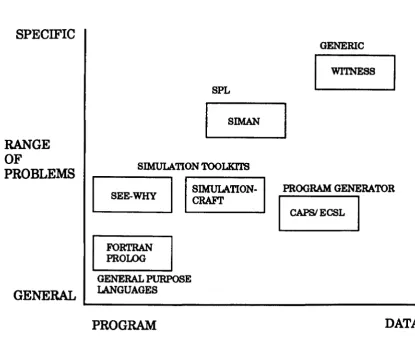
general purpose procedural or declarative programming language (FORTRAN,
PROLOG), to a general purpose procedural language simulation library
simulation program generator (CAPS! ECSL), to a generic modelling system
(WITNESS), (Figure 3.1. (after O'Keefe and Haddock [37]). The scope of these
approaches, in terms of the classes of system which they can model, ranges
from any class using a general purpose language, to a specific class or
sub-class using a generic tool. The modelling effort and development time required
for modelling a specific system decreases as the scope of applicability is
narrowed, because more of the work has already been done by the developer of
the tool used, so more of the modelling can be done through data input rather
than through writing code. In the case of a generic tool which is aimed at a
specific system or class of systems it should be possible to build up a detailed
model through data input only. Therefore, a suitable generic simulation tool
should enable the requirements for building a scheduling simulation to be met
and most simulation systems which have been developed for scheduling are
based on the generic approach. The development of an appropriate generic tool
for scheduling will be discussed in detail in Section 3.3. on generic simulation.
Control Logic
Some scheduling simulation approaches, such as that described by Bollino
[38], simply allow the user to specify which of a number of standard queuing
priority rules should be used to control production through a plant. However,
In a scheduling system a true representation of decision making based on the
global system state is desirable as described by Larsen and Alting [39]
because queueing priority rules only use local information based on the
operation for which the batches! jobs are queueing, which implies limited
decision scope. Bhattacharrya, Roy and Huang [6] say that the effects of this
are that ' .. requirements of customer demand are not specifically considered,
nor is any consideration given to potential capacity shortages'. This is
particularly true of a batch process plant in which the activities carried out in
different parts of the plant are very interdependent. For example Barnes and
RANGE OF
PROBLEMS
GENERAL
WITNESS SPL
SIMAN
SIMULATION TOOLKITS
r__---_
SEE-WHY
I
~TION·I
PROGRAM GENERATORFORTRAN
PROLOG
GENERAL PURPOSE
LANGUAGES
I
CARVECSLI
~---PROGRAM
[image:46.530.64.479.127.465.2]RANGE OF REPRESENTATION
Figure 3.1. Model Building Approaches (After O'Keefe and Haddock)