Original citation:
Coja-Oghlan, Amin, Cooper, Colin and Frieze, Alan. (2010) An efficient sparse regularity
concept. SIAM Journal on Discrete Mathematics, Vol.23 (No.4). pp. 2000-2034. ISSN
0895-4801
Permanent WRAP url:
http://wrap.warwick.ac.uk/5351
Copyright and reuse:
The Warwick Research Archive Portal (WRAP) makes this work by researchers of the
University of Warwick available open access under the following conditions. Copyright ©
and all moral rights to the version of the paper presented here belong to the individual
author(s) and/or other copyright owners. To the extent reasonable and practicable the
material made available in WRAP has been checked for eligibility before being made
available.
Copies of full items can be used for personal research or study, educational, or
not-for-profit purposes without prior permission or charge. Provided that the authors, title and
full bibliographic details are credited, a hyperlink and/or URL is given for the original
metadata page and the content is not changed in any way.
Copyright statement:
“First Published in SIAM Journal on Discrete Mathematics in Volume 23 and Number 4,
published by the Society of Industrial and Applied Mathematics (SIAM)
http://dx.doi.org/10.1137/080730160”
“Copyright © by SIAM. Unauthorized reproduction of this article is prohibited.”
A note on versions:
The version presented in WRAP is the published version or, version of record, and may
be cited as it appears here.
AN EFFICIENT SPARSE REGULARITY CONCEPT∗
AMIN COJA-OGHLAN†, COLIN COOPER‡, ANDALAN FRIEZE§
Abstract. LetAbe a 0/1 matrix of sizem×n, and letpbe the density ofA(i.e., the number of ones divided bym·n). We show thatAcan be approximated in the cut norm withinε·mnp by a sum of cut matrices (of rank 1), where the number of summands is independent of the size
m·nofA, provided that Asatisfies a certain boundedness condition. This decomposition can be computed in polynomial time. This result extends the work of Frieze and Kannan [Combinatorica, 19 (1999), pp. 175–220] tosparsematrices. As an application, we obtain efficient 1−εapproximation algorithms for “bounded” instances of MAX CSP problems.
Key words. approximation algorithms, regularity lemma, matrix decomposition, cut norm, random discrete structures
AMS subject classifications.05C85, 05C65
DOI.10.1137/080730160
1. Introduction and results. For many fundamental optimization problems there are known NP-hardness of approximation results, showing that not only is it NP-hard to compute the optimum exactly but even to approximate the optimum within a factor bounded away from 1. For instance, in the MAXk-SAT problem it is NP-hard to achieve an approximation ratio better than 1−2−k [21]. Furthermore, it is NP-hard to approximate MAX CUT within better than 16/17≈0.94118 [21, 26] (which can be tightened to≈0.87856 under a stronger hypothesis [22]).
Frieze and Kannan [17] showed that the situation is much better fordense prob-lem instances. For example, if G = (V, E) is a graph on n vertices of density p = 2n−2|E|, then its MAX CUT can be approximated within a factor of 1−ε in time poly(exp((εp)−2)·n). Hence, ifp > δ for some fixed numberδ >0, then this algorithm has a polynomial running time. Similarly, ifF is ak-SAT formula with at leastδ2knkclauses (i.e., at least a constant fraction of all possible clauses is present), then the maximum number of simultaneously satisfiable clauses can be approximated within 1−εin polynomial time for any fixedε >0.
The key ingredient in [17] is an algorithm for approximating a dense matrix A by a sum of a bounded number of “cut matrices.” Applied to the adjacency matrix of a graph, this yields the aforementioned algorithm for MAX CUT. Moreover, an extension of this matrix algorithm tok-dimensional tensors yields the approximation algorithms for dense instances of MAX CSP problems. To explain the matrix de-composition, let us consider a 0/1 matrix A of size m×n, and let 0 ≤ p ≤ 1 be thedensity ofA, i.e., the number of ones in Adivided by m·n. Acut matrix is a matrix D such that there are setsS ⊂[m], T ⊂ [n] and a numberd such that the
∗Received by the editors July 14, 2008; accepted for publication (in revised form) October 12,
2009; published electronically January 6, 2010. An extended abstract of this paper appeared in
Proceedings of the Twentieth ACM-SIAM Symposium on Discrete Algorithms, 2009, pp. 207–216. http://www.siam.org/journals/sidma/23-4/73016.html
†University of Edinburgh, School of Informatics, 10 Crichton Street, Edinburgh EH8 9AB, UK
([email protected]). This author’s research was supported by grant DFG CO 646 and was done while visiting Carnegie Mellon.
‡Department of Computer Science, King’s College, University of London, London WC2R 2LS, UK
([email protected]). This author’s research was supported by Royal Society grant 2006/R2-IJP.
§Department of Mathematical Sciences, Carnegie Mellon University, Pittsburgh, PA 15213 (alan@
random.math.cmu.edu). This author’s research was supported in part by NSF grant CCF0502793.
entryDij is equal todif (i, j)∈S×T and 0 otherwise. We denote such a matrix by D= CUT(d, S, T) and observe that cut matrices have rank one. Thecut norm of a m×nmatrixM= (Mij)i∈[m],j∈[n] is
M2= max
S⊂[m],T⊂[n]|M(S, T)|, where
M(S, T) = (s,t)∈S×T
Mst.
Frieze and Kannan proved that for any A and any ε > 0 there exist cut matrices D1, . . . ,Ds such that
A−(D1+· · ·+Ds)2< ε·mn,
wheres≤cε−2 for a constantc >0. Indeed, such a decomposition can be computed in time ε−2·poly(mn) (or even in “constant” expected time O(ε−2·polylog(1/ε)) by sampling). Hence, if p ≥ δ for some fixed δ > 0, i.e., if A is a dense matrix, then settingε =εpwe can use this algorithm to find a decomposition ofA within εA2 = ε·mnp efficiently by a sum of at most cε−2 = c(εp)−2 ≤ c(εδ)−2 cut matrices. The crucial point here is that the number of cut matrices is bounded independently of the sizem·nofA.
The goal of the present paper is to extend this result to sparse matrices, where the densitypofAis no longer bounded below by a fixed number. Thus, in asymptotic terms, we are interested in p=o(1) as m, n→ ∞. Clearly, in this case the bound c(εp)−2on the number of cut matrices in the decomposition guaranteed by [17] is no longer “constant” but grows with the size m·nof A. Of course, we cannot expect to obtain the same results as in the dense case for arbitrary sparse matrices. This is because in light of the aforementioned hardness results this would imply P = NP. Hence, our main result is that even in the sparse case a 0/1 matrix A (or, more generally, ak-dimensional tensor) can be approximated in the cut norm by a sum of cut matrices with a number of summands independent ofm,n, andp,provided that
Asatisfies a certain boundedness condition. This condition basically requires thatA does not feature relatively large, extraordinarily dense spots. In addition, we shall use these decomposition results to obtain (1−ε)-approximation algorithms for instances of MAX CSP problems that have a suitable boundedness property. As we shall see, in a sense these results mediate between the “average” and the worst-case analysis of algorithms.
Outline. In this section we state our results and discuss related work. Section 2 contains a few preliminaries, and in section 3 we present the algorithms and their analyses for decomposing matrices and graphs. Further, in section 4 we deal with k-dimensional tensors. Then, in section 5 we apply the tensor algorithm to approxi-mate MAX CSP problems. Finally, section 6 contains a few examples, which link our results to the “average case” analysis of algorithms.
1.1. Approximating 0/1 matrices. LetAbe a 0/1 matrix of sizem×nand densityp. GivenC, γ >0, we say thatAis (C, γ)-bounded if for any two setsS⊂[m] andT ⊂[n] of sizes|S| ≥γm,|T| ≥γnwe have
(1) A(S, T) =
(s,t)∈S×T
In other words, for any two sufficiently large setsS, T the numberA(S, T) of ones in the squareS×T must not exceed the number|S| · |T| ·pthat we would expect ifS, T wererandom sets by more than a factor ofC.
Theorem 1. There exist an algorithm ApxMatrix, absolute constants ζ ≥ 1, 0< ζ≤1, and a polynomialΠsuch that the following holds. Suppose that0< ε < 12 andC >1. Let
(2) κ=ζC
2
ε2 and γ=γ(ε, C) = ζε 210κC.
If A is a (C, γ)-bounded 0/1 matrix, then in time κ·Π(m·n), ApxMatrix(A, C, ε) outputs cut matrices D1, . . . ,Ds such that s ≤ κ and A−(D1+· · ·+Ds)2 ≤ εA2.
We emphasize that the upper bound κon the number of cut matrices depends only onC and εbut not on the size ofA or the densityp. Also observe that, as A is a 0/1 matrix,A2=mnpis just the “number of ones” inA.
Given the 0/1 matrixAand partitionsS of [m] andT of [n], we define a matrix AS×T as follows. Ifs∈S∈ Sandt∈T ∈ T, then the corresponding entry (AS×T)s,t equals|S|−1|T|−1A(S, T). Hence, on each squareS×Tthe matrixAS×T is constant, and the value it takes is just the average ofAover that square.
Corollary 2. There exist an algorithm PartMatrix and a polynomial Π that
satisfy the following. Suppose that ε, C > 0, let κ, γ be as in (2), and assume that A is a (C, γ)-bounded 0/1 matrix of size m×n. Then in time 2κ·Π(m·n) PartMatrix(A, C, ε) computes partitions S of [m] and T of [n] such that
A−AS×T2 ≤ 2εA2. The number of classes in each partition S, T is at most2κ.
1.2. Weak regular partitions of graphs. Let G = (V, E) be a graph on n vertices, and let 0≤p≤1 be such that|E|=n2p/2. We refer topas thedensityofG. Moreover, we assume that V = [n]. Let A =A(G) be the adjacency matrix of G. We say thatGis (C, γ)-bounded ifAhas this property. Thus, ifGis (C, γ)-bounded, then for any two setsS, T ⊂V of size at leastγn we haveeG(S, T)≤Cγ|S×T|p, whereeG(S, T) is the number ofS–T-edges inG.
We call a partition V of V a weak ε-regular partition of Gif A−AV×V2 ≤ εA2= 2ε|E|. Hence, if, for instance,S, T ⊂V are disjoint sets of vertices, then the number A(S, T) ofS–T-edges is within 2ε|E|of AV×V(S, T). As we shall see below, this definition is related to the notion of regular partitions introduced by Szemer´edi. Corollary 3. There exist an algorithmWeakPartitionand a polynomialΠthat
satisfy the following. Suppose thatC >1and0< ε < 12, letκ, γ >0be as in(2), and letG= (V, E)be a(C, γ)-bounded graph onnvertices. ThenWeakPartition(G, C, ε) computes a weak 4ε-regular partition ofG in time 22κ·Π(n). This partition has at most22κ classes.
1.3. Approximatingk-dimensional 0/1 tensors. Ak-dimensional tensor is a mapM: R1×R2×· · ·×Rk→R, whereR1, . . . , Rk are finite index sets. Moreover, extending the matrix case tokdimensions, we say thatC: R1×R2× · · · ×Rk →R is acut tensor if there exist setsSi⊆Ri fori= 1,2, . . . , kand a real numberdsuch that
C(i1, i2, . . . , ik) =
In this case we write C= CUT(d, S1, . . . , Sk). Further, we define the cut norm of a tensor as
M2= max
Si⊆Ri|M(S1, S2, . . . , Sk)|, where
M(S1, . . . , Sk) = (s1,...,sk)∈S1×···×Sk
M(s1, . . . , sk).
Let A: R1×R2× · · · ×Rk → {0,1} be a 0/1 tensor. Set k1 =k/2. Then letting R = R1×R2× · · · ×Rk1 and C = Rk1+1×Rk1+2× · · · ×Rk, we define a (2-dimensional) matrixB=B(A) :R × C → {0,1}by
(3) B((i1, i2, . . . , ik1),(ik1+1, ik1+2, . . . , ik)) =A(i1, i2, . . . , ik).
We say thatAis (C, γ)-bounded ifB(A) has this property.
Theorem 4. There exist an algorithm ApxTensor, a polynomial Π, and a
con-stant Γ > 1 such that the following is true. Suppose that C > 1 and 0 < ε < 12. Let
γ= exp(−Γ(C/ε)2).
IfA: R1×R2×· · ·×Rk→ {0,1}is a(C, γ)-bounded0/1tensor,ApxTensor(A, C, ε) outputs cut tensors
Di =CUT(di, Si1, . . . , Sik) (Si1⊂R1, . . . , Ski ⊂Rk)
for i= 1, . . . , swiths≤(ΓC/ε)2(k−1)such that
A−(D1+· · ·+Ds)2≤εA2.
Moreover, si=1d2i ≤ (Cp)2Γ2k. The running time is (expΓ(C/ε)2+ (ΓC/ε)3k)· Π(|R1× · · · ×Rk|).
IfR1, . . . ,Rk are partitions ofR1, . . . , Rk, then we define a tensor AR1×···×Rk : R1× · · · ×Rk →[0,1] as follows: ifti∈ρi∈ Ri fori= 1, . . . , k, then we set
AR1×···×Rk(t1, . . . , tk) = A(ρ1, . . . , ρk k)
i=1|ρi| =
(v1,...,vk)∈ρ1×···×ρkA(v1, . . . , vk)
k
i=1|ρi|
.
In other words, on every rectangleρ1× · · · ×ρk made up of partition classesρi∈ Ri the entry ofAR1×···×Rk is the average ofAover that rectangle.
Corollary 5. There exist an algorithm PartTensor, a polynomial Π, and a
constant Γ˜ >0 such that the following is true. Suppose that C >0 and 0 < ε < 12. Let γ= exp(−Γ(˜ C/ε)2). IfA: R1×R2× · · · ×Rk → {0,1} is a(C, γ)-bounded0/1 tensor, thenPartTensor(A, C, ε)computes partitions R1, . . . ,Rk of R1, . . . , Rk such that
A−AR1×···×Rk2< εA2.
Each of the partitionsRi consists of at mostexp((˜ΓC/ε)2(k−1))classes. The running time is bounded by
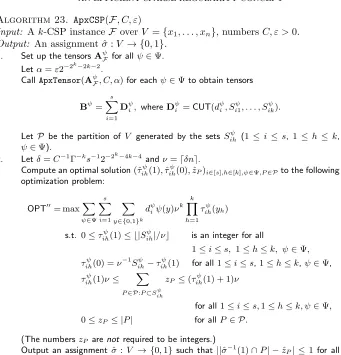
1.4. An approximation algorithm for bounded MAX CSPs. Let V =
{x1, . . . , xn}be a set ofnBoolean variables. A(binary)k-constraint overV is a map
φ:{0,1}Vφ → {0,1} that is not identically zero, whereVφ ⊂V is a set of size k. For an assignment σ∈ {0,1}V we let φ(σ) =φ((σ(x))x∈Vφ). Further, a k-CSP instance overV is a setF ofk-constraints over V, and we define
OPT(F) = max
σ∈{0,1}V
φ∈F
φ(σ).
We let Ψ = Ψk be the set of all 22k −1 nonzero maps {0,1}k → {0,1}. Let ψ∈Ψ, and letφ:{0,1}Vφ → {0,1}be ak-constraint, whereVφ={xi1, . . . , xik}with 1 ≤i1 <· · · < ik ≤n. Then we say that φ is of type ψ if for anyσ :Vφ → {0,1} we have ψ(σ(xi1), . . . , σ(xik)) = φ(σ). With this notion we can represent a k-CSP instance F by a family (AψF)ψ∈Ψ of 22k −1 k-tensors as follows. For any tuple (i1, . . . , ik)∈[n]k we let
AψF(i1, . . . , ik) =
1 if there isφ∈ F of typeψ withVφ ={xi1, . . . , xik},
0 otherwise.
Further, we say thatFis (C, γ)-boundedif all tensorsAψF are (C, γ)-bounded (ψ∈Ψ). Theorem 6. There exist an algorithmApxCSP, a constant Γ>0, and a
polyno-mialΠ such that for anyk, C >1,0< ε < 21 there is a numbern0=n0(C, ε, k)such that the following is true. Let
γ= exp(−Γ22k+2k+2(C/ε)2).
If F is a (C, γ)-bounded k-CSP instance over V = {x1, . . . , xn} for some n ≥ n0, thenApxCSP(F, C, ε)outputs an assignmentσ:V → {0,1} such that
φ∈F
φ(σ)≥(1−ε)OPT(F).
The running time is at mostΠ[exp(k2k22k(ΓC/ε)2kln(C/ε))nk].
1.5. Related work.
1.5.1. Approximating dense matrices and tensors. As mentioned earlier, Frieze and Kannan [17] dealt withdense matrices and tensors. More precisely, they showed that given a tensor A : R1 × · · · ×Rk → [0,1] and ε > 0 one can com-pute cut tensorsD1, . . . ,Ds such thatA−si=1Di2 < ε|R1× · · · ×Rk| in time O(ε2(1−k)polylog(1/ε)) withs≤O(ε)2(1−k) asε→0. Let us point out two things.
2. The error termε|R1× · · · ×Rk| does not account for the density of A. For example, suppose that Ais the adjacency matrix of a graph G= (V, E) on n vertices with densityp = 2n−2|E|. Then the algorithm from [17] can be used to compute a cut norm approximation ofAto withinεn2for anyε >0. Hence, we can use this approximation to solve graph partitioning problems such as MAX CUT within an additive error ofεn2 (edges). This is why this approach is limited todense problem instances: if the total number of edges is of lower order thann2, then an approximation within an additiveεn2for a fixedε >0 is of little value. For similar reasons the techniques of [17] apply only to dense problem instances ofk-ary MAX CSP problems, i.e., instances with at least Ω(nk) constraints, where nis the number of variables.
In spite of these differences, some of the algorithms that we present are very similar to those from [17]. Thus, our main contribution is toanalyzethese algorithms on sparse matrices/graphs/tensors. For instance, the matrix approximation algorithm for Theorem 1 is almost identical to the procedure described in [17, section 4.1]. The only difference is that [17] employs as a subroutine a combinatorial procedure for approximating the cut norm of a givenm×nmatrix within anadditive error ofεmn, whereas here we need to approximate the cut norm within a constantmultiplicative factor. To this end, we rely on an algorithm of Alon and Naor [4] (which is based on semidefinite programming). Nonetheless, as we shall see in section 3 in the sparse case the analysis requires new ideas. For instance, additional arguments are necessary in order to bound the number of cut matrices that are needed to approximate the input matrixAwithin the desired εA2 in the cut norm.
1.5.2. Szemer´edi’s regularity lemma. Corollary 3 and the concept of weak regular partitions are related to Szemer´edi’s well-known regularity lemma [25]. While the original version [25] deals only with “dense” graphs, Kohayakawa [23] and R¨odl [24] independently extended the regularity lemma to the sparse case; for a comprehensive survey on the subject see Gerke and Steger [18]. The papers [23, 24] establish that for anyε >0 and anyC >0 there is a numberγsuch that any (C, γ)-bounded graph has a regular partition (V1, . . . , Vs) in the following sense.
• We have|Vi−n/s| ≤1 for alli.
• All but εs2 pairs (Vi, Vj) satisfy the following. For any two sets S ⊂ Vi, T ⊂Vj of size|S| ≥ε|Vi|,|T| ≥ε|Vj|we have
(4) eG(S, T)
|S×T| −
eG(Vi, Vj) |Vi×Vj|
≤εp, wherepis the density ofG.
The numbersof classes is bounded by a functionT(C/ε); i.e., it isindependent ofn. This is the key fact that makes Szemer´edi’s lemma so useful in extremal combina-torics. However, from an algorithmic perspective the bound T(C/ε) is somewhat disappointing, because it is a tower function of height (C/ε)5:
2 .. . 2 2
⎫ ⎪ ⎪ ⎪ ⎬ ⎪ ⎪ ⎪ ⎭
(C/ε)5.
While [23, 24, 25] focus on proving that a regular partition exists, [1, 2, 9] deal with algorithmic versions of the regularity lemma. In the dense case (i.e.,|E|= Ω(n2)) there is a purely combinatorial algorithm [2] with running time T(ε−5)·poly(n). In addition, the paper [9] contributes an algorithm for computing a regular partition of a densek-partite graph, provided thatk+ ln(ε)<0. The number of classes is bounded
by 4(k2)ε−5.
An algorithm for computing a regular partition of a sparse graph was presented in [1]. The running time isT((C/ε)9)·poly(n) for (C, γ)-bounded graphs, and the algorithm is based on the semidefinite programming algorithm for approximating the cut norm from [4]. For instance, this yields an algorithm for approximating the MAX CUT on (C, γ)-bounded graphs within 1−εin timeT((C/ε)9)·poly(n).
Corollary 3 relates to [1] as follows. While the “strong” regularity condition (4) takes into account the “microscopic” edge distribution within (almost) each pair (Vi, Vj), the “weak” regularity concept from Corollary 3 just provides a “macroscopic” approximation w.r.t. the cut norm. This approximation is sufficiently strong for algo-rithmic applications such as MAX CUT (but it would not suffice for applications in extremal combinatorics that rely on the “counting lemma”). In effect, the algorithm is more efficient. Indeed, instead of scaling as a tower functionT((C/ε)9), the running time of the algorithmWeakPartitionfrom Corollary 3 is bounded by exp(O(C/ε)2) in terms ofC, ε. Although this may still seem impractical, this is just a worst-case upper bound, and it is quite conceivable that it is practically much easier to find a good approximation in the cut norm than a good regular partition. Besides, as The-orem 1 shows, one can approximate a (C, γ)-bounded adjacency matrix by a sum of O(C/ε)2 cut matrices (if the actual partition of the vertex set is not needed), thus avoiding the exponential dependence onC/ε. Similarly, the parameterγrequired in the boundedness condition is justγ= exp(−O(C/ε)2), rather thanγ= 1/T((C/ε)9) as in [1]. Consequently, Corollary 3 applies to a larger class of graphs.
A further novel aspect here is that we extend our results tok-dimensional tensors (ork-uniform hypergraphs). This point is not addressed in [1].
2. Preliminaries and notation. IfM= (Mij)i∈[m],j∈[n]is a realm×nmatrix, then we let
MF =
m
i=1
n
j=1 M2ij
signify the Frobenius norm ofM. Moreover, we set
M∞= max
(i,j)∈[m]×[n]|Mij|.
Suppose that X is a set and thatP1,P2 are partitions ofX. We say thatP1 is coarser thanP2 if each class ofP2 is contained in a class ofP1. IfS is an arbitrary set of subsets ofX, then there is a unique partitionP ofX such that
1. each set inS is a union of classes ofP,
2. P is coarser than any other partition that satisfies 1.
We call P the partitiongenerated byS. Clearly, P has at most 2|S| classes. (Intu-itively,P consists of the classes of the Venn diagram of the sets inS.)
Theorem 7. There exist a polynomial time algorithm and a number α0 > 0
such that the following is true. Given anm×nmatrixM, the algorithm outputs sets S⊂[m] andT ⊂[n]such that |M(S, T)| ≥α0M2.
Alon and Naor present a randomized algorithm withα0>0.56 and a deterministic one withα0≥0.03.
The algorithm ApxTensorfor Theorem 4 employs an algorithm FKTensorfrom Frieze and Kannan [17] as a subroutine.
Theorem 8. There are a polynomialΠF K, an algorithmFKTensor, and a number ΓF K >0such that the following is true. Suppose that M:R1× · · · ×Rk →[0,1]is a tensor, and let 0 < δ < 1. Then FKTensor(M, δ) outputs cut tensors D1, . . . ,Ds
such that M−D1− · · · −Ds2 ≤ δki=1|Ri| and s ≤ (ΓF K/δ)2(k−1). More-over, si=1Di2∞ ≤ ΓF Kk , and the running time is at most (ΓF K/δ)3kΠF K(|R1×
· · · ×Rk|).
Actually Frieze and Kannan have a slightly stronger statement [17, section 6] (better running time), but the above is sufficient for our purposes and easier to state.
The following simple observation will prove useful.
Lemma 9. Let A : R1 × · · · ×Rk → R be a tensor, and let R1, . . . ,Rk be
partitions ofR1, . . . , Rk. Suppose that Ais constant on each rectangle S1× · · · ×Sk withS1∈ R1, . . . , Sk ∈ Rk, i.e.,
(5) A(x) =A(x) for anyx, x∈S1× · · · ×Sk.
Then there exist sets X1⊂R1, . . . , Xk⊂Rk such that |A(X1, . . . , Xk)|=A2 and each Xj is a union of classes ofRj (j= 1, . . . , k).
Proof. LetX1 ⊂R1, . . . , Xk ⊂Rk be sets such that |A(X1, . . . , Xk)|=A2. ReplacingAby−Aif necessary, we may assume thatA(X1, . . . , Xk)≥0. LetS∈ R1 be a set such thatX1∩S =∅. The assumption (5) implies thatA({x}, X2, . . . , Xk) = A({x}, X2, . . . , Xk) for all x, x ∈S. Hence, if there werex∈S such that
A({x}, X2, . . . , Xk)<0,
then
A(X1 \S, X2, . . . , Xk) =A(X1, . . . , Xk)−
x∈X
1∩S
A({x}, X2, . . . , Xk)
>A(X1, . . . , Xk) =A2,
which is a contradiction. Thus,A({x}, X2, . . . , Xk)≥0 for allx∈S. Consequently,
A(X1 ∪S, X2, . . . , Xk) =A(X1, . . . , Xk) +
x∈S\X
1
A({x}, X2, . . . , Xk)
≥A(X1, . . . , Xk) =A2.
Since this holds for all S ∈ R1 such that X∩S = ∅, we see that the set X1 =
S∈Rj:X
1∩S=∅S satisfies
A(X1, X2, . . . , Xk)≥A(X1, . . . , Xk) =A2.
Clearly, this entails that actually A(X1, X2, . . . , Xk) = A2. Proceeding induc-tively, we conclude that the sets
Xj=
S∈Rj:Xj∩S=∅
Algorithm 10. ApxMatrix(A, C, ε)
Input: A 0/1 matrixAof sizem×n, numbersC, ε >0. Output: A sequence of cut matrices.
1. SetA0=A.
2. Forj= 0,1,2, . . . , κdo
3. Compute setsSj+1, Tj+1of sizes|Sj+1| ≥m/2,|Tj+1| ≥n/2such that |Aj(Sj+1, Tj+1)| ≥α0Aj2/4.
4. If|Aj(Sj+1, Tj+1)|< α0εmnp/4andj≥1, then
output the cut matricesD1, . . . ,Djand halt.
5. else
compute
dj+1= A|Sj(Sj+1, Tj+1)
j+1||Tj+1| ,
setDj+1=CUT(dj+1, Sj+1, Tj+1), and letAj+1=Aj−Dj+1.
6. Output “failure.”
Fig. 1.Pseudocode forApxMatrix.
satisfy A(X1, X2, . . . , Xk) = A2. This yields the assertion, as X1, . . . , Xk are unions of classes ofR1, . . . ,Rk.
3. Approximating and partitioning 0/1 matrices and graphs. This sec-tion contains the proofs of Theorem 1 and Corollaries 2 and 3. In secsec-tion 3.1 we discuss the algorithm ApxMatrix in Figure 1 and outline the proof of Theorem 1. Section 3.2 contains the proof of a proposition that is needed to establish Theorem 1. Furthermore, section 3.3 deals with the proof of Corollary 2, and section 3.4 features the proof of Corollary 3.
3.1. The algorithm ApxMatrix for Theorem 1. LetC >1 and 0 < ε < 12. Moreover, letα0 be the constant from Theorem 7, and set
(6) κ=513C
2
ε2α20 , γ
= εα0
210(κ+1)C.
Throughout this section we assume thatAis a 0/1 matrix of sizem×n.
In order to approximateA by a sum of cut matrices,ApxMatrixproceeds in up toκ+ 1 roundsj= 0,1, . . . , κ, each time generating a new cut matrixDj+1. Hence, in iteration j Aj = A−ji=1Dj is the remaining “error term” that results from approximating A by ji=1Dj. If j = 0, then of course A0 = A is just the input matrix. Thus, the goal is to eventually achieve an approximationD1+· · ·+Dj such that the “error term” Aj has a sufficiently small cut norm (namely, cut norm less thanεA2).
To this end, step 3 computes sets Sj+1, Tj+1 of rows and columns such that
|Aj(Sj+1, Tj+1)| is a good approximation of the cut norm of Aj. More precisely, we have|Aj(Sj+1, Tj+1)| ≥α0Aj2/4, where α0 is the constant from Theorem 7. Hence, if|Aj(Sj+1, Tj+1)|< α0εmnp/4, then we are done because
(7) A−(D1+· · ·+Dj)2=Aj2≤εmnp=εA2.
By contrast, if |Aj(Sj+1, Tj+1)| ≥ α0εmnp/4, then Sj+1, Tj+1 witness a set of rows/columns on whichD1+· · ·+Dj does not yet provide a good enough approxi-mation. Therefore, step 5 adds a further “patch”Dj+1, which is a cut matrix whose value on Sj+1 ×Tj+1 is just the average dj+1 of Aj over that square. Note that dj+1 may be negative. This construction ensures thatAj+1(Sj+1, Tj+1) = 0 and thus remedies the discrepancy witnessed bySj+1, Tj+1.
If the algorithm outputs cut matricesD1, . . . ,Dj, then (7) guarantees thatD1+
· · ·+Dj approximatesA sufficiently well. Hence, in order to establish Theorem 1, we need to prove the following:
(a) Step 3 of ApxMatrixcan be implemented by a polynomial time algorithm. (b) IfA is (C, γ)-bounded, then the halting condition in step 4 will be satisfied
for some 1≤j≤κ.
The following proposition takes care of (a).
Proposition 11. In step3,Sj+1, Tj+1 can be computed in timepoly(mn).
Proof. We apply the algorithm from Theorem 7 to the m×n matrix Aj. The algorithm has running time poly(nm) and outputs sets Sj+1, Tj+1 such that
|Aj(Sj+1, Tj+1)| ≥ α0Aj2. The problem is that Theorem 7 does not guarantee a lower bound on the sizes of these sets, while it is required that|Sj+1| ≥m/2 and
|Tj+1| ≥n/2. To resolve this issue we proceed as follows. Case1: |Sj+1| ≥m/2. We just letSj+1=Sj+1. Case2: |Sj+1|< m/2. Since
Aj([m], Tj+1) =Aj(Sj+1, Tj+1) +Aj([m]\Sj+1, Tj+1),
we have
max{|Aj([m], Tj+1)|,|Aj([m]\Sj+1, Tj+1)|} ≥ |Aj(Sj+1, Tj+1)|/2
≥α0Aj2/2. (8)
LetSj+1= [m] if|Aj([m], Tj+1)| ≥ |Aj([m]\Sj+1, Tj+1)|, and setSj+1= [m]\Sj+1 otherwise. Then (8) ensures that|Aj(Sj+1, Tj+1)| ≥α0Aj2/2 and the assumption
|Sj+1|< m/2 implies|Sj+1| ≥m/2.
In order to obtainTj+1 we proceed similarly. Case1: |Tj+1| ≥n/2. LetTj+1=Tj+1. Case2: |Tj+1|< n/2. We have
max{|Aj(Sj+1,[n])|,|Aj(Sj+1,[n]\Tj+1)|} ≥ |Aj(Sj+1, Tj+1)|/2
≥α0Aj2/4.
Setting either Tj+1 = [n] or Tj+1 = [n]\Tj+1 thus yields a set of size at least n/2 such that|Aj(Sj+1, Tj+1)| ≥α0Aj2/4.
The overall running time is clearly polynomial inm·n.
The following proposition establishes (b) above. We defer its proof to section 3.2. Proposition 12. If A is (C, γ)-bounded, then there is 1 ≤ j ≤ κ such that
|Aj(Sj+1, Tj+1)|< α0εmnp/4.
Proof of Theorem 1. Proposition 11 ensures that each iteration of steps 3–5 runs in time Π(mn) for some polynomial Π. Hence, the total running time of ApxMatrixis bounded byκ·Π(mn), as claimed. Furthermore, Proposition 12 ensures that on a (C, γ)-bounded input A ApxMatrixwill output a sequence D1, . . . ,Dj of cut matrices for some 1 ≤ j ≤ κ. Finally, (7) entails that this sequence satisfy
3.2. Proof of Proposition 12. Throughout this section we assume thatAis a (C, γ)-boundedm×nmatrix. We let κ, γbe as in (6) and setγ = 2κγ. The proof is by contradiction. That is, we assume that
(9) |Aj(Sj+1, Tj+1)| ≥α0εmnp/4 for all 0≤j ≤κ.
We are going to construct families (Aj)1≤j≤κ and (Dj)1≤j≤κ of matrices such that the matrices Dj, Aj are “close” to Dj, Aj in the cut norm and such that we can use the boundedness condition to derive upper and lower bounds on the Frobenius norms ofAj for 1 ≤j ≤κ. These bounds on the Frobenius norm will then yield a contradiction to (9).
The matrices Dj, Aj are defined as follows. Due to assumption (9), step 4 of ApxMatrixdoes not terminate the algorithm for anyj≤κ. Hence, steps 2–5 construct setsS1, . . . , Sκof rows andT1, . . . , Tκof columns. LetSbe the partition of the set [m] of row indices generated byS1, . . . , Sκ. Similarly, letT be the partition of the column set [n] generated by T1, . . . , Tκ. Then both S and T have at most 2κ classes. We define
R0=
S∈S:|S|<γm
S, C0=
T∈T:|T|<γn
T
to be the sets that comprise the “small” classes of the partitionsS,T.
Fact 13. We have|R0| ≤γm and|C0| ≤γn.
Proof. The definition ofR0 ensures that|R0| ≤ |S| ·γm. SinceS has at most 2κ classes, we obtain|R0| ≤2κγm=γm. Similarly, |C0| ≤2κγn=γn.
LetA0=A be the matrix obtained from Aby replacing all rows inR0 and all columns in C0 by 0. In addition, define inductively Sj =Sj\R0 and Tj =Tj\C0 and
dj+1 =
Aj(Sj+1, Tj+1)
|Sj+1||Tj+1| , D
j+1 = CUT(Sj+1, Tj+1, dj+1), Aj+1=Aj−Dj+1.
LetSbe the partition of [m]\R0generated byS1, . . . , Sκ, and letTbe the partition of [n]\C0 generated byT1, . . . , Tκ.
Fact 14. All classes ofS (resp., T) have size at least γm(resp., γn).
Proof. LetS be the partition of [m]\R0that consists of all classes S∈ S such that S ⊂[m]\R0. Then each class of S has size at leastγm, becauseR0 contains all classes of S that are smaller than γm. Moreover, each of the sets S1, . . . , Sκ is a union of classes ofS. Hence,Sis coarser thanS, and thus each class ofScontains a class ofS. Therefore, each class of S has size at least γm. The same argument applies toT.
The key step is to derive the following bound on the Frobenius norm ofAj.
Lemma 15. For all 1≤j≤κwe haveAj2
F ≤ A2F(1−j·α20ε2p/256). The proof of Lemma 15 requires some preparations: we need to bound the cut normsA−A2 (Lemma 16), Dj−Dj2 (Corollary 18), and Aj−Aj2 (Corollary 19).
Lemma 16. We have A−A2≤A(R0,[n]) +A([m], C0)≤2Cγmnp.
the rowsR0 and the columnsC0 by 0. Therefore,A−A is a 0/1 matrix, whose cut norm equals the number of ones it contains. Hence,
A−A2= (A−A)([m],[n]) =A(R0,[n]) +A([m], C0)−A(R0, C0)
≤A(R0,[n]) +A([m], C0).
To show thatA(R0,[n])≤Cγmnpwe consider two cases. Recall that we are assum-ing thatAis (C, γ)-bounded.
Case1: |R0| ≥γm. Because the boundedness condition implies
A(R0,[n])≤C|R0|np,
Fact 13 entailsA(R0,[n])≤Cγmnp.
Case 2: |R0|< γm. Let R0⊂R0 ⊂[m] be a superset ofR0 of sizeγm. Since Ais a 0/1 matrix, we haveA(R0,[n])≤A(R0,[n]). Moreover, as|R0| ≥γm, we can apply the boundedness condition to getA(R0,[n])≤C|R0|np≤Cγmnp, as desired.
The same argument yieldsA([m], C0)≤Cγmnpand thus the assertion. To show that the matricesDj,Dj are close in the cut norm, we need a bound on the coefficientsdj from step 5 of ApxMatrix.
Lemma 17. |dj| ≤2jCp for all1≤j≤κ.
Proof. The proof is by induction onj. Since the matrixA=A0is (C, γ)-bounded and|S0| ≥ m2 and|T0| ≥ n2 (cf. step 3), we haveA0(S1, T1)≤C|S0||T0|p. Hence,
d1= A0(S1, T1)
|S1||T1| ≤Cp.
Furthermore, assuming that|di| ≤2iCpfor alli≤j, we obtain
|Aj(Sj+1, Tj+1)|=
A0(Sj+1, Tj+1)−
j
i=1
Di(Sj+1, Tj+1)
=
A0(Sj+1, Tj+1)−
j
i=1
di|Sj+1∩Si| |Tj+1∩Ti|
≤ |A0(Sj+1, Tj+1)|+|Sj+1||Tj+1|
j
i=1
|di| [triangle inequality]
≤ |A0(Sj+1, Tj+1)|+|Sj+1||Tj+1|
j
i=1
2iCp [by induction]
≤ |A0(Sj+1, Tj+1)|+ (2j+1−1)|Sj+1||Tj+1|Cp. (10)
As A0 is (C, γ)-bounded and |Sj+1| ≥ m2 and |Tj+1| ≥ n2 by the construction in step 3, we have the bound |A0(Sj+1, Tj+1)| ≤ Cp|Sj+1||Tj+1|. Thus, (10) yields
|dj+1|=|Aj(Sj+1, Tj+1)|/(|Sj+1||Tj+1|)≤2j+1Cp. Corollary 18.
1. For all1≤j≤κwe haveDj−Dj2≤28jCγmnp.
Proof. We prove the first assertion by induction onj. The definitions ofdj and dj imply that
d
j−dj=
Aj−1(Sj, Tj)
|Sj||Tj| −
Aj−1(Sj, Tj)
|Sj||Tj|
= |Sj||Tj|A
j−1(Sj, Tj)− |Sj||Tj|Aj−1(Sj, Tj) |Sj||Sj||Tj||Tj|
≤ Aj−1(Sj, T|j)−Aj−1(Sj, Tj)
Sj||Tj| +
(|Sj||Tj| − |Sj||Tj|)Aj−1(Sj, Tj)
|Sj||Sj||Tj||Tj|
+A
j−1(Sj, Tj)−Aj−1(Sj, Tj)
|Sj||Tj| .
(11)
To bound the denominators, remember from step 3 that |Sj| ≥ m2 and |Tj| ≥ n2. Furthermore, asSj =Sj\R0 and|R0| ≤γm < m/4 by Fact 13, we have |Sj| ≥ m4. Similarly,|Tj| ≥n4. Hence, (11) yields
d
j−dj≤16(mn)−1(Aj−1(Sj, Tj)−Aj−1(Sj, Tj))
+ 64(mn)−2|Aj−1(Sj, Tj)|(|R0||C0|+|R0||Tj|+|Sj||C0|) + 16(mn)−1Aj−1(Sj, Tj)−Aj−1(Sj, Tj).
(12)
To start the induction, we evaluate the term on the right-hand side (r.h.s.) of (12) forj= 1. Since S1 =S1\R0andT1 =T1\C0, and asA0 is obtained fromA =A by replacing the rowsR0and the columnsC0by 0, we haveA0(Sj, Tj) =A0(Sj, Tj). Hence, the third term on the r.h.s. of (12) vanishes. Moreover, asA0is a 0/1 matrix, we have
A0(S1, T1)−A0(S1, T1) =A0(S1∩R0, T1) +A0(S1, T1∩C0)
−A0(S1∩R0, T1∩C0)
≤A([m], C0) +A(R0,[n])≤2Cγmnp [by Lemma 16].
Hence,
(13) 16(mn)−1(Aj−1(Sj, Tj)−Aj−1(Sj, Tj))≤32γCp.
Further,A0(S1, T1)≤A0([m],[n]) =mnp. As|R0| ≤γmand|C0| ≤γnby Fact 13, we get
(14) 64(mn)−2|Aj−1(Sj, Tj)|(|R0||C0|+|R0||Tj|+|Sj||C0|)≤64γ(2+γ)p≤192γp.
Plugging (13) and (14) into (12), we get |d1−d1| ≤ Cγp(32 + 192) = 224Cγp. Consequently,
D1−D12≤ |d1−d1|mn≤28Cγmnp,
as claimed.
Now let 2≤j≤κ, and assume that
For any two setsS⊂[m],T ⊂[n] we have
|Aj−1(S, T)|=
A(S, T) +
j−1
i=1
Di(S, T)
≤A(S, T) +
j−1
i=1
|Di(S, T)| [triangle inequality]
≤A(S, T) +
j−1
i=1
|di||S||T|
≤A(S, T) +
j−1
i=1
2iCp· |S||T| [by Lemma 17]
≤A(S, T) + (2j−1)Cp|S||T|. (16)
Therefore,
Aj−1(Sj, Tj)−Aj−1(Sj, Tj)
=|Aj−1(Sj, Tj∩C0) +Aj−1(Sj∩R0, Tj)−Aj−1(Sj∩R0, Tj∩C0)|
≤|Aj−1(Sj, Tj∩C0)|+|Aj−1(Sj∩R0, Tj)|+|Aj−1(Sj∩R0, Tj∩C0)|
≤A(Sj, Tj∩C0) +A(Sj∩R0, Tj) +A(Sj∩R0, Tj∩C0)
+ (2j−1)Cp(|Sj||Tj∩C0|+|Sj∩R0||Tj|+|Sj∩R0||Tj∩C0|)
≤A(R0,[n]) +A([m], C0) + (2j−1)Cp(|R0|n+m|C0|). (17)
SinceA(R0,[n]) +A([m], C0)≤2Cγmnpby Lemma 16 and|R0| ≤γm,|C0| ≤γn by Fact 13, (17) yields
Aj−1(Sj, Tj)−Aj−1(Sj, Tj)≤2j+1γCmnp. (18)
Moreover, asAis a 0/1 matrix, (16) yields
|Aj−1(Sj, Tj)| ≤A(Sj, Tj) + (2j−1)Cp|Sj||Tj|
≤A([m],[n]) + (2j−1)Cmnp≤2jCmnp. (19)
Furthermore,
Aj−1(Sj, Tj)−Aj−1(Sj, Tj)=
j−1
i=1
Di(Sj, Tj)−Di(Sj, Tj)
≤ j−1
i=1
Di(Sj, Tj)−Di(Sj, Tj)
≤ j−1
i=1
Di−Di2
≤Cγmnp
j−1
i=1
28j [by (15)]