University of Warwick institutional repository: http://go.warwick.ac.uk/wrap
This paper is made available online in accordance with
publisher policies. Please scroll down to view the document
itself. Please refer to the repository record for this item and our
policy information available from the repository home page for
further information.
To see the final version of this paper please visit the publisher’s website
.
Access to the published version may require a subscription.
Author(s): MA Juarez and MFJ Steel
Article Title: Non-Gaussian Dynamic Bayesian Modelling for Panel
Data
Year of publication: 2009
Link to published article: http://dx.doi.org/10.1002/jae.1113
Publisher statement: This is the pre-peer reviewed
version of the following article: Juarez, M.A. and Steel, M. F. J. (2009).
Non-Gaussian Dynamic Bayesian Modelling for Panel Data. Journal of
Applied Econometrics, Vol. 25 (7), pp. 1128–1154which has been
published in final form at
Non-Gaussian Dynamic Bayesian Modelling for
Panel Data
Miguel A. Juárez and Mark F. J. Steel
∗University of Warwick
Abstract
A first order autoregressive non-Gaussian model for analysing panel data is proposed.
The main feature is that the model is able to accommodate fat tails and also skewness,
thus allowing for outliers and asymmetries. The modelling approach is to gain
suffi-cient flexibility, without sacrificing interpretability and computational ease. The model
incorporates individual effects and we pay specific attention to the elicitation of the prior.
As the prior structure chosen is not proper, we derive conditions for the existence of
the posterior. By considering a model with individual dynamic parameters we are also
able to formally test whether the dynamic behaviour is common to all units in the panel.
The methodology is illustrated with two applications involving earnings data and one on
growth of countries.
JEL Classification:C11; C23.
Keywords: autoregressive modelling; growth convergence; individual effects; labour earnings; prior elicitation; posterior existence; skewed distributions.
1
Introduction
Autoregressive models are used extensively in the analysis of panel or longitudinal data (Arellano, 2003; Baltagi, 2001; Hsiao and Pesaran, 2004; Liu and Tiao, 1980; Mátyás and Sevestre, 1995; Sáfadi and Morettin, 2003). In this paper we will assume that the data available y = {yi t} form a (possibly unbalanced) panel of i = 1, . . . ,m individuals for each of which we have Ti consecutive observations, and focus on the first order autoregressive model:
yi t= βi(1−α)+αyi t−1+λ−
1
2εi t, (1)
∗Corresponding author: Mark Steel, University of Warwick, Department of Statistics, CV4 7AL, Coventry,
2 2. The models
where the errors{εi t}are independent and identically distributed (iid) random quantities cen-tred at zero with unit precision, and α is the parameter governing the dynamic behaviour of the panel. The intercepts β = {β1, . . . , βm} are often called individual effects. It is also assumed that the process is stationary, i.e.|α|< 1.
The common approach is to assume that the error term in (1) is standard Gaussian, εi t ∼ N(εi t | 0,1). From a Bayesian perspective, which will be pursued in this paper, prior distributions must be specified for the model parameters,{α,β, λ}, and any parameters index-ing the error distribution. Then, inference is carried out usindex-ing numerical techniques, usually Markov chain Monte Carlo (MCMC). See e.g. Chib and Greenberg (1994); Nandram and Petruccelli (1997); Wang and Ghosh (2002). To account for tail behaviour heavier than Nor-mal, a useful approach is to specify a Student-tνdistribution for the errors, withνdegrees of
freedom (often fixed at a small value) and to incorporate this into the sampler through a scale mixture of Normals representation of the Student (augmenting with the mixing variables).
In order to achieve more flexibility, Hirano (2002) proposes a semiparametric approach, with a nonparametric distribution onεitusing a Dirichlet process prior. However, such a fully nonparametric approach sacrifices interpretability and computational ease for the sake of flexibility. Here we propose a flexible, yet fully parametric, framework, which allows us to fully maintain control of the properties of the error distribution and facilitates computation, interpretation, communication and testing.
Section 2 describes the models and the prior elicitation we propose, and provides con-ditions for posterior propriety. These models are used in Section 3 in the context of three applications: two involving earnings data (regional averages and individual earnings) and one on GDP growth of countries. A final section concludes.
2
The models
The Student-tνmodel described briefly above has been used successfully in a number of
ap-plications. However, asymmetries are often found in real data which this formulation cannot account for. Also, it seems sensible to let the data determine the tail behaviour, i.e. not to fix νin advance but estimate it along with the rest of the parameters.
2. The models 3
Fernández and Steel (1998) introduced an alternative way of skewing univariate distribu-tions, namely by scaling a symmetric distribution (around the origin) by reciprocal weights. We will use these families of distributions in the sequel for a number of reasons: their param-eters separately control for location, scale, skewness and tail behaviour, with the skewness parameter being a simple transformation of an interpretable skewness measure, they are easy to use, and they allow for any amount of skewness at either side of the mode.
Formally, Fernández and Steel (1998) consider a unimodal probability density function f, symmetric around zero, such that f (s)= f (|s|)and define the skew version of f, indexed by γ ∈R+, as
S f (s | γ)= 2
γ+γ−1
f (sγ) I(−∞,0](s)+ f (sγ−1) I(0,∞)(s)
. (2)
This skew version obviously does not have zero mean (forγ ,1), but still has a unique mode at zero. Further, γ controls the amount of skewness (in particular, the relative amount of probability mass to the right of the mode) given that
ϕ=γ2 = P[s>0 | γ]
P[s<0 | γ] .
Clearly,S f (s | γ)=S f (−s | 1/γ), so thatγ >1and1/γintroduce the same amount of right and left skewness, respectively. By contrasting (2) with the original symmetric distribution (the special case whenγ= 1), we can test for symmetry.
In particular, we will focus on the skew versions of the Normal and Student-tν(ort)
distri-butions, leading to
SN(ε| γ)= 2
γ+γ−1
r
1
2π exp
−1
2ε
2γ2I
(−∞,0](ε)+γ−21(0,∞)(ε)
, (3)
and
Skt(ε| γ, ν)= 2
γ+γ−1
Γ[(ν+1)/2] Γ[ν/2]
r
1
ν π
1+ 1
νε 2γ2I
(−∞,0](ε)+γ−21(0,∞)(ε)
−ν+1 2
. (4)
Thus, we will use (1) withεi t distributed according to (3) or (4), for uniti= 1, . . . ,m, and with T1, . . . ,Tmconsecutive measurements in time. This parameterisation allows for a clear interpretation of α as the parameter governing the dynamics of the panel, λas driving the precision in the measurements andβias an individual location (level) or “individual effect”. In addition, γwill control the skewness and, in the case of (4),νdetermines the tail behaviour. Since the error distributions have a mode at zero, individual effects are interpreted as the corresponding modes. Further, these are assumed to be related according to
4 2.1. The prior
which is a commonly used random effects specification, found e.g. in Liu and Tiao (1980), Nandram and Petruccelli (1997) and Gelman (2006), where βis a common mean andτ the precision. Within a Bayesian framework, (5) is merely a hierarchical specification of the prior on theβi’s. Also, we assume that the initial observed value for individualiisyi 0, on which we condition throughout, and that the process started a long time ago.
2.1
The prior
For the full skew-tmodel we will specify a prior of the product form
π(α, β, τ, λ, γ, ν)=π(α)π(β)π(τ)π(λ)π(γ)π(ν). (6)
Prior for(β, λ):
As we do not want to include strong prior beliefs, we will use the standard “diffuse” prior for the individual effects’ meanβand for the observational precision,λ
π(β)π(λ)∝λ−1 . (7)
Prior forτ:
It is well known that a flat prior on the log of the precision in (5), i.e.π(τ)∝τ−1, will yield an improper posterior (Hill, 1965; Sun et al., 2001). Gelman (2006) analyses this problem in the context of hierarchical Gaussian models and proposes alternative distributions. Fernández et al. (1997) give conditions under which the posterior is proper in the context of panel data
with unobserved heterogeneity in the location.
Here, we propose to elicit a proper prior,π(τ), centred at a valueτ0. Specifically, we will use a Gamma distribution with mode at τ0 (for aτ > 1) and use the shape parameter aτ to
control its spread, i.e.τ∼Ga(aτ,(aτ−1)/τ0)or
π(τ | aτ, τ0)=
h
(aτ−1)/τ0
iaτ
Γ[aτ]
τaτ−1 exp
−(aτ−1)
τ0 τ
. (8)
2.1. The prior 5
(Spiegelhalter et al., 2004) and to approximate the noninformative prior mentioned above. This specification allocates a lot of prior mass to low values of the precision. Gelman (2006) argues that the resulting posterior can be quite sensitive to the particular choice of (small)aτ
if the data allow mass forτclose to zero.
Therefore, we takeaτ =2which avoids a lot of prior mass close to zero and we calibrate
the prior to the scaling of the data by choosing the mode τ0 equal to c/s2β, where s2β is the (between-group) sample variance of the group means and c > 1 to account for the influence of the within-group variation. We take c = 2 in our examples, which works well. This dependence of the prior on a (fairly minor) aspect of the data is inevitable, if we wish to avoid inadvertently informative priors and make sure that the prior information is never greatly at odds with the data. However, the fairly small value ofaτ (which is combined with
m/2in the conditional posterior) means that the prior is still relatively vague and prior mass is spread over a wide range of (reasonable) values.
Prior forγ:
To specify a prior for γ we focus on a more readily interpretable quantity, namely the (scale-free) amount of skewness,AG, measured as in Arnold and Groeneveld (1995) by one minus twice the probability mass left of the mode. In the case of the skew family defined by (2) this is simply a one-to-one function of the relative amount of mass to the right of the mode,ϕ =γ2
AG = ϕ−1
ϕ+1 .
This means that we are able to derive equivalent priors, starting from either parameterisa-tion of the skewness parameter. Clearly, −1 < AG < 1, with negative (positive) values corresponding to left (right) skewness andAG =0for the original, symmetric model.
We propose a Beta prior distribution onAG, rescaled to (-1,1),
π(AG | a,b)= 2
1−a−b
B(a,b)(1+AG)
a−1(1−AG)b−1 a,b>0,
thus implying
π(ϕ | a,b)= 1 B(a,b) ϕ
a−1(1+ϕ)−(a+b) ,
an inverted Beta distribution with parameters(a,b,1)(Zellner, 1971, p. 376), which, in turn, implies that abϕ follows a Snedecor F(2a,2b) distribution with(2a,2b)degrees of freedom. In particular, settinga = bimplies symmetry in the distribution for AG, which we think is sen-sible in the absence of strong prior beliefs. Thus, ϕ ∼ F(2a,2a) and, therefore, P[ϕ < x] =
6 2.1. The prior
1 2 3 4 5
0.25 0.5 0.75 1 1.25 1.5 1.75
γ
a=0.5
a=1
a=3
[image:7.595.170.433.80.235.2]a=10
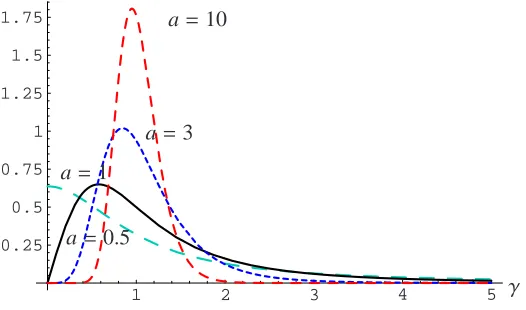
Figure 1. The implied prior for the skewness parameter,γ, derived from a re-scaled sym-metric beta distribution on the amount of skewnessAG.
If we further leta=1(i.e. a flat prior onAG), the implied distribution in terms ofγ, is
π(γ)=2γ
1+γ2
−2
. (9)
Note that even though the implied prior for ϕ with this specification is proper (indeed, an
F(2,2)), it does not have a mean but still retains its median at one.
Prior forα:
In order to restrict the values of the dynamics parameter to the stationarity region, the prior onαis taken as
π(α | aα,bα)=
21−aα−bα
B(aα,bα)
1+αaα−1 1−αbα−1 |α|<1, aα,bα> 1, (10)
i.e. a Beta distribution re-scaled to (-1,1). This specification is the same as in Liu and Tiao
(1980), but we now make the hyperparameters{aα,bα}stochastic (i.e. we use a hierarchical
prior on α) to permit greater flexibility. As we wish to remain relatively non-informative on the dynamic behaviour of the panel, we propose identical Gamma priors, Ga(· | r,q), for the hyperparameters{aα,bα}, thus centring the induced marginal prior forαat zero and making
it symmetric.
For technical reasons described in Section 2.2, and to keep π(α) symmetric, we will impose the restriction aα,bα > 1. To set specific values for {r,q} we balance the marginal
odds P[|α| ≤ 0.5]/P[|α| ≥ 0.5] and control for P[|α| > 0.9]. These region probabilities are
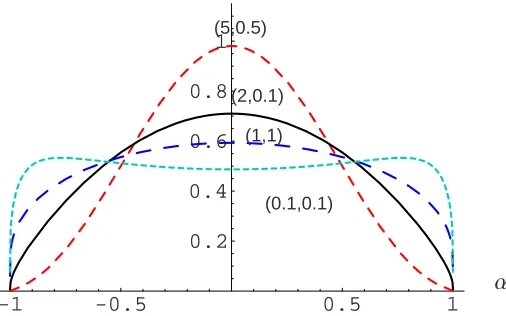
shown in Table 1 for different combinations of the parameters. Figure 2 shows the induced marginal prior densities onαfor these choices. Overall, we think it is sensible to set{r,q}=
2.1. The prior 7
-1 -0.5 0.5 1
0.2 0.4 0.6 0.8 1 (5,0.5) (2,0.1) (1,1) (0.1,0.1) α
Figure 2. Induced marginal priors forα, with Gamma hyperpriors Ga(· | r,q), and different combinations of{r,q}.
1/40 to the region where|α| ≥0.9. Therefore, we will use
[image:8.595.169.422.62.220.2]π(aα)∝aαe−0.1 aα, aα >1 and π(bα)∝bαe−0.1 bα, bα> 1. (11)
Table 1. Induced marginal prior probabilities forαwith Gamma,Ga(· | r,q), hyperpriors.
{r,q} (5,0.5) (2,0.1) (1,1) (0.1,0.1)
P|α| ≤0.5 0.805 0.658 0.575 0.495
P|α| ≥0.9 0.004 0.026 0.056 0.085
Prior forν:
Finally, for the (skew)-tmodel, we specify a Gamma(2,0.1)prior for the degrees of free-dom, given by
π(ν)= ν
100e
−ν/10. (12)
This distribution assigns some mass to large values ofν(virtually implying Normality) as well as to small values of the degrees of freedom, thus also allowing for thicker tails.
Priors for restrictions of the skew-t model (i.e. Normal, skew-Normal or Student-tν
mod-els) are obtained by deleting the corresponding irrelevant factors in (6).
Once data become available, (1) defines the likelihood which, using the scale mixture of normals representation for the skew-tmodel, becomes
l(α,β, γ, λ,ω, ν,aα,bα)∝ λ
T 2
"
ν/2ν/2 Γ[ν/2]
#T Ym
i=1 Ti Y
t=1 ων+21−1
i t
"
21−aα−bα
B(aα,bα)
1+αaα−1 1−αbα−1
#
×
"
2
γ+γ−1
#T exp " −1 2 m X i=1 Ti X t=1 ωi t
ν+ε2 i t
γ2
I(−∞,0](εi t)+γ−2I(0,∞)(εi t)
#
8 2.2. Propriety of the posterior
whereω = {ωi t,i = 1, . . . ,m,t = 1, . . . ,Ti}and theωi tare iid, Gamma(ν/2, ν/2)distributed mixing parameters, εi t = λ1/2
yi t−βi(1−α)−αyi t−1
, andT = Pmi=1Ti, the total available observations. This will be combined with the prior structure defined by (6) through (12).
2.2
Propriety of the posterior
Note that (7) makes the joint prior improper. The following theorem states a sufficient condi-tion under which the resulting posterior is proper (i.e. well-defined as described in Fernández et al., 1997). The proof is deferred to Appendix A.
Theorem 1.
Consider the Bayesian model defined by (1) (with either (3) or (4)), (5) and (6) through (12).
IfT > m+1, then the joint posterior is proper .
As will be clear from the proof in the Appendix, the conditionbα > 1in (11) is important in
avoiding non-integrability due to the implied prior onβi(1−α)exploding as α→1. We also restrictaα >1, in order to maintain symmetry on the induced prior forα.
The condition in Theorem 1 is very mild and trivial to check. Indeed, for example, as long as Ti ≥ 1with strict inequality for at least two units, the posterior will be proper.
2.3
A model with individual dynamics
In the next section we will analyse three data sets: one comprising average earnings in 14 metropolitan areas (Liu and Tiao, 1980), another with annual labour earnings of young male household heads (Hirano, 2002) and the third one on GDP of 25 OECD countries. In these studies, panels were formed not necessarily according to statistical criteria, but rather geographical, demographical or political affinity, thus we think is sensible to verify whether the dynamic properties should indeed be pooled. We feel this situation is likely to occur in practice, so we entertain the “non-pooled” version of (1),
yi t= βi(1−αi)+αiyi t−1+λ−
1 2ε
i t , (13)
with individual dynamics parameters αi, i = 1, . . . ,m arising independently from the same distribution (10). In order to make the comparison fair, the same prior structure and specifi-cations for the error termεi twill be maintained.
3. Applications 9
Theorem 2.
Consider the Bayesian model defined by (13) (with either (3) or (4)), (5) and (6) through
(12). IfT > 2 m, then the joint posterior is proper .
This sufficient condition is somewhat more demanding than the one in Theorem 1, but is still straightforward to check and quite easily satisfied in practice. If we have more than two observations per individual on average, we are sure that the posterior exists.
3
Applications
Throughout, we will use the pooled model in (1) and the non-pooled model in (13), each with the Normal (N), Student-tν (t), skew-Normal (SN; see (3)) and Skew-t (Skt; see (4)) error
distributions. As the posteriors are not of a known form, we implement (Metropolis-Hastings within Gibbs) MCMC samplers to estimate the parameters. Details of the samplers used as well as the Matlab code for implementing them are available upon request.
The MCMC samplers were ran for 1.7×10⁵ repetitions, dropping the first 2×10⁴ (the burn-in) and then recording every tenth draw, thus ending up with chains of length 15,000. The parameters of the proposal Metropolis-Hastings distributions were tuned as to achieve acceptance rates of around 1/3. We will use the formal tool of Bayes factor (BF) to compare alternative models, calculating the required marginal likelihoods with the method of Newton and Raftery (1994), with their δ = 0.1. As a check on the numerical accuracy of the latter method, we also compute Bayes factors through the Savage-Dickey density ratios (Verdinelli and Wasserman, 1995), where this is feasible. We have successfully used the Bayesian models and algorithms on two simulated panels (not reported): one set of pooled data and the other non-pooled.
3.1
Regional average earnings
The data, described in Liu and Tiao (1980), consist of yearly averages of the hourly earn-ings of production workers within each of 14 metropolitan areas in California (transformed to growth rates). Each of the series ends in 1977 but have different beginnings, the longest be-ginning in 1945 and the shortest in 1963. This data set has also been analysed by Nandram and Petruccelli (1997).
Table 2 shows the log BF in favour of the Normal model with common dynamics. Thus, negative numbers indicate support for the alternative model in question.1 Our model
com-1For example, the BF for the Normal model versus the skew-Normal, both with common dynamics, is
10 3.1. Regional average earnings
Table 2. Regional average earnings. Estimated log Bayes factors in favour of the Normal
model with common dynamics.
Commonα Differentαi
SN t Skt N SN t Skt
log BF -8.04 -8.16 -11.54 0.68 -10.17 -8.42 -13.46
alpha ba aa prior
0 20 40 60 80 100
0.000
0.025
0.050
gamma 1.0 1.2 1.4 1.6 1.8 2.0
0
1
2
beta
0.015 0.030 0.045 0.060
0
20
40
60
nu
0 9 18 27 36 45
0.00
0.04
0.08
lambda 1500 3000 4500
0 e+00
4 e−04
8 e−04
tau
0 10000 30000 50000
0 e+00
3 e−05
6 e−05
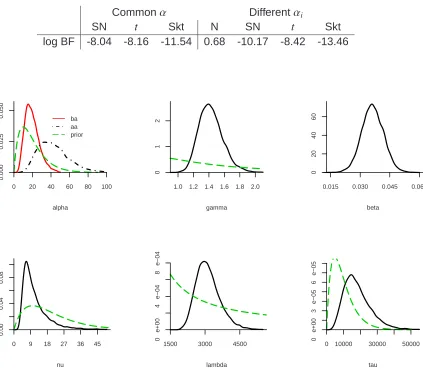
Figure 3. Regional average earnings data set with the skewtmodel with individual dynam-ics. Priors (dashed) and estimated marginal posterior distributions (solid).
parison results do not reject pooling for any symmetric model, but give mild evidence against it for any skew distribution. This is consistent with the findings of Nandram and Petruccelli (1997), who assume Normality in the error term2; in this case, our BF’s in favour of pooling are 2.0 for the Normal and 0.12 for the SN model. Nandram and Petruccelli (1997) find that pooled and non-pooled estimates of the dynamics parameters are similar for all but four of the series; in our Normal case the estimated posterior mean of the common αis 0.42, and when we allow for a different value for each region, the intervals of length two posterior stan-dard deviations around the posterior mean and the posterior credible intervals3 of size 0.95
2Nandram and Petruccelli (1997) do not compute Bayes factors, but consider one-step-ahead prediction
performance as a measure of model adequacy.
3.2. Individual labour earnings data 11
for each region contain 0.42.
In the modelling scenario with common dynamics, the BF does not distinguish between the SN and the t models. This could indicate that the model uses heavy tails to account for asymmetry when the latter feature is not introduced in the model and vice versa. This interpretation is corroborated by the fact that if the model only includes one of those features, the latter is invariably exaggerated with respect to the results for the model with both features. When both skewness and thick tails are included, BF’s indicate evidence in favour of the Skt models versus the symmetric Student-tν models. The difference in log BF’s is 3.4 and 5.0
for the models with common and individual dynamics. In this case, we can compute the log Savage-Dickey density ratios, which are 2.4 and 2.9 for the pooled and non-pooled models, respectively. Overall, the Skt model with different dynamics is preferred (BF=7 versus the Skt with commonα), with estimated posterior medians of Med[γ | y] = 1.38 andMed[ν | y] =
10.1. The estimated marginal posterior density functions are depicted in Figure 3. A more interpretable measure of skewness is AG, the posterior distribution of which is plotted in Figure 4 (a), clearly indicating the overwhelming evidence in favour of right skewness. The usual assumption of Normality (as used by Liu and Tiao, 1980 and Nandram and Petruccelli, 1997) is decisively rejected by the data (with BF=1.0×10⁵ for the pooled case and BF=1.4×
106 for the unpooled case).
Of special interest is the behaviour of predictive distributions. Figure 4 (b) depicts the posterior predictive distributions of the error term for the Normal and Skt models. The un-equal distribution of the mass at either side of the mode is apparent for the Skt model; also, the Normal model must adopt a much larger dispersion than the Skt in order to accommodate the observations in the tails.
3.2
Individual labour earnings data
The data is drawn from the Panel Study of Income Dynamics (PSID) and records annual labour earnings for males who were heads of households between the ages of 24 and 33, during the period from 1967 to 1991. The data is filtered as described in Hirano (2002)4, who constructs three subsets from the resulting 10 years of observations for 516 individuals, according to their education: high school dropouts (HSD, m = 37), high school graduates (HSG,m=100) and college graduates (CG,m=122). The full sample withm =516will be denoted by TOT.
As illustrated in Table 3 the data overwhelmingly favour the heavy-tailed models in both scenarios. In contrast with the previous example, the feature that provides the strongest
p)/2and(1+p)/2percentiles.
4The log of the earnings is regressed on a constant, an indicator for race, indicators for different education
12 3.2. Individual labour earnings data
0 0.1 0.2 0.3 0.4 0.5 0.6 0.7 0
1 2 3 4
(a) Amount of skewness
−0.110 −0.08 −0.05 −0.02 0 0.02 0.04 0.07 0.1 0.12 5
10 15 20 25
[image:13.595.108.510.66.236.2](b) Predictive densities
Figure 4. Regional average earnings. Panel (a): posterior density of the skewness measure
AG under the preferred Skt model with individual dynamics (solid) and prior (dashed). Panel (b): posterior predictive densities of the error term for the Normal (dashed) and Skt (solid) models with common dynamics.
evidence against Normality is tail behaviour. Also, a common dynamics behaviour is not supported by the data regardless of the model selected.
Table 3. Individual labour earnings. Estimated log Bayes factors in favour of the Normal
model with common dynamics, for all subsets and the whole sample.
Commonα Differentαi
Sample SN t Skt N SN t Skt
HSD -31.15 -93.00 -96.02 -3.45 -33.01 -104.58 -105.41
HSG -74.10 -230.96 -237.06 -14.01 -95.56 -276.98 -279.22
CG -31.17 -229.10 -229.05 -59.95 -84.28 -316.67 -313.45
TOT -248.47 -1157.26 -1177.43 -137.34 -404.97 -1510.07 -1518.25
These results are in line with those in Hirano (2002), who proposes nonparametric mod-elling of the error term which allows for more flexibility in the distribution. He also finds evidence of heavy tails and some left skewness, but does not provide a formal way to test or measure these characteristics.
Using Hirano’s parameterisation, namely θi = βi(1− α) with θi ∼ N
· | ψyi 1,Ω−1
, the estimated posterior medians of{α, λ, ψ,Ω}for the Normal model with common dynamics and the non-pooled Skt model (including the t for HSD, where it is close, and for CG, where it is preferred) are shown in Table 4. For α we also present the mean (which exists sinceα has bounded support) and the mode. For the Skt andtmodels with individual dynamics the estimated overall meanα¯ (modeα) are calculated (using the Rao-Blackwell idea) through˜
¯
α= aα−bα aα+bα
and α˜ = aα−bα
aα+bα−2
[image:13.595.95.514.404.497.2]3.2. Individual labour earnings data 13
[image:14.595.146.439.223.388.2]When comparing his semiparametric model with the usual Normal model, Hirano (2002) finds higher values of the dynamics parameter for all but the HSD sample, and less variability in the individual effects distribution for CG and TOT. Our estimates of the dynamics parameter are also higher in the preferred models than in the Normal case5; however, Hirano’s are larger than ours, mainly due to differences in the prior. Overall, our results are consistent with those in Hirano (2002).
Table 4. Individual labour earnings. Posterior medians of the parameterisation in Hirano
(2002). Forαthe mean (α¯) and mode (α˜) are also presented
.
Subset Model α¯ α˜ α λ−12 ψ Ω
1 2
N 0.31 0.33 0.32 0.32 0.31 0.19
HSD t 0.39 0.41 0.39 0.14 0.29 0.20
Skt 0.36 0.38 0.37 0.14 0.39 0.20
N 0.35 0.37 0.35 0.29 0.32 0.21
HSG
Skt 0.40 0.44 0.41 0.13 0.37 0.19
N 0.39 0.41 0.40 0.25 0.41 0.21
CG t 0.48 0.52 0.49 0.11 0.45 0.17
Skt 0.48 0.53 0.50 0.11 0.46 0.16
N 0.38 0.39 0.38 0.27 0.34 0.20
TOT
Skt 0.44 0.54 0.47 0.14 0.29 0.20
From Table 3, the fat-tailed models with individual-specific dynamics are the most favoured alternatives for all data sets. Figure 5 displays the posterior density functions for the param-eters of the Skt model using the HSD data. The log BF’s in favour of the symmetrict model against the Skt are -0.82, -2.24, 3.22 and -8.18, while the log Savage-Dickey density ratios are 1.3, -2.22, 2.50 and -10.53, for the HSD, HS, CG and the whole sample, respectively. Thus, we cannot clearly distinguish between the Skt and the t model for the HSD subset. This feature is illustrated in the top centre panel of Figure 5, where the estimated marginal posterior for the skewness parameter is seen to have considerable mass in the neighbor-hood of one, without being squarely centred over one (it indicates mild negative skewness, as found in Hirano, 2002).
Estimated 95% credible intervals for this case are shown in Table 5. This also highlights the main feature of the data sets: extremely heavy tails. Indeed, estimated posterior intervals for all sets (not shown) are roughly within (1,3).
Figure 6 depicts the estimated posterior predictive densities of the error term for the Normal and Skt models with individual dynamics for the HSD subset, both in regular and log scales. It is interesting to note how in the fitting of the Normal model, the precision
5In contrast, the preferred non-pooled Skt model in the previous application leads to smaller values for α
14 3.3. GDP growth
alpha ba aa prior
0 15 30 45 60 75
0.00
0.03
0.06
gamma 0.6 0.8 1.0 1.2
0
1
2
3
4
beta
−0.1 0.0 0.1 0.2 0.3 0.4
0
2
4
nu
1 2 3 4
0.0
0.4
0.8
1.2
lambda
20 40 60 80
0.00
0.02
0.04
tau
0 5 10 15 20
0.00
0.05
0.10
[image:15.595.109.532.86.368.2]0.15
Figure 5. Individual labour earnings. HSD subset with the skew-tmodel with individual dynamics. Priors (dashed) and estimated marginal posterior distributions (solid).
Table 5. Individual labour earnings. Estimated posterior 95% credible intervals for the HSD
subset using the Skt andtmodels with individual dynamics.
γ λ ν β τ
Skt (0.73,1.06) (35,71) (1.6,3.1) (0.01,0.28) (6,16)
t – (35,71) (1.6,2.9) (-0.02,0.20) (6,16)
parameter is much smaller, as it tries to account for the heavier tail behaviour. In contrast, the predictive distribution for the Skt model is more concentrated around the mode, also allowing for different tail behaviour to either side of the mode. It is apparent from the logarithmic density plots in Figure 6 (b) that the tails of the Skt model are much heavier.
3.3
GDP growth
[image:15.595.150.456.453.500.2]3.3. GDP growth 15
−1.20 −0.9 −0.6 −0.3 0 0.3 0.6 0.9 1.11.1 2
4 6 8 10
(a) Actual scale.
−1.2 −0.9 −0.6 −0.3 0 0.3 0.6 0.9 1.11.1 −7
−5 −3 −1 0 1 3
[image:16.595.93.497.69.239.2](b) Log scale.
Figure 6. Individual labour earnings, HSD subset. Estimated posterior predictive densities
of the error term for the Normal (dashed) and Skt (solid) models with individual dynamics.
(see Appendix B). The panel is unbalanced as, for instance, there is no available data for Germany previous to 1970.
Using our model (1) on growth rates of GDP gives us the model examined in e.g. Ho (2006), where we can interpret1/αas a measure of the speed of GDP convergence6andβ
i as the steady state GDP growth level for countryi.
As shown in Table 6, there is no evidence in favour of skewness, but overwhelming sup-port for heavy tails. The most favoured models are the ones with Student-ttails and individual dynamics. Evidence against pooling is definitive, with a log BF of around 14, irrespective of the error distribution.
Table 6. GPD growth of OECD countries. Estimated log Bayes factors in favour of the
Normal model with common dynamics.
Commonα Differentαi
SN t Skt N SN t Skt
log BF -0.59 -85.55 -85.75 -15.24 -15.40 -99.74 -99.95
For the non-pooled Skt model, most of the estimated means of country-specific dynamics coefficients are within (0.35,0.45), with one group of rapid convergence (αi ≤ 0.35) consti-tuted by Denmark, Spain, Luxembourg, Mexico, New Zealand, Portugal, Turkey and USA (ranging from values forαcentred around 0.1 for Turkey to values around 0.33 for Portugal) and a group of slow convergence (αi ≥ 0.45) formed by France (median ofαis 0.45), Ger-many (0.46), Italy (0.45) and Japan (0.53). All of the estimated median growth steady states are within (0.055, 0.061), except for Spain (0.063), Ireland (0.062), Japan (0.065), Luxem-bourg (0.0614) and Portugal (0.062). Although there is no strong evidence in favour ofγ ,1,
6This is so-called beta convergence, or convergence within an economy. For an analysis of output
16 3.3. GDP growth
around 89% of the posterior mass ofγ(AG) is to the right of 1 (0), which could be caused by the model accounting for these few countries with growth rates above the average. Fat tails account for the greatest evidence against Normality, with (3.0, 4.7) a 95% posterior credible interval forν.
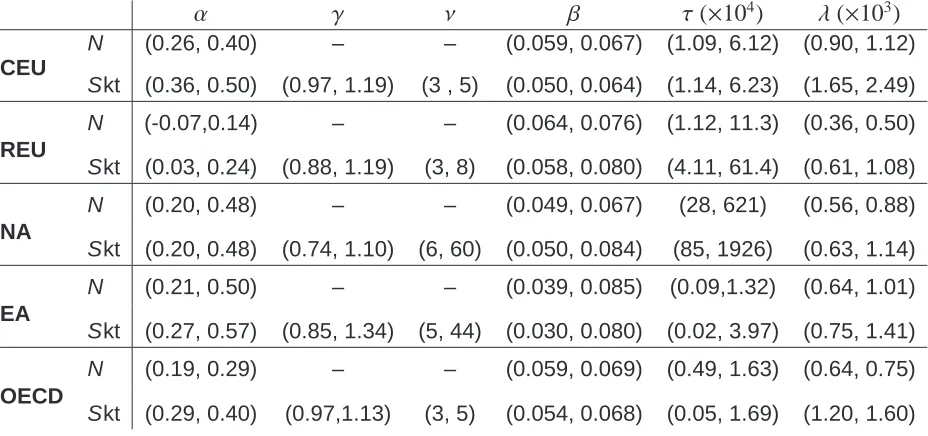
Based on the results above, we decided to break the data up into four disjoint subsets, as listed in Appendix B: core-EU (CEU), with 13 countries; rest-EU (REU), withm= 6; North America (NA),m=3; and East Asia (EA),m=3, and to estimate a separate model for each group. The resulting BF’s support pooling within all subsets, and only suggest weak evidence against pooling for the REU and EA subsets when using either tmodels (log BF = -1.7 and -1.4, respectively). As shown in Table 7, there is, again, no real evidence of skewness in any subset, the salient feature against Normality being fat tails (Med[νCEU | y] = 3.8,
[image:17.595.87.551.512.730.2]Med[νREU | y] = 4.4,Med[νEA | y]= 13.2). This is true for all but the NA subset, for which the pooled Normal model is not definitively rejected (Med[νNA | y] = 20.2), with a log BF in favour of the Normal pooled model against the Skt of around -1.1. The posterior credible intervals forαof the two European subsets do not overlap, creating two well separated clubs of slow and rapid growth dynamics, which ties in the concept of convergence clubs in Quah (1997) and the evidence in favour of different regimes in Durlauf and Johnson (1995) and Canova (2004). This is not the case for the other two subsets, which might be merged in a subsequent analysis. An alternative to this grouping into subsets is to use a double-threshold model as in Hansen (1999) and Ho (2006), which allows for different speeds of convergence depending on the income levels.
Table 7. GPD growth of OECD countries. Estimated 95% credible intervals for the
param-eters using the pooled Normal and Skt models for the four subsets and the whole sample (figures forλare in thousands and in tens of thousands forτ).
α γ ν β τ(×104) λ(×103)
N (0.26, 0.40) – – (0.059, 0.067) (1.09, 6.12) (0.90, 1.12)
CEU
Skt (0.36, 0.50) (0.97, 1.19) (3 , 5) (0.050, 0.064) (1.14, 6.23) (1.65, 2.49)
N (-0.07,0.14) – – (0.064, 0.076) (1.12, 11.3) (0.36, 0.50)
REU
Skt (0.03, 0.24) (0.88, 1.19) (3, 8) (0.058, 0.080) (4.11, 61.4) (0.61, 1.08)
N (0.20, 0.48) – – (0.049, 0.067) (28, 621) (0.56, 0.88)
NA
Skt (0.20, 0.48) (0.74, 1.10) (6, 60) (0.050, 0.084) (85, 1926) (0.63, 1.14)
N (0.21, 0.50) – – (0.039, 0.085) (0.09,1.32) (0.64, 1.01)
EA
Skt (0.27, 0.57) (0.85, 1.34) (5, 44) (0.030, 0.080) (0.02, 3.97) (0.75, 1.41)
N (0.19, 0.29) – – (0.059, 0.069) (0.49, 1.63) (0.64, 0.75)
OECD
4. Conclusions 17
In the case of the European countries, estimates for the dynamics parameter are clearly lower under Normality than when allowing for fat tails and skewness, thus erroneously sug-gesting a more rapid convergence in the former case. It is also apparent how the estimated observation precision, λ, must be much lower in the Normal case in order for the model to accommodate the observations in the tails. Remarkably, the estimates of the hyperparam-eter β are fairly similar, indicating that at least the mean of the distribution of the individual effects is not much affected by the choice of error distribution. In the case of CEU the same holds for the entire individual effects distribution.
Figure 7 plots the posterior distributions for the measure of speed of convergence,1/α,
estimated from the pooled Skt model, for each subset; different speeds of convergence are apparent for the two European subsets, while the difference is not so clear for the American and Asian groups. Clearly, forcing the dynamic behaviour of the REU cluster to be the same as that for the other groups (resulting in the graph labelled OECD) flies in the face of the data evidence. The faster convergence rate of the REU group is in line with the relatively recent industrialisation of most of these countries and the results in Canova (2004).
1 3 5 7 9 11
0.0
0.5
1.0
1.5
2.0
[image:18.595.159.470.398.590.2]OECD CEU REU NA EA prior
Figure 7. GDP growth of OECD countries. Posterior distributions and prior for 1/α, the measure of speed of convergence, from the pooled SKt model and the four subsets.
4
Conclusions
18 4. Conclusions
a Bayesian perspective and a sensible prior structure is proposed that does not incorporate strong prior beliefs and which allows for comparisons across models. Further, an alternative model, which allows the dynamics to change over individuals, is considered. Estimation is done numerically through MCMC techniques.
The methodology is illustrated with three real data sets. The application to regional av-erage earnings data strongly favours skewed models with moderately fat tails, whereas the evidence against Normality for the other data sets mostly centers around fat tails. However, in some cases fat tails may partially account for skewness and vice versa, and therefore it is important to treat both quantities as unknown and estimate them simultaneously. The applications to individual earnings data and to the growth of countries provide conclusive evidence against the assumption of common dynamics. The latter data, however, allow for pooling once the individual countries are clustered into four, more homogeneous, groups. Interestingly, for those cases where fat tails are strongly supported, the usual Normal model leads to substantially smaller values for the dynamics parameter. This is of particular interest for the application to economic growth, where this parameter is directly linked to the speed of GDP convergence.
Several extensions to the model are possible. In some cases, the interest of the re-searcher lies primarily in the effect of certain covariates. For instance, it may be of special interest to investigate the degree of influence of race, schooling, etc. on the income dynamics of individuals; or the effect of human capital, investment, etc. on economic growth. In that case, it is natural to include a set of covariates grouped in ati× pmatrixXi, such that
yi t= βi(1−α)+αyi t−1+xitδ+λ
−1 2ε
i t ,
where δ = (δ1, . . . , δp)0 are the additional parameters, with prior π(δ), and xit is the t-th row of Xi. This can be accommodated straightforwardly within the procedure described in the paper, just by adding an extra step in the sampler for the new parameters. Such an extension would be natural for all the applications treated in the paper. Recall that Hirano’s data (also used in Subsection 3.2) are in fact residuals from a least-squares regression on a number of covariates, and including these covariates in the model would be preferable, both from a methodological perspective and an empirical one. Inference on δmight well depend quite crucially on the distributional assumptions on the error term.
Another extension that is fairly easy to implement is to include in the model a distribution for yi 0, the initial value, rather than conditioning on a fixed value. This could be particularly important in cases where the time dimension of the panels are relatively short (such as the Hirano data).
ad-19
vantage. Bayes factors are well-defined for any number of individualsmand repeated mea-sures through timeTi, as long as the posteriors and priors on model-specific parameters are proper. In contrast, most of the alternative frequentist tests are based on semi-asymptotic results (see e.g. Pesaran et al., 1995, and references therein) whose conditions are often not met in practice or are difficult to check.
With our methodology we can easily test whether to pool the dynamics across the whole panel. Of course, trying to find clusters of units exhibiting similar dynamic behaviour can be of paramount interest in some applications, such as growth economics (Arbia and Piras, 2005; Canova, 2004; Quah, 1997). In this paper, we have used the model with individual dy-namics to suggest a useful clustering of the individuals into relatively homogeneous groups. Whereas that often works reasonably well in practice, this approach can be deemed some-what ad-hoc.7 Thus, we also intend to make the clustering mechanism part of the model and allow for a free selection of the number and composition of clusters within the model, follow-ing previous approaches in Canova (2004) and Frühwirth-Schnatter and Kaufmann (2004). Using a hierarchical framework, this would be a natural extension of the model and algorithm and is the topic of ongoing research.
Acknowledgements
We gratefully acknowledge comments from participants of the 13th International Conference on Panel Data, Cambridge. This research was supported by the UK research council EPSRC under grant number GR/T17908/01.
Appendix A
Proofs
A.1
Proof of Theorem 1
The proof is done in two steps. First, we will prove that the posterior is proper forγ >0if and only if (iff) it is proper forγ= 1. Then, we will prove propriety of the posterior for the simpler cases of the Normal and Student distributions.
For step one, we use Theorem 1 of Fernández and Steel (1998) which states that the posterior of the skew model is proper iff it is proper whenγ= 1. So we write
I=
Ym
i=1 Ti Y
t=1
f (yi t | α, β, γ, τ, λ, ν) dPαdPβdPγ dPτdPλdPν.
7Although it perhaps has the advantage that it is not totally mechanical and considerations beyond statistical
20
Clearly f (s) = f (|s|) is decreasing in|s|, so the same upper and lower bounds for the
sam-pling density as in Fernández and Steel (1998) hold, and using gi(θ) = βi(1−α)+αyi t−1 these bounds are given by
2λ12
γ+γ−1 f
λ
1
2 |yi t−gi(θ)|
h(γ)
,
with
h(γ)=
max n
γ, γ−1o for the upper bound
minnγ, γ−1o for the lower bound.
Therefore,I<∞iffI< ∞underγ =1.
In step two we write the model asy= Xθ+ε, with
y=
y1 1 ...
y1 T1
y2 1 ...
ym Tm
, X=
1T1 0T1,m−1 y1
0T2,1 1T2 0T2,m−2 y2
... . .. . . . ...
0Tm,m−1 1Tm ym
and θ=
β1(1−α) β2(1−α)
... βm(1−α)
α
where yi =
n
yi0, . . . ,yiTi−1 o
,1k is ak-dimensional vector of ones and0A,B is an A× Bmatrix of zeros. So, y ∈RT,X is a full column rank matrix of sizeT ×(m+1)andθ∈ Rm+1, with
T = Pm
i=1Tithe total number of observations.
We now use Theorem 3 of Fernández et al. (1997), which states that the posterior distri-bution exists ifπ(θ1, . . . , θm)is bounded,π(α)is proper andT is strictly greater than the rank ofX.
Normal case After integrating outλwe have that the posterior is proper iff the integral
I=
y−Xθ0y−Xθ −T/2
π(θ) dθ
is finite.
From the prior specification, we have fori= 1, . . . ,m
θi | α, β, τ∼ N
θi | β(1−α), τ/(1−α)2
and so
π(θi)=
N
θi | β(1−α), τ/(1−α)2
21
withπ(β, τ)=cτaτ−1exp[−b
ττ]. Given that N(· | µ, ϕ)< ϕ1/2, we have that
π(θi)≤c
τ12 (1−α)τ
aτ−1exp[−b
ττ]π(α) dτdα
≤c0
(1+α)aα−1(1−α)bα−2dα,
which is bounded ifbα >1, as imposed in (11).
Therefore, given that the rank ofXism+1,I<∞ifT >m+1.
Student case Let us consider thetdistribution as a scale mixture of Normals as in Fernán-dez and Steel (2000). So, after integrating outλ, the posterior is proper if the integral
I=
y−Xθ0Ωy−Xθ −T/2
π(θ)π(Ω | ν)π(ν) dθdΩdν
is finite, whereΩ = diag{ωi t},t = 1. . . ,Ti, i = 1, . . . ,mis a diagonal matrix with the T (augmented) mixing parameters andπ(ωi t | ν)=Ga(ωi t | ν/2, ν/2), i.i.d.
Now we use the same argument as in the Normal case to prove thatπ(θ1, . . . , θm) is bounded, provided thatbα > 1. Further, Theorem 4(ii) of Fernández and Steel (2000)
provides an upper bound for the integral above ifT >m+1.
A.2
Proof of Theorem 2
This proof is almost identical to that of Theorem 1, except that the parameterisation in step two now becomes
X=
1T1 0T1,m−1 y1 0T1,m−1
0T2,1 1T2 0T2,m−1 y2 0T2,m−2
... . .. . . .. ...
0Tm,m−1 1Tm 0Tm,m−1 ym
and θ=
β1(1−α1) β2(1−α2)
... βm(1−αm)
α1 α2 ... αm
22
Appendix B
List of OECD countries
Core-EU Rest-EU North America East Asia
Austria Great Britain Spain Canada Australia
Belgium Germany Greece Mexico Japan
Switzerland Iceland Ireland USA New Zealand
Denmark Italy Luxembourg
Finland Netherlands Portugal
France Norway Turkey
Sweden
References
Arbia, G. and Piras, G. (2005). Convergence in per-capita GDP across European regions using panel data models extended to spatial autocorrelation effects, Working Paper 51, Istituto di Studi e Analisi Economica, Roma.
Arellano, M. (2003). Panel Data Econometrics, Oxford: Oxford University Press.
Arnold, B. C. and Beaver, R. J. (2002). Skewed multivariate models related to hidden trunca-tion and/or selective reporting, Test, 11, 7–54.
Arnold, B. C. and Groeneveld, R. A. (1995). Measuring skewness with respect to the mode, The American Statistician, 49, 34–38.
Azzalini, A. (1985). A class of distributions which include the normal ones, Scandinavian Journal of Statistics, 12, 171–178.
Azzalini, A. and Capitanio, A. (2003). Distributions generated by perturbations of symmetry with emphasis on a multivariate skewt-distribution, Journal of the Royal Statistical Society, B, 65, 367–389.
Baltagi, B. (2001). Econometric Analysis of Panel Data, Chichester: Wiley, second ed.
Barro, R. J. and Sala-i-Martin, X. (2004). Economic Growth, Cambridge: MIT Press, second ed.
23
Canova, F. (2004). Testing for convergence clubs in income per capita: A predictive density approach, International Economic Review, 45, 49–77.
Chib, S. and Greenberg, E. (1994). Bayes inference in regression models with ARMA(p,q) errors, Journal of Econometrics, 64, 183–206.
Durlauf, S.N. and Johnson, P.A. (1995). Multiple regimes and cross-country growth be-haviour, Journal of Applied Econometrics, 10, 365–384.
Durlauf, S.N. and Quah, D.T. (1999). The new empirics of economic growth, Handbook of Macroeconomics Vol.1 (J.B. Taylor and M. Woodford, eds.), Amsterdam: Elsevier, pp. 235–
308.
Evans, P. (1998). Using panel data to evaluate growth theories, International Economic Re-view, 39, 295–306.
Evans, P. and Karras, G. (1996). Do economies converge? Evidence from a panel of US states, The review of Economics and Statistics, 78, 348–388.
Fernández, C., Osiewalski, J. and Steel, M. F. J. (1997). On the use of panel data in stochas-tic frontier models with improper priors, Journal of Econometrics, 79, 169–193.
Fernández, C. and Steel, M. F. J. (1998). On Bayesian modeling of fat tails and skewness, Journal of the American Statistical Association, 93, 359–371.
Fernández, C. and Steel, M. F. J. (2000). Bayesian regression analysis with scale mixtures of normals, Econometric Theory, 16, 80–101.
Frühwirth-Schnatter, S. and Kaufmann, S. (2004). Model-based clustering of multiple time series, mimeo, Johannes Kepler Universität Linz.
Gaulier, G., Hurlin, C. and Jean-Pierre, P. (1999). Testing convergence: A panel data ap-proach, Annales D’économie et de Statistique, 55-56, 411–427.
Gelman, A. (2006). Prior distributions for variance parameters in hierarchical models, Bayesian Analysis, 1, 515–534.
Genton, M. G. (2004). Skew-Elliptical Distributions and Their Applications: A Journey Beyond Normality, Boca Raton: Chapman & Hall.
24
Heston, A., Summers, R. and Aten, B. (2002). Penn world table version 6.1, http://pwt.econ.upenn.edu/php_site/pwt_index.php. Center for International Com-parisons at the University of Pennsylvania (CICUP).
Hill, B. M. (1965). Inference about variance components in the one-way model, Journal of the American Statistical Association, 60, 806–825.
Hirano, K. (2002). Semiparametric Bayesian inference in autoregressive panel data models, Econometrica, 70, 781–799.
Ho, T. (2006). Income thresholds and growth convergence: A panel data approach, The Manchester School, 74, 170–189.
Hsiao, C. and Pesaran, M. H. (2004). Random coefficient panel data models, IEPR Working Paper 04.2, University of Southern California.
Islam, N. (1995). Growth empirics: a panel data approach, Quarterly Journal of Economics,
110, 1128–1170.
Jones, M. C. and Faddy, M. J. (2003). A skew extension of thet-distribution, with applications, Journal of the Royal Statistical Society, B, 65, 159–174.
Lee, M., Longmire, R., Mátyás, L. and Harris, M. (1998). Growth convergence: some panel data evidence, Applied Economics, 30, 907–912.
Liu, M. C. and Tiao, G. C. (1980). Random coefficient first-order autoregressive models, Journal of Econometrics, 13, 305–325.
Mátyás, L. and Sevestre, P. (1995). The Econometrics of Panel Data. A handbook of the theory with applications, The Netherlands: Kluwer, second ed.
Nandram, B. and Petruccelli, J. D. (1997). A Bayesian analysis of autoregressive time series panel data, Journal of Business and Economic Statistics, 15, 328–334.
Newton, M. A. and Raftery, A. E. (1994). Approximate Bayesian inference with the weighted likelihood bootstrap, Journal of the Royal Statistical Society, B, 56, 3–48.
Pesaran, M. H. (2006). A pair-wise approach to testing for output and growth convergence, Journal of Econometrics, forthcoming.
25
Quah, D. T. (1997). Empirics for growth and distribution: Stratification, polarization and con-vergence clubs, Journal of Economic Growth, 2, 27–59.
Sáfadi, T. and Morettin, P. A. (2003). A Bayesian analysis of autoregressive models with random Normal coefficients, Journal of Statistical Computation and Simulation, 8, 563– 573.
Spiegelhalter, D. J., Abrams, K. R. and Myles, J. P. (2004). Bayesian approaches to clinical trials and health-care evaluation, Chichester: Wiley.
Sun, D., Tsutakawa, R. K. and He, Z. (2001). Property of posteriors with improper priors in hierarchical linear mixed models, Statistica Sinica, 11, 77–95.
Temple, J. (1999). The new growth evidence, Journal of Economic Literature, 37, 112–156.
Verdinelli, I. and Wasserman, L. (1995). Computing Bayes factors using a generalization of the Savage-Dickey density ratio, Journal of the American Statistical Association, 90, 614–618.
Wang, D. and Ghosh, S. K. (2002). Bayesian analysis of random coefficient autoregressive models, Joint Statistical meeting proceedings.