CheckMerge: A System for Risk
Assessment of Code Merges
Jan-Jelle Kester
Master Thesis Master of Computer Science Software Technology specialization
University of Twente
Faculty of Electrical Engineering, Mathematics and Computer Science Formal Methods and Tools research group
April 26, 2018
Supervisors
prof.dr. M. Huisman dr. A. Fehnker
Abstract
Acknowledgements
I would like to thank ALTEN Netherlands, and especially Rob Essink, for providing this project. I have found it an interesting challenge to work on. As a developer I have faced merge problems myself many times, albeit on a relatively small scale. It is satisfying to work on a solution for these problems.
Furthermore I would like to thank my supervisors for the excellent feed-back and, at times, tough questions. On many occasions this has forced me to think a bit more about certain problems and their possible solutions, resulting in either a better choice or a better understanding of the reason for a certain choice.
I also would like to thank Robin Hoogervorst for letting me use code we developed together for an assignment of the Software Security course. This code was turned into a test case for the system.
Table of contents
Acknowledgements 5
1 Introduction 9
1.1 Motivation . . . 9
1.2 Goals . . . 11
1.3 Approach . . . 11
1.4 Structure of the report . . . 12
1.5 Contributions . . . 12
2 Background 15 2.1 Version control systems . . . 15
2.1.1 Concepts . . . 15
2.1.2 Merges . . . 16
2.1.3 Merge techniques . . . 16
2.2 The impact of code changes . . . 18
2.3 Abstract syntax trees and control flow graphs . . . 19
2.4 Tree differencing . . . 19
2.5 Source code analysis tools . . . 20
3 Problematic changes in merges 23 3.1 Problematic changes . . . 23
3.2 Detection strategies . . . 26
3.2.1 Changes at the same point in a program (PC1) . . . . 26
3.2.2 Changes modifying the same value in a scope (PC2) . 26 3.2.3 Refactorings (PC3) . . . 30
4 Code analysis tools 33 4.1 Tools under consideration . . . 33
4.2 Evaluation steps and criteria . . . 34
4.3 Results . . . 35
4.3.1 C Intermediate Language . . . 35
4.3.2 Clang . . . 36
4.3.3 Rascal . . . 37
5 System architecture 39
5.1 Requirements and considerations . . . 39
5.2 Architecture decomposition . . . 40
5.2.1 High level architecture . . . 40
5.2.2 System components . . . 40
6 Implementation 43 6.1 Framework . . . 43
6.1.1 Internal data representation . . . 43
6.1.2 Plugin system . . . 44
6.2 Tree differencing . . . 44
6.2.1 Considered diff algorithms . . . 45
6.2.2 Tree differencing implementation . . . 46
6.3 Static analysis . . . 46
6.4 Interfacing with the system . . . 47
6.4.1 Declarative API . . . 47
6.4.2 Command line interface . . . 48
6.5 C support with Clang and LLVM . . . 48
6.5.1 Custom LLVM pass . . . 48
6.5.2 Clang parser . . . 49
7 Results 51 7.1 Evaluation . . . 51
7.1.1 Test plan . . . 51
7.1.2 Test cases . . . 52
7.1.3 Results . . . 53
7.2 Known limitations . . . 57
8 Related work 59 8.1 Generic abstract syntax trees . . . 59
8.2 Source code differencing . . . 60
8.3 Static analysis of source code changes . . . 61
9 Conclusions and recommendations 63 9.1 Conclusions . . . 63
9.2 Future work . . . 64
References 67
A Requirements for the proposed tool 71
B GumTree algorithm 73
Chapter 1
Introduction
For many software developers merging changes in a version control system is a common task. However, this task is error-prone due to the fact that the merging algorithms commonly used by version control systems do not take the semantics and structure of a programming language into account [19]. Merging is especially risky when versions have diverged significantly, either over time or by very involved changes like refactorings. Some combination of changes in two versions may cause the result of a merge to be different from the expected or wanted result, either because of incorrect computations or syntactical or structural errors [2].
To aid developers with the task of merging software versions ALTEN
Netherlands (in this report also referred to as ‘the client’), a technical con-sulting firm, has proposed to develop a software tool for analyzing the risk of code merges by identifying changes that can lead to unwanted results after merging.
1.1
Motivation
Code merges are a common task in large software projects with many con-tributors. Some of these merges are considered trivial and do not require review. When changes are more involved there is a chance that the code re-sulting from the merge will not work or will not behave as expected. Merges can accidentally undo earlier fixes or improvements and in some cases in-troduce new bugs which were not present in any of the versions of the code which were merged together. Manually reviewing code merges takes a lot of time, while possible errors might still not be identified by the reviewer(s).
if ((err = SSLFreeBuffer(&hashCtx)) != 0)
goto fail;
if ((err = ReadyHash(&SSLHashSHA1, &hashCtx)) != 0)
goto fail;
if ((err = SSLHashSHA1.update(&hashCtx, &clientRandom)) != 0)
goto fail;
if ((err = SSLHashSHA1.update(&hashCtx, &serverRandom)) != 0)
goto fail;
if ((err = SSLHashSHA1.update(&hashCtx, &signedParams)) != 0)
goto fail;
goto fail;
if ((err = SSLHashSHA1.final(&hashCtx, &hashOut)) != 0)
goto fail;
Listing 1.1: Code fragment illustrating the ‘goto fail’ vulnerability
The problems with code merges as described above were noticed in some C/C++ projects at a large technology firm where software engineering con-sultants of ALTEN Netherlands work on embedded software. These prob-lems especially arise when two versions of a program have been developed in parallel for a while. When these versions are merged many duplicate or conflicting improvements may exist. When the implementation of duplicate improvements is not exactly identical, or if improvements in different ver-sions are not compatible with each other, merging them can be troublesome. Industry standard merge tooling, like those found in common version con-trol systems, does not detect these problems making manual inspection of changes necessary.
A well-known example of a (possible) merge error is the ‘goto fail’ vul-nerability in the Apple TLSimplementation [33]. In the function containing the bug, error codes were checked with bracketless if statements, so only the line immediately following the if statement is skipped if the condition does not hold. In this example the conditions check for error codes and if one was present the statement goto fail; was executed. Because at some point in the code this statement appeared twice, the second occurrence was always executed, resulting in the function returning no error code while not all checks were performed. It is likely that this bug was introduced by a merge gone wrong, although Apple has not released these specifics. Nev-ertheless it is a real-world security issue which, if caused by a merge error, might have been prevented by a merge analysis tool, as noted by Wheeler [33]. The offending code is shown in listing 1.1.
1.2
Goals
The focus of this project is to find out whether it is feasible to implement a system to check for code merge problems as illustrated in the previous section. This leads to the following goal:
To design and implement a prototype of a system for assessing the risk of side effects of code merges.
To reach this goal a number of research questions have been formulated. These questions are addressed in the upcoming chapters and the outcomes were used in the development of the prototype. The research questions are as follows:
Q1 Which kind of changes are likely to cause problems in code merges?
Q2 Which algorithms are best suited to compare code versions to find changes?
Q3 Which techniques exist to detect these merge problems from the changes between versions?
1.3
Approach
In order to gain a better understanding of the problem domain, existing literature has been studied on the subjects of source code merging, source code analysis and tree differencing. Together with the client a number of requirements was agreed upon, which were taken into account during the rest of the project. A number of categories of relevant changes were spec-ified based on interviews with developers, experience of the client and the personal experience of the author. Algorithms for the detection of some of the categories have been developed.
In order to make algorithm development easier, a supporting prototype system was developed. First, different tools for parsing C code were eval-uated of which one was chosen (see chapter 4 for evaluation criteria and methods). Subsequently a high-level system architecture was designed and a prototype of this system was implemented. A tree differencing algorithm for comparing abstract syntax trees and finding the changes between them was chosen (see section 6.2 for details). Based on the chosen C parser and tree differencing algorithm a simple internal representation of an AST was cre-ated and a transformation from the output of the C parser and the internal representation was developed. This allowed the tree differencing algorithm to be implemented and tested.
with unit tests and partially with manually evaluated test cases that use the whole system. The results of these tests were used to improve the al-gorithms. For the final evaluation the precision and recall of the algorithms was calculated to determine the qualitative performance. A number of per-formance metrics were collected to determine the runtime perper-formance.
1.4
Structure of the report
This report is structured as follows. Chapter 2 contains background informa-tion on the problem domain. In chapter 3 changes that are of interest when detecting merge problems are defined in categories, and newly developed algorithms for detecting some of these problems are presented. Chapter 4 lists a number of C code parsers and analysis tools that can provide the necessary information for the algorithms. A high level architecture of the system is given in chapter 5 and implementation details of the prototype can be found in chapter 6. Chapter 7 shows the evaluation strategy and results for the new algorithms. Other works related to this research are discussed in chapter 8. Finally, the conclusions and recommendations for future work are given in chapter 9.
1.5
Contributions
The contributions presented in this report are threefold.
Definition of problematic changes First of all, this report defines the term problematic change in the context of code merges. A number of cat-egories of these problematic changes are listed. This is done with the goal of developing algorithms for identifying these changes and reporting these problems to the user that wants to merge two versions of a program.
Detection algorithms Secondly, two new algorithms for the detection of a subset of these changes have been created. These algorithms are able to detect certain problems in code merges that were previously not detected by existing merge tooling.
Analysis system prototype Finally, a system design and a prototype implementation of this design, incorporating the aforementioned algorithms, has been created for the C programming language. This prototype is used to evaluate the algorithms. These contributions show that risk analysis on code merges is worth looking into further as practical applications are feasible and likely to improve the quality of code merges while reducing the work load of developers carrying out these merges.
Chapter 2
Background
2.1
Version control systems
During the development of software the program evolves rather than being constructed correctly in a single go. Requirements and library dependencies change, new insights come along and different developers work on the pro-gram. Version control systems help in the software development process by allowing multiple versions of a program to be worked on at the same time. These systems also keep a history of the evolution of the software so that it is possible torevert to an earlier version of a program at any time.
2.1.1 Concepts
The data structure in which the files and their history is stored is called a repository. This repository can be stored centralized or decentralized (also called distributed) [24]. When using a centralized version control system developers must check-in individual changes into a central repository on a server. Well-known centralized version control systems are CVS and SVN. With decentralized version control systems each developer has a copy of the repository on their system. He or she synchronizes the repository with copies on different machines. Usually a central repository is chosen to synchronize with, although it is possible to synchronize with each copy individually. Examples of decentralized version control systems are Git and Mercurial.
0
1
2 3
4
5 A, C
B
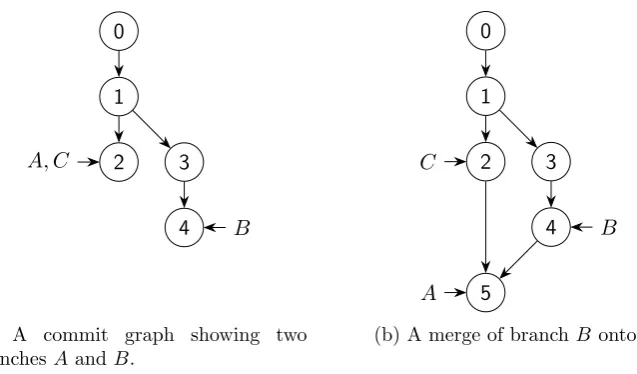
(a) A commit graph showing two branchesA andB.
0
1
2 3
4
5 A
B C
[image:16.595.133.452.119.306.2](b) A merge of branchB ontoA.
Figure 2.1: Commit graphs showing the merge of diverged branches A and B. A third branchC is not affected.
2.1.2 Merges
In the context of a merge, a branch can be seen as a collection of changes since t a specific point in time. Given two branches, the changes each branch represents are the changes that were committed since the common ancestor commit of the two branches.
In some cases it is trivial to merge changes to source code. If two changes are merged, and both changes only affect independent parts of a program which are in separate files, the merge can be completed by just combining the changes. If changes affect the same file a new version of the file has to be saved that incorporates both changes, which can be done automatically by many version control systems. However, version control systems and other merge tooling might raise a merge conflict if it is not able to compute the result with confidence. An example of this situation is two changes to the same line. The absence of a merge conflict does not imply that the result is as expected, as noted by Aziz, Lee and Prakash in their book about typical problems software engineers run into [2]. This is explored further in chapter 3.
2.1.3 Merge techniques
There are different techniques and algorithms for merging different versions of a program. Mens provides a comprehensive survey of code merging tech-niques [19]. These techtech-niques can be categorized with respect to a number of properties.
First of all a distinction is made between two-way merging, where only two versions of a program are considered, and three-way merging where the
0 1 2 3 4 5 C B A
(a) A two-way merge of branchesAand
B into a new branchC.
0 1 2 3 4 5 A′′ B A′ A
(b) A three-way merge of branch B
[image:17.595.139.456.106.308.2]ontoA, moving the branch pointer to the merge result.
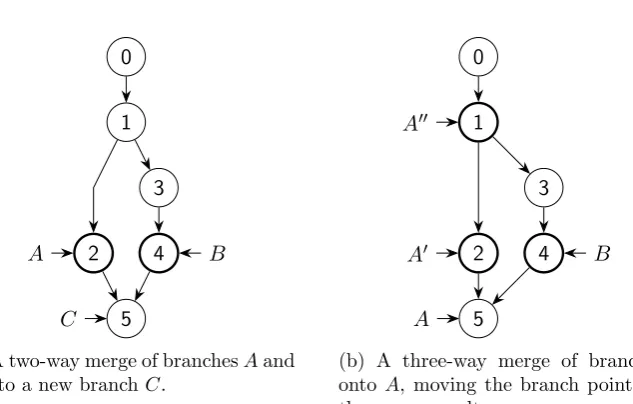
Figure 2.2: A comparison between two-way merges and three-way merges. The inspected versions are denoted by a bold line.
changes in two versions since a common ancestor version are used. With two-way merging all the files in the branches are compared and combined where possible. For large repositories this can become quite resource intensive. Three-way merging helps with merge decisions, especially when some code is removed in one of the versions. It is a performance optimization as well, as only the changes since the common ancestor of the branches are being merged. For example, given the merge in figure 2.1b only the combination of the changes in {2,3,4} is computed when using three-way merging while for two-way merging also the changes made in {0,1} and all ancestors of 0 that are not shown are taken into account.
Figure 2.2 contains a comparison between two-way merging and three-way merging. Two-three-way merging takes only the merged versionsAandBinto account, creating a completely new version C containing the union of the source versions. Three-way merging takes only the changes since a common ancestor version into account, replaying the changes of the merged version B onto the program versionA′, resulting inA.
2.2
The impact of code changes
Changes to source code can introduce bugs immediately or pose problems when merged with other changes. There might be a relation between certain kinds of changes and the risk of introducing problems. In software evolution the impact of changes is analyzed to find relations between kinds of changes and the risk they have to introduce bugs.
The impact of source code changes is a typical software evolution prob-lem. This problem can be approached on a high level where one tries to es-timate the amount of time and/or the risk involved with a proposed change, for example a new feature. On a lower level one looks at transformations of source code and the risk of introducing defects. The latter is relevant for this project.
The claim that changes to relatively complex code are more likely to cause issues than changes to relatively simple code seems self-evident. This claim is supported by Munson and Elbaum [20]. In their research they tried to find a metric that could serve as a surrogate for the risk of introducing a fault. They found that a high rate of change in the relative complexity could serve as an indicator for higher risk changes. They do note that there are multiple ways of calculating complexity, which influences the metric. However, the relative complexity of a change is a good indicator of the risk associated to it.
Besides complexity, the size of a change is also a factor. Small code changes are less likely to cause issues than large code changes. Purushota-man and Perry studied small code changes and tried to differentiate between multiple kinds of changes [26]. In their research they categorized changes as corrective (repairing faults), adaptive (introducing new features) or perfec-tive (nonfunctional improvements). They categorized the changes based on keywords in the commit messages. The software of a central (provider level) telephone switch was analyzed and they found that nearly 40% of changes intended to fix a bug introduced a new bug. They also found that less than 4% of one-line changes resulted in a bug, while nearly 50% of changes involving 500 lines of code or more introduced one or more bugs, thereby supporting the claim that small changes are less likely to introduce bugs than large ones.
Bavota et al. looked at refactorings, which typically have a lot of depen-dent changes. They found that certain refactorings are more likely to cause bugs than others [5]. Refactorings changing the class hierarchy were very likely to cause errors because these changes have impact on many references, and therefore many lines of code. The errors might be due to lack of tool support for this kind of refactorings.
Function F
Block
Return
Binary operator+
Reference b Reference a
[image:19.595.176.421.124.258.2]Parameterb Parameter a
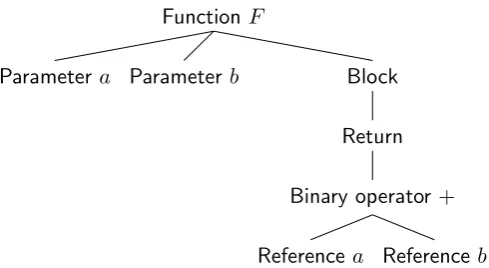
Figure 2.3: Example of an abstract syntax tree of a function performing binary addition.
2.3
Abstract syntax trees and control flow graphs
The source code of computer programs is mostly represented as text. How-ever, there exist other representations for programs, like abstract syntax trees and control flow graphs.An abstract syntax tree is a tree representation of source code. Each node in the tree represents a construct used in the program. The kinds of nodes that are used depend on the specific programming language, more specifically, it depends on the constructs that a programming language offers. Abstract syntax trees differ from concrete syntax trees in the level of detail they provide. While concrete syntax trees include syntactically relevant characters like parentheses these are omitted in abstract syntax trees. An example of an abstract syntax tree for a very simple program can be found in figure 2.3.
From an abstract syntax tree a control flow graph can be built. A con-trol flow graph shows the possible execution paths in (part of) a program. From this graph information about the relation of parts of the code can be obtained. As a control flow graph is based on statements it can be embedded into an abstract syntax tree. Control flow graphs are typically collapsed by leaving out the nodes that have only one entry and one exit point. When embedded into an abstract syntax tree this is less practical. When evaluat-ing the tree it is more convenient to have control flow information at every node.
2.4
Tree differencing
another version. From this information not only regularmerge conflicts can be found, but these changes can also be further analyzed.
Definition 2.1(Bille [7]). An edit scriptis a sequence of operationsOT→T′ that, when applied, transform a tree T into another treeT′.
From this definition follows that the difference between two trees can be expressed as an edit script.
Edit scripts can grow large and have no theoretical maximum size, how-ever, algorithms that calculate these edit scripts often try to find the smallest and most logical (from a developer’s point of view) number of changes. This is achieved by assigning a cost to every edit operation. The sum of the costs determines the quality of the edit script. The cost of a type of operation is often not fixed and can be used to tweak these algorithms.
Definition 2.2 (Bille [7]). The tree edit distance of two trees T and T′ is defined as the length of the minimum cost edit script for these trees.
The tree edit distance is a measure for the similarity of trees. Two trees with a short edit distance have little operations in their edit script and are therefore relatively similar. Trees with a large edit distance have a large edit script and are therefore relatively dissimilar. The cost of each edit operation is often assumed to be 1, however, in some uses cases other constants or cost functions are used. The cost of an edit script is the sum of the cost of the edit operations.
2.5
Source code analysis tools
Besides the specific techniques listed above there are some more generic ways of getting certain information from source code. The code analysis tools listed here are primarily focused on the C programming language (in accordance with the requirements listed in appendix A).
A large number of studies useCILfor C code analysis. CILa C interme-diate language designed for analysis of C programs. It was first described by Necula, McPeak, Rahul and Weimer [22]. CIL is designed to support compiler specific extensions and contains both an abstract syntax tree and a control flow graph. On GitHub1 the authors describe the tool as follows: “CIL is a front-end for the C programming language that facilitates program analysis and transformation. CIL will parse and typecheck a program, and compile it into a simplified subset of C.” CIL is written in OCaml [23] and this is the language that needs to be used to use the tools to analyze the code.
Just like dedicated analysis tools, C compilers have a lot of useful infor-mation internally. Clang is a front-end compiler for C and C-like languages
1
TheCILGitHub repository is located athttps://github.com/cil-project/cil.
which uses the LLVM back-end [8, 16]. Clang is designed with tool support in mind, meaning that it can provide a lot of information about code to an external program. This makes it suitable for C code analysis. Clang offers a C API that can be used by other programs. It is able to export abstract syntax trees of parsed code which can be used by a number of the described algorithms.
Chapter 3
Problematic changes in
merges
This chapter describes categories of changes that can cause issues during or after code merges. Following this definition, two new algorithms for detecting some of these categories of changes are developed.
3.1
Problematic changes
A number of kinds of changes can cause issues when combined (for example with a merge) with certain other changes in another version of the software. In the context of this paper these changes will be referred to as problematic changes. In order to formally define a problematic change, first a distinction needs to be made between a text-based merge, which is common, and the ideal world situation in which the intentions behind the code are taken into account.
Definition 3.1. Given the versions of the same (partial) programAandB, the textual mergeof these programs is the program resulting from combining A and B using a textual merge strategy. A textual merge is represented as A∪tB.
Definition 3.2. Given the versions of the same (partial) programAandB, the (hypothetical)functional mergeof these programs is the program resulting from combining the functionality encoded in A and B and is represented as A∪f B.
manually checking if the result of the automated merge was as intended, and if not, correcting the errors. A problematic change is a change that, when merged, does not result in the intended functionality. This can be formalized as follows.
Definition 3.3. Given a program P and modifications of that program c1, . . . , cn, the subsequent version P′ resulting from applying these changes
is represented as P′ =P⊕c1, . . . , cn.
Definition 3.4. Given a programP with subsequent versions Px, Cx is the
set of changes such that Px ≡P ⊕Cx.
Definition 3.5. Given a program P with subsequent versions P1 =P ⊕C1 and P2 = P ⊕C2, a problematic change is a change c ∈ C1 for which a change c′ ∈C2 exists such thatP ⊕c∪tP⊕c′ ∈/ P1∪f P2.
According to this definition a change is only problematic in the context of this report if it is combined with other changes in another version of the program. Whether a change is problematic therefore depends on the context of the merge.
From examples in the literature described in chapter 2 and talks with a number of software developers the following practical problematic changes have been identified:
PC1 Both versions introduce a change at the same point in a program.
PC2 Both versions introduce a change modifying the same value in a scope.
PC3 A version contains a refactoring while the other version added refer-ences to the refactored statement(s).
PC3a An identifier was renamed.
PC3b An identifier was removed.
PC3c The type signature of a declared entity changed.
PC3d A declared entity was split up or merged.
Changes like PC1 are generally not a problem since these are covered by most, if not all, version control systems. Merge algorithms typically are line-based and since these changes occur at the same line (or nearly the same line) a line-based tool will detect a possible problem. A well-known algorithm that does this is the algorithm powering Diff [14]. These detected problems are referred to as merge conflicts [2, 19]. Merge conflicts will prevent merging until they are manually resolved.
An example of PC2 is shown in listing 3.1. This example shows two ver-sions of thecalcfunction fixing the same bug (the result is 1 too high) that was present in the original version. Listing 3.1d shows the result of merging
int calc(int a, int b) {
int c = a + b; printf("c=%d\n", c);
return c; }
(a) Original version of the program.
int calc(int a, int b) {
int c = a + b; printf("c=%d\n", c);
return c - 1; }
(b) Branch A of the program with a bug fixed by changing the return value.
int calc(int a, int b) {
int c = a + b - 1; printf("c=%d\n", c);
return c; }
(c) Branch B of the program with a bug fixed by changing the intermediate variable c.
int calc(int a, int b) {
int c = a + b - 1; printf("c=%d\n", c);
return c - 1; }
(d) Result of naively merging A and B, which consistently returns a value that is 1 lower than expected.
Listing 3.1: Trivial example of a merge of two correct versions of a program resulting in an incorrect program (PC2).
the two branches with a textual merge algorithm. Only when inspecting the result it becomes clear that it is not as intended as the result is now 1 too low because of the ‘double’ fix.
The example given in section 1.1, the ‘goto fail’ vulnerability in the Apple TLS implementation, might be an example of PC2. While with this example it is not publicly known whether this was caused by an incorrect merge, it might be possible. If it were caused by an incorrect merge, an implementation checking for PC2 should be able to detect it.
Another example, shown in listing 3.2, illustrates problem PC3a. In this example two arguments are renamed in one version (a → x and b → y), while the other version introduces a new occurrence of the variable a. Both versions work as expected (for that version). The result of a textual or line-based merge in listing 3.2d shows the result, which is not a valid program due to the broken reference to variable a.
int calc(int a, int b) {
int c = a + b; printf("c=%d\n", c);
return c; }
(a) Original version of the program.
int calc(int a, int b) {
int c = a + b; printf("c=%d\n", c);
return c + a; }
(b) Branch A of the program, with an algorithmic change.
int calc(int x, int y) {
int c = x + y; printf("c=%d\n", c);
return c; }
(c) Branch B of the program, with a refactoring (renamed a → x and b →
y).
int calc(int x, int y) {
int c = x + y; printf("c=%d\n", c);
return c + a; }
(d) Result of merging A and B with a line-based algorithm, which contains a reference to an undefined variable.
Listing 3.2: Trivial example of a merge where a renamed parameter in one version causes a broken reference after merging (PC3a).
3.2
Detection strategies
For each problematic change at least one strategy for detecting the possible problem is discussed below.
3.2.1 Changes at the same point in a program (PC1)
These kinds of changes are already detected by existing merge algorithms as these algorithms are unable to merge these kinds of changes. Therefore a detection algorithm for these kinds of changes is not included in the system. Some of these changes might be picked up by other detection algorithms if the change also satisfies the criteria of another group of changes.
3.2.2 Changes modifying the same value in a scope (PC2)
A change might conflict with another change if both changes affect the same value. Given a single program,dependence analysisproduces the set of state-ments that may directly affect the result of a statement. This information can be used to find the dependencies of a changed instruction and see if a change in one version of a program may affect a change in another version of the same program.
Dependence analysis
In dependence analysis a distinction is made between several kinds of de-pendencies. First of all there are control dependencies, which encode that the execution of a specific instruction is conditionally guarded by another instruction. Secondly there are data dependencies ormemory dependencies which encode dependencies between instructions that read or write the same memory.
Definition 3.6 (Banerjee [4]). A statement S2 has a memory dependency on a statement S1 if a memory location M exists such that:
1. Both S1 and S2 read or write M;
2. S1 is executed before S2 in the sequential execution of the program; 3. In the sequential execution M is not written between the executions of
S1 and S2.
For detecting changes like PC2 memory dependencies are very useful. When a changed statement in one version of the program has a dependency on a statement that is changed in a second version of the same program the merge result might not be as expected. The control dependencies are less useful as changing the condition of a conditionally evaluated block does usually not change the intention of that block.
Given the fact that a statement that accesses a memory location is ei-ther a read or a write, four distinct kinds of memory dependence can be distinguished.
Definition 3.7 (Banerjee [4]). Given statements S1, S2 where S2 has a memory dependency on a statement S1 with memory locationM.
1. S2 is flow dependentonS1 ifS1 writes M andS2 readsM (read after write);
2. S2 is anti-dependent on S1 if S1 reads M and S2 writes M (write after read);
3. S2 is output dependent onS1 if S1 and S2 both writeM (write after write);
4. S2 is input dependent on S1 if S1 and S2 both read M (read after read).
Conflict detection algorithm
function MemDepConflicts(T1,T2) R:={∅}
N :={n|n∈T1∪T2∧ |deps(n)∪rdeps(n)|>0}
for n∈N do
M :={mapping(d)|d∈deps(n)∪rdeps(n)} A:={d|d∈deps(m)∪rdeps(m)∧m∈M} C:={c|(c∈M ∪A∨c=n)∧changed(c)}
if (∃c1, c2 ∈C | c1 ∈T1∧c2 ∈T2)then R :=R∪ {C}
end if end for
return OptimizeNodeSets(R)
end function
Algorithm 3.1: Memory dependence conflict detection.
function OptimizeNodeSets(I)
R:=∅
M :=Map{n→n|n∈I}
for (S1, S2)∈I×I do ▷ (S1, S2)≡(S2, S1)
for(n1, n2)∈S1×S2 do
if n1∈descendants(n2) then put(M, n1 →n2)
else if n2 ∈descendants(n1)then put(M, n2 →n1)
end if end for end for
I :={{get(M, n)|n∈S} |S ∈I}
for n∈I do
if {i|i∈I∧n⊂i}=∅then R :=R∪ {n}
end if end for return R end function
Algorithm 3.2: Merge algorithm for overlapping sets ofASTnodes.
FA
a b
c ret
+ c c
a −
b 1
FB
a b
c ret
+ c −
a b c 1
(a) First step of algorithm 3.1. The black node is the inspected node n, the red arrows are dependencies be-tween nodes. Thick-edged nodes are currently inspected. The shaded nodes are in the dependence graph ofn.
FA
a b
c ret
+ c c
a −
b 1
FB
a b
c ret
+ c −
a b c 1
(b) Second step of algorithm 3.1. The blue arrows are mappings between
nodes. The shaded nodes are the
mapped counterparts of the previously selected nodes, stored inM.
FA
a b
c ret
+ c c
a −
b 1
FB
a b
c ret
+ c −
a b c 1
(c) Third step of algorithm 3.1. The shaded nodes are in the dependence graph of the added nodes of the pre-vious step, stored inA.
FA
a b
c ret
+ c c
a −
b 1
FB
a b
c ret
+ c −
a b c 1
[image:29.595.313.474.333.428.2](d) Fourth step of algorithm 3.1. All unchanged nodes are removed to re-veal a conflict, consisting of the shaded nodes. These nodes are stored inC. Figure 3.1: Illustrations of the steps taken by algorithm 3.1.
of memory operations (nodes with memory dependencies) are considered as well as it is assumed that these descendants influence their parent. A memory operation with children is typical for value assignments. Therefore the set deps(n)∪rdeps(n) contains all nodes influencing and influenced by a node n. The functiondescendants(n) returns the nodes in the tree below the given node. The function mapping(n) returns the counterpart of the given node in the other version, if any exists, and the function changed(n) returns whether the given node is changed.
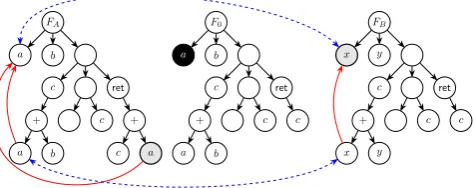
are selected and stored inM (figure 3.1b). For each of the selected counter-parts the dependence graph is built again and the resulting nodes are stored in A (figure 3.1c). The nodes in M and A are the nodes that are possibly affected by a change of the inspected node n. The conflicting nodes C are the changed nodes from the set of affected nodes M ∪A and the inspected node n. This result is shown in figure 3.1d. If the set of changed nodes contains at least one element in each tree, the set is added to the result set. The results are compressed by merging sets of nodes that overlap to-gether. For this purpose algorithm 3.2 has been developed. This algorithm first replaces nodes that are a descendant of another node in the set with the ancestor. This can be done since the ancestor node, given it is a memory operation, covers its descendants. Secondly any set of nodes that is a subset of a larger set is removed to avoid duplicates.
3.2.3 Refactorings (PC3)
Different kinds of refactorings exist. Earlier in this chapter a distinction was made between renamed identifiers, deleted identifiers, changed types of declared identifiers, and split or merged entities (like functions or classes in an object-oriented language). Below these kinds are discussed in more detail, and a new algorithm for detecting renamed and deleted identifiers is given.
Renamed and deleted identifiers (PC3a, PC3b)
Renamed and deleted identifiers can be detected with the same strategy. A new, naive algorithm for this detection is shown in algorithm 3.3.
First, the algorithm iterates over the declarations in the common ances-tor D. For each declaration d0, the mapped nodesd1 and d2 in both other versionsT1andT2are looked up. The next part of the algorithm is executed for each version separately.
If a declaration in a version of a program is changed from its counterpart in the common ancestor, there may exist some conflict. The nodes that cause the conflict are the newly added uses of the refactored declaration in the other version. These are determined by looking at the nodes referencing the refactored node in the version without the refactored declaration and discarding the nodes with a mapping.
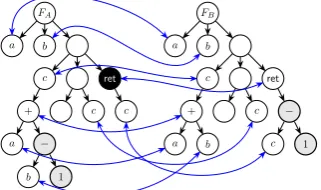
This process is visualized in figure 3.2.
Changed types of identifiers (PC3c)
Type information is at the moment not present in the intermediate rep-resentation, besides from the labels of declarations. Also, given the way C works, it is hard to correctly determine type (in)compatibility in static analysis for some statements. An example of such a statement is accessing
function ReferenceConflicts(T0,T1,T2) R:=∅
D:={d|d∈subtree(T0)∧is declaration(d)}
for d0 ∈D do
d1 :=mapping(d0, T1) d2 :=mapping(d0, T2)
U0 :={u|u∈subtree(T0)∧reference(u) =d0}
if changed(d1)∧d2 ̸=∅then
U2:={u|u∈subtree(T2)∧reference(u) =d2} R :=R∪ {u|u∈U2∧ ¬∃mapping(u, T0)}
end if
if changed(d2)∧d1 ̸=∅then
U1:={u|u∈subtree(T1)∧reference(u) =d1} R :=R∪ {u|u∈U1∧ ¬∃mapping(u, T0)}
end if end for return R end function
Algorithm 3.3: Detection algorithm for broken identifiers after merging a refactoring.
data in memory through a pointer. Due to the complexity this problem is not addressed in this research.
Split or merged entities (PC3d)
Declared entities containing program logic (like classes or functions) can be split up into two or more different entities, requiring two calls instead of one, and two functions can be merged into one. This means that the statements referencing these entities need to be changed as well. Godfrey and Zou describe a method for identifying the splitting and merging of entities [12]. Their method requires user interaction as fully automatic detection is not precise enough. The tool they developed shows the user a list of possibilities, of which the user can choose one. The fact that this technique requires user input makes this method not suitable for this tool.
FA
a b
c ret
+ c +
a b c a
F0
a b
c ret
+ c c
a b
FB
x y
c ret
+ c c
x y
(a) Process of algorithm 3.3. The black node is the inspected node d0. The red arrows are declaration references, the blue arrows mappings between nodes from the common ancestor (middle) to the compared versions. The dashed blue arrows are rename mappings. The shaded nodes are the uses that are inspected due to the changed mapping. These are (from left to right) stored in U1andU0respectively.
FA
a b
c ret
+ c +
a b c a
F0
a b
c ret
+ c c
a b
FB
x y
c ret
+ c c
x y
[image:32.595.181.419.318.412.2](b) Result of algorithm 3.3. The shaded nodes form a detected conflict consisting of a changed declaration in one version and new uses in the other version.
Figure 3.2: Illustrations of the steps taken by algorithm 3.3.
future changes to the implementation might cause strange behavior if part of the code is still using the old functions as the new functionality will not be used in all places it is expected to.
Chapter 4
Code analysis tools
In order to find problematic changes the code that will be merged needs to be analyzed. For every category of changes described in chapter 3, except for item PC1, not only the textual representation of the code, but also its meaning needs to be looked at. A good representation of source code that is often used for code analysis is an abstract syntax tree (AST). Additionally, many algorithms discussed in chapter 2 depend on the AST. The prototype will support the C programming language as this is a specific requirement as listed in appendix A.
In this chapter a number tools are be discussed. The tools under con-sideration are all able to parse C code and produce an AST. Some of the tools have additional functionality, which is discussed in the next section. The tools have been evaluated on certain criteria to assess their usefulness in the context of this project. One tool was chosen that will be used as a basis for the rest of the project.
4.1
Tools under consideration
For the system under development three tools were considered:
– C Intermediate Language (CIL) [22]
– Clang [8] + LLVM[29]
– Rascal [27]
OCaml, and provides libraries for that language. It also comes with a script that allows it to function as a drop-in replacement for GCC that applies transformations before passing the code on to GCC.
Clang is a front end compiler for theLLVMcompiler framework. Besides C it supports a number of C-like languages, including C++ and Objective C. Like CIL, it supports GCC extensions and should therefore be able to compile most C programs. Clang and LLVM were developed with tooling in mind and therefore a number of different APIs for tooling are available. Clang and LLVMlibraries are only available for C, however, these ship with Python bindings. Additionally some support for dynamically extending the compiler is available.
Rascal is a metaprogramming environment designed for analyzing, trans-forming and generating source code. It is designed to support many lan-guages. Rascal comes with its ownDSLfocused on code analysis and trans-formation. Rascal has extensions for C code analysis, however, these are still in development. At the time of writing only the support for Java is mature.
4.2
Evaluation steps and criteria
The goal of the tool evaluation process is to make an informed decision on the tool to further use in the project. Each tool is evaluated according to the evaluation process which is defined below. The tools are scored on a number of aspects related to the process steps.
The evaluation process is as follows:
1. Install the tool.
2. Using the tool, build an AST of a minimal example and a larger ex-ample.
3. Analyze the AST produced by the tool for completeness and detail.
4. Interface with the tool programmatically to build and output andAST.
There are a number of factors on which the tools are scored. For each score an explanation will be given.
– Installation and configuration: are there any installation or configura-tion issues?
– Performance: how much time is needed to parse the examples?
– Data quality: how useful and precise is the AST?
– API quality: is it easy to interface with the tool?
– Language support: which variants of C are supported, and are other languages supported as well?
The relative performance of the tools under evaluation is measured by compiling a small benchmark program consisting of a main file, a library and a header file for the library. The benchmark program is a command line program for interacting with a doubly linked list that was used for a Software Security course at the University of Twente. This small bench-mark should give an approximation of the performance since building an AST is an integral part of compiling a program. Since not all three tools support dumping an AST from the command line benchmarking the whole compilation process gives the most comparable results.
The performance benchmark is executed with a Python script running on Python 3.5. For each of the tools under evaluation, the script compiled the benchmark program exactly 10 times, measuring the total execution time. The subprocess module was used to call the executables of the tools. The system used to run the benchmark on is a relatively modern dual-core laptop computer running Linux.
The program used for the performance benchmark is also used for eval-uating the data andAPI quality, together with a trivial program consisting of only a main function and a return statement.
4.3
Results
The characteristics of each individual tool with respect to the evaluation criteria are discussed below.
4.3.1 C Intermediate Language
For CIL there are clear instructions for installation. First of all OCaml and OPAM, the OCaml package manager, need to be installed. This is fairly straightforward as these are available as packages on the test system. The installation of these dependencies is painless and no configuration is necessary. AnOPALpackage forCILexists to make installing it a matter of running a couple of commands.
The data structures provided by CILare detailed. It provides a number of extensions to a plain AST, including data structures for control flow and data flow analysis. The data structures are documented relatively well.
CILlibraries are available for the OCaml functional language. The API has been documented and some additional instructions are available. Sadly, all I got from CILwas a syntax error on the input file, even when trying to parse the trivial program. This is unexpected given that other researches have had success with CIL and that the command line compiler using CIL is able to produce a working program.
CIL only supports the C programming language. For this language it supports mostGCCextensions, according to the authors. The authors claim to have compiled the Linux kernel withCIL, which is usually a good indicator that the compiler can handle most other projects as well.
4.3.2 Clang
Clang was very easy to install. Version 4.0 was present in the package repos-itories of the test system, so a single command installed Clang successfully. Due to issues with the Python bindings as described below under ‘API qual-ity’ I opted for Clang 6.0 which is available from the official LLVMpackage repository, which I added to the software sources of the test system. This was therefore very easy as well.
Clang is a compiler front end and uses theAST for compiling the code to the intermediate representation of the LLVM compiler. Therefore it can be expected that the AST building is optimized for performance. For these small programs it seemed that writing the output to the terminal took more time than actually building the AST. Clang took just under 1.5 seconds in the performance test, which makes it quicker than CIL, but considerably slower than GCC. The relatively large difference is worth mentioning since the speed of a compiler is of importance for larger software projects.
TheASTprovided by Clang is very extensive and low-level. Data quality is therefore very good. However, some flattening of the tree might be needed in order to more easily compare nodes with each other. A downside of this level of detail is that knowledge of C specifics is required to properly process them.
Clang has an extensiveAPIfor which C libraries are provided. For the de-faultlibclanglibrary there are also Python bindings available. The Python bindings were used since ‘playing’ with the data structure in a Python shell is much easier than writing C code for the same purpose. It turns out that Clang and the Python bindings don’t play well together if they are not the exact same version. Also, the Python 3 compatible bindings are only available with later versions of Clang. The Python bindings in the package repository are for Python 2 only, therefore the Python source code from
the GitHub repository1 was used. This worked well together with Clang 6.0. It was very easy to access the AST as documented in the C library documentation.
Clang has support for a number of languages in the extended C family, including C++, Objective C and OpenCL C. There is, as expected, no sup-port for other languages. The C language supsup-port is good and many GCC extensions are supported by Clang.
LLVM
TheLLVMintermediate representation can contain metadata about the orig-inal program. This intermediate representation (IR) is much simpler than C code. It is therefore easier to perform analysis on this code after the complexity has been taken care of by the front end compiler, which is Clang in for the C language. The LLVM optimizer already contains a number of analysis algorithms, including control flow graphs and memory dependence analysis. Many parts of the IR can be traced back to a specific location in the original code, making the analysis useful for our purpose. By default LLVM does not output sufficient data for the purposes of this project, but the optimizer can be extended with additional passes to get the data out of the system.
4.3.3 Rascal
Rascal can either be used as a standalone JAR or with an Eclipse plugin. It is noteworthy that Rascal requires a JDK to run, only a Java runtime environment is not sufficient. A separate plugin provides C analysis capa-bilities. Eclipse update repositories are available for both plugins, making installation very easy. There is no manual configuration required.
I was not able to accurately measure the time taken by Rascal to parse the example code into an AST. This is due to the fact that this can only (easily) be done from their own console, there is no single command line program that can be run and timed. The command to parse the code in the Rascal console returns reasonably quick, however, it is impossible to rank this in comparison to CILand Clang.
Rascal’s tree representation is equally detailed as the representation of the other two tools. It does not add control flow information to the tree by default. Rascal provides a domain-specific language (DSL) to work with the AST. Because of its limited purpose this language is very suited to the task of analyzing source code. The data structures Rascal provides forASTs are very generic and are designed to be extended by specific language im-plementations. The C implementation seems to provide the necessary data structures for the supported C90 grammar. However, because of a lack of
1The Clang GitHub repository is located at
CIL Clang Rascal
Installation and configuration − + +
Performance = =
Data quality + = −
APIquality = + −
C language support = + −
Other language support − = +
[image:38.595.173.422.124.285.2]Overall − + −
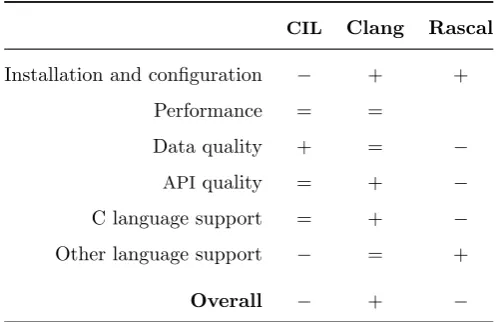
Table 4.1: Scoring table of the tools under evaluation. A score is either positive (+), neutral (=) or negative (−).
documentation and the fact that both Rascal and the extension for C sup-port are still in development, I was not able to get any practical use out of this tool. Data andAPIquality are therefore considered to be poor, with the side node that this might improve over time as the code repository seems to be active.
I have not found any claims regarding the level of support for the C pro-gramming language. Rascal includes by default a C90 parser which would not be sufficient for modern software. Rascal is extensible to support mul-tiple languages, however, currently only Java is relatively well supported.
4.4
Conclusions
The relative score resulting from the evaluations as described above is shown in table 4.1. Each tool has been scored on each factor. No score is given if it was not possible to evaluate that part of the tool.
At first the ‘overall’ score in the table was indented to represent a score for the tool considering the evaluated factors. Because only one evaluated tool actually works as expected it is unfair to give a positive rating to an tool that has not been observed in a usable state.
Besides the fact that Clang turned out to be the only properly working tool, it has scored well on the criteria that were defined beforehand. This might be due to the relatively large user base of the tool. Of the evaluated tools Clang seems to be the only one being used (at least with C code) outside of a research context.
Given that Clang scored well on the evaluation criteria and works as ex-pected it will be the tool of choice for this project. Of course the algorithms do not depend on any specific tool.
Chapter 5
System architecture
5.1
Requirements and considerations
For this project a number of requirements have been given by the client, ALTEN Netherlands. These requirements are listed in appendix A. Besides these requirements certain aspects of the chosen code analysis tool (see chap-ter 4) and algorithms (see section 3.2) need to be taken into account.
The abstract syntax tree (AST) produced by Clang is very detailed and, as one would expect, tied to C structure and context. Some data that is required for the analysis algorithms, which are discussed in section 3.2, is not encoded in theAST, so additional analysis has to be done beforehand. Due to the complexity of some parts of the C language this is relatively hard. The Clang compiler compiles C code to the LLVM intermediate representation (IR) which is easier to analyze. It also allows tracing back instructions from the IR to the original C source code. Therefore it makes sense to do parts of the analysis with LLVM and annotate the Clang AST with information obtained from LLVM.
Because the C parsing and preprocessing will be performed by differ-ent programs, it makes sense to have an analysis program that can receive data from any source. This combined with having a programming language independent representation of the program as input format results in the possibility of supporting multiple programming languages.
5.2
Architecture decomposition
5.2.1 High level architectureOn the highest level, three distinct components can be identified from the requirements. The first component, Parse, is responsible for parsing the source code into an internal representation of the AST. This component is also responsible for adding some analysis data specific to the programming language. Because two versions of a program need to be compared there are two independent Parse components. Secondly, the differences between the two versions need to be calculated. The Diff component serves this purpose and takes the ASTs produced by theParsecomponents as input. Given the ASTs and the calculated changes, the actual analysis can be performed by theAnalyze component. Finally the results need to be reported to the user, for which a Reportcomponent exists. The composition of these components is shown in figure 5.1.
Of course a system for configuring and controlling these components needs to be in place, however, these have been omitted from the architecture as these are not considered a core part of the system.
[image:40.595.135.461.389.416.2]Parse Diff Analyze Report
Figure 5.1: Composition of the high-level subsystems.
5.2.2 System components
Parse
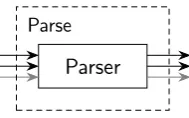
The Parsecomponent consists of a number of parsers, each with a different implementation. A parser is implemented for a specific programming lan-guage or a specific toolset for parsing code. The parser parses two programs for two-way analysis and three programs for three-way analysis. Both ver-sions that will be merged need to be parsed, and in the case of three-way analysis their common ancestor needs to be parsed as well.
Parser
Parse
Figure 5.2: Contents of theParsecomponent for a single run.
The Parser component accepts a program as input and is responsible for generating and parsing an intermediate analysis representation of the program. It also adds additional analysis information to the intermediate
[image:40.595.251.346.586.645.2]representation. While the exact implementation of this component might differ greatly for different programming languages some detail is given about the design of our C parser.
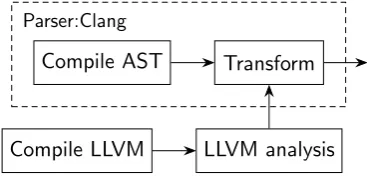
The C parser requires the path to the file containing the root of the program as input, just as a C compiler would. It then uses the Clang Python bindings to compile the source code into an AST. It also requires analysis performed by LLVM. This analysis is exported to a file using an extension module for the LLVM compiler. This file is then parsed by the parser after which the data is combined with the Clang AST and put into an internal data structure.
The architecture of the C/Clang version of the Parse component, de-noted by Parser:Clang, is shown in figure 5.2. In this diagram the Compile AST component represents libclang, the interface with the Clang compiler. The Compile LLVMcomponent represents the regular Clang compiler which compiles the C program into LLVM byte code. The LLVM analysis compo-nent represents theLLVMoptimizer with the analysis extension library that brings some static analysis results from the LLVM compiler to the Parser component.
Compile AST Transform
LLVM analysis Compile LLVM
[image:41.595.205.389.380.468.2]Parser:Clang
Figure 5.3: Composition of the Clang specific Parser component and sup-porting programs.
Diff
The Diff component calculates the difference between the parsed abstract syntax trees. The diff compontent takes the ASTs as input and returns the mapping between corresponding nodes in the trees and the changes that can be derived from this mapping. The algorithm that is used in the implementation is described in section 6.2. Pseudocode of the algorithm implementation can be found in appendix B.
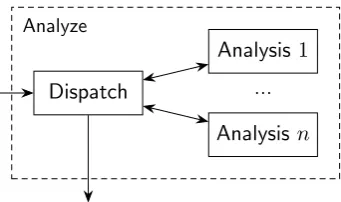
Analyze
results from the Diff component as input and produce detected conflicts. Each detected conflict consists of a number of conflicting changes and infor-mation on the details of the conflict. Each conflict is assigned a score based on the severity of the conflict. The composition is shown in figure 5.4.
The Analysis components, containing the analysis algorithms, are de-signed to work independent of each other. Therefore the execution order is not important. Since the algorithms do not modify existing data these could also be executed in parallel.
Analysis 1
...
Analysis n Dispatch
[image:42.595.215.386.242.343.2]Analyze
Figure 5.4: Composition of theAnalyze component.
Report
The Report component takes the output of the analysis and aggregates scores. It also reports the specific detected problems to the user. The detected problems have scores and the problems are sorted based on this score. A total and average score of the analysis is given to provide insight into the ‘danger’ of performing the merge.
The developed proof of concept does not support configuring the sever-ity of each kind of conflict to suit specific project needs. Also, no dynamic severities are implemented. Instead, each type of conflict is assigned a con-stant score to make a distinction between the types of conflicts. An example of a dynamic severity of a conflict would be to have the severity depend on the number of changes in the conflict.
Chapter 6
Implementation
A prototype of the system has been implemented in the Python program-ming language. The system architecture as described in the previous chapter is used as structure for the subsystems and interfaces. The system uses a plugin system allowing for easy integration of extensions to the functionality.
6.1
Framework
A small framework has been created from the architecture description. The framework additionally includes an intermediate data representation and a plugin system for extensibility.
6.1.1 Internal data representation
The abstract syntax trees are internally represented by a more generic tree structure. The internal data representation has been designed to have a small memory footprint. It therefore does not hold all data that a proper abstract syntax tree would. Instead, the tree nodes contain only the essen-tial information that is required by the algorithms. For extensibility each node can hold additional, unspecified metadata. At this moment the data in the intermediate representation has been selected based on the require-ments of the analysis, and the parser is responsible for providing that data. When the system is developed further it might be a good idea to spend time investigating a different data representation that provides more flexibility. One possible solution is discussed in chapter 8.
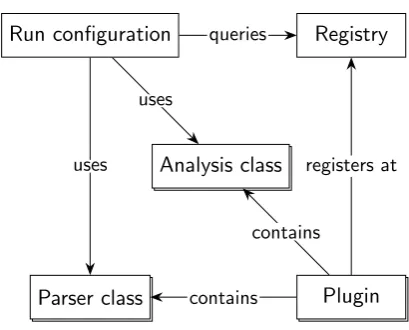
Dependencies and references
Registry Run configuration
Plugin Plugin Analysis class
Analysis class
Parser class Parser class
registers at
contains contains queries
[image:44.595.195.400.119.284.2]uses uses
Figure 6.1: Abstract diagram of the plugin system.
Changes
A change is represented as a combination of two nodes, each from a different AST, and a change operation. At this moment three change operations are supported: an insert, a delete, and a rename. Changes are modeled as a 3-tuple containing the node in the first version, the node in the second version, and the change operation. Either one of the nodes might be absent in case of an insert or delete operation. A different diff algorithm might support more change operations in the future, for example, moved subtrees.
6.1.2 Plugin system
For extensibility purposes the system has been designed to be plugin-based. There is a very small base system that consists of code for running the analysis, the intermediate representation and abstract classes that can be implemented by plugins. The default plugin adds implementations for a diff algorithm and some analysis algorithms. The C parser has been imple-mented in a separate plugin.
Plugins are loaded dynamically by looking for certain files on the Python path. Each plugin can define different implementations that it provides. These implementations are registered in a central registry and can be used when running the system. Figure 6.1 shows an abstract view of the compo-nents and their interactions.
6.2
Tree differencing
Tree differencing is used to compute the changes between the abstract syntax trees of two versions of a program. Typical algorithms take two labeled trees
as input, and yield a one-to-one mapping of the nodes in the trees that are considered equal. Non-mapped nodes are either inserted or deleted, mapped nodes with different labels are renamed.
In this section a number of algorithms are presented and the chosen algorithm and its implementation are discussed in more detail.
6.2.1 Considered diff algorithms
The ChangeDistiller algorithm combines comparing the structure of a sub-tree and the string labels of nodes for mapping nodes of two sub-trees [11]. Leaf nodes in the tree are mapped if their labels (ASTnode types) match and the string similarity of the values (concrete syntax) is above a certain thresh-old. For subtrees the same comparisons are used, with the addition that the number of matched leafs compared to the maximum number of leafs in one of the subtrees must exceed a certain threshold.
By default, ChangeDistiller works with coarse-grained AST nodes, re-sulting in small edit scripts but relatively large changes. This is not ideal for our purpose as detailed changes will result in detailed and specific prob-lematic changes that can be detected. If the extracted changes are relatively large the risk exists that a large number of these changes will be marked as problematic, while making it unclear in which part of the change the problem exists.
TheRTEDalgorithm (Robust Tree Edit Distance) is presented as an ef-ficient way of calculating the tree edit distance independent of the shape of the trees [25]. The authors claim that their algorithm computes at most the same number of subproblems that the competitors need to compute, while being more efficient when the competing algorithms run into the worst case scenarios. RTEDcomputes the optimal edit script by performing an exhaus-tive search on all possible strategies for calculating the tree edit distance and only doing the actual calculation on the optimal strategy.
RTED does not consider move operations, only insert, delete and re-name. This limitation allows the algorithm to be a lot faster compared to algorithms that do consider move operations. Also, computing moves can-not always be done properly as some parts of code tend to repeat many times, for example a variable. However, this approach may lead to a large edit script when existing code is wrapped in another statement, for example when code is wrapped in a conditional statement.
it-erated bottom up to map nodes with a lot of matching children, signifying renames. Finally an edit script is computed for the remaining nodes, for which theRTED algorithm is used.
Dotzler and Philippsen proposed a number of optimizations for shorten-ing the computed edit scripts to the aforementioned algorithms [9]. They describe five different optimizations that are applicable to all considered algorithms. The optimizations show improvements on the quality of the mappings as in all cases the optimizations resulted in less than 1.2% of the tests in worse results. The run time of the algorithms does seem to suffer in the case ofRTEDand GumTree, while the optimizations shorten the average run time for ChangeDistiller.
In conclusion, the more recent algorithm, GumTree, promises the best performance, both in edit script size and time. ChangeDistiller performs not as good and is less suitable for the level of detail that we like to have. Since RTED is used on the subtrees that were not matched by GumTree in the first phase, GumTree could be seen as an optimization for RTED.
6.2.2 Tree differencing implementation
The tree differencing algorithm that is used is an implementation of the GumTree algorithm as described in [10]. Several tweaks to the pseudocode have been made in order to make it more suitable for implementation in Python.
A relatively simple implementation of theopt() function in the algorithm has been used. This part of the algorithm matches subtrees if their similarity is above a certain threshold. The similarity is computed based on the shape of the tree and the similarity of the node types and labels. The specific algorithm that is chosen for computing the similarity is the Zhang-Sasha algorithm [34]. This algorithm is chosen in favor of the RTED algorithm that is described above as a working library for the Zhang-Sasha algorithm was available [13], while a working version ofRTEDwas not. The similarity of the nodes based on their type and labels is determined by the Levenshtein distance, which denotes the similarity of two strings. The specific algorithm that is used is the Wagner-Fischer algorithm [30].
The optimizations described by Dotzler and Philippsen [9] were not im-plemented due to time constraints.
The implementation specifics of the tree differencing algorithm can be found in appendix B.
6.3
Static analysis
The changes that are found in two versions need to be analyzed to find prob-lematic changes as discussed in chapter 3. For this purpose the detection
from checkmerge import CheckMerge, RunConfig
from checkmerge.analysis.dependence import DependenceAnalysis
from checkmerge.analysis.reference import ReferenceAnalysis
from checkmerge.diff import GumTreeDiff
from checkmerge_clang.parse import ClangParser
# Make sure CheckMerge is setup properly
if not CheckMerge.ready(): CheckMerge.setup()
# Create a new run configuration
run = RunConfig(parse_cls=ClangParser, diff_cls=GumTreeDiff)
# Create a run with a tree-way diff and two analysis algorithms analysis_run = run.parse(’a/program.c’, ’b/program.c’, ’0/program.c’
).diff().analyze(DependenceAnalysis).analyze(ReferenceAnalysis)
# Get the analysis results
conflicts = analysis_run.analysis()
Listing 6.1: Usage example of the declarative API. This example is without using the plugin system.
algorithms listed there have been implemented. As the pseudocode in chap-ter 3 has been written based on the prototype implementation in Python there are no significant differences between the pseudocode and actual im-plementation.
6.4
Interfacing with the system
The system provides two ways to interface with it. There is a command line interface for direct use, and a declarativeAPIfor integrating the system into another program or to turn it into a web service.
6.4.1 Declarative API
A single class,RunConfig, contains all logic to set up an analysis run. When it is initialized with a valid parser and diff algorithm, methods can be chained to form an analysis chain. Afterwards, or mid-way, result data can be ex-tracted. An example is shown in listing 6.1.
python -m checkmerge.cli analyze -p clang -a dependence -a reference a/program.c b/program.c 0/program.c
Listing 6.2: Usage example of the command line interface.
6.4.2 Command line interface
The command line interface can be accessed by running the checkmerge. cli Python module. Via the command line it is possible to diff and to analyze programs, as well as to view the installed plugins and the parsers and analysis these provide. When diffing or analyzing two programs one of the installed parsers must be specified. When analyzing two programs, one or more analysis algorithms must be specified as well. Instructions for using the command line interface can be obtained by running it with the --help flag. An example of a command line invocation is shown in listing 6.2, performing the same task as the ASTexample above.
6.5
C support with Clang and LLVM
The C support plugin uses the Clang Python bindings to derive the AST from a program. A customLLVManalysis pass is provided to use the LLVM optimizer to get dependency data to enrich the ASTwith.
6.5.1 Custom LLVM pass
LLVM, being a compiler back-end, can perform a lot of different analysis on transformed C code already. However, this data is mostly kept internal and is not exposed via a command line interface or library. Some analysis functions in LLVMdo have output, but this output is mostly aggregates and no raw data.
With an analysis pass custom code can be dynamically loaded intoLLVM and executed on parsed code. The custom pass declares its dependence on the memory dependence pass, making sure it is executed. Then the memory dependence information is queried and formatted into a YAMLfile, which is written to the file system to be read later on by the analysis system.
Because the analysis of LLVM works with the LLVM IR instead of the C code directly, the IR code is compiled with debug information, allowing instructions to be traced back to the original C code. The memory depen-dence information that is saved is combined with file names and line and column numbers for that purpose. The matching of the memory dependence information with the C code is done in the parser of the analysis system.