University of Warwick institutional repository: http://go.warwick.ac.uk/wrap A Thesis Submitted for the Degree of PhD at the University of Warwick
http://go.warwick.ac.uk/wrap/4421
This thesis is made available online and is protected by original copyright. Please scroll down to view the document itself.
By
Hao
Lin
A THESIS SUBMITTED IN PARTIAL FULFILLMENT OF THE REQUIREMENTS FOR THE DEGREE OF
DOCTOR OF PHILOSOPHY AT
UNIVERSITY OF WARWICK, \VARWICK BUSINESS SCHOOL COVENTRY, UNITED KINGDOM
To
my
parents and
my
wife.
List of Tables List of Figures Acknow ledgements Declaration
Abstract
1 Introduction
1.1 The scope of the thesis . . . . 1.2 The organization of the thesis
2 Literature review
2.1 Literature on equity market making. 2.1.1 Inventory models . . . . 2.1.2 Asymmetric information models 2.2 Literature on option market making. 2.3 Literature on horse race bookmaking .
3 Market making with inventory uncertainty and information asym-metry
3.1 Introduction . . . . . 3.2 The model . . . . 3.2.1 Assumptions.
3.2.2 The Kalman filter updating
3.2.3 The market maker's optimization problem 3.3 The solutions . . . .
3.4
3.5 3.6 3.7
3.3.1 The optimal bid and ask prices . . . -1:2 :3.3.2 The market maker's pricing bias . . . .
3.3.3 The market maker's pricing bias when the spread is constant Numerical experiments . . . .
3.4.1 Parameter values . . . . 3.4.2 Simulated prices and quotes . . . . 3.4.3 The effect of risk aversion on the pricing bias . 3.4.4 The market maker's cumulative profit . . . The continuous time extension of the monopolistic model The extension to competitive market making.
Conclusion. . . .
-fj 17 -18 -18 ;:)0 51 52 55 58 60
4 Market making with return commonality 63
63 69 69 72 74 75 77 77 79 83 4.1 Introduction . . . . .
4.2 The model . . . . 4.2.1 Assumptions . . . . 4.2.2 The Kalman filter updating
4.2.3 The market maker's optimization problem 4.2.4 The results . . . . 4.3 The benefit of knowing return covariance . . . . 4.3.1 Parameter values and simulation design. 4.3.2 The simulation results
4.4 Conclusion . . . .
5 The role of market makers' hedging on the spreads in options and
stock markets 86
5.1 Introd uction . . . 86
5.2 The model . . . 93
5.2.1 Assumptions. 93
5.2.2 Bid and ask prices in the stock market 96
5.2.3 The informed traders' trading strategy 100
5.2.4 The OMM's hedging strategy . . . 102
5.2.5 The general problem . . . 105
5.3 When the OMM does not hedge: the benchmark case 106
5.3.1 The bid and ask prices in the underlying market . 107
5.3.2 The option bid and ask prices . . . . 107
5.3.3 The informed trading in equilibrium 108
5.4 When the Of\If\I hedges: the regular case 108
S.-1.1 Parameter values . .. . . . . 108
5.4.5 The expected return on investment in stocks and options 122 5.·5 A market for several options when hedging is done in the underlying
stock. . . 126 5.6 A market for several options when hedging is done with options 133
5.7 Empirical implications 14()
5.8 C o n c l u s i o n . . . 142
6 A simple model of horse race bookmaking 6.1 Introduction...
6.2 A simplified model . . . . .
6.3
6.4
6.5
6.2.1 Assumptions . . . . . 6.2.2 A numerical solution Stochastic liabilities. . . . . 6.3.1 First stage: constant a
6.3.2 First stage: proportional a
Subsequent stages odds setting 6.4.1 Expected demands 6.4.2 Noisy demands Conclusion.
7 Conclusion
7.1 Summary and conclusions 7.2 Directions for future research
A Proof of results in Chapter 3 A.l Proof of Proposition 3.1 A.2 Proof of Corollary 3.2 . . A.3 Proof of Proposition 3.3 A.4 Proof of Corollary 3.4 . .
145 145 148 148 152 155 158 160 162 162 167 170 174 174 181 184 184 185 186 186
B Simulation of random variables that has a covariance matrix V In
Chapter 4 187
C Simulation of shocks in Chapter 6 191
Bibliography 192
List of Tables
3.1 Parameter and initial values used in the simulation . . . .. -19
5.1 Parameter values and variables' ranges used in the numerical calculations. 109 5.2 The effect of j.1, a, and K on the informed trading strategy . . . . .. 113
5.3 Informed trading intensity in stocks in the cases of 01\11\1's hedging and not hedging in the stock market. . . .. 11-1 5.4 Stock spreads in the cases of OMM's hedging and not hedging in the
underlying market 118
5.5 Option spreads in the cases of OMM's hedging and not hedging in the
underlying market 119
5.6 Summary of the effects of j.1, a and K on stock and option spreads in
the cases of the 0 MM' s hedging and not hedging . . . . 120 5.7 The effect of j.1 on option spreads when the OMM hedges
5.8 The expected returns on investment in stocks and options
122 125
6.1 Parameter values used in the numerical solution 153
6.2 Bookmaker's quotes: deterministic demands . . 15-1
6.3 Bookmaker's quotes: stochastic demands with constant a 158 6.4 Bookmaker's quotes: stochastic demands with proportional a . 160
6.5 Multistage odds setting: expected demands. 164
6.6 l\lultistage odds setting: noisy demands. . . 169
3.1 Market demand functions: the model of monopolistic market making 38 3.2 Simulated prices and quotes . . . jO
3.3 The effect of risk aversion on the pricing bias. 52
3.4 Mean vs. standard deviation of the cumulative profits of 25 and 100
time steps for different ). 54
4.1 The time series of prices . . . 80
4.2 The benefit of knowing return covariance 81
4.3 The contribution of correlated order flow information in price estimation 82
5.1 Information structure of the model .. . . .. 97 5.2 Stock and option spreads when an OMM does and does not hedge in
the underlying market . . . . . . .. 111 5.3 Stock and option spreads when the OMM makes a market for two
options and hedges in the underlying market . . . . 131 5.4 Information structure when OMMs hedges using options 135 5.5 Stock and option spreads when OMMs hedge using the underlying and
the other options . . . .. 139
6.1 Distributions of books and normalized prices: expected demand functions 166 6.2 Distributions of books and normalized prices: noisy demand functions 168
Acknow ledgernents
I am extremely indebted to my advisor, Professor Stewart Hodges. He has beeIl a great source of intellectual inspiration during the entire period of my doctoral studv. His patient guidance and invaluable comments are indispensable to the completion of this thesis. I hope we will continue to co-operate in the future as we have done in these rewarding years.
I am also grateful to Professor Antonio Mello at the University of \Visconsin-Madison for his insights, motivation and hospitality. Chapter 5 of the thesis is com-pleted under his supervision when I visited UW-Madison.
A special thank goes to the examiners of my thesis, Professor Anthony Neuberger and Professor Ian Tonks, for their helpful comments and suggestions.
I am thankful to my friends and colleagues at the Warwick Business School and School of Business at UW-Madison for their friendship over the years.
I would like to dedicate this thesis to my parents and my wife Lan. Without their continuous support, this work cannot be finished.
Finally I thank the financial support from the Warwick Postgraduate Research Fellowship, the University of Wisconsin-Madison Fellowship, and the Warwick Busi-ness School Studentship.
Coventry, United Kingdom July, 2006
Vlll
I declare that this thesis is submitted to the University of Warwick for the degree of Doctor of Philosophy in 2006. Except where acknowledged, the material contained in this thesis is my own work and that it has neither been previously published nor submitted elsewhere for the purpose of obtaining an academic degree.
Coventry, United Kingdom
July, 2006
IX
Abstract
Market making is central to the study of market microstructure. Market makers stand ready to provide liquidity, market stability and price discovery, issues of great importance to regulators, practitioners and academics. This thesis contributes to the literature by studying four topical issues related to market making.
The thesis consists of four essays. In the first essay we develop a simple multi-period model of market making for a monopolistic stock market maker. The market maker tries to solve simul-taneously the problems of managing his inventory and trading with informed traders. He uses a Kalman filter to update his estimates of the unknown market prices through his noisy order flow observation. We analytically characterize the optimal bid and ask prices and find that they depend on the beginning inventory, the estimated price, and the market maker's prior estimation error of the price process for each time period. We obtain desirable numerical results by using properly chosen parameters. The extensions to the continuous time and a competitive market making environment are also discussed.
The second essay extends the model in the first essay to consider the market making of multiple stocks. The market maker still does not know the true prices but is assumed to know the return covariance structure of these stocks. When the market maker considers the correlated order flow information, his knowledge of the return covariance improves his estimation of the unknown price processes, resulting in higher cumulative profits and lower risks of the profits.
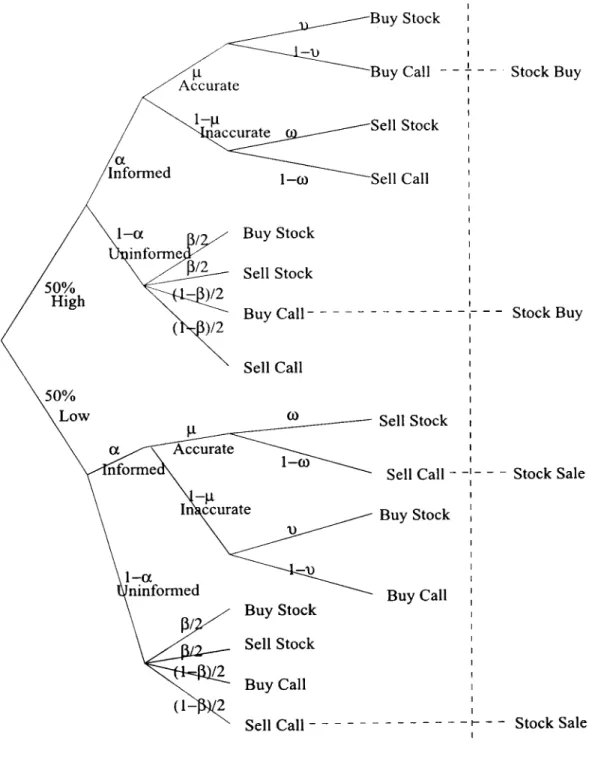
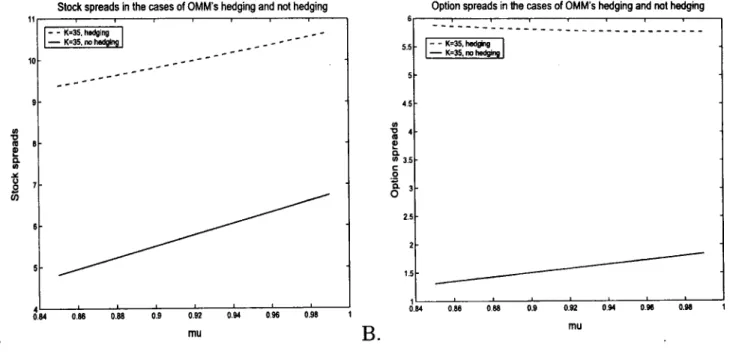
The third essay analyzes the effect of option market makers' hedging on the informed trading strategy and the subsequent changes in the costs of liquidity provision in both stock and option markets. In a sequential trading framework, an option market maker uses the stock market to hedge his option position. His hedging trade affects the way that informed traders submit their orders in both the stock and the option market, which in turn changes the informed trading pressure faced by the market makers in each market. Furthermore, information in the option trading is passed to the stock market through the hedging trade. Both stock and option spreads are wider with option market maker's hedging. The increase in the spreads is more significant when the option market maker hedges in the underlying market than when it hedges with different options.
The fourth essay provides a model of bookmaking in a horse race betting market. The bookmaker observes the noisy public betting flow and faces the risk of trading with possible informed traders, as well as the risk of his unbalanced liability exposures. Even the noisy demand can unbalance the bookmaker's book. In our model, the bookmaker revises his odds to mitigate the risk. Allowing the bookmaker to set odds over several rounds of betting gives a clear view of the bookmaker's price setting strategy and its impact on the public betting flow over time. The study of horse race bookmaking provides useful insights into the market making of state contingent claims such as options.
Introduction
Over the past 30 years, market microstructure has become an important research area
in financial economics. It studies the process by which investors' latent demands are
ultimately translated into transactions (Madhavan (2000)). Of particular interest in
the market microstructure research is the study of market makers. l\Iaker makers are
a special group of dealers and they playa central role in financial markets. They stand
ready to buy and sell securities on a regular and continuous basis at a publicly quoted
price.l Perhaps the most prominent example of market makers are the specialists at
New York Stock Exchange (NYSE). A specialist performs five essential functions in
the specific securities allocated to him at NYSE. He manages the auction process by
establishing the opening price for his security every day and executes orders for floor
brokers. He also serves as catalysts by bringing buyers and sellers together, enabling
a transaction to take place that otherwise would not have occurred. He provides
capital by trading against the trend of the market to minimize the order imbalance.
1 http://www.sec.gov/answers/mktmakers.htm.
2
and stabilizes prices to ensure smooth trading. 2 Market makers therefore play an important role in price discovery and market stability, issues of great interests to
regulators, practitioners and academics.
This thesis is differentiated from the previous studies on market microstructure
in two aspects. First, we are mainly interested in the normative problem of how a
market maker should behave; the answers are important guides to public and private
decision makings. Second, we are particularly interested in how an option market
maker should behave in setting his bid and ask prices. Options at different strike
prices are a parameterized family of substitutable securities and the study of the
relation among closely related option contracts poses challenges to researchers. The
models in this thesis provide some foundations to understand the complexity of option
market making in practice.
1.1
The scope of the thesis
This thesis contributes to the literature by investigating four issues related to the
market making in various financial markets. The first issue is related to the well
known literature on market makers' price setting strategies. Previous literature has
documented that market makers generally face two problems: the inventory problem
and the asymmetric information problem. Market makers face the risk of building
up risky inventories in the market making business. They change their bid and ask
prices to elicit the unexpected imbalance of buy and sell orders, aiming to restore
inventories to a preferre? position. In a market with asymmetric information, the
bid-ask spread arises from the existence of informed traders, who have better knowledge
of the stock's future value. Market makers lose on average to informed traders but
recoup their information loss from trading with uninformed traders.
The literature however focuses on these two problems separately. In practice,
market makers hardly face only one problem and not the other. It is of interest
to integrate the two problems into one setting under which both problems can be
analyzed simultaneously. In particular, a market maker's inventory positions should
enter into the model explicitly so that his price setting strategy directly affects his
inventory exposures. In addition, a market maker must be able to observe the noisy
signal about the stock's true value, which only informed traders know exactly.
These two ingredients are incorporated into our model in Chapter 3. In a Bayesian
updating framework, a monopolistic market maker uses the order flow information to
estimate the true value of a stock. The order flow conveys two pieces of information:
first, the net order flow contributes to the net changes in his inventory, and second,
the part of informed trading in the overall order flow provides a noisy signal of the
true prices. Using Bayes rule, the market maker obtains optimal estimates of the true
prices and sets optimal bid and ask prices to influence the public order flow so as to
manage his inventory positions.
4
The second issue of this thesis concerns the market making of multiple stocks.
The traditional focus of market making research has been on the liquidity provision
of an individual security. In practice, a market maker normally makes markets for
more than one security. At NYSE, for example, there are currently 7 specialist firms
making markets for approximately 2672 listed companies. It is therefore of interest to
examine the implication of the multiple stocks market making on the market maker's
price setting strategies and its impact on order flows.
In Chapter 4, we extend our single stock market making model in Chapter 3 to
incorporate multiple stocks. We assume that the market maker, still a monopolist,
does not know the true prices but knows the return covariance structure of these
stocks. He still uses order flow information to update his estimates of the true prices.
His knowledge of the return covariance structure in this case affects order flows. We
find that, by considering the correlated order flow information in his price estimation,
the market maker obtains better estimates of the stocks' true values, which improves
his market making profitability.
A direct implication from the market maker's knowledge of the return
covari-ance is that order flows exhibit liquidity commonality. Liquidity commonality is
important because systematic liquidity is most likely a priced source of risk (Amihud
(2003)). Consistent with empirical findings of Coughenour and Saad (2004), our
re-sults provide another support to the claim that common market makers are a possible
reason for liquidity commonality.
Chapter 4 also serves as a first step for our study of option market making. An
option market maker makes markets for a number of option contracts, in a much
similar way as market making multiple stocks. Our assumption of the stocks' return
covariance structure is also particularly suitable for analyzing option market making.
Our model in Chapter 4 therefore provides insights into the market making of the
parameterized family of substitutable securities such as options with different strike
prIces.
The third issue in this thesis concerns the informed trading across stock and its
option markets. For stocks with their options traded, informed trading can take
place in either the underlying stock market or the option market. There is a growing
body of literature that provides evidence that informed traders do trade in option
markets and the option market makers' hedging activities affect the costs of liquidity
provision in both stock and option markets. Analyzing the option market maker's
hedging therefore provides an important link of the liquidity in these two markets.
Chapter 5 provides the first theoretical model that explicitly considers the
op-tion market makers' hedging activity and analyzes its effect on the informed trading
6
option markets. We show that the hedging by market makers has a significant impact
on the choice of the market that informed traders submit their orders to. Since
infor-mation that is channeled by options trading is passed on to the stock market through
the hedging trade of the market maker, both stock and option spreads are wider with
option market maker's hedging. The model is able to explain the recent empirical
results of Kaul, Nimalendran, and Zhang (2004) and de Fontnouvelle, Fisher, and
Harris (2003), that suggest that the cost of hedging has an important effect on both
stock and option spreads.
Chapter 5 also contributes to the literature that investigates how informed trading
in the option market is distributed across strike prices. We study this problem by
extending the model to include multiple options on the same underlying asset. We
show that stock spreads are smaller when more options are traded. Compared to
the case in which each option is the only traded option, the spreads of each option
are smaller when multiple options are traded simultaneously. For the stock, we show
that when informed traders have the choice of trading multiple options, there is less
informational content in the option market maker's hedging trade. This eases the
informed trading threat in the stock market and allows the stock market maker to
narrow the stock spreads. Also, since options have a convex payoff structure, the
combined hedge ratio of multiple options is smaller than the hedge ratio for each
narrows the option spreads.
The fourth issue of this thesis concerns the bookmaking in a horse race betting
market. Studying horse race bookmaking provides a way to understand the market
making of state contingent claims such as options since a bookmaker and an option
market maker share many similarities. For example, an option market maker's profits
are contingent on the final value of the stock. Suppose an option market maker deals
with butterfly spreads instead of a single option, there is one and only one option of
the spreads that will payoff at expiry. It is exactly the same in a horse race: there
is one and only one horse that will win the race eventually. Furthermore, an option
market maker wants to have flat and positive positions over all option exposures, so
that he could always have positive profits and avoid negative ones. Similarly in a
horse betting market, a bookmaker sells liabilities over all horses and wishes to avoid
large liability exposures. Since a horse betting market is an especially simple financial
market, in which the complexity of the pricing problem is reduced, it provides a clear
view of pricing issues which are more complicated elsewhere.
Chapter 6 provides a simple model of bookmaking in a horse race betting market.
The book is liable to become unbalanced because the betting demands are noisy
and the bookmaker may not know the correct odds to quote. He has to worry about
trading with informed traders. Furthermore, whenever his book becomes unbalanced,
liability exposures can be alleviated. Even random shocks from nOIse t radel's are
costly to the bookmaker since his book could become less balanced.
In our model, the bookmaker revises his odds to mitigate the risk. He influences
the public betting flow by raising the normalized prices for horses with high initial
liabilities and lowering the normalized prices for horses with low initial liabilities.
Allowing the bookmaker to set odds several rounds before the race starts gin>s llS
a clear view of the bookmaker's price setting strategy and its impact on the public
betting flow over time. Our model helps to understand the complexity of managing
a series of state contingent exposures such as options for a single expiry date.
1.2
The organization of the thesis
Following the introduction, the thesis is organized in the following way. In Chapter
2, we review the literature that is related to our work in this thesis, namely, the
literature on equity market making, the literature on option market making, and the
literature on horse race bookmaking. Chapter 3 develops a simple multi-period model
for a monopolistic market maker who tries to solve simultaneously the problems of
managing his inventory and trading with informed traders. The market maker uses
a Kalman filter to update his estimates of the true prices through his order flow
observation. Chapter 4 extends the single stock model in Chapter 3 to consider the
market making of multiple stocks. Gin>n the market maker's knowledge of the return
considering the correlated order flow information in his price estimation. Chapter 5
studies the informed trading in the option market and the effect of the option market
maker's hedging on the costs of liquidity provision in both stock and option markets.
We find the option market maker's hedging trade conveys information and affects
the informed traders' order placement strategy, which in turn changes the informed
trading pressure faced by the market makers in each market. Chapter 6 provides a
simple model of bookmaking in a horse race betting market. A bookmaker influences
the public betting flow by setting appropriate odds for all horses to mitigate the
risk of an unbalanced book. The bookmaker's odds setting strategy provides useful
insights into the management of state contingent exposures such as options. Finally,
Chapter
2
Literature review
In the frictionless Walrasian models of trading behavior, perfect competition and free
entry are typically assumed. Market microstructure studies what Walrasian
mod-els have ignored, yet an important aspect of financial markets: frictions (O'Hara
(1995)). It examines the process of price formation in the presence of risks, costs and
asymmetric information.!
In this chapter, we discuss the literature that is relevant to our work in the thesis.
We divide this chapter into three sections. The first section reviews the literature
on equity market making, the traditional focus of the market microstructure study.
Given its uniqueness, we review the literature on option market making separately in
the second section. The last section reviews the literature on horse race bookmaking
sincc we will develop some strong parallels between this and option market making. 1 For a comprehensive review of the theoretical literature on market microstructure, see O'Hara
(1995). I\Iadhavan (2000), Stoll (2003) and Biais, Glosten and Spatt (2005) provide mon' recent surveys.
2.1
Literature on equity market making
Early literature on market microstructure focuses on the operations of dgents called
market makers. They stand ready to buy and sell securities on a regular and
contin-uous basis at a publicly quoted price. Given the central role of market makers, it is
a natural starting point to study how prices are determined inside the so-called black
box of a security market (Stoll (1976) and O'Hara (1995)).
Market makers quote bid and ask prices at which they buy and sell securities. The
difference between the bid and ask prices is called the bid-ask spread. The analysis
of how bid-ask spreads are determined provides insights of how market makers set
prices in the market.
The bid-ask spread reflects the difference between what active buyers must pay
and what active sellers receive. It is an estimator of the cost of liquidity provision
and the illiquidity of a market (Stoll (2003)). Demsetz (1968) observes that buyers
and sellers may enter the market at different times and the bid-ask spread arises as
the size of price concession needed for immediate transaction. Demsetz (1968) is the
first to describe the specialists at NYSE as suppliers of immediacy: they passively
provide liquidity to accommodate the transitory order imbalance by adjusting bid-ask
spreads, and thereby stabilize prices. The bid-ask spread provides the specialists wi t h
the appropriate return under competition.
12
find it can be explained by economic variables.2 In fact, the relation between the spread of a security and the trading characteristics of that security is one of the
strongest and most robust relations in finance (Stoll (2003)). In a more recent study,
Stoll (2000) finds over 79% of the cross-sectional variation in proportional spreads is
explained by stock characteristics. The well-known key results are: spreads are lower
for stocks with greater trading volume, with lower return volatility, with higher price,
and with smaller trading imbalance.
In the following sections, we discuss two general theoretical frameworks that
deter-mine the bid-ask spread of a security, namely, inventory risk models and asymmetric
information models.
2.1.1
Inventory models
Inventory models focus on the issue that market makers must carry unwanted
in-ventories in order to perform their dealership functions. When there is an order
imbalance that moves the market maker away from his desired inventory position,
he adjusts the bid and ask prices to attract orders and re-optimizes his inventory
position. Important pape~s of inventory models include Garman (1976), Amuhud
and Mendelson (1980), Stoll (1978), Ho and Stoll (1981, 1983), O'Hara and Oldfield
(1986) and Madhavan and Smidt (1993).
Garman (1976) is perhaps the earliest paper focusing on the market maker's
in-ventory risk. While Demsetz (1968) studies the trading desire of an individual trader,
Garman (1976) focuses on the stochastic arrivals of order flows and how the market
itself works to solve the clearing problem. He characterizes an exchange market by
a flow of stochastic orders to buy and sell and the imbalance between supply and
demand could temporarily arise. This imbalance gives an importance to the temporal
microstructure, i.e., how the exchange between buy and sell actually occurs at any
point in time.3 In his dealership structure, the single, monopolistic market maker's
objective is to maximize his expected profit per unit of time, subject to the avoidance
of failure (i.e., running out of cash or inventory). Central to the dealer's problem is
therefore the asynchronism between the flow of buys and sells. Garman's analysis
demonstrates that the inventory determines the dealer's viability.
Garman's (1976) work stimulates the subsequent research in the inventory models.
For example, Amihud and Mendelson (1980) explicitly incorporate inventory into the
dealer's pricing problem and show that the dealer has a preferred inventory level
because of the nature of the order arrival process. Optimal bid and ask prices exhibit
a positive spread. Stoll (1978) examines the dealer's role as the supplier of immediacy.
Different from the order-based analysis in Garman (1976) and Amihud and Mendelson
(1980), Stoll's focus is on the portfolio risk that the dealer faces. The dealer is willing
14
to alter his desired portfolio position to accommodate other traders' trading needs.
In the same way that any intermediary must be compensated, risk averse dealers4
must be rewarded for the costs of providing their services. The market spreads reflect
the cost of bearing the risk associated with the unwanted inventory.
The inventory model in Stoll (1978) has been extended to account for multiple
stocks, multiple time periods (Ho and Stoll (1981)) and multiple market makers (Ho
and Stoll (1983)). The intertemporal model of Ho and Stoll (1981) differs from
the risk neural intertemporal models of Garman (1976) and Amihud and Mendelson
(1980) in that the market maker's attitude toward risk affects his optimal pricing
policy. In solving the maximization problem of the market maker's expected utility
of the terminal wealth, the authors find the spread is largely independent of the
market maker's inventory position but depends on the fundamental characteristics
of the stock (such as the risk of the stock) and the market maker (such as his risk
aversion and the time horizon). The market Jllaker affects the order arrival processes
by moving the placement of the spread rather than adjusting the size of the spread.
The literature that we have reviewed so far focuses on a single, monopolistic dealer.
Ho and Stoll (1983) examine the pricing setting strategy in a model of competitive
dealers. They analyze two competing market makers each trading two stocks and
choosing bid and ask prices to maximize his own expected utility. However their
simple one-period model does not explicitly incorporate the intertemporal inventory
position of the competing market maker, so the strategic element of market maker's
price setting strategies is not considered. Since traders could trade with the market
maker who has the best price, each market maker's pricing problem should depend on
the actions of every other market maker (O'Hara (1995)). Modeling the competition
among market makers is therefore more complicated. The formal treatment of the
competitive dealership would require a careful game-theoretical analysis.
In summary, central to inventory models are the uncertainties in order flows, which
can result in inventory problems for market makers. Since unbalanced inventory
carries risk, market makers have to moderate the random order flows according to
their respective risk structure. The bid-ask spread arises either to reflect market
makers' market power (Garman (1976) and Amihud and Mendelson (1980)) or to
compensate market makers for bearing the risk of holding undesired inventories (Stoll
(1978) and Ho and Stoll (1981, 1983)). In the long run order flows are balanced by
assumption and they are irrelevant in determining security prices. But in the short
run, they do affect the fine price behavior. Important empirical questions arise from
inventory models include what a market maker's preferred inventory position is and
whether the inventory level induces mean-reverting in security prices5. These studies
advance our knowledge of how prices are determined in the black box of a security
16
market.
2.1.2
Asymmetric information models
Recent literature on market microstructure applies the insights from information
economics to study the dealer's behavior. The origin of asymmetric information
models is usually attributed to an influential paper by Jack Treynor (writing under
the pseudonym of Bagehot (1971)). Treynor suggests the presence in the market of
traders who have superior information (informed traders) and who are liquidity
moti-vated (uninformed traders). In an anonymous market, dealers must lose to informed
traders, for the informed traders are not identified.6 He notes that the losses to the
informed must be offset by the profits from the uninformed traders if dealers are to
stay in business. The spread therefore reflects a balancing of losses to the informed
with gains from the uninformed. That is, adverse selection imposes a cost, which
must be made up by a spread, even for a risk neutral, competitive market maker
(Copeland and Galai (1983)). This provides a way to explain the market bid-ask
spreads without relying on exogenous technological specifications of the transaction
cost. Important theoretical papers that build on the adverse-selection cost of the
spread include Glosten and Milgrom (1985), Easley and O'Hara (1987), and Kyle
(1985).
Since informed traders only buy when the price is low and sell when the price
is high, the trades themselves could reveal the underlying information and therefore
affect the price process. This is the insight of the sequential trading models of Glosten
and Milgrom (1985) and Easley and O'Hara (1987) in which a rational market maker
gradually learns this underlying information and sets ex post regret-free prices that
converge to the expected value of the underlying asset. In Glosten and Milgrom
(1985), the bid-ask spread is increasing in the information asymmetry (as measured
by the percentage of informed traders in total trading popUlation) and in the degree
of asset value uncertainty (as measured by the range of possible values of the asset).
Easley and O'Hara (1987) allow for trades of different sizes and assume that traders
with superior information prefer larger size transactions. Adverse selection arises
because a rational market maker interprets large orders as a signal of informational
trading and adjusts the price and spread accordingly.
Kyle first characterizes the strategic behavior of informed traders who maximize
the value of their private information before the information becomes common
knowl-edge. In a batch trading model, the market maker aggregates the orders and sets one
price (instead of bid and ask prices) to clear the market. Kyle demonstrates the
existence of a rational expectation equilibrium in his model in whieh the informed
traders' conjecture of the market maker's pricing policy and the market maker's
infer-ence about the informed traders' information are both correct in the equilibrium. He
18
prices eventually incorporate all available information.
Kyle's (1985) model was further extended by Holden and Subrahmanyam (1992)
and Admati and Pfleiderer (1988). Holden and Subrahmanyam (1992) incorporate
competition among multiple risk-averse insiders with long-lived private information.
They demonstrate the existence of a unique linear equilibrium in which competition
among insiders is associated with high trading volumes and rapid revelation of private
information. In the limiting case in which the number of informed traders goes to
infinity, all information is revealed in the first trading interval and the price equals
the true value instantaneously. Admati and Pfleiderer (1988) develop a model of
strategic play by informed and uninformed traders. They allow some uninformed
traders (called discretionary uninformed traders) to have discretion over which time
period they want to trade in.7 The optimal behavior for an uninformed discretionary
trader is determined by solving for the minimum cost trading period in which to
transact. Admati and Pfleiderer show that in the equilibrium the discretionary traders
choose the lowest-cost period in which the variance of the uninformed trade is highest.
I t follows that to maximize the variance of the uninformed trade, discretionary traders
all select the same period to transact, inducing the observed patterns8 that trades
are concentrated in particular time periods within the trading day and the periods of
high trading volume also tend to be the periods of higher return variability.
7 Other papers that consider the uninformed strategic behavior include Foster and Viswanathan
(1990), Seppi (1990), and Spiegel and Subrahmanyam (1992).
In summary, the key element of asymmetric information models is that trades
convey information. A market maker, by observing trading activities, gradually learns
the information held by informed traders. The market maker adjusts prices so that, at
any point in time, the prices reflect the expectation of the security's value, conditional
on all public information, including the prior trades. The price dynamics are therefore
derived from the mechanism of the market maker's learning process. Most asymmetric
information models basically solve this dynamic learning problem via an application
of Bayes rule.9 The strategic traders models of Kyle (1985) and subsequent papers (e.g., Holden and Subrahmanyam (1992) and Admati and Pfleiderer (1988)) link the
market microstructure research to the rational expectation literature to allow better
characterization of the trading behavior of different market participants.
2.2
Literature on option market making
Literature on option market making focuses on the informational role of option
trad-ing. In a complete market, an option is a redundant asset: its prices are determined
unilaterally by the price of its underlying asset and do not convey information (Black
and Scholes (1973)). If, however, the market is not complete and market frictions do exist, an option is not redundant and an option trading process contains
infor-mation about the underlying asset prices. Back (1993) shows that, with continuous
20
arbitrage. The option market therefore provides another channel through which in-formed traders can profit from their information. Black (1975) argues that the option market is an ideal venue for informed trading because of its leverage advantages, low transaction costs, less stringent margin conditions, and the absence of the up tick rule for shorting.
One way to study the informational effect of option trading on the underlying market is to examine which market leads the other in information discovery (the lead-lag effect). The empirical findings are however inconclusive. The results of Manaster and Rendleman (1982), and Anthony (1988) suggest that the price changes in option markets lead the price changes in stock markets. However, Stephan and Whaley (1990), Chan, Chung and Johnson (1993) and others find no evidence that supports such lead. These conflicting results may due to the particular time frame or the market structure that the data set has been drawn from.
returns. Cherian and Weng (1999) investigate the presence of volatility informational trading in the option market and its implications for option bid-ask implied volatility spread. They find a positive correlation between option volume and implied volatility spread given the presence .of directional and volatility informational traders, a result consistent with that of Easley, O'Hara and Srinivas (1998). Cao, Chen, and Griffin (2005) observe abnormal option trading volume prior to takeover announcements.
22
on equity option spreads and find that options listed on multiple exchanges have nar-rower spreads than those listed on a single exchange, but the difference diminishes as the option's volume increases.
Compared to many empirical studies, theoretical works on this area are however surprisingly sparse. Papers by Biais and Hillion (1994), Easley, O'Hara, and Srini-vas (1998), and John, Koticha, Narayanan, and Subrahmanyam (2003) suggest that the amount of informed trading in the option market depends on the relative liquid-ity in the option and its underlying market. Biais and Hillion (1994) analyze the effects of introducing options when information may be asymmetric. Although the option mitigates the market breakdown problem created by market incompleteness and asymmetric information, the market maker finds more difficult to interpret the informational content of trades and consequently the introduction of options reduces the information efficiency of the market.
option and they allow a single wealth-constrained informed trader. They analyze the
impact of option trading and margin rules on the behavior of informed trading and
on the market microstructure of both stock and option markets.
Analyzing option market maker's hedging activities provides another important
way to understand the informational linkage between the option and its underlying
. .
market. Cho and Engle (1999) propose a derivative hedge theory and argue that in a
perfect hedge world, option spreads arise from the illiquidity of the underlying market,
rather than from inventory risk or informed trading in the options itself. Spreads in
the derivative markets exist because market makers in those markets find it difficult
to hedge their position given an illiquid underlying market. Their paper provides
insights that adverse selection in the underlying market arises from the possibility of
the option market maker's inability of executing his initial delta hedge at the level he
wants to.
This insight has been investigated by an increasing number of empirical researchers
recently. Kaul, Nimalendran, and Zhang (2004) find that the underlying stock's
spread has an important impact on the option spread due to option market maker's
hedging activities. de Font nouvelle , Fishe, and Harris (2003) show that the option's
delta and the underlying stock's effective spread are significantly related to the size of
option spreads. Petrella (2001) proposes an empirical model that explicitly considers
24
the order processing costs and other factors that affect the market makers' gross profit. His model shows that the option spread is positively related to the spread of the underlying assets. The reservation spread, computed as a linear combination of the option delta and the underlying asset's tick size, plays a very important role in explaining the option spread.
2.3
Literature on horse race bookmaking
There are some important parallels between how a horse race bookmaker in the CK
manages his book and how an option market maker does. For this reason, we include
a chapter on the former even though extending it to a comprehensive model of option
market making would be rather difficult.
The British horse betting system provides a convenient way to study the market
making of state contingent claims such as options. In a n horse race, each horse
corresponds to each future state of the world. When the ith horse wins the race, the
ith state obtains. Furthermore, the odds determine the prices of the basic
Arrow-Debreu securities that pay a dollar if a particular state obtains and nothing otherwise.
Since a bookmaker sets odds for each horse, all basic securities are priced and traded
(Shin (1992)). A horse race betting market also has a well-defined termination point at
which each asset (bet) possesses a definite value. Horse betting markets are especially
simple financial markets, in which the complexity of the pricing problems is reduced.
In addition, a horse race bookmaker and an option market maker share many
other similarities. In each case there is a clear maturity date (end of race vs. expiry
of options) at which thE' profits can be unambiguously counted. In each case too, the
payoff at maturity it) known beforehand as a outcome which is contingent on a single
26
The analogy would be particularly perfect if an option market maker simply accepts
orders from butterfly spreads: there is one and only one option of the spread that
will payoff at expiry. It is exactly the same as in a horse race: there is one and only
one horse that will win the race. Moreover, an option market maker wants to have
some flat, positive positions over all option exposures, so that he could always have
positive profits and avoid negative ones. Similarly, a bookmaker sells liabilities over
all horses and wishes to avoid large liabilities. Both an option market maker and a
bookmaker therefore wish to obtain a more balanced book in which large exposures
can be avoided. The bookmaker's strategies can therefore be represented as one of
meeting this contingent profile as satisfactorily as possible.
Wagering markets have long been a focus of economic research.lO The early work
applies the advances in utility theory to examine investors' risk-taking behavior in
gambling markets.l l Recent focus of the academic research is on the testing of
in-formation efficiency in betting markets.12 Much of the academic attention has been
devoted to examine whether there are significant differences in the expected return
to wagers placed on those possible outcomes judged by the market to possess a high
likelihood of occurring compared with those judged to possess a low likelihood of
occurring. Empirical evidence tends to suggest that betting level stakes in the lower
lOSauer (1998) is a recent survey of the economics literature on gambling market.
llSee, for example, Friedman and Savage (1948), Hirshleifer (1966), Markowitz (1952), Samuelson
(1952), among many others.
range of odds produce a significant higher return than betting the same stake in the
higher ranges of odds, a phenomenon usually known as the favorite-longshot bias (see,
for example, Dowie (1976), as presented by Crafts (1985)). When a favorite-longshot
bias exists, the percentage mark-ups in the prices over the true liabilities are generally
not uniform. In particular, normalized prices on the favorites of the race understate
the winning chances of these horses, while the normalized prices on the longshots
exaggerate their winning chances.
In a series of papers, Shin (1991, 1992, 1993) uses game theoretical models to
provide an explanation of the favorite-longs hot bias from the supply side of the
mar-ket, i.e., the bookmaker. He studies how the bookmaker sets prices against punters
who may have insider information. In his model, asymmetric information creates the
favorite-Iongshot bias through the optimal pricing response by the bookmaker. In
or-der to recover sufficient revenue from outsior-ders to pay the insior-der their winnings, the
bookmaker deliberately raises the odds offered against favorites winning the race and
lowers those on longshots, whilst ensuring at the same time that their profit margin
is sufficient to protect them against the expected proportion of insiders amongst their
customers.13 Subsequent empirical works find evidence in support of Shin's models. 14
There has been rather limited academic attention devoted to the study of
book-making. Broadly speaking, the bookmaker's problem is analogous to that faced by
13Shin (1993) empirically estimates the probability that the bookmaker encounters an insider to be a statistically significant 0.02.
28
the market makers in setting bid and ask prices in financial markets. Most literature
on horse race betting markets deals with the parimutuel system where the
book-maker's strategy is defined for him and is trivial. Shin's work is based on the British
betting system and can be seen as a model of bookmaking where the bookmaker faces
asymmetric information.
In summary, bookmaking in a betting market provides an useful channel to study
market making of state contingent claims such as options. A bookmaker faces
prob-lems of managing his odds across different horses and trading with possible insiders,
in a much similar way as those faced by an option market maker. A betting market
however is a simple financial market in which the complexity of the pricing problem is
reduced. It allows us to focus on the essential features of the market making problem
Market making with inventory
uncertainty and information
asymmetry
3.1
Introduction
Ever since the study by Demsetz (1968), market making has been an important area
of market microstructure research. In short, market makers are a special group of
dealers responsible for providing a continuous market by quoting bid and ask prices for
investors to buy and sell securities. Previous research has documented that market
makers generally face two problems: the problem of accumulating unwanted risky
inventories (the inventory problem), and the problem of trading with informed traders
(the asymmetric information problem). This chapter provides a normative analysis
of a monopolistic market maker's strategy when he considers these two problems
simultaneously. 1
1 The assumption of monopolistic market making can be justified by institllt ional features in some
major ('xcliclllges such as New York Stock Exchange ,vhere there is currently one specialist, or market
maker, per stock. The specialist's main responsibilit,· is to maintain a fair and orderly TTlllrkl'f. For
30
Previous literature focuses on the inventory problem and the asymmetric
infor-mation problem separately. It is well known that market makers change their bid
and ask prices in order to elicit unexpected imbalance of the buy and sell orders, in
order to restore their inventories towards a preferred position. In a market with
asym-metric information, the bid-ask spread arises from the existence of informed traders,
who have better knowledge of the future value of the stock. The market makers lose
on average to informed traders but recoup their information loss from trading with
uninformed traders.
In our model we put both the inventory and asymmetric information problems
into a single framework and analyze the market maker's pricing strategy under such
a framework. We model a monopolistic market maker similar to a specialist at NYSE.
He has the perfect knowledge of his inventories and the order flow information, but
does not know the true value of the stock. Given a constant absolute risk aversion
(CARA) utility function, the market maker maximizes his expected utility of per
period profits, which comprise two parts: the incremental value of his inventories, and
the instantaneous cash flow from his trading with the public buy and sell demands.
Neither the order flow nor the inventory alone provides a sufficient statistic for him to
set optimal bid and ask prices. He must use these two pieces of information together
to estimate the true price in order to set the optimal prices. We obtain the closed
form solutions of the optimal bid and ask prices that the market maker sets of every
time period.
Our model is related to the seminal paper of Kyle (1985). Kyle considers the
problem of trading with informed traders explicitly and managing the order imbalance
implicitly. The net order flow from both informed and noise traders affects the market
maker's inventory position in the Kyle's model. Kyle derives one price that clears all
market orders. In contrast, our model considers the trading with informed traders
implicitly and the inventory problem explicitly. We also take Kyle's analysis one step
further by characterizing the optimal bid and ask prices set by the market maker to
manage the problems of inventory and asymmetric information simultaneously.
Central to our model is a Bayesian updating framework that the market maker uses
to update his estimates of true prices over time. The framework can be summarized
in a particular state-space form called the Kalman filter. 2 The market maker uses the Kalman filter to continuously update his belief of the true market prices through the
noisy order flow observation. The Kalman filter has been widely used in economics
and finance studies.3 In the related market microstructure literature, Madhavan and
Smidt (1991) apply the Kalman filter algorithm to develop a model of intra-day price
2The Kalman filter is described in Kalman (1960) and Anderson and Moore (1979). Harvey (1989) and Hamilton (1994) provide nice treatment in the context of econometrics and time series analysis.
32
movements. In their model, a representative market maker uses Bayes rule to update
his belief. The purpose of their paper is to find an econometric model to test the
empirical data. Our model has a simpler construction compared to theirs. More
recently, Koopman and Lai (1999) use the Kalman filter to smooth the estimates of
the fundamental prices and spreads of three liquid stocks on London Stock Exchange.
As in many market microstructure models, order flows play an important role in
this model. 4 All information is aggregated in the order flow and the market maker
processes this information through the Kalman filter so that he learns the non-public
information. In particular, the order flow in this model conveys two pieces of
infor-mation. First, the net order flow is the net change in the market maker's inventory
levels; and second, the part of informed trading in overall order flow provides a noisy
signal of the true prices.
In this chapter, we first find that the optimal bid and ask prices are linear functions
of the beginning inventory of each period. The parameters of the price functions are
themselves functions of known variables generated by the Kalman filter algorithm. Of
particular importance is that some parameters contain the market maker's estimation
variance from his noisy order flow observations. We then define the pricing bias (PB)
as the difference between the market maker's mid-quote and his prior estimate of the
true price. The PB measures the deviation of the quotes from the markpt maker~s
prior belief of the price. We find that the PB is linearly related to the beginning
inventory of each period and is negatively correlated with the market maker's relative
risk aversion parameter. Intuitively the more risk averse the market maker is, the
stronger mean reverting effects of the inventory on positioning the quotes are. \ re
also consider a special case of the PB when the total spread is constant.
In the numerical work that follows, we simulate a sample price process together
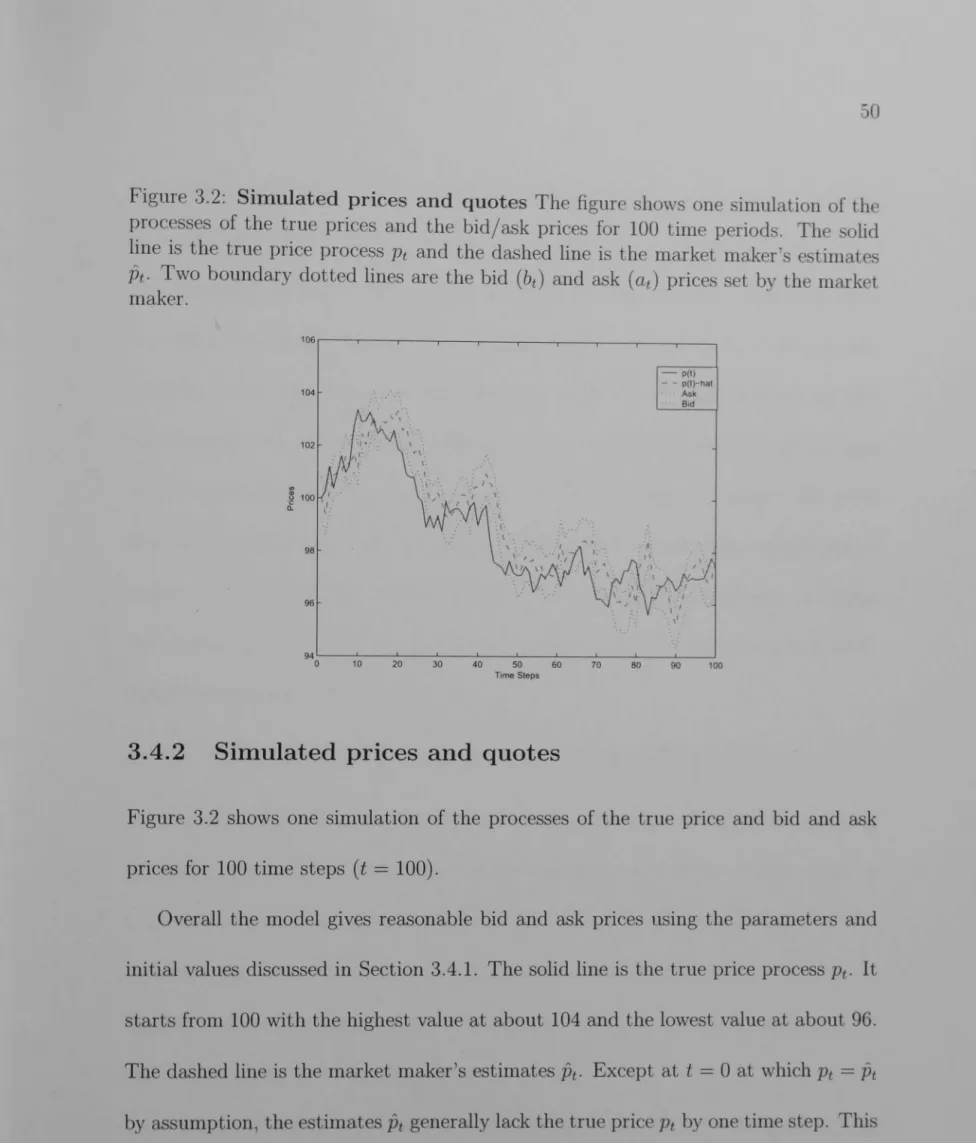
with the optimal bid and ask prices for 100 time steps. \Ve are interested in the
market making profitability in our model. We calculate the summary statistics of
the cumulative profits of the market making over a number of time periods. In
general, our model gives reasonably good numerical results using properly chosen
model parameters and initial values.
We then consider the extension of the monopolistic model to the continuous time.
We summarize the model into a system of three state variables, namely, the market
maker's estimation error, the change in the market maker's inventory, and the change
in the market maker's cumulative profit. We show that the system has nice economic
interpretations and provides further insights into the model. Finally, we discuss the
extension to the competitive market making in which market makers compete for
order flows. We argue that the equilibrium bid-ask spread is the smallest possible
This chapter is organized as follows. Section 3.2 describes our basic model of
market making. Section 3.3 provides the main solutions, followed by numerical results
in Section 3.4. Section 3.5 extends the model to the continuous time. Section 3.6
discusses the competitive market making and Section 3.7 concludes this chapter. All
proofs are presented in Appendix A.
3.2
The model
3.2.1
Assumptions
The market for a risky security operates over an indefinite number of short time
periods. Prices are set at points in time
t, t
=
1,2, ... , T. We refer to the time intervalbetween time points t and t
+
1 as period t. Order flow Qt occurs during period t.There are three types of market participants: a risk-averse monopolistic market
maker, many informed traders and many uninformed, liquidity traders. The market
maker knows neither whom he is trading with, nor any trader's trading activities.
The only information that the market maker has is his order book. We assume that
all orders are market orders and submitted to the market maker so that he has perfect
knowledge of the order flow information. We do not explicitly characterize the trading
behavior of informed and uninformed traders. Their existence however gives rise to
the market maker's noisy order flow observation of the stock's true value, which we
define as the price at which the expected net order flow is zero.
beginning of period
t,
the market maker has a prior belief, denoted asilt,
of the true price Pt, based on his information up to and including periodt -
1. The noise of his belief is St=
Vart-I[Pt]. He sets the bid (bt) and ask (at) prices for traders tosell and buy securities. Traders submit orders during period
t
at the bid and ask prices and the net order flow observed by the market maker isQt.
With the net order flow information, the market maker updates his belief through the Kalman filter and obtains a posterior belief PHI with noise St+I at the beginning of next period t+
1.The public demand for buying
(Q
Bt)
and selling securities(Q
St)
are represented by the following two equations:(3.2.1)
(3.2.2)
where a and f3 are positive constants. Note that when at
=
bt=
Pt,E[QB - Qs]
= 0,
i.e., the expected net order flow is zero with cleared demands Qo. The noise of the market demands are UB€B and usgs, where UB and Us are the standard deviations of the public buy and sell orders, respectively.5 We assume that noise represented by € with various subscripts is normal LLd. with zero mean and unit variance.There are two themes from the ,market demand functions (3.2.1) and (3.2.2). First, the average level of orders depends on the difference between the market maker's bid
36
(ask) price and the true market price. Second, the market maker sets his bid and ask
prices using his information set, which includes both his estimate Pt and his beginning
market maker follows a linear pricing rule according to
at(pt, It)
= Pt+
bat (It) andThe market demand functions now become:
(3.2.3)
(3.2.4)
From the market maker's viewpoint, the sell orders
(l:jSt)
he receives increase hisinventory and buy orders
(QBt)
reduce it. Given the market demand functions (3.2.3)and (3.2.4), the net orders are given by:
(3.2.5)
where O'QeQ
=
O'ses - O'BeB and O'Q is the standard deviation of the net order flow.Note that a positive value of
Qt
indicates more public sell orders than public buyorders, which contributes to an increase in the market maker's inventory level
(D.I
>
0). The net order flow
(Qt)
is the only information that the market maker observesfrom the market.7
6In fact, we will solve a quadratic optimization problem for the market maker and the optimal solution is linear.
We note that the buy and sell orders are crossed first before they are submitted
to the market maker, in a much similar way as in Kyle (1985). So the market maker
only knows the net order flow information but not the order flow information on each
side of the market. The simulations in Section 3.4 are consistent since the market
maker only uses the net order flow information when he updates his beliefs.
Finally we assume that the true value of the stock follows a simple random walk,
defined as:
(3.2.6)
where a fJ, is the standard deviation of the true price.
Figure 3.1 shows the assumptions of the market demand functions.
E[QB]
andE[Qs]
are the expected public buy and sell demands which intersect at point A, atwhich the market clears at price Pt, with the cleared demand of Qo. The slopes of
E[QB]
andE[Qs]
are a and {j, respectively and Pt is the market maker's prior estimate of Pt before he observes the order flow during periodt.
The market maker's bid andask prices are bt and at and
E[Qst]
andE[QBt]
are the corresponding demands forpublic sell and buy orders at time t. Note that in this particular case,
E[QBt]
exceedsE[QsJ
We call the difference between at (bt) and Pt as the ask (bid) component 8at(8
bt ) of the spread.It is worth noting that we put the price on the horizonal axis and the quantity on
38
Figure 3.1: Market demand functions: the model of monopolistic market making. The expected buy and sell order flows are
E[QB]
andE[Qs].
The true market price is Pt, andPt
is the market maker's prior estimate (somewhere different from Pt). Note bt (at) is bid (ask) price quoted by the market maker and Obt
(oaJ
is the bid (ask) component of the spread.Q
E[Q ErG)
B
~ --- A
I
---,---°b
~ : , - _ - - , ,-'---ir---..
hI P, P, p
in economics. The reason is the following. In this model, the public demands for , orders depend on the prices set by the market maker. 'fraders choose the sizes of their buy and sell demands in responds to the perceived difference between the true price Pt and market maker's quotes. Figure 3.1 demonstrates this relation.