University of Warwick institutional repository: http://go.warwick.ac.uk/wrap
This paper is made available online in accordance with publisher policies. Please scroll down to view the document itself. Please refer to the repository record for this item and our policy information available from the repository home page for further information.
To see the final version of this paper please visit the publisher’s website. Access to the published version may require a subscription.
Author(s): Michael J. Mol
Article Title: Does being R&D intensive still discourage outsourcing?: Evidence from Dutch manufacturing
Year of publication: 2005 Link to published article:
http://dx.doi.org/10.1016/j.respol.2005.03.007
Does being R&D intensive still discourage outsourcing? Evidence
from Dutch manufacturing
Michael J. Mol1
London Business School & University of Reading
London Business School
Regent‟s Park
London NW1 4SA, United Kingdom
Phone ++44-(0)20-72625050
E-mail address: [email protected]
1
Abstract:
Being R&D intensive has traditionally been seen as an impediment to outsourcing.
This study confirms that empirically this was the case for a set of manufacturing
industries in the Netherlands in the early 1990s but also shows that R&D intensity
became a positive predictor for changes in outsourcing levels over the 1990s,
suggesting firms in R&D intensive industries have increasingly started to rely on
partnership relations with outside suppliers. This confirms the need to move the
analysis from scale, opportunism and appropriation concerns to a relational
perspective when studying outsourcing in R&D intensive industries.
Keywords:
Does being R&D intensive still discourage outsourcing? Evidence
from Dutch manufacturing
1. Introduction
Firms no longer are what they used to be, appears to have become the
communis opinio among practitioners and academics alike when it comes to the
newly emerging vertical structures of high-tech firms. More extensive outsourcing of
activities, including activities in the manufacturing and product development realms,
has led to more nimble and leaner firms, so the argument often starts (Domberger,
1998; Quinn, 2000). To compensate for the loss of internal technological capabilities,
however, firms increasingly rely on partnering relations with outside suppliers that
can act as an effective substitute to the internal generation of knowledge and
innovation (Dyer and Nobeoka, 2000; Dyer and Singh, 1998; Hagedoorn, 1993;
Kinder, 2003; Nooteboom, 1999; Quinn, 2000). Yet, through all the anecdotal
evidence on leading manufacturing firms supporting these statements, it is unclear
whether such changes in outsourcing policy have indeed taken on broader
significance to the extent that R&D intensive industries have been engaged in
large-scale outsourcing efforts.
It has long been argued that a high R&D intensity should lead to lower levels
of outsourcing (Harrigan, 1985; Stigler, 1951; Williamson, 1985). In R&D intensive
industries scale advantages are usually sufficient to allow for more vertical integration
(Harrigan, 1985; Stigler, 1951). Furthermore innovative activities may be harder to
appropriate if they are not performed inside the firm (Teece, 1986; Pisano, 1990). And
where the R&D concerned is of a proprietary rather than a generic nature
(Williamson, 1985). Yet an alternative, relational view has arisen, which predicts
outsourcing levels should be on the rise in the context of R&D intensive firms, since
there is increasing inter-sector technological specialization and buyer-supplier
relations have become more effective vehicles for exchanging technological
know-how (Dyer and Nobeoka, 2000; Dyer and Singh, 1998; Kinder, 2003; Quinn, 2000). It
has been suggested that in the face of severe technological change (Afuah, 2001) or if
heterogeneity among firms is a substantial driver of the competitive process (Barney,
1999) vertical integration can instill rigidity into technological trajectories.
Furthermore the widening range of technologies needed to produce products like
aircraft engines forces firms to look to outside suppliers for an increasing part of their
innovative needs (Brusoni, Prencipe and Pavitt, 2001). Thus there is now no
conceptual agreement on the relation between R&D intensity and outsourcing.
This article attempts to tackle this controversy in the outsourcing and
technology literatures by empirically unraveling the relationship between R&D
intensity and outsourcing. Its central contention is that R&D intensity is no longer a
negative predictor of outsourcing because firms in high-tech industries increasingly
use cooperative relations with outside suppliers to obtain technology in areas that they
know of but are not themselves specialized in. By investigating outsourcing both as a
state variable, in terms of how much a firm relies on external suppliers for producing
its goods, and as a flow variable, in terms of changes in that external reliance, static
and dynamic effects are captured. The two rival theoretical explanations are
contrasted. An empirical test of 52 manufacturing industries in the Netherlands
provides support for the traditional argument initially but also shows how the
intensive industries were originally more vertically integrated but have outsourced a
substantial amount of activities and are now less integrated than other industries. This
casts substantial doubt over the tenability of the conventional argument and suggests
the relational view (Dyer and Singh, 1998) is more appropriate.
The second section of the article discusses the current stock of knowledge on
outsourcing in the management and applied economics literature, focusing in
particular on how R&D is believed to influence make-or-buy decisions. It also puts
forward two hypotheses. Section three discusses developments in outsourcing in the
Netherlands over the 1990s and presents the empirical data underlying this study. In
the fourth section these data are used to test the hypotheses through regression
models. The conclusions, in section five, center on the theoretical implications, in
terms of our understanding of when (not) to outsource and on the policy implications,
particularly how the changing nature and extent of outsourcing forces managers and
policy makers to rethink existing practices.
2. Outsourcing and its predictors
The make-or-buy or outsourcing decision has been the subject of substantial analysis
in economics and management. While this is neither the place nor is there enough
space to fully review this area here, it is useful to recapture some of the main
arguments and findings. In particular various attempts have been made to construct
contingency models that help explain under which conditions outsourcing is a
beneficial solution. Transaction cost economics clearly is one such model that predicts
(Williamson, 1981, 1985) outsourcing occurs under conditions of low asset
employ highly specific assets markets fail due to pressures for opportunism, forcing
firms to internalize transactions (Walker and Weber, 1984). Similarly if a certain asset
is required frequently, the transaction cost disadvantages of the market will increase
and internalization occurs. Uncertainty, for instance in the form of volume or profit
margin fluctuations, will induce the same effect, since contracts with suppliers will be
imperfect, making external contracting less attractive. This effect of uncertainty is
strongest in the simultaneous presence of asset specificity (Williamson, 1985).
Williamson (1981) originally also argued that technological uncertainty, like volume
uncertainty, would lead to vertical integration. Yet this has not been consistently
confirmed in empirical research (Walker and Weber, 1984). More recently,
Williamson‟s stance on this has changed somewhat in that technological uncertainty
is no longer seen as a significant predictor of outsourcing (Williamson, 1996). But
technological uncertainty is not quite the same as R&D intensity, the focus of this
article, as will be discussed shortly. There is of course also a literature linking
different types of innovation to organizational forms (e.g. Henderson and Clark, 1990;
Brusoni et al, 2001) but that is not within the scope of this article.
Measurement and information approaches (Milgrom and Roberts, 1987) point
at monitoring problems and information differentials between buyer and supplier as
explanations of outsourcing. If a supplier‟s behavior cannot be appropriately
monitored, this will stimulate vertical integration. Likewise the existence of
substantial information differences, when the supplier knows things the buyer does
not know, will induce vertical integration. Another type of explanation of outsourcing
focuses more on analysis of the capabilities of the firm. The knowledge-based (Grant,
1996; Kogut and Zander, 1992) and resource-based (Barney, 1999; Quinn, 2000)
which it is not particularly specialized or that are „non-core‟ because the firm is less
capable of performing those activities. So rather than invoking a market failure
explanation, this suggests firms may fail in certain respects. When there is such „firm
failure‟ outsourcing will come into play. Applying real options theory Leiblein and
Miller (2003) argue that whether to outsource an activity or not can also be a
consequence of the likelihood of that activity becoming a platform for future growth.
In addition some scholars have pointed at the influence of the institutional
environment on outsourcing. Toulan (2001) related increases in outsourcing to
liberalization of the economy because liberalization provides more freely operating
markets. This closely follows the institutional voids argument of Khanna and Palepu
(2000), who argue that internalization of activities can be a consequence of the lack of
properly functioning institutions in a country. Relational rent (Dyer and Singh, 1998)
and trust (Zaheer, McEvily and Perrone, 1998) arguments suggest that establishing
long-term, trusting, and idiosyncratic relations with certain suppliers can provide
above average returns, which may also act as an incentive to outsource these
activities. Very briefly these are some of the main arguments in the outsourcing area.
2.1 Innovation and R&D
For the purposes of this article, however, it makes sense to discuss in some more
detail the relation between R&D intensity and outsourcing. R&D intensity is normally
defined as research and development expenditures divided by sales and is a strong
correlate for the innovative output of the firm (Colombo and Garrone, 1996; Greve,
2003). At this point it is necessary to elaborate upon the difference between
technological uncertainty, which is one of the variables originally included in
and R&D intensity. Empirically there is probably a positive correlation between R&D
intensity and technological uncertainty, since disruptive technological change is more
likely to substantially impact firms‟ business models in technologically intense
industries and because R&D expenditures generate new technologies and therefore
technological upheaval in the industry. But this correlation is nowhere near perfect.
Many industries that are not technologically intensive, in the sense of substantial
R&D investments, have faced much disruptive technological change in the internet
era. This holds true both for retailers like Barnes & Noble in its battle with Amazon
and for many office environments, including for instance business schools.
Furthermore R&D intensity can be measured at a distinct moment in time while
technological uncertainty by definition refers to future technological flows that cannot
be predicted well nor actually measured with as much accuracy. In conclusion R&D
intensity will primarily be interpreted here as an input measure for innovative activity.
Thus while I do not suggest R&D is the same as innovation I do maintain that R&D is
performed in order to generate innovations, particularly of the technological type.
While the existing literature has put forward some anecdotal evidence and conceptual
discussions that relate innovation to outsourcing (Kinder, 2003; Williamson, 1985;
Quinn, 2000), no large-scale empirical test appears to exist.
The wider literature on technological change provides some additional clues
that can help us understand the R&D-outsourcing relationship. Dosi (1997) has for
instance noted that technological change is a process driven by both factors inside the
firm and outside sources of knowledge like suppliers, who usually provide knowledge
complementary to that of the outsourcing firm, in areas where it may not be
well-versed, an argument akin to that of Dyer and Singh (1998). Malerba and Orsenigo (
appropriability will be low and tacit knowledge will be abundant and therefore
vertical integration will usually be the preferred solution. Using Pavitt‟s classification
of industries, Malerba and Orsenigo (1996) further stated that scale-based industries
are also strongly vertically integrated. Patel and Pavitt (1997) showed that many
firms, particularly large multinationals, hold competences across a wide range of
technologies. In later work Pavitt and colleagues (Brusoni et al., 2001) used this
notion to suggest that firms know more than they make, implying that components
and materials that could potentially be made by the firm are in fact outsourced, a
useful extension of the resource-based argument discussed earlier. Cantwell and
Santangelo (1999) found that while much of R&D spending is highly localized in the
parent company, there are some instances of sourcing abroad. These appear dictated
either by supply-side factors, with certain knowledge only being available in one or a
few foreign clusters, or by the ability of large multinational firms to develop a global
knowledge exploration network inside and around the firm. Thus the technological
change literature, while not being very specific on how innovation, and R&D intensity
in particular, ought to influence outsourcing levels, has developed useful notions on
the implications of the type of product and industry for sourcing behavior. I will now
build two contrasting hypotheses to link R&D investment levels to outsourcing levels.
The first builds upon conventional insights, mostly drawn from economics, and the
second brings in more recent findings from the management literature.
2.2. The conventional argument on innovation and outsourcing
Conventional industrial organization (IO) accounts of vertical integration
(Stigler, 1951) tend to stress how it is used as a means to enhance the scale of
a large operating scale because R&D investments are mostly fixed costs that can be
recuperated more easily at high revenue levels. The marginal costs of production are
relatively low in technologically intensive industries. Thus a technologically intensive
industry can be expected to be dominated by one or a few firms that employ
substantial amounts of backward vertical integration to maximize the scale of
operations. More recent observers in the IO tradition (Harrigan, 1985; Porter, 1980)
seem to concur that where R&D matters, vertical integration is preferred over
outsourcing.
In transaction cost economics Williamson‟s (1985: 141-144) discussion on the
role of innovation in vertical integration decisions brings to light several arguments
favoring integration under conditions of substantial innovation but also includes some
discussion concerning hybrid agreements as a solution. The key advantage of
integration is that it promotes cooperation between stages. On the other hand it will
compromise the high-powered incentives available in markets because costs and
benefits will tend to be shared between the purchasing and supply stages in an
integrated setting (Williamson, 1985). Additionally there may be instances of
higher-level intrusion or accounting manipulation that can further distract from such
incentives. The latter, however, will exist to a larger degree in markets where
opportunistic behavior is more common. Williamson (1985) concludes that where
innovation is of a proprietary rather than a generic type it will lead to integration or at
the very least partial ownership (hybrid forms), particularly when combined with a
need for specific assets. He further suggests that non-specific assets will normally
only lead to generic innovation. Thus there appears to be a positive correlation
between proprietary innovations and specific assets. This further suggests that if R&D
innovation for the firm and should generally be associated with vertical integration
according to Williamson. Teece (1986) has added that when the R&D intensity of a
sector is high, it will be more prone to integrate activities into the firm rather than to
outsource them in order to protect intellectual property rights. Pisano (1990) similarly
argued that appropriation problems around knowledge, like that obtained from R&D,
lead to vertical integration, as did Malerba and Orsenigo (1993).
Monteverde (1995) discussed the application of transaction cost economics in
the exchange of technical engineering knowledge. He investigated empirically how
unstructured technical dialog, one form of human asset specificity, affects outsourcing
decisions. Because organizations can internally develop a specific dialect for
exchanging unstructured and tacit knowledge, they are much more efficient at
transferring this type of knowledge. Therefore the costs of transacting are
substantially lower inside the organization and vertical integration is the preferred
solution. Note that the latter observation, that organizations can be more efficient
carriers of knowledge than markets, takes Monteverde‟s work closer to the
knowledge-based explanation of Kogut and Zander (1992), which argues governance
forms are less a result of market failure than one of organizational superiority in
certain types of transactions.
In sum this conventional view suggests that innovation is created more
efficiently inside firms than through markets. Outsourcing is not a means to innovate
because outside suppliers lack incentives to innovate for the buying firm. Where they
do innovate, it will be hard for the buying firm to appropriate the rents of innovations
(Teece, 1986) as the supplier will seek to use it for a wide range of clients. Thus
dedicated innovation is particularly hard to achieve under an outsourcing regime. All
firms in that industry will integrate more activities and outsource fewer, which best
summarizes this view on R&D and outsourcing.
Hypothesis 1: The R&D intensity of an industry is a negative predictor of its
extent of outsourcing.
2.3. A relational view of innovation and outsourcing
To provide an explanation for the recent changes in the supply chain strategies of
firms discussed in the introduction a different conceptual perspective is in order. For
if R&D intensity and outsourcing are as incompatible as suggested above, how can we
explain the rises in outsourcing in R&D intensive environments that have been
reported (Leiblein and Miller, 2003; Quinn, 2000)? This other perspective, which is
here coined a relational view (Dyer and Singh, 1998), argues that much of a firm‟s
innovation now occurs in conjunction with outside suppliers rather than inside the
firm. Because developments in non-core technology areas have become very rapid, it
is no longer feasible to keep up with all of these technologies in as much detail as
needed (Brusoni et al, 2001; Quinn, 2000). Therefore outside technology sources are
in many instances the only option for firms that wish to keep up-to-date (Hagedoorn,
1993). Barney (1999) has suggested that firms need not necessarily own all relevant
capabilities, as long as they have sufficient access to them. Such access may well be
obtained through relations with outside suppliers.
Brusoni et al (2001) have noted that among manufacturing firms knowledge is
now becoming more extensive than needed for the activities performed inside the
firm. In other words, firms must know more than they make in order to be able to
technological change in underlying components and the more often the
interdependencies between components change, the more slack knowledge the buying
firm needs to maintain (Brusoni et al, 2001). Nishiguchi (1994) has argued that the
use of outside suppliers creates the option to access a much larger productive network
and knowledge pool. This network provides much-needed flexibility to cope with
changes in demand and helps to lower time-to-market substantially. Afuah (2001)
further suggested that over the life cycle of a technology firms are best off by
gradually increasing their extent of outsourcing. Only when a radical, competence
destroying, technological change occurs does it make sense to revert to vertical
integration into this new technology (Afuah, 2001).
In the context of innovation, Langlois and Robertson (1992) have developed
the notion that it is feasible to develop initial innovation through outsourcing in a
decentralized network, especially if substantial network externalities are present. If
outsourcing is to make sense in the context of R&D intensive businesses though,
relations with suppliers ought to replicate some of the characteristics of firms. For if
relations are of a strict arm‟s length type, there is no incentive for external suppliers to
undertake innovative activities on behalf of the buying firm. Dyer and Singh (1998)
have developed a relational view of rent attainment, which argues that
inter-organizational relations, including buyer-supplier relations, can provide benefits
similar to hierarchies without the production cost disadvantages associated with
hierarchies. Dyer and Nobeoka (2000) detail through their case study of Toyota how
new technology is developed through dedicated buyer-supplier relations. This new
model of interorganizational relations as a means to innovation is superseding
Quinn, 2000). This trend ought to be reflected in the outsourcing levels of R&D
intensive industries, which should rise as a consequence.
Hypothesis 2: The R&D intensity of an industry is a positive predictor of
changes in its extent of outsourcing.
3. Outsourcing in Dutch manufacturing
Similar to elsewhere outsourcing and increasingly cooperative relations have in the
1990s been identified as a key trend in the Netherlands (De Wit, Mol & Van Drunen,
1998; Nooteboom, 1998). Firms in the Netherlands have increased their reliance on
external suppliers dating back even to the late 1970s but from the early 1990s
onwards a particularly large shift towards outsourcing occurred (De Wit et al, 1998).
Where firms previously outsourced secondary and support activities, like catering,
temporary labor, and other facilities management activities, they now also outsourced
manufacturing activities. There was increasing technological specialization between
industries. The production of printed circuit boards (PCBs) for instance, which was
formerly operated as a small-scale, made-to-order internal activity, was now
subcontracted to specialized PCB suppliers. Rapid technological developments in
electronics, mechatronics, and related fields made much of the existing internal
knowledge on PCBs and other electronic components obsolete and raised the
production costs because of rising equipment needs. Therefore in many cases
non-specialized firms had little choice but to outsource.
The nature of the underlying supplier relations had to be altered because the
sensitivity to overall product outcomes (Nooteboom, 1998). The implementation of
these changes was sometimes problematic and buyers and suppliers both needed to
adjust to the changed circumstances. Wynstra and Weggeman (2001) provide some
evidence that manufacturing firms in the Netherlands have increasingly engaged in
cooperation with suppliers to produce product innovation. Finally outsourcing also
took on a more prominent role in the Dutch discourse on management and among
policy makers. Management consultancy firms published on the topic, government
institutions became interested in its consequences for local employment and growth,
academics increasingly wrote about it and all kinds of employers‟ associations,
training agencies and conference firms organized activities on outsourcing.
3.1. Empirical measures
The empirical tests, which will be discussed shortly, are based on 3-digit level
census data of Statistics Netherlands (Centraal Bureau voor de Statistiek) on 52
industries. The 3-digit industry level is specific enough to include a clearly defined
product, like pharmaceuticals or machine tools, but no so specific as to render the
number of companies in the industry too small for reliable analysis. The industry
classification used is the European NACE system, similar to SIC in the United States,
and all industries included are in manufacturing, ranging from complex assembly to
simple processing industries. The industry level variables are formed by aggregation
of business unit level data gathered directly from manufacturing firms. The latter are
collected on an annual basis and include questions on total sales, external sourcing,
profitability, R&D expenditures, total exports, and the number of firms, including an
indication of the nationality of the parent firm. The dependent variable of
1994 by total sales in the industry in 1994. Therefore it measures to what extent the
industry relies on external suppliers for the creation of products across all its
activities, including manufacturing, design and services. This OUTSOURCING
measure represents the vertical structure of the firm. The accompanying flow variable,
of OUTSOURCING CHANGE is calculated as the difference between outsourcing in
1998 and outsourcing in 1994. R&D INTENSITY, the predictor variable, is measured
as the industry‟s 1993 total R&D expenditures over its 1993 total sales. In these data
R&D levels are fairly constant across years (inter-year correlations range from 0.75
upwards). Recent research in the transaction costs strand (Gilley and Rasheed, 2000;
Leiblein, Reuer and Dalsace, 2003) has continued its focus on how a set of predictors
at a given time influences outsourcing choices at that time. Yet time differences will
often exist between the presence of R&D intensity and the implementation of
outsourcing and a one-year time lag between all independent variables and the
dependent variable, from 1993 to 1994, was introduced to reflect this. In addition any
claim to causality is much strengthened if the independent variable is measured prior
to the dependent variable.
Five control variables are employed in addition to the R&D intensity variable.
The AVERAGE SIZE variable is the average size of firms in the industry in 1993,
measured by the average turnover per firm. Larger firms often take on a different role
in the supply chain, by primarily becoming an assembler and not a producer, and may
therefore outsource more. The extent of presence of FOREIGN FIRMS is measured
by dividing the number of foreign subsidiaries over the total number of firms. It is
conceivable foreign firms have developed a different outsourcing pattern because they
are less familiar with local suppliers. There is an effect that is known as the „liability
Because foreign firms are less familiar with their host environments they will have
more difficulties than local firms in partnering with local suppliers. Given the higher
search and evaluation costs for foreign firms, outsourcing is normally a less viable
option for them. In addition foreign firms have often established themselves in their
host environment on the basis of some superior set of internal capabilities that may
help them offset the liability of foreignness (Dunning, 1993). Having such a superior
set of internal capabilities, for instance human resources, also makes it less likely that
foreign firms will outsource activities since they will want to fully exploit these
internal strengths. PRODUCTIVITY is calculated as 1993 total sales divided by the
1993 total number of employees. In order to become more productive firms in an
industry probably need to focus on a smaller set of tasks, which they can do by
outsourcing more. Productivity as measured here, however, relates positively to
outsourcing because outsourcing normally reduces the number of employees while
sales remain constant. Productivity is therefore one of the drivers of outsourcing
decisions and a positive association must be expected. EXPORT INTENSITY is the
1993 total amount of exports over 1993 total sales. Since the ability to export products
is an indicator of company strength, more export intensive industries possess more
internal capabilities and may therefore outsource less. Similar to foreignness, a high
export intensity reflects the competitive strength of an industry. The more internal
strengths firms in an industry possess, the less likely they are to outsource. In general,
competition between firms stimulates outsourcing (Cachon and Harker, 2001). More
export intensive industries will be faced with a more competitive environment and
will therefore seek to outsource more. UNCERTAINTY in the industry is measured
by the variance in the industry‟s annual return on sales measures over the 1993-1998
Ordinary least squares (OLS) regression is used to test the hypothesized relationships
because the variables are such that it is an efficient and reliable estimator.
4. Empirical results and discussion
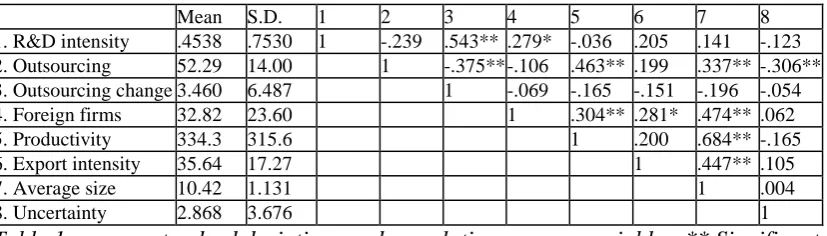
Table 1 below briefly captures the means, standard deviations, and correlations of the
key variables. It is worth noting that the average outsourcing level stood at 52.3% of
sales in 1994 and increased by 3.5% between 1994 and 1998, which is a fairly
substantial increase. Also note that while the average R&D intensity is not
particularly high among these industries, about 0.5% of sales, there is substantial
variance in R&D levels in the sample. Finally observe that there is a negative
correlation between the outsourcing and outsourcing change variables, implying a
catching-up effect. Industries that initially outsourced less have now seen substantial
increases.
---
Insert table 1 around here
---
Table 2 investigates the effect of 1993 R&D intensity and a set of control variables on
the industry average level of outsourcing in 1994. It confirms hypothesis 1: R&D
intensive industries initially displayed a lower level of outsourcing. Thus the
conventional perspective, which holds that under conditions of high innovation
expenditures there are scale, appropriation, and opportunism concerns that make
---
Insert table 2 around here
---
Table 2 also provides some interesting findings on the control variables employed.
The presence of foreign firms is a slightly negative predictor for outsourcing levels,
which confirms the liability of foreignness argument presented before. As expected
the productivity of firms, measured as per-employee turnover, is positively related to
outsourcing. As noted above this is both a strongly intuitive and a mathematically
determined relation, since firms that produce large volumes with a limited number of
employees will typically also need to outsource many activities to achieve such
productivity. In fact, the causality probably runs in two directions: outsourcing
increases productivity and a desire to increase productivity may be at the heart of
outsourcing decisions. The average size of firms in the sector is not a significant
predictor of outsourcing, although the sign is positive. Perhaps the indirect form of
measurement, using average size of firms in an industry to link that to industry
outsourcing, disguises size effects though. A study of the size of firms and their
outsourcing levels could clarify this further. The positive impact of the export
intensity variable points to the role that having to compete more ferociously, in
international markets, can play in forcing firms to outsource. Uncertainty is shown to
be a strongly negative predictor of outsourcing levels, confirming the TCE logic. In
the presence of substantial uncertainty it is harder to write complete contracts.
In table 3 the results of the regression analysis on changes in the outsourcing
between R&D intensity in 1993 and subsequent changes in the level of outsourcing.
Thus the second hypothesis is confirmed in that R&D intensity acted as a positive
predictor for changes in outsourcing1. This confirms what many authors have
suggested about the changing nature of outsourcing, though the evidence presented
here is not based on perception data or anecdotal or small-scale evidence. Especially
in technologically volatile environments where R&D is a key priority, firms have
increased their reliance on external suppliers. They could do this because of the
changed nature of underlying technologies and relations with suppliers. The need to
understand and utilize multiple technologies that cannot all be maintained in-house
forces firms to outsource more activities than before. Changes in communication
technologies and the increasing openness of economies increase the rent potential of
relations with external suppliers, many of them foreign, and permit firms to set up
closer relations with suppliers than hitherto possible.
---
Insert table 3 around here
---There are two other significant findings in table 3. Foreign firms have not increased
their extent of outsourcing as much as have local firms, consistent with the logic
outlined above. Foreign firms will have a lower degree of penetration among local
1 In fact, a rerun of the analysis presented in table 2 for 1997 R&D intensity and 1998 outsourcing
suppliers and will use their internal capabilities as much as possible. Uncertainty is a
positive predictor of changes in outsourcing levels. This could be construed to imply
that the predictive power of TCE has been decreasing over time, since more
uncertainty is no longer associated with more vertical integration. As stated before
though uncertainty is seen to explain integration particularly effectively in the joint
presence of asset specificity. Since no asset specificity test was included, it is not
possible to reach any final conclusion on this point.
4.1 Research limitations and extensions
In terms of limitations, the number of sampled industries (52) is fairly low which is
potentially troublesome in the context of running regressions, where some 40
observations are often seen as a bare minimum and 5 to 10 observations are needed
per variable to create models with sufficient statistical power. Yet there are several
reasons to believe the number of observations is not problematic here. First, the
industry data themselves are aggregates of firm level data, involving thousands of
firms. Thus any aberrations at the firm level are wielded out through the aggregation
process and the resulting industry level data are very reliable. Second, the model
statistics of both models are solid. The F-tests are fairly high and adjusted R2 figures
are also quite satisfactory. Third, more industries become available when omitting the
focal R&D variable from the regressions, i.e. there are quite a few missing values for
R&D expenditure in the database. Missing values appear mostly in industries with
particularly small numbers of firms where industry level R&D data could be traced
back to individual firms. When rerunning the models for a wider set of some 84
more significant. Therefore it appears fair to conclude that the results are fairly robust
in spite of the small number of observations.
Another data-related problem is the use of R&D intensity as a proxy for
innovative behavior. While it is suggested that R&D intensity is indeed a close
correlate of innovation (Greve, 2003), this is not a perfect correlation as noted earlier.
Indeed R&D intensity could perhaps also be interpreted as one possible measure of
technological uncertainty, in which case the key point of this article would really be
that firms have started to outsource more, and particularly do so in the face of high
technological uncertainty. Regardless of these issues, however, R&D intensity itself is
worthy of study (Colombo and Garrone, 1996; Greve, 2003) and the nature of its
relation to outsourcing decisions is informative for strategic decision-making.
One variable missing from the equations was asset specificity, for which no
valid empirical measures were available in the present study. Including asset
specificity might have provided additional explanatory power. On the other hand,
asset specificity is likely also positively correlated with R&D intensity as argued
before. Furthermore it is hard to say what would constitute a proper measure of asset
specificity across a wide range of transactions at the business unit level, which is how
both outsourcing and R&D intensity were measured here. Another limitation is that
the R&D intensity of industries is only one indicator of an industry‟s innovative
output. And it is not a perfect measure for innovative output either. Thus it could be
informative to test how other innovation measures, like the number of patents granted,
are related to the outsourcing behavior of firms. Similarly the empirical context used
here, the Dutch manufacturing sector, may produce results specific to that sector‟s
development. Although there are no obvious indications that outsourcing in the
certainly be differences in timing or degree. A replication elsewhere would be useful.
Where available firm level data could shed a different and more detailed light on the
outsourcing-innovation relation than these industry level data, for instance by
investigating possible interactions with asset specificity, capabilities or firm size.
Such a trade-off of breadth for depth could generate additional insights. Similarly
there is merit in applying other outsourcing measures, for instance by linking the
probability that a specific component will be outsourced given its R&D intensity. The
results on outsourcing as a firm level concept provided here, however, are not only a
useful starting point for such further studies but also interesting in their own right.
5. Conclusions
A major controversy in the area of outsourcing and innovation is whether R&D
intensity discourages outsourcing or is compatible with it. This article is the only
recent test of this relationship with large-scale empirical data. It demonstrated, in the
empirical context of the Dutch manufacturing sector, that while R&D may historically
have been a negative predictor of outsourcing there was a clear reversal over the
1990s. The relational view of outsourcing and innovation, which maintains that
buyer-supplier relations can be an effective substitute for internal development, thus
appears to have gained impetus in practice. Alternatively the more humble, and
probably more correct, perspective is that the relational view appears to be an
appropriate portrait of empirical reality as it has been developing. Product life cycles
are becoming shorter and there has been a shift in priorities away from appropriating
in-house innovations towards developing the ability to rapidly launch new products.
where a more flexible, wider, and larger joint research capacity can be obtained than
inside a single firm. In terms of the outsourcing literature this article has demonstrated
that predictors of outsourcing are not necessarily stable over time and that theoretical
positions may therefore not remain valid indefinitely. In terms of the technological
change literature, the key point would be that alternative production arrangements of
innovative products, involving outside suppliers, have become a feasible supplement
to vertical integration.
Brusoni et al (2001: 599) stated that: “firms invest in broadening their
knowledge bases while narrowing down their manufacturing bases”. The evidence
presented here seems to suggest that the latter aspect, of narrowing down the
manufacturing base, is moving at a much faster pace than the former, the broadening
of the knowledge base. Industries in this sample did not significantly raise their R&D
investments but did increase their dependence on outside suppliers. Further anecdotal
evidence suggests many Dutch firms have rapidly and thoroughly disengaged from
activities like the production of printed circuit boards but maintain some basic
knowledge of such activities. Therefore firms do generally know more than they make
(Brusoni et al, 2001) and the gap between knowing and making may be on the rise but
this is mostly due to the fact they are starting to make less than they know and not
necessarily because their knowledge base widens rapidly. To test this further it could
be fruitful to find out whether R&D investments in specific subfields are generally
maintained over longer time periods, even when firms have disengaged from the
underlying activities. This would require data on R&D spending patterns and specific
outsourcing patterns, which could perhaps only be obtained when studying one or a
few cases. It also points to one of the problems associated with outsourcing, which is
knowledge with a supplier and at the same time assess the supplier‟s performance.
Since many instances of outsourcing involve moving people to suppliers much
knowledge can be lost with the transition. Outsourcing can become a source of serious
bargaining and learning problems in the long run.
Firms increasingly outsource activities that are crucial to the competitive
advantage of the firm. In itself this type of outsourcing can be beneficial, if rents can
be obtained from the relation. Where such rents are deeply ingrained in the relation
itself, there are few problems of spillovers. But there is a big question mark over how
to appropriate such rents in the case of new technology. Technology that is developed
in conjunction with a supplier may have multiple alternative uses for the supplier but
none for the buying firm. Technological knowledge is often replicated fairly easily
within the same supplier firm. Under such circumstances there are serious dangers of
knowledge leaks to competitors and appropriate governance responses must be found
unless the value of knowledge stocks in an industry depreciates so fast that this
knowledge has limited value for competitors by the time it reaches them (Nooteboom,
1999). Where knowledge leaks occur a need for creating different contracting
solutions arises in which buyers and suppliers are both provided with incentives to
innovate and can obtain joint ownership. From a public policy perspective this creates
pressures for legal protection of joint intellectual property.
Another key public policy implication of increased outsourcing is how it
affects underlying technology activities and employment. If R&D intensive industries
can outsource many more manufacturing and design activities, as now appears to be
the case, this implies these activities become increasingly footloose. The recent rise of
global sourcing structures is therefore not limited to activities where cost of labor is
(Mol, Pauwels, Matthyssens, and Quintens, 2003). For practicing managers global
sourcing poses different challenges, for instance in terms of how to deal with
suppliers in institutional and cultural environments different from that of the buyer.
There are few longitudinal accounts of how outsourcing and R&D intensity
are related in current literature and none of recent origin. Yet, quite a bit is known
about technological collaboration between buyer and supplier and what influences
outsourcing levels at a given point in time. What is needed then, is a more intricate
understanding of how the R&D-outsourcing relation evolves over time. Some specific
research questions can be suggested. Under what conditions is a high R&D intensity
compatible with much outsourcing? Will outsourcing levels be maintained in the face
of discontinuous technological change (Afuah, 2001)? Answers to these questions
References
Afuah, A. 2001. Dynamic boundaries of the firm: Are firms better off being vertically
integrated in the face of a technological change? Academy of Management Journal,
44(6), 1211-1228.
Barney, J. B. 1999. How a firm's capabilities affect boundary decisions. Sloan
Management Review, 40(3), 137-145.
Brusoni, S., Prencipe, A., & Pavitt, K. 2001. Knowledge Specialization,
Organizational Coupling, and the Boundaries of the Firm: Why Do Firms Know More
Than They Make? Administrative Science Quarterly, 46(4), 597-621.
Cachon, G.P. & Harker, P.T. 2002. Competition and Outsourcing with Scale
Economies. Management Science, 48(10), 1314-1333.
Colombo, M.G., and Garrone, P. 1996. Technological cooperative agreements and
firm‟s R&D intensity: A note on causality relations. Research Policy, 25(6), 923-932.
De Wit, B., Mol, M. J., & Van Drunen, E. C. 1998. Uitbesteden en Toeleveren:
Motieven, Trends en Effecten. Utrecht: Lemma.
Domberger, S. 1998. The Contracting Organization: A Strategic Guide to
Outsourcing. Oxford: Oxford University Press.
Dyer, J. H., & Nobeoka, K. 2000. Creating and managing a high-performance
knowledge-sharing network: The Toyota case. Strategic Management Journal, 21(3),
345-367.
Dyer, J. H., & Singh, H. 1998. The relational view: Cooperative strategy and sources
of interorganizational competitive advantage. Academy of Management Review,
23(4), 660-679.
Dunning, J.H. 1993. Multinational Enterprises and the Global Economy. Wokingham:
Gilley, K.M., & Rasheed, A. 2000. Making more by doing less: An analysis of
outsourcing and its effect on firm performance. Journal of Management, 26(4),
763-790.
Grant, R.M. 1996. Prospering in dynamically-competitive environments:
Organizational capability as knowledge integration. Organization Science, 7(4),
375-387.
Greve, H.R. 2003. A behavioral theory of R&D expenditures and innovations:
Evidence from shipbuilding. Academy of Management Journal, 46(6), 685-702.
Hagedoorn, J. 1993. Understanding the rationale of strategic technology partnering:
Interorganizational modes of cooperation and sectoral differences. Strategic
Management Journal, 14(5), 371-385.
Harrigan, K., R. 1985. Vertical integration and corporate strategy. Academy of
Management Journal, 28(2), 397-425.
Henderson, R., & Clark, K. 1990. Architectural innovation: the reconfiguration of
existing product technologies and the failure of established firms. Administrative
Science Quarterly, 35(1), 9-30.
Khanna, T., & Phalepu, T. 2000. Is group affiliation profitable in emerging markets?:
An analysis of diversified Indian business groups. Journal of Finance, 55(2), 867-891.
Kinder, T. 2003. Go with the flow—a conceptual framework for supply relations in
the era of the extended enterprise. Research Policy, 32(3), 503-523.
Kogut, B., & Zander, U. 1992. Knowledge of the firm, combinative capabilities, and
the replication of technology. Organization Science, 3(3), 383-397.
Kostova, T. & Zaheer, S. 1999. Organizational legitimacy under conditions of
complexity: The case of the multinational enterprise. Academy of Management
Langlois, R.N., & Robertson, P.L. 1992. Networks and innovation in a modular
system: Lessons from the microcomputer and stereo component industries. Research
Policy, 21(4), 297-313.
Leiblein, M.J., & Miller, D.J. 2003. An empirical examination of transaction- and
firm-level influences on the vertical boundaries of the firm. Strategic Management
Journal, 24(9), 839-859.
Leiblein, M. J., Reuer, J. J., & Dalsace, F. 2002. Do make or buy decisions matter?
The influence of organizational governance on technological performance. Strategic
Management Journal, 23(9), 817-833.
Milgrom, P. & Roberts. J. 1987. Informational Asymmetries, Strategic Behavior, and
Industrial Organization. American Economic Review, 77(2), 184-193.
Mol, M.J., Pauwels, P., Matthyssens, P. & Quintens, L. 2004. A technological
contingency perspective on the depth and scope of international outsourcing. Journal
of International Management, 10(2), 287-305.
Monteverde, K. 1995. Technical dialog as an incentive for vertical integration in the
semiconductor industry. Management Science, 41(10), 1624-1638.
Nishiguchi, T. 1994. Strategic Industrial Sourcing: The Japanese Advantage. Oxford:
Oxford University Press.
Nooteboom, B. 1998. Management van Partnerships: Over Allianties tussen
Bedrijven. Schoonhoven: Academic Service.
Nooteboom, B. 1999. Inter-firm alliances: Analysis and design. London: Routledge.
Patel, P., & Pavitt, K. 1997. The technological competencies of the world‟s largest
firms: Complex and path-dependent but not much variety. Research Policy, 26(2),
Pisano, G.P. 1990. The R&D Boundaries of the Firm: An Empirical Analysis.
Administrative Science Quarterly 35(1), 153-176.
Porter, M.E. 1980. Competitive Strategy. New York: Free Press.
Quinn, J. B. 2000. Outsourcing innovation: The new engine of growth. Sloan
Management Review, 41(4), 13-28.
Stigler, G.J. 1951. The division of labor is limited by the extent of the market. Journal
of Political Economy, 59(2), 185-193.
Teece, D.J. 1986. Profiting from technological innovation. Research Policy, 15(6),
285-305.
Toulan, O.N. 2002. The impact of market liberalization on vertical scope: The case of
Argentina. Strategic Management Journal, 23(6), 551-560.
Walker, G., & Weber, D. 1984. A transaction cost approach to make-buy decisions.
Administrative Science Quarterly, 29(3), 373-391.
Williamson, O.E. 1981. The economics of organization: The transaction cost
approach. American Journal of Sociology, 87(3), 548-577.
Williamson, O. E. 1985. The Economic Institutions of Capitalism. New York: Free
Press.
Williamson, O.E. 1996. The Mechanisms of Governance. Oxford: Oxford University
Press.
Wynstra, F., & Weggeman, M. 2001. Managing supplier involvement in product
development: Three critical issues. European Management Journal, 19(2), 157-167.
Zaheer, A., McEvily, B., & Perrone, V. 1998. Does trust matter? Exploring the effects
of interorganizational and interpersonal trust on performance. Organization Science,
Tables
Mean S.D. 1 2 3 4 5 6 7 8
1. R&D intensity .4538 .7530 1 -.239 .543** .279* -.036 .205 .141 -.123 2. Outsourcing 52.29 14.00 1 -.375** -.106 .463** .199 .337** -.306** 3. Outsourcing change 3.460 6.487 1 -.069 -.165 -.151 -.196 -.054 4. Foreign firms 32.82 23.60 1 .304** .281* .474** .062 5. Productivity 334.3 315.6 1 .200 .684** -.165 6. Export intensity 35.64 17.27 1 .447** .105
7. Average size 10.42 1.131 1 .004
[image:32.595.94.508.107.225.2]8. Uncertainty 2.868 3.676 1
Table 1: means, standard deviations and correlations among variables. ** Significant at the 1% level; * significant at the 5% level. N = 84, except for row 1 where N = 52.
Variable Unstand. β Standard error t-value significance
[image:32.595.93.400.275.407.2]Constant 0.459 0.191 2.399 0.021 Foreign firms -0.133 0.071 -1.872 0.068 R&D intensity -0.051 0.019 -2.680 0.010 Productivity 0.000 0.000 2.814 0.007 Export intensity 0.002 0.001 2.245 0.030 Average size 0.004 0.021 0.194 0.847 Uncertainty -0.017 0.004 -4.537 0.000 F-value: 10.185 (.000) R2: .576 Adjusted R2: .519
Table 2: OLS regression on 1994 industry level of outsourcing. N = 52.
Variable Unstand. β Standard error t-value significance
Constant -0.075 0.103 -0.731 0.469 Foreign firms -0.066 0.038 -1.729 0.091 R&D intensity 0.055 0.010 5.356 0.000 Productivity -0.000 0.000 -1.753 0.086 Export intensity -0.000 0.000 -0.992 0.326 Average size 0.014 0.012 1.219 0.229 Uncertainty 0.005 0.002 2.482 0.017 F-value: 6.861 (.000) R2: .478 Adjusted R2: .408
[image:32.595.99.399.445.576.2]