i
Master Thesis: Detecting Exploit kits using Machine
Learning
Author:
Pallavi Jagannatha ([email protected])
MSc: EIT Digital Master on Security and Privacy
Graduation Committee
:
Dr. Zhiyuan (Thomas) Tan (Edinburgh Napier University)
Dr. Andreas Peter (University of Twente)
Dr. Alexandr Vasenev (University of Twente)
Christian Prickaerts (FOX-IT)
Maarten Van Dantzig (FOX-IT)
ii
Abstract
The job of a security analyst is often similar to the task of finding a needle in a haystack when the clock is ticking. It is not about having the knowledge of computing and networking on a level of how it functions, but it is about finding something that is present underneath the covers. A security analyst has to go through a lot of data manually to learn/identify about a security incident. However, it is not only time-consuming, but also difficult to perform a thorough analysis of large data manually. This work focuses on providing an efficient methodology for a two-layer detection scheme, which is not only lightweight but also effective in attack detection and clustering.
Exploit kits are a serious cyber threat today as they are responsible for a big percentage of malware infections worldwide. Everyone from inexperienced hacker to a sophisticated cybercriminal can use an Exploit kit to spread malware. An Exploit kit is a tool which detects and Exploits the vulnerabilities present in a system to spread malware (banking malware, ransomware, etc.). An Exploit kit typically has a management console, add-on functions and a set of vulnerabilities that can Exploit different applications (which have security-related vulnerabilities) to launch an attack. The whole process is automated which makes it very effective. Exploit kits contribute to a significant portion of web-based threats on the internet today, creating an effective staging ground for criminal activities. Through the extensive history of Exploit kit attacks, it is evident that it is important to have an effective system in place to detect and defend users from such attacks.
This research project has developed a new approach for the automatic detection of a network security incident, namely Exploit kits in this work. This research uses machine learning to detect Exploit kits with the help of supervised and unsupervised learning approach. The feature selection based on information gain allows data itself to explain the importance of individual features for the detection. This helps human experts avoid tedious manual feature selection.
iii
Dedication
iv
Acknowledgements
I would like to use this opportunity to express my gratitude to my supervisors from the University of Twente, Dr. Zhiyuan (Thomas) Tan, Dr. Andreas Peter and Dr. Alexandr Vasenev for their guidance, advice and support in my research and academic developments. I would like to specially thank my supervisor, Dr. Zhiyuan (Thomas) Tan for motivating me to build my machine learning knowledge. Without that knowledge and his guidance, this research would not have been possible. I appreciate that he believed in me to provide his time and knowledge to make this possible. Dr. Zhiyuan (Thomas) Tan is a great person and a scholar; without him, this thesis may not have been written.
I would like to thank my supervisors from FOX-IT, Barry Weymes, Christian Prickaerts, Maarten Van Dantzig and Martin Van Hensbergen for providing me with an intellectual environment, constant support and the long discussions about my research.
I would like to thank Renato Fontana, Dirk-Jan Korpershoek, Yonne de Bruijn, Lennart Haagsma, Antonios Terefos, Leon Buikstra, Erik Schamper, Max de Bruijn, Gina Doekhie, Mike Stokkel, Matthijs Gielen, Pepijn Westen, Bradley Prent from FOX-IT for their valuable insights on my research.
I would like to thank my best friends at FOX-IT, Valentijn Harmers, Maarten van Dantzig Paolo Schipani, Juno Teeuw, Claudia, Paul Platanias and Rolf Don for their support, encouragement, and making my research experience at FOX-IT a memorable journey.
v
Contents
Abstract ... i
Dedication ... iii
Acknowledgements ... iv
List of Figures ... viii
Abbreviations ... x
Chapter 1 Introduction ... 1
1.1 Research question ... 2
1.1 Contribution ... 2
1.2 Limitations and scope ... 3
1.3 Structure of the report ... 4
Chapter 2 Related Work ... 5
2.1 Analysis of Exploit kits ... 5
2.1.1 PExy ... 5
2.1.2 Anatomy of Exploit Kits, Preliminary Analysis of Exploit Kits as Software Artefacts ... 6
2.1.3 MalwareLab ... 6
2.1.4 Manufacturing Compromise: The Emergence of Exploit-as-a Service ... 7
2.2 Detection of Exploit kits ... 8
2.2.1 Kizzle ... 8
2.2.2 EkHunter ... 9
2.2.3 WebWinnow ... 9
2.2.4 Revolver ... 9
vi
2.2.6 Cujo ... 10
2.2.7 Hidost ... 10
2.2.8 Learning to detect and classify malicious executables in the wild ... 11
2.2.9 Unsupervised anomaly-based malware detection using hardware features ... 11
2.2.10 Next-generation of Exploit kit detection by building simulated obfuscators ... 11
Chapter 3 Background and main concepts ... 12
3.1 Bro Network Security monitor logs ... 12
3.2 Exploit kits ... 12
3.1.1 Background and origin: ... 13
3.1.2 How an Exploit kit works ... 14
3.3 Machine Learning ... 16
3.2.1 Supervised learning ... 18
3.2.2 Unsupervised learning ... 20
3.4 Multinomial Naive Bayes ... 21
3.5 K-means clustering ... 23
3.6 Input data ... 24
3.7 Textual data to numeric format ... 24
3.7.1 Word count vector ... 24
3.8 Feature selection ... 25
3.9 Scikit- library ... 26
Chapter 4 Method ... 28
4.1 Feature selection through information gain ... 29
4.2.1 Malicious/Bad data for training ... 32
4.2.2 Legitimate/Good data for training ... 33
vii
4.3.1 Term frequency and inverse document frequency (TFIDF) ... 34
4.3.2 Word count vector ... 38
4.4 Layer 1 - Multinomial Naive Bayes. ... 38
4.5 Feature selection for k-means clustering ... 41
4.6 Layer 2-Textual data to numeric format ... 41
4.6.1 Uni-gram characterisation ... 41
4.7 Layer 2 - K-means clustering ... 44
4.7.1 Visualisation and Principal Component Analysis ... 45
Chapter 5 Results ... 47
5.1 Analysis of Features ... 47
5.2 Accuracy of the Classifier on the Training Set... 48
5.2.1 Cross Validation ... 48
5.3 Accuracy of the classifier on the Test Set ... 55
5.4 Accuracy of Clustering... 55
Chapter 6 Conclusions ... 58
6.1 Future work ... 59
viii
List of Figures
Figure 2.1: Architecture of PExy . Adapted from [44])...5
Figure 2.2:Infections per time window per Exploit kit. Adapted from [58]...7
Figure 2.3: Architecture of Kizzle. Adapted from [43]...9
Table 3.1: Timeline of Exploit kits...14
Figure 3.1: Overview of a typical Exploit kit attack...15
Figure 3.2: A general framework for the machine learning approach...17
Figure 3.3: A general framework for the Supervised Machine Learning approach...19
Figure 3.4: A general framework for the Unsupervised Machine Learning approach...20
Figure 4.1: Overview of the methodology...28
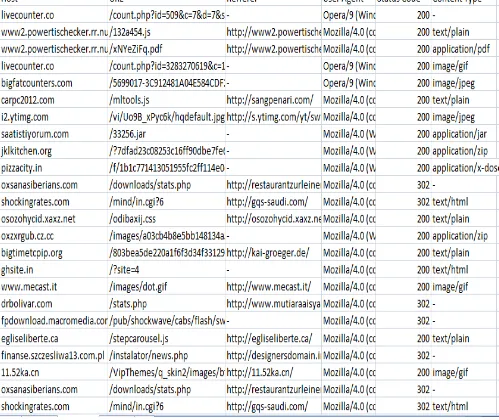
Table 4.1: Malicious data set up for training...33
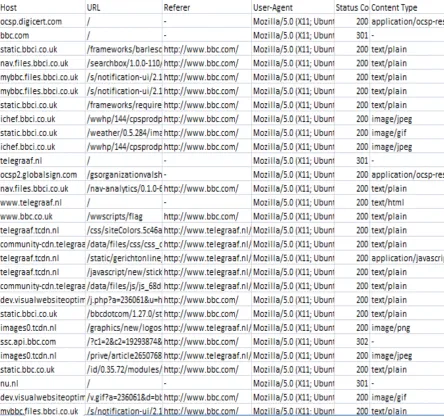
Table 4.2: Legitimate data set up for training...34
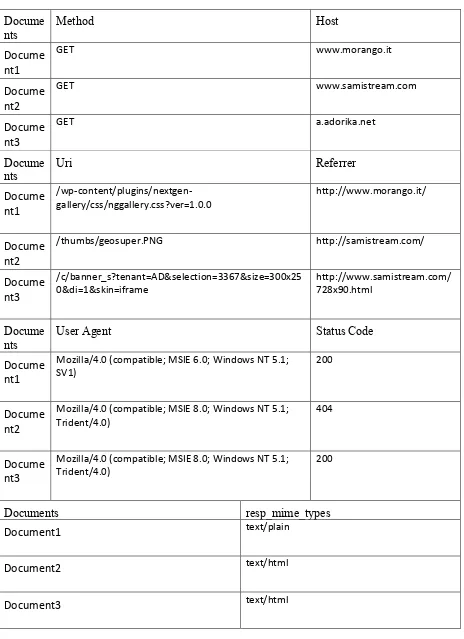
Table 4.3: set of documents used set up as an example for TFIDF vectorisation...35
Table 4.4: Term frequency and inverse document frequency calculation for the documents..37
Table 4.5: Vector from of the documents calculated using Term frequency and inverse document frequency calculation...37
Table 4.6: An example for work count vector...38
Table 4.7: An example for multinomial Naive Bayes Classification...39
Table 4.8: Input data for Uni-gram Characterisation...43
Table 4.9: Output of Uni-gram Characterisation...44
Figure 4.2: Principal Component Analysis . Adapted from [63]...46
Figure 5 1: Analysis of features using Information gain...47
ix
Figure 5.3: Performance of the classifier for K=2...49
Figure 5.4: Performance of the classifier for K=3...50
Figure 5.5: Performance of the classifier for K=4...50
Figure 5.6: Performance of the classifier for K=5...51
Figure 5.7: Performance of the classifier for K=6...51
Figure 5.8: Performance of the classifier for K=7...52
Figure 5.9: Performance of the classifier for K=8...52
Figure 5.10: Performance of the classifier for K=9...53
Figure 5.11: Performance of the classifier for K=10...53
Table 5-1: Performance of the classifier on the training data using K-fold validation...54
Figure 5.12: Performance of the classifier on the test data...55
Table 5.2: Performance of the classifier on the training set...55
Figure 5.13: Calculation of the value of K using Elbow method for the test data...56
Figure 5.14: Visualisation of clusters of the test data using Principal Component Analysis...56
x
Abbreviations
SOC Security Operation Centre SSE Sum Squared Error
IDS Intrusion Detection System NB Naive Bayes
1
Chapter 1 Introduction
The internet was originally developed when computers were huge and expensive. Only a few organizations, such as universities, business organizations and governments could afford them. We had a network of computers when these computers started communicating with each other and it grew up as Personal Computers (PCs) which emerged in 1980s. People started using it for more than just communication. Other devices, such as phone, cell tower
and so on started connecting with them. Today’s world is made of computers, laptops, tablets
and smart-phones. We use them for communication, work, news and entertainment. Furthermore, we connect to a global network that brings the entire world to us via them. We extend ourselves to the online world through our devices. We are always connected to a global network; this means we could be vulnerable just by being connected. The ease at which all these devices could connect with each other has come at the expense of security. The widespread use of multiple new platforms gives rise to new points of attack for cyber criminals. Exploits are malicious programs that contain an executable code with an intent to take advantage of one or more vulnerabilities present in the software running on a remote device. An Exploit kit is a toolkit that contains Exploits to spread malware. The Exploit kits have become powerful and easily available, enabling even less technically proficient cybercriminals to take advantage of them. Therefore, common devices such as computers, laptops, tablets and smart-phones, now need methods to monitor and handle the security breaches.
Before considering the methods to handle security breaches, it is important to understand where we stand from the security point of view. A security analyst has to go through a lot of data to learn/identify about a network security incident. As of now, the security analysts are investing their time and efforts to do their best by investigating the security incidents in the data manually. However, they can do a lot better with tools that can optimise their work. There are many security events generated by many devices which detect abnormal behaviour in the network. This has led to the obvious problem of generation of enormous amount of data. Added to this, some events reported could also be a case of false alarm at times.
Despite having enormous data filled with all the valuable information, it is still a lot of work to obtain the needed information in order to detect, prevent and respond to network security incidents. It is only logical to build upon the knowledge obtained from understanding the past incidents that can help to respond to incidents effectively. This is where machine learning can help to address the issue and automate the process.
2
1.1 Research question
Exploit kits are currently the most powerful weapon used to spread malware on the Internet. This is a big threat to Internet security as it allows cybercriminals to easily infect a large volume of machines Exploiting various software vulnerabilities. The impact of Exploit kits is dramatic since a cyber criminal can perform several kinds of attacks, like identity theft or banking fraud using them.
This thesis revolves around the threat of Exploit kits, in particular to provide an efficient methodology to detect and cluster different types of Exploit kits. This can reduce the manual efforts that has to be made by security analysts in detecting this network security incident. How to design an efficient and automated approach to detect Exploit kits and cluster them further into different types?
1.1 Contribution
By combining the supervised and the unsupervised machine learning approaches, this work takes the idea of a two-layer detection scheme which provides an effective classification and clustering of the Exploit kits.
In supervised approach, instances, namely data objects, are assigned with pre-defined category labels. The malicious data (i.e. Exploit kit) and legitimate data are the pre-defined labels in this work. The given new instance is assigned a label based on the likelihood suggested by the training set of labelled instances. This method requires manual labelling of the data; and in unsupervised approach, there is no need for labelled instances or human intervention at any point in the whole process but poses the difficulty to determine the number of clusters in advance. Therefore, significant research efforts have been invested to bridge the gaps.
The combined efforts of these two techniques can reduce the manual efforts that has to be made by security analysts in detecting this network security incident. This research provide an efficient methodology of two-layer detection scheme to classify and cluster the Exploit kits of all different types.
This two layer detection scheme can be used when clients have HTTP logs, which in this research project are BRO HTTP logs. In general, these HTTP logs could also come from a proxy or firewall log. Many companies do have HTTP logs available rather than PCAP files, which is commonly used in network-based IDS. Knowing the type of Exploit kits is useful, because the types of Exploits served by various Exploit kits can help an analyst in assessing the possible damage the Exploit kit could to the end users of a certain network. For example if Exploit D only employs Flash Exploits, while all end users in the attacked network do not have Flash installed, there is little damage to be done by this specific Exploit kit.
Contributions to FOX-IT:
3
prevention of such attacks harder. Security analysts are urged to reduce cyber criminals’ free time within the network, to reach root causes quicker, and to gain knowledge from recent incidents to reduce future attacks. With the time sensitive nature of security incidents, it is important to have automated tools to help an analyst investigate the network security incidents as it can save time. This research project presents FOX-IT a proof of concept that automates the detection of various types of Exploit kits.
Contributions to Society:
The cyber security landscape is getting complex. The potential cyber threats and the increase in sophistication of attacks urges the security engineer to be technically proficient enough to fight as innovation in the digital world happens much faster than that in the physical world. Thus, this research is intended to address this problem. Moreover, with Internet of Things (IoT) getting popular, there are going to be many security incidents to be examined. The research achievements of this project could help to reduce the manual efforts to be made to detect the Exploit kits.
Contributions to Science:
This research project will contribute optimised methods to detect Exploit kits effectively and to reliably identify various kinds of Exploit kits without demanding expensive time and efforts. The outcomes of this project will serve as the foundation for the future work to be done in this field.
1.2 Limitations and scope
As with any research, there are limitations to be taken into consideration. The malicious data of Exploit kits used to set up the training data does not have the name of the respective Exploit kit family/group each Exploit kit belongs to. The second stage of the work involves clustering of the data which indicates the possible number of different Exploit kits' family/group present in the data. It is usually very difficult to determine the accurate number of clusters.
Following the above considerations, our aim is to demonstrate the effectiveness of the introduced methodology and as a generic example, this work will apply it to the data derived from the post classification stage. Also, when it comes to results of clustering, this work does not focus on deep analysis of the clusters formed, that is the different families/groups of Exploit kits formed, as it beyond the scope of this research due to time constraint.
4
1.3 Structure of the report
5
Chapter 2 Related Work
Before going through this work, it is important to take a look at the existing work related to detection of Exploit kits, specifically paying attention to the most advanced techniques and strategies used by security researchers. There are basically two techniques, namely static analysis and dynamic analysis, to detect malicious activities on the web pages. The static analysis uses some static features and the source code of the web pages to characterize the malicious payload. The dynamic analysis focuses on analysis of the behaviour when a web page is loaded and executed in a browsing environment. A strategy common to both static and dynamic analysis is that they extract features to capture the patterns that can identify malicious payloads in web pages, based on which classification method is decided, generally using machine learning techniques.
Exploit kits are not an easy threat and cannot be tackled easily as they have different software components. Hence, this requires a diversified approach to detect and defend. Only by combining different types of solutions one can build an effective detection system which can identify Exploit kits and prevent the Exploitation of vulnerabilities.
In recent years, many behaviour-based strategies based on sandboxes and script analyzers that execute scripts and code snippets in a protected environment are used for the detection of Exploit kits. There are also web-based solutions to analyse URLs that is usually implemented in browsers. They help add these compromised websites to blacklists to prevent users from visiting these web pages. Then there are file-based solutions which can help in the post-infection stage, that is after the malicious payload is delivered to the victim's system. They look for the malicious executable in the file system and block the same to not to allow it to run on the victim's s system anymore.
2.1 Analysis of Exploit kits
This further section presents work related to analysis of Exploit kits.
2.1.1 PExy
[image:15.595.122.457.596.684.2]De Maio et al. [44] provide analysis of the source code of multiple Exploit kits.
6
PExy presents detailed overview of the server-side part of the Exploit kits, performing static analysis, De Maio et al. have discovered the important coding practice followed, interesting detection mitigation techniques and the methods used by the Exploit-kit authors to decide on the type of Exploit kits to be served.
The static analysis of the source code to extract as many Exploits as possible aims to provide the entire set of checks that an Exploit kit performs to decide on the right kind of Exploit to deliver to the victim. The difficult part is to generate the configuration that can extract all the possible Exploits associated with a kit. The study also presents the common practices followed by Exploit kit developers and shows that the signs of similarities are found among the different families/kinds of Exploit kits. when some detection system identifies an Exploit sent by an Exploit kit, the URL is normally flagged as malicious. Since each Exploit kit has several Exploits, flagging a web site as malicious based on this detection is not enough. This is because one can easily miss out on updating signatures present in the antivirus for all the Exploits present in the detected Exploit kit. The PExy uses the source code of an Exploit kit to find and narrow down set of URL parameters and user agents to extract all the possible Exploits from a particular Exploit kit. The set of parameters extracted from an Exploit kit also work very well with an Exploit kit from another family since many Exploit kits from different families share a certain amount of code in common. The figure 2.1 presents the architecture of PExy. The goals of this research are 1) to find HTTP parameters dependant branches in the code 2)to find the set of parameters that these branches depend on. This can characterize an Exploit kit with a collection of HTTP parameters, and a set of values for those parameters that can cover the largest portion of source code possible. The results of this study show that in spite of complex analysis on the server-side components of an Exploit kit, it is not a simple task to trigger a complete Exploit kit execution (involving all the Exploits) even with big set of URL parameters.
2.1.2 Anatomy of Exploit Kits, Preliminary Analysis of Exploit Kits as
Software Artefacts
Kotov et al. [57] present a comprehensive analysis performed on the source code of more than 30 different Exploit kits. The surprising revelation from this research is that the number of vulnerabilities targeted by the tested Exploit Kit is very limited, and modes of attack are in fact very simple. The strength of the Exploit kits lies in the possibility of choosing suitable Exploits and way to monitor traffic. The analysis is based on source code obtained from more than 30 different Exploit kits. They focused their investigation on functional features of the Exploit kits, their delivery mechanisms, the evasion techniques used by them, code being re-used, and code protection mechanisms used. This leads to a conclusion that Exploit kit developers' primary concern is to improve the experience of their customers, and the functionalities common to all Exploit kits are user-agent validation, code obfuscation, IP blocking, use of commercial code protection tools and a management board for the customization of the kit.
2.1.3 MalwareLab
7
resilience against change of software in time and the results showed for how long they could effectively perform. The Exploit kits collected were from the period of 2007 to 2011.
[image:17.595.88.492.355.652.2]Their first experiment in this direction failed because of the fact that the different Exploits in an Exploit kit were engineered well enough to work regardless of the state of the memory on the victim's machine. Figure 2.2 shows the results for the resilience of the Exploits kits against software configuration updates. This graph basically shows three types of Exploit kits. The first group contains Exploit kits that show similar trends in infecting effectiveness. These were poor quality Exploit kits. The curves are identical for these Exploit kits which indicate that these kits have the same Exploits. The second group of Exploit kits exhibit significantly high resiliency. In the figure 2.2, Shaman exhibits better performance in comparison to Eleonore. The third group contains Exploit kits that were designed to be effective for a specific period of time. In the figure 2.2, Eleonore shows high infection rate till 2008 and drops significantly in the following years. These are time-specific Exploit kits. Through the experiment, Allodi et al. have demonstrated that some Exploit kit developers put in great efforts in writing resilient code and this can be clearly seen in high quality Exploit kits. The higher quality kits are effective for a longer period of time with lower peaks and low quality kits infect more number of victims in a short period of time but have lower resilience. This work demonstrates the performance of Exploit kits over time in terms of "quality".
Figure 2.2:Infections per time window per Exploit kit. Adapted from [58]
8
Grier et al. [59] present the concept of Exploit-as-a-service which is one of the major threats for internet security. This research examines the topics such as the amount of traffic generated in the malicious website after the malware is successfully installed on the victim's machine, possibility to support the kit with custom malware, overview of the prevalence and statistics of malware binaries. These malware binaries are divided into families to portray the characteristics of each family along with the respective preferred channel used for their delivery. This research has collected data of 77.000 malicious URLs provided by Google Safe Browsing and a crowd-sourced blacklist. This work considers DNS traffic from real network, provides statistics on the popularity of the malware families, and lifetime and popularity of the domains that are part of drive-by-download infections. This work describes the overview of the malware landscape with its various delivery channels such as droppers, email, drivebys, and warez. This work shows that due to the short lived domains hosting Exploit kits and cloaking techniques, the Crawler-based detection systems are not very effective. Therefore, in-browser defensive strategies prove to be an efficient approach as it can mitigate the difficulties about locating and decloaking.
2.2 Detection of Exploit kits
This further section presents work related to detection of Exploit kits.
2.2.1 Kizzle
9
Figure 2.3: Architecture of Kizzle. Adapted from [43]
2.2.2 EkHunter
Eshete et al. [60] present an effective counter-offensive model against the threat of Exploit kits after surveying 30 real-world Exploit kits. They adopted an offensive approach to find vulnerabilities in Exploit kit source code. They obtained good results with their approach as they found more than 180 vulnerabilities in the Exploit kits surveyed. Their experiment showed that Exploit kits did not implement protection mechanisms to resist counter-offensive attacks. Eshete et al. have designed a tool, EkHunter which can detect vulnerabilities in Exploit kit's code. This information can be used to find the identity of the kit user and to compromise an Exploit kit. Their strategy can accelerate the process of detecting and taking down the botnets which are big threat to Internet security today. They explain the problem of kit infiltration and the steps that led to the deployment of the vulnerability analysis system. They also discuss the ethical and legal implications of their approach.
2.2.3 WebWinnow
Eshete et al. [11] present WebWinnow to detect URLs hosted by Exploit kits. They have built a detection system based on features extracted from over 40 Exploit kits. It uses machine learning techniques to train a classifier based on both the attack-centric behaviour and the self-defence behaviour exhibited by the Exploit kits. Attack-centric features are those features involved in the actual infection, such as fingerprinting, obfuscation, etc. The features such as evasion techniques and IP blocking are the features related to self-defence behaviour. when an unknown URL is presented to the detection system, WebWinnow analyses the URL under test to check if it matches with the pattern of known Exploit kits' URLs. The performance of the classifier has a true positive rate of about 99% on a separate testing sets except for the Random Tree classifier.
2.2.4 Revolver
10
static code. The analysis made by Revolver consists of several phases. During the first phase, Revolver compares the different scripts and detects syntactic-level differences in each cluster. In the next phase, Revolver then figures out the effects of the differences on page execution. In the final phase, it tries to detect presence of evasion routines. The main contribution of their work is an efficient code similarity detection technique and an evasive code detection engine. The code similarity detection technique is based on Abstract Syntax Tree analysis and dynamic analysis techniques that are resilient to polymorphism, dynamic code generation and obfuscation. The evasive code detection engine is based on different classification of similar scripts.
2.2.5 JSAND
Cova et al. [62] present a detection approach that employs both anomaly detection and emulation techniques to uncloak any hidden behaviour of the JavaScript code. This work focuses on malicious applications of the JavaScript code such as attacks on browsers and their plug-ins that can enable drive-by-download attack. They present a tool called JSAND (JavaScript Anomaly-based Analysis and Detection). This has been tested over 140,000 web pages and can be used to analyze a suspicious URL and files. This tool can detect zero-day drive-by downloads as it has both anomaly detection and machine learning techniques which can be used to compare the behaviour of the emulated JavaScript code under test with a learned model of benign JavaScript code execution. The detection system then generates a set of signatures that can be implemented in a signature-based system.
The system uses an instrumented browser to visit a webpage to analyze the events that would be triggered during the HTML elements interpretation and JavaScript code execution. The system extracts one or more features for each event and these features are classified as either anomalous or non-anomalous using anomaly detection techniques. The system also provides the attack's details such as Exploits used.
Cova et al. have identified ten features that efficiently identify drive-by download attacks with their intrinsic characteristics. This work also generates signatures that can deobfuscate obfuscated JavaScript code.
2.2.6 Cujo
Rieck et al. [63] present a system, CUJO which is embedded in a web proxy to efficiently detect drive-by-downloads with emphasis on malicious JavaScript. Rieck et al. have made use of both static and dynamic analysis to examine the JavaScript code. They have built and trained a binary classifier with JavaScript features to detect drive-by-downloads using Support Vector machines. This classifier provides a detection rate of 95% with an average analysis time of 0.5 seconds per a web page and low false alarms.
2.2.7
Hidost
11
2.2.8
Learning to detect and classify malicious executables in the wild
Kolter et al. [46] provide a method to detect and classify malicious executables using machine learning and data mining. They set up a training set with benign and malicious executables using n-grams to characterise the features. They have used Naive Bayes, Decision tree, and support vector machines algorithms. They have achieved the accuracy of 97.11 % with Naive Bayes algorithm.
2.2.9
Unsupervised anomaly-based malware detection using hardware features
Tang et al. [47] have presented a detector, which works based on unsupervised machine learning to find malware Exploits. They have carefully selected micro architectural features to build baseline models of benign program execution and then use the same profiles to detect deviations that occur due to malware Exploitation. The approach works better along with signature-based detectors to improve the security as it can serve as complementary to signature based detectors.
2.2.10 Next-generation of Exploit kit detection by building simulated
obfuscators
Luo et al. [1] provide a rather structured approach towards Exploit kit detection, but it is case specific (JavaScript samples of 5 Exploit kit families). They have aimed to minimize the manual efforts when reproducing the obfuscator (reverse engineering the obfuscator from obfuscated samples) based on JavaScript normalization technique and hierarchical cluster algorithm. They have opted for agglomerative approach to measure the proper threshold to best classify samples depicting the timeline of Exploit kits from the perspective of the evolution of its obfuscator.
There have been many different efforts to provide an effective approach for the automation of detecting different kinds of Exploit kits. The understanding about identifying the different types of Exploit kits present in the network traffic is the key. This in turn can be used to generalise which can be used for the automation.
Unlike the others' work that has opted for either supervised learning technique or unsupervised learning technique and not both in combination, this work makes use of both. This work relies on the features that are extracted from HTTP log file to characterize the behaviour of the Exploit kits. These derived features are used for the detection. In the first layer, this work uses Multinomial Naive Bayes algorithm to detect the Exploit kits as Multinomial Naive Bayes is a fast algorithm with low storage requirement. This is a supervised machine learning algorithm and is robust to irrelevant features as they tend to cancel each other out without affecting the results. This algorithm works best when many equally important features are to be considered as it is the case in this work. It provides a good dependable baseline for classification involving text data.
12
Chapter 3 Background and main concepts
This chapter presents the main concepts and relevant terminologies to this research work.
3.1 Bro Network Security monitor logs
This section mentions about the log files that are considered as input for this research.
Network security monitoring provides us with a picture of the state of a network via security log files. However, manual analysis of these log files can be labour intensive. One of the potential solutions is to structure the data from these logs and to mine the most valuable hidden information.
Although there are many good Intrusion Detection Systems (IDS) available on the market, most of them are proprietary products and provide very limited room for conducting academic research. Thus, IDS products from open-source communities are better fit into my research project. Open-source IDSes, such as Bro or SNORT [14], could be potential platforms to carry out the research.
Bro IDS has features such as the ability to run in high speed environments, use sophisticated signatures, and can be flexibly configured, making it the more suitable choice in comparison with SNORT. Bro is also polished enough with more than 15 years of research, has bridged a gap between academia and industry, and has been continuously supported. Bro is in use in many scientific environments and widely used by major universities, research labs, supercomputing centres, and open-science communities making it the best choice for my project [14].
Bro is an open source Unix-based network monitoring framework. It performs at high speed, can handle large volume monitoring, no packet drops, real time notification and its logging mechanism is separated from the alerting policies. It provides network security monitor, traffic inspection, attack detection, log recording, distributed analysis, full programmability and several other features which are useful for security analysts. Bro creates high level flow of the events and stores them in multiple separate files. The data can be parsed and mined for the crucial information about the malicious activities in the network monitored. These logs include complete record of every connection seen along with application-layer transcripts such as all HTTP sessions with their requested URIs, key headers, MIME types, server responses, DNS requests with replies, SSL certificates, key content of SMTP sessions, and much more. This can display the network's activity in detail with the flexibility for production deployment. [15]
3.2 Exploit kits
13
malware infections worldwide. [65] Exploit Kits are powerful cyber weapons that carry out a malicious campaign targeting innocent victims to leverage them for various methods of profit. Everyone from inexperienced hackers to sophisticated cybercriminals can use the Exploit kits to spread malware through Exploitation of client-side vulnerabilities, usually targeting browsers and plug-ins that a website can access through the browser exposed APIs. Exploit kits have pre written code which make use of outdated software applications running on a computer. The drive-by-downloads, spam and denial-of-service are some of the examples of attacks that are launched through Exploit Kits. They have been around in the cyber world for the past 10 years at least. They have evolved through the years and have become modular and sophisticated enough with capabilities to evade detection, thwart analysis and deliver suitable Exploit kits.
3.1.1 Background and origin:
The history of the Exploit kit attacks dates back to the creation of WebAttacker kit [1] found in Russian underground market in 2006. WebAttacker kit Exploits vulnerabilities found in
Microsoft™ Windows®, Mozilla Firefox®, and Java applications through spam and
compromised websites.
Later 2006, another Exploit kit, named Mpack, [66] was spotted. It is more sophisticated than WebAttacker kit in terms of information gathering. Mpack provides detailed statistics of the victim including its location. This kit consists of a collection of PHP scripts that targets security holes in programs like Mozilla Firefox or Apple Quicktime [1].
Then several Exploit kits were released in 2007, namely, NeoSploit, Phoenix, Tornado, and Armitage Exploit kits. They were followed by more Exploit kits, namely Fiesta, AdPack, and FirePack Exploit kits in 2008. Then the Blackhole Exploit Kit which surfaced in 2010 was widely used Exploit kit in 2012 and 2013, and posed a major threat to users. Then there were several other Exploit kits, namely, Fiesta, Nuclear, SweetOrange, Styx, FlashPack, Neutrino, Magnitude, Angler, and Rig which were still in use in 2014. [1]
The ability of an Exploit kits to launch attacks depends on the vulnerabilities they can Exploit and these vulnerabilities have be updated in timely fashion. If a vulnerability is new and not been patched by a user, this could be of great value to an attacker as he can spread malware more efficiently. The key for an attacker is to constantly update their Exploit kits with new vulnerabilities to Exploit.
14
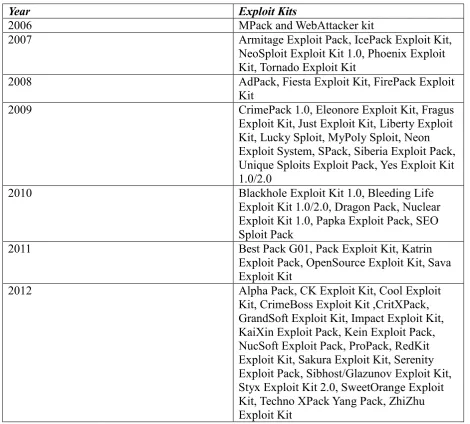
Year Exploit Kits
2006 MPack and WebAttacker kit
2007 Armitage Exploit Pack, IcePack Exploit Kit,
NeoSploit Exploit Kit 1.0, Phoenix Exploit Kit, Tornado Exploit Kit
2008 AdPack, Fiesta Exploit Kit, FirePack Exploit
Kit
2009 CrimePack 1.0, Eleonore Exploit Kit, Fragus
Exploit Kit, Just Exploit Kit, Liberty Exploit Kit, Lucky Sploit, MyPoly Sploit, Neon Exploit System, SPack, Siberia Exploit Pack, Unique Sploits Exploit Pack, Yes Exploit Kit 1.0/2.0
2010 Blackhole Exploit Kit 1.0, Bleeding Life
Exploit Kit 1.0/2.0, Dragon Pack, Nuclear Exploit Kit 1.0, Papka Exploit Pack, SEO Sploit Pack
2011 Best Pack G01, Pack Exploit Kit, Katrin
Exploit Pack, OpenSource Exploit Kit, Sava Exploit Kit
2012 Alpha Pack, CK Exploit Kit, Cool Exploit
[image:24.595.64.535.96.520.2]Kit, CrimeBoss Exploit Kit ,CritXPack, GrandSoft Exploit Kit, Impact Exploit Kit, KaiXin Exploit Pack, Kein Exploit Pack, NucSoft Exploit Pack, ProPack, RedKit Exploit Kit, Sakura Exploit Kit, Serenity Exploit Pack, Sibhost/Glazunov Exploit Kit, Styx Exploit Kit 2.0, SweetOrange Exploit Kit, Techno XPack Yang Pack, ZhiZhu Exploit Kit
Table 3.1: Timeline of Exploit kits
The table 3.1 shows the timeline of different Exploit kits from 2006 to 2012. [46]
3.1.2 How an Exploit kit works
15
Figure 3.1: Overview of a typical Exploit kit attack
When a user visits a legitimate website that has been compromised, the user's browser is redirected to a malicious website that hosts an Exploit kit. This is called a drive-by attack. [64] Then the Exploit kit scans the browser to look for vulnerabilities/security holes, such as out-of-date browser plug-ins, and delivers the payload, which is typically a malicious software. Finally, the malware proceeds to function as it is programmed to. This can be seen in Figure 3.1.
In a typical Exploit kit attack scenario, contact is the first step of the infection. During this step, an attacker tries to lure users to access the link of an Exploit kit server. This is often done through spammed emails, compromised websites or malicious advertisements [3]. In the case of spammed emails, an attacker usually tries to trick the users into clicking the link through social engineering. In the case of malicious advertisements, the advertisements redirects the users of website to Exploit kit server.
In the second step, an attacker screens the victims using a traffic direct system based on Exploit kit web Page
Compromised legitimate Website /Phishing emails
Scanning for vulnerabilities in a system
16
certain set criteria. This involves the use of traffic distribution system (TDS), whose primary function is to intelligently route web traffic that arrives at the TDS. The redirection of traffic is not necessarily monitored by an attacker but by the person who sells the same in Underground markets. An attacker can specify the target and this is achieved by filtering out victims based on the mentioned requirements. [3]
The next steps would be Exploitation and infection. Once the attacker is successful in getting a victim past steps 1 and 2, a victim will be in Exploit kit's landing page. The landing page would profile the environment of a victim, and to determine which vulnerabilities can be best used in the attack [3].
The page will send requests to the Exploit kit server to download the Exploit files based on the vulnerable application identified. The usual targeted vulnerabilities by Exploit kits are those found in Web browsers, Java, Adobe Flash Player, and Adobe Acrobat and Reader. The attacker then delivers and executes the malware in the victim’s environment after successfully exploiting the vulnerability. There are many types of malware that are associated with Exploit kit attacks, such as ransomware, online banking malware, etc. [3].
The Exploit kits can now obfuscate the payload with encryption which makes detection almost impossible as the payload will be later decrypted in victim's machine in memory by shellcode after it has been successfully downloaded in victim's machine. The Exploit kits obfuscate the Exploit file using different techniques to avoid detection. For example, jar files can be compressed using Pac200 [3] which is a compacting archive format, angler Exploit kit makes use of the same for its java Exploits to avoid the detection. Another example would be use of the tool called DoSWF [3] by Exploit kits, namely FlashPack [3] and Magnitude, to hide Flash player Exploit files [1].
Exploit kits do far more sophisticated things like using techniques such as domain shadowing which is compromising registered accounts, hosting the malicious activities under sub domains for those legitimate domains, 302 cushioning which is use of HTTP 302 redirects to use as another tier of redirection (another way for them to hide in the noise), custom encrypted payloads where the victim system is posting out data, payload is custom encrypted to every single victim [3].
3.3 Machine Learning
17
data to train a model for solve various problems, such as classification, clustering, prediction, anomaly detection, etc. The figure 3.2 shows the general framework for machine learning approach.
[image:27.595.52.529.142.225.2]DATAfff
Figure 3.2: A general framework for the machine learning approach
Data pre-processing:
The different types of data available are binary/discrete, continuous values, time series, natural language text, images, sound and so on. Data pre-processing involves data cleaning and representation. Real-life data is usually noisy. The different possible reasons are missing data, out of sync fields, misspellings, special values, spikes, and data from different sources (old/new) with slightly different meaning, inconsistent data or irrelevant data. [7] This step is done to present the data in a form that could be used to extract information which helps in understanding the data with its importance in the context of relevance and details. The exact choice of learning method and the choice of representation of features are very important. With the wrong representation, no method would be successful and a good representation guarantees success with almost any method chosen. The process of finding a suitable representation requires much domain knowledge and problem understanding.
Model generation:
The different types of machine learning algorithms can be used to build and train a model based on the requirement specifications. This model is then tested with the some part of the data set used for training using methods such as k-fold validation method for example. This can be repeated multiple times to check the accuracy of the algorithm. The different machine learning methods include
Case based methods
This is based on the fact that similar patterns belong to the same class. This is generally easy to train (every pattern is saved but sometimes similar patterns may not be identical), but takes longer during recall, to find the similar patterns. Model size increases with the number of seen examples. This requires specification of a distance measure. Examples of this are Table lookup, Nearest neighbour, k-Nearest neighbour. [49]
VERIFYING THE MODEL
MODEL GENERATION DATA PEPARATION
(Data Cleaning & data
18 Logical Inference
This is based on constructing logical expressions that characterizes the classes. This typically considers one feature at a time. Examples of this are Inductive logic, Decision trees, Rule based systems [50].
Artificial Neural Networks
This is inspired by the neural structure of the brain. The neural units are connected with others and each connection is weighted. The weights are adjusted to produce the best mapping. The ‘Deep’ architectures require much data to train. Examples of this are multilayer perceptron, Self-Organizing Maps, Bolzmann machines, deep neural networks [51].
Statistical methods
There are large number of methods, from simple to complex. The fundamental idea is to calculate the probability of each class(c) given a feature vector(x), P(c|x). The Parametric versus nonparametric methods are considered depending on whether the forms of the class distributions are known or not. Examples of this are Naive Bayes, Mixture models, Hidden Markov models, Bayesian networks, MCMC, Kernel density estimators, Particle filters. [52]
Heuristic search. Examples of this are Genetic algorithms, Reinforcement learning, simulated annealing, Minimum Description Length. [53]
Validation of the model:
The created model is validated using previously unseen data samples, which are also known as test data. “Validation” demonstrates how the model performs while being put into practise.
3.2.1 Supervised learning
Supervised machine learning algorithms learn from supplied data instances to produce general hypotheses, which then make predictions about unknown data instances. In the predictive or supervised learning approach, it learns a function from a set of labelled data, which is also known as training data, containing a set of inputs Xi mapped to set of outputs (labels/classes) Yi, The learnt function is then used to map a new given data sample (also known as test data) to its corresponding label/class.
19
Since supervised algorithms assume that the labels of data items are known, the need for knowing the category structure in advance and generation of correctly labelled training set can be challenging at times in case of large and dynamic datasets.
Figure
Figure 3.3: A general framework for the Supervised Machine Learning approach
Figure 3.3 presents a general framework for the supervised machine learning approach. The data in the training set are labelled with pre-defined classes. It guides the machine learning algorithm to find the corresponding label for the given training data. Every data instance in training set and test set used by machine learning algorithms is represented using the same set
Features (Vectors) Training data
Ex: Text, image, sound
Machine Learning Algorithm Labels
Label of the class for the new data Model
(Predicti ve) Features
(Vectors) Testing data
20
of features. These features can be continuous, categorical or binary. The trained classifier can assign class labels to test data instances. [5]
In supervised approach, instances (data) are assigned with pre-defined category labels based on the likelihood suggested by a training set of labelled but requires the manual labelling of data.
3.2.2 Unsupervised learning
The second main type of machine learning is the descriptive or unsupervised learning approach. Here we are only given inputs, and the goal is to find the pattern that exists in the data which can be an answer to a question. This is called knowledge discovery. [7]
Figure
Figure 3.4: A general framework for the Unsupervised Machine Learning approach
Features (Vectors) Training data
Ex: Text, image , sound
Machine Learning Algorithm
Testing data
(new data) Model
Features (Vectors)
21
Figure 3.4 gives a general framework for the Unsupervised Machine Learning approach. Here, depending on the algorithm used, a pattern is found in the given data which is used to classify new data presented.
In unsupervised approach, there is no need for labelled instances or human intervention at any point of the whole process but at the same time poses the difficulty such as determining the number of clusters for clustering in advance.
3.4 Multinomial Naive Bayes
This section mentions about the supervised machine learning algorithm used in layer 1 of this work.
For an input instance X, the Naive Bayes classifier determines the probability of X belonging to each different class given and then one with the highest probability is assigned to the instance. The features are assumed to be mutually independent in Naive Bayes and probability of class Ciis calculated using Bayes’ Theorem.
� �
�|�⃗ =
� � |�� � � |�� � � |�� �⃗⃗� ...� ��|�� .� ��(3.1)
Equation 3.1 provides mathematical formula to calculate the probability of class Ci given X. The Naive Bayes (NB) classifier uses the joint probabilities of terms and respective categories to estimate the probabilities of categories given a test data making it a is a probabilistic model. [36] This is sometimes called naive because of the assumption that all terms involved in the data are conditionally independent of each other given a category. Due to this, the parameters for each term can be learned separately and this speeds the computation operations compared to other classifiers. There are two common event models for NB which involves text classification, multinomial model and multivariate Bernoulli model. In these models classification of test data is performed by applying the Bayes’ rule [18]
� |
=
� � ∙ � |(3.2)
where di is a test data and cj is a category. The equation 3.2 gives mathematical formula for Naive Bayes. The posterior probability of each category cj given the test data di, i.e. P(cj|di), is calculated and di, data is assigned to the category with the highest probability. The P(cj) and P(di|cj) are estimated from the training set data to calculate P(cj|di). The P(di) can be eliminated from the computation as it is same for each category. The category prior probability, P(cj), can be estimated as follows:
�̂ =∑�= ,
22
where, N is number of training data and y(di|cj) is defined as follows:
,
= {
�
(3.4)
The equation 3.3 and 3.4 provides mathematical formula to calculate prior probability for each category. The prior probability of each category cj is estimated by the fraction of data in the training set belonging to that category cj . The multinomial model and multivariate Bernoulli model use different ways to estimate P(di | cj) .The multinomial model is explained below:In the multinomial model a document di is an ordered sequence of term events, drawn from the term space T. The probability of each term event does not depend on position in the document, term's context and length of the document as it is assumed to be independent in this model. So, each document di is drawn from a multinomial distribution of terms with number of independent trials equal to the length of di. The Equation 3.5 provides the mathematical formula for probability of document di belonging to a category in multinomial model
The probability of a document di given its category cj can be approximated as:
�
|
≈ ∏
| |=� ,
(3.5) where |di| is the number of terms in data di; and ti is the ith term occurring in document di. Thus the estimation of P(di|cj) is reduced to estimating each P(ti|cj) independently. The following Bayesian estimate is used for P(ti|cj):
�̂
|
=
| | +∑ + , ,∈
(3.6)
The Equation 3.6 provides mathematical formula for Bayesian Estimate applied to P(ti|cj). Here, TF(ti,cj) is the total number of times term ti occurs in the training set documents belonging to category cj . The summation term in the denominator stands for the total number of term occurrences in the training set data belonging to category cj . This estimator is called Laplace estimator and assumes that the observation of each word is a priori likely [17]. Multinomial model: an instance is represented by a feature vector with integer elements whose value is the frequency of that word in the instance.
Thus given a training set of instances (with labelled class) and a set of K classes, multinomial text classification model is as follows:
23
2. In the training set, the total number of instances and frequency of the word are calculated. The total number of instances is N. The number of instances labelled with class C=k, for each class k=1, . . . , K, Nk. The frequency of word wt in instance Di, xit is computed for every word wt in V.
3. The likelihoods P(wt|C=k) is estimated using
�̂
| =
=
∑�=∑| |= ∑�=
(3.7)
where ��� is an indicator variable which equals 1 when Di has class C=k, and equals 0 otherwise
4. The priors P(C=k) are estimated using
�̂ =
=
�� (3.8)
5.The unlabeled instance Dj is classified by estimating the posterior probability for each class using
P(C|Dj)
∝
P(C|xj)
∝ �
∏
|�|=�
|
(3.9)
3.5 K-means clustering
This section mentions about the machine learning algorithm used in the layer 2 of the work. Clustering is a type of unsupervised machine learning algorithms, which do not require any labelled data for training. Clustering algorithms group data points according to their similarities. In other words, how close these data points are. Give a real-life example, Assuming that we have a dataset containing human data samples and dog data samples but we are not sure how humans and dogs look like. Each sample described with two features,
namely “walking with four legs” and “having a tale”. The two features of each sample have
Boolean values. A clustering algorithm groups all the samples according their feature values. If the data samples collected properly, we should see identical patterns in the two clusters, namely the human cluster and the dog cluster. Thus, we can use the patterns to describe and distinguish humans and dogs.
It is important to know the of number of clusters to be formed, then clusters can be found using the kmeans algorithm.
Let k be the number of clusters. The algorithm is as follows:
1. k data points from the data set are selected randomly as the initial centroids
24
K-means is a simple but powerful technique for identifying grouping data with similar features in.
The centroid vector c of cluster C of instances is given by the equation 3.10 :
=
∑ =(3.10) So, c is obtained by averaging the weights of the terms of the instances in C. The similarity between a instance d (data) and a centroid vector c is given by cosine similarity measure equation 3.11.
,
=
| |.| | • (3.11)3.6 Input data
This section mentions about the format of the data considered as input for this research. There are several websites with databases collecting information on various types of security incidents, and one such place is Security Repo, an open source containing data of various security incidents and is available at http://www.secrepo.com/#. The data considered for this research is meta data of bro logs of various Exploit kits collected and generated in 2012. The data for training is set up with 2000 instances which includes 1000 instances of legitimate data and 1000 more instances of malicious data (Exploit kit in this case). The malicious data for training is obtained from the meta-data of bro logs of Exploit kits found in secrepo.com. The legitimatedata for training is obtained by generating a PCAP file which can be done using, for example, Wireshark or tcpdump.
3.7 Textual data to numeric format
The data under consideration for the research is textual data. This data has to be converted to numeric format to use it in machine learning. This can be done by using following methods:
3.7.1 Word count vector
This is based on Vector Space Model [64]. Each instance is treated as a vector of its words. There is one co-ordinate for every possible word w. The similarity between vectors is calculated by their dot product. Given the instances I1 and I2, their dot product is given by equation 3.12
25
The obvious problem is that dot product is not scale invariant. This is solved by normalising them by words using equation 3.13.
� ∙�
||� ||∙||� || (3.13)
When the angle between vectors given by � � , � = � � ∙�
||� ||∙||� || is 0, then the instances are identical and is not identical when it is 90°.
The algorithm takes into account the number of occurrences of a given term in training instances from its class , including multiple occurrences. [35]
The algorithm reads the different instances. Then the algorithm splits each instances (for each character in the line, if it is not alphanumeric, previous word is added to the list and then it starts with a new word)into words. Then it counts the word frequencies (the word list is sorted, for each word in word list, counter is incremented if it same as last word else last word and its counter is added to the list and counter is reset to 0). Then it computes the dot products (it starts with first words of each instance if the words are equal, word frequencies are multiplied and added to the total, and is repeated until the instances run out of words). When the dot product is 0, it implies that the instances are same and when the dot product is 90°, it implies that instances are not identical. [35]
3.8 Feature selection
This section mentions about the method to validate the strength of the features considered for machine learning.
The goal of feature selection is to pick the strong relevant features which can help solve the problem at hand by ignoring redundant and noisy features which do not give much information about the data.
Information gain assign a scoring to each feature by applying a statistical measure to the features. The features are ranked by the score and the suitable features can be selected based on their score. This is univariate and considers all the features independently, or with regard to the dependent variable. This makes it suitable for this work.[56]
Information Gain:
26
�� � = − ∑ � �
�. �� � �
��=
+ � � . ∑ � �
�|� . �� � �
�|�
�=+ � �̅ ∑ � �
�|�̅ . �� � �
�|�̅
�=(3.14) Equation 3.14 provides mathematical formula to calcualte information gain for each term. For the two cases of when the feature is present and when the feature is absent, decrease in the entropy is calculated. � �� is the prior probability of category �� It can be estimated from the fraction of instances in the training set belonging to category ��. P(t) is the prior probability of term t. It can be estimated from the fraction of instances in the training set in which term t is present. � �̅ can be estimated from the fraction of instances in the training set in which term t is absent. The Terms whose Information gain are less than some predetermined threshold which depends on the problem at hand are removed from the feature space. [16]
3.9 Scikit- library
This section mentions about the functions made use of in the implementation of this work. Scikit Learn provides a wide range of supervised learning algorithms and unsupervised learning algorithms via a consistent interface in Python. It is licensed under a permissive simplified BSD license. It is distributed under many Linux distributions, encouraging academic use and commercial use. [68]
Some popular groups of models provided by Scikit Learn include Clustering, Cross Validation, Datasets, Dimensionality Reduction, Ensemble methods, Feature extraction, Feature selection , Parameter Tuning, Manifold Learning, Supervised Models (Naive Bayes, discriminate analysis, neural networks, support vector machines and decision trees). [68] This work has made use of following scikit-library functions:
1) class sklearn.naive_bayes.MultinomialNB
This is Naive Bayes classifier used for multinomial models (multinomially distributed data). This is usually used when discrete features (for example word count vectors) are considered for classification. [68]
2) sklearn.feature_extraction.text import CountVectorizer
27
2 letters as a word) as token and assigns an integer and counts the number of times it occurs in a instance(data). [68]
3) class sklearn.cluster.KMeans
28
Chapter 4 Method
[image:38.595.181.412.185.649.2]This research uses machine learning to detect the Exploit kit attacks with the help of supervised learning and unsupervised learning. The procedure is explained below.
Figure 4.1: Overview of the methodology
Figure 4.1 represents the overview of the methodology used in this work. Layer 1:
Layer 1-Supervised Classification
Algorithm: Naive Bayes classifier
Aim: To classify the data as
legitimate or malicious {Exploit kit in this case}
Layer 2-Unsupervised Classification
Algorithm: K-Means Clustering
Aim: To cluster malicious data belonging to different Exploit kits
Layer 3 - Visualization of Clusters
29
This stage involves supervised machine learning approach by using multinomial Naive Bayes algorithm. The Naive Bayes algorithm classifies the given data as either legitimate data or malicious data which is Exploit kit in this research project.
The information gain algorithm [16] is implemented to select the best features for machine learning. Based on this algorithm and relevance of features for detection, the features are chosen and used in detection of Exploit kits.
Layer 2:
In the second stage of the work, the output of the first stage is clustered using an unsupervised learning algorithm, namely K-means clustering [7]. This algorithm clusters the data into different groups of Exploit kits.
The data is textual and it is converted to numeric format using unigram Characterization [67]. Each alphabet within a feature, which is a string in context of Exploit kit detection, is mapped to a number to build a distinct profile. A 36-dimensional numeric vector represents the URL and domain name of the malicious data. The value of each element in the vector is a digit, and each dimension stands for a distinct alphabet or a number.
Then the data is clustered into groups of different Exploit kits based on the similarity between the profiles of malicious instances. The value of k, namely the number of clusters, is determined based on the knowledge of the data and using an Elbow method [54]. Then the data is clustered into k different groups of Exploit kits.
Layer 3:
The clusters are visualised after being reduced to two dimensions using Principal Component Analysis (PCA) [63] as the data is 36 in dimension at layer 2.
4.1 Feature selection through information gain
The different parameters typically present the HTTP bro log are id.orig_h, id.orig_p, id.resp_h, id.resp_p, trans_depth, method, host, uri, referrer, user_agent, request_body_len, response_body_len, status_code, status_msg, info_code, info_msg, filename, tags, username, password, proxied, orig_fuids, orig_mime_types, resp_fuids, resp_mime_types. As currently all popular Exploit kits use the HTTP protocol, not HTTPS, this work will consider the HTTP log file as input.
It is expected that an increasing amount of Exploit kits will start favouring the use of HTTPS in the future, as the encryption of the traffic will be advantageous to the criminals behind these kits. Using encryption their attacks might stay under the radar longer, because intrusion detection systems will have more difficulties detecting their patterns.
![Figure 2.1: Architecture of PExy . Adapted from [44])](https://thumb-us.123doks.com/thumbv2/123dok_us/9781737.479277/15.595.122.457.596.684/figure-architecture-pexy-adapted.webp)
![Figure 2.2:Infections per time window per Exploit kit. Adapted from [58]](https://thumb-us.123doks.com/thumbv2/123dok_us/9781737.479277/17.595.88.492.355.652/figure-infections-time-window-exploit-kit-adapted.webp)
![Figure 2.3: Architecture of Kizzle. Adapted from [43]](https://thumb-us.123doks.com/thumbv2/123dok_us/9781737.479277/19.595.86.513.77.246/figure-architecture-kizzle-adapted.webp)