i
Master Thesis
Improving the scheduling of aircraft service tasks at KLM Aircraft Services
Author/Student F.J.J. Politiek
i
Improving the scheduling of aircraft service tasks at KLM Aircraft Services
by F.J.J. Politiek
Amsterdam, 13 November 2015
Master program Industrial Engineering and Management Specialization track Production and Logistics Management
Faculty Behavioural, Management and Social Sciences (BMS)
Institute University of Twente
Company KLM Royal Dutch Airlines
Department KLM Aircraft Services
ii
iii
Preface
In the past eight months I have been a fuel truck operator, catering truck operator, aircraft towing operator, and water truck operator for one day. My time at KLM was a great experience and I enjoyed it to the fullest. Before I started with the master Industrial Engineering and Management at the University of Twente I studied Aeronautical Engineering. To do my master’s research at KLM was thus a great opportunity for me.
KLM is a large company, and large companies are often not known by their fast and simple processes. In a large company it takes often a long time and huge effort to accomplish the goals that someone has at the start of a project. I started with the task to improve the scheduling of aircraft service tasks. This sounds maybe easy, but where to start? During my research I found out that the scheduling of aircraft service tasks are influenced by many parameters, not only mathematically, but also by human factors. However, I found my way through this research and I am more than happy with the results.
A preface without acknowledgements is not a preface. I start with my supervisors from KLM Aircraft Services Mark Bovenkerk and Maarten Vos. The help in finding the right people in the organization, the discussions about the assignment and other KLM related processes, and the arrangement of taster days in the operation made it to a great experience and helped me to finish this thesis. I next thank my supervisors from the University of Twente Marco Schutten and Leo van der Wegen. They always provided me valuable feedback on the research content and I always left Enschede with new ideas, it definitively helped me to improve my thesis. At last I thank my colleagues from KLM AS Tony, Pascal, Elizabeth, Iwi, Marian, Tonnie, Erik, Glen, and Wilfried for the good working atmosphere, the non-work related discussions, and everyday lunches.
Finally, I thank my younger brother Hylke Politiek for sharing his apartment and the great time that we had together in Amsterdam.
Amsterdam, 13th of November 2015.
iv
Summary
Introduction
This research focuses on scheduling improvements of aircraft service tasks at KLM Aircraft Services. The scheduling of aircraft service tasks is done by dispatchers (in Dutch: regisseurs). These dispatcher are helped by the coordination and scheduling of aircraft service tasks by CHIP (Communicatie & Hub Indelings Programma). Only aircraft towing, aircraft pushbacks, aqua services, toilet services, and aircraft refueling tasks are scheduled with CHIP.
Problem description
The aviation world is a highly competitive market where every minute counts. As increasing number of flights and shorter turnaround times make the timely completion of aircraft service tasks more and more important. Currently there is a common feeling under AS management that CHIP is underperforming. Instead of scheduling pro-actively and constantly keeping track of future critical events, the dispatchers and CHIP are scheduling re-actively. The underperformance is also caused by limited knowledge and insight in what actually happens inside CHIP. These underperformance tendencies are the basis of the research goal of this thesis. The research goal is to provide insights into the scheduling of aircraft service tasks and to propose schedule improvements.
Approach
We investigate the CHIP scheduling process during the day, describe the scheduling problem, and define a new measurement method to measure the performance in the future. This measurement method consists of a dynamic workload graph tool and a dynamic performance measurement tool. Based on the dynamic workload graph we are able to identify critical scheduling issues and propose scheduling improvements. With the dynamic performance measurement tool we developed a new way for the dispatcher to see critical events in advance. We evaluate the dynamic workload graph and dynamic performance measurement tool by using the operational data of a specific day.
Important results and findings
v
Dispatchers are able to see critical time windows in advance when using the performance measurement tool and dynamic workload graph.
We showed that operators are sent home before their shift ends. To facilitate this the dispatcher re-schedules tasks at the end of a shift to the next shift without considering the future workload. This leads to unnecessary increases in the workload and should therefore be avoided.
CHIP uses many optimization criteria to optimize the assignment of tasks to operators. Due to this complex optimization the dispatcher should make as less changes to the schedule as needed. Since the dispatcher is unable to evaluate all optimization criteria in a short time.
We showed that breaks are scheduled at the last moment and often on their latest end time. We propose a break schedule that gradually assigns breaks to operators and that is fixed at the start of the day. This leads to a more predictable break schedule and decreases the nervousness of the scheduling system.
During the shift change between 14:00 and 14:30 on average one task is completed. A shift change schedule that is gradually implemented will lead to more completed tasks and higher resource utilization during the shift change.
Recommendations
We recommend KLM AS to discuss and further improve the performance measurement tool and workload graph together with all KLM AS dispatchers and DMAs. We believe that the scheduling process and schedule can be improved if these tools are used by the dispatcher and DMA. However, a new tool will only be successful if one has the full collaboration and acceptance of the users. KLM AS should invest enough time to demonstrate and explain the importance of the tool to users.
We also recommend KLM AS to discuss the early departure of operators that is facilitated by the dispatchers. In this discussion KLM AS should use the dynamic workload graph to show the effects of re-scheduling tasks to a next shift to facilitate the early departure of operators.
vi
Contents
1 Introduction ... 1
1.1 Background ... 1
1.1.1 KLM ... 1
1.1.2 KLM Aircraft Services ... 2
1.1.3 Hub control center ... 2
1.1.4 Duty Manager Aircraft ... 2
1.1.5 Aircraft Services dispatcher ... 3
1.2 Research Motivation ... 3
1.3 Research objective and questions ... 4
1.4 Outline... 6
2 Current situation... 7
2.1 KLM Aircraft services in detail ... 7
2.2 Information system ... 9
2.2.1 CHIP ... 9
2.3 The dispatcher ... 13
2.3.1 Position, duties, and responsibilities ... 13
2.4 Conclusion ... 15
3 Literature review ... 16
3.1 The scheduling problem ... 16
3.2 Scheduling process ... 19
3.2.1 Robustness during scheduling ... 21
3.3 Information ... 22
3.4 Human and organizational aspects ... 23
3.5 Performance measurement ... 24
3.5.1 Performance measurement in general ... 24
3.5.2 Performance measures ... 25
vii
3.6 Conclusion ... 27
4 Performance and quality of online scheduling... 29
4.1 Stakeholder analysis ... 29
4.2 Schedule performance over time ... 30
4.2.1 Measurement methods ... 30
4.2.2 Data gathering method ... 36
4.3 Analysis ... 38
4.3.1 Workload analysis ... 38
4.3.2 Dynamic workload graphs ... 39
4.3.3 Performance measurement sheet analysis ... 44
4.3.4 Actual performance ... 64
4.4 Conclusion ... 65
5 Scheduling improvements ... 68
5.1 Schedule improvements based on dynamic workload graphs ... 68
5.2 Schedule improvements based on dynamic performance measurement sheet ... 70
5.3 Dispatcher’s tool ... 72
5.4 Implementation ... 74
5.5 Conclusion ... 75
6 Conclusion and recommendations ... 77
6.1 Conclusion and discussion ... 77
6.2 Recommendations ... 79
Bibliography ... 81
Appendix A Python data pre-processing code ... 84
Appendix B HCC Organogram ... 87
viii
List of Abbreviations
Abbreviation Meaning
A0 Arrival performance
ADC All Doors Closed
AIBT Actual In-Block Time
AS Aircraft Services
CHIP Communicatie Hub Indelings Programma
D0 Departure performance
DAM Duty Area Manager
DARP Dial-a-Ride Problems
DHM Duty Hub Manager
DMA Duty Manager Aircraft
EXIT Estimated Taxi-In Time
EXOT Estimated Taxi-Out Time
FIRDA Flight Information Royal Dutch Airlines System
GS Ground Services
HCC Hub Control Center
HTO Human Technological Organization
TOBT Target Off-Block Time
TSP Traveling Salesman Problem
VRP Vehicle Routing Problem
VRPSD Vehicle Routing Problem Stochastic Demand
VRPSTT Vehicle Routing Problem Stochastic Travel Times
- 1 -
1
Introduction
This thesis is written during an eight month internship at KLM Aircraft Services. We first introduce Aircraft Services with the following question: Have you ever thought while you were sitting in an aircraft which services were needed before your aircraft could leave? Most of the readers of this thesis probably did not. The aircraft must be fueled, cleaned, supplied with water, catered, de-iced if necessary, and in most cases pushed back from the gate. At Amsterdam Schiphol Airport these services are provided by KLM Aircraft Services (AS).
The aircraft services are controlled by a department of KLM at Amsterdam Airport. Within this department dispatchers (in Dutch: ‘regisseurs’) coordinate the operation of aircraft services separately. The scheduling and coordination of these services is a complex task. During the day there are a lot of disturbances that ruin a predefined schedule of tasks. The dispatcher is helped in the coordination of these processes by the CHIP system (In Dutch: Communicatie & Hub Indelings Programma). CHIP contains all tasks related to a service that an operator needs to do during the working day and automatically dispatches jobs to operators.
The aim of this research is to improve the control and planning of aircraft services. In this research we analyze the work environment of an AS dispatcher and we perform a literature study to make suggestions for improvement in the coordination of aircraft services.
Section 1.1 introduces KLM and specifically KLM AS. In Section 1.2 we explain the research motivation and in Section 1.3 the research objective and research questions. Section 1.4 presents the outline of this thesis.
1.1 Background
Section 1.1.1 describes the KLM in general. Section 1.1.2 addresses all aircraft services in further detail.
1.1.1 KLM
The KLM is started and established in 1919 as ‘Koninklijke Luchtvaart Maatschappij’. Nowadays KLM is the oldest airline in the world that is operating under its original name. The huge growth of KLM is remarkable to mention. In the first operating year KLM transported 345 passengers and 25,000 kilograms freight. The KLM annual report of
- 2 -
with KLM, Air France, or its partners. The merger between KLM and Air France was established in 2004 and KLM is now part of Air France KLM Group.
1.1.2 KLM Aircraft Services
KLM Aircraft Services is part of KLM Ground Services (GS). GS manages all hub operations at Amsterdam Schiphol Airport. An airport is called a hub when an airline is using this airport as a transfer point to get passengers to their intended destination. AS offers the following services:
De-icing/Anti-icing
Aircraft Towing
Aircraft Pushbacks
Aqua Services
Toilet services
Aircraft Refueling
Cabin quality/cleaning
Catering services
1.1.3 Hub control center
All activities and processes from the daily flight operations are monitored and controlled by AS dispatchers in the Hub Control Center (HCC). The HCC in general is responsible for all flight operations of KLM and partners and has the following primary tasks:
Managing the critical resources on the day itself.
Managing the flights on hub Amsterdam Airport in cooperation with the Operational Control Center (OCC).
Responding to emergencies and operational crisis situations.
Preparing and evaluating the hub performance.
Within the HCC there are different functions. Appendix B describes those in further detail. The Duty Manager Aircraft (DMA) and Aircraft Services dispatchers are part of this research. Section 1.1.4 briefly describes the role of the DMA. Section 1.1.5 addresses the role of the Aircraft Service dispatcher.
1.1.4 Duty Manager Aircraft
- 3 -
1.1.5 Aircraft Services dispatcher
The dispatchers of AS are responsible for the operational scheduling of aircraft services during the day. Each aircraft service is controlled separately by a dispatcher. The dispatcher is helped with the control of services by the CHIP system. CHIP is a computer program that helps the dispatcher to plan tasks in time. CHIP contains all tasks related to a service that an operator needs to do during the working day and automatically dispatches jobs to operators. This dispatching is based on many different input parameters.
The operational scheduling by dispatchers can be positioned in the planning and control framework of Hans et al. (2011) as follows (see Figure 2).
Figure 2: Positioning of dispatcher in the hierarchical planning & control framework, based on Hans et al. (2011)
According to Hans et al. (2011) online operational planning involves “the control mechanisms that deal with monitoring the process and reacting to unforeseen or unanticipated events”. This definition can be translated to the tasks of the dispatcher. CHIP together with the AS dispatcher functions as a control mechanism to monitor the aircraft service process. The dispatcher and CHIP should react and anticipate on unforeseen events.
1.2 Research Motivation
Currently there are multiple reasons to start a research into the online operational scheduling of AS services. Shorter turnaround times and an increasing number of flights put high pressure on the planning and control on the day of execution. There is a common feeling under AS management that the CHIP system is underperforming. This underperformance is partly due to the actions and interventions of the dispatcher who is responsible for the coordination of the aircraft services. This underperformance is a direct cause for further analysis into the work environment of the dispatcher. There is also a lack of insight into the working methods of the dispatchers and discussion about the responsibilities and mandate of a dispatcher. Of course what they do is known, but how and based on what are questions that are not fully clear at this moment and that gives potential for improvement.
In an ideal world where all future events are known it is less difficult to construct a ‘good’ schedule for the aircraft services. The dispatcher can schedule pro-actively and anticipate on disturbances and adjust the schedule if needed. However, in the real world the dispatcher has to deal with a lot of unknown events. These unknown events are often the
Strategic Tactical
Operational
•Online operational
- 4 -
cause that CHIP cannot schedule automatically. In those cases the dispatcher schedules manually.
The dispatcher often schedules the tasks re-actively instead of pro-actively. When a job is not planned automatically by CHIP, the dispatcher waits until the equipment is available. After it is available the dispatcher gives the job to the operator with the free equipment. This is called scheduling re-actively. Scheduling re-actively often results in a poor schedule.
At this moment it is not possible to assess the quality of a constructed plan at the end of the day. The quality cannot be assessed, because the performance measures that are used to measure the quality are not clear. This research will construct and evaluate performance measures for quality to use and measure the effect of proposed improvements in the scheduling process. Summarizing, there are opportunities for further improvements in the online scheduling.
1.3 Research objective and questions
The goal of this research is to improve the process of online scheduling of aircraft services within the Hub Control Center. The improvement proposals will be gathered by a thorough analysis into the work environment of an AS dispatcher and literature study. The improvements will lead to better control and planning of aircraft services on the day of execution. These improvements contribute to the priorities and performance goals that are set by the hub Schiphol.
This research focusses on the current working methods and structure within the HCC. It does not assess a different organization structure or the use of other IT programs to control the operation. This results in the following main research question:
“How can KLM Aircraft Services improve the online scheduling of aircraft services, within the current organization and IT structure?”
The first step is to obtain a clear understanding about the current working methods of AS dispatchers within the HCC.
Research question 1
What is the current situation regarding online scheduling of aircraft services? We divide research question 1 into the following sub questions:
i. What information and systems are used by an AS dispatcher? ii. What are the current working methods of an AS dispatcher?
- 5 -
To understand the current situation and working methods that are used within the HCC we spend several weeks at the HCC. We closely observe, question, and describe the operation and talk with the DMA and dispatchers about their working day.
Research question 2
What is described in literature that can help to improve the planning and control of aircraft services?
i. How can the scheduling problem of aircraft services be characterized? ii. Which process information is needed for these scheduling problems? iii. What are the human and organizational aspects in scheduling? iv. What is needed to define good performance measures?
We start defining the scheduling problem of aircraft services related to the scientific literature. From this definition we argue and try to find out which information is needed to solve these scheduling problems. Next, the answer to sub question iii describes how scheduling is influenced by the scheduler and the organization. Sub question iv is formulated as basis for research question 3.
Research question 3
How can we measure the performance and quality of a schedule?
i. What is considered as schedule quality for different stakeholders?
ii. How can we assess and measure the scheduling performance over time?
By answering research question 3, we present performance measures that quantitatively describe the quality of a created schedule over time for the aircraft services. We provide insights into schedule changes during a day. To find the data that is needed to construct the performance measures we ask the help from process analysts of KLM AS.
Research question 4
Which improvements can be made in the online scheduling of aircraft services? i. What are the potential improvements for the decision of assigning tasks to
operators?
ii. How can AS and the HCC implement the proposed improvements?
- 6 - 1.4 Outline
The remainder of this thesis is structured as follows:
- 7 -
2
Current situation
This chapter describes the current situation of online scheduling of aircraft services. Section 2.1 presents and briefly explains all aircraft services. Section 2.2 describes the decision support system CHIP. We explain the different types of tasks, the dispatching of tasks, and the optimizer behind CHIP. Section 2.3 presents an overview of the responsibilities and position within the organization of a KLM AS dispatcher. Section 2.4 ends with a conclusion.
2.1 KLM Aircraft services in detail
Each aircraft service has its own dispatcher that controls the daily operation. The dispatchers are sitting together so that they can interact and discuss with each other easily. Section 1.1.2 enumerates all aircraft services. To understand the current working methods of an AS dispatcher we first explain each aircraft service in more detail. Only aircraft towing, aircraft pushbacks, aqua services, toilet services, and aircraft refueling are coordinated with CHIP.
De-icing/Anti-icing
De-icing is a treatment where de-icing fluid is sprayed onto the aircraft to remove snow and ice from the critical areas of the airplane. Critical areas are for example the wings and the stabilizers. There are two major reasons why de-icing is necessary. The first reason is to ensure the free movement of the steering surfaces of the aircraft. The second reason is that a possible layer of ice on the wings can disrupt the airflow around a surface which can lead to a loss
of lift. The de-icing department is located at a remote area of Schiphol. The aircraft taxi towards this position and the engines can stay running while undergoing the treatment. In total there are 24 Safeaero de-icing vehicles available. Figure 3 shows a KLM aircraft that receives a de-icing treatment by de-icing vehicles.
Aircraft towing
Aircraft towing and aircraft pushbacks are operated by the KLM Aircraft Towing & Pushback services department. Towing is needed to move aircraft from and to the buffers and gate positions on Schiphol Airport. A buffer is an outside position on Schiphol Airport where aircraft can be parked. When an aircraft has a long ground time the buffer is used to free up space at the gate positions. Towing is also needed when aircraft are located at the maintenance department at Schiphol East. Figure 4 shows an aircraft towing tug.
- 8 -
Aircraft pushbacks
A pushback is an operation where the aircraft is moved backwards from the gate. An aircraft needs a pushback to leave the gate, because the aircraft is not capable of riding backwards. However, some aircraft are: they can use reverse thrust from its engines, but this can cause severe damage to the terminal and gate. A pushback is performed by a tug (see Figure 4).
Figure 4: KLM tug Figure 5: KLM Toilet truck
Figure 6: Fuel bowser Figure 7: Catering services
Aqua services & Toilet services
Aqua service is responsible for the supply of potable water to the aircraft. The water is delivered by small trucks with a water tank. The toilet service is separated from the water service and operated with a different truck. Figure 5 shows a KLM toilet truck. The truck has a platform that can lift so that the toilet drains can be reached.
Aircraft refueling
The refueling department is responsible for the supply of fuel to the aircraft. The department has three large bowsers (80m3) and 15 smaller bowsers (40m3) that refuel the
- 9 -
bowser that is refueling an aircraft. Many gates at Schiphol have a fuel hydrant point. In those cases it is not necessary to reach the aircraft with a large truck. To use this system 21 dispensers are available. A dispenser is a truck that has the equipment to use the fuel hydrant system, such as hoses, couples, and pumps.
Cabin quality/cleaning
Aircraft cleaning activities are outsourced to Asito and Klüh that are both cleaning companies that are not part of KLM. Both cleaning companies operate autonomously, however they are supervised by a contract manager from KLM. Both companies have a dispatcher to control the daily operation.
Catering services
The catering activities are outsourced to a subsidiary company KLM Catering Services (KCS). KCS is responsible for the supply of meals and non-food items that can be found in the aircraft. Catering trucks are used to supply the aircraft. Figure 7 shows a catering truck. The container is lifted to align the aircraft doors with the container which makes loading easier.
2.2 Information system
This section describes the information system CHIP that is used for dispatching aircraft service tasks to resources.
2.2.1 CHIP
CHIP is used by the dispatcher to control the operation of a specific aircraft service. CHIP is a computer program that is built by INFORM1. INFORM is a company based in Aachen
Germany which is specialized in intelligent planning and logistics decision-making software. CHIP is a tool for decision support, not for decision take-away. It does not replace the human dispatcher, but helps the dispatcher making the best assignment at that time. We start with an explanation of the basic idea behind CHIP.
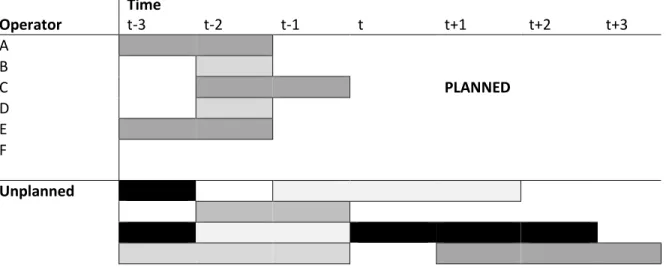
Figure 8 shows six operators (A to F), a timeline where t denotes the current time, and several unplanned jobs. With jobs we mean specific aircraft service tasks, for example refueling, potable water supply etc. The jobs are represented by grey blocks. All jobs must be planned and assigned to AS operators. However, there are a lot of restrictions when dispatching jobs to operators. Time windows, shift roster limitations, breaks, flight schedules, and equipment in use for example. If a dispatcher should manually collect all information that is needed to dispatch a job and interpret this information continuously, he or she will be unable to schedule aircraft service jobs.
- 10 -
Time
Operator t-3 t-2 t-1 t t+1 t+2 t+3
A
B
C PLANNED
D
E
F
Unplanned
Figure 8: Basic scheduling representation CHIP
Information input CHIP
Figure 9 shows the input sources of CHIP. The input of CHIP consists out of the flight information system, base data, and roster control.
INPUT OUTPUT
Flight information system
Base data CHIP Operators
Roster control
Figure 9: Input information CHIP
- 11 -
as displayed in Figure 8 are created by CHIP based on the input information as displayed in Figure 9. Tasks are continuously created, updated, and deleted based on the real time information from its input sources.
Types of tasks
A task can be flight related or non-flight related. In the first case a task is linked to actual flight events, whereas the non-flight related tasks do not have a link with a flight event. This can be for example a standard daily activity. CHIP considers also single-flight and multi-flight related tasks. As the name suggests single-flight tasks are related to one single-flight event, whereas multi-flight tasks are related to multiple flights. For instance a check-in task for multiple flights is considered as a multi-flight task. CHIP also makes a distinction between time-interval-oriented and moment-oriented tasks. A time-interval-oriented task is a task that must be performed during a given time-interval. For example, a Boeing 747-400 must be refueled during its ground time. Moment-oriented tasks are tasks that must be performed at a given moment in time, or start at a given time.
CHIP also considers main tasks and sub tasks. Sub tasks that belong to the same operation are grouped together in a main task. Important to mention is that only sub tasks can be assigned to resources. Main tasks are considered as a structure within the data. When tasks are created, the next step is to dispatch the tasks to operators.
Dispatching tasks
CHIP creates tasks for the following day during the night. It receives the initial flight data of the next day and based on that information it creates the tasks for the next day. During the day these tasks are updated due to the real time flight information which can lead to the generation of new tasks, changing tasks or subtasks, or deleting tasks and subtasks.
Starting from Figure 8, the unplanned tasks must be assigned to one of the operators. The operators are considered as resources. Each task has a set of different qualifications that are needed to perform this task. For example for the refueling of a Boeing 747-300 an operator needs a specific license. This can be considered as a qualification for the task. The qualifications are split up in mandatory and non-mandatory qualifications. When a task is assigned to a resource, it must comply with all mandatory qualifications and to some degree with the non-mandatory. The resources have also specific qualifications, for instance a tank operator with a specific license, or a bowser with a capacity of 40m3. When allocating a task
- 12 -
However, if there are more resources that match with the qualifications of a specific task the system has to make a decision which resource to assign. This assignment is performed by the optimizer within CHIP. Table 1 shows which data is used by the optimizer when making an assignment.
Tasks Time windows
Duration
Travel time
Priority
Task type
Workload
Work area
Task requirements
Teaming
Shifts Start and end time of a shift
Table 1: Optimizer data
Time windows
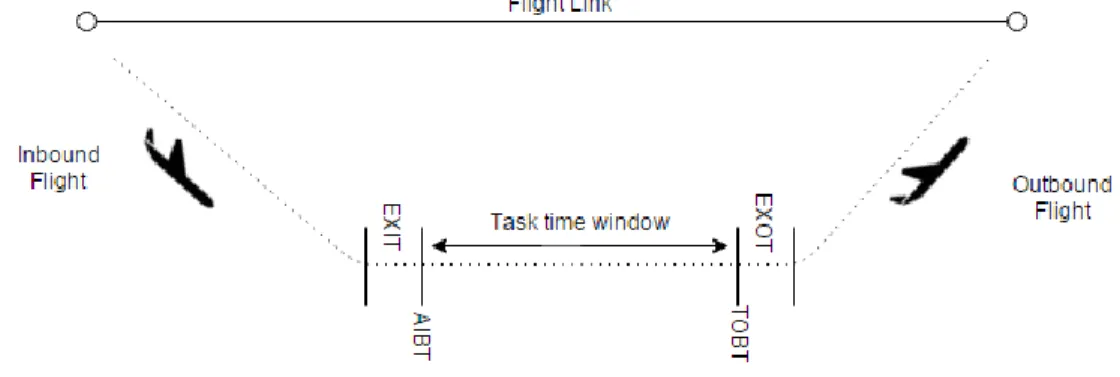
CHIP considers time windows when a certain task has to be planned. The time window is based on the earliest start and latest end time requirement. These requirements are related to the actual landing time and scheduled departure time. Figure 10 schematically presents the time window when a job has to be planned. The EXIT time is the Estimated Taxi-In Time. It is the time that an aircraft spends taxiing between the run way and parking place. The actual in-block time (AIBT) is the actual time and date when the parking brakes of the aircraft have been engaged at the parking position (EUROCONTROL, 2009). The end of the task time window is marked with the target off-block time (TOBT). At that point in time the ground handling process is concluded and the aircraft is ready to start-up and pushed backed from the parking position. The TOBT is a forecasted value. The Estimated Taxi-Out Time (EXOT) is the outbound taxi time. If a task is planned later than its latest end time requirement, the aircraft will be delayed.
- 13 -
The optimizer in more detail
CHIP considers and creates a schedule for the next four-hour time window. Before task allocation, the optimizer starts with a search for all combinations of tasks and resources that are allowed based on the qualifications of the resource and task. Second, a cost value is associated with each task and resource combination based on a cost function. The cost function consists of different parameters. The exact parameters of this cost function are not given by INFORM. The optimizer tries to minimize the total costs of all task allocations to resources. The cost function is configurable by the system owner with predefined so called alpha parameters.
2.3 The dispatcher
In Section 2.2.1 we discussed and explained the working of CHIP in detail. We explained the basic idea of CHIP, the information input sources, types of tasks, dispatching tasks, and the optimizer. In this section we discuss the dispatcher, who is responsible for the schedule output of CHIP. Currently2 26 dispatchers are working within the HCC. There are also
back-up dispatchers. A back-back-up dispatcher is someone who is normally working in the operation as an operator, but if there are not enough dispatchers available at a specific time he or she can also play the role of a dispatcher. We do not count the dispatchers from the cleaning companies Klüh and Asito, simply, because they are not part of KLM. Another important note is that the catering KCS is not using CHIP, but a different system.
Table 2 displays all 26 dispatchers and their qualifications. In total there are 18 dispatchers certified for aqua and refueling and 20 for towing and push-back.
# Dispatchers Aqua Towing Push-Back Refuel
4 ✔ ✔ ✔ ✔
8 ✔ ✔ ✔
6 ✔ ✔
8 ✔ ✔ ✔
Table 2: Number of dispatchers with qualifications
The dispatchers are working within shifts. The first shift is from 6:00 AM to 2:30 PM. The next shift is the day shift which starts at 7:00 AM and ends at 3:30 PM. The late shift starts at 2:00 PM and ends at 10:30 PM. The night shift is from 10:00 PM to 6:30 AM.
2.3.1 Position, duties, and responsibilities
The goal of the dispatcher is that all aircraft service processes are finished on time. The dispatcher is responsible for the effective dispatching of jobs to the available resources that
- 14 -
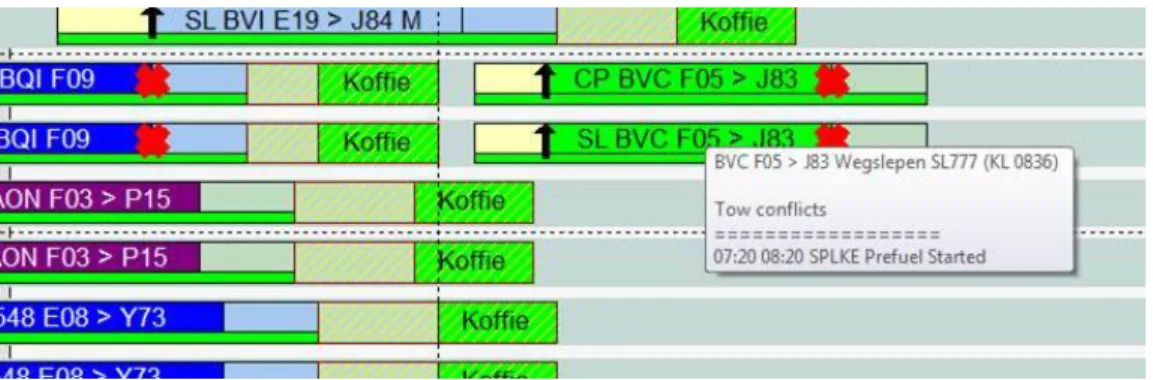
day. When dispatching the jobs the dispatcher should in some cases communicate with the other aircraft services. This communication is needed when a task of a different service conflicts with another task of another service. The towing department has the highest priority in CHIP compared to the other services. So other service tasks are planned around the towing task. Figure 11 displays a task conflict. The red sign at the end of the task indicates this conflict. The conflicting task of the other aircraft service is not visible for this dispatcher, only the start time of the task is given. There is a conflict between a towing task and pre-fuel task. It is namely not possible to tow an aircraft when the fuel truck is fueling. This conflict occurs when the fuel task has a longer duration than expected or the pre-fuel is planned manually for a certain reason. In those cases it is necessary that a dispatcher communicates with the dispatcher of another service.
Figure 11: Task conflict with other service (Date: 25/06/2015)
The dispatcher should also act according to the priorities set by the duty hub manager (DHM) and the duty area manager (DAM). The DHM is the highest responsible person for the operational control of the handling processes of KLM and third parties at Hub Schiphol Airport. The goal of this function is to realize the flight schedule and to minimize the impact of disturbances. The DAM supports the DHM and is responsible for the daily operation and prioritization of services to ensure the timely departure of aircraft. The DMA coordinates and supervises the AS dispatchers. The shift leader of a specific aircraft service is responsible for the operators on the floor. This function is positioned between the AS dispatcher and the operators, but the shift leader is not responsible for dispatching of tasks. Summarizing the dispatcher is influenced by several people as displayed in Figure 12.
Shift leader DMA DAM DHM
AS Dispatcher
- 15 - 2.4 Conclusion
In this chapter we explained the current working methods of the AS dispatcher and responsibilities, duties, and position within KLM of an AS dispatcher. We started with a description of all aircraft services in more detail. Important is that only pushback/towing, aircraft refueling, and water/toilet services use CHIP as decision support system. CHIP is built by INFORM and uses a Gantt chart as main front-end that displays all resources and tasks. In total there are 26 dispatchers available that can work with CHIP. The information in CHIP is retrieved from three input sources, the flight information system FIRDA, the base data, and roster control. FIRDA provides real time flight information, the base data contains data that defines the operative environment, and the roster control holds information related to the operators. When dispatching tasks it is obligatory that a task matches the qualifications of the resource. When dispatching tasks the tasks must match with the qualifications of the resource, in order to ensure that a certain task is operated by an operator that has the right qualifications and certifications. Another important aspect that we considered in this chapter is the time window in which a task can be planned. This time window is bounded by the AIBT and the TOBT.
- 16 -
3
Literature review
This chapter reviews the current literature on scheduling problems related to the scheduling problem of AS. In Section 3.1 we position the scheduling problem of AS within the scheduling literature and describe the scheduling problem according to the current knowledge. Section 3.2 discusses the scheduling process and related issues and techniques that are used to schedule against uncertainty. Section 3.3 explains the importance of the quality and timeliness of information in managing uncertainty. Section 3.4 discusses the human aspects of scheduling which are of great importance in an efficient scheduling process. At last, we discuss the construction of performance measures and stakeholder analysis in Section 3.5.
3.1 The scheduling problem
All aircraft services share common properties with respect to scheduling. All aircraft service tasks must be performed within a certain time window. Each aircraft service has limited resources available. Cost reduction is the shared optimization criterion, together with the on time departure. Each aircraft service has a process time that in most cases is stochastic. A good example of this process time stochasticity is the water service. The amount of water left in the airplane is not known beforehand when doing a refill. Therefore it is difficult to calculate the processing time upfront.
We consider the aircraft as customers of the aircraft service providers. The aircraft undergo a certain service treatment. The customers are at fixed places at the airport, the aircraft service is visiting the customers at their parking place. The former indicates that the aircraft service scheduling can be characterized as a vehicle routing problem (VRP). De Man (2014) considers the scheduling of refueling tasks also as a VRP problem, and mentions the fact that a VRP does not consider time-windows. Within the VRP the objective is to find a set of routes whose travel costs is minimized, taking into account that each customer is visited, the depot is used as start and end point, and that the demand of all customers does not exceed the capacity of the vehicles. This all complies with the scheduling problem of aircraft services. However, De Man (2014) already mentioned that time windows are not considered in the basic VRP problem.
The vehicle routing problem with time windows (VRPTW) is an important generalization of the basic VRP (Cordeau et al., 2007). Each service has to be performed in a given time interval [ai, bi]. For a service it is allowed to arrive before ai , but arrivals after bi are not
allowed. If a service arrives before ai it has to wait until ai. In the aircraft service case it is
allowed to arrive before the aircraft is at its parking place. Different from the VRPTW is that it is allowed to arrive later than bi. This results in a late departure which is not desirable.
- 17 -
this is not considered in the original VRPTW. The task time window start time ai and task
time window end time bi are not precisely known upfront, the flight schedule is known
beforehand, but gives no certainty on exact landing and departure times of aircraft beforehand. So the VRPTW has some similarities with the aircraft service case, but does not cover the exact problem.
The aircraft service scheduling problem has also properties of the Capacitated VRP. The capacity of each vehicle is known in advance, and it is not allowed to load the vehicle more than its capacity. Not all aircraft services share this property. For example the push-back service has no capacity constraints, simply because it does not carry any load. However, the refueling service has capacity constraints, it can supply a set of aircraft of fuel and after multiple hours it needs to refill the truck. A property of the capacitated VRP problem is that the demand of each customer is known beforehand (Daneshzand, 2011). This is certainly not the case in the aircraft service case where for most services the exact demand is not known upfront.
The time-window of arrival and departure of aircraft is considered as stochastic. This stochastic aspect is covered within the stochastic vehicle routing problems (SVRPs) and can deal with random components, stochastic customers, stochastic demands, and stochastic times (Cordeau et al., 2007). Stochastic customer means whether a customer is present or not. Stochastic demand means that the demand of customer i is a random variable. Stochastic service times means that the service time si and the travel time tij are random
variables. De Man (2014) argues that the problem of refuel scheduling can be characterized as the stochastic demand VRP (VRPSD). The problem could also be treated as the stochastic customer VRP. A flight schedule does not give full certainty whether an aircraft arrives or not. An important note is that the opposite is also true, an aircraft that was not expected shows up. This situation can be translated in the show up probability pi which is used within
the stochastic customer VRP. We consider the travel times from and to the aircraft as deterministic, the travel times are estimated based on the distances and the vehicle speed. However, in the ‘real’ world travel times are not completely deterministic. Therefore, the vehicle routing problem with stochastic travel times (VRPSTT) fits the aircraft service scheduling problem. Nevertheless, we consider the travel times as deterministic, because the travel times are estimated by CHIP based on the vehicle speed and distances on the platform Therefore we do not use the VRPSTT to describe the aircraft service scheduling problem.
- 18 -
types of dial-a-ride problems: static or dynamic problems. In a static DARP all request are known beforehand. In a dynamic DARP requests are not known beforehand and become available throughout the day. Feuerstein and Stougie (2001) study the dial-a-ride problem in an on-line setting where the calls for rides come in time while the driver is travelling. However, they consider the single-server problem. If we had only one truck and one type of aircraft service this would be the case in the aircraft service scheduling, but this does not hold. Literature about the on-line multi-server dial-a-ride problems is limited. Bonifaci and Stougie (2009) study the online multi-server routing problems in which they propose several algorithms and proof lower bounds.
Pillac et al. (2013) argue that there are two important dimensions when considering vehicle routing problems within the real-world. The first dimension is evolution. Evolution is used in the sense that information gradually becomes available during the execution of routes. The second dimension is quality. Quality reflects the uncertainty that lies within the data. Another important distinction that Pillac et al. (2013) address and also De Man (2014) mentions is the difference between static and dynamic VRP. In a static VRP, all information for the construction of routes is available beforehand. In a dynamic VRP, information becomes gradually available and routes are created online. The scheduling problem of aircraft services is a dynamic or online scheduling problem. According to Pillac et al. (2013) the online arrival of customers is the most common source of uncertainty; this precisely matches the aircraft service case.
In this section we positioned the scheduling problem of aircraft service within the existing literature. However, the scheduling
algorithm is an important part of scheduling process of aircraft services, but not the only part. It is part of the scheduling process. Kuhn and Loth (2009) did research towards algorithms for scheduling airport service vehicles. The objective was to minimize the fuel costs and air carrier delays for the service provider. Several algorithms were proposed and tested by using simulation data of Hamburg and Dallas-Fort Worth Airports. Figure 13 gives the framework that is developed by Kuhn and Loth (2009). This framework has many similarities with
- 19 -
the aircraft service case in this research. They end their paper with the remark that further research is needed to study the impact of uncertainty in airport arrival and departure onto the scheduling of service vehicles. Another important note to conclude this section is the fact that the scheduling of services includes three optimization problems according to Ip et al. (2013). The first one is the optimal assignment of jobs to operating crew. The second includes the optimization for obliging the flight schedule. The third encompasses the optimization of travelling time. These optimization problems cannot be seen separately. Next, we continue with the scheduling process.
3.2 Scheduling process
In Section 3.1 we outlined the difficulty of capturing the stochastic influence and uncertainty of given parameters within the scheduling problem of aircraft services. Most of the VRP models are rather static than dynamic. Uncertainty definitely increases the complexity of the assignment of jobs to aircraft service resources. Infeasibilities and process disturbances are often caused by uncertainty and are therefore considered as very important in production scheduling (Li & Ierapetritou, 2008). Pistikopoulos (1995) divides uncertainty in four categories:
Model-inherent uncertainty
Process-inherent uncertainty
External-uncertainty
Discrete uncertainty
Model-inherent uncertainty could be kinetic constants, physical properties, and so on. Process-inherent uncertainty could be uncertain processing times and equipment availability. External-uncertainty is uncertainty that is caused by factors outside the model such as prices and product demands. Finally discrete uncertainties are random discrete events such as personnel absence or broken equipment. Within the coordination and control of aircraft services we consider all types of uncertainty as proposed by Pistikopoulos (1995).
- 20 -
fuzzy description, where the parameter is described with a value between 0 and 1. A high value implies a high possibility and a low value a poor possibility (Li & Ierapetritou, 2008).
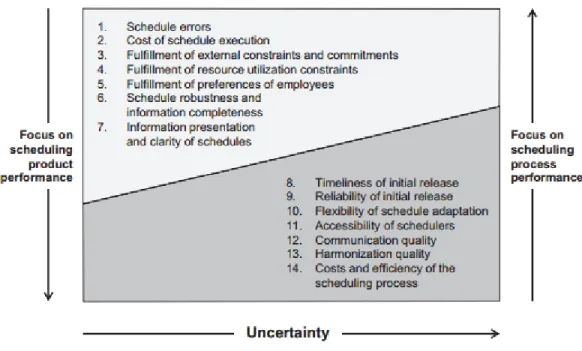
To place uncertainty in the broader concept of the scheduling process we use the performance matrix of De Snoo et al. (2011). Figure 14 shows the performance matrix. In this matrix uncertainty is placed on the x-axis. The product performance on the left y-axis represents the mathematical side of the scheduling process. The process performance on the right y-axis encompasses the softer side of the scheduling process. This matrix shows that when uncertainty is low the mathematical side of scheduling is more important and when uncertainty is high the ‘soft’ side is more important. In that case the communication of dispatchers is more important.
Figure 14: Scheduling performance matrix De Snoo et al. (2011).
De Snoo et al. (2011) performed three studies towards scheduling performance. The authors conclude that scheduling is not only a ‘production process’ of constructing a schedule. It is also a ‘service process’. The authors argue that within this service process “information is collected and delivered, interests and trade-offs are discussed, and constraints or commitments are negotiated”.
- 21 -
with uncertainty that influences the schedule on the day of execution. A way of coping with uncertainty within a schedule is to use the robustness principle. We discuss this in Section 3.2.1.
3.2.1 Robustness during scheduling
De Man (2014) describes the importance of creating a robust schedule. He describes robustness as a buffer against variability. We use and interpret the explanation of Herroelen and Leus (2004): if we can cope and protect the schedule of aircraft services against uncertainty we are able to create a robust schedule that is protected against anticipated schedule disruptions.
Li and Ierapetritou (2008) make a distinction between reactive scheduling and preventive scheduling. In handling uncertainty, we start with this distinction. The starting point in reactive scheduling is the baseline schedule. This schedule is constructed prior to the operation and modified in time to cope with or handle uncertainties. Preventive scheduling tries to deal with uncertainties prior to schedule execution, but it also uses a baseline schedule. We explain the difference between preventive and reactive with an example. Suppose we have an aircraft that is parked at the gate. The next task is to supply the aircraft with potable water, but suddenly this task is disturbed, because the water truck is broken. When scheduling reactively, this event is handled by changing the assignment of the water truck. This event could not have been captured into the schedule (preventive) prior to schedule execution.
Within the literature different approaches are described for preventive scheduling: Stochastic based approaches, robust optimization, fuzzy programming methods, sensitivity analysis, and parametric programming methods (Li & Ierapetritou, 2008). In a stochastic based approach, the uncertain variables are treated as random variables. Robust optimization tries to formulate the problem in such a way that the solution is robust with respect to the uncertainty in the data. A measure that is often used to measure the performance of a deterministic schedule is the standard deviation. The problem instance is solved for different settings of the random variables so that different results are realized (scenarios). The standard deviation is then given by Equation 1.
𝑆𝐷 = √∑(𝐻𝑘− 𝐻𝑎𝑣𝑔)2
𝑝𝑡𝑜𝑡− 1
𝑘
- 22 -
Here 𝐻𝑎𝑣𝑔represents the average makespan over all scenarios k, 𝐻𝑘 the measurement
value, and 𝑝𝑡𝑜𝑡 shows the total number of scenarios.
If the information to describe a probability distribution is not available another option is to use fuzzy programming. Sensitivity analysis can be used to describe how the output of a model depends upon the random variable input. It is then possible to evaluate for which values of the variables the output remains the same and which parameters are important for the model output.
De Man (2014) discusses the use of time slack to buffer against process time variability. The total planned time is described as the average process time plus a factor of the variance. However, slack considers only process time variability whereas in the scheduling of aircraft services more different uncertainties arise. The use of slack can be a way to absorb the uncertainty in processing times. A key issue in the use of slack is that if more slack is added to a task’s processing time the robustness of the schedule increases, but the quality of the schedule decreases (Davenport et al., 2001). In Section 3.3 we continue with the explanation of the value of information.
3.3 Information
Information can be described by the quality of information or the timeliness of information. The higher the quality of information, the more precise the information of a certain parameter is. When information about a parameter is provided earlier it is less difficult to anticipate on this parameter or event. De Man (2014) mentions that most information that is known by AS is based on forecasts. The flight schedule can be considered as a reliable forecast. However, not all tasks are related to the flight schedule, those tasks are more difficult to plan according to De Man (2014). Most of the tasks that are scheduled within CHIP are flight related. The biggest non-flight related tasks are the lunch breaks of the operators.
- 23 -
leads to improved competitiveness in comparison to the TSP with release dates. This finding contributes to the fact that the timely release of information is of high importance in scheduling.
Cowling and Johansson (2002) argue that if there are well-defined procedures for handling real time information, the nervousness of the system can be decreased and schedule improvement can be realized. For handling real time information they propose a four stage model given in Figure 15: detection, classification, identification, and diagnosis. The first step is detection of the information. For example, there is an arriving aircraft that needs service immediately, but was not listed on the flight schedule prior to execution. This information is detected by the system CHIP and the dispatcher that is responsible for the aircraft service. Next, this event must be classified by the system or dispatcher. This depends on the type of information whether it can be recognized by CHIP or the dispatcher. Often there is a need for more information about the event, the identification step. This step is proposed by Cowling and Johansson (2002) for prevention and improved prediction when a certain similar event occurs in the future. The last step a decision or action is taken to respond to the event, this is called the diagnosis step.
Figure 15: Four stage model Cowling and Johansson (2002)
The decision on a certain event is taken either by the system or by the dispatcher. An important aspect is that the dispatcher is not a computer that handles according to given rules. The dispatcher is part of the scheduling process and the organization. The decisions that the dispatcher makes related to the schedule are not only influenced by the scheduling problem, but also due to external effects. It is therefore important to assess the human and organizational aspects in Section 3.4.
3.4 Human and organizational aspects
CHIP is a decision support system that supports the dispatcher in the scheduling of aircraft service tasks. At the end the dispatcher is responsible for the schedule that is created. This schedule outcome is not only influenced by the technical scheduling process, but also by the dispatcher’s informal authority and the activities between the different organizational groups where the dispatcher is working (Berglund & Karltun, 2007).
The main research area is on the mathematical side of the scheduling processes. The human and organizational aspects in the scheduling chain are often not considered. However, in this research the dispatcher plays an important role and the human and organizational
- 24 -
aspects cannot be totally excluded. MacCarthy et al. (2001) argues that also in most manufacturing organizations scheduling still require human support to ensure the establishment of a schedule. The literature describes that scheduling is influenced by roles, trust, respect, and interpersonal interaction (McKay et al., 1992).
From Figure 14 we argued that when facing high uncertainty the need for high quality communication is larger. The dispatcher must not only be capable of creating a schedule, but needs also skills in communication and negotiation. De Snoo et al. (2011) explicitly describes when appointing schedulers the communication skills of the scheduler need to be assessed. This invigorates the finding that scheduling is more than only the mathematical construction of a feasible schedule, the human aspects cannot be omitted.
Berglund and Karltun (2007) consider an HTO-concept that can be used for the analysis and understanding of highly complex work activities. The H stands for human. It addresses the contribution of the individual to the process. In this research the main ‘human’ is the dispatcher which is responsible for the scheduling. The T in ‘HTO’ denotes the technical system. In this research the system CHIP is considered as the technical aspect. The O stands for the organizational aspects. H means the organization which is the complete set of humans. We believe that we need to consider all three aspects in this thesis to improve the online scheduling of aircraft services.
3.5 Performance measurement
In this section we review the literature about performance measurement. We review this literature, because in paragraph 4.3.3 we start with the construction of performance measures. Section 3.5.1 gives a general introduction about performance measurement. Section 3.5.2 describes the construction of performance measures in detail.
3.5.1 Performance measurement in general
- 25 -
Performance measurement plays a central role in this research. Currently there is no performance measurement system with performance indicators that describe the quality of a schedule that is created by CHIP. However, there are performance indicators that indicate the overall performance of aircraft services, for example the on time departure performance according to the customer norm times, but there are no indicators that specifically describe the quality of a plan. In this research we are mainly interested in performance measurement rather than the construction of a performance measurement system.
3.5.2 Performance measures
Performance measures are used to quantify an activity. De Snoo et al. (2011) developed a scheduling performance criteria framework, which is displayed in Figure 16. In this framework, scheduling performance is divided into four different performance areas.
Scheduling performance criteria
Criteria focused on the scheduling product
Criteria focused on the scheduling process
Indirect scheduling performance criteria
Influencing factors
1. Schedule errors 1. Timeliness of initial release
1. Realized performance 1. Organizational planning structure 2. Cost of execution of the
schedule
2. Reliability of initial release
2. Complaints and feedback from schedule users
2. Scheduler knowledge/skills
3. Fulfillment of constraints and commitments made to external parties
3. Flexibility of schedule adaptation
3. Information technology
4. Fulfillment of resource utilization constraints
4. Accessibility of schedulers
4. Complexity & uncertainty 5. Fulfillment of
preferences and wishes of employees using the schedules
5. Communication quality
6. Schedule
robustness/information completeness
6. Harmonization quality
7. Information
presentation and clarity
7. Cost and efficiency of the scheduling process
Figure 16: Scheduling performance criteria framework based on De Snoo et al. (2011).
- 26 -
Figure 17: Stakeholder typology (Mitchell et al., 1997)
group comprises all indicators that influence scheduling performance. For instance, the scheduler’s knowledge and skills, the availability of information technology, and the level of complexity and uncertainty in the scheduling environment.
Several studies (Neely et al. (1997); Lohman et al. (2004)) recommend several aspects when constructing performance measures:
Performance measures should be well-defined, understandable, and simple.
When presenting the performance indicators the target must also be displayed.
Performance indicators have to be used in combination with each other so as to cover all relevant aspects of an activity.
However, it is not only the construction of a performance measure that must be taken into account, also the purpose of the measure, frequency of measurement, and the source of data have to be considered (Neely et al., 2005). A stakeholder analysis is a helpful tool to relate performance measures to the end customers. Mitchell et al. (1997) developed a useful stakeholder typology which we explain in the next paragraph.
3.5.3 Stakeholder analysis
The perceived quality of a schedule during execution depends heavily on the stakeholder. A schedule that contains a lot of coffee breaks will probably be considered as ‘high’ quality from the perspective of an operator. However, a schedule with a lot of coffee breaks is considered as ‘low’ quality from the perspective of a dispatcher, simply for the reason that there is less scheduling flexibility. The difference in opinions between stakeholders invigorates the need for a decent
stakeholder analysis before we start to measure the performance.
According to the Oxford English Dictionary a stakeholder is “a person, company, etc., with a concern or (esp. financial) interest in ensuring the success of an organization, business, system etc.” Mitchell et al. (1997) have constructed a very useful classification or typology to address different stakeholders. Their model is based on three different
stakeholder typologies: power,
- 27 -
stakeholders. Figure 17 displays the stakeholder typology. The first circle represents power. Mitchell et al. (1997) use the definition of Weber (1947) power is “the probability that one actor within a social relationship would be in a position to carry out his own will despite resistance”. Legitimacy refers to socially accepted or the acceptance of authority. The combination of legitimacy and power creates authority (Mitchell et al., 1997).
Another helpful definition comes from the Oxford English Dictionary where legitimacy is described as: “conformity to rule or principle; lawfulness”. The last circle represents urgency. Urgency is added to the model, because power and legitimacy does not capture the dynamics of stakeholder-manager interactions (Mitchell et al., 1997). The authors conclude that adding urgency to the typology moves the model from rather static to dynamic. The Oxford English Dictionary describes urgency as: “the state, condition, or fact of being urgent; pressing importance; imperativeness”. Those three typologies are the basis of the stakeholder typology. Within the model there are eight different types of stakeholders: dormant stakeholder, discretionary stakeholder, demanding stakeholder, dominant stakeholder, dangerous stakeholder, dependent stakeholder, definitive stakeholder, and non-stakeholder.
3.6 Conclusion
In this chapter we positioned the AS scheduling problem within the current literature. We also discussed the scheduling process and uncertainty in scheduling. Furthermore, the chapter described the robustness of a schedule and the quality of information. The chapter ended with a discussion about the human and organizational aspects in scheduling and the construction of performance measures.
Scheduling problem
- 28 -
throughout the day does fit the scheduling problem of AS, where service requests are also not completely known beforehand. However, literature on multi-server dial-a-ride problems in an online fashion is limited.
Uncertainty increases the complexity of the assignment of AS tasks to AS resources. Four uncertainty categories can be identified: model-inherent, process-inherent, external, and discrete uncertainty. Those four categories are all present in the AS scheduling process. To describe the parameter uncertainty in numbers we can use the parameter’s distribution, mathematical interval, or the fuzzy description. When we place the AS scheduling problem in the scheduling performance matrix of De Snoo et al. (2011) we conclude that the ‘soft’ aspects of the scheduling process are important. This is due to the high uncertainty that is involved in the AS scheduling problem. We also argued that if we can cope and protect the schedule of AS against uncertainty we are able to create a robust schedule that is protected against unanticipated schedule disruptions. A way to achieve this is to add slack as a buffer against process time variability. The main weakness with this slack is that it considers only process time variability whereas in the AS scheduling more uncertainties arise.
Process information and Human and Organizational aspects
Quality and timeliness are two important aspects of information. The higher the quality of information the more precise the information of a certain parameter is. Timeliness describes that when information is presented earlier it is less difficult to anticipate on this parameter or event. Cowling and Johansson (2002) developed a four stage model for handling real time information. This model consists out of four stages: detection, classification, identification, and diagnosis. The authors conclude that if there are well-defined procedures for handling real time information the nervousness of the system can be decreased and schedule improvement can be realized. Finally, we argued that the human aspects are of high importance in scheduling performance. This also fits the finding from the scheduling performance matrix, where we identified the importance of the ‘soft’ side of the scheduling process.
Performance measures and stakeholder analysis
- 29 -
4
Performance and quality of online scheduling
In this chapter we provide insight into the scheduling performance and schedule quality during a day. Section 4.1 contains a stakeholder analysis that is used as basis for the performance measures. Section 4.2 discusses the importance of time in online scheduling and presents the measurement methods that we use to describe the scheduling performance. Section 4.3 presents the results from the performance analysis and outcomes. We conclude this chapter in Section 4.4 with an extensive discussion and conclusion about the results from the data analysis.
4.1 Stakeholder analysis
The dispatcher is responsible for scheduling aircraft service tasks. The output is a schedule that is continuously updated. We start with a list of all stakeholders that are involved or affected by a schedule. Next, we categorize them according to the stakeholder typology of Mitchell et al. (1997). Table 3 presents the results of the stakeholder analysis.
Stakeholder Type
KLM Aircraft Service operators Demanding KLM Aircraft Services Definitive
Pilots Dependent
Crew Dependent
Dispatchers Definitive
KLM Aircraft Service shift leaders Dominant DAM (Duty Area Manager) Definitive DHM (Duty Hub Manager) Definitive DMA (Duty Manager Aircraft) Definitive
Passengers Dependent
Table 3: CHIP stakeholders and type