Vibrating Drivers for Transportation
Ben Zion Sandler, Vladimir Chapsky
Mechanical Engineering Department, Ben Gurion University, Beer Sheva, Israel Email: [email protected]
Received January 7, 2013; revised March 22, 2013; accepted April 11,2013
Copyright © 2013 Ben Zion Sandler, Vladimir Chapsky. This is an open access article distributed under the Creative Commons Attribution License, which permits unrestricted use, distribution, and reproduction in any medium, provided the original work is properly cited.
ABSTRACT
The movement of objects by means of vibrations is a widely known idea, used for bodies transportation in automated industry based on vibrating bases, on which the transported elements are placed. We consider an inversed idea: vibra- tion is applied to the movable element. Surface, on which this displacement must be realized, is unmovable. The asym- metry of the friction forces in the different phases of the vibration is the cause of motion in this case. A distinctive fea- ture of the proposed device is a slope of the plane of vibration of the inertial mass, which leads to increasing of the asymmetry of friction. In this paper, we consider an example of application of the device to the lateral vehicle parking. The idea is numerically estimated and tested with a laboratory prototype. The movement along a straight line of the trolley with sloped vibrating mechanism under influence of asymmetric friction forces has been estimated and practi- cally simulated with the laboratory prototype.
Keywords: Inertial Drivers; Asymmetric Friction Force; Parking Mechanism
1. Introduction
In this paper, the author addresses a powerful means for developing new technical concepts, finding novel solu- tions and solving certain technical problems. It involves a method of thinking that produces results over several different cognitive levels: from the simplest design level in up to the highest conceptual level used to formulate new technical ideas. The method has already been par- tially described in this author’s book [1].
The movement of objects by means of vibration is the widely known idea, used for transportation different parts and bodies in automated industry based on the use of vibrating bases, on which the transported elements are placed. This vibration is mainly realized by electro- magnets and variable voltage. In this paper we consider the inversed idea: the vibration is applied to the moved element while the surface, on which this displacement must be realized, is unmovable.
The most known use of vibration of the object to move it himself is the vibro-hammers, used in the building and mining industries. These designs are mainly intended for movement in the vertical direction. Here, except the iner- tia forces, the force of weight acts in the vertical direc- tion and leads to the asymmetry of the acting forces. An- other situation occurs in devices intended for horizontal movement. In them the difference is caused by the asym- metry of the friction forces, acting on the base at differ-
ent periods of the movement of the inertial mass, mount- ed on the base.
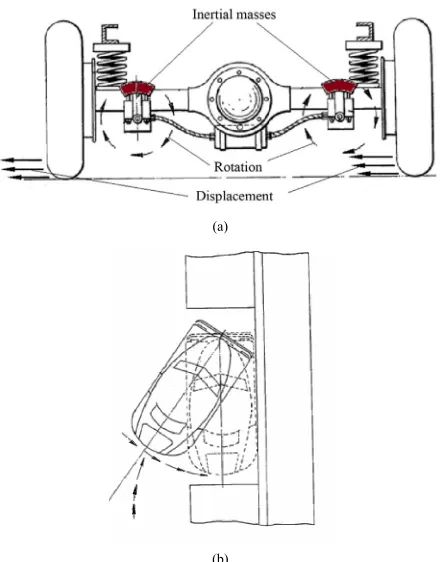
Example of such device is the mechanisms described in the patent USP No. 2639777 [2]. It intended for vehi- cles parking. In the method described in this patent the difference of friction between the wheels and the road in different phases of the rotation of the inertial mass (Fig- ure 1(a)) is provided by an additional pressure, caused
by the force of inertia of the rotating masses. This leads to the displacement of the car (Figure 1(b)). But calcula-
tions showed low efficiency of this design.
Search the efficiency of this method has led to a me- thod of inertial driver, described in this article. In the new proposed method, the plane of rotation of the inertial mass is inclined to the line of moving direction. Calcula- tions and simulations show that the proposed method is much more efficient than previously known, and can ac- tually be used in practice. In addition, there are pros- pects for the use of this type of inertial drives to simply move the mobile objects.
2. Description of the Proposed Mechanism
2.1. Construction
The inclined inertial device is shown in Figures 2(a) and (b). It consists of two identical engage gears (1), driven
B. Z. SANDLER, V. CHAPSKY 78
(a)
[image:2.595.62.282.84.365.2](b)
Figure 1. Parking of the car. Figures from USP No. 2639777.
rically fixed masses (3). The gears are assembled in a bearing common base (6) by means of two axes 4 and ball bearings (5). The assembly is mounted on a platform (7) at an inclination angle . The platform slides on the surface (8) in the direction X. The transmission of rota- tion from the motor (2) to gears (1) is provided by two pulleys (9) and belt (10). Two force vectors F tv
and
h
F t are created as a result of masses (3) rotation,
which influences the normal force creating the friction between surface (8) and the devices support and the driving force moving the body the device is fastened on.
2.2. The Working Principle
We consider the operation of proposed vibration driver mechanism on example of car parking (Figure 3).
Laboratory model that demonstrates this movement is shown in the following video [3].
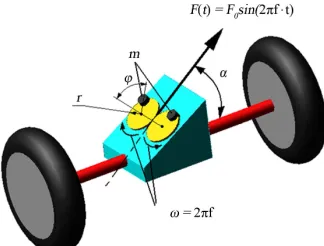
In following example the proposed mechanism con- sists from two rotating gear wheels mounted on rear axis of the car at some inclination angle as shown schemati- cally in Figure 4.
The working principle is based on difference between friction forces, acting in two half-periods of wheels rota- tion. The rotation of the inertial masses, fixed on the disks, in the opposite direction leads to inertia forces, acting on the car, in the direction perpendicular to the line connecting the centers of disks (F t
in Figure4).The components of inertial forces, acting along the line,
connecting the centers of disks, are equals and opposite in direction, so they cancel each other out. If the rotation of the discs is with a constant angular velocity 2πf , then the function of inertia forces versus time is of a harmonic function with frequency f, as shown in Figure 4.
0Sin 2
π
F t F ft (1)
where F0 is magnitude of the inertial force, created by two rotating masses:
20 2 2π
F m f r (2)
m, mass of one inertial body; f, the frequency of rota- tion of the discs in Hertz units (or rotations per second); r, the distance between the centers of mass of the inertial bodies and the centers of the rotating disks.
The vertical component of force F t
changes the pres- sure on the car axle, and consequently changes the force of friction in the different phases of the rotation of the discs. The horizontal component of harmonic force
F t together with the different friction forces in the
different phases of the discs rotation, leads to the move- ment of the car.
2.3. Calculation of the Angle of Car Displacement
In common case the movement of the car consists of three parts in each period of disc rotation: 1) sliding, the motion with friction, when the horizontal component of force is greater than the friction force and the vertical force component is less than the weight of the moving
object; 2) hovering above the road, when the vertical
component of force is greater than the weight of the moving object (which leads to its flying); 3) deceleration, motion in the presence of the friction force after touch- ing the road.
Let’s assume some restrictions on the physical model for considered here numerical examples (the estimated quantities are approximate):
The friction index does not depend on the motion
speed;
Vehicle mass is much greater than the inertial mass of rotating bodies;
The magnitude of the loading force, acting on bearing
of rotating rings does not exceed 10,000 Newton;
The rotation speed of the rings does not exceed 1200
rpm.
As shown in Figure 3, the car’s back part is mowed
inside the free place due to the vibrating driver. The same way, after the device is rotated for 180 degrees, it can be used for bringing the car out of the parking place by moving it reverse.
[image:3.595.74.523.90.258.2]
(a) (b)
Figure 2. General view of the vibrations generating device.
inclination angles are ;
1 45 , 2 30 , 3 15
1
2 2 2
3 4
index of friction is k0.8;
the permissible load on the bearings of the rotation
discs assumed as Fb5000 N.
The purpose of the calculation is to estimate the angu- lar displacement of the car relative the center of front suspension for all given α during one cycle, one second, and ten seconds.
For definiteness, the initial conditions assume as:
Figure 3. Lay-out of the parking place 1 in a street near the side walk 3. Car 2 finishes the parking process by moving
its back part 4. The discs are already spinning with angular velocity
rad / sec
At the time t0 the position of the inertial body
0
.
The car is not moving.
1) Sliding. For calculation of the first part of dis-
placement, when car moves with friction, the time, when car starts to move and time when car starts to hover should be defined. Also, we need to define the equation of motion in horizontal direction.
Let F tv
be the time function of the vertical com- ponent of the inertial force F t
:
0
2π
Sin Sin Sin
v
F t F t F t
T
(3)
Figure 4. Schematic diagram of the back car’s axe with inclined inertial device, mounted on it.
where T 1
f
is the period of disc rotation. F0, mag-
rameters of the vehicle and the inertial unit close to the
real. Here are the following data: nitude of the inertial force (Equation 3);
mass of the car is M 1000 kg;
0 9474.82 N
F . (The load on the bearings Fb = F0/2 =
4737.41 N is less than permissible.
distance between rear and front axles is L2.5
meters; At the time, when the vertical component of inertial
force equals or greater than the pressure force on the rear car axle, it breaks away from the road.
moment of inertia of the car relative to center of the front suspension J2600 kg m 2;
pressure on the rear axle due to gravitation weight of
the car is P5000 N (Newton); F t t tv
breakF tv
break
P, (4) radius of rotation disc is r0.1 meter;
mass of the inertial body m3 kg; The break time tbreak was calculated from Equations (3)
and (4). The graphs of function F tv
for different in-
f 20 rps, T 0.05 sec
; [image:3.595.88.250.426.549.2]B. Z. SANDLER, V. CHAPSKY 80
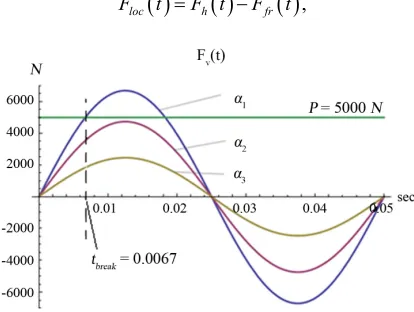
clination angles and the break time tbreak were calculated using the Wolfram’s Mathematica 8 software, shown in
Figure 5. As shown in Figure 5, for 1 tbreak =
0.0067 seconds. As can be seen from Figure 5, in the
current example only for α1 the hovering takes place.
Thus, further we consider the current example separately for
45
1
, and then for 2 and3.
Determination of time tstart when back part of the car starts to move transversal with friction, sliding.
The condition for horizontal moving is the horizontal component of the inertial force becomes greater than friction force. The following equation expresses this con- dition:
0 0
2π 2π
Sin Sin Sin
Cos
F t k
T PF T t
(5)
where F0Cos
, the magnitude of horizontal compo- nent of inertial force.From Equation (5) implies that:
0 2π Sin Sin kP tT F Cos k
, and
stat rt ArcSi
2π Sin
kP
F k
0
n T
Cos (6)
Equation (6) is true for all 1, 2, and 3. Calcula- tion gives the following:
sta sta sta 0.00 sec, 0.00 sec, 0.002 sec. t t t rt1 rt 2 rt3 269 271 92
Let F th
be the horizontal component of the inertialforce F t , Floc
t be the locomotive power, defined as difference of horizontal component of the inertial force and force of friction F tfr
:
,loc h fr
[image:4.595.66.273.540.696.2]F t F t F t
Figure 5. Vertical component of the inertial force versus time for different inclination angles of the plane of rotation discs.
where:
0
2π
Cos Cos Sin ,
h
F t F t F t
T
(7)
fr v
F t k P F t (8)
The moments of the corresponding forces relative to center of the front axle are:
v v
M t F t L , the moment of vertical component of inertial force,
h h
M t F t L , the moment of horizontal compo- nent of inertial force,
fr fr
M t F t L ,the moment of friction force,
loc loc
M t F t L , the moment of locomotive po-
wer,
where L, the distance between rear and front axles. The angular acceleration of the car relative to center of front axle, caused by moment of locomotive force during first part of motion (sliding):
loc
sM t A t
J
(9)
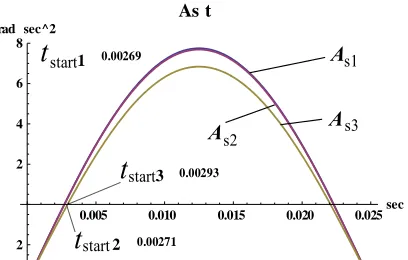
Graphs of function A ts
versus time for different in- clination angles of discs plane are shown in Figure6.The angular velocity V ts
s
of the car relative to cen- ter of front axle as function of time is calculated by inte-
gration of the function A t over time and is repre-
sented in Figure7.
The area under velocity plot from t = tstart1 = 0.00269 sec to t t break10.0067 sec. numerically equals to an- gular displacement
s of the car during one cycle.The result of calculation gives s and the angular ve-
locity at the time of breaking Vbreak:
1 0.000013977 rad, break 0.0102 rad / sec
s V
(10)
2) Hovering. The second part of the motion is the
movement of a car under the action of gravitational and inertial forces, without touching the road with an initial velocity.
The vertical component of the initial angular velocity equals to zero. Equation of the second part of motion (hovering) in vertical direction looks as follows:
break , d v vhov t v vhov tF t P
A t L
J
t A t
t(11)
where Avhov
t , vertical component of angular accel-eration during hovering; ,angular displacement in
vertical direction during hovering as function of time. The numerical representation of Equation (11) and graph of function
v t
vhovA t for inclination angle is
shown in Equation (12) and Figure 8.
1 45
B. Z. SANDLER, V. CHAPSKY 81
s2
s1
s3
A
A A
start
start
start
t
t
t
1
3 2
0.00269
0.00271
0.00293
0.005 0.010 0.015 0.020 0.025sec
2 2 4 6 8 rad
sec^2 [image:5.595.71.275.85.215.2]
As t
[image:5.595.66.277.263.400.2]
Figure 6. Horizontal angular acceleration of the car during sliding and friction on the road as a function of time.
[image:5.595.63.270.449.572.2]Figure 7. The horizontal angular velocity of the car for in- clination angle α1 during sliding.
Figure 8. Vertical angular displacement φv(t) during hover-
ing as function of time.
2
0.00003236 0.066354 2π
2.40386 0.000408Sin
vhov t t
t t
T
(12)
Obviously only positive values of the vertical dis- placement make sense. Figure8 shows that contact with
the road exists in the second half of the period T of disks rotation. It means that after the time of t T 2 inertial force acting opposite the movement of the car and slows it.
The horizontal component of the initial angular veloc- ity equals to the angular velocity at the time of breaking
Vbreak
. Equations of the second part of motion (hover-ing) in horizontal direction looks as follows:
break
break
break ,
d ,
d . h
hhov
t
hhov hhov
t
t
hhov hhov
t
F t
A t L
J
V t V A t t
t V t t
(13)
Or in the numeric representation:
0.0443162 0.051264Cos 2πvhov
V t t
T
(14)
where Ahhov
t , horizontal component of angular ac-celeration during hovering, , horizontal com-
ponent of angular velocity during hovering, hhov
V t
hhov t
,
angular displacement in horizontal direction during hov- ering.
Figure 9 shows the horizontal component of angular
velocity Vhhov
t of the car relative to center of front axle as function of time. The area under velocity plot frombreak1 0.0067 sec
t t to . Nume-
rically equals to the angular displacement of the
car during one hover. The result of calculation gives: 0.03086 sec cont
t t
hhov
0.001649 rad.hhov
The horizontal component of angular velocity at the time of contact with road is:
0.0822946 rad / sec. cont
V (15)
3) Deceleration. We assume that the collision with the
road was of the nature of the inelastic and there was no rebound. Thus, the third part of movement is the hori- zontal sliding with presence of friction force with initial
angular velocity Vcont under action of the moment of
horizontal component of inertial force M th
. The [image:5.595.318.522.583.711.2]B. Z. SANDLER, V. CHAPSKY 82
equations of motion for third part are the same, as for the first part, but with other initial conditions. There are as follows:
,
d ,
d , cont
cont loc d
t
d cont d
t
t
d d
t
M t A t
J
V t V A t t
t V t t
(16)
where A t V td
, d ,d t
d V t
,are the angular acceleration, velocity, and displacement during the third part of move- ment (deceleration). Numerical representation of the an-
gular velocity is follows:
0.13263 3.84615 0.0922753Cos 2πd
V t t t
T
(17)
Graph of this function is shown in Figure10. The area
under the graph of numerically equals to angular
displacement of the car during part of deceleration: d
V t
0.0002532 radd t
(18)
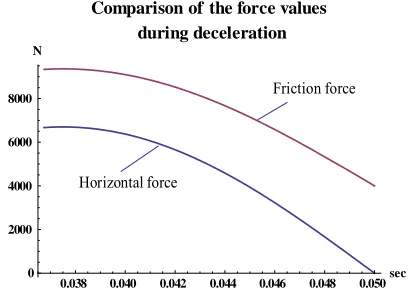
Finally, the absence of a reverse movement should be checked. For this purpose, the model must satisfy the following condition: the value of horizontal force less than the value of friction force, F th
F tfr
, for, or, according to Equation (5): stop
t t
stopstop
T
0
0 2π
Cos Sin
2π
Sin Sin
t
T
t
F t
T
k P F t
T
(19)
Graphs of left and right sides of Equation (19) are shown in Figure11.
As clear from Figure 11, the condition of Equation
(19) is satisfied. Reverse movement during deceleration is absent.
Figure 10. Angular velocity of car’s movement during hori- zontal deceleration, as a function of time.
Horizontal force
Friction force
0.038 0.040 0.042 0.044 0.046 0.048 0.050sec 0
2000 4000 6000 8000 N
[image:6.595.319.527.86.231.2]Comparison of the force values during deceleration
Figure 11. Comparison of the force values during decelera- tion.
Full rotation in one cycle is the sum of three parts of angular displacement:
cycle1 cycle1 hov t d t 0.001916 rad
(20)
The full rotation in one second is:
sec1 f cycle1 0.038323 rad
(21)
The full rotation in fifteen seconds is:
15_1 15 sec1 0.575 rad
, or in degrees:
15_1D 32.9
(22)
The calculations of the angular displacements for in-
clination angles 2 and 3 were per-
formed in the same way as for Parts 1 and 3 of previous calculation, but only for continuous time range from
start to tstop. The corresponding start times, which have been calculated previously by Equation (6), are:
30
15
t
start 2
t 0.00271 sec, tstart30.00292 sec.
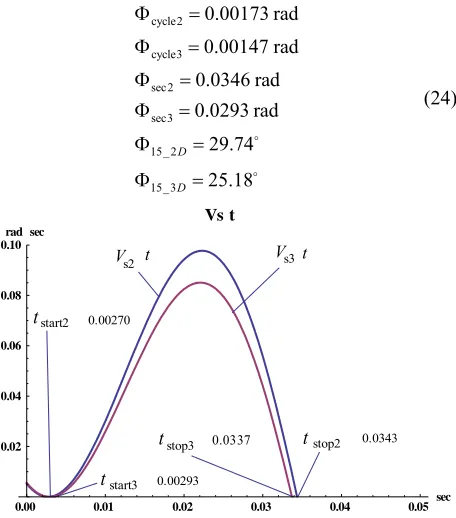
By integration of function of angular acceleration of the car Equation (9) the function of angular velocity for
2
and 3 should be obtained. The results of calcula- tions are follows:
2
3
2π
0.0969367 3.84615 0.0918Cos
2π
0.09906089 3.84615 0.08504 Cos
s
s
V t t t
T
V t t t
T
(23)
The graphs of listed functions are shown in Figure12.
cycle2
cycle3
sec2
sec3
15_ 2
15_3
0.00173 rad 0.00147 rad 0.0346 rad 0.0293 rad
29.74 25.18 D
D
(24)
Vs2 t
Vs3
t
t
t
tstop3 0.0337 tstop2 0.0343 start2 0.00270
start3 0.00293
0.00 0.01 0.02 0.03 0.04 0.05 sec
0.02 0.04 0.06 0.08 0.10
rad
sec
Vs t
pl
o change the angle (α) of the plane of
of the lateral icient of fric-
tio ce.
ce in the friction
tional weight, for increasing the force of sl
of rolling friction, but in the trans-
ve ce of
.
Calculations using the algorithm
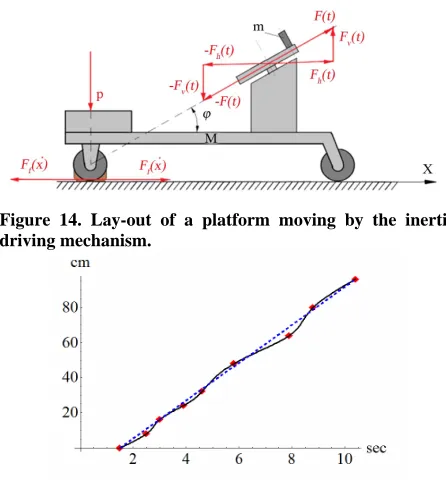
car parking (for the sliding motion) gave results similar those observed in the video clip. The trolley has an average speed of 11.3 cm/second, slightly more than in the video clip (~10.8 cm. per second.). Measuring the distance traveled by the trolley is represented by the graph in Figure15.
Approximation section (interrupted line) obvi-
ously can be described by ple formula of the fol-
lowing form:
Figure 12. Function of angular velocity during sliding for inclination angles α2 = 30˚ and α3 = 15˚.
The results of calculations showed that the proposed model of the inertial drive with inclination angle of discs
ane 30˚ - 45˚ is acceptable for use for car parking.
2.4. Some Possible Improvements of the Proposed Devise
The above example shows the opportunity to apply the proposed inertial drive for parking a small car. Some additional design solutions can enhance the capabilities of the devices, described above.
A design in which exists the possibility of rotation of the device around the vertical axis by 180˚, will allow the car both, to enter inside a parking place and out of it.
The ability t
disks rotating will change the parameters movement of the car according to the coeff
n between the tires and the road surfa
For heavy goods vehicles the inertial unit with four or more rotating inertia bodies can be used. The schematic
drawings of such units are shown in Figure 13 or in
Figures 6 and 9 in the patent 4050527 “Vibrodriving
apparatus” [4].
3. Brief Discussion about Linear
Displacement of the Vehicle
As it is obvious from the description of the operating principle of the proposed inertial drive, it can also be used for different other vehicles. A necessary condition is
the creation as much as possible differen
forces between the vehicle and the road, acting in the various phases of the rotation of the inertial drive. Recti- linear movement of the vehicle with the inertial drive on the normal wheels in the presence of rolling friction (which is much less than sliding friction) is not effective. To use the above described model with the inertial drive for the rectilinear motion of the vehicle, its design shall ensure the presence of the forces of sliding friction.
Experimental Model Examination
An example of this design is the model of a trolley with inertial drive, which is shown in the following video clip [5].
In this trolley, the back axle was stalled and was loaded with addi
iding friction. Also, the line of action of the inertial force passes through the rear axle of the trolley that in- creases the effect of the vertical component of the force of inertia on value of pressure on the rear axle (Figure 14).
The front swivel wheels provide a stable direction of the trolley motion because in the direction of rectilinear motion acts the force
rse direction acts the for sliding friction between
rubber tires and the floor, which is much larger than rolling friction
described above for
to
S t a sim
10.8 15 [image:7.595.59.287.85.344.2]S t t (25)
[image:7.595.353.542.531.695.2]B. Z. SANDLER, V. CHAPSKY 84
Figure 14. Lay-out of a platform moving by the inertial driving mechanism.
Figure 15. Displacements of the trolley versus time (ac- cording to test, shown in the video clip). A linear approxi- mation of the “motion versus time” is also shown in this Figure.
(Time is taken from about ~1.5 seconds without move- ment, which is about 15 cm, while further it moves with the speed about 10.8 cm/sec for about t = 10 sec).
4. Conclusion, Some Possible Designs
We consider this paper as an example mainly describing e ormulated
is
consideration of this approach and description of it are iven, for instance in some author’s books [1,2] and oth- ers.
Technical Proposals for Transportation
ate driving the m
re 2).
An idea to drive by the device, considered in Figure 2,
placing it on elas ubber balls. This
may be a specific vibrator can be
dler, “Creative Machine Design, Design Innova-ons,” Paragon House Publishers,
ll, “Method and Device for Imparting Lateral
=B3p4zH4992c&featur e=relmfu
[4] J. L. Lebelle, “Vibrodriver Apparatus,” US Patent: 4050527, 1977.
[5] Video Clip in YouTube. http://youtu.be/Owu2ANuwPLw
the first steps in the design process. The step, wh main idea of the solution, answering the f
re the tions and the Right Soluti
New York 1985. [2] M. L. Du
problem the design task requires, must be found, at least one answer, or a number of them. At this stage, the main accent is put on the lay-out or model of the solution. It
can be found in already existing designs, or inversed ex- [
ting idea, or somehow changed, improved existing idea.
We are speaking about mechanical dynamic vibrations as a reason to create certain displacement of a car, improv- ing the parking possibilities. This dynamic mechanical effect, as is here reminded, is widely used in industry.
We inversed this idea by deciding to vibrate the back of the car (not the surface the car is standing on) in such a way moving it to the needed place. Another change, which we propose in our design, is not to use electro- magnets as a vibration source, which is often used in industrial machines, usually automatic, for transportation parts. We propose pure mechanical vibrator design (see
Figure 2). The simplest consideration brings us to think
about counterbalance fly-wheels used in rail-way engines or locomotives. The same solution is sometimes used in crank-shaft mechanisms. The cranks and wheels usually rotate in vertical plane, which makes the inertial forces appearing here not appropriated to cre
echanism to certain direction. To reach the effect of certain movement direction, the orientation of the vibrat- ing device in space must be changed and the direction of the driving force must be strictly defined. This is achiev- ed in the given here solution (Figu
tic bases, say, on 4 r device, on which the
directed in the needed way. Such a device may be a sim- ple toy or a special used carriage.
REFERENCES
[1] B. SanMovement to an Automobile,” US Patent No: 2639777, 1953.
3] Video Clip in YouTube. http://www.youtube.com/watch?v
[image:8.595.61.281.85.180.2]