http://www.scirp.org/journal/jis ISSN Online: 2153-1242
ISSN Print: 2153-1234
Optimized Homomorphic Scheme on Map
Reduce for Data Privacy Preserving
Konan Martin
1, Wenyong Wang
2, Brighter Agyemang
11Department of Computer Science and Technology, University of Electronic Science and Technology of China (UESTC), Chengdu, China
2Department of Computer Science and Engineering, University of Electronic Science and Technology of China (UESTC), Chengdu, China
Abstract
Security insurance is a paramount cloud services issue in the most recent decade. Therefore, Mapreduce which is a programming framework for pre-paring and creating huge data collections should be optimized and securely implemented. But, conventional operations on ciphertexts were not relevant. So there is a foremost need to enable particular sorts of calculations to be done on encrypted data and additionally optimize data processing at the Map stage. Thereby schemes like (DGHV) and (Gen 10) are presented to address data privacy issue. However private encryption key (DGHV) or key’s parame-ters (Gen 10) are sent to untrusted cloud server which compromise the infor-mation security insurance. Therefore, in this paper we propose an optimized homomorphic scheme (Op_FHE_SHCR) which speed up ciphertext (Rc)
re-trieval and addresses metadata dynamics and authentication through our se-cure Anonymiser agent. Additionally for the efficiency of our proposed scheme regarding computation cost and security investigation, we utilize a scalar ho-momorphic approach instead of applying a blinding probabilistic and poly-nomial-time calculation which is computationally expensive. Doing as such, we apply an optimized ternary search tries (TST) algorithm in our metadata repository which utilizes Merkle hash tree structure to manage metadata au-thentication and dynamics.
Keywords
Privacy, Mapreduce, Homomorphic Encryption, Ciphertexts Retrieval, Optimization, Authentication
1. Introduction
The rapid development in outsourcing data processing and storage by
distri-How to cite this paper: Martin, K., Wang, W.Y. and Agyemang, B. (2017) Optimized Homomorphic Scheme on Map Reduce for Data Privacy Preserving. Journal of Infor-mation Security, 8, 257-273.
https://doi.org/10.4236/jis.2017.83017
Received: June 29, 2017 Accepted: July 22, 2017 Published: July 25, 2017
Copyright © 2017 by authors and Scientific Research Publishing Inc. This work is licensed under the Creative Commons Attribution International License (CC BY 4.0).
http://creativecommons.org/licenses/by/4.0/
buted computing framework, and in addition to complex and huge data collec-tion mining have extended the availability of useful data to various organizacollec-tions of modern society in the exponential way. But, data privacy insurance is a prin-cipal issue in huge dataset management on cloud environment, as the dataset proprietor has not any more physical control of his dataset as per the Cloud Se-curity Alliance (CSA) [1]. For instance, the remote body sensed data monitoring system contains delicate data like patient identity and address that can lead to harmful consequences in case of disclosure. Therefore, Mapreduce which is a computing framework that process and create substantial distributed informa-tion must be strongly secure for data privacy preserving in cloud. Security as-surance issues identified with MapReduce and cloud have started to draw se-rious consideration. Puttaswamy et al. [2] presented a set of tools called Silver-line that can isolate all practically encryptable information from other cloud ap-plication information to guarantee data protection. Likewise, Zhang et al. [3]
proposed a privacy leakage upper-bound limitation based solution to deal with data privacy preserving issue by just encrypting part of available data on cloud. Roy et al. [4] proposed a framework named Airavat which constrains obligatory access control via differential privacy technic. Blass et al. [5] proposed a data privacy model named PRISM for the Map Reduce structure on cloud to perform parallel word search on encrypted data collections. Ko et al. [6] proposed the HybrEx Map Reduce model that processes very sensitive and private informa-tion by a private cloud, while others data can be securely processed in the public cloud. Zhang et al. [7] proposed a system called Sedic which partitions Map Re-duce computing tasks in terms of the security labels of data. Thereby, they work on and then assign the computation without sensitive data to a public cloud. However, conventional data encryptions that are considered as the essential technique to address security issue in cloud can’t be straightforwardly imple-mented in Mapreduce framework. Therefore a new cryptosystem called homo-morphic encryption which could process encrypted data is first introduced in [8]
to find an effective solution to this challenge. This fully homomorphic encryp-tion (FHE) can compute arbitrary funcencryp-tion on encrypted data without using se-cret key. However, FHE rose two major challenges regarding its implementation and computation cost [9] [10]. First, the number of available FHE schemes in the literature is very limited (few). Second, the efficiency of fully homomorphic encryption is the biggest challenge to address. Therefore, the efficiency of FHE has been the key problem since its invention, which hinders its myriad of poten-tial applications such as private cloud computing in practical. Specially, the size of key in FHE scheme is big. Thereby, a FHE scheme based on Learning with Error (LWE) doesn’t only include public key and private key but also includes some evaluation keys. For an L-Leveled FHE scheme, there are L evaluation keys. Each evaluation key is a
(
)
2(
)
1 log 1
n+ q× n+ matrix. A public key is at least
(
)
alternative to address data privacy assurance issue which is considered by infor-mation security community as a paramount topic. Thereby, schemes like DGHV
[12] and Gen 10 [13] are introduced to securely compute data through homo-morphic approaches on Mapreduce environment. Unfortunately those mentioned solutions experience some basics shortcomings as far as security concerns [12] [13]. The DGHV scheme [12] uses many of the tools from Gentry’s construction. But this model does not require ideal lattices. Moreover, they prove that the somewhat homomorphic component from Gentry’s ideal lattice-based scheme [13]
can be replaced with a very simple somewhat homomorphic scheme that uses in-tegers. Therefore their model is conceptually simpler, but the private key should be transferred to cloud server, which is very insecure. Gentry proposed a homomor-phic encryption Gen 10 scheme [13], applicable in cloud environment and con-ceptually simple. In this scheme the encryption function is homomorphic with re-spect to addition, subtraction and multiplication. The relationship between c and
m is that m is the residue of c with respect to modulus p, that is m=cmodp. To
retrieve the ciphertext, the Gen 10 scheme doesn’t present the private key as [12]. But a random private key parameter q instead R=
(
ci−cindex)
modq, whichseems quite more secure. Yet the parameter q is sent to the server, by using the formula cmodq, the plaintext m mayleaks out. So this scheme suffers from
se-curity weakness too. The goal of this paper is to construct an efficient FHE scheme with better key size. Thereby in this work, we introduce our solution by presenting an optimized scalar homomorphic scheme (Op_FHE_SHCR) that first addresses the above mentioned data privacy protection shortcomings through efficient oper-ations over ciphertexts without compromising the cryptosystem like the existing models [12] and [13]. Furthermore, we demonstrate how fast our proposed solu-tion retrieves ciphertexts at Reduce stage in an optimized and secure way. At that point of this work, we present the programming and cryptographic primitives in Section 2. A short discussion on related work is presented in Section 3. The Section 4 will give details of the concrete execution and security analysis of our proposed solution. At long last we close this work in Section 5.
2. Preliminaries
2.1. Map Reduce
Map Reduce in [14] is defined as a computation framework to process and gen-erate large datasets. In this programming environment, users specify a Map
function that processes a key/value pair to generate a set of intermediate key/ value pairs, and a Reduce function that merges all intermediate values related with the identical intermediate key. We have such a variety of problems solving that are expressible by Mapreduce, like the problem of counting the number of occurrences of each term in a large dataset. The Mapreduce architecture can be viewed as below (Figure 1).
2.2. Homomorphic Encryption Scheme
Figure 1. Mapreduce execution overview in [14].
A homomorphism between two algebras, A and B, over a field (or ring) K, is a
mapF: A → B such that for all k in K and x, y in A;
• F kx
( )
=kF x( )
• F x y
(
+)
=F x( )
+F y( )
• F xy
( )
=F x F y( ) ( )
If F is bijective then F is said to be an isomorphism between A and B. ♦ Homomorphic Encryption
As an ever increasing number of data is outsourced into distributed storage, frequently unencrypted, considerable trust is required in the cloud providers. The CSA records information breach as the top issue to cloud security [1]. En-crypting the data with conventional encryption addresses the issue. But in this case, the end user can’t work on the encrypted data and must download them and performs the decryption locally. Therefore, there is a need to allow com-pletely the public cloud server to perform calculations in the interest of the end users and return just the encrypted result. Thereby, the development of homo-morphic encryption is a very impressive advance, incredibly amplifying the ex-tent of computation which can be applied to process encrypted data homomor-phically. Thus, the enthusiasm in the research community is justified by the various applications in the real world (like medical applications, consumer pri-vacy in advertising, data mining, financial pripri-vacy) of this theme.
poor performance is the big disadvantage of this scheme. Ciphertexts are much larger than the plaintexts, so communication requirements typically go up. The computations on these large ciphertexts are typically slower than if you just per-formed the computation on the plaintext itself. Because of this, in the outsourc-ing computation model, we typically see a requirement that encryptoutsourc-ing inputs and decrypting outputs should be faster than performing the computation itself. Therefore there is a high need to optimize the data processing in order to reduce efficiently the computation and communication costs.
3. Related Work
Security insurance issues on Mapreduce framework have started to draw esca-lated consideration. In this manner data confidentiality protection issues have been widely examined and productive progress have been accomplished by the security community practitioners. We quickly audit few existing models about security protection on Mapreduce framework.
3.1. Xu Chen and Qiming Huang Scheme in [16]
The authors in [16] presents a data privacy insurance scheme on Mapreduce uti-lizing homomorphic encryption. It is a modified Mapreduce model, to guarantee data secrecy, and additionally processing the data in encrypted form. They pick two major prime numbers A, B, and make P = A * B, and afterward generate a random positive integer A, which is the private key, and B ought to likewise be confidential.
Encryption:
(
r)
modC= M+ ∗A A
(1)
Decryption:
mod
M=C A (2)
But, to apply homomorphic encryption in this scheme, authors do few mod-ifications on ciphertexts to allow the Reduce function to find the identical keys and afterward group them like following:
For a ciphertext C←
(
M+ ∗A Ar)
modP, authors obtain*
C = ∗ ∗C B R, with R as random positive number.
Then, the authors compare ( *
C ), rather than C to retrieve similar keys.
The-reby, it’s obvious that their proposed solution needs an additional computation ( *
C ) at reduce phase which is costly in term of computation in order to get a
probabilistic homomorphic cryptosystem. Review that this homomorphic cryp-tosystem is exceptionally expensive, therefore their model is inefficient.
3.2. FHE_SHCR Scheme in [17]
don’t address the security and efficiency ciphertext retrieval issues. Therefore, authors in [17] present their contribution FHE_SHCR, which is based on schemes [13][18] and [19] to address the privacy shortcomings of models [12] [13] and [16]. Subsequently, the main objective of this model is to securely re-trieve ciphertexts at reduce stage and enhance the retrieval algorithm accuracy without getting any information about the content of intermediate searchable ciphertext to fix the security shortcomings in [12] and [13]. The FHE_SCHR scheme is an efficient candidate for homomorphic encryption to preserve data privacy in cloud by a strong hybrid encryption [17].
Our contribution:
Note that, the improvement on this paper is mainly on the optimization of the input file decomposition (map phase) and ciphertext retrieval algorithm (reduce phase) by addressing the metadata dynamics and authentication path through a logical Merkle tree repository structure (optimized space-time cost).
4. The Optimized FHE_SHCR (Op_FHE_SHCR)
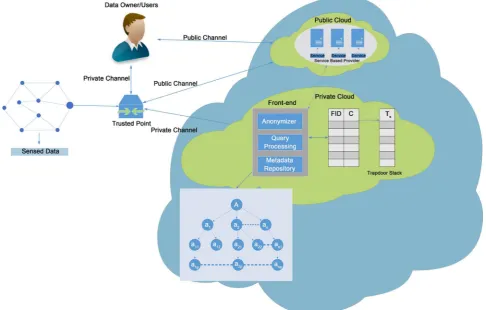
As clearly proved by the research community; the homomorphic encryption can carry some operations over encrypted data effectively, but it is very expensive scheme in terms of computation and communication costs [8][11][13]. There-fore, we introduce a new Logical agent: Anonymiser (with its three components: Decomposition Table, Query Processing, and the Metadata Repository) at the user side under the control of the master program. Doing so, the user program can efficiently send to the master program the optimal decomposition (Splitting: Key/value) of a given input files before encrypting the data (Shuffle). Thereby, we use our optimized ternary search tries (TST) [20] in a logical Merkle tree structure to optimally address the metadata authentication and dynamics through the Metadata repository component. The architecture overview of the proposed solution can be depicted by Figure 2.
Thus, our optimized algorithm (Op_FHE_SHCR) through successful experi-ments (see section below) performs 3 times faster the original FHE_SHCR scheme [17] and effectively addresses the metadata dynamics and authentication issues through a secure and efficient metadata repository (Optimized ternary search tries to address the time space constraints). Furthermore, we speed up the ciphertext retrieval algorithm (accuracy and efficiency) at the reduce phase by using the optimal Lagrange multiplier (µ*) as the optimum number N e (See
section below). Note that, the implementation of this Anonymiser as our Trusted Front End Database Management (TFE) is to enhance the security and speed up the data processing of our proposed solution and represents the key point of this extended work.
4.1. Optimized Metadata Authentication and Dynamics
Figure 2. Architecture Overview of optimized FHE_SHCR.
gram. The Anonymiser has three pieces namely: Decomposition table, Query Processing, and Metadata Repository. Their functions can be briefly described as following:
♦Decomposition table: It is responsible for defining the exact set of attributes (Α ) for particular input files in the optimal number.
♦The Query Processing: It filters the candidate map workers queries request generated by the master program to produce anonymous query-based request on data location for processing.
♦ The Metadata Repository: It keeps data decomposition done by the de-composition table and forwards them to the Query Processing unit to generate new anonymous query request. For the efficiency of the proposed scheme, we use Merkle hash tree structure to deal with metadata authentication and dynam-ics [21]. Thereby the master program assigns a particular input files decomposi-tion table (A)to map workers for processing logically as below:
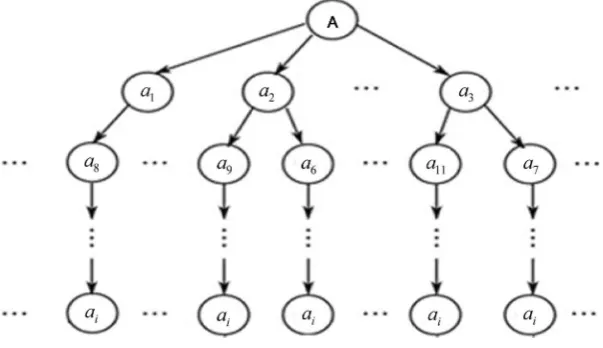
All input files are transformed into a set of symbols (A) as a1, a2, a3, an
as depicted by the above Figure 3. The data matching and authentication starts from root node in a top-down manner and its dynamics process can be de-scribed as follows.
File uploading: Suppose that a data owner wants to process a file F identified by ai (leaf node) with public cloud server whose attributes satisfy an access
Figure 3.Efficient Symbol-based Tree Retrieval.
file F consists of a keyword set W. Then, the owner randomly chooses a symme-tric key Ske from the key space and encrypts the file F with Ske to obtain the
ciphertext Ctf. Subsequently, data owner runs the algorithm Encrypt(AP, Ske)
to obtain the ciphertext Cske which is the encryption of the symmetric key Ske
with respect to the access policy AP. The owner uploads
(
a C Ci, tf, ske)
to thepublic cloud. Furthermore, to generate the trapdoors for keywords in W, the owner also sends (ai, AP, W) to the private cloud. Upon receiving (ai, AP, W),
the private cloud transforms the access policy AP into a set
{ }
Pj AP of privileges.Then, for each wi∈W and pi∈
{ }
Pj AP , it computes tpi,wi =f(
kpi,wi)
,where kpi is the symmetric key for each pi. Finally, the private cloud sends
{
}
(
ai, tpi,wi)
to the public cloud as well.To enhance the searching efficiency, a symbol-based tree is utilized to build an index stored in private cloud (metadata repository). More precisely, divide the output of one-way function f into l parts and predefine a set A=
{
a1ai}
con-sisting of all the possible values in each part (an example of such tree can be shown in Figure 3). Initially, the index based on symbol-based tree has only a root node (denoted as 𝑛𝑛𝑜𝑜𝑑𝑑𝑒𝑒0) which consists of ∅ (an empty set). The search process in a symbol based tree is a depth first search. The tree can be updated and searched as follows.
Update: Assume the data owner wants to outsource a file F identified by ai
with keyword set W, the public cloud will receive
(
a C Ci, tf, ske)
and{
}
(
ai, tpi,wi)
where pi are the corresponding privileges and wi are keywordsin W from the data owner and private cloud respectively. Then, for each
(
tpi,wi)
the public cloud will add it into the trie index as the following steps.i) Step 1: Public cloud parses
(
tpi,wi)
as a sequence of symbols a ai1 i2ail.ii) Step 2: Public cloud starts with the root node of tree: it scans all the children of the root node and checks whether there exists some child node 1 such that the symbol contained in node 1 equals ail. This action is performed in a
top-down manner. In general, assuming that the subsequence of symbols
1 2 1
i i ij
a a a − has been matched and the current node is nodej−1, the public
node, for example nodej such that the symbol contained in nodej equals
ij
a . If such node exists, the current node is set as nodej and aij+1 is the
next matching object, otherwise jump to step 3.
iii) Step 3: Assume that current node nodej has no children to match the
sym-bol aij+1, the public cloud will build nodes nodej+1,,nodejl for all the rest
of the symbols (i.e. aij+1,aij+2,,ail) respectively and link them as a node list
appended with nodej. Finally, add another node identified by ai as the leaf
node appended with nodejl.
Search: Assuming that the legitimate user wants to search outsourced files with keyword w and privileges
{ }
pi , the public cloud will receive(
tpi,wi)
from the private cloud. For each
(
tpi,wi)
the public cloud will perform actionssimilar to the three steps described above. One exception is that if matching fails (i.e. the current node has no children which can match the symbol), the search for
(
tpi,wi)
is aborted. Otherwise, get the corresponding(
C Ctf, ske)
) throughthe identifier ai in the leaf node.
So to address Merkle tree traversal problem, our scheme uses some tools from the efficient algorithm in [22] to overcome the space-time issue. Furthermore, to optimize the time space constraints in the Merkle hash tree traversal process, we designed an optimized ternary search tries (TST) [20] which is a sorting algo-rithm that blends quicksort and radix sort. Thereby, it is competitive with the best known C sort codes. It is faster than the traditional hashing and other commonly used search methods as shown below (Figure 4):
The TST is space efficient, but increases with the number of strings (N). Therefore the traversal problem is how to calculate efficientlythe authentication path for all leaves one after another starting with the first leaf up to the last leaf, for minimum amount of space-time cost. Hence, it implies to analyze an optimal distribution of singleton attribute (ai) to enhance the efficiency of the proposed
[image:9.595.217.532.548.716.2]solution; that is to find the optimal number of strings or attributes (N) to popu-late the tree. In this work we use the Karush-Kuhn-Tucker (KKT) condition of constrained optimization problem [24] to solve the above mentioned issue in the section below. Practically, we design our solution using some mathematical tools
from the scheme in [25] to find the minimum number of singleton quasi-identifier that gives the optimal security level for the proposed traversal algorithm effi-ciency.
Let n n n1, 2, 3,,nn be the number of values along the different columns of
the Anonymiser decomposition table to populate the distinct levels set
1, 2, 3, , n
L L L L of the Merkle tree respectively. The total number of distinct
val-ues taken by the different levels set (n n n1, 2, 3,,nn) is N. We assume that each
column set (Ci) of the decomposition table takes (ni) different values with the
probability (pi) respectively, where 1 1 N
i i= p =
∑
.Therefore the probability for the (ith) element to be a singleton in the universal
decomposition table by selecting one of the (n) choices (entries) is
(
)
11 n
i i
np −p − .
Let the variable xi be the indicator representing whether (i
th) element is a
singleton, then its expectation is calculated as below:
[ ]
[
]
(
)
1def( )
1 1 n e npi
i i i i i
E x =P x = =np −p − =np − (3)
Let 1 N
i i
X =
∑
= x , be the variable that counts the number of singleton; itsex-pectation is given by:
[ ]
1[ ]
1( )
ei
np
N N
i i
i i
E X =
∑
= E x =∑
= np −(4) We aim to find the smallest number of singleton to populate efficiently the Merkle tree in the metadata repository.
It implies to minimize 1
( )
e i np N i i np − =∑
;Subject to 1 N
i i= np =n
∑
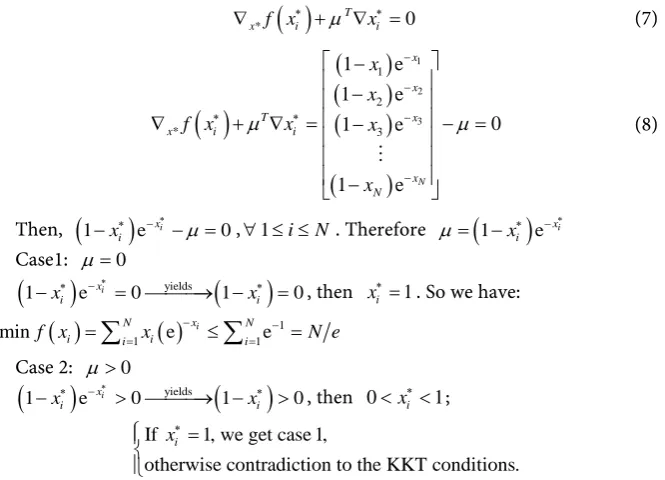
, with 0≤npi, ∀ ≤ ≤1 i N .Therefore we get the optimized number of singleton by rewriting the above distribution as a constrained optimization problem [24]. Doing so, we find the dual solution of the primal problem which is fast and reduces the space-time costs as follows:
( )
( )
( )
1min e (P) 0; 1 i x N
i i i
i i
f x x
st g x x
i N
− =
=
= >
∀ ≤ ≤
∑
(5)
KKT condition: Primal variable: xi; Lagrange Multiplier: λ µ,
Let us considering an optimization problem of forms Minimize f(x) Subject to
( )
0;( )
0i i
h x = g x ≤ ;
With i=1,,m
( )
( )
( )
( )
( )
( )
* * * * 1 1 * * 00, 0, for 1, , , 1, ,
0, 0
m m
i i i j X
i j
i j
j i
f x h x g x T x
h x g x i m j r
µ λ µ λ = = ∇ + ∇ + ∇ + = ≤ = = ≥ ≥
∑
∑
(6)
Using the Lagrange multiplier and the duality theorem, the solution of the problem (P) is determined as following:
(
,)
( )
( )
iT
x i
L f µ = f x −µ g x ,
Then
( )
( ) ( )
( ){
( )
( )
}
def
0 1
, ; e i
i i
x
N T
x X i g x i i i
( )
q µ is a smooth function, then its gradient equals to zero at the optimal
number (x*):
( )
* 0
T x f xi µ xi
∗ ∗
∇ + ∇ =
(7)
( )
(
)
(
)
(
)
(
)
1 2 3 1 2 * 3 1 e 1 e 0 1 e1 e N
x x T x i i x x N x x
f x x x
x µ µ − − − − ∗ ∗ − − ∇ + ∇ = − − = − (8)
Then,
(
1)
e xi 0 ix∗ −∗ µ
− − = ,∀ ≤ ≤1 i N. Therefore
(
1)
e xii
x
µ= − ∗ −∗
Case1: µ=0
(
)
yields(
)
1 e i 0 1 0
i i
x
x∗ −∗ x∗
− = → − = , then xi 1
∗= . So we have:
( )
1( )
1 1
m ni N e xi N e
i i i i
f x =
∑
= x − ≤∑
= − =N eCase 2: µ>0
(
)
yields(
)
1 e i 0 1 0
i i
x
x∗ −∗ x∗
− > → − > , then 0 xi 1
∗ < < ;
If 1, we get case 1,
otherwise contradiction to the KKT conditions. i x∗ =
Finally the optimal number of singleton quasi-identifiers for a decomposition table of (n) entries with maximum total number of distinct values (N) is N e.
Using this optimum number (N e) to populate the ternary search tree, we
im-prove the performance of the Merkle tree traversal algorithm by addressing the space-time cost issue. Thereby, the overall ciphertext retrieval time at reduce phase for our optimized algorithm Op_FHE_SCHR is almost three times less than the exiting one FHE_SCHR refer to Figure 5.
4.2. FHE_SCHR Efficiency and Implementation Analysis
[image:11.595.209.542.104.344.2]Regardless of the advances in remote sensor network (WSN) to controls systems into cloud, there are still enormous challenges in term of security insurance over
[image:11.595.221.528.525.717.2]outsourced data processing and storage [26]. Therefore, we work for experiment purposes over trained sensed dataset for cancer pattern monitoring project. So our main goal in this paper is to securely optimize the map phase (input files decomposition) and ciphertexts retrieval (reduce phase) process. Thereby, we implement an optimized scalar homomorphic based Mapreduce scheme Op_FHE_SHCR, which contains four algorithms: KeyGen (ke), Encrypt (1
σ,
e
k , s.m) Decrypt(c) and Retrieval(c). Note that these four algorithms are quite
similar like those in [21], with modified mapping and hashing algorithm like below (Algorithm 1).
Pseudo code:
This algorithm initializes the selected feature subset (splitting the input file into subsets) denoted by FS, with the empty set. A candidate feature subset,
denoted by FC, will be produced by adding a feature, denoted by fd, with
[ ]
1,
d∈ D , to the selected feature subset, and the hashing index IWIFC will be
computed by Algorithm 2. Then, the algorithm removes this feature and adds
Algorithm 1: Splitting.
Input: < Fi input file (key/value) >
Output: < FS searchable ciphertext (key/value ) > Initialize: FS= ∅;
repeat Ft=Fi; repeat
produce the candidate feature set FC=fcFS,fc∈F ct, ∈
[ ]
1,D ;remove fc from Ft;
compute and record Fc by Algorithm 2; until Ft== ∅
:
S d S
F =f F , where
(
)
C
d F
f =argNMax IWI ;
remove fd from FO; until FO== ∅ or meeting the threshold
Algorithm 2: Hashing.
Input: < searchable ciphertext (key/value ) >
Output: < splitting searchable ciphertext (key/value ) > 1. #include <stdio.h>
2. #include <string> 3. using namespace std; 4. class MyHash
5. {private: string ** table; int * maxind; 6. long width;
7. long depth;
8. protected: bool insert(long value,string s); 9. void printone(long v);
10. public:MyHash(long N, long Depth); 11. long apply(string s);
another feature to generate a new candidate. That is, the new feature in the cho-sen candidate will be added to the selected feature subset. Thus, this algorithm iteratively adds one feature (or the fixed number of features if the floating strat-egy has been used) to increase the selected feature subset until the threshold is met. It should be pointed out that the main difference between the proposed al-gorithm and the existing ones in the literature is that our alal-gorithm produces high correlated data subsets based on the hashing index value. Therefore the ci-phertext retrieval process at the reduce stage will be more efficient in terms of speed.
The design of our OP_FHE_SCHR cryptosystem is done using the HElib- master-2015.03 library in Dev C++ IDE. We utilize the WDBC Test training da-taset for cancer management project. Our security algorithm is implemented in four steps using Gentry cryptosystem [13][18] and [19].
The efficient analysis of the candidate solution is proved by its experiments results that are compared with the existing blinding fully homomorphic
[image:13.595.208.542.626.730.2]FHE_DFI_LM algorithm, previous FHE_SCHR, and our new optimized Op_FHE_SCHR algorithm. Recall that, the improvement on this paper is mainly on the optimization of ciphertext retrieval time and metadata dynamics and au-thentication path in the logical Merkle tree repository (optimized space-time cost).
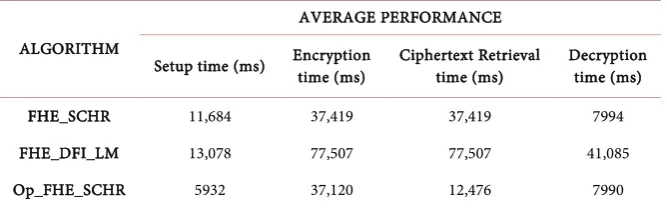
Table 1 and Figure 5 show the average performance of our proposed solution (Op_FHE_SCHR) in comparison to related works (FHE_DFI_LM & FHE_SCHR). Recall that, the experimental requirements are to optimize the outsourced data processing at the map stage and prevent intermediate data disclosure at the re-duce phase in order to reinforce data privacy on Maprere-duce framework. There-fore our Op_FHE_SCHR processes almost the data at Map stage (setup phase refer to Table 1 and Figure 5) three time less (5932 ms) than FHE_DFI_LM (13078 ms) and two time less than our previous work FHE_SCHR (11684 ms). This result is obtained by an optimized map workers selection using the optimal number N e, for a given decomposition table of (n) entries at the splitting step.
Thereby for a given dataset N, our algorithm calculates in advance the exact op-timal number of subsets (feature selection) and map workers to speed up the splitting and data allocation process at the Map stage. Furthermore, each ele-ment (feature) of a subset is selected by an efficient feature selection algorithm (refer Algorithm 1).
Table 1. Average performance Comparison.
ALGORITHM
AVERAGE PERFORMANCE
Setup time (ms) Encryption time (ms) Ciphertext Retrieval time (ms) Decryption time (ms)
FHE_SCHR 11,684 37,419 37,419 7994
FHE_DFI_LM 13,078 77,507 77,507 41,085
Based on the result of effective experiments directed, it is unmistakably certain that the proposed optimized scheme Op_FHE_SCHR speedups the setup (input files decomposition) and ciphertext retrieval time without compromising the cryptosystem. Thereby, the graph 5 shows that the proposed alternative is more efficient regarding the ciphertext retrieval and computation cost reduction. Note that homomorphic cryptosystem is extremely expensive [15]. Therefore, our so-lution contribution is a reliable alternative to minimize the overall computation and communication costs.
4.3. FHE_SCHR Security Analysis
Two security requirements are to be achieved, that is data confidentiality and integrity. Therefore, our security scheme is based on a hybrid encryption design. Since the file is encrypted with a hybrid encryption as
(
Ctf,Cske)
, the adversaryshould first decrypt Cske. However, such a session key is protected by the ABE
scheme. Thus, data confidentiality can be reduced to the confidentiality security of ABE. Moreover, the keywords which are needed to be protected against the public cloud are encrypted with a one way trapdoor function. The underlying ABE scheme for this work is known to be semantically secured. This private key is under the security proof of the ABE scheme and reduced to the bilinear deci-sional Diffie-Hellman (BDDH) problem [27]. The bilinear decisional Diffie- Hellman (BDDH) problem is such that given g, gx,gy,gz∈G for unknown random values x, y, z ∈ R ZP, and T ∈ R, GT, prove the distinguish ability of
(
,)
xyze g g from any random number in the target group is very hard to decide
if T =e g g
(
,)
xyz. We say that the (t, ϵ)-BDDH assumption holds in G, if no t-time algorithm has the probability at least 1
2+ in solving the BDDH problem
for non-negligible ϵ.
Recall that this paper is based on [17], and therefore we use the same crypto-system to fix the data privacy preserving challenge. Furthermore, to enhance the security of our proposed solution in terms of data authentication paths and dy-namics, we adopt the Merkle’s hash tree to store the metadata decomposition
{
}
(
ai∈ =A a a1, 2,,an)
; which is freely secure from any number theoreticcon-jectures [21]. Indeed the Merkle’s hash trees are veryuseful because they allow efficient and secure verification of the contents of large data structures. This se-curity lies mainly on two properties of hash functions:
i) Pre-image resistance: that is, given a hash value (h), it is difficult to find a message m such that h = hash (m).
ii) Collision resistance: that is, finding two messages m1 ≠ m2 such that hash (m1) = hash (m2) is difficult.
This data structure is a complete binary tree with an n-bit hash value asso-ciated with each node. Each internal node value is the result of a hash of the node values of its children. Merkle trees are designed so that a leaf value h (ai)
(
)
A=h ha1 || ha2 || ha3 |||| han ; refer to the Figure 3. So an attacker holding a hash value
( )
hai in order to reconstruct (A); needs some additional values called Auxiliary Authentication Information (AAI) which are kept secret by the metadata repository administrator under the supervision of the Anonymiser Query system. Therefore it is very hard for the public cloud server or outside at-tacker to reconstruct the input files by the decomposition table (A).To summarize the security analysis, we can say by implementing a secure front end database management agent (Anonymiser) on top of FHE_SHCR se-curity mechanism [17] that the data privacy insurance has been greatly rein-forced in our proposed solution (Optimized FHE_SHCR).
5. Conclusion
In this paper, the requirements are to optimize the outsourced data processing at the map stage and prevent intermediate data disclosure at the reduce phase in order to reinforce data privacy on Mapreduce framework. Therefore, we imple-ment a secure Front End Database Manageimple-ment agent: the Anonymiser with its three components (Decomposition table, Query Processing, and Metadata Repo-sitory.) to enhance the data security mechanism of our proposed solution. The cryptosystem tool is a scalar homomorphic encryption that performs some sorts of calculations over encrypted data in more secure and optimized design. The optimized cryptosystem Op_FHE_SCHR is by the experiments results an effi-cient candidate for the communication and computation costs reduction. Prac-tically, it takes as input files an optimized decomposition table (for map work-ers), and improves the speed and accuracy of ciphertext retrieval process (for reduce workers) on Mape Reduce environment. Furthermore, we address the metadata dynamics and time space cost constraints for the traversal of Merkle tree structure in our metadata repository by applying an optimized ternary search tries (TST) algorithm.
Acknowledgements
This work has been supported by MoE-CMCC (Ministry of Education of China- China Mobile Communications Corporation) Joint Science Fund under grant MCM20130661.
References
[1] Cloud Security Alliance (2010) Top Threats to Cloud Computing Version 1.0. http://www.cloudsecurityalliance.org/topthreats/csathreats.v1.0.pdf
[2] Puttaswamy, K.P.N., Kruegel, C. and Zhao, B.Y. (2011) Silverline: Toward Data Confidentiality in Storage-Intensive Cloud Applications. Proceedings SoCC’11 the 2nd ACM Symposium on Cloud Computing.
https://doi.org/10.1145/2038916.2038926
[4] Roy, I., Setty, S.T.V., Kilzer, A., Shmatikov, V. and Witchel, E. (2010) Airavat: Secu-rity and Privacy for MapReduce. Proceedings NSDI’10 7th USENIX Conference on Networked Systems Design and Implementation, 297-312.
[5] Blass, E.-O., Pietro, R.D., Molva, R. and Önen, M. (2012) Prism-Privacy Preserving Search in MapReduce. Proceedings PETS’12 the 12th International Conference on Privacy Enhancing Technologies, 180-200.
https://doi.org/10.1007/978-3-642-31680-7_10
[6] Ko, S.Y., Jeon, K. and Morales, R. (2011) The Hybrex Model for Confidentiality and Privacy in Cloud Computing. Proceedings HotCloud’11 the 3rd USENIX Confe-rence on Hot Topics in Cloud Computing Article 8.
[7] Zhang, K., Zhou, X., Chen, Y., Wang, X. and Ruan, Y. (2011) Sedic: Privacy Aware Data Intensive Computing on Hybrid Clouds. Proceedings CCS’11 18th ACM Con-ference on Computer and Communications Security, 515-526.
https://doi.org/10.1145/2046707.2046767
[8] Rivest, R.L., Adleman, L. and Deaouzos, M.L. (1978) On Data Banks and Privacy Homomorphism. In: DeMillo, R.A., Ed., Foundations of Secure Computation, Aca-demic Press, New York, 169-179.
[9] Craig, G., Shai, H. and Nigel, S. (2012) Fully Homomorphic Encryption with Poly-log Overhead. In: Pointcheval, D. and Johansson, T., Eds., Advances in Cryptology, Springer, Heidelberg, 465-482.
[10] Zvika, B., Craig, G. and Shai, H. (2013) Packed Ciphertexts in Lwe-Based Homo-morphic Encryption. In: Kurosawa, K. and Hanaoka, G., Eds., Public-Key Crypto-graphy-Pkc 2013, Springer, Heidelberg, 1-13.
[11] Gentry, C. (2009) Fully Homomorphic Encryption Using Ideal Lattices. In: 41st Annual ACM Symposium on Theory of Computing, ACM Press, New York, 169- 178.https://doi.org/10.1145/1536414.1536440
[12] Dijk, M.V., Gentry, C., Halevi S. and Vaikuntanathan, V. (2010) Fully Homomor-phic Encryption over the Integers. In: Proceedings Advances in Cryptogra-phy-Eurocrypt, Springer-Verlag, Berlin, 24-43.
[13] Gentry, C. (2010) Computing Arbitrary Functions of Encrypted Data. Communica-tions of the ACM, 53, 97-105.https://doi.org/10.1145/1666420.1666444
[14] Dean, J. and Ghemawat, S. (2008) MapReduce: Simplified Data Processing on Large Clusters. Communication of ACM, 51, 107-113.
https://doi.org/10.1145/1327452.1327492
[15] Jaydip, S. (2013) Homomorphic Encryption—Theory and Application. In: Jaydip, S., Ed., Theory and Practice of Cryptography and Network Security Protocols and Technologies, Tech.https://doi.org/10.5772/56687
[16] Chen, X. and Huang, Q. (2013) The Data Protection of MapReduce Using Homo-morphic Encryption. Proceedings ICSESS the 4th IEEE International Conference on Software Engineering and Service Science, Beijing, 23-25 May 2013, 419-421. [17] Martin, K., Wenyong, W. and Brighter, A. (2016) Efran (O) Efficient Scalar
Ho-momorphic Scheme on MapReduce for Data Privacy Preserving. Proceedings CSCloud the 3rd IEEE International Conference on Cyber Security and Cloud Computing, Beijing, 25-27 June 2016, 66-74.
[18] Gentry, C. and Halevi, S. (2011) Implementing Gentry’s Fully-Homomorphic En-cryption Scheme. In: Proceedings Advances in Cryptography-EUROCRYPT, Springer-Verlag, Berlin, Vol. 6632, 129-148.
Ber-lin, Vol. 6223, 116-137.https://doi.org/10.1007/978-3-642-14623-7_7
[20] Jon, L.B. and Robert, S. (1997) Fast Algorithms for Sorting and Searching Strings.
Proceedings ACM-SIAM the Eight Annual Symposium on Discrete Algorithms, New Orleans, 5-7 January 1997, 360-369.
[21] Merkle, R.C. (1989) A Certified Digital Signature. Proceedings CRYPTO Advances in Cryptography, Vol. 435 of LNCS, 218-238.
[22] Markus, K., Willi, M. and Carlo, U.N. (2014) A Space- and Time-Efficient Imple-mentation of the Merkle Tree Traversal Algorithm.
[23] Robert, S. and Kevin, W. (2002) Algorithms. 4th Edition.
http://algs4.cs.princeton.edu/home/
[24] Bertsekas, D.P., Nedic, A. and Ozdaglar, E.A. (2003) Convex Analysis and Optimi-zation. Athena Scientific, Cambridge, 560 p.
[25] Yu, Y. (2010) Privacy Protection in Secure Database Service. Proceedings the Second International Conference on Networks Security, Wireless Communications and Trusted Computing, Wuhan, 218-222.
[26] Huang, X. and Du, X. (2013) Efficiently Secure Data Privacy on Hybrid Cloud. Pro-ceedings ICC IEEE International Conference on Communication, 9-13 June 2013, Budapest, 1936-1940. https://doi.org/10.1109/ICC.2013.6654806
[27] Sahai, A. and Waters, B. (2005) Fuzzy Identity-Based Encryption. In: Cramer, R., Ed., Eurocrypt, Springer, Heidelberg, LNCS, Vol. 3494, 457-473.
https://doi.org/10.1007/11426639_27
Submit or recommend next manuscript to SCIRP and we will provide best service for you:
Accepting pre-submission inquiries through Email, Facebook, LinkedIn, Twitter, etc. A wide selection of journals (inclusive of 9 subjects, more than 200 journals)
Providing 24-hour high-quality service User-friendly online submission system Fair and swift peer-review system
Efficient typesetting and proofreading procedure
Display of the result of downloads and visits, as well as the number of cited articles Maximum dissemination of your research work
![Figure 1. Mapreduce execution overview in [14].](https://thumb-us.123doks.com/thumbv2/123dok_us/7737229.707087/4.595.209.543.60.243/figure-mapreduce-execution-overview-in.webp)
![Figure 4. String symbol table implementation cost summary from [23].](https://thumb-us.123doks.com/thumbv2/123dok_us/7737229.707087/9.595.217.532.548.716/figure-string-symbol-table-implementation-cost-summary.webp)