Characteristics of Bitcoin Users: An
Analysis of Google Search Data
Wilson, Matthew and Yelowitz, Aaron
University of Kentucky, University of Kentucky
3 November 2014
Characteristics of Bitcoin Users: An Analysis of Google Search Data
Matthew Wilson Aaron Yelowitz*
Abstract: The anonymity of Bitcoin prevents analysis of its users. We collect Google Trends data to examine determinants of interest in Bitcoin. Based on anecdotal evidence regarding Bitcoin users, we construct proxies for four possible clientele: computer programming enthusiasts, speculative investors, Libertarians, and criminals. Computer programming and illegal activity search terms are positively correlated with Bitcoin interest, while Libertarian and investment terms are not.
JEL Codes: E42, F33, K42, K49
Keywords: Bitcoin, Digital currency, Google search data, Libertarians, Illegal Activity
* Yelowitz (corresponding author) Contact Information E-mail – [email protected]
Introduction
Bitcoin, a virtual global currency, has been the topic of much media, internet and policy discussion. Over
13.4 million bitcoins are in circulation and have a total market value of $4.6 billion.1 Little is known
about the characteristics of Bitcoin users, even though thousands of businesses accept bitcoins as
payment. Transactions with Bitcoin are near anonymous due to the cost associated with identifying a
user’s electronic signature. Although some convenience sampling exists of Bitcoin enthusiasts, no
systematic data collection has been done.
We use Google Trends (hereafter, “GT”) data to study the clientele driving interest in Bitcoin, with the
caveat that search query interest need not imply active participation. Based on anecdotal evidence
about Bitcoin users, we construct proxies for four possible clientele: computer programming
enthusiasts, speculative investors, Libertarians, and criminals. Illegal activity and computer programming
are both positively associated with Bitcoin use, while no association exists for Libertarian ideology or
investment motives in most specifications.
The Bitcoin Market
Bitcoin was created in 2009 as an unregulated, alternative method of exchange for online payments.
Upon signing up for an account, an individual receives a electronic signature that secures transactions
and disallows double spending (enforced by a diverse computer network). This process circumvents
conventional methods that involve trust in and fees to a third-party. Conventional methods involve
third-party fees, deterring small transactions (Nakamoto, 2008).2 Anonymity is theoretically achieved
due to Bitcoin’s encryption, with the sole link being the electronic signature. Meiklejohn, et al. (2013)
1
https://blockchain.info/charts/total-bitcoins
2
find that anonymity is nearly impossible with large scale transactions, but there are high costs to
identifying users.
Who Might Be Bitcoin Users?
Profit and politically-charged aspirations coincide with the basic design of the Bitcoin market. Prices for
bitcoins have fluctuated enormously over time, which might prove tempting for a speculative investor.
The unregulated set-up makes it appealing to Libertarians who philosophically oppose “inflationary
central-bank meddling.”3 Other clientele appreciate Bitcoin's market structure for different reasons. For
example, Bitcoin has appeal among computer programmers; miners (the term for those seeking to
discover new bitcoins) can earn the currency in exchange for utilizing special software to authenticate
real-time Bitcoin transactions.4 The anonymity of Bitcoin is attractive for criminal activity. The October 2,
2013 FBI takedown of the Silk Road website – an online marketplace “for everything from heroin to
forged passports” where transactions took place in bitcoins – highlighted the importance of Bitcoin’s
perceived anonymity and led to a 22% reduction in Bitcoin’s price.5
In order to understand the underlying rationale for Bitcoin use, Lui (2013) surveyed 1,133 members of
the Bitcoin community (by posting links on Bitcoin websites).6 The survey identified three key motives:
curiosity, profit, and political. Respondents (which included both owners and non-owners of Bitcoin) are
likely unrepresentative of the larger community; for example, those using Bitcoin for illegal activity are
unlikely to participate.
3
http://www.economist.com/news/finance-and-economics/21599053-chronic-deflation-may-keep-bitcoin-displacing-its-fiat-rivals-money
4
http://www.bitcoinmining.com/
5
http://online.wsj.com/articles/SB10001424052702303722604579115692946177328 and https://www.tradingview.com/v/4xVX2cFq/
6
GT Data
We collected GT search query data from January 2011 to July 2013 for all US states and Washington DC.7
We looked for terms related to Bitcoin and its possible clientele.8 Some of these correlations are
inherently difficult to measure, due to the sensitivity of the activity; Stephens-Davidowitz (2013, 2014)
argues, however, that Google data are unlikely to suffer from major social censoring, and uses GT to
explore child abuse and racial animus.9 Although it is conceivable that higher Bitcoin search volume
need not translate into increased market participation, Kristoufek (2013) demonstrates a strong positive
correlation between Bitcoin searches and exchange prices.
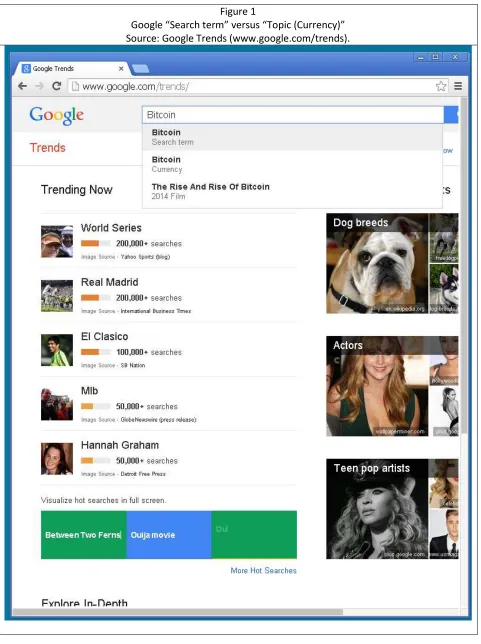
GT can be used to extract data for precise search terms and more general topics (see Figure 1). Search
terms will return data for the exact query while topics count related searches too.10 For instance, the
topic “Bitcoin (Currency)” includes the terms “Bitcoin”, “Bitcoins”, “Bitcoin Mining”, “Bit Coin”, “Bitcoin
exchange”, “Bitcoin price” and “Bitcoin value”. We use search topics for Bitcoin (under “Currency”) and
Computer Science (under “Discipline”). For other clienteles – Illegal Activity, Libertarians and Speculative
Investors – we use the search terms “Silk Road”, “Free Market”, and “Make Money” respectively.11
GT does not report raw search counts for a topic; such counts would be misleading because Google’s
popularity (and search queries) grow over time.12 Instead GT computes the number of topic searches
relative to all searches, normalizes the series so the highest value is 100, and scales all other values
7
We start in January 2011 because GT better measures state-level search activity from that point. We end in July 2013 because the “Silk Road” website – unknown to most of the public – was shut down soon after and made front-page headlines in national publications.
8
GT data has been predictive of behavior in diverse economic markets including entertainment, labor, and housing (Hand and Judge, 2012; Askitas and Zimmerman, 2009; Varian and Choi, 2009; Wu and Brynjolfsson, 2013). It has also been used for detecting health patterns, including influenza outbreaks and Lyme disease cycles (Ginsberg, et al., 2009; Seifter et al., 2010; Carneiro and Mylonakis, 2009).
9
He shows that cross-sectional state variation in GT is highly correlated with other data sources; for example the search rate for the word “God” explains 65% of the variation in the percent of a state’s residents believing in God.
10
https://support.google.com/trends/answer/4355000?hl=en
11
We attempted to use alternative terms for these concepts (such as “Libertarian” or “Ron Paul” for Libertarianism), but search interest was either too sparse or had a strong political cycle.
12
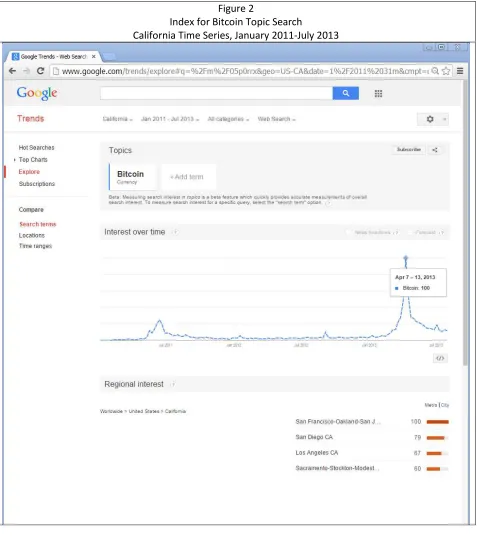
relative to the highest. Figure 2 illustrates the Bitcoin time series in California, where popularity peaked
in April 2013.For each state, we initially compute a 31-month time series for the relative popularity of
Bitcoin and each clientele grouping.13 We then use GT to measure relative state-level popularity of each
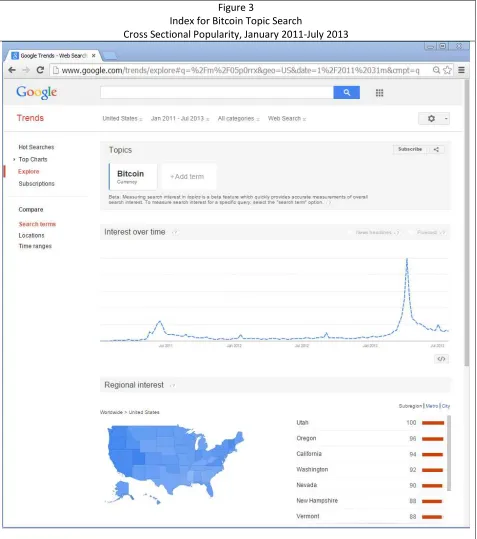
search term for the full period and scale each state-series relative to the most popular state. During the
observed timeframe, the states with the highest interest in Bitcoin were Utah, Oregon, California,
Washington, Nevada, New Hampshire and Vermont (see Figure 3). We then rescale each state-specific
time series by its geographic popularity. Thus, using California’s value of 94 from the geographic Bitcoin
comparison, the entire California time series would be rescaled to 0.94 of its original value.
Our outlined methodology presents us with two limitations. First, GT samples its database and
computes the index based on that sample.14 We observed slightly different values for the index by
refreshing the webpage, even with the same restrictions. Although the overall conclusions are unlikely
to change from sampling, this prohibits exact replication. Second, GT gives a value of zero if it cannot
gather enough data.15 We exclude state-month observations with missing values. While every index has
missing values for particular months, some states returned a missing value in the cross-sectional
analysis, which prevents rescaling of the state-specific time series. Delaware, North Dakota, and
Wyoming were excluded as they had missing values for “Free Market” and/or “Silk Road.” Out of 1,488
(48 states x 31 months) potential observations, our analysis uses 794 with non-missing values on Bitcoin,
Computer Science, Free Market, Silk Road, and Make Money. The most populous states tend to have the
fewest missing state-month observations.
13
Some states and search terms had weekly activity (such as California’s Bitcoin activity in Figure 2). In such cases, we computed monthly averages for all non-missing values, and then rescaled the series with a maximum value of 100.
14
https://support.google.com/trends/answer/4355213?hl=en&ref_topic=4365599
15
Empirical Results
Follow Stephens-Davidowitz (2014), we normalize each search rate to its z-score and estimate the
following specification:
(1) 𝐵𝐵𝐵𝐵𝐵𝐵𝐵𝑗𝑗=𝛽0+𝛽1𝑋𝑗𝑗+𝛿𝑗+𝛿𝑗+𝜀𝑗𝑗
where 𝐵𝐵𝐵𝐵𝐵𝐵𝐵𝑗𝑗 is Bitcoin interest in state j in month t, 𝑋𝑗𝑗 are clientele interest, and 𝛿𝑗 and 𝛿𝑗 are
state and time fixed-effects. Each state-month is weighted by state population in July 2011 and standard
errors are corrected for non-nested two-way clustering at the state and time levels (Cameron, Gelbach
and Miller, 2011). By including fixed effects in our fully-saturated specification, the impact of clientele
association on Bitcoin is measured through differential within-state changes over time (Yelowitz, 1995).
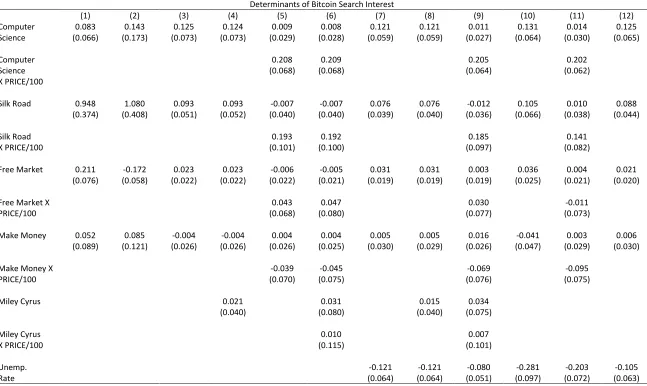
Results for a variety of specifications are presented in Table 1. Columns (1)-(3) progressively include
additional controls for state and time. The inclusion of both state and time fixed effects identifies
interest in Bitcoin by exploiting within-state changes over time. In this specification, interest in
computer science and Silk Road are both positively associated with interest in Bitcoin and are
statistically significant at the 10% level. The interpretation of the specification in column (3) is the
following: a one-standard deviation increase in computer science interest leads to a 0.13 standard
deviation increase in Bitcoin interest, while a one-standard deviation increase in Silk Road interest leads
to a 0.09 standard deviation increase in Bitcoin interest. Column (4) adds a “placebo clientele” –
searches for the singer Miley Cyrus. Reassuringly, inclusion of this placebo variable neither changes any
of the inferences on the other clientele, nor is the variable itself significant.
Columns (5)-(6) interact each clientele search term with average monthly Bitcoin prices. Profit
motivated clientele – such as speculative investors – may find Bitcoin more intriguing when prices are
groups of computer programming enthusiasts and those possibly engaged in illegal activity (in the
interaction term, not the main effect). The other clientele groups remain insignificant.
Columns (7)-(9) include the state-level monthly unemployment rate. Columns (7)-(8) show that the
inferences on computer science and illegal activity are unchanged, but there is some evidence that
Libertarian activity also drives interest in Bitcoin (although the specification including interactions with
Bitcoin prices is insignificant). Higher unemployment rates are negatively associated with Bitcoin
interest. Columns (10)-(11) estimate the model from 2012 onward (when Bitcoin was more popular),
while column (12) estimates it for the 24 states with at least 20 monthly observations. In all cases,
fluctuations in computer science and illegal activity continue to drive Bitcoin interest, as well as the
business cycle.
Discussion
Although many commentators have speculated about motives for using Bitcoin, our study is the first to
systematically analyze Bitcoin interest, including the interest of hard-to-observe clientele. We find
robust evidence that computer programming enthusiasts and illegal activity drive interest in Bitcoin, and
References
Askitas, N., Zimmerman, K.F. 2009. “Google Econometrics and Unemployment Forecasting.” Applied Economics Quarterly, 55(2), 107-120.
Cameron, A.C., Gelbach, J.B., Miller, D.L. 2011. “Robust Inference With Multiway Clustering.” Journal of Business & Economic Statistics, 29(2), 238-249.
Carneiro, H.A., Mylonakis, E. 2009. “Google Trends: A Web-Based Tool for Real-Time Surveillance of Disease Outbreaks.” Clinical Infectious Diseases, 49(10), 1557-1564.
Ginsberg, J., Mohebbi,M.H., Patel, R.S., Brammer, L., Smolinski, M.S., Brilliant, L.. 2009. “Detecting Influenza Epidemics using Search Engine Query Data.” Nature, 457, 1012-1014.
Google Trends. www.google.com/trends.
Hand, C., Judge, G. 2012. “Searching for the Picture: Forecasting UK Cinema Admissions using Google Trends Data.” Applied Economics Letters, 19(11), 1051-1055
Kristoufek, L. 2013. “Bitcoin meets Google Trends and Wikipedia: Quantifying the Relationship Between Phenomena of the Internet era.” Scientific Reports, 3(3415), 1-7.
Lui. 2013. “The Demographics of Bitcoin (Part 1 Updated).” http://simulacrum.cc/2013/03/04/the-demographics-of-bitcoin-part-1-updated/
Meiklejohn, S., Pomarole, M., Jordan, G., Levchenko, K., McCoy, D., Voelker, G.M., Savage, S. 2013. “A Fistful of Bitcoins: Characterizing Payments Among Men with No Names.” In Proceedings of the 2013 conference on Internet measurement conference, IMC ’13, 127-140.
Nakamoto, S. 2008. “Bitcoin: A Peer-to-Peer Electronic Cash System.” https://bitcoin.org/bitcoin.pdf
Seifter, A., Schwarzwalder, A., Geis, K., Aucott, J. 2010. “The Utility of ‘Google Trends’ for
Epidemiological Research: Lyme Disease as an Example.” Geospatial Health, 4(2), 135-137. Stephens-Davidowitz, S. 2013. “Unreported Victims of an Economic Downturn,” Working Paper.
http://static.squarespace.com/static/51d894bee4b01caf88ccb4f3/t/51e22f38e4b0502fe211fab 7/1373777720363/childabusepaper13.pdf
Stephens-Davidowitz, S. 2014. “The Cost of Racial Animus on a Black Candidate: Evidence Using Google Search Data.” Journal of Public Economics, 118, 26-40.
Varian, H.R., Choi, H. 2009. “Predicting the Present with Google Trends.” Google Research Blog
http://googleresearch.blogspot.com/2009/04/predicting-present-with-google-trends.html . Available at SSRN: http://ssrn.com/abstract=1659302
Figure 1
Figure 2
Index for Bitcoin Topic Search
Figure 3
Index for Bitcoin Topic Search
Table 1
Determinants of Bitcoin Search Interest
(1) (2) (3) (4) (5) (6) (7) (8) (9) (10) (11) (12) Computer Science 0.083 (0.066) 0.143 (0.173) 0.125 (0.073) 0.124 (0.073) 0.009 (0.029) 0.008 (0.028) 0.121 (0.059) 0.121 (0.059) 0.011 (0.027) 0.131 (0.064) 0.014 (0.030) 0.125 (0.065) Computer Science X PRICE/100 0.208 (0.068) 0.209 (0.068) 0.205 (0.064) 0.202 (0.062)
Silk Road 0.948 (0.374) 1.080 (0.408) 0.093 (0.051) 0.093 (0.052) -0.007 (0.040) -0.007 (0.040) 0.076 (0.039) 0.076 (0.040) -0.012 (0.036) 0.105 (0.066) 0.010 (0.038) 0.088 (0.044) Silk Road X PRICE/100 0.193 (0.101) 0.192 (0.100) 0.185 (0.097) 0.141 (0.082)
Free Market 0.211 (0.076) -0.172 (0.058) 0.023 (0.022) 0.023 (0.022) -0.006 (0.022) -0.005 (0.021) 0.031 (0.019) 0.031 (0.019) 0.003 (0.019) 0.036 (0.025) 0.004 (0.021) 0.021 (0.020)
Free Market X PRICE/100 0.043 (0.068) 0.047 (0.080) 0.030 (0.077) -0.011 (0.073)
Make Money 0.052 (0.089) 0.085 (0.121) -0.004 (0.026) -0.004 (0.026) 0.004 (0.026) 0.004 (0.025) 0.005 (0.030) 0.005 (0.029) 0.016 (0.026) -0.041 (0.047) 0.003 (0.029) 0.006 (0.030)
Make Money X PRICE/100 -0.039 (0.070) -0.045 (0.075) -0.069 (0.076) -0.095 (0.075)
Miley Cyrus 0.021