INDIA’S CHALLENGES TO ACTIVE AGEING IN THE CONTEXT OF GLOBALIZATION AND
SOLUTIONS: A CRITICAL ANALYSIS
1
Sourav Goswami
1
Department of Community Medicine, MGIMS, Sevagram
2
Department of Pharmacology, JNMC, Sawangi (Meghe), Wardha, Maharashtra
ARTICLE INFO ABSTRACT
Ageing is a universal phenomenon. With the decline of communicable diseases and fertility rates and increased and improvised medical services, the average longevity of the people round the globe has increased, so also
population, there has been very less improvement in the quality of life of the elderly in India. Though different activities are going on for developing “healthy ageing”, yet there are a number of challenges that the Indian elderly population faces in
sole purpose of this article is to review the current challenges among the Indian elderly population in the context of globalization.
Copyright © 2017, Sourav Goswamiand Jagruti Bhattacharjee permits unrestricted use, distribution, and reproduction
INTRODUCTION
Ageing is an inevitable process occurring in living beings which is multifactorial and complex and understanding it has been a challenge since a long time. There is a lack of consensus of the age at which a person becomes old. The use of chronological age is most common. In most countries, the chronological age is the age at which one can begin to receive
pension benefits. “Too many people, when they get old, think
that they have to live by the calendar.” John Glenn, the oldest person to board a U.S Space Shuttle at age 77, exemplified the view that one shouldn’t let age define themselve
is a useful way to let one know the date, but to be hemmed in by his/her chronological age, is a deprivation from potentially valuable opportunities. The world is facing a situation without precedent: we soon will have more older people tha
and more people at extreme old age than ever before. The number of people aged 65 or older is projected to grow from an estimated 524 million in 2010 to nearly 1.5 billion in 2050 worldwide, (United Nations., department of Economics and Social Affairs, Population Division. World Population ageing 1950-2050) with most of the increase in developing countries
and the first quarter of 21st century is going to be known as
“the age of ageing”. Japan has the oldest population, with more
*Corresponding author: Jagruti Bhattacharjee
Department of Pharmacology, JNMC, Sawangi (Meghe), Wardha, Maharashtra
ISSN: 0975-833X
Vol.
Article History: Received 04th August, 2017
Received in revised form 09th September, 2017
Accepted 19th October, 2017
Published online 30th November, 2017
Citation: Sourav Goswamiand Jagruti Bhattacharjee,
analysis”, International Journal of Current Research, 9, (11), Key words:
Active ageing, Old age, Healthy ageing, Global health.
RESEARCH ARTICLE
INDIA’S CHALLENGES TO ACTIVE AGEING IN THE CONTEXT OF GLOBALIZATION AND
SOLUTIONS: A CRITICAL ANALYSIS
Sourav Goswami
and
2,*Jagruti Bhattacharjee
Department of Community Medicine, MGIMS, Sevagram
Department of Pharmacology, JNMC, Sawangi (Meghe), Wardha, Maharashtra
ABSTRACT
Ageing is a universal phenomenon. With the decline of communicable diseases and fertility rates and increased and improvised medical services, the average longevity of the people round the globe has increased, so also is the case of developing nations like India. In spite of an increased elderly population, there has been very less improvement in the quality of life of the elderly in India. Though different activities are going on for developing “healthy ageing”, yet there are a number of challenges
e Indian elderly population faces in day to day life, that prove to be a bar in
sole purpose of this article is to review the current challenges among the Indian elderly population in the context of globalization.
and Jagruti Bhattacharjee. This is an open access article distributed under the Creative in any medium, provided the original work is properly cited.
Ageing is an inevitable process occurring in living beings and complex and understanding it has been a challenge since a long time. There is a lack of consensus of the age at which a person becomes old. The use of chronological age is most common. In most countries, the an begin to receive
Too many people, when they get old, think
John Glenn, the oldest person to board a U.S Space Shuttle at age 77, exemplified the selves. The calendar is a useful way to let one know the date, but to be hemmed in by his/her chronological age, is a deprivation from potentially The world is facing a situation without precedent: we soon will have more older people than children and more people at extreme old age than ever before. The number of people aged 65 or older is projected to grow from an estimated 524 million in 2010 to nearly 1.5 billion in 2050 United Nations., department of Economics and ffairs, Population Division. World Population ageing with most of the increase in developing countries
century is going to be known as “the age of ageing”. Japan has the oldest population, with more
Department of Pharmacology, JNMC, Sawangi (Meghe), Wardha,
than 22 per cent of its population aged 65 and over. This figure is 20 per cent in Italy and Germany; and Uruguay has the oldest population with almost 14 per cent of its population aged over 64. This tendency will increase everywhere by the year 2050 (United Nations., department of Economics and Social Affairs, Population Division. World Population ageing 1950 United Nations., department of Economics and Social Affairs, Population Division. World Population Ageing 2015 demography of the second popu
changing keeping pace with the globalization. According to Census 2011, the population of elderly (60 years and above) in India is 7.5%. (Office of the Registrar general & Census Commissioner. Government of India. Census of India
India, proportion of elderly has shown an increase from 5.6% in 1961 to 7.5% in 2011 and projected to be 12.4% by 2026 (Population reference Bureau. Today’s Research on ageing 2012; Central Statistics Office. Ministry of Statistics & Programme Implementation. Government of India. Situation Analysis of the elderly in India
population age 60 years and older is projected to climb from 8% in 2010 to 19% in 2050, according to the United Nations Population Division (UN 2011). By mid
years and older population is expected to encompass 323 million people, a number greater than the total U.S. population in 2012 (Population reference Bureau
ageing, 2012). Our motto in handling this
demography should not be limited to decreasing the morbidity of the elderly population, but concentrating on “
International Journal of Current Research
Vol. 9, Issue, 11, pp.60626-60631, November, 2017
and Jagruti Bhattacharjee, 2017. “India’s challenges to active ageing in the context of globalization and its solutions: A critical
, 9, (11), 60626-60631.
INDIA’S CHALLENGES TO ACTIVE AGEING IN THE CONTEXT OF GLOBALIZATION AND THIER
Department of Community Medicine, MGIMS, Sevagram
Department of Pharmacology, JNMC, Sawangi (Meghe), Wardha, Maharashtra
Ageing is a universal phenomenon. With the decline of communicable diseases and fertility rates and increased and improvised medical services, the average longevity of the people round the globe has India. In spite of an increased elderly population, there has been very less improvement in the quality of life of the elderly in India. Though different activities are going on for developing “healthy ageing”, yet there are a number of challenges day to day life, that prove to be a bar in active ageing. The sole purpose of this article is to review the current challenges among the Indian elderly population in
Creative Commons Attribution License, which
22 per cent of its population aged 65 and over. This figure is 20 per cent in Italy and Germany; and Uruguay has the oldest population with almost 14 per cent of its population aged over 64. This tendency will increase everywhere by the year 2050
Nations., department of Economics and Social Affairs, Population Division. World Population ageing 1950-2050; United Nations., department of Economics and Social Affairs, Population Division. World Population Ageing 2015). The demography of the second populous nation, India is also changing keeping pace with the globalization. According to Census 2011, the population of elderly (60 years and above) in Office of the Registrar general & Census Commissioner. Government of India. Census of India, 2011) In India, proportion of elderly has shown an increase from 5.6% in 1961 to 7.5% in 2011 and projected to be 12.4% by 2026 Population reference Bureau. Today’s Research on ageing, Central Statistics Office. Ministry of Statistics & Implementation. Government of India. Situation Analysis of the elderly in India, 2011). The share of India’s 60 years and older is projected to climb from 8% in 2010 to 19% in 2050, according to the United Nations 11). By mid-century, India’s 60 years and older population is expected to encompass 323 million people, a number greater than the total U.S. population Population reference Bureau, Today’s Research on . Our motto in handling this changing demography should not be limited to decreasing the morbidity
of the elderly population, but concentrating on “Active ageing”,
INTERNATIONAL JOURNAL OF CURRENT RESEARCH
which is defined by WHO as “ the process of optimizing opportunities for health, participation and a security to enhance quality of life as people age” ((Population reference Bureau. Today’s Research on ageing, 2012). Healthy ageing is not only a state, but also a process; for example, engaging in health-promoting behaviors and adapting successfully to life’s circumstances. In the current scenario of globalization, for a developing country like India, this may pose mounting pressures on various socio economic fronts including pension outlays, health care expenditures, fiscal discipline, savings levels etc. Again this segment of population faces multiple medical and psychological problems. Though India has recently initiated the National Program for Health Care of Elderly (NPHCE) (Ministry of Health & Family Welfare. Government of India. National Program for Health Care of Elderly (NPHCE) 2016), there is an emerging need to pay greater attention to ageing-related issues and to promote holistic policies and programmes for dealing with the elder society. Globalization has led to decreased fertility rates, remarkable increase in life expectancy, and a shift of disease pattern from communicable to non-communicable diseases in developing nations like India, which is responsible for this transition of India’s demography like any other countries in the World. In such a condition, a detailed review on the challenges towards a healthy ageing in India and their solutions becomes very essential.
Methodology
A. Data Sources
I. Name of the databases searched: PubMed. Besides this, general search (via Google search engine) for original articles and government documents in regards to “healthy ageing in India” was searched in the context of globalization.
II. Time period: January 2000 to August 2016
III. Language: English publications were searched for and the following publication types were omitted: “letters”, “editorials” and “comments”.
IV. Search strategy: Both MeSH (Medical Subject Headings) and Non- MeSH.
B. Eligibility Criteria: The search focused on articles that
examined barriers to healthy ageing among Indian elderly (age > 60 years) population in the context of globalization. The articles must have been published in some peer-reviewed journal. Some government documents and original articles were also included in the review, which were found to be important in the Indian context. Many articles, which were not from Indian studies, were also included as there was scarcity of work on barriers to healthy ageing in India.
C. Search Strategy: The author began by searching the
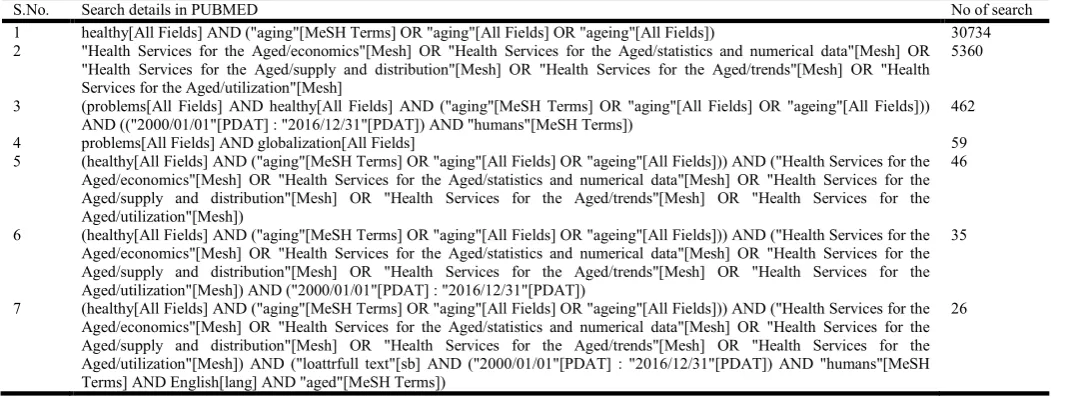
literature for reviews of challenges to healthy (also active) ageing in the context of globalization, mainly in Indian subcontinent. Table 1 shows the search details in the PubMed:
Out of the 26 articles, 21 articles were rejected after going through the abstract as the articles did not hold good with the inclusion criteria set for the systematic review. There is scarcity of articles on “healthy ageing” and “active age” in Indian context, so, Government of India documents/programs, United Nations reports and WHO reports/documents were also included. Apart from these, few relevant articles on the topic,
which satisfied the inclusion criteria, were also included from Google scholar.
1. Challenges to active ageing in India
I. Demographic scenario in India and globalization
Population ageing is being witnessed in different parts of the
world (Clarfield et al., 2004). The main reason for this
demographic transition is the decrease in mortality and fertility rates along with an increase in life expectancy. With a rapidly increasing elderly population (>60 years), India is no exception to this worldwide phenomenon. At present there are around 104 million elderly in India, the 60 + population was 24 million; which increased to 33 million in 1971, 43 million in 1981,57 million in1991, 77 million in 2001 and 103 million in 2011
(Census of India, 1961-2011) (Irudaya Rajan et al., 2003).
According to projections by some demographers the elderly population is expected to reach 298 million by 2051 and 505 million by 2101. Percentage wise this cohort has gone up from 5.6 percent of the total population in 1961 to 6 percent in 1971, 6.5 percent in 1981, 6.8 percent in 1991,7.4 percent in 2001 and 8 percent in 2011. Among older persons in India, the percentage of those aged over 70 and 80 years is also steadily increasing. There were 9 million 70+ elderly in India in 1961; the number rose to 29 million in 2001 and 42 million in 2011. They are expected to reach 131 million in 2051 and 273 million in 2101. The population of those aged over 80 years was 2 million in 1961; it increased to 8 million in 2001 and to around 11 million in 2011. It is expected to rise to around 41 million in
2051 and around 106 million in 2101 (Irudaya Rajan et al.,
2003). A higher proportion of older persons reside in rural India. The 2001 census showed that 75 percent of the elderly population lived in rural areas and 25 percent in urban areas. In 2011 those aged 60 and above constituted 8.1 percent of the total population in rural areas. This transition of population is the result of increased awareness, increased education and transition of disease pattern in India, as a consequence of the globalization, which ultimately resulted in increased longevity among the Indians.
II. Globalization and elderly health in India
There is a growing change of disease pattern in India. Earlier the various infectious diseases were responsible for increased mortality and morbidly among the elderly population like other age groups, in India. But, now there is a shift of the disease pattern. Hypertensions, Diabetes, Myocardial Infarction, Stroke etc. (World Health Organization. World report on Ageing and
Health. Luxembourg, 2015; Lena et al., 2009) are important
causes of morbidity for the Indian elderly population now. Others include Cataract, Anemia, Skin problems, Asthma.
(Lena et al., 2009; Paltiel and Clarfield, 2009)Osteoarthritis is
found to be more common among the Indian females compared
to the elderly males, (Lena et al., 2009) while other diseases
communicable diseases of this type rise sharply with age and have the ability to affect economic growth.
III. Economic security
Despite India’s recent economic growth, the living conditions of a majority of elderly people remain poor. Less than 11 percent of older Indians have a pension of any sort, as per the
national surveys. (Irudaya Rajan et al., 1999)In the current
scenario of price hike for all the essential items, food or non-food, and with low-income generation, savings is really a problem, with unavailability of banks in all parts of rural India. Though the government provides pension schemes, but they are not sufficient to maintain livelihood. So, most Indian elderly people are dependent economically on their kilns. The condition has deteriorated in the current picture of increasing number of nuclear families and lack of family support. Lack of insurance scheme, dedicated for the geriatric population adds to the economic insecurity among this population.
IV. Social security
Traditionally in Indian families, the elderly is regarded as the head of family and all the family members stay together. But in the trend of globalization, where, for earning a bread, the family members have to migrate to other places, it’s the old people, who suffer the most. As an impact of westernization, there are increased numbers of nuclear families in India now, not only in the urban areas but in the rural areas too, which deprives the poor elderly people from a good family support.
(Cramm et al., 2015; Heap et al., 2016)Most of India is of
agricultural lands. Earlier, it was the head of the family who used to go to the fields with their sons and teach them the art of cultivation, but, now, as a result of increased trend in urban migration, finding alternate ways of income, better education, the young generation is least interested in cultivation. So, they no more need the help of the elder ones to learn the abc of plowing and sowing. All these results in decreased social security among the elder age group and it is a direct effect of globalization.
V. Gender inequality among the elderly Indians
Marital status is becoming an important issue among the Indian elderly population, as the care in the old age seems to be better
among those who are married compared to the widowed one.
(Irudaya Rajan et al., 2003; Irudaya Rajan et al., 1999) Due to
longer lifespan of the Indian females and as customarily Indian women marry persons who are elder to them, so, there is a marked gender disparity among elder population with more number of elderly females. Also, the widowed males are often seen to remarry unlike the widowed females.
VI. Psychosocial problem among the elderly age group:
The World Health Organization estimated that the overall prevalence rate of depressive disorders among the elderly generally varies between 10% to 20% depending on the cultural scenarios (World Health Organization. World report on
Ageing and Health. Luxembourg, 2015).The community-based
mental health studies in India have revealed that the point prevalence of depressive disorders in the elderly Indian
population varies between 13% and 25% (Barua et al., 2010;
Abhishekh et al., 2013). Depression is under treated in this age
group and perhaps particularly so because it is not yet
perceived as a priority public health problem in India. But, there is under diagnosing of the cases of depression among the elderly population, as they are often over- looked clinically because its symptoms are erroneously assumed to be a normal
part of aging. (Sinha et al., 2013) This disorder, which can
substantially impair quality of life (Prina et al., 2011)has also
been associated with increased risk of mortality (Prina et al.,
2011) and disability.
[image:3.595.35.571.74.275.2]Because many adult and older-age health problems were rooted in early life experiences and living conditions, ensuring good child heath can yield benefit in old age. In the meantime, generations of children and young adults who grew up in poverty and ill health in developing countries will be entering old age in coming decades, potentially increasing the health burden of older populations in those countries. A lot of work is going on regarding Alzheimer’s disease (Clarfield, 2005) throughout the globe. Most dementia patients eventually need constant care and help with the most basic activities of daily living, creating a heavy economic and social burden. Prevalence of dementia rises sharply with age. An estimated 25-30 percent of people aged 85 or older have dementia. But, still now, in many parts of India, ‘forgetfulness’ and ‘delirium’ is considered as normal senile physiology, and so no treatment is being sought for.
Table 1. Algorithm of article search
S.No. Search details in PUBMED No of search
1 healthy[All Fields] AND ("aging"[MeSH Terms] OR "aging"[All Fields] OR "ageing"[All Fields]) 30734 2 "Health Services for the Aged/economics"[Mesh] OR "Health Services for the Aged/statistics and numerical data"[Mesh] OR
"Health Services for the Aged/supply and distribution"[Mesh] OR "Health Services for the Aged/trends"[Mesh] OR "Health Services for the Aged/utilization"[Mesh]
5360
3 (problems[All Fields] AND healthy[All Fields] AND ("aging"[MeSH Terms] OR "aging"[All Fields] OR "ageing"[All Fields])) AND (("2000/01/01"[PDAT] : "2016/12/31"[PDAT]) AND "humans"[MeSH Terms])
462
4 problems[All Fields] AND globalization[All Fields] 59 5 (healthy[All Fields] AND ("aging"[MeSH Terms] OR "aging"[All Fields] OR "ageing"[All Fields])) AND ("Health Services for the
Aged/economics"[Mesh] OR "Health Services for the Aged/statistics and numerical data"[Mesh] OR "Health Services for the Aged/supply and distribution"[Mesh] OR "Health Services for the Aged/trends"[Mesh] OR "Health Services for the Aged/utilization"[Mesh])
46
6 (healthy[All Fields] AND ("aging"[MeSH Terms] OR "aging"[All Fields] OR "ageing"[All Fields])) AND ("Health Services for the Aged/economics"[Mesh] OR "Health Services for the Aged/statistics and numerical data"[Mesh] OR "Health Services for the Aged/supply and distribution"[Mesh] OR "Health Services for the Aged/trends"[Mesh] OR "Health Services for the Aged/utilization"[Mesh]) AND ("2000/01/01"[PDAT] : "2016/12/31"[PDAT])
35
7 (healthy[All Fields] AND ("aging"[MeSH Terms] OR "aging"[All Fields] OR "ageing"[All Fields])) AND ("Health Services for the Aged/economics"[Mesh] OR "Health Services for the Aged/statistics and numerical data"[Mesh] OR "Health Services for the Aged/supply and distribution"[Mesh] OR "Health Services for the Aged/trends"[Mesh] OR "Health Services for the Aged/utilization"[Mesh]) AND ("loattrfull text"[sb] AND ("2000/01/01"[PDAT] : "2016/12/31"[PDAT]) AND "humans"[MeSH Terms] AND English[lang] AND "aged"[MeSH Terms])
VII. Addiction and improper nutrition:
Addiction to tobacco and alcohol is common in the geriatric age group, more so in the rural India. When it is associated with improper unhealthy diets, it is responsible for causing the different illnesses in them.
Finding solutions to the current challenges
On the International Day for the Older Persons 2003, the United Nations addressed healthy older people as a resource for their families, societies and the economy of their respective countries. In India, the government concern for the elderly began with India's participation in the World Assembly Conference in Vienna in 1982, where India adopted the United Nations International Plan of Action on Ageing. This plan focused on the government's role in adopting programs for the care and protection of the elderly, synchronizing these with the changing socio-economic conditions of the society. The government has begun to recognize the aged as a social category, in need of specialized attention. One of the early interventions was the introduction of pension schemes that were applicable to a minority of the elderly along with other
welfare measures. (Gupta et al., 1995)Besides this, the elderly
(aged >= 60 years) get discount in air/rail and bus tickets, while travelling in government vehicles. Free health checkups with nominal rate for investigations are being included in all government hospitals. Cataract Surgeries are being done free of cost, which includes to and fro movement from their home. India has recently launched the National Program for Health Care of Elderly (NPHCE) (Ministry of Health & Family Welfare. Government of India. National Program for Health
Care of Elderly (NPHCE), 2016)Comprehensive public health
action on population ageing is urgently needed. To create environment in which we would like to grow old needs to be developed. This will require coordinated responses from many sectors and multiple levels of government. Adding onto the prevailing services in regards to the Indian geriatric population, the following action plan may be regarded beneficial in addressing the challenges to active ageing in India in the context of globalization.
I. Retirement and pre-retirement:
The physically abled elderly employees who have retired recently due to their chronological age norm are likely to have various health problem including mental agony. It might be harder for them to find new jobs, especially those requiring job training, because potential employers may view these workers as a poor investment compared with their younger counterparts. This could lead to an extended period of unemployment or even involuntary retirement, depending on their particular age and circumstances. Studies have found that premature unemployment reduces the longivity of the individual by around three years on average. Our technological advancement have restricted our physical work. At the same time, if the elderly peopledo not do regular exercise and workup, it will increase the risk of occurrence of non-communicable diseases. Today, even, in the Indian villages, we find many people who are more than 70 years old go to field regularly and do all the work throughout the day. These instances should be brought to light and they should be encouraged. Though someone has to retire sometime from his work and hand over the duties to his successors, but the retirement should not be an official one. The pension schemes
should be rendered depending upon the working ability of the person. What is meant by this, is, the retired person should not be stopped to carry out his normal job, if his health permits. But, that doesn’t mean one shouldn’t have any pre retirement plans. Compulsory retirement plans in terms of finance and work should be sorted out before one goes for retirement, as it will safe guard ones social and economic security once he gets old.
II. Role of media & provision of access to the internet
Globalization and media can be termed as two sides of the same coin. The word “Media” was first used in respect of books and newspapers i.e. print media and with the advent of technology, media now encompasses television, movies, radio and Internet. In today’s world, media becomes as essential as our daily needs. Media of today is playing an outstanding role in creating and shaping of public opinion and strengthening of society. In this era of Facebook, Twitter, Whattsapp and many more, the distance between the eastern and the western world has lessened dramatically to few seconds as a result of media. It helps the older people to know people, meet people of their age, and share with them different views. It’s the media that help them to raise voice against any injustice done to them by anybody. And it is a very good pastime. The internet help them to stay in contact with their siblings and relatives who are residing overseas. Many cities in India have started providing free Wi-Fi for the citizen. Internet Café booth may be installed in every village, or if not, a specific time may be allotted from
the office computers of the gram panchayats (village level
administrative body), village schools, hospitals and banks, so as the older people may surf the net.
III. Peer groups in the villages
Peer group is defined in the dictionary as “a group of people of approximately the same age, status and interests”. Peers have an important role to play in the aged population, as it does among the children and adolescent. When an individual turn very old, and there is nobody to listen to him, to regard his views, it’s the other man of the same age and circumstance, who can put a hand on his shoulder. The importance of peer group, is more important for the elderly females, as in India women are more vulnerable to social and financial insecurity than men due to reasons such as lack of productive employment and income, their widowhood status and low education, all of which make them dependent on others and also less empowered so that they are unable to voice their
needs and problems. (Gupta et al., 1995) Initiatives should be
taken from the administration level in creating peer groups, so that, the older people can have a quality time, when their kilns and other family members are busy with their own schedule.
IV. Government quarters for the elderly
V. Psycho-social counselling centers at village level
“A healthy mind helps make a healthy body”. All human activities are governed by the mind. It has been seen while reviewing the constraints for healthy Indian ageing, depression, anxiety and frustrations are among the major mental health issues among this group of people, which can be due to a number of reasons, starting from poor health, lack of social and familial support, economic insecurity, death of spouse and many others. These mental problems may be responsible for increased stress levels causing different non-communicable diseases, or it may also lead to delirium and death. So, a fully functional psychosocial counseling unit becomes mandatory to boost up their mental status. This may be linked to the Geriatric clinic. Or, the social workers, trained in counseling may provide home visits and counsel them as per the situations. Mahatma Gandhi Institute of Medical Sciences (MGIMS), Sewagram, Maharashtra runs a “Mind Body Clinic” in its urban center. It’s a bi-weekly clinic, where al the geriatric people of both sexes come in the afternoon for an hour or two, where the trained health workers help them in performing Yoga and meditation. Such initiatives can be included in the national program for the geriatric and can be practiced in every health center.
VI.Geriatric clubs
It’s a sort of place, where all the elderly people will come and spend some quality time, may be reading a newspaper or a novel together. There may be sports for them, both indoor and outdoor. It’s a peer group in a broader sense with a designated place for them to spend time. There will be gym in the club to help them workout. The Geriatric club may be linked with the geriatric health clinic, where they will be screened for any diseases. Physiotherapy units can be set up along with the gym, as osteoarthritis is very common in this age group.
VII.Elderly education
India is a country, where the literacy rate among the older people residing in the rural areas is not much high. As per the concept of healthy ageing or active ageing is concerned, it’s not only the health, which we should be concerned with, but lot more. Education is a key variable that determines who would be better able to express his/her demand. Adult education programs that already exist in many forms need to be more aggressively targeted, because the benefits spill over from adults to the elderly. Might be for any reason, they were deprived from being able to read and write, but the retired life should be utilized to teach them to read good novels and write their own feelings and experiences. Reading will rejuvenate new energy in them that is very essential for this age group.
VIII. Increasing & strengthening the geriatric clinics
Economic development and urbanization have brought lifestyle changes that have led to unhealthy nutrition, physical inactivity, and obesity contributing to the prevalence of Diabetes and Hypertension. Geriatric clinics that are already running in the country should be strengthened and should include facilities to regularly screen non-communicable diseases like Hypertension, Diabetes, Cancer , Ischemic heart diseases etc. These facilities should be available in the community level itself, so that the elder person may get the benefit of it without anybody’s help. Further, if possible, the
facilities should be made free or linked to any insurance scheme or should be subsidized, so as to minimize the out of pocket expenditure.
IX. Enforcing laws against domestic violence against on the aged
According to Census 2011 (Office of the Registrar general & Census Commissioner. Government of India. Census of India.2011), 8.6% of people above 60 years of age were victims of domestic violance. Our country fails to provide due respect, care, affection and security, which elderly people require the most. A number of cases of adult abuses are reported in news papers as these people are easy victims of violence and criminal activities. The society comes to know about only those problems, which are reported, the innumerable cases of disrespect and neglect are not given any
consideration (Govil and Gup- ta, 2016).Many of them suffer
from physical abuse. Even cases of murder have also been reported. Although, the constitution provides various legal provisions for the safety and respectful life of senior citizens, yet the situation is very pathetic. This is the high time government should review the laws and legislations with regards to Elderly population and strengthen the norms and keep a vigilant eye on them.
X. Sharing the experience of life
1st October is celebrated as International day for Elderly
People. A number of programs are being organized throughout India on that day, some by government and some by non-government organizations. This day may be utilized by asking the representatives from peer geriatric group to share their experience and perspective in life, so that, its not only the older people but also the younger generation who can listen and learn from their stories of struggle, joy and victory. And at the same time, the local media channels may broadcast these events, in an effort to encourage them. This may be a good platform for celebrating the Geriatric day to the true sense. And WHO toolkit (World Health Organization, 2015) on action for ageing is also available and it may act as a guide for
undertaking such a program successfully.
XI. Easy loan facilities from the banks
In the dusk of their life, if they want to open any new firm for starting a business or for their treatment, procedures to get a bank loan should be quick and easy, without making the elderly undergo any mental and physical stress. This may help in bringing up economic stability and security among the older people in India.
XII. Vocational training centers
The geriatric Clubs can be the hub for vocational training centers also, where, each one may share their expertise with others. For example, they may start a small handloom factory by themselves and it can be a source of earning for them. And in the mean time, they will be engaged in some activity, so, it will ultimately help them in leading an active life, to the true sense. They may be engaged in any social work, like organizing blood donation camps, physiotherapy camps etc.
XIII. Insurance schemes for the aged
the geriatric people. Planning has to be started, when one is young enough to save for this later life, so that he does not fall a prey to financial insecurity. A small fixed amount may be collected as a premium when the people are in their mid 30s and the amount will be saved for their older age. Though a number of such private schemes are there and some newly launched government initiatives are also there, but the Government has to be more careful in this regard. So, at the national level, a mixture of pension schemes, social security systems or insurance need to be funded and implemented, which would go a long way in helping elderly men and women.
XIV. Governmental portal on “Active Ageing”
This could be a very good initiative to launch a web portal by government of India to promote “Active Ageing”, which will contain all the information about the geriatric health and wellbeing. There may be an answering machine, with a toll free number, where the geriatric people can call at any time and seek medical advice.
XV. Scope of research on “Active ageing “ in India
To plan for any program, we first have to know and understand the circumstances in details. For this purpose, more extensive research has to be conducted for understanding the scopes of healthy ageing in India and also to understand its limitations, before working out any new program for the geriatric Indian population.
XVI. Missing links
There are several information gaps relating to the relationship between ageing and health. First, the awareness as regards to the demographic shift to geriatric population isn’t up to the mark, secondly the process of healthy ageing isn’t fully understood. Though Census and other national surveys help us with the data of elderly population and the associated factors, and quite a good initiative is being taken in timely registration of death, but to make a satisfactory information module for Indian elderly people, more energetic efforts have to be taken. With regards to the health service outcome of the geriatric clinics, there is lack of data relating to the client outcomes, their feedback and experiences of care, which is very essential for evaluation purpose, upon which government has to develop more concern.
REFERENCES
Abhishekh HA, Karthik R, Shivakumar S, Balaji AL. 2013. Prevalence of depression in community dwelling elderly:
study from rural population. J Neurosci Rural Pract.,
4(Suppl 1): S138.
Barua A, Ghosh MK, Kar N, Basilio MA. 2010. Distribution
of depressive disorders in the elderly. J Neurosci Rural
Pract., 1(2): 67–73.
Central Statistics Office. Ministry of Statistics & Programme Implementation. Government of India. Situation Analysis of the elderly in India. June 2011.
Clarfield AM, Rosenberg E, Brodsky J, Bentur N. 2001.
Healthy aging around the world: Israel too? Isr Med Assoc
J., 6(9):516-20.
Clarfield AM. 2005. Reversible dementia--the implications of
a fall in prevalence. Age Ageing., 34(6):544-5.
Cramm J M, Bornscheuer L, Selivanova A, Lee j. 2015. The Health of India’s Elderly Population: A comparative assessment using subjective and objective health outcomes.
Journal of Population Ageing, Vol 8,Issue 4; 245-259. Govil, P. and Gup- ta, S. 2016. Domestic Violence against
Elderly People: A Case Study of India. Advances in Aging
Research, 5, 110-121.
Gupta I, Dasgupta P, Sawhney M. Health of the elderly in India: some Aspects of Vulnerability.Institute of Economic GrowtDelhi.1995 Available from: http://silverinnings.in/ wp-content/uploads/2016/10/Health-Insurance-for-Elderly-in-India.pdfHeap j, Fors S, Lennartsson C. 2016. Coexisting Disadvantages in later life: Demographic and
socio-economic inequalities. Journal of Population Ageing,
[Internet: http://link.springer.com/article/10.1007/s12062-016-9158-y, cited on: 27.09.16]
Irudaya Rajan, S, Mishra, US and Sarma, PS. 2003.
‘Demography of Indian Ageing, 2001-2051’, Journal of
Ageing and Social Policy, 15(2&3), 11-30.
Irudaya Rajan, S., Mishra, US and Sarma, PS. 1999. India’s
Elderly: Burden or Challenge? New Delhi: Sage
Publications and London: Thousand Oaks.
Lena A, Ashok K, Padma M, Kamath V, Kamath A. 2009. Health and social problems of the elderly: A cross-sectional
study in Udupi Taluk, Karnataka. Indian J of Community
Med., Vol 34; Issue 2:131-4. [Internet:http://www.ijcm.
org.in/text.asp?2009/34/2/131/51236, cited: 20.09.16] Ministry of Health & Family Welfare. Government of India.
National Program for Health Care of Elderly (NPHCE).
[Internet: http://www.mohfw.nic.in/index1.php?lang=1&
level=2&sublinkid=2183&lid=1879, Cited on 25.09.16] Office of the Registrar general & Census Commissioner.
Government of India. Census of India.2011. [Internet: http://censusindia.gov.in, Cited: 28.09.16]
Paltiel O. and Clarfield AM. 2009. Anemia in elderly people:
Risk marker or risk factor? Canadian Medical Association
Journal, 181(3-4):129-130.
Population reference Bureau. Today’s Research on ageing. March 2012; Issue 23.
Prina AM, Ferri CP, Guerra M, Brayne C, Prince M. 2011. Prevalence of anxiety and its correlates among older adults
in Latin America, India and China: cross-cultural study. Br
J Psychiatry, 199(6): 485–491.
Sinha SP, Shrivastava SR, Ramasamy J. 2013. Depression in
an older adult rural population in India. MEDICC Review,
Vol 15, No 4: p 41-44.
United Nations., department of Economics and Social Affairs, Population Division. World Population ageing 1950-2050.
[Internet: http://www.un.org/esa/population/publications/
worldageing19502050/, Cited on 28.09.16]
United Nations., department of Economics and Social Affairs, Population Division. World Population Ageing 2015. New York; 2015.
World Health Organization. Action for ageing: a toolkit for organizing innovative events on the World report in ageing and health.
World Health Organization. World report on Ageing and Health. Luxembourg.2015.