ISSN Print: 2156-8553
DOI: 10.4236/as.2018.99081 Sep. 21, 2018 1168 Agricultural Sciences
Reshaping Agriculture Using the Nuclear
Techniques: The Pakistan Case
Mukhtar Ahmed Rana
Technical Services Division, Nuclear Institute of Agriculture (NIA), Tandojam, Hyderabad, Sindh, Pakistan
Abstract
The field of nuclear agriculture is introduced very briefly. Nuclear agriculture research/development system in Pakistan is described highlighting the achievements of the system partners. Description and discussion are genera-lized in concluding remarks at the end of the article. This article is an expe-rimental guide for a developing nuclear agriculture system.
Keywords
Nuclear Agriculture, The PAEC, Crop Varieties, Hunger
1. Introduction to Nuclear Agriculture
Agriculture has been the backbone of the development throughout the human history. It helps us in the production of foods, clothing and the raw materials for the old and modern industry, details in the refs. [1]-[6]. Nuclear agriculture re-fers to the application of nuclear techniques and methods in the field of agricul-ture. It is an example of peaceful uses of nuclear technology. No residual radia-tion is left in the plants developed through radiaradia-tion induced mutaradia-tions. Gene-ralized objectives in agriculture are high yield, wide adaptability and stability in performance, tolerance to diseases and abiotic stresses, e.g., drought, heat, cold, and salinity etc. Induced mutations are the least hazardous in developing resis-tance in plants against diseases and insect pests. Important aspects of mutation breeding include desirable plant characters, mutability, genetic manipulation and genetic analysis. Detection of rare genetic variants in large populations is difficult. Selection of genetic variants in mutation breeding is critical. Selection errors occur due to a number of reasons including wrong selection criteria, in-adequate techniques, lack of accuracy and too low screening population. Muta-tions induced by radiation or chemical mutagens include a small fraction of How to cite this paper: Rana, M.A. (2018)
Reshaping Agriculture Using the Nuclear Techniques: The Pakistan Case. Agricul-tural Sciences, 9, 1168-1172.
https://doi.org/10.4236/as.2018.99081
Received: August 18, 2018 Accepted: September 18, 2018 Published: September 21, 2018
Copyright © 2018 by author and Scientific Research Publishing Inc. This work is licensed under the Creative Commons Attribution International License (CC BY 4.0).
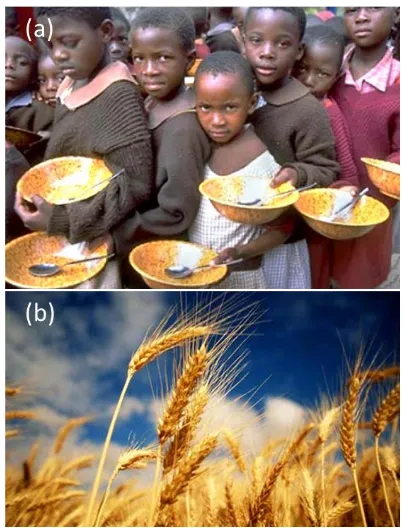
DOI: 10.4236/as.2018.99081 1169 Agricultural Sciences useful genetic alterations. Very small fraction of induced mutants (<1%) get se-lected for yield trials and further only 1% of sese-lected and evaluated mutants qualify official tests and obtain approval of commercial utilization in the form of a variety. Nuclear agriculture is an active area of research and development around the world. Use of nuclear techniques in agriculture is helping to provide food security to third world countries of Asia and Africa (photos in Figure 1).
2. Nuclear Agriculture Research/Development System in
Pakistan
Nuclear agriculture is among priorities of Pakistan’s neighbors India and China. Pakistan is not behind its neighbors in nuclear agriculture and has developed close to 100 new varieties of various crops including wheat, cotton, rice, lentil, chickpea, brassica and sugarcane, etc. Developed varieties have higher yield po-tential and resistance against diseases and insect pests than their parent varieties. Pakistan Atomic Energy Commission (PAEC) has paid considerable attention to promote the nuclear techniques for the development of agriculture sector in the country. PAEC and its agriculture research system of institutions include Nuc-lear Institute of Agriculture (NIA), Tandojam, NucNuc-lear Institute for Agriculture and Biology (NIAB), Faisalabad, Nuclear Institute for Food and Agriculture (NIFA), Peshawar and National Institute of Biotechnology and Genetic Engi-neering (NIBGE), Faisalabad. They have played an important role in the devel-opment of new crop varieties by using the nuclear techniques in agriculture. Development of crop varieties is a slow process as it takes 12 - 15 years to devel-op new varieties and to achieve stability in performance.
Table 1 gives nuclear agriculture development in Pakistan. It shows start-up years of PAEC institutes working on agriculture and related fields. These insti-tutes work in coordination and competition with each other compelling them to keep active in useful research and development (R & D) work. A number of crop varieties have been developed by PAEC institutes (Table 2). Wheat, cotton, rice and sugarcane are major crops on which breeding work through radiation in-duced mutations is being conducted at PAEC institutes. Varieties of 8 different crops are released which shows the broad scope of breeding work continued at PAEC agriculture centers. PAEC agriculture centres have developed new tech-nologies, crop varieties and instruments/methods related to the agriculture. They have transferred the developed technologies to the end users or farmers. The released crop varieties have resulted in outstanding improvement in prod-uctivity and tolerance of the crops.
DOI: 10.4236/as.2018.99081 1170 Agricultural Sciences
Figure 1. (a) Hunger circumstances [7] and (b)
[image:3.595.207.539.399.487.2]agri-culture as the food source [8].
Table 1. PAEC Institutes working on nuclear agriculture and related fields.
Institute Starting Year
NIA, Tandojam, Sindh 1963
NIAB, Faisalabad, Punjab 1972
NIFA, Peshawar, Khyber Pakhtunkhah 1982
NIBGE, Faisalabad, Punjab 1994
Table 2. Crop varieties developed by the PAEC institutes.
Crop/Institute NIA NIAB NIFA NIBGE Total
Brassica 1 4 5
Cotton 4 12 7 23
Chickpea 5 4 9
Lentil 1 2 3
Mungbean 1 11 1 13
Sugarcane 3 3
Rice 6 3 9
Wheat 13 7 20
Total 29 33 16 7 85
[image:3.595.209.540.521.693.2]DOI: 10.4236/as.2018.99081 1171 Agricultural Sciences dominates in Sindh province covering more than 25% of land under wheat. Shandar is a rice variety, released by NIA dominates and covers more than 50% of area under rice in Sindh. NIA has released rice variety Shua for saline lands. Saduri is the best cotton variety released by NIA and it covers more than 25% of land under cotton in Sindh. NIA-2004 is a sugarcane variety, released by NIA, which is very popular in Sindh. Pakistan is an agricultural state where crop im-provement can have a significant impact on the national economy. So, agricul-ture R&D in Pakistan is very important.
3. Concluding Remarks
Rising world population requires the increase of food production and decrease of crop losses. Nuclear techniques in agriculture can help in achieving the goal of matching food production with its demand by developing high yield and stress resistant crop varieties. Pakistan is applying scientific knowledge/experience in solving the problems of agriculture. Pakistan has produced a number of stress-resistant/tolerant crop varieties. Programs relating to insect control and soil management for better crops are active in the country. PAEC is doing nuc-lear R&D in 5 thematic programs of agriculture, plant breeding, soil science, plant protection, plant physiology and animal sciences. PAEC’s achievements in nuclear agriculture are admirable. Nuclear agriculture institutions in Pakistan have improved agriculture in the country through release of better crop varieties suitable for local conditions. Nuclear agriculture is helping in the fight against the hunger. Other breeding technologies are described in Refs. [9]-[12] and ref-erences therein.
Acknowledgements
Useful discussions with Mr. Muhammad Yousuf Memon (Director NIA), Dr. Nazir Ahmad, Mr. Abdullah Khatri, and Dr. Azeem Asad are gratefully ac-knowledged and appreciated. Author is basically a physicist who worked in agriculture as a visiting scientist during 2014-15.
Conflicts of Interest
The author declares no conflicts of interest regarding the publication of this pa-per.
References
[1] Johnston, B.F. and Mellor, J.W. (1961) The Role of Agriculture in Economic De-velopment. The American Economic Review, 51, 566-593.
[2] Brown, A. (2016) Agriculture: World without Deforestation. Nature Climate Change, 6, 541. https://doi.org/10.1038/nclimate3047
Pso-DOI: 10.4236/as.2018.99081 1172 Agricultural Sciences roptescuniculi. Scientific Reports, 8, 1609.
https://doi.org/10.1038/s41598-018-19964-0
[4] Levy, M.A., Lubell, M.N. and McRoberts, N. (2018) The Structure of Mental Models of Sustainable Agriculture. Nature Sustainability, 1, 413-420.
https://doi.org/10.1038/s41893-018-0116-y
[5] Pretty, J.N. (1995) Participatory Learning for Sustainable Agriculture. World De-velopment, 23, 1247-1263.
De Wrachien, D. and Goli, M. (2015) Global Warming Effects on Irrigation Devel-opment and Crop Production: A World-Wide View. Agricultural Sciences, 6, 734-747.
[6] De Wrachien, D. and Goli, M. (2015) Global Warming Effects on Irrigation Devel-opment and Crop Production: A World-Wide View. Agricultural Sciences, 6, 734-747. https://doi.org/10.4236/as.2015.67071
[7] Ghana News (2018) Africa Dominating Rising Global Hunger Rates. https://www.myjoyonline.com/ghana-news/
[8] AgriLand Media Limited (2017). https://www.agriland.ie
[9] Schaart, J.G., van de Wiel, C.C., Lotz, L.A. and Smulders, M.J. (2016) Opportunities for Products of New Plant Breeding Techniques. Trends in Plant Science, 21, 438-449. https://doi.org/10.1016/j.tplants.2015.11.006
[10] Kasai, A. and Harada, T. (2015) Epimutant Induction as a New Plant Breeding Technology. Japan Agricultural Research Quarterly: JARQ, 49, 301-305.
https://doi.org/10.6090/jarq.49.301
[11] Promnart, U., Puripunyavanich, V., Boonsirichai, K., Doungsoongnern, P., Kaew-chuenchai, R., Chamotri, S., Klakhaeng, K. and Sarsu, F. (2017) Breeding Thai Rice for Flood Tolerance through Electron Beam-Induced Mutations. International Journal of Genetic Engineering, 5, 1-10.
[12] Chen, T., Chen, G., Yang, S., Zhao, Y., Ha, Y. and Ye, Z. (2017) Recent Develop-ments in the Application of Nuclear Technology in Agro-Food Quality and Safety Control in China. Food Control, 72, 306-312.