doi:10.4236/lce.2011.24028 Published Online December 2011 (http://www.SciRP.org/journal/lce)
Comparative Study on Microorganisms Used for
the Bioethanol Production
Corina Amalia Macarie1, Adina-Elena Segneanu1, Ionel Balcu1, Raluca Pop1, Georgeta Burtica2, Vasile-Daniel Gherman2
1
National Institute for Research and Development in Electrochemistry and Condensed Matter, Timisoara, Romania; 2The Faculty of Civil Engineering, Politehnica University of Timisoara, Timisoara, Romania.
Email: [email protected]
Received September 2nd, 2011; revised October 10th, 2011; accepted October 17th, 2011.
ABSTRACT
Two different methods, namely simultaneous saccharification and fermentation and two-stage hydrolysis and fermen-
tation have been used for the conversion of the cellulose into bioethanol. Both aerobic and anaerobic conditions were
employed in order to obtain two types of microorganisms—Trichoderma reesei and Zymomonas mobilis—that are used
for the production of cellulases. The aim of the paper is to investigate also the efficiency of a microorganism’s
consor-tium in the fermentation stage of the two processes and the action of this microorganism’s consortium on different
con-centrations of the cellulosic substrate, in order to determine the optimum parameters of the process. Good yields (45% - 70%) of the cellulose degradation into fermentable sugars have been obtained.
Keywords: Bioethanol, Lignocellulosic Biomass, Microorganism
1. Introduction
Due to the limitations of fossil energy, there is a conti- nuous increasing interest in finding new alternatives for oil-based fuels. Renewable resources like sugarcane or agricultural crops have represented the major raw materi- als for the bioethanol production [1]. In the last years, lignocellulosic materials have gained much importance for the obtaining of bioethanol, mostly due to their large availability. The main disadvantage is represented by the higher costs caused by the small yields and by the diffi- culties encountered in the cellulose hydrolysis (deploy- merization) in soluble sugars [2,3].
Chemical methods for the depolymerization of the cellu-lose are the acid, basic or enzymatic hydrolysis. Among them, enzymatic hydrolysis shows the advantages of mild reactions conditions and of avoiding the corrosion prob-lems [4-7].
Cellulose transformation into soluble sugars during the enzymatic hydrolysis process occurs by the means of cel- lulase, an enzyme with a high cost of production. Lately, in the biofuels industry, cellulases obtained from the Tricho-
derma reesei fungus are used, with good results regarding the vegetal feedstock degradation [8,9]. This could enlarge the possible biomass resources. Another microorganism used for the bioethanol production is Zymomonas mobilis
that may be used only for substrates that contain glucose, fructose and sucrose [10-12].
There are two main procedures used for the bioethanol production starting from cellulose. The first one implies two different stages, namely the hydrolysis of the cell- ulosic substrate, followed by the fermentation of the obt- ained sugars. The second method implies the simulta- neous saccharification and fermentation [10,13,14].
The present paper presents the cellulose degradation under the action of Trichoderma reesei and Zymomonas
mobilis, in order to determine the optimum conditions for the bioethanol production through the hydrolysis and fermentation of cellulose-based materials. The hydrolysis of the cellulosic substrate was performed using Tricho-
derma reesei, and for the separate fermentation of sugars there were used enzymes from Zymomonas mobilis. For the simultaneous saccharification and fermentation of a cellulosic substrate a consortium of the two microrgan- isms was employed. The results of the two fermentation methods (separate and simultaneous) have been quan- tified by means of the concentration of the unreacted fer- mentable sugars that were not transformed into ethanol.
2. Experimental Part
and Zymomonas mobilis (ATCC 29191)were used, that were reactivated at their transfer on the culture media.
2.1. The Obtaining of Cellulose and Hemicellulose Degrading Enzymes from Micro-Organism Cultures
Cellulases from Trichoderma reesei and Zymomonas mo-
bilis.
The cultures were incubated for several days at a tem-perature of 30˚C, without shaking, both in anaerobic and aerobic conditions. At various time intervals samples were taken in order to analyze the cellulase activity on the substrate (carboxymethylcellulose standard) and also for the determination of the protein content.
2.2. Cellulose Degradation by Enzymes Obtained from Trichoderma reesei
The Trichoderma strains were inoculated on a natural culture medium that contained 100 mL potato extract, 2 g glucose and 0.5 g, 0.75 g, 1.0 g, 1.5 g and 2.0 g Avicel, respectively. The cultures were sterilized in an autoclave, inoculated and thermostated for several days at 30˚C. Samples of a few milliliters were taken in order to deter- mine the total sugar content.
2.3. Sugar Fermentation by Enzymes from Zymomonas mobilis
Cultures of Zymomonas in a synthetic medium were used. The synthetic culture medium was made by 0.5 g yeast extract, 0.1 g (NH4)2SO4, 0.2 g K2HPO4, 0.1 g MgSO4
and 2.0 g, 4.0 g, 6.0 g and 8.0 g glucose, respectively. The cultures were syntetized by the same way like in case of Trichoderma reesei strains.
2.4. Cellulose Degradation by Enzymes Obtained from Trichoderma reesei and Zymomonas mobilis
Cultures of Trichoderma and Zymomonas on natural me- dium were used. The natural culture medium contained 100 mL potato extract, 2 g glucose and 1.0 g, 1.5 g, 2.0 g, 3.0 g and 4.0 g Avicel, respectively. Sterylization proce- dure of cultures is identical with the previous method.
2.5. Determination of the Total Sugar Content
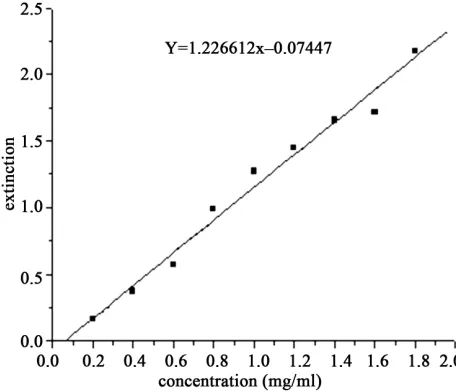
The total sugar content was calculated using the colori-metric method for the determination of the reducing sug-ars with the DNS (3,5-dinitrosalycilic acid) reagent. In order to calculate the total sugar content, Equation (1) was used.
540
Total sugars
A 0.07447 1.22612 dilution factor
(1)
where, A540-solution absorbance (extinction) at 540 nm
dilution factor-5.
The calibration curve used for the determination of the total sugar content (as glucose) is presented in Figure 1.
3. Results and Discussions
The total protein content obtained from cultures of Tri-
choderma reesei and Zymomonas mobilis both in anae- robic and aerobic is presented in Figures 2-3 and Tables 1-2.
The protein content in aerobic and anaerobic conditions has been determined from the influence of the concentration of oxygen on the development of Trichoderma reesei and
[image:2.595.306.534.274.470.2]Zymomonas mobilis.
Figure 1. Glucose calibration curve using the colorimetric method (Correlation coefficient R(2) = 0.9908).
The cellulosic substrate degradation with the enzymes obtained from T. reesei was quantified by the determina-tion of the sugar content of the culture medium at differ-ent times. The Zymomonas strains present less efficiently in aerobic conditions (Table 2) then in anaerobic conditions (Table 1), but in this case also, no cellulase was produced. We can conclude that it cannot be used to produce cellulase in the given, studied, conditions.
The results are presented in Table 2 and, in a graphic form, in Figure 3. As a comparison, the theoretical quan-tities that could be obtained from the cellulose degrada-tion with a 100% yield were calculated (Table 3). Data from the Tables 3 and 4 were used for the calculation of the yield of the cellulose enzymatic hydrolysis to sugars, results that are presented in Table 4 and Figure 4.
As it may be observed, best results are obtained for the culture media with a low content of cellulose (higher values are obtained for the methods where an initial con-
Figure 3. The evolution in time of the cellulase produced by Trichoderma reesei and of the amount of glucose obtained in aerobic conditions.
Table 1. The total protein content in Zymomonas mobilis cultures in anaerobic conditions.
Time [h] Carbon source Protein [mg/ml]
24 0.971 48 0.771 144 Cellulose 5 g/L 0.918
Table 2. The total protein content in Zymomonas mobilis cultures in aerobic conditions.
Time [h] Carbon source Protein [mg/ml]
24 0.482
48 0.438
144
Cellulose 5 g/L
0.524
Table 3. Maximum theoretical concentrations of total sugars and ethanol, considering maximum efficiency of the hydrolysis and fermentation processes.
No. of culture Initial cellulose concentration (g/L) Theoretical sugars concentration (g/L) Theoretical ethanol concentration (g/L)
1 5 43.21 22.08
2 7.5 45.41 23.21
3 10 47.61 24.33
4 15 52.01 26.58
5 20 56.41 28.83
Table 4. Results of the cellulose hydrolysis into fermentable sugars by means of enzymes obtained from Trichoderma reesei.
No. of culture
Initial cellulose
conc. (g/L) Time (h)
Total sugars concentration (g/L)
Sugars yield (%)
24 22.19 51.3
48 24.84 57.5
72 30.19 69.9
1 5
96 28.17 65.2
24 28.05 64.9
48 29.60 68.5
72 30.23 70.0
2* 5
96 28.20 65.3
24 25.91 57.1
48 28.08 61.8
72 31.36 69.1
3 7.5
96 29.87 65.8
24 27.55 60.7
48 26.12 57.5
72 29.44 64.8
4* 7.5
96 29.11 64.1
24 29.70 62.4
48 28.08 59.0
72 28.64 60.2
5 10
96 31.01 65.1
24 28.08 59.0
48 23.35 49.0
72 32.32 67.9
6* 10
96 28.89 60.7
24 20.11 38.7
48 19.83 38.1
72 26.40 50.8
7 15
96 23.74 45.6
24 25.15 48.4
48 23.53 45.2
72 31.04 59.7
8* 15
96 30.49 58.6
24 34.18 60.6
48 30.85 54.7
72 30.0 53.2
9 20
96 31.13 55.2
24 25.05 44.4
48 25.18 44.6
72 28.16 49.9
10* 20
96 29.54 52.4
Figure 4. Yields of total sugars obtained from cellulose (best results of each duplicate culture are presented).
centration of 5 g/L, 7.5 g/L and 10 g/L cellulose was used). The maximum yield of the cellulose in glucose transformation is 70% and it is obtained for a concentra-tion of the cellulosic substrate of 5 g/L and a reacconcentra-tion time of 72 h. An increase of the reaction time leads (ex-cept the case of the substrate with the greatest cellulose content) to better results in concentrations of the fer-mentable sugars.
The fermentation process of the glucose using
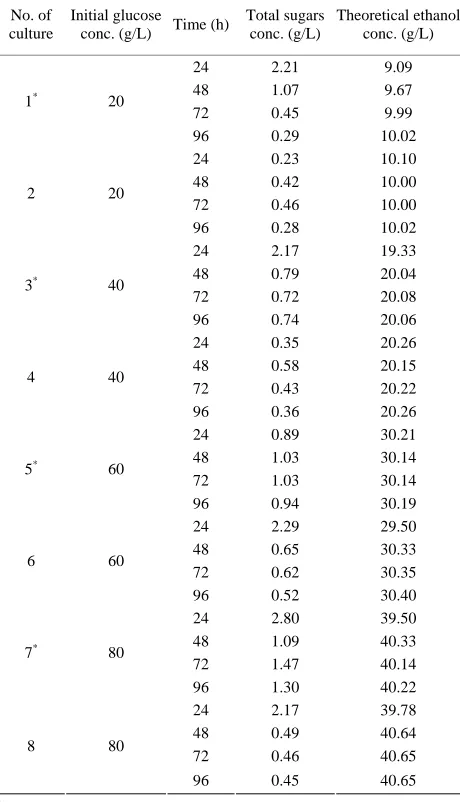
[image:4.595.306.541.38.703.2]Zymo-monas mobilis resulted in small amounts of unfermented sugars. Results presented in Table 5 and Figure 5 show that only small concentrations of unfermented sugars were obtained. It may also be observed that the best re-sults are obtained during a longer reaction time (48 h - 96 h) and when shaking is applied.
Table 5 shows the untransformed sugar contents after the glucose fermentation in the presence of Z. mobilis and, starting from these experimental values, theoretical etha-nol yield was calculated. The results presented in Figure 5 show that, independent from the substrate concentration, the best results are obtained after an enzyme action time of 72 - 96 h.
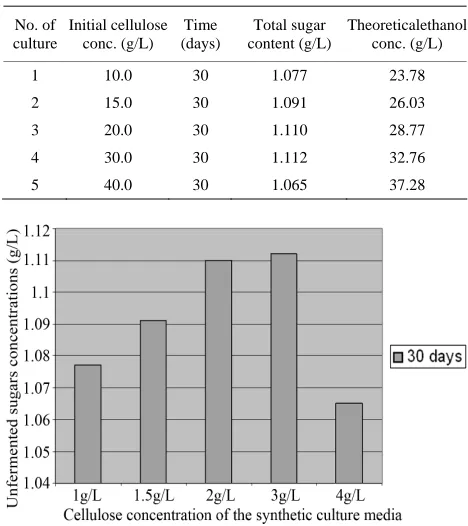
A series of cellulosic substrates (Table 6) were sub-jected to the simultaneous action of Trichoderma reesei and Zymomonas mobilis for a 30 days period. The results are presented in Table 6 and Figure 6.
The results show no significant differences among the content of untransformed total sugars, independent of the initial cellulose concentrations. It appears that, in this case, higher initial concentrations of cellulose have positive in-fluence on the total amounts of fermented sugars.
4. Conclusions
[image:4.595.56.288.85.234.2]Trichoderma reesei cultures showed a lower growth of the microorganism under aerobic conditions than under anaerobic conditions. Cellulase was not detected after the first day, but after 48 hours it was formed in sufficiently
Table 5. The total sugar content experimentally resulted and the calculated theoretical ethanol concentration at sug-ars fermentation with Zymomonas.
No. of culture
Initial glucose
conc. (g/L) Time (h)
Total sugars conc. (g/L)
Theoretical ethanol conc. (g/L)
24 2.21 9.09
48 1.07 9.67
72 0.45 9.99
1* 20
96 0.29 10.02
24 0.23 10.10
48 0.42 10.00
72 0.46 10.00
2 20
96 0.28 10.02
24 2.17 19.33
48 0.79 20.04
72 0.72 20.08
3* 40
96 0.74 20.06
24 0.35 20.26
48 0.58 20.15
72 0.43 20.22
4 40
96 0.36 20.26
24 0.89 30.21
48 1.03 30.14
72 1.03 30.14
5* 60
96 0.94 30.19
24 2.29 29.50
48 0.65 30.33
72 0.62 30.35
6 60
96 0.52 30.40
24 2.80 39.50
48 1.09 40.33
72 1.47 40.14
7* 80
96 1.30 40.22
24 2.17 39.78
48 0.49 40.64
72 0.46 40.65
8 80
96 0.45 40.65
*
shaken at 150 rot/min.
[image:4.595.308.538.126.527.2]Table 6. The total sugar content at the action of a mixture of T. reesei and Z. mobilis on cellulosic substrates.
No. of culture
Initial cellulose conc. (g/L)
Time (days)
Total sugar content (g/L)
Theoreticalethanol conc. (g/L)
1 10.0 30 1.077 23.78
2 15.0 30 1.091 26.03
3 20.0 30 1.110 28.77
4 30.0 30 1.112 32.76
5 40.0 30 1.065 37.28
Figure 6. Total content of untransformed sugars after the action of a mixture of T. reesei and Z. mobilis.
large amounts. after 6 days, it disappeared almost comp- letely from the medium. Cellulase can be also biosynthe- sised under aerobic conditions from Trichoderma reesei cultures, but it is very important to know the optimum time for stopping the culture if the cellulase activity is elevated. Zymomonas strain presented a lower growth under aerobic conditions than under the anaerobic ones, but cellulase was not produced in none of the cases. It may be said that the studied Zymomonas strain cannot produce cellulase in the culture media that were used in our experiments.
The results of the study show that T. reesei action on cellulose led to the obtaining of sugars (determined as glucose) in 45% - 70% yield. Higher content of sugars are obtained for an initial cellulose concentration of 5 g/L - 10 g/L. Cellulose concentrations of 15 g/L - 20 g/L show an inhibitory effect on the cellulose degradation.
The experimental values of the total sugar content after the Z. mobilis action on glucose show that only small sugar amounts had not been transformed. Similar values of untransformed sugars are obtained after the action of a mixture of T. reesei and Z. mobilis on cellulosic subst- rates. As results from the values presented in Table 6 and
Figure 6, higher cellulose concentration of the synthetic culture medium does not have negative consequences on the cellulose degradation process.
REFERENCES
[1] M. Balat, H. Balat and C. Oz, “Progress in Bio-Ethanol Processing,” Progress in Energy and Combustion Science, Vol. 34, No. 5, 2008, pp. 551-573.
doi:10.1016/j.pecs.2007.11.001
[2] F. Abd El-Zaher and M. Fadel, “Production of Bioethanol via Enzymatic Saccharification of Rice Straw by Cellu-lase Produced by Trichoderma reesei under Solid State Fermentation,” New York Science Journal, Vol. 3, 2010, p. 72.
[3] E. A. Bayer, R. Lamed and E. Himmel, “The Potential of Cellulases and Cellulosomes for Cellulosic Waste Man-agement,” Current Opinion in Biotechnology, Vol. 18, No. 3, 2007, pp. 237-245. doi:10.1016/j.copbio.2007.04.004 [4] H. Golias, G. J. Dumsday, G. A. Stanley and N. B.
Pam-ment, “Evaluation of a Recombinant Klebsiella oxytoca Strain for Ethanol Production from Cellulose by Simulta- neous Saccharification and Fermentation: Comparison with Native Cellobiose-Utilising Yeast Strains and Per- formance in Co-Culture with Thermotolerant Yeast and Zymomonas mobilis,” Journal of Biotechnology, Vol. 96, No. 2, 2002, pp. 155-168.
doi:10.1016/S0168-1656(02)00026-3
[5] S. Kumar, S. P. Singh, I. M. Mishra and D. K. Adhikari, “Recent Advances in Production of Bioethanol from Lig-nocellulosic Biomass,” Chemical Engineering & Tech-nology, Vol. 32, No. 4, 2009, pp. 517-526.
doi:10.1002/ceat.200800442
[6] Y. Sun and J. Cheng, “Hydrolysis of Lignocellulosic Ma-terials for Ethanol Production: A Review,” Bioresource Technology, Vol. 83, No. 1, 2002, pp. 1-11.
doi:10.1016/S0960-8524(01)00212-7
[7] H. C. Vogel and C. L. Todaro, “Fermentation and Bioche- mical Engineering Handbook,” Noyes Publications, New Jersey, 1997.
[8] T. Fujii, X. Fang, H. Inoue, K. Murakami and S. Sa-wayama, “Enzymatic Hydrolyzing Performance of Acre- monium cellulolyticus and Trichoderma reesei against Three Lignocellulosic Materials,” Biotechnology for Bio-fuels, Vol. 2, 2009, p. 24.
doi:10.1186/1754-6834-2-24
[9] B. Nidetzky, W. Steiner, M. Hayn and M. Claeyssens, “Cellulose Hydrolysis by the Cellulases from Trichoderma reesei: Adsorptions of Two Cellobiohydrolases, Two Endo-cellulases and Their Core Proteins on Filter Paper and Their Relation to Hydrolysis,” Biochemical Journal, Vol. 298, 1994, p. 705.
[10] V. Ferreira, M. Faber, S. Mesquita and N. Pereira Jr., “Simultaneous Saccharification and Fermentation Process of Different Cellulosic Substrates Using a Recombinant Saccharomyces cerevisiae Harbouring the β-Glucosidase gene,” Electronic Journal of Biotechnology, Vol. 13, No. 2, 2010, p. 1.
doi:10.1002/bit.260250304
[12] H. Nellaiah, T. Karunakaran and P. Gunasekaran, “Etha-nol Fermentation of Cassava Starch by Zymomonas mobi-lis NRRL B-4286,” Biomass, Vol. 15, No. 3, 1988, pp. 201-207. doi:10.1016/0144-4565(88)90085-6
[13] S. H. Krishna, T. J. Reddy and V. Chowdary, “Simulta-neous Saccharification and Fermentation of Lignocellu-losic Wastes to Ethanol Using a Thermotolerant Yeast,”
Bioresource Technology, Vol. 77, No. 2, 2001, pp. 193- 196. doi:10.1016/S0960-8524(00)00151-6