ISSN Print: 2327-5219
DOI: 10.4236/jcc.2018.612016 Dec. 28, 2018 157 Journal of Computer and Communications
Knowledge Driven Paper Recommendation
Using Heterogeneous Network Embedding
Method
Irfan Ahmed
1, Zubair Ahmed Kalhoro
21Department of Computer Science and Engineering, Southeast University, Nanjing, China 2Institute of Mathematics and Computer Science, University of Sindh, Jamshoro, Pakistan
Abstract
We search a variety of things over the Internet in our daily lives, and numer-ous search engines are available to get us more relevant results. With the rap-id technological advancement, the internet has become a major source of ob-taining information. Further, the advent of the Web2.0 era has led to an in-creased interaction between the user and the website. It has become chal-lenging to provide information to users as per their interests. Because of cop-yright restrictions, most of existing research studies are confronting the lack of availability of the content of candidates recommending articles. The con-tent of such articles is not always available freely and hence leads to inade-quate recommendation results. Moreover, various research studies base rec-ommendation on user profiles. Therefore, their recrec-ommendation needs a sig-nificant number of registered users in the system. In recent years, research work proves that Knowledge graphs have yielded better in generating quality recommendation results and alleviating sparsity and cold start issues. Net-work embedding techniques try to learn high quality feature vectors auto-matically from network structures, enabling vector-based measurers of node relatedness. Keeping the strength of Network embedding techniques, the proposed citation-based recommendation approach makes use of heteroge-neous network embedding in generating recommendation results. The no-velty of this paper is in exploiting the performance of a network embedding approach i.e., matapath2vec to generate paper recommendations. Unlike ex-isting approaches, the proposed method has the capability of learning low-dimensional latent representation of nodes (i.e., research papers) in a network. We apply metapath2vec on a knowledge network built by the ACL Anthology Network (all about NLP) and use the node relatedness to generate item (research article) recommendations.
How to cite this paper: Ahmed, I. and Kalhoro, Z.A. (2018) Knowledge Driven Paper Recommendation Using Heteroge-neous Network Embedding Method. Jour-nal of Computer and Communications, 6, 157-170.
https://doi.org/10.4236/jcc.2018.612016
Received: December 5, 2018 Accepted: December 25, 2018 Published: December 28, 2018
Copyright © 2018 by author(s) and Scientific Research Publishing Inc. This work is licensed under the Creative Commons Attribution International License (CC BY 4.0).
DOI: 10.4236/jcc.2018.612016 158 Journal of Computer and Communications
Keywords
Network Embedding, Heterogeneous Representation Learning, Paper-Citation Relations, Recommender System,
Learning Latent Representations
1. Introduction
Due to the availability of enormous information on the World Wide Web, it is quite daunting and difficult to get access to relevant information. Information overload and cognitive stress are the core issues users are facing these days when they are in search of relevant items/information. To cope with such issues, re-commender systems in different online services are playing a significant role in finding relevant information/item for the user. Traditional approaches such as a matrix factorization attempt try to characterize user-item interaction records (e.g., using user-item rating matrix) by learning an effective prediction function. Due to the availability of web services, recommender systems can consume var-ious kinds of auxiliary information and generate more useful recommendations
[1] [2] [3]. However, to model and utilize such complex heterogeneous informa-tion is a daunting task. Furthermore, it is more challenging to develop a rela-tively general approach to model these varying data in different systems or plat-forms. In recent years, research works have proven that integrating knowledge graphs with state of the art CF methods have yielded quality recommendation results. Additionally, their hybridization helps in resolving issues such as new scarce items, faced by existing recommendation approaches [4]-[9].
Among existing approaches, meta-path2vec has performed well in learning the features of network structure. Research work [10] has exploited its efficiency over other existing approaches in link prediction and node classification scena-rios. In light of these studies, our research aims to use metapath2vec in learning knowledge network and find research items that meet user requirements.
In this research, we have proposed a research paper recommendation system using a novel heterogeneous network embedding technique called CN_HER ex-ploiting latent relations in the scholarly paper recommendation. Furthermore, it can adequately amalgamate different kinds of information in HIN to enhance the quality of generated results. In literature, researchers have exploited citation networks in recommending research papers; however, they ignore the latent re-lations by employing direct rere-lations such as co-citation rere-lationships as accom-plished in [11] [12]. Identifying and incorporating the latent relations across re-search papers could play a significant role and may improve the recommenda-tion performance. The authors mined the hidden relarecommenda-tion between a target paper and its references to present utile recommendations.
In a nutshell, the contributions of this paper can be summarized as follows:
• To uncover the semantic and structural information, we use a heterogeneous
DOI: 10.4236/jcc.2018.612016 159 Journal of Computer and Communications
• To the best of our knowledge, we integrate heterogeneous network
embed-ding approach, i.e. CN_HER which can adequately incorporate embedding information into HIN resulting in enhanced recommendation results.
• We perform experiments on real-world dataset showing the effectiveness of
our proposed model. Additionally, we examine its capability in resolving various problems, including sparsity, cold start, prediction accuracy and sca-lability issues, and reveal its improved recommendation results in HINs. The paper is organized as follows. Section 2 mainly introduces the related work closely related to the research of this paper. Section 3 introduces Proposed Description and problem formulation of our model. Section 4 is devoted to ex-perimental study, and section 5 concludes the paper.
2. Related Work
2.1. Knowledge Graph Embeddings Based Item Recommendation
Using Node2vec
In a graph, node2vec [10] is a learning representation of nodes using the word2vec model on node sequences experimented through random walks. Node2vec is the concept of random walk exploration that is easygoing to represent several of con-nectivity patterns in a graph, node2vec brings this innovation. This proposed work shows that node2vec can be efficiently used to learn Knowledge network embed-dings to perform in recommendation system. Node2vec is applied in a knowledge network, including user feedback on items, modelled by the special relation “feedback”, and item relations to other entities; then, using the similarity be-tween users and items in the vector space model for producing the recommen-dations results. In this study, how learning knowledge network embedding’s us-ing node2vec can be used to generate items. To use node2vec on a knowledge graph built from the MovieLens 1M dataset and DBpedia and use the node si-milarity for generating item recommendations. Given a knowledge network K
consisting of users, items (I, U)(the object of the recommendations, e.g. a mov-ie) and other entities E (objects connected to items, e.g. the director of a movie), vector representations of the users xuand of the items xi(and of other entities xe)
are generated by node2vec. Thus, propose to use as a ranking function the simi-larity between the user and the item vectors: m u i c x x
( ) (
; = u; i)
where c is theco-sine similarity in this work.
2.2. Recommendation Model Based on Knowledge Graph
Representation Learning Technology
DOI: 10.4236/jcc.2018.612016 160 Journal of Computer and Communications
network is expressed. F. Zhang et al. [13], the idea of adding the information in the knowledge graph to the recommendation model by means of learning is presented in the following ways: first, through TRANSR [14] learning the vec-tors of entities and relationships in the knowledge network. Then, the potential feature model is used to decompose the user’s object matrix to obtain the latent eigenvector of the user and the object, and finally the vector of the object and the potential eigenvector of the object, which is embedding with the structure in-formation of the knowledge network is added to obtain the final vector of the object. The recommended results are ultimately determined by the score ranking obtained by the user vector and the object vector. The distributed representation of goods is based on the structure learning of the graph in the knowledge net-work, so the direct addition and form cannot directly describe the structural in-formation that is learned from the graph, we propose a new method to combine the Knowledge Network Embeddings technology with the recommendation model. In response to the above problems, our approach uses a method similar to [13], using embedding technology to learn the vector of entities and relation-ships in the knowledge network, and then, by multiplying the product vectors to get the relationship matrix of the object. The user-object preference matrix is obtained through the user-object feedback matrix and the product-item rela-tionship matrix products, we introduce the idea of knowledge network informa-tion similar to [15], pass the user’s preference through the structure of the knowledge network. Finally, the user-object preference matrix is decomposed to obtain the potential eigenvector of users and objects.
We propose a citation based research paper recommender system using Het-erogeneous Information Network Embedding method for Recommendation (CN_HER). Given a Heterogeneous Information Network Embeddings, the task is to learn the low-dimensional latent representations (embeddings) d
v
e ∈R
for every object v ∈ V. The learned low-dimensional latent representations are
expected to highly encapsulate informative characteristics, which are probable to be beneficial in paper recommender systems represented on Heterogeneous In-formation Network Embeddings. Nevertheless, most of the current network embedding approaches mostly focus on homogeneous networks, which are not capable to efficiently model heterogeneous information networks. For example, a node2vec and deepwalk, etc.; to generate node sequences are used by the in-novative study [10] [16], which cannot contradistinguish nodes and edges with different object and relation types. Therefore, it needs a more righteous way to traverse the Heterogeneous Information Network Embeddings and generate meaningful node sequences. For the first time, we integrate heterogeneous net-work embedding model (metapath2vec) in recommendation, which has been enhanced the recommendation results.
3. Proposed Description and Problem Formulation
3.1. Problem Definition
DOI: 10.4236/jcc.2018.612016 161 Journal of Computer and Communications
consisting of node v and edge e. A Heterogeneous Information Network is associated with its mapping functions and , respectively. The sets of object and relation types are de-noted as a and , where . For instance, the information network can be one represented in Figure 1 with authors (V), papers (T), venues (A), terms (P) as an object set V (nodes), where, publish (A-P, P-V), co-author (A-A), terms (P-T) relationships are indicated as a link set E (edges). The sche-ma-level description is determined as the complexity of the heterogeneous net-work of understanding the object types and relation types better in the netnet-work. Therefore, to describe the Meta-structure of a network proposes the concept of network schema.
Definition 2. Denotes the network meta. Network meta [17] [18]. Network meta is a meta-template for a heterogeneous information network
isassociated with the sets of object type mapping
and the relation type mapping , it is an object type , with edges as relations from was defined by a directed graph.
Definition 3. Heterogeneous Network Representation Learning: To learn the d-dimensional latent representations are the task in a given to capture the structure and semantic associations between them. The output of the Heterogeneous Network Representation Learning is the low-dimensional matrix X, with the Vth row—a d-dimensional vector X corresponds to the
repre-sentation of node v. Notice that, even though the representations of different types of nodes in V mapped into the same latent space. The node representations are learned can benefit heterogeneous research papers network recommendation task. For instance, as the feature input in similarity search tasks can use the em-bedding vector of each node.
[image:5.595.216.537.499.706.2]Definition 4. Heterogeneous Information Network based recommendation. A Heterogeneous citation network can model the various kinds of information in a
DOI: 10.4236/jcc.2018.612016 162 Journal of Computer and Communications
recommender system. In this work, we formulate the citation based heteroge-neous networks, recommendation problem as the problem of learning a relev-ance score list s x y X Y
(
, :)
× →R for a manuscript x X∈ and a trainingpaper y Y∈ based on the heterogeneous paper’s network of scientific papers. The learned score list s x y
( )
, is used to rank the scores between manuscript and all the scientific papers in the dataset to produce a recommendation.3.2. Architecture and Working of Proposed Solution
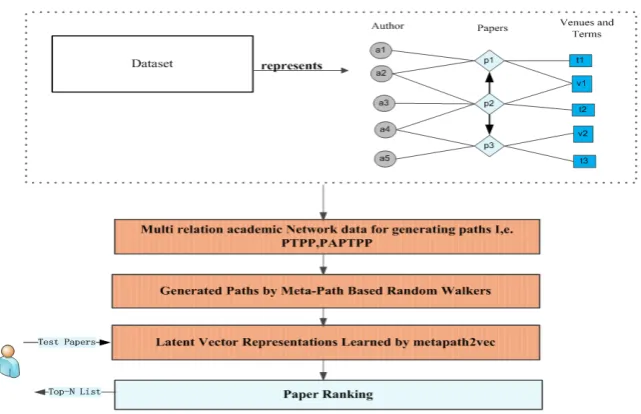
In this paper, we investigate a citation based research paper recommender sys-tem using Heterogeneous Information Network Embedding model for Recom-mendation to recommend the relevant top-N research paper. In recommending papers, the proposed work goes through different phases.
3.2.1. System Overview
As introduced earlier, our Network-based citation recommendation framework includes the following three main stages:Training data preparation, Representa-tion learning and Network-based citaRepresenta-tion recommendaRepresenta-tion (See Figure 1).
3.2.2. Heterogeneous Information Network Construction
For given information, our multi-layered network model can be defined as fol-lows: A Graph G defines a Heterogeneous Information Network G=
(
V E A, ,)
consisting of node v and edge e. A Heterogeneous Information Networkis asso-ciated with their mapping functions f v V
( )
: →AV and X R∈ V Xd,dV ,respectively. The sets of object and relation types are denoted as a AV and AE,
where AV + AE >2.
For instance, the information network can be one represented in Figure 1
with authors (V), papers (T), venues (A), terms (P) as an object set V (nodes), where, publish (A-P, P-V), co-author (A-A), terms (P-T) relationships are indi-cated as a link set E (edges).
3.2.3. Heterogeneous Network Embedding: Metapath2vec
The recent progress on network embedding [10] [16] encouraged. We propose a CN_HER approach in order to extract and represent useful information on He-terogeneous Information Networks for the paper recommendation.
Given a Heterogeneous Information Network Embeddings, The task is to learn the low-dimensional latent representations (embedding) d
v
e ∈R for
every object v ∈ V. The learned low-dimensional latent representations are
DOI: 10.4236/jcc.2018.612016 163 Journal of Computer and Communications
the Heterogeneous Information Network Embeddings and generate meaningful node sequences.
3.2.4. Meta-Path Based-Random Walks
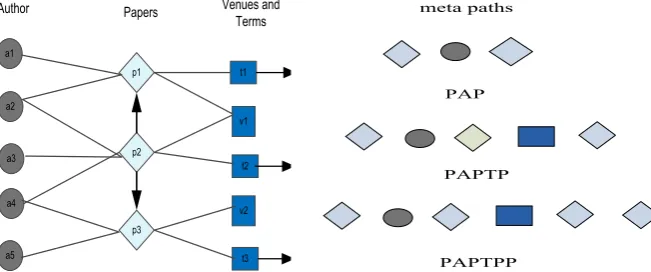
To design an effective walking strategy, it is essential to generate meaningful node sequences, that are capable to capture the complex semantics in Heterogeneous Information Network Embeddings. In the literature of Heterogeneous Informa-tion Network Embeddings, to characterize the semantic patterns for Heterogene-ous Information Network Embeddings [19], the meta-path is an important con-cept. Hence, to generate the node sequence, meta-path based random walk me-thod proposed. As shown in Figure 2, giving a heterogeneous network, and a me-ta-path 1 1
1 1 1
: R ... Rt ... R
p t t l
m A → A →A+ →A+ wherein R R R R= 1, 2,..., l−1
denotes the composite relations between node types A1 and Al [20]. We can generate a sampled sequence "p1→a1→p2 →a2" according to Equation (2).
The following distribution generates the walk path:
(
)
1( )( )
( )
1
1
1 , , and
otherwis
; ,
0, e,
t v
A
t t p
t
v x E x
N
m x v m A
P m + +
+ ∈ ∅ = = = = (1)
where v has the type of At, mt, is the t-th node in the walk, and the first-order
neighbor set for node v with the type of At+1 is t1( )v
A
N +
. The pattern of a me-ta-path will be followed continuously by a walk, until Walk has reached the pre-defined length.
3.2.5. CN_HER Model Citation Recommendation Algorithm
Given a manuscript P, we propose a heterogeneous scientific papers network re-presentation citation recommendation approach, which aims to return top-ranked scientific papers as reference papers by measuring the similarity scores between the manuscript and all the scientific papers in the dataset. In our work, we for-mulate the manuscript P as a manuscript author a, term t, venue v i.e.
{
, ,}
t
P = a t v . We suppose Ptas a testing paper, Paas an author of the manuscript
[image:7.595.211.537.557.693.2]and all the scientific papers in the dataset PT as training papers. Algorithm 1
Figure 2. A demonstrative example of the proposed meta-path based random walk. We perform random walks directed by some selected meta-paths.
a1 a5 a2 a4 a3 p1 p3 p2 t1 t2 t3 v1 v2
Author Venues and
Terms
Papers meta paths
PAP
PAPTP
DOI: 10.4236/jcc.2018.612016 164 Journal of Computer and Communications Algorithm 1. The algorithm of CN_HER.
summarizes the whole process of the heterogeneous scientific papers network representation citation recommendation approach.
The similarity scores are represented as,
{
1, 2,..., n}
,(
1,2,...,)
P PP PP PP n
r = r r r P ∈P i= n (2) The input to the recommendation system is the word sequence of training pa-pers and testing papa-pers, all the authors, terms, venues and citation papa-pers of the training papers and authors, terms, venues of the test papers, as well as the adja-cency matrix based on the network. All these papers and, all the authors, terms, venues and citation papers are mapped into vectors based on our proposed CN-HER model. Thus the similarity scores can be calculated as:
T Ttxt Ta Tt Tv Tp
P P R P AR P TR P VR P PR P
r =V V +V V +V V +V V +V V (3)
where P RT is the vector representation of training papers, txt
P is the vector representation of the manuscript text, VARis the vector representation of authors
related to training papers, VPa is the vector representation of the manuscript
author, VPt is the vector representation of the manuscript terms, VPv is the
vector representation of the manuscript venues, VPp is the vector
representa-tion of the manuscript citarepresenta-tion papers. Training papers are ranked according to the similarity scores, the top-ranked ones, are selected as the final recommenda-tion list.
4. Experimental Evaluation
The aim of this section is to evaluate the performance of the recommendation using the meatapath2vec methodology on the dataset for determining its accu-racy and efficiency.
4.1. Data Preparation
DOI: 10.4236/jcc.2018.612016 165 Journal of Computer and Communications
In our work, we extract the title and abstract of the papers in the dataset as document content. We remove the papers which have missed titles or abstracts in the dataset. Then, we use the remaining 13,929 papers published from 1975 to 2013 as an experimental dataset. Through the following steps each paper pre-processed 1) extract paper abstract and title; 2) remove the words that con-sist less than 3 characters; 3) remove stop words. For reducing the noise, we re-moved those words that seemed less than ten in the dataset. We got a total of 4397 different candidate words. Using a naive approach TF-IDF as an indicator
[21], we recognized keywords from the set of candidate words for constructing the paper-word graph. If the TF-IDF of a word was greater than a TF-IDF thre-shold of 0:03, this word was selected as a keyword. A total of 3804 different key-words were identified in the set of 13,939 papers at a TF-IDF threshold frequen-cy 0:03. For assessment purposes, we divide the entire data set into two separate sets, the papers 2015 are assessed as a training set (12,738 papers) and the re-maining papers fall into the testing published before set (1211 papers).
4.2. Evaluation Metrics
In order to assess and evaluate recommendation results, we have used Recall [20], precision and NDCG [22]. These matrices are used to check the perfor-mance of the proposed method in terms of recommendation accuracy and pre-dicted ranks quality. In literature, they are commonly used for evaluating rec-ommendation results.
• Recall. Recall measure the ratio between the number of total cited papers to the number of articles system has presented in a Top-N recommendation list. The ratio represents the number of hits divided by the size of each user test data. The formula for recall is given as follows:
(
)
(
)
(
)
relevant papers retrieved_ papers Recall
relevant_papers
=
∑
∩
∑
∑
(4)• NDCG. The recommendation results generated by the paper recommender system are sensitive to the positions of the relevant reference papers, using recall we cannot evaluate that intuitively. Therefore, it is indispensable for closely related references to appear higher in the Top-N list. We use (NDCG) to measure the ranked recommendation list. The NDCG value can be calcu-lated using the following formula: calcucalcu-lated as
(
)
1 2
2 1 NDCG
log 1
ri n
i= i
− =
+
∑
(5)where r(i) is the rating value of the i-th paper in the ranking list. r(i) = 1 means the article is relevant otherwise r(i) = 0 if it is not.
Preci-DOI: 10.4236/jcc.2018.612016 166 Journal of Computer and Communications
sion value has an inverse relationship with false positive, greater the precision the less is false positive. Trade-off exists between precision and recall scores as there is an inverse relationship between the two, increase in one metric results decrease in another. For establishing the balance, there should be a trade-off between the two as given following:
(
)
(
)
(
)
relevant papers retrieved_ papers Precision
relevant_papers
=
∑
∩
∑
∑
(6)4.3. Results and Discussions
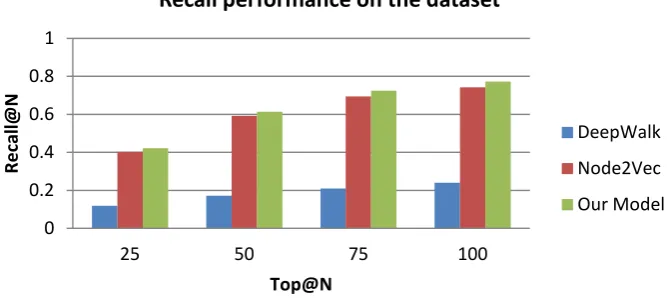
Evaluating metapath2vec with the various latest network representations, learn-ing methods, DeepWalk [16], and node2vec [10], our original intention to pro-pose the network representation approach consists in hopes to obtain more meaningful vector representation of each vertex in the network, and then per-form citation recommendation based on the vector representations of these ver-tices. For that purpose, so we compare our proposed bibliographic network re-presentation approach with another two network rere-presentation approach: DeepWalk, (2) Node2Vec, which learns a mapping of paper vertices to a low dimensional space of features that maximizes the likelihood of preserving paper network neighborhoods of paper vertices. After obtaining network representa-tion with the above different approaches, citarepresenta-tion recommendarepresenta-tion can then be performed. Which learns paper network representation by utilizing network structure information; the obtained results are given in Figure 3 and Figure 4. These figures show the results of comparisons supported (Recall) and (Preci-sion) severally. The result obtained in Figure 5 shows that the model has im-mensely and commonly outperformed the baseline ways for all N recommenda-tions values based on Recall. DeepWalk performs the worst of the three results, whereas for sure, the performance of our model will increase as the amount of N will increase. However, the best results supported Recall are obtained once N = 100 (Top@N).
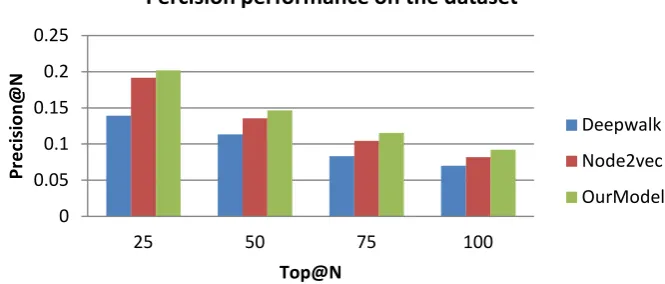
[image:10.595.207.541.556.705.2]Then again, the assessment results based on Precision are described in Figure 4.
Figure 3. Recall performance on the dataset.
0 0.2 0.4 0.6 0.8 1
25 50 75 100
Rec
al
l@
N
Top@N
Recall performance on the dataset
DOI: 10.4236/jcc.2018.612016 167 Journal of Computer and Communications Figure 4. Precision performance on the dataset.
Figure 5. Ndcg performance on the dataset.
Between our model and the Node2vec results differences are not much note-worthy. While as estimated, the performance of our model decreases when the number of @N increases. This is because as the number of @N increases, the af-finity of retrieving inappropriate results also increases and thereby affecting the cumulative Precision results. Though, both the two approaches considerably outclassed the Deepwalk method. This is because, the two approaches can leve-rage which learns a mapping of paper vertices to a low dimensional space of features that maximizes the likelihood of preserving paper network neighbor-hoods of paper vertices, and different from the Deepwalk method which learns paper network representation by utilizing network structure information.
Figure 5 respectively represents the results, comparisons based on Ndcg. The Ndcg result of our model is significant over the baseline methods for all N rec-ommendations values. However, the Node2vec approach outperformed the proposed approach when N = 50 (N@50). Our model results start with encour-aging results, specifically when N = 25 (N@25), but becomes less noteworthy when the number of recommendations (N) increases. However, both methodol-ogies statistically outperformed the Deep walk method based on Ndcg.
In this section, we have compared our network embeddings method to the two state-of-the-art methods node2vec and deepwalk. These methods proposed,
0 0.05 0.1 0.15 0.2 0.25
25 50 75 100
Pr
ec
isio
n@
N
Top@N
Percision performance on the dataset
Deepwalk Node2vec OurModel
0 0.1 0.2 0.3 0.4 0.5 0.6 0.7
25 50 75 100
N
dc
g@
N
Top@N
Ndcg performance on the dataset
[image:11.595.210.540.244.410.2]DOI: 10.4236/jcc.2018.612016 168 Journal of Computer and Communications
based on word2vec-based network embeddings learning frameworks. However, these methods have thus far focused on homogeneous network representation learning of a single type of nodes and relation types. Our network embeddings method (metapath2vec) performs considerably better heterogeneous network embedding’s more than current high-tech methods, as measured by evaluation metrics. The plus point of our proposed method lies in their proper thought of the network heterogeneity challenge the existence of more than one type of nodes and relation types.
5. Conclusion
In this paper, to uncover the semantic and structural information of research ar-ticles, we use a heterogeneous network embedding approach called meta-path2vec. The proposed citation-based recommendation approach makes use of heterogeneous network embedding in generating recommendation results. The novelty of this paper is in exploiting the performance of a network embedding approach i.e., matapath2vec to generate paper recommendations. Unlike existing approaches, the proposed method has the capability of learning low-dimensional latent representation of nodes (i.e., research papers) in a network. We performed experiments on real-world dataset showing the effectiveness of our proposed model. Additionally, we examine its capability in resolving various problems, in-cluding sparsity, cold start, prediction accuracy and scalability issues, and reveal its improved recommendation results in HINs.
Acknowledgements
Time flies, two years of graduate study are coming to an end, and I will leave the familiar southeast university and embark on a new journey of life. I would like to express my heartfelt thanks to my teachers, classmates who have helped me and my family who have been supported me.
Conflicts of Interest
The author declares no conflicts of interest regarding the publication of this pa-per.
References
[1] Dias, M.B., Locher, D., Li, M., El-Deredy, W. and Lisboa, P.J. (2008) The Value of Personalized Recommender Systems to E-Business: A Case Study. Proceedings of the 2nd ACM Conference on Recommender Systems, Lausanne, 23-25 October 2008, 291-294.
[2] Koren, Y. and Bell, R. (2015) Advances in Collaborative Filtering. In: Ricci, F., Ro-kach, L. and Shapira, B., Eds., Recommender Systems Handbook, Springer, Boston, 77-118.https://doi.org/10.1007/978-1-4899-7637-6_3
[3] Schafer, J.B., Frankowski, D., Herlocker, J. and Sen, S. (2007) The Adaptive Web. Springer, Berlin, Heidelberg, 291-324.
Know-DOI: 10.4236/jcc.2018.612016 169 Journal of Computer and Communications ledge Graphs: A Probabilistic Logic Programming Approach. Proceedings of the
10th ACM Conference on Recommender Systems, Boston, 1-19 September 2016, 325-332. https://doi.org/10.1145/2959100.2959131
[5] Noia, T.D., Ostuni, V.C., Tomeo, P. and Sciascio, E.D. (2016) SPrank: Semantic Path-Based Ranking for Top-N Recommendations Using Linked Open Data. ACM Transactions on Intelligent Systems and Technology (TIST), 8, Article No. 9.
https://doi.org/10.1145/2899005
[6] Ostuni, V.C., Di Noia, T., Di Sciascio, E. and Mirizzi, R. (2013) Top-N Recommen-dations from Implicit Feedback, Leveraging Linked Open Data. Proceedings of the
7th ACM Conference on Recommender Systems, Hong Kong, 12-16 October 2013, 85-92. https://doi.org/10.1145/2507157.2507172
[7] Palumbo, E., Rizzo, G. and Troncy, R. (2017) Entity2rec: Learning User-Item Rela-tedness from Knowledge Graphs for Top-N Item Recommendation. Proceedings of the Eleventh ACM Conference on Recommender Systems, Como, 27-31 August 2017, 32-36.https://doi.org/10.1145/3109859.3109889
[8] Rosati, J., Ristoski, P., Di Noia, T., Leone, R.D. and Paulheim, H. (2016) RDF Graph Embeddings for Content-Based Recommender Systems. CEUR Workshop Pro-ceedings, Vol. 1673, 16 September 2016, Boston, 23-30.
[9] Yu, X., Ren, X., Sun, Y., Gu, Q., Sturt, B., Khandelwal, U., Norick, B. and Han, J. (2014) Personalized Entity Recommendation: A Heterogeneous Information Net-work Approach. Proceedings of the 7th ACM International Conference on Web Search and Data Mining, New York, 24-28 February 2014, 283-292.
https://doi.org/10.1145/2556195.2556259
[10] Grover, A. and Leskovec, J. (2016) Node2vec: Scalable Feature Learning for Net-works. Proceedings of the 22nd ACM SIGKDD International Conference on Know-ledge Discovery and Data Mining, San Francisco, 13-17 August 2016, 855-864.
https://doi.org/10.1145/2939672.2939754
[11] McNee, S.M., Albert, I., Cosley, D., Gopalkrishnan, P., Lam, S.K. and Rashid, A.M. (2002) On the Recommending of Citations for Research Papers. Proceedings of the ACM Conference on Computer Supported Cooperative Work, New Orleans, 16-20 November 2002, 116-125.https://doi.org/10.1145/587078.587096
[12] Small, H. (1973) Co-Citation in the Scientific Literature: A New Measure of the Re-lationship between Two Documents. Journal of the American Society for Informa-tion Science,24, 265-269.
[13] Konstas, I., Stathopoulos, V. and Jose, J.M. (2009) On Social Networks and Colla-borative Recommendation. Proceedings of the 32nd Annual International ACM SIGIR Conference on Research and Development in Information Retrieval,Boston, 19-23 July 2009, 195-202.
[14] Lin, Y., Liu, Z., Sun, M., Liu, Y. and Zhu, X. (2015) Learning Entity and Relation Embeddings for Knowledge Graph Completion. Proceedings of the 29th AAAI Conference on Artificial Intelligence,Austin, 25-30 January 2015, 2181-2187. [15] Jamali, M. and Ester, M. (2009) TrustWalker: A Random Walk Model for
Combin-ing Trust-Based and Item-Based Recommendation. Proceedings of the 15th ACM SIGKDD International Conference on Knowledge Discovery and Data Mining, Par-is, 28 June-1 July 2009, 397-406.https://doi.org/10.1145/1557019.1557067
DOI: 10.4236/jcc.2018.612016 170 Journal of Computer and Communications [17] Sun, Y. and Han, J. (2013) Mining Heterogeneous Information Networks: A
Struc-tural Analysis Approach. ACM SIGKDD Explorations Newsletter, 14, 20-28. https://doi.org/10.1145/2481244.2481248
[18] Sun, Y., Yu, Y. and Han, J. (2009) Ranking-Based Clustering of Heterogeneous In-formation Networks with Star Network Schema. Proceedings of the 15th ACM SIGKDD International Conference on Knowledge Discovery and Data Mining, Par-is, 28 June-1 July 2009, 797-806.
[19] Sun, Y., Han, J., Yan, X., Yu, P.S. and Wu, T. (2011) PathSim: Meta Path-Based Top-K Similarity Search in Heterogeneous Information Networks. Proceedings of the VLDB Endowment, 4, 992-1003.
[20] Liu, Q., Chen, E., Xiong, H., Ding, C.H.Q. and Chen, J. (2012) Enhancing Collabor-ative Filtering by User Interest Expansion via Personalized Ranking. IEEE Transac-tions on Systems, Man, and Cybernetics, Part B (Cybernetics), 42, 218-233. https://doi.org/10.1109/TSMCB.2011.2163711
[21] Wu, H., He, J., Pei, Y. and Long, X. (2010) Finding Research Community in Colla-boration Network with Expertise Profiling. In: Huang, D.S., Zhao, Z., Bevilacqua, V. and Figueroa, J.C., Eds., Advanced Intelligent Computing Theories and Applica-tions. ICIC 2010. Lecture Notes in Computer Science, Vol. 6215, Springer, Berlin, Heidelberg, 337-344.