ISSN Print: 2327-4352
DOI: 10.4236/jamp.2018.68136 Aug. 9, 2018 1606 Journal of Applied Mathematics and Physics
Finite Difference Simulation of Implosive
Collapsing for Aluminum Spherical Shell
Weicheng Bi, Banghai Jiang, Chenglong Han
National University of Defense Technology, College of Letters and Science, Changsha, China
Abstract
Implosive collapsing for spherical metal shells is a kind of dynamic compressing method, in which high pressure and high compression degree of materials can be attained. In present work, the dynamic process of implosive collapsing for spherical metal shells was regard as spherical symmetry ideally, so one-dimensional spherical symmetric fluid dynamics conservation equations were established, and the finite difference schemes for solving these equations were given. An aluminum spherical shell was assumed, whose inner radius is 4cm and thickness is 2 cm. In numerical simulation, initial centripetal veloci-ties (800, 1000 and 1200 m/s) were used to make aluminum spherical shell collapse. The simulation results show that during the process of implosive collapsing, the material exhibits a compression-expansion-compression pul-sation process, and the internal pressure changes and distribution are consis-tent with the theoretical expectations. The simulation results can be used as a reference for relevant analysis.
Keywords
Implosive Collapse; Spherical Shell Finite Difference; Numerical Simulation
1. Introduction
The centripetal collapse of the shell [1] structure is an important phenomenon in the study of nuclear weapons and nuclear fusion. It refers to the process in which the hollow shell or cylinder is driven by the external pressure and the shell material is contracted to the center. In this process, the material is subjected to Rapid compression, or can achieve high energy density state and achieve the corresponding nuclear reactions, so it is very meaningful to understand the re-levant dynamic mechanism in this process. There are two special cases in which the shell collapses and the “free fall” and “constant pressure” collapse toward the
How to cite this paper: Bi, W.C., Jiang, B.H. and Han, C.L. (2018) Finite Difference Simulation of Implosive Collapsing for Alu-minum Spherical Shell. Journal of Applied Mathematics and Physics, 6, 1606-1613.
https://doi.org/10.4236/jamp.2018.68136
DOI: 10.4236/jamp.2018.68136 1607 Journal of Applied Mathematics and Physics
heart. The former means that the shell initially has a centripetal velocity, and the shell has no other external forces. Relies on the process of inertial centripetal contraction; the latter refers to the process of the centripetal contraction where the shell is initially stationary and the outer boundary is subjected to a constant pressure. A deeper understanding of these two special processes is of great signi-ficance for understanding the relative dynamics of the collapse of the shell structure. This paper focuses on the former for numerical simulation studies.
In this paper, the centripetal collapse process of a spherical shell is considered as a spherical symmetry motion process, and a one-dimensional spherical sym-metric fluid dynamics conservation equation group is used to describe it. The difference scheme for solving the conservation equation group is given. The size of a spherical shell is defined. The numerical simulation of the “free fall” centri-petal collapse process under a working condition is carried out. The displace-ment-time curves of some shell materials and the pressure distribution curves of the shell at different times are obtained. Analysis of the law of the shell move-ment in the process.
2. Simplification of Three-Dimensional Fluid
Dynamics Equations
2.1. Three-Dimensional Fluid Dynamics Equations
The fluid mechanics equations [2] refer to mass, momentum, and energy con-servation equations as follows
0 0 :
u u
e D
ρ ρ
ρ σ
ρ σ
+ ∇ ⋅ =
− ∇ ⋅ =
=
(1)
In the above equations, the pulling force is positive, and the body force is ig-nored. Meanwhile, the satellite derivative is replaced by a marker on the physical quantity, where
ρ
is the density, u is the velocity vector, σ is the stress tensor, e is the ratio Energy, D is the strain rate tensor.2.2. The Divergence of Velocity and Stress Tensor under
One-Dimensional Spherical Symmetry
In the spherical coordinates, the velocity vector u=
(
u u ur, ,θ ϕ)
T, according tothe vector divergence in the spherical coordinates, has
2
1 1 cot
sin
r u u r u
u u
u
r r r r r
ϕ θ θ θ
θ ϕ θ
∂ ∂
∂
∇ ⋅ = + + + +
∂ ∂ ∂
(2)
When the problem is spherically symmetric, the medium only has displace-ment in the r direction, and there is no displacement in the directions
θ
andϕ
, so there isu=(
ur,0,0)
T. If the component ur is abbreviated as u, then2
u u
u
r r
∂ ∇ ⋅ = +
∂
(3)
DOI: 10.4236/jamp.2018.68136 1608 Journal of Applied Mathematics and Physics
rr rϕ rθ
ϕϕ ϕθ
θθ
σ σ σ
σ σ σ
(4)
The divergence of this tensor in spherical coordinates is
2 cot
1 1
( )
sin
3 cot 2
1 1
( )
sin
3 cot ( )
1 1
( )
sin
r r rr r
rr r
r r
r r
r r r r
r r r r
r r r r
ϕ θ ϕϕ θθ θ
ϕ ϕϕ ϕθ ϕ ϕθ
ϕ
ϕθ θ θθ ϕϕ
θ θθ
θ
σ σ σ σ σ θσ
σ
θ ϕ θ
σ σ σ σ θ σ
θ ϕ θ
σ σ θ σ σ
σ σ
θ ϕ θ
∂ − − + ∂ ∂ ∇ ⋅ = + + + ∂ ∂ ∂ ∂ ∂ ∂ + ⋅ ∇⋅ = + + + ∂ ∂ ∂ ∂ ∂ ∂ + ⋅ − ∇ ⋅ = + + + ∂ ∂ ∂ σ σ σ (5)
When the problem is spherically symmetric, there are only positive stress components σrr、σϕϕ and σθθ in the medium. There is no shear stress
component, meanwhile σϕϕ =σθθ. All positive stresses are only related to r,
there is no distribution in the directions
θ
andϕ
. If the positive stress com-ponents σrr, σϕϕ and σθθ are imply denoted as σr, σϕ and σθ (whereϕ θ
σ =σ ), then
2( ) ( )
( ) 0 ( ) 0
r r
r r r θ
ϕ θ σ σ σ − ∂ ∇⋅ = + ∂ ∇ ⋅ = ∇⋅ = σ σ σ (6)
2.3. Hydrodynamic Equations under One-Dimensional Spherical
Symmetry
In the case of spherical symmetry, according to the above discussion, there are simplified hydrodynamic conservation equations
2 2( ) 2 r r r
V u u
V r r
u
V r r
e u u
V r r
θ θ σ σ σ σ σ =∂ + ∂ − ∂ = + ∂ = ∂ + ∂
(7)
In the above formula
1
V
ρ= , 2
V V
ρ
= − where V is the specific volume, u is the velocity vector, σr is the radial stress,
θ
σ is the hoop stress, e is the specific internal energy, and the direction of the
pulling force is taken as positive.
3. Finite Difference Format
rec-DOI: 10.4236/jamp.2018.68136 1609 Journal of Applied Mathematics and Physics
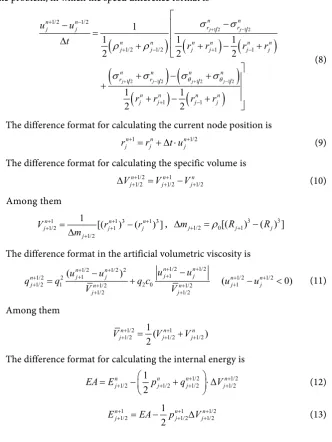
ommended. This paper uses the explicit center difference method [3] to solve the problem, in which the speed difference format is
(
) (
) (
)
(
) (
)
(
) (
)
1 2 1 2
1 2 1 2 1 2 1 2
1/2 1/2
1/2 1/2 1 1
1 1
1
1 1 1
2 2 2
1 1
2 2
j j
j j j j
n n
n n
r r
j j
n n n n n n
j j j j j j
n n n n
r r
n n n n
j j j j
u u
t r r r r
r r r r
θ θ
σ σ
ρ ρ
σ σ σ σ
+ − + − + − + − + − + − + − − − = ∆ + + − + + − + + + − + (8)
The difference format for calculating the current node position is
1 1/2
n n n
j j j
r + =r + ∆ ⋅t u+ (9)
The difference format for calculating the specific volume is
1/2 1
1/2 1/2 1/2
n n n
j j j
V + V + V
+ + +
∆ = − (10)
Among them
1 1 3 1 3
1/2 1
1/2
1 [( ) ( ) ]
n n n
j j j
j
V r r
m + + + + + + = − ∆ , 3 3
1/2 0[( 1) ( ) ]
j j j
m+ ρ R+ R
∆ = −
The difference format in the artificial volumetric viscosity is
1/2 1/2
1/2 1/2 2
1 1
1/2 2 1/2 1/2
1/2 1 1/2 2 0 1/2 1
1/2 1/2 ( ) ( 0) n n n n j j j j
n n n
j n n j j
j j
u u
u u
q q q c u u
V V + + + + + + + + + + + + + + + − −
= + − <
(11) Among them
1/2 1
1/2 1 (2 1/2 1/2)
n n n
j j j
V + V + V
+ = + + +
The difference format for calculating the internal energy is
1/2 1/2 1/2 12 1/2 1/2 1/2
n n n n
j j j j
EA E p q + V +
+ + + +
= − + ⋅ ∆
(12)
1 1 1/2
1/2 12 1/2 1/2
n n n
j j j
E + EA p+ V +
+ = − + ∆ +
(13)
4. Analysis of Examples
As shown in Figure 1, an aluminum ball shell collapses inward under the initial velocity, and analyzes its dynamic process. The initial state is shown in Table 1, and the material parameters are shown in Table 2. The ideal elastic-plastic mod-el for fluids is used in aluminum materials, and the Gruneisen equation of state is used [4]. The relevant parameters are shown in Table 3.
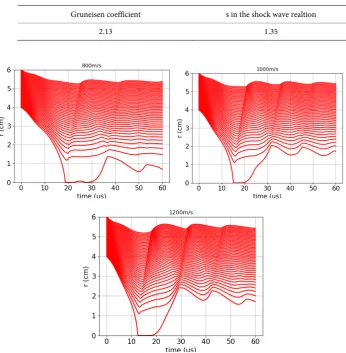
[image:4.595.211.544.97.540.2]This article uses c language compiler to get the solution of the above example. As shown in Figure 2.
DOI: 10.4236/jamp.2018.68136 1610 Journal of Applied Mathematics and Physics
Figure 1. Compression spherical shell.
Table 1. Spherical shell parameter.
Inner diameter(cm) Thickness(cm) Initial velocity(m/s) Time span(μs)
4.0 2.0 800, 1000, 1200 60
Table 2. Aluminum material parameter.
Density (g/cm3) Sound velocity(cm/μs) Modulus of shearing(GPa) Yield strength(GPa)
2.8 0.54 27 0.7
Table 3. Parameter of Gruneisen properties equation of elastic-plastic model for Aluminum.
Gruneisen coefficient s in the shock wave realtion
2.13 1.35
[image:5.595.189.536.354.708.2]DOI: 10.4236/jamp.2018.68136 1611 Journal of Applied Mathematics and Physics
DOI: 10.4236/jamp.2018.68136 1612 Journal of Applied Mathematics and Physics
time, and when the speed reaches 1200 m/s, we can see three distinct compres-sion-expansion processes. It can be seen from the figure that the spherical shell is compressed inward but the thickness is gradually thickened. After analysis, the reason is considered to the compressibility of the material. At the beginning, the inner and outer surfaces shrink at the same speed, and the inner surface accele-rates. Due to conservation of momentum and energy, the outer surface decele-rates and the thickness of the spherical shell increases. Due to the compressibili-ty of the material, the increase in pressure in the spherical shell is accompanied by an increase in density.
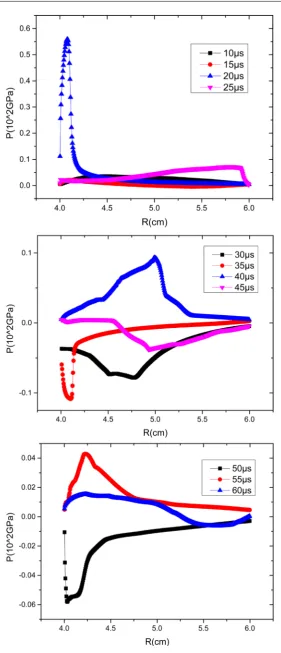
Figure 3 shows when the initial centripetal velocities is 800 m/s, the variation law of the stress in the spherical shell output every 5 μs, where the abscissa is the Lagrange coordinate. It can be seen that the pressure value of 20 μs is much higher than other moments. According to the analysis of Figure 2, since the spherical shell collapses to the center of the sphere, the compression wave con-verged to generate a positive high pressure. Then start the expansion process. We see that the pressure value of 30 μs is basically negative, and that the com-pressive process starts again at 40 μs.
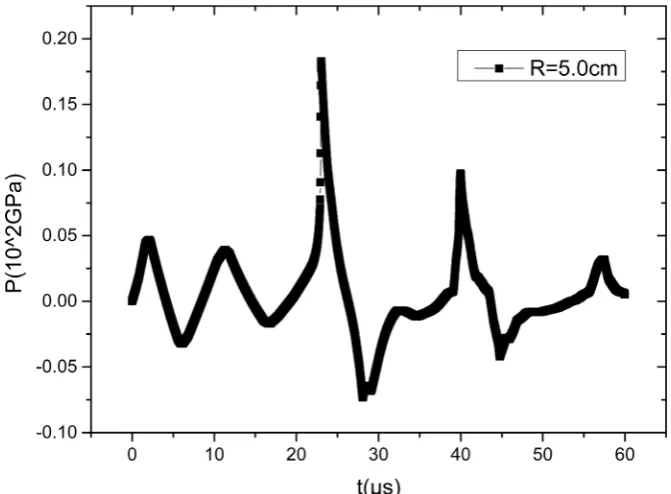
Figure 4 shows the variation law of the pressure at the 1/2 thickness of the spherical shell over time. The analysis of the integrated two graphs can be seen. In the 0 ~ 60 μs time, the pressure in the spherical shell changes with a sinusoid-al function.
5. Conclusions
[image:7.595.206.542.457.704.2]The following conclusions can be drawn from the analysis of the variation law and pressure distribution of the above spherical shell particles with time:
DOI: 10.4236/jamp.2018.68136 1613 Journal of Applied Mathematics and Physics
1) In the spherical shell implosive centripetal collapse, the collapse is only due to inertia [5], and as the time evolves, the outer surface of the shell shrinks in-ward and becomes smaller, the shell becomes thicker, and the density becomes bigger.
2) The inner surface of the spherical shell shrinks faster than the outer surface. Because of the conservation of momentum and energy, the outer surface decele-rates. The momentum transfer generates a pressure gradient inside the shell. The peaks of the expansion pressure and the compression pressure appear in the spherical shell 1/2 thickness of the inner surface.
Conflicts of Interest
The authors declare no conflicts of interest regarding the publication of this pa-per.
References
[1] Huang, X.C. (2010) Analysis of Mechanical States and Failure Modes of Shells Sub-jected to Implosive and Explosive Loadings. Institute of Systems Engineering China Academy of Engineering Physics.
[2] Xiong, Z.H., Fu, Y.M. and Xiong, H.E. (1997) Continuum Mechanics Foundation. Hunan University Press.
[3] Liu, Q.K., Xu, X.W. and Wu, J.F. (2011) An Adaptive Explicit Time Intergration Algorithm for Hydrodynamic Equations and Application in ICF. Chinese Journal of Computation Physics, 28, 174-180.
[4] Wu, Q. (2004) Studies on Equation of State and Gruneisen Parameter for Metals at High Pressures and Temperatures. Institute of Systems Engineering China Academy of Engineering Physics.