ISSN Online: 2333-9721 ISSN Print: 2333-9705
DOI: 10.4236/oalib.1105178 Jan. 25, 2019 1 Open Access Library Journal
Analysis of Thermal Conduction in the Machine
Border Collapse: Numerical and Experimental
Comparison
Giancarlo Ferreira Matos, Diego Alves de Miranda
Department of Mechanical Engineering, University of the Region of Joinville—UNIVILLE, Joinville, Brazil
Abstract
The success of a design of a machine manufacturing line is directly related to the efficiency in the use of raw material and components, requiring a total control of the process. In this work the numerical simulation was applied to analyze the conduction of heat transferred in the Edge gluing machine Smc1 and to validate the simulations with the temperature differences collected ex-perimentally. These validations were performed with the collection of tem-peratures via thermal imaging, which provides greater accuracy of thermal conduction capture. The results obtained are similar in relation to certain points captured by thermal imaging. The thermal model analyzed represents proximity to the heat distribution during the use of the machine.
Subject Areas
Computer Engineering, Experimental Physics, Mathematical Analysis
Keywords
3D Heat Transfer, Numerical Simulation, Finite Volumes Method
1. Introduction
In recent years, progress has been made in relation to numerical simulation and process monitoring techniques, with the aim of improving and verifying effi-ciency through the creation of virtual models. Due to the great search in the area of research and development of computational analysis, the simulation of processes is highlighted. Oba [1] applied numerical simulation to compare expe-rimentally with furnaces used in the production of ceramic blocks, in which the simulation was applied to solve the thermal problem of a complete tunnel and to How to cite this paper: Matos, G.F. and de
Miranda, D.A. (2019) Analysis of Thermal Conduction in the Machine Border Collapse: Numerical and Experimental Comparison. Open Access Library Journal, 6: e5178. https://doi.org/10.4236/oalib.1105178
Received: January 11, 2019 Accepted: January 22, 2019 Published: January 25, 2019
Copyright © 2019 by author(s) and Open Access Library Inc.
This work is licensed under the Creative Commons Attribution International License (CC BY 4.0).
http://creativecommons.org/licenses/by/4.0/
DOI: 10.4236/oalib.1105178 2 Open Access Library Journal analyze the influence of several parameters in the operation of the equipment. Other dissertations helped to understand the theme, as an example of Oliveira
[2], referring to the thermal modeling of the reciprocal linear compressor oper-ating without lubricoper-ating oil, being its model developed to adopt a prediction of the velocity and temperature fields, as well as heat in different regions of the compressor.
Barban [3] analyzed the tensions generated in materials, after the welding, generating a model of the temperature distribution during the process and Teix-eira [4] where he carried out the analysis of the thermal effect and the creep in the structures executed in layers, mainly in dams of concrete compacted with roll contributed in the understanding to the subject. Eger [5] performed the modeling of turbulent flows under the alternating rotation action that took ad-vantage of fluid movement to reduce non-uniformity in composition, tempera-ture and other properties. Barrios [6] performed a thermal modeling, aiming to know the heat flux generated during the milling process, thus being able to de-termine better cutting conditions and also to design new products with better performance. Pereira [7] performed the thermal analysis of a small 3D printing, promoting a new model of region studied, reducing its heating by 50%, aiming to solve problems of instability.
In this context, it is intended to apply a three-dimensional heat conduction simulation, observing the transfer of heat from the surface of the contact area of the heaters in relation to the structural assembly of the edge-sealing machine, so that fluid can be viscoplastic in the appropriate temperature range.
2. Methods
This paper aims to analyze the thermal performance of conductive heat transfer in the machine system through the structure, components and product (viscop-lastic), collecting data, performing numerical simulation and experimentally comparing the results in order to validate the use of the heaters they provide heat to the system maintaining the indicated temperature range of application of the viscoplastic fluid, without compromising its flow. Thus reducing costs in components and preparation as the use of thermal paste and machining of the positions of the heaters.
2.1. Study Equipment
The structural assembly shown in Figure 1 comprises the storage of the viscop-lastic ethylene vinyl acetate fluid and flows through a spindle to its point of ap-plication in accordance with the indicated temperature range of 130˚C to 160˚C.
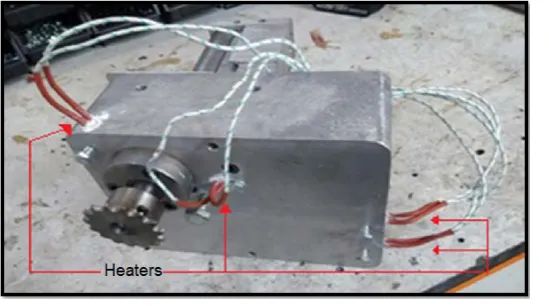
Figure 1(a) depicts the assembly of reservoir parts, axle holder, scraper, ap-plicator shaft and glue and Figure 1(b) shows the exploded view of the assem-bly. In order to carry out the heat transfer, the set uses four cartridge heaters of 400 W each, totaling 1600 W. Their positions are represented in Figure 2.
DOI: 10.4236/oalib.1105178 3 Open Access Library Journal order to fix the heaters in their proper positions. Its positions of 3 heaters are applied horizontally in the reservoir and one is applied vertically between the reservoir assembly and the axis support.
2.2. Equipment Capabilities and Processing Parameters
The set analyzed in this work is part of the SmC1 SmartmaqCollapse machine, represented in Figure 3, which according to the company’s website is a Collapse designed for beginner and medium-sized carpenters, with optional extensor tables that can also be used for larger jobs.
The SmC1 Collapse shown in Figure 3 has the largest opening of the glue box on the market; this facilitates cleaning the collet without removing the glue box and has the ability to glue edge ribbons from materials such as PVC, ABS, paper and wood, with glue width up to 80 mm [8]. Its technical specifications are:
[image:3.595.241.501.346.524.2]1) Tape thickness: 0.3 to 2.0 mm; 2) Maximum tape width: 10 to 80 mm; 3) Table dimensions: 870 × 600 mm; 4) Auxiliary tables (optional); 5) Feed rate: 5.5 m/min; 6) Temperature 120˚C to 220˚C; 7) Power: 1600 Watts; 8) Voltage: 220 V/110V-Single phase.
[image:3.595.241.516.556.709.2]Figure 1. Structural set. (a) Isometric view. (b) Exploded view.
DOI: 10.4236/oalib.1105178 4 Open Access Library Journal
Figure 3. SmC1 SmartmaqCollar [8].
2.3. Data Collect
For a better understanding of the thermal performance performed in the struc-tural set it is necessary to collect data as the time taken to heat the heaters as shown in Figure 4.
As shown in Figure 4(a) in about 1 minute the resistance reaches the temper-ature of 247.9˚C and Figure 4(b) off after 10 minutes it still remains at elevated temperatures of 166.8˚C.
2.4. Numerical Simulations
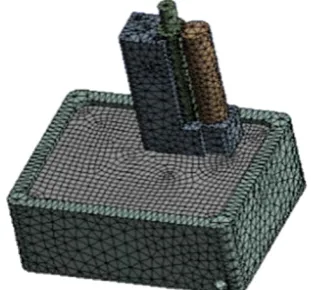
Due to the complexity of the geometry analyzed as the example of the spindle in the applicator axis, it is necessary to transfer the CAD geometry to the ANSYS software. In order to perform the numerical simulation using the finite volume method, the mesh is shown in Figure 5.
The generation of the mesh for the proposed problem is of multi-block form to carry out its refinement as illustrated in Figure 5, being an important variant in the accomplishment of the thermal modeling.
2.5. Contour Conditions
The correct heat conduction in relation to the viscoplastic fluid used in the process is fundamental for the operation of the machine, being transmitted from the heat generation of the heaters positioned in the reservoir to the applicator axis. For the numerical simulation, the temperatures were applied according to
Figure 6.
DOI: 10.4236/oalib.1105178 5 Open Access Library Journal (a) (b)
[image:5.595.295.451.272.417.2]Figure 4. Heater temperature measurement. (a) Higher temperature. (b) After being switched off.
Figure 5. Generation of mesh.
Figure 6. Application of temperatures.
2.6. Validation
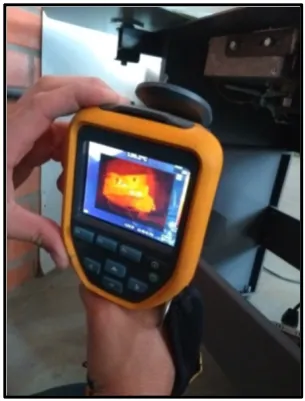
In order to manage the heat distribution in the set, thermal photos of the me-chanism were taken during its operation as shown in Figure 7.
[image:5.595.252.493.450.627.2]per-DOI: 10.4236/oalib.1105178 6 Open Access Library Journal formed to verify the thermal efficiency of the process at different points in the set and to validate the results obtained during the numerical simulation. Due to the need for the process, care was taken to ensure heat transfer to the applicator shaft. For this, a point thermometer was used for measurement according to
Figure 8.
The temperature found in Figure 8 was 149.9˚C, remaining within what is suggested for the process.
3. Results and Discussions
The method used to understand the thermal model created was that of finite vo-lumes, which has the principle of performing a subdivision of the structure ana-lyzed in order to understand each element to understand the set. After the mesh generation procedure was applied to the experimentally collected temperature of the resistance in the contact faces of the mechanical assembly. For the elabora-tion of the numerical simulaelabora-tion, the initial temperature of 8˚C was used for
Figure 9(a) where the photo was taken during the winter period, requiring a longer time for heating and releasing the machine.
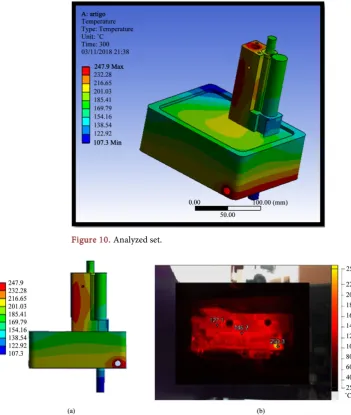
On the day in question the machine took approximately 6 minutes from 8˚C to reach the temperature recorded in Figure 9(b) of 131˚C. Collecting the ther-mal data can generate the therther-mal model presented in Figure 10, thus obtaining a better understanding of the physical phenomenon presented.
The virtual model shown in Figure 10 represents the transmission of the heat obtained numerically generated from the heaters in relation to the structural storage set of the machine after the period of 300 seconds, bringing the results closer to the actual situation. Thus the transient model created reached close thermal points in comparison to the thermal image captured during its opera-tion, due to the considered temperature constant of the resistors. It is possible to compare the results according to Figure 11(a) representing the thermal model-ing performed through simulations and Figure 11(b) thermal photo during the use of the mechanism.
As shown in Figure 11(a), the points found in simulation are similar to those found in practice in Figure 11(b) of their surface heat transfer, and therefore, the temperature distribution in a given section of the reservoir.
Figure 12 represents the transfer of heat in a section of the surface of the re-servoir and exhibits in certain points temperatures near 250˚C due to the prox-imity to the resistance in the place, but in average stays between 140˚C within the parameters of work.
After the machine was started, the heaters take around 60 seconds to reach the temperature of 247.9˚C, which was considered as a constant for the simulation, thus performing the heat transfer to the mechanism. After 300 seconds reaches the average temperature of 150.9˚C according to the numerical simulation per-formed as shown in Figure 13.
re-DOI: 10.4236/oalib.1105178 7 Open Access Library Journal sistances, the minimum temperature and its heating ramp during 300 seconds of simulation and average in relation to the two. According to data collected and numerical simulation, to sum up the heating times of the resistors and heat transfer, the device is released for its operation in approximately 6 minutes keeping steady state.
[image:7.595.296.448.386.537.2]Figure 7. Thermal analysis.
Figure 8. Thermal analysis.
(a) (b)
[image:7.595.227.521.567.693.2]DOI: 10.4236/oalib.1105178 8 Open Access Library Journal
[image:8.595.246.501.73.294.2]Figure 10. Analyzed set.
Figure 11. Comparison of results found. (a) Thermal modeling. (b) Thermal photo.
[image:8.595.174.536.331.487.2] [image:8.595.170.538.523.700.2]DOI: 10.4236/oalib.1105178 9 Open Access Library Journal
Figure 13. Comparison of results found.
4. Conclusions
The simulation is extremely important for process validation, since the functio-nality of the mechanism studied in the Smc1 border collapsing machine is di-rectly related to heat transfer at its point of application. By applying the numeri-cal simulation the process is understood and validated, being a tool of great util-ity in the area of engineering to assist in making decisions to perfect the processes, generating an increasingly competitive product in the market.
Finally, the computational method applied numerically was validated experi-mentally by thermal image analysis captured from the mechanism, presenting points with similar temperature, thus presenting the possibility of applying the study in different processes, as possible improvements in the current mechan-ism. That is why studies in the field of mechanical engineering are of fundamen-tal importance and maintaining full control of the processes becomes through simulations becomes increasingly attractive to improve the practical processes.
Conflicts of Interest
The authors declare no conflicts of interest regarding the publication of this pa-per.
References
[1] Oba, R. (2015) Simulation and Thermal Analysis of Tunnel Kiln Applied to the Ce-ramic Industry. Doctoral Thesis, Federal University of Santa Catarina, Florianópo-lis. (In Portuguese)
[2] Oliveira, M.J. (2014) Thermal Modeling of the Linear Reciprocating Compressor Operating without Lubricating Oil. Master’s Dissertation, Federal University of Santa Catarina, Florianópolis. (In Portuguese)
DOI: 10.4236/oalib.1105178 10 Open Access Library Journal [4] Teixeira, R.R. (2006) Finite Element Modeling for Strain and Creep Analysis in Roller Compacted Concrete. Master’s Dissertation, Federal University of Paraná, Curitiba. (In Portuguese)
[5] Eger, R.S. (2010) Modeling of Turbulent Flows under Alternating Rotation. Mas-ter’s Dissertation, Federal University of Santa Catarina, Florianópolis. (In Portu-guese)
[6] Barrios, A.N.S. (2013) Thermal Modeling for Temperature Evaluation in the Milling of Steels for Molds and Dies. Master’s Dissertation, University of the State of São Paulo, São Paulo. (In Portuguese)
[7] Pereira, F.D.A.S., Freitas M.S., Silva, J.V.L. and Rosário, J.M. (2014) Study and Im-provement of a Modeling Head by Molten Filament Deposition by Means of Ther-mal Analysis of Finite Elements. VIII National Congress of Mechanical Engineer-ing, Uberlândia, 10 August 2014, 1-8.
http://www.swge.inf.br/PDF/CONEM2014-0305_12192.PDF [8] Smartmaq Industry and Trade of Machines.
![Figure 3. SmC1 SmartmaqCollar [8].](https://thumb-us.123doks.com/thumbv2/123dok_us/9217555.408804/4.595.241.505.70.274/figure-smc-smartmaqcollar.webp)