ISSN Print: 2161-7597
Buck Semen Does Not Easily Succumb to
Oxidative Stress
Cyril Mpho Pilane
1*, Malebogo Audrey Bopape
2, Bovula Ntombizodwa
1,3,
Mohleko Helen Mapeka
11Agricultural Research Council, Animal Production Campus, Germplasm Conservation & Reproductive Biotechnologies, Irene,
South Africa
2Department of Biological and Agricultural Sciences, Sol Plaatjie University, Kimberly, South Africa
3Department of Agricultural, Earth and Environmental Science, Animal and Poultry Science, University of KwaZulu-Natal,
Scottsville, South Africa
Abstract
Semen processing and manipulation generally result in loss of sperm motility and sperm velocity due in part to oxidative stress. In this study we investi-gated the vulnerability of South African indigenous unimproved buck semen to oxidative stress induced by an oxidative stress inducing agent, namely, hy-drogen peroxide (H2O2). Semen ejaculates were collected from four superior
South African indigenous unimproved bucks in a total of ten collections and then each duplicate was treated with different concentrations of H2O2 in
presence or absence of Dithiothreitol (DTT). Sperm motility and velocities were determined using the computer aided sperm class analyser (CASA). SYBR-14 and propidium iodide (PI) Live/Dead assay kit was used to deter-mine cell viability and Yo-Pro-1 plus PI Apoptosis kit was used to deterdeter-mine apoptosis. Statistical analysis was performed on the data using SPSS version 17.0 for Windows (SPSS Inc., Chicago, IL). South African indigenous unim-proved buck raw semen motility was between 97% with 98% viability and 0% apoptotic cells. Comparisons of the untreated controls at 0 and 3 hrs incuba-tions revealed that after 3 hrs there was overall a decrease in the number vi-able cells with the majority of remaining cells exhibiting circular movements accompanied by high progressive (PM) and rapid (RAP) motilities. In treated
South African indigenous unimproved buck semen, H2O2 marginally
in-creased total motility (TM) with few apoptotic sperm cells while retaining high viability. Also, H2O2 increased straight line distances travelled of more
than 4 fold as compared to untreated controls with no circularly moving cells. Moreover, inclusion of DTT, an antioxidant, had minimal effects on TM, RAP, curvilinear velocity (VCL), straight line velocity (VSL), linearity (LIN)
How to cite this paper: Pilane, C.M., Bo-pape, M.A., Ntombizodwa, B. and Mapeka, M.H. (2019) Buck Semen Does Not Easily Succumb to Oxidative Stress. Open Journal of Animal Sciences, 9, 65-75.
https://doi.org/10.4236/ojas.2019.91006
Received: November 6, 2018 Accepted: January 1, 2019 Published: January 4, 2019
Copyright © 2019 by authors and Scientific Research Publishing Inc. This work is licensed under the Creative Commons Attribution International License (CC BY 4.0).
http://creativecommons.org/licenses/by/4.0/ Open Access
and wobble (WOB) but positively affected PM, average path velocities (VAP), apoptosis and viability. Our Pearson’s correlation data revealed that only straightness (STR) was highly positively affected by H2O2. Overall, the South
African indigenous unimproved buck semen resisted deterioration in TM, RAP, VCL, VAP, VSL, LIN, WOB, viability and apoptosis under oxidative stress conditions. These data suggest that the South African indigenous un-improved buck semen does not easily succumb to oxidative stress.
Keywords
South African Indigenous Bucks, Oxidative Stress, Motility, Semen
1. Introduction
There is growing interest in the cryopreservation of the buck semen worldwide
[1] [2]. Cryopreservation is the technique of freezing cells and tissues at very low temperatures at which the biological material remains genetically stable but me-tabolically inert. In South Africa, cryopreservation of gametes from indigenous breeds has been recognised as a national priority due to their superior traits that are suitable for the local conditions [3] [4]. In particular, the South African in-digenous unimproved bucks are currently enjoying maximum attention as they have been previously ignored [5] [6].
Previously published data indicates that raw semen from this breed has TM
above 83%, high PM, and high RAP accompanied by high viability [5].
Accom-panying these features were high VAP, LIN, STR and WOB, characteristic of superior quality semen [5]. These experiments have also revealed that following cryopreservation, the South African indigenous unimproved buck semen showed decreased TM to less than 40% with low PM and RAP, accompanied by lower
VAP, LIN, STR and WOB, indicating deterioration of semen quality [5].
Hydrogen peroxide (H2O2) is often used as an experimental source of
oxy-gen-derived free radicals such as superoxide radical (O2−.) and hydroxyl radical
(.OH) which induces oxidative stress [7]. Oxidative stress has been implicated as
the main culprit for the decreased semen motility and semen velocity parameters in males leading to infertility [8]. However, a cocktail of antioxidants can effec-tively improve semen parameters in infertile males [9]. Other studies have indi-cated that the addition of antioxidants to cryopreservation medium can improve post-thaw sperm quality [10], while other antioxidants, mainly thiols, like DTT can prevent H2O2 mediated loss of sperm motility [11].
Our previously published data indicated that in boars, the semen motility and
semen velocity parameters were compromised under H2O2 induced oxidative
stress in the presence or absence of an anti-oxidant like DTT [12]. Notably, TM, PM, RAP plus VAP, LIN, STR and WOB were all drastically decreased under oxidative stress, irrespective of the presence or absence of an antioxidants like DTT. The decreases in these parameters, accompanied by high rate of sperm cell
death via apoptosis and decreased viability, indicated that boar semen is highly
susceptible to oxidative stress and DTT fail to rescue them [12]. We have also
shown recently that other antioxidants like α-tocopherol, taurine and cysteine do not restore boar semen motility and velocity parameters following oxidative stress associated with liquid preservation [13]. Others have shown that post-thaw buck semen exhibited decreased DNA damage and lipid peroxidation accompa-nied by increased antioxidant enzyme activities with no changes in progressive motilities and sperm velocity parameters in the presence of antioxidants [14].
The South African unimproved buck semen has never been directly exposed to an oxidative stress inducing agent to test their susceptibility to oxidative stress. Hence, this study was conducted to assess whether the South African unimproved buck semen can easily succumb to oxidative stress induced by H2O2, in the presence or absence of an antioxidant like DTT.
2. Materials and Methods
The study was conducted at the Small Stock Research Unit of Agricultural Re-search Council, Germplasm Conservation & Reproductive Biotechnologies Unit, Irene, South Africa. The Agricultural Research Council-Irene campus is located at 25˚55'South; 28˚12'East. The institute is located in the Highveld region of South Africa and situated at an altitude of 1525 meters above sea level. Four su-perior South African indigenous bucks were stratified based on age (2 years) and weight (25 - 45 kg). The South African indigenous unimproved bucks were in good health condition throughout the duration of the study. This study was car-ried out in strict accordance with the recommendations in the Guide for the Care and Use of Animals under the guidelines of the Agricultural Research Council, Animal Production Institute Animal Ethics Committee (APIEC2011/38). Water was given ad libitum throughout the duration of the study.
2.1. Bucks Semen Collection and Processing
Semen was collected from four South African indigenous unimproved bucks using an electro-ejaculator, each with a total of ten collections. After collections, the semen samples were placed into the thermo-flask at 37˚C and transported to the laboratory. In the laboratory semen evaluations were performed within 1 h. Semen volume was measured by using the graduated falcon tube, pH was meas-ured using the pH meter (Oaklon, EW35614-30, Cole-Parmer, USA), the sperm concentration was measured using the spectrophotometer (Jenway 6310 spec-trophotometer, Bibby Scientific, England), the semen motility rates were assessed
using the CASA system (Sperm Class Analyzer [SCA] 5.0, Microptic, Barcelona,
Spain), semen viability and apoptosis were evaluated using the SYBR/PI live/dead kit (Invitrogen, Molecular probes, USA) and Yo-Pro-1/PI apoptosis kit (Invi-trogen, Molecular probes, USA) respectively.
2.2. Treatments
For semen treatment, H2O2 stock solution was prepared in pre-warmed BO-Wash
medium and kept at 4˚C until use. During the experiment, semen at equal
con-centration and volume was treated with pre-warmed H2O2 stock to make 0, 5
µM, 50 µM and 200 µM concentrations in pre-warmed BO-Wash medium. The treated semen samples were then incubated at 37˚C for three hours in a
humidi-fied 5% CO2 and 95% atmospheric air incubator (Sanyo, Japan). After three
hours the samples were evaluated for total motility, progressive motility, rapid motility, semen velocities, sperm cell viability and sperm cell apoptosis.
2.3. Sperm Motility Rate
About 10 μl of raw semen were placed into 500 μl of BO-Wash medium in 15ml
tube (Falcon 352099, USA). The tube was then kept in CO
2 incubator (Sanyo,
Japan) adjusted to 39˚C. Five micro litres of semen was placed on the warm glass slide (~76 × 26 × 1 mm, Germany) and placed with a warmed cover slip (22 × 22 mm, Germany) over the microscope-warm plate (Omron) adjusted at 39˚C. The sperm motility rates were evaluated by computer assisted sperm analysis system
(Sperm Class Analyzer [SCA] 5.0, CASA, Microptic, Barcelona, Spain) at the
10× magnification (Nikon, China). The semen TM, PM, RAP and semen veloc-ity parameters were then determined.
2.4. Viability Assay
For cell viability, SYBR-14 and PI Live/Dead kit was used and the cells were treated according to the manufacturer’s recommendation (Invitrogen, Molecular probes, USA). Briefly, 50 µl of semen was diluted with pre-warmed BO-Wash to 1 ml and 5 µl of a 50 times diluted SYBR-14 was added to the cells followed by incubation at 37˚C for 10 minutes. After 10 minutes, 5 µl of PI was added to the cells followed by incubation for another 10 minutes. After 10 minutes 5 µl of cells was immediately placed on pre-warmed glass slide and observed under a fluorescent microscope at 10× magnifications (Olympus, model BX51). For this analysis, viable cells appeared green in colour while non-viable cells appeared red in colour. The percent cell viability was determined by counting the number of green cells out of three hundred cells in a field, divided by three. A correlation was then established between viability and H2O2 treatment in the presence or
absence of DTT.
2.5. Apoptosis Assay
To determine cell apoptosis, cells were treated with the Yo-Pro-1/PI staining kit solutions according to the manufacturer’s recommendations (Invitrogen, Mo-lecular probes, USA). In brief, cells were treated with 5 µl of Yo-Pro-1 and PI at the same time and incubated for 10 minutes. After incubation, 5 µl of the stained cells was placed on a slide and viewed under a fluorescent microscope at 60× magnification (Olympus, model BX51). Four populations of cells were obtained, the light green or clear (live cells), the dark green (apoptotic cells), and red (dead/necrotic cells) and the red plus green cells (dead cells). The percent cell
apoptotic cells were determined by counting the number of dark green cells out of three hundred cells in a field. A correlation was then established between the apoptosis and H2O2 treatment in the presence or absence of DTT.
2.6. Data Analysis
Pearson’s correlation coefficients were calculated to test the relationship between the motility and velocity rates parameters, namely, TM, PM, RAP, VCL, VSL, VAP, LIN, STR, WOB, apoptosis and viability against the treatments. Data were examined using the Kolmogorov-Smirnov test to determine their distribution, a multivariate analysis of variance was performed (ANOVA) and when significant differences were found, and the non-parametric Mann-Whitney U-test was used to compare pairs of values directly if data did not adjust to a normal distribu-tion. All analyses were performed using SPSS version 17.0 for Windows (SPSS Inc., Chicago, IL). Significance was set at p < 0.05.
3. Results
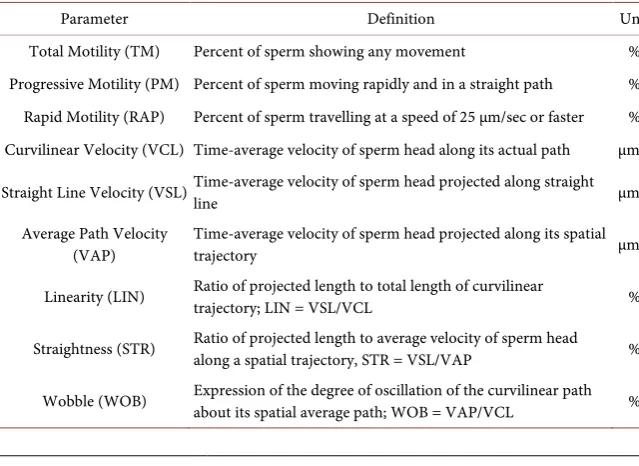
The analysis of the sperm motility and velocity parameters, by definition, gives an excellent insight into the sperm quality profile (Table 1). The raw semen ob-tained from the South African indigenous unimproved bucks showed an average sperm concentration of 0.876 ± 321.55 × 10⁹ cells/ml, with a pH of 7.5 ± 0.5,
vi-ability of 98 ± 1.5 and no apoptotic spermatozoa (Table 2). The analysed sperm
quality profile of this raw semen revealed the percentage TM value of97.0 ± 3.95, PM of 29.3 ± 1.3 and RAP of 8.37 ± 8.01 accompanied by VCL of 70.3 ± 1.56, VSL of 30.83 ± 4.32, VAP of 44.0 ± 7.21 and LIN plus STR of 64.6 ± 5.32 and 67.73 ± 5.28, respectively (Table 3).
[image:5.595.210.530.510.743.2]The analysis of sperm cell viability using the SYBR-14/PI revealed a clear dis-tinction between the viable and non-viable cells, with viable cells fluorescing
Table 1. Definitions of the sperm motility and velocity parameters.
Parameter Definition Unit
Total Motility (TM) Percent of sperm showing any movement % Progressive Motility (PM) Percent of sperm moving rapidly and in a straight path % Rapid Motility (RAP) Percent of sperm travelling at a speed of 25 µm/sec or faster % Curvilinear Velocity (VCL) Time-average velocity of sperm head along its actual path µm/s
Straight Line Velocity (VSL) Time-average velocity of sperm head projected along straight line µm/s
Average Path Velocity
(VAP) Time-average velocity of sperm head projected along its spatial trajectory µm/s
Linearity (LIN) Ratio of projected length to total length of curvilinear trajectory; LIN = VSL/VCL %
Straightness (STR) Ratio of projected length to average velocity of sperm head along a spatial trajectory, STR = VSL/VAP %
Wobble (WOB) Expression of the degree of oscillation of the curvilinear path about its spatial average path; WOB = VAP/VCL %
Table 2. South African indigenous unimproved buck raw semen viability, apoptosis and macroscopic evaluations represented as mean ± SD.
Raw semen (1 × 10Concentration 9 sperm cells/ml) pH Volume (ml) Viability (%) Apoptosis (%)
Buck 0.876 ± 321.55a 7.5 ± 0.5a 0.45 ± 0.20a 98.5 ± 1.5a 0.00a aValues with different subscripts with the same column differ significantly (p ≤ 0.05).
Table 3. The motility and velocity rates of the South African indigenous unimproved buck raw semen represented as mean ± SD.
TM% PM% RAP% VCL (µm/s) VSL (µm/s) VAP (µm/s) LIN% STR% WOB%
97.0 ± 3.95a 29.3 ± 1.3b 8.37 ± 8.01a 70.3 ± 1.56b 30.83 ± 4.32a 44.0 ± 7.21a 64.6 ± 5.32a 67.73 ± 5.28 63.5 ± 0.5b a,bValues with different subscripts with the same column differ significantly (p ≤ 0.05).
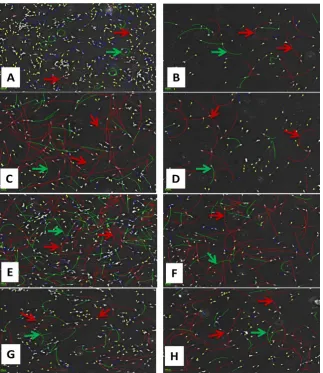
green due to SYBR-14 absorption and non-viable cells absorbing SYBR-14 and PI and appearing as dominant red fluorescence (Figure 1). The class distribution of sperm cells according to average speed and distance travelled indicated un-treated controls at 0 hrs and 3 hrs revealed a decrease in the number of motile cells as the viability decreased (Figure 2). At 0 hrs the RAP and PM motilities appears to be dominant however, after 3 hrs, NPM become dominant with more cells moving in circles or semi-circles (Figure 2) This class distribution of sperm cells according to average speed and distance travelled also revealed that while the H2O2 treatment decreased the overall number of viable cells, the progressive
and rapid motilities remained high accompanied by the elimination of circular moving cells as compared to untreated controls (Figure 3). After 3 hrs of incu-bation, DTT, H2O2 and H2O2 plus DTT appeared to activate sperm cells to travel
longer distances in excess of 100 µm as compared to untreated controls (Figure 3). Interestingly, all H2O2 concentrations used increased TM, but 50 µM H2O2
in-creased both TM and RAP in the presence of DTT (Figure 3, Table 4).
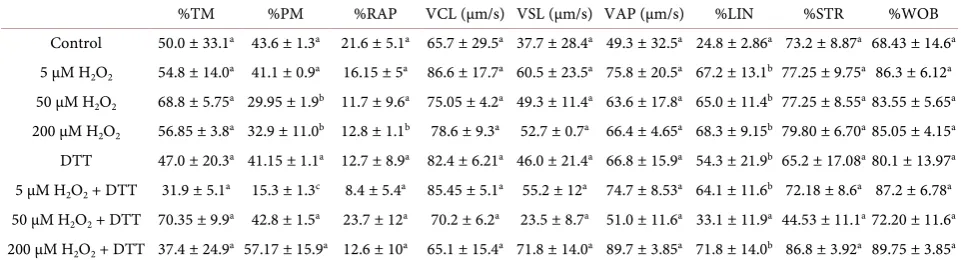
The untreated control semen had TM = 50.0 ± 33.1, PM = 43.6 ± 1.3 and RAP = 21.6 ± 5.1. Treatment with H2O2 revealed that 50 µM H2O2 decreased PM
(29.95 ± 1.95) and RAP (23.7 ± 12) but increased TM (68.8 ± 5.75). 200 µM
H2O2 also decreased RAP (12.8 ± 1.1) and PM (32.95 ± 11.05) with no changes
in TM (56.85 ± 3.85) (Table 3). Also, in the presence of DTT, only 50 µM H2O2
increased PM (from 29.95 ± 1.95 to 42.8 ± 1.5) and RAP (from 11.7 ± 9.6 to 23.7
± 12.0) while 200 µM H2O2 increased PM (from 32.95 ± 11.05 to 57.17 ± 15.92)
and decreased TM (from 56.85 ± 3.85 to 37.4 ± 24.9) with no change in RAP (from 12.8 ± 1.1 to 12.6 ± 10.1) (Table 3). The TM Pearson’s correlation
coeffi-cient with H2O2 concentration remained low in the presence (−0.0719) or
ab-sence (0.182) of DTT, while in the preab-sence of DTT, PM Pearson’s correlation improved from r = 0.104 to r = 0.752 and the RAP correlation changed from moderate but negative correlation (−0.557) to low positive correlation (0.0477) (Table 4).
Interestingly, H2O2 increased LIN (24.89 ± 2.86) significantly at 5 µM, 50 µM
and 200 µM H2O2 to 67.25 ± 13.15, 65.05 ± 11.45, and 68.35 ± 9.15 respectively
Figure 1. (A) The SYBR-14/PI cell viability staining of buck semen where red fluores-cence represent non-viable sperm cells and green fluoresfluores-cence represent viable sperm cells (10× magnification); (B) The Yo-Pro-1/PI apoptosis staining of buck semen showing apoptotic sperm cells in green fluorescence, moribund/dying sperm cells with dual rescence, dead sperm cells in red fluorescence while live cells had clear/light green fluo-rescence (60× magnification).
Figure 2. The class distribution of sperm cells according to their average speed showing
the rapidly moving spermatozoa (RAP, red), Progressive motility (PM, green), Non-progressive motility (NPM, blue) and static (yellow) for untreated controls at (A) 0 hrs and (B) 3 hrs, bar = 25 µm.
Table 4. The sperm motility and velocity rates of treated South African indigenous unimproved buck semen repre-sented as mean ± SD.
%TM %PM %RAP VCL (µm/s) VSL (µm/s) VAP (µm/s) %LIN %STR %WOB
Control 50.0 ± 33.1a 43.6 ± 1.3a 21.6 ± 5.1a 65.7 ± 29.5a 37.7 ± 28.4a 49.3 ± 32.5a 24.8 ± 2.86a 73.2 ± 8.87a 68.43 ± 14.6a 5 µM H2O2 54.8 ± 14.0a 41.1 ± 0.9a 16.15 ± 5a 86.6 ± 17.7a 60.5 ± 23.5a 75.8 ± 20.5a 67.2 ± 13.1b 77.25 ± 9.75a 86.3 ± 6.12a 50 µM H2O2 68.8 ± 5.75a 29.95 ± 1.9b 11.7 ± 9.6a 75.05 ± 4.2a 49.3 ± 11.4a 63.6 ± 17.8a 65.0 ± 11.4b 77.25 ± 8.55a 83.55 ± 5.65a 200 µM H2O2 56.85 ± 3.8a 32.9 ± 11.0b 12.8 ± 1.1b 78.6 ± 9.3a 52.7 ± 0.7a 66.4 ± 4.65a 68.3 ± 9.15b 79.80 ± 6.70a 85.05 ± 4.15a DTT 47.0 ± 20.3a 41.15 ± 1.1a 12.7 ± 8.9a 82.4 ± 6.21a 46.0 ± 21.4a 66.8 ± 15.9a 54.3 ± 21.9b 65.2 ± 17.08a 80.1 ± 13.97a 5 µM H2O2 + DTT 31.9 ± 5.1a 15.3 ± 1.3c 8.4 ± 5.4a 85.45 ± 5.1a 55.2 ± 12a 74.7 ± 8.53a 64.1 ± 11.6b 72.18 ± 8.6a 87.2 ± 6.78a 50 µM H2O2 + DTT 70.35 ± 9.9a 42.8 ± 1.5a 23.7 ± 12a 70.2 ± 6.2a 23.5 ± 8.7a 51.0 ± 11.6a 33.1 ± 11.9a 44.53 ± 11.1a 72.20 ± 11.6a 200 µM H2O2 + DTT 37.4 ± 24.9a 57.17 ± 15.9a 12.6 ± 10a 65.1 ± 15.4a 71.8 ± 14.0a 89.7 ± 3.85a 71.8 ± 14.0b 86.8 ± 3.92a 89.75 ± 3.85a a,b,cValues with different subscripts with the same column differ significantly p ≤ 0.05).
while the other semen velocity parameters of treated semen were not signifi-cantly different from their corresponding untreated controls (Table 3). In the
[image:7.595.59.540.534.666.2]Figure 3. The class distribution of sperm cells according to their average speed showing the rapidly moving spermatozoa (RAP, red), Progressive motility (PM, green), Non-progressive motility (NPM, blue) and static (yellow). Sperm cells were treated for 3 hrs (A) Untreated controls; (B) 5 µM DTT; (C) 5 µM H2O2; (D) 5 µM H2O2 plus 5 µM DTT; (E) 50 µM
H2O2; (F) 50 µM H2O2 plus 5 µM DTT, (G) 200 µM H2O2; (H) 200 µM H2O2 plus 5 µM
DTT. DTT treatment alone show comparable effects to H2O2 treatments. The arrows
in-dicate the typical length showing the distance travelled by RAP motile sperm cell (red ar-row) and progressive motility (green arar-row), bar = 25 µm.
presence of DTT, 50 µM H2O2 induced a decrease in VSL (from 49.3 ± 11.4 to
23.5 ± 8.71), VAP (from 63.63 ± 17.86 to 51.07 ± 11.6), LIN (from 65.05 ± 11.45 to 33.1 ± 11.98), STR (from 77.25 ± 8.55 to 44.53 ± 11.12) and WOB (from 83.55 ± 5.65 to 72.20 ± 11.6). The presence of DTT did not improve the Pearson’s cor-relation coefficient of all the semen velocity parameters except for VCL, which indicated a high negative correlation in the presence of DTT (r = −0.829) and a low correlation in the absence of DTT (r = 0.165), and VAP which indicated a moderately high correlation in the presence of DTT (r = 0.644) and a low corre-lation in the absence of DTT (r = 0.184), plus STR which indicated a high mod-erate correlation in the presence of DTT (r = 0.791) and a low modmod-erate correla-tion in the absence of DTT (r = 0.424). The correlacorrela-tion for the other semen
velocity parameters were VSL (r = 0.581 from r = 0.562), LIN (r = 0.446 from r = 0.489) and WOB (r = 0.455 from r = 0.235). In addition, H2O2 had a low
correla-tion with buck semen apoptosis(r = 0.305) while the presence of DTT increased the buck semen apoptosis correlation (r = 0.9886) and also the buck semen vi-ability correlation (from r = 0.128 to r = 0.7299) (Table 4).
4. Discussions
This study indicates that H2O2 induces oxidative damage to the South African
indigenous unimproved buck semen which is accompanied by changes in the semen velocity parameters, semen motility parameters and semen viability after 3 hours of treatment. Interesting, after 3 hours of H2O2 treatment there was
minimal changes in the pH which accompanied decreases in cell viability. H2O2
increased TM but the presence of DTT decreased it, except at 50 µM were TM was increased by 20%. In a similar study, Griveau et al.[15] demonstrated that 50 µM H2O2 accelerated the hyperactivation and acrosome reaction of semen
af-ter incubation for 3 hrs. In this study, at the highest H2O2 concentration used
(200 µM), PM was increased by 4%. Amazingly, DTT further increases PM of
buck semen by a further 16%. For RAP, H2O2 induced an increase of 4% above
the raw semen RAP value. These observations indicated that buck semen was more robust in dealing with ROS effects on motility parameters, as opposed to boars under similar conditions [12]. This is in agreement with de Lamirande et al. [16] who concluded that, the deleterious effects of ROS on the semen motility parameters, depends on the species being investigated. Also, Sarangi et al. [17]
reported that buck semen liquid preserved in tris-based extender in the presence of vitamin E and glutathione antioxidants revealed high PM, viability, acrosome integrity and antioxidant enzymes with low lipid peroxidation.
Also, 200 µM H2O2 increased VCL, VAP, VSL, LIN, STR and WOB in South
African indigenous unimproved buck semen. In the presence of DTT, VAP, VSL, LIN, STR and WOB were even further increased but not VCL. Also, semen
treated with 200 µM H2O2, DTT had no effect on VCL. The decrease in semen
VCL is due to a reduction in both the angle of lateral head displacement (ALH) and the beat cross frequency (BCF). A decrease in ALH means the sperm head is moving less from side to side while a decrease in BCF means these actions occur
slower. The VSL is increased by H2O2 and further increased by DTT. Since VSL
is improved, this indicates that the buck semen could still be used for fertiliza-tion of an oocytesince increases in VSL is indicative of high semen fertilizing potential, as shown previously in rats [18] and hamsters [19]. VAP was increased even further by DTT in H2O2 induced semen. Also, H2O2 had a minimal increase
in LIN that was further improved by about 10% by presence of DTT. STR and
WOB were increased by 10% by H2O2 and further increased by 18% in the
pres-ence of DTT as compared to buck raw semen values. This data demonstrates that buck semen can resist and remain viable under moderate to high oxidative stress.
5. Conclusion
South African indigenous unimproved buck semen characterisation is currently been addressed and knowledge of their vulnerability to oxidative stress is neces-sary. Interestingly South African unimproved buck semen shows robust resis-tance to ROS effects, as shown by improved or unaffected motility and velocity parameters. Currently, in livestock, semen motility parameters are being used as a measure of their fertility potential. In South African unimproved buck semen, fertilizing potential might not be an issue since they show resistance to ROS, however the use of antioxidant should still be considered. While these data show buck semen resistance to ROS, more research is required to investigate how and why buck semen has resistance to ROS as compared to semen from boars.
Acknowledgements
The authors wish to acknowledge the Agricultural Research Council (ARC) and Department of Forestry and Fisheries (DAFF) for providing necessary facilities and financial support, respectively.
Conflicts of Interest
The authors declare no conflicts of interest regarding the publication of this pa-per.
References
[1] Narwade, B.M., Mohanty, T.K., Bhakat, M. and Rahim, A. (2017) Goat Semen Cryopreservation Using Egg Yolk and Soya Based-Extenders Containing Trehalose.
The Indian Journal of Animal Sciences, 87, 851-855.
[2] Purdy, P.H. (2006) A Review on Goat Sperm Cryopreservation. Small Ruminant Research, 63, 215-225. https://doi.org/10.1016/j.smallrumres.2005.02.015
[3] Webb, E.C., Cronje, P.B. and Donkin, E.F., Eds. (1999) Research and Training Strategies for Goat Production Systems in South Africa. Proceedings of a Work-shop, Hogsback, 22-26 November 1998.
[4] Visser, C., Hefer, C.A., van Marle-Köster, E. and Kotze, A. (2004) Genetic variation of three commercial and three indigenous goat populations in South Africa. South African Journal of Animal Science, 34, 24-27.
[5] Ramukhithi, F.V., Nedambale, T.L., Sutherland, B. and Lehloenya, K.C. (2011) Cryopreservation of South African Indigenous Goat Semen. African Journal of Bio-technology, 10, 17898-17902.
[6] Bopape, M.A., Lehloenya, K.C., Chokoe, T.C. and Nedambale, T.L. (2015) Com-parison of Electro Ejaculator and Artificial Vagina on Semen Collection from South African Indigenous Goat Following Assessment by Computer Aided Sperm Analy-sis. Open Journal of Animal Sciences, 5, 210-218.
https://doi.org/10.4236/ojas.2015.52023
[7] Coyle, C.H., Martinez, L.J., Coleman, M.C., Spitz, D.R., Weintraub, N.L. and Kader, K.N. (2006) Mechanisms of H2O2-Induced Oxidative Stress in Endothelial Cells.
Free Radical Biology and Medicine, 40, 2206-2213.
https://doi.org/10.1016/j.freeradbiomed.2006.02.017
[8] Agarwal, A., Virk, G., Ong, C. and du Plessis, S.S. (2014) Effect of Oxidative Stress on Male Reproduction. The World Journal of Men’s Health, 32, 1-17.
https://doi.org/10.5534/wjmh.2014.32.1.1
[9] Taylor, K., Roberts, P., Sanders, K. and Burton, P. (2009) Effect of Antioxidant Sup-plementation of Cryopreservation Medium on Post-Thaw Integrity of Human Spermatozoa. Reproductive BioMedicine, 18, 184-189.
https://doi.org/10.1016/S1472-6483(10)60254-4
[10] Ahmadi, S., Bashiri, R., Ghadiri-Anari, A. and Nadjarzadeh, A. (2016) Antioxidant Supplements and Semen Parameters: An Evidence Based Review. International Journal of Reproductive BioMedicine, 14, 729-736.
https://doi.org/10.29252/ijrm.14.12.729
[11] Bilodeau, J.F., Blanchette, S., Gagnon, C. and Sirard, M.A. (2001) Thiols Prevent H2O2-Mediated Loss of Sperm Motility in Cryopreserved Bull Semen.
Theriogenol-ogy, 56, 275-286. https://doi.org/10.1016/S0093-691X(01)00562-3
[12] Pilane, C.M., Bopape, M.A., Mapeka, M.H. and Netshirovha, T.R. (2016) Assess-ment of the Susceptibility of Boar Semen to Oxidative Stress. Open Journal of Ani-mal Sciences, 6, 123-130. https://doi.org/10.4236/ojas.2016.62015
[13] Chatiza, F., Mokwena, P.W., Nedambale, T.L. and Pilane, C. (2018) Effect of Anti-oxidants (Taurine, Cysteine, α-Tocopherol) on Liquid Preserved Kolbroek Boar Semen Characteristics. African Journal of Biotechnology, 17, 65-72.
https://doi.org/10.5897/AJB2016.15527
[14] Tuncer, P.B., Bucak, M.N., Sariözkan, S., Sakin, F., Yeni, D., Ciğerci, I.H., Ateşşahin, A., Avdatek, F., Gündoğan, M. and Büyükleblebici, O. (2010) The Effect of Raffi-nose and Methionine on Frozen/Thawed Angora Buck (Capra Hircus Ancryrensis) Semen Quality, Lipid Peroxidation and Antioxidant Enzyme Activities. Cryobiol-ogy, 61, 89-93. https://doi.org/10.1016/j.cryobiol.2010.05.005
[15] Griveau, J.F., Renard, P. and LeLannou, D. (1994) An in Vitro Promoting Role for Hydrogen Peroxide in Human Sperm Capacitation. International Journal of An-drology, 17, 300-307. https://doi.org/10.1111/j.1365-2605.1994.tb01260.x
[16] De Lamirande, E., Jiang, H., Zini, A., Kodama, H. and Gagnon, C. (1997) Reactive Oxygen Species and Sperm Physiology. Reviews of Reproduction, 2, 48-54.
https://doi.org/10.1530/ror.0.0020048
[17] Sarangi, A., Singh, P., Virmani, M., Yadav, A.S., Sahu, S., Ajithakumar, H.M., Ku-mari, A. and Rath, A.P. (2017) Effect of Antioxidants Supplementation on the Qual-ity of Beetal Buck Semen Stored at 4˚C. Veterinary World, 10, 1184-1188.
https://doi.org/10.14202/vetworld.2017.1184-1188
[18] Moore, H.D.M. and Aknondi, M.A. (1996) Fertilising Capacity of Rat Spermatozoa Is Correlated with Decline in Straight-Line Velocity Measured by Continuous Computer-Aided Sperm Analysis: Epididymal Rat Spermatozoa from the Proximal Cauda Have a Greater Fertilising Capacity in Vitro than Those from the Distal Cauda or Vas Deferens. Journal of Andrology, 17, 50-60.
[19] Slott, V., Jeffay, S.C., Suarez, J.D., Barbee, R. and Perreault, S. (1995) Synchronous Assessment of Sperm Motility and Fertilizing Ability in the Hamster Following Treatment with Chlorohydrin. Journal of Andrology, 16, 523-535.