406
Surf at MEDIQA 2019: Improving Performance of
Natural Language Inference in the Clinical Domain
by Adopting Pre-trained Language Model
Jiin Nam AI Core Team Samsung Research
Seoul, Korea
Seunghyun Yoon Dept. ECE
Seoul National University Seoul, Korea
Kyomin Jung Dept. ECE
Seoul National University Seoul, Korea [email protected]
Abstract
While deep learning techniques have shown promising results in many natural language processing (NLP) tasks, it has not been widely applied to the clinical domain. The lack of large datasets and the pervasive use of domain-specific language (i.e. abbreviations and acronyms) in the clinical domain causes slower progress in NLP tasks than that of the general NLP tasks. To fill this gap, we employ word/subword-level based models that adopt large-scale data-driven methods such as pre-trained language models and transfer learning in analyzing text for the clinical domain. Em-pirical results demonstrate the superiority of the proposed methods by achieving 90.6% ac-curacy in medical domain natural language in-ference task. Furthermore, we inspect the inde-pendent strengths of the proposed approaches in quantitative and qualitative manners. This analysis will help researchers to select neces-sary components in building models for the medical domain.
1 Introduction
Natural language processing (NLP) has broadened its applications rapidly in recent years such as question answering, neural machine translation, natural language inference, and other language-related tasks. Unlike other tasks in NLP area, the lack of large labeled datasets and restricted access in the clinical domain have discouraged active par-ticipation of NLP researchers for this domain ( Ro-manov and Shivade,2018). Furthermore, the per-vasive use of abbreviations and acronyms in the clinical domain causes the difficulty of text nor-malization and makes the related tasks more diffi-cult (Pakhomov,2002).
In building NLP models, a word embedding layer that transforms a sequence of tokens in text into a vector representation is considered as one
of the fundamental components. In recent stud-ies, it has been shown that the pre-trained lan-guage models by using a huge diversity of corpus (i.e. BERT (Devlin et al.,2018) and ELMo (Peters et al., 2018)) generate deep contextualized word representations. These methods have shown to be very effective for improving the performance of a wide range of NLP tasks by enabling better text understanding and have become a crucial part of the tasks since they have published.
To stimulate the research in the clinical domain, researchers have further investigated to transform the pre-trained language models from general pur-pose version into the medical domain-specific ver-sion.Lee et al.(2019) propose BioBERT that uti-lizes large-scale bio-medical corpora, PubMed ab-stracts (PubMed) and PubMed Central full-text ar-ticles (PMC), to obtain a medical domain spe-cific language representation through fine-tuning the BERT. Similarity, a PubMed-ELMo1, trained with medical domain corpus, is released as one of the contributed ELMo models for medical do-main researchers. However, these models are not yet fully explored in medical domain tasks.
Besides these general efforts in building bet-ter word representations, Romanov and Shivade
(2018) introduce a large and publicly available natural language inference (NLI) dataset, called MedNLI, for the medical domain (see table 1). Considering the expensive annotation cost of med-ical text due to the sparsity of the clinmed-ical-domain experts, the medical NLI task plays an import role in boosting existing datasets for medical tion answering systems by retrieving similar ques-tions that are already answered by human ex-perts. Along with this effort, ACL-BioNLP 2019 committee announced a shared task, NLI for the medical domain, motivated by a need to develop
# Premise Hypothesis Label
1
She was treated with Magnesium Sulfate, Labetalol, Hydralazine and bedrest as well as betamethasone.
The patient is pregnant. entailment
2 Denied headache, sinus tenderness, rhinorrhea or
congestion. Patient has history of dysphagia contradiction
3 Type II Diabetes Mellitus 3. The patient does not require insulin. neutral
4 Ruled in for NSTEMI with troponin 0.11. The patient has myocardial ischemia. entailment
5 Her CXR was clear and it did not appear she had an
infection. Chest x-ray showed infiltrates contradiction
6 CHF, EF 55% 6. complains of shortness of breath neutral
Table 1: Examples from the development set of MedNLI.
relevant methods, techniques and gold standards for inference and entailment (Ben Abacha et al.,
2019). The newly released dataset is larger in size than that of any other previous medical domain NLI dataset, however, it is still not enough to train complicated neural network based models.
To fill this gap, we propose a combination approach of NLP models and machine learning methods to tackle the medical domain NLI task. Our contributions are summarized as follows:
• We adopt the pre-trained language models (BioBERT, PubMed-ELMo) to overcome the shortage of training data which is a common problem in the clinical domain.
• We apply the transfer learning method with two general domain NLI datasets and show that a source task in a domain can benefit learning a target task in a different domain.
• We show the independent strengths of the proposed approaches in quantitative and qualitative manners. This analysis will help researchers to select necessary components in building models for the clinical domain.
2 Related Work
Researchers have investigated NLI tasks. Most of the works employed a recurrent neural network to encode each pair of sentences and to compute the similarity between them (Conneau et al.,2017;
Subramanian et al., 2018). Recently, Liu et al.
(2019) proposed multi-task learning for natural language tasks and achieved the best results on NLI tasks. In the medical domain,Romanov and Shivade (2018) adopted the ESIM (Chen et al.,
2017) model to the MedNLI task. The ESIM
model employs two bidirectional LSTM to en-code each sentence independently and to calculate a matching score between the sentences by using alignment and pooling methods. They also applied transfer learning with SNLI (Bowman et al.,2015) and MNLI (Williams et al.,2018) datasets to im-prove model performance in the MedNLI task.
Recently, pre-trained language models were proposed (Peters et al.,2018;Devlin et al.,2018). The multi-task benchmark for natural language understanding (Wang et al.,2018) has shown that these pre-trained language models brought addi-tional performance gain by providing deep contex-tualized word representations. Upon this success, researchers further extended previous pre-trained language models to medical domain-specific ver-sions such as BioBERT (Lee et al., 2019) and PubMed-ELMo (Peters,2018).
However, none of these researches directly ap-plied the pre-trained language models of the med-ical domain to the MedNLI task.
3 Dataset and Problem
MedNLI (Romanov and Shivade, 2018), a large publicly available and expert annotated dataset, has been recently published for the MEDIQA 2019 shared task. This dataset comprises of
tu-ples<P, H, Y >where:PandHare a clinical
MIMIC-𝒆𝒆𝟏𝟏𝒑𝒑 𝒆𝒆𝒏𝒏𝒑𝒑
𝒆𝒆[𝑪𝑪𝑪𝑪𝑪𝑪]
[CLS] 𝑝𝑝1 𝑝𝑝𝑛𝑛 [SEP] ℎ1 ℎ𝑚𝑚
𝒆𝒆𝟏𝟏𝒉𝒉 𝒆𝒆𝒎𝒎𝒉𝒉
𝒆𝒆[𝑪𝑪𝑺𝑺𝑺𝑺]
Tm Tm Tm Tm
… . . .
…
𝒕𝒕𝟏𝟏𝒑𝒑 𝒕𝒕𝒏𝒏𝒑𝒑
C … 𝒕𝒕[𝑪𝑪𝑺𝑺𝑺𝑺] 𝒕𝒕𝟏𝟏𝒉𝒉 … 𝒕𝒕𝒎𝒎𝒉𝒉
[image:3.595.89.272.71.204.2]Class label
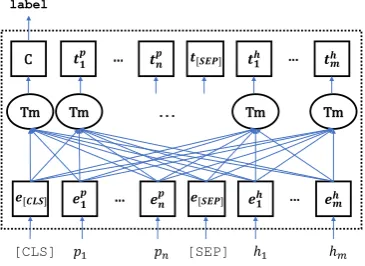
Figure 1: Overview of the BERT model.
III (Johnson et al.,2016).
In this research, we are interested in building a model that classifies the given sentence pair into the corresponding category. First, we consider a
point-wise approach that classifies each pair of
data independently into one of the three classes. Next, we re-organize the dataset into the set of a list that contains one of each class sentence pair. Then we apply list-wise classification that clas-sifies three sentence pair into each “entailment”, “contradiction”, and “neutral” class exclusively.
4 Methods
As the size of the MedNLI dataset is limited to train the whole weight parameters in complicated neural network based models, we first choose a BERT (Devlin et al.,2018) based model that pro-vides pre-trained model parameters from a large corpus. To further explore the performance of modern neural network based models, we extend the compare aggregate model (Wang and Jiang,
2016) with another type of pre-trained word-level embedding, ELMo (Peters et al.,2018). Addition-ally, we apply transfer learning from similar NLI tasks (Bowman et al.,2015;Williams et al.,2018), and we try to expand medical abbreviations to deal with the general problem in the medical domain.
4.1 BioBERT
As a baseline model, we choose BioBERT (Lee et al., 2019) since MedNLI is a bio-domain spe-cific NLI task. It shows strength in understanding medical domain text as it is fine-tuned with bio-datasets such as PubMed and PMC. The BioBERT adopts the same architecture as BERT, as shown in figure 1, that takes WordPiece embeddings from textual input and generates a language represen-tation using a transformer model (Vaswani et al.,
2017).
WordPiece embedding: BioBERT utilizes the
WordPiece dictionary of BERT generated from general domain corpus. Each premise P and hypothesis H turn into sub-word embeddings,
EP∈Rn×de and EH∈Rm×de, using the
dictio-nary wheredeis a dimension of sub-word embed-ding vectors and n and m are the length of the sequences ofPandH, respectively.
EP =WordPiece embedding(P),
EH =WordPiece embedding(H). (1)
BioBERT adds the special classification embed-ding “[CLS]” as the first token of every sen-tence and separatesEP andEH with a special to-ken “[SEP]”. The final input representation fed to transformer blocks is the sum of the token embed-dings (ET), position embeddings (EP o), and seg-mentation embeddings (ES) as follow.
E=ET +EP o+ES,
ET = [E[CLS], EP, E[SEP], EH].
(2)
Transformer encoder: The transformer
en-coder consists of multiple transformer blocks. Each block uses Multi-Head Attention (MHA) generating h different attentions. All the at-tention heads calculated with different weights are concatenated. A linear layer with a weight matrix WH∈R(h×dv)×de computes the MHA
(Rinput length×de) with the concatenated attention
heads as follows:
MHA(Q, K, V)= (concat{hd1, .., hdn})WH,
hdi=attn(Qi,Ki,Vi),
attn(Qi,Ki,Vi) =softmax(
QiKTi
√
dk
)Vi,
(3) whereQ= [Q1, ..., Qh], Qi ∈Rn×
de h,
K = [K1, ..., Kh], Ki ∈Rn×
de h,
V = [V1, ..., Vh], Vi ∈Rn×
de h.
4.2 Compare Aggregate (CompAggr)
𝑝𝑝1 𝑝𝑝2 𝑝𝑝𝑛𝑛 PubMed-ELMo
+ 𝒆𝒆1𝑃𝑃 𝒆𝒆2𝑃𝑃 𝒆𝒆𝑛𝑛𝑃𝑃
𝒂𝒂1𝑃𝑃 𝒆𝒆1𝐻𝐻
⊙
𝒂𝒂2𝑃𝑃 𝒆𝒆2𝐻𝐻
⊙
𝒂𝒂𝑚𝑚𝑃𝑃 𝒆𝒆𝑚𝑚𝐻𝐻
⊙
𝒄𝒄1 CNN
𝒆𝒆1𝐻𝐻 𝒆𝒆2𝐻𝐻 𝒆𝒆𝑚𝑚𝐻𝐻
ℎ1 ℎ2 ℎ𝑚𝑚 𝒄𝒄2 𝒄𝒄𝑚𝑚
… …
… …
PubMed-ELMo
[image:4.595.87.273.60.251.2]… …
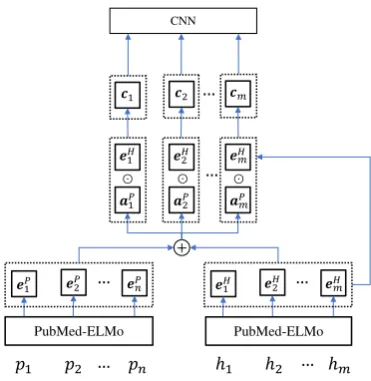
Figure 2: Overview of the CompAggr model.
and Jiang, 2016). In addition to the CompAggr model, we adopt PubMed-ELMo, that is trained with medical domain corpus and released as one of contributed ELMo models (Peters et al.,2018;
Peters,2018), to alleviate the lack of training cor-pus for the shared task. The final model consists of four parts which are shown in figure2.
Word representation: PremiseP∈Rd×nand
hy-pothesisH∈Rd×m, (whered is a dimensionality
of word embedding andn,mare length of the se-quences inPandH, receptively), are processed to capture contextual information within the sentence by using pretrained PubMed ELMo (Peters et al.,
2018) as follows:
EP =PubMed-ELMo(P),
EH =PubMed-ELMo(H). (4)
Attention: The soft aliment of the EP andEH
are computed by applying an attention mechanism over the column vector inEP for each column vec-tor in EH. Using an attention weightαi for each column vector in EP, we obtain a corresponding vectorAP∈Rd×mfrom weighted sum of the
col-umn vectors ofEP.
AP =EP · softmax((WEP)|EH), (5)
whereWis a learned model parameter matrix.
Comparison: We use an element-wise
multipli-cation as a comparison function to combine each pair ofAP andEH into a vectorC∈Rd×m.
Aggregation: FinallyKim(2014)’s CNN withn
-types of filters is applied to aggregate all the infor-mation followed by another fully connected layer
to classify thePandHpair as follow:
R=CNN(C), (R∈Rnd)
ˆ
yc=softmax((R)|W+b),
(6)
where yˆc is the predicted probability distribution for the target classes and theW∈Rnd×3 and bias bare learned model parameters.
Our loss function is cross-entropy between pre-dicted labels and true-labels as follow:
L=−log
N
Y
i=1
C
X
c=1
yi,clog(ˆyi,c), (7)
where yi,c is the true label vector, and yˆi,c is the predicted probability from the softmax layer.Cis the total number of classes (entailment, contradic-tion, and neutral for this task), andN is the total number of samples used in training.
4.3 Transfer learning
Pan and Yang(2010) provide definitions of trans-fer learning as follows:
Definition 1 (Transfer Learning) Given a source
domainDS and learning taskTS, a target domain DT and learning taskTT,transfer learningaims to help improve the learning of the target predictive functionfT(·) inDT using the knowledge in DS andTS, whereDs6=DT, orTS 6=TT.
While MedNLI has a relatively large amount of training data in the clinical domain, NLI tasks in general domain such as SNLI (Bowman et al.,
2015) and MNLI (Williams et al.,2018) have way larger training data than MedNLI has. Since a source and a target task in different domains can improve a model performance if they are related to each other we decide to use the two general do-main NLI tasks to train BERT and BioBERT to transfer their knowledge for MedNLI. Our case is DS 6= DT where the feature spaces between the domains are different or the marginal probability distributions between domain datasets are differ-ent (P(XS)6=P(XT)).
4.4 Abbreviation expansion
Not unlike other medical text, abbreviations and acronyms are easily found throughout the text in MedNLI as table 1 shows from # 4 to 6. In or-der to unor-derstand the effect of expanded forms for clinical abbreviations, we replace the abbre-viations with corresponding expanded forms. As
Dataset Accuracy
dev test
+PMC 80.50 78.97
+PubMedd 81.14 78.83
[image:5.595.309.524.63.161.2]+PubMed+PMC 82.15 79.04
Table 2: The BioBERT performance on the MedNLI task. Each model is trained on three different combina-tions of PMC and PubMed datasets (top score marked as bold).
or dictionary for clinical abbreviations is available we gather and exploit the public medical abbrevi-ations from Taber’s Online2.
5 Experiments
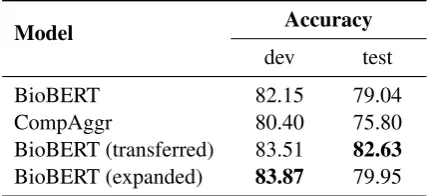
We explore three kinds of BioBERT that are fine-tuned from the original BERT with PMC, PubMed, and PMC+PubMed datasets. As shown in table 2, BioBERT trained on PubMed+PMC performs the best. Thus we select it as a base BioBERT model for the rest of the experiments. Depends on a need for comparison or better un-derstanding, we also include original BERT in the experiments and report the results. The overall re-sults of MedNLI are shown in table3.
5.1 Experimental Setup
All experiments based on BioBERT and BERT have a fixed learning rate 2e-5. We add early stop-ping to stop the models from learning if evaluation loss has not decreased for 4 steps where 1 step is defined 20% of the whole training data. Other than the learning rate and early stopping, all settings are the same as they are in BioBERT and BERT.
For the CompAggr model, we use a context pro-jection weight matrix with 100 dimensions. In the aggregation part, we use 1-D CNN with a total of 500 filters, which involved five types of fil-tersK∈R{1,2,3,4,5}×100, 100 per type. The weight
matrices for the filters were initialized using the Xavier method (Glorot and Bengio,2010). We use the Adam optimizer (Kingma and Ba, 2014) in-cluding gradient clipping by norm at a threshold of 5. For the purpose of regularization, we applied dropout (Srivastava et al.,2014) with a ratio of 0.7.
2
https://www.tabers.com/tabersonline/view/Tabers-Dictionary/767492/all/Medical˙Abbreviations
Model Accuracy
dev test
BioBERT 82.15 79.04
CompAggr 80.40 75.80
BioBERT (transferred) 83.51 82.63
BioBERT (expanded) 83.87 79.95
Table 3: The model performance of four different meth-ods (top score marked as bold). BioBERT (transferred) and BioBERT (expanded) refer to the best results of transfer learning experiments and the result of MedNLI with abbreviation expansion on BioBERT respectively.
5.2 Performance evaluation
Transfer learning: We conduct transfer
learn-ing on four different combinations of MedNLI, SNLI, and MNLI as it shown in the table 4(line 4 to 7) and also add the results of general domain tasks (MNLI, SNLI) for comparison. As expected, BERT performs better on tasks in the general do-main while BioBERT performs better on MedNLI which is in the clinical domain.
In overall, positive transfer occurs on MedNLI. There are three things we can observe from the re-sults. First of all, even though BioBERT is fine-tuned on general domain tasks before MedNLI, transfer learning shows better results than that fine-tuned on MedNLI directly. It implies that the same tasks in different domains have overlapping knowledge and transfer learning between the tasks effects positively on each other as the definition of transfer learning mentions in section 4. Sec-ond, the domain specific language representations from BioBERT are maintained while fine-tuning on general domain tasks by showing that the trans-fer learning results of MedNLI on BioBERT have better performance than the results on BERT (line 4 to 7). Lastly, the accuracy of MNLI and SNLI on BioBERT is lower than the accuracy on BERT. The lower accuracy indicates that BioBERT cap-tures different feacap-tures such as medical terms and generate different representations than what BERT does which are helpful for the clinical domain task, MedNLI, but not for the other two tasks.
The best combination is SNLI → MNLI → MedNLI on BioBERT. We refer to the best result of transfer learning as BioBERT (transferred).
Results analysis for different models: There are
[image:5.595.77.288.64.146.2]Dataset BERT BioBERT
dev test dev test
MedNLI 79.56 77.49 82.15 79.04
MNLI (M) 83.52 - 81.23
-SNLI (S) 90.39 - 89.10
-M→MedNLI 80.14 78.62 82.72 80.80
S →MedNLI 80.28 78.19 83.29 81.29
M→S→MedNLI 80.43 78.12 83.29 80.30
S→M→MedNLI 81.72 77.98 83.51 82.63
MedNLI (expanded) 79.13 77.07 83.87 79.95
[image:6.595.84.515.63.250.2]S→M→MedNLI (expanded) 82.15 79.95 83.08 81.85
Table 4: All experiment results of transfer learning and abbreviation expansion (top-2 scores marked as bold). MedNLI (expanded) denotes MedNLI with abbreviation expansion.
7% BioBERT
CompAggr
66% 13%
14%
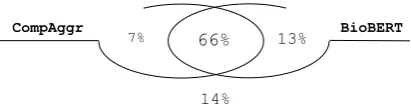
Figure 3: Venn diagram for the test results of Compare Aggregate model and BioBERT.
to sub-word level and uses the transformer model while CompAggr uses word-level embeddings and Compare&Aggregate model. In light of the dis-similar nature, we expect each model captures dif-ferent features and generates difdif-ferent language representations.
Figure 3 shows the percentage for each area takes of the test set. CompAggr correctly classifies 97 examples (7% of the test set) which BioBERT classifies them incorrectly while BioBERT clas-sifies 188 examples correctly (13% of the test set) which CompAggr does not. It demonstrates that both models have different strength on the MedNLI task.
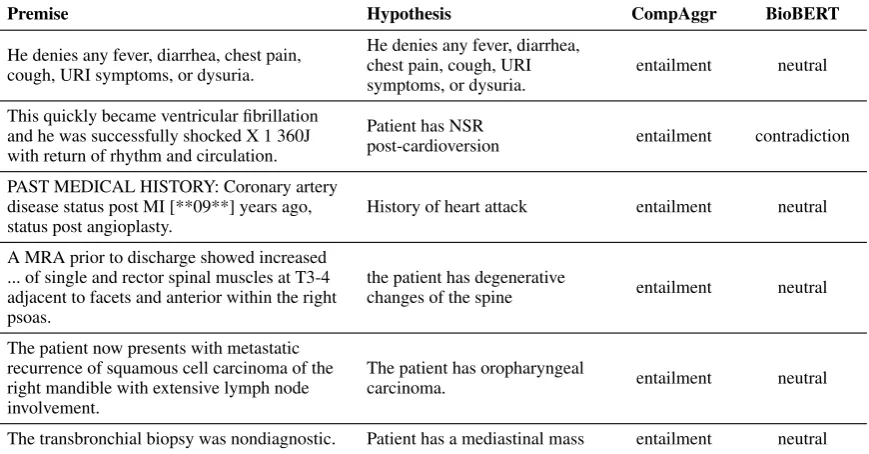
We manually examine all promise and hypoth-esis pairs of each portion of 7% and 13% of the test set with high confidence and “element” label. For CompAggr, we pick pairs with the probability higher than 0.80 which are 6 pairs. For BioBERT, we select pairs with top 10 probabilities. Interest-ingly, each pair from CompAggr does not have overlapping words between premise and hypoth-esis. It appears that CompAggr’s strength is in it’s ability to capture the relationship between two sentences even though there is no word overlap while BioBERT labels them “neutral” except one
pair as you can see in table5. In contrast, the ma-jority of the pairs, 7 out of 10, from BioBERT have overlapping words between them. Biobert shows strong confidence when premise and hypothesis have overlapping words as below.
• (Premise) En route to the Emergency De-partment, she developed worsening subster-nal chest pain without any radiation.
• (Hypothesis) patient has chest pain
Lastly, we compute the average conditional probability of the correct results to check the con-fidence of each model. The results are 0.87 and 0.82 for BioBERT and CompAggr showing that BioBERT predicts labels with higher confidence.
Abbreviation expansion: We refer to the
dataset of MedNLI with abbreviation expansion as MedNLI (expanded). The inconsistency of the experiment results on MedNLI (expanded) makes it difficult to observe their effects. MedNLI (ex-panded) shows better performance than MedNLI on BioBERT while MedNLI works better on BERT (see table4). Furthermore, the performance of MedNLI (expanded) with transfer learning is higher on BERT and lower on BioBERT than the performance of MedNLI with transfer learning.
[image:6.595.78.284.300.353.2]Premise Hypothesis CompAggr BioBERT
He denies any fever, diarrhea, chest pain, cough, URI symptoms, or dysuria.
He denies any fever, diarrhea, chest pain, cough, URI symptoms, or dysuria.
entailment neutral
This quickly became ventricular fibrillation and he was successfully shocked X 1 360J with return of rhythm and circulation.
Patient has NSR
post-cardioversion entailment contradiction
PAST MEDICAL HISTORY: Coronary artery disease status post MI [**09**] years ago, status post angioplasty.
History of heart attack entailment neutral
A MRA prior to discharge showed increased ... of single and rector spinal muscles at T3-4 adjacent to facets and anterior within the right psoas.
the patient has degenerative
changes of the spine entailment neutral
The patient now presents with metastatic recurrence of squamous cell carcinoma of the right mandible with extensive lymph node involvement.
The patient has oropharyngeal
carcinoma. entailment neutral
The transbronchial biopsy was nondiagnostic. Patient has a mediastinal mass entailment neutral
Table 5: Examples with the highest probabilities showing the strength of CompAggr.
Rank Team Accuracy
1 WTMED 98.0
2 PANLP 96.6
3 Double Transfer 93.8
4 Sieg 91.1
5 Surf (ours) 90.6
6 ARS NITK 87.7
7 Pentagon 85.7
8 Dr.Quad 85.5
9 UU TAILS 85.2
[image:7.595.83.518.64.291.2]10 KU ai 84.7
Table 6: Performance comparison among the top-10 participants (official) of the NLI shared task. Teams [1-4, 6-10] are from (Wu et al.,2019;Zhu et al.,2019;Xu et al.,2019;Bhaskar et al.,2019;Agrawal et al.,2019;
Pugaliya et al.,2019; Bannihatti Kumar et al.,2019;
Tawfik and Spruit,2019;Cengiz et al.,2019), respec-tively.
classes. For instance, a pair of Premise and Hy-pothesislike below is not changed after abbrevia-tion expansion since it does not contain any abbre-viations or acronyms.
• (Premise) He denied headache or nausea or vomiting.
• (Hypothesis) He is afebrile.
However, the results are different. It is originally classified into “neutral” which is the right label for the pair but it is classified into “entailment” when we use MedNLI (expanded).
5.3 MEDIQA-NLI shared task
We are participating in a shared task MEDIQA-NLI of the bioNLP workshop at ACL 2019. In or-der to solve the task, we try four different point-wise approaches, CompAggr, BioBERT, transfer learning, and abbreviation expansion. We run each model several times to obtain the best result out of each. Our best result, which is ranked 5th on the leaderboard of the task, is obtained by ap-plying list-wise approach (in section 3) with the best result (BioBERT (transferred)). Table6shows the model performance of each participant in the leaderboard.
6 Conclusion
observe that it transfers positive knowledge from general NLI tasks to the MedNLI task. In contrast, a abbreviation expansion method needs particular care when adopting since it may hurt the model to predict the conditional probability distribution of the task.
Acknowledgments
We sincerely thank the reviewers for their in depth feedback that helped improve the paper. K. Jung is with Automation and Systems Research Institute (ASRI), Seoul National University, Seoul, Korea, and was supported by the Ministry of Trade, In-dustry & Energy (MOTIE, Korea) under Industrial Technology Innovation Program (No.10073144).
References
Anumeha Agrawal, Rosa Anil George, Selvan Sunitha Ravi, Sowmya Kamath, and Anand Kumar. 2019. Ars nitk at mediqa 2019:analysing various methods for natural language inference, recognising question entailment and medical question answering system. InProceedings of the BioNLP 2019 workshop, Flo-rence, Italy, August 1, 2019. Association for Com-putational Linguistics.
Vinayshekhar Bannihatti Kumar, Ashwin Srinivasan, Aditi Chaudhary, James Route, Teruko Mitamura, and Eric Nyberg. 2019. Dr.quad at mediqa 2019: Towards textual inference and question entailment using contextualized representations. In Proceed-ings of the BioNLP 2019 workshop, Florence, Italy, August 1, 2019. Association for Computational Lin-guistics.
Asma Ben Abacha, Chaitanya Shivade, and Dina Demner-Fushman. 2019. Overview of the mediqa 2019 shared task on textual inference, question en-tailment and question answering. InProceedings of the BioNLP 2019 workshop, Florence, Italy, August 1, 2019. Association for Computational Linguistics.
Sai Abishek Bhaskar, Rashi Rungta, James Route, Eric Nyberg, and Teruko Mitamura. 2019. Sieg at mediqa 2019: Multi-task neural ensemble for biomedical inference and entailment. In Proceed-ings of the BioNLP 2019 workshop, Florence, Italy, August 1, 2019. Association for Computational Lin-guistics.
Samuel R Bowman, Gabor Angeli, Christopher Potts, and Christopher D Manning. 2015. A large anno-tated corpus for learning natural language inference. In Proceedings of the 2015 Conference on Empiri-cal Methods in Natural Language Processing, pages 632–642.
Cemil Cengiz, Ulas¸ Sert, and Deniz Yuret. 2019. Ku ai at mediqa 2019: Domain-specific pre-training and
transfer learning for medical nli. InProceedings of the BioNLP 2019 workshop, Florence, Italy, August 1, 2019. Association for Computational Linguistics.
Qian Chen, Xiaodan Zhu, Zhen-Hua Ling, Si Wei, Hui Jiang, and Diana Inkpen. 2017. Enhanced lstm for natural language inference. In Proceedings of the 55th Annual Meeting of the Association for Compu-tational Linguistics (Volume 1: Long Papers), pages 1657–1668.
Alexis Conneau, Douwe Kiela, Holger Schwenk, Lo¨ıc Barrault, and Antoine Bordes. 2017. Supervised learning of universal sentence representations from natural language inference data. InProceedings of the 2017 Conference on Empirical Methods in Nat-ural Language Processing, pages 670–680.
Jacob Devlin, Ming-Wei Chang, Kenton Lee, and Kristina Toutanova. 2018. Bert: Pre-training of deep bidirectional transformers for language understand-ing.arXiv preprint arXiv:1810.04805.
Xavier Glorot and Yoshua Bengio. 2010. Understand-ing the difficulty of trainUnderstand-ing deep feedforward neural networks. InProceedings of the AISTATS.
Alistair EW Johnson, Tom J Pollard, Lu Shen, H Lehman Li-wei, Mengling Feng, Moham-mad Ghassemi, Benjamin Moody, Peter Szolovits, Leo Anthony Celi, and Roger G Mark. 2016. Mimic-iii, a freely accessible critical care database.
Scientific data, 3:160035.
Yoon Kim. 2014. Convolutional neural networks for sentence classification. InProceedings of the 2014 Conference on Empirical Methods in Natural Lan-guage Processing (EMNLP), pages 1746–1751.
Diederik Kingma and Jimmy Ba. 2014. Adam: A method for stochastic optimization. arXiv preprint arXiv:1412.6980.
Jinhyuk Lee, Wonjin Yoon, Sungdong Kim, Donghyeon Kim, Sunkyu Kim, Chan Ho So, and Jaewoo Kang. 2019. Biobert: pre-trained biomed-ical language representation model for biomedbiomed-ical text mining. arXiv preprint arXiv:1901.08746.
Xiaodong Liu, Pengcheng He, Weizhu Chen, and Jian-feng Gao. 2019. Multi-task deep neural networks for natural language understanding. arXiv preprint arXiv:1901.11504.
Yue Liu, Tao Ge, Kusum Mathews, Heng Ji, and Deb-orah McGuinness. 2015. Exploiting task-oriented resources to learn word embeddings for clinical ab-breviation expansion. InProceedings of BioNLP 15, pages 92–97.
Sinno Jialin Pan and Qiang Yang. 2010. A survey on transfer learning. IEEE Transactions on knowledge and data engineering, 22(10):1345–1359.
Matthew Peters. 2018. PubMed ELMo. https: //allennlp.org/elmo. [Online; accessed 09-May-2019].
Matthew Peters, Mark Neumann, Mohit Iyyer, Matt Gardner, Christopher Clark, Kenton Lee, and Luke Zettlemoyer. 2018. Deep contextualized word rep-resentations. In Proceedings of the 2018 Confer-ence of the North American Chapter of the Asso-ciation for Computational Linguistics: Human Lan-guage Technologies, Volume 1 (Long Papers), pages 2227–2237.
Hemant Pugaliya, Karan Saxena, Shefali Garg, Shee-tal Shalini, Prashant Gupta, Eric Nyberg, and Teruko Mitamura. 2019. Pentagon at mediqa 2019: Multi-task learning for filtering and re-ranking answers us-ing language inference and question entailment. In
Proceedings of the BioNLP 2019 workshop, Flo-rence, Italy, August 1, 2019. Association for Com-putational Linguistics.
Alexey Romanov and Chaitanya Shivade. 2018. Lessons from natural language inference in the clin-ical domain. InProceedings of the 2018 Conference on Empirical Methods in Natural Language Pro-cessing, pages 1586–1596.
Nitish Srivastava, Geoffrey E Hinton, Alex Krizhevsky, Ilya Sutskever, and Ruslan Salakhutdinov. 2014. Dropout: a simple way to prevent neural networks from overfitting. Journal of machine learning re-search, 15(1):1929–1958.
Sandeep Subramanian, Adam Trischler, Yoshua Ben-gio, and Christopher J Pal. 2018. Learning gen-eral purpose distributed sentence representations via large scale multi-task learning. InICLR.
Noha Tawfik and Marco Spruit. 2019. Uu tails at mediqa 2019: Learning textual entailment in the medical domain. In Proceedings of the BioNLP 2019 workshop, Florence, Italy, August 1, 2019. As-sociation for Computational Linguistics.
Ashish Vaswani, Noam Shazeer, Niki Parmar, Jakob Uszkoreit, Llion Jones, Aidan N Gomez, Łukasz Kaiser, and Illia Polosukhin. 2017. Attention is all you need. InAdvances in neural information pro-cessing systems, pages 5998–6008.
Alex Wang, Amapreet Singh, Julian Michael, Felix Hill, Omer Levy, and Samuel R Bowman. 2018. Glue: A multi-task benchmark and analysis platform for natural language understanding. arXiv preprint arXiv:1804.07461.
Shuohang Wang and Jing Jiang. 2016. A compare-aggregate model for matching text sequences. arXiv preprint arXiv:1611.01747.
Adina Williams, Nikita Nangia, and Samuel Bowman. 2018. A broad-coverage challenge corpus for sen-tence understanding through inference. In Proceed-ings of the 2018 Conference of the North American Chapter of the Association for Computational Lin-guistics: Human Language Technologies, Volume 1 (Long Papers), pages 1112–1122.
Zhaofeng Wu, Yan Song, Sicong Huang, Yuanhe Tian, and Fei Xia. 2019. A hybrid approach to biomedical natural language inference. In Proceedings of the BioNLP 2019 workshop, Florence, Italy, August 1, 2019. Association for Computational Linguistics.
Yichong Xu, Xiaodong Liu, Chunyuan Li, Hoifung Poon, and Jianfeng Gao. 2019. Doubletransfer at mediqa 2019: Multi-source transfer learning for nat-ural language understanding in the medical domain. InProceedings of the BioNLP 2019 workshop, Flo-rence, Italy, August 1, 2019. Association for Com-putational Linguistics.