503
Automated essay scoring with string kernels and word embeddings
M˘ad˘alina Cozma and Andrei M. Butnaru and Radu Tudor Ionescu University of Bucharest
Department of Computer Science 14 Academiei, Bucharest, Romania [email protected]
Abstract
In this work, we present an approach based on combining string kernels and word em-beddings for automatic essay scoring. String kernels capture the similarity among strings based on counting common character n-grams, which are a low-level yet powerful type of feature, demonstrating state-of-the-art results in various text classification tasks such as Arabic dialect identification or native language identification. To our best knowl-edge, we are the first to apply string kernels to automatically score essays. We are also the first to combine them with a high-level semantic feature representation, namely the bag-of-super-word-embeddings. We report the best performance on the Automated Stu-dent Assessment Prize data set, in both in-domain and cross-in-domain settings, surpass-ing recent state-of-the-art deep learnsurpass-ing ap-proaches.
1 Introduction
Automatic essay scoring (AES) is the task of as-signing grades to essays written in an educational setting, using a computer-based system with nat-ural language processing capabilities. The aim of designing such systems is to reduce the involve-ment of human graders as far as possible. AES is a challenging task as it relies on grammar as well as semantics, pragmatics and discourse (Song et al., 2017). Although traditional AES methods typi-cally rely on handcrafted features (Larkey,1998; Foltz et al.,1999;Attali and Burstein,2006;Dikli, 2006; Wang and Brown, 2008; Chen and He, 2013;Somasundaran et al.,2014;Yannakoudakis et al.,2014;Phandi et al.,2015), recent results in-dicate that state-of-the-art deep learning methods reach better performance (Alikaniotis et al.,2016; Dong and Zhang,2016;Taghipour and Ng,2016; Dong et al., 2017; Song et al., 2017; Tay et al., 2018), perhaps because these methods are able to
capture subtle and complex information that is rel-evant to the task (Dong and Zhang,2016).
In this paper, we propose to combine string kernels (low-level character n-gram features) and word embeddings (high-level semantic features) to obtain state-of-the-art AES results. Since recent methods based on string kernels have demonstrated remarkable performance in various text classification tasks ranging from authorship identification (Popescu and Grozea, 2012) and sentiment analysis (Gim´enez-P´erez et al., 2017; Popescu et al., 2017) to native language iden-tification (Popescu and Ionescu, 2013; Ionescu et al., 2014;Ionescu, 2015;Ionescu et al., 2016; Ionescu and Popescu, 2017) and dialect identifi-cation (Ionescu and Popescu, 2016; Ionescu and Butnaru,2017), we believe that string kernels can reach equally good results in AES. To the best of our knowledge, string kernels have never been used for this task. As string kernels are a simple approach that relies solely on character n-grams as features, it is fairly obvious that such an approach will not to cover several aspects (e.g.: semantics, discourse) required for the AES task. To solve this problem, we propose to combine string ker-nels with a recent approach based on word embed-dings, namely the bag-of-super-word-embeddings (BOSWE) (Butnaru and Ionescu, 2017). To our knowledge, this is the first successful attempt to combine string kernels and word embeddings. We evaluate our approach on the Automated Student Assessment Prize data set, in both in-domain and cross-domain settings. The empirical results in-dicate that our approach yields a better perfor-mance than state-of-the-art approaches (Phandi et al.,2015;Dong and Zhang,2016;Dong et al., 2017;Tay et al.,2018).
2 Method
do-main. For example, in text mining, string ker-nels can be used to measure the pairwise similar-ity between text samples, simply based on charac-ter n-grams. Various string kernel functions have been proposed to date (Lodhi et al.,2002; Shawe-Taylor and Cristianini,2004;Ionescu et al.,2014). One of the most recent string kernels is the his-togram intersection string kernel(HISK) (Ionescu et al.,2014). For two strings over an alphabetΣ,
x, y ∈ Σ∗, the intersection string kernel is for-mally defined as follows:
k∩(x, y) = X v∈Σn
min{numv(x),numv(y)}, (1)
where numv(x) is the number of occurrences of n-gram vas a substring in x, and nis the length ofv. In our AES experiments, we use the inter-section string kernel based on a range of charac-ter n-grams. We approach AES as a regression task, and employν-Support Vector Regression (ν -SVR) (Suykens and Vandewalle, 1999; Shawe-Taylor and Cristianini,2004) for training.
Bag-of-super-word-embeddings. Word embed-dings are long known in the NLP community (Bengio et al.,2003;Collobert and Weston,2008), but they have recently become more popular due to theword2vec(Mikolov et al.,2013) framework that enables the building of efficient vector repre-sentations from words. On top of the word embed-dings, Butnaru and Ionescu(2017) developed an approach termed bag-of-super-word-embeddings
(BOSWE) by adapting an efficient computer vi-sion technique, the bag-of-visual-words model (Csurka et al.,2004), for natural language process-ing tasks. The adaptation consists of replacprocess-ing the image descriptors (Lowe,2004) useful for recog-nizing object patterns in images with word embed-dings (Mikolov et al.,2013) useful for recognizing semantic patterns in text documents.
The BOSWE representation is computed as fol-lows. First, each word in the collection of training documents is represented as word vector using a pre-trained word embeddings model. Based on the fact that word embeddings carry semantic infor-mation by projecting semantically related words in the same region of the embedding space, the next step is to cluster the word vectors in order to ob-tain relevant semantic clusters of words. As in the standard bag-of-visual-words model, the cluster-ing is done by k-means (Leung and Malik,2001), and the formed centroids are stored in a random-ized forest of k-d trees (Philbin et al.,2007) to
re-duce search cost. The centroid of each cluster is interpreted as a super word embedding or super word vectorthat embodies all the semantically re-lated word vectors in a small region of the embed-ding space. Every embedded word in the collec-tion of documents is then assigned to the nearest cluster centroid (the nearest super word vector). Put together, the super word vectors generate a vo-cabulary (codebook) that can further be used to describe each document as a bag-of-super-word-embeddings. To obtain the BOSWE represenation for a document, we just have to compute the oc-currence count of each super word embedding in the respective document. After building the repre-sentation, we employ a kernel method to train the BOSWE model for our specific task. To be con-sistent with the string kernel approach, we choose the histogram intersection kernel and the same re-gression method, namelyν-SVR.
Model fusion. In the primal form, a linear classi-fier takes as input a feature matrixXofrsamples (rows) with m features (columns) and optimizes a set of weights in order to reproduce ther train-ing labels. In the dual form, the linear classifier takes as input a kernel matrix K of r ×r com-ponents, where each componentkij is the similar-ity between examplesxi andxj. Kernel methods work by embedding the data in a Hilbert space and by searching for linear relations in that space, us-ing a learnus-ing algorithm. The embeddus-ing can be performed either(i)implicitly, by directly speci-fying the similarity function between each pair of samples, or(ii)explicitly, by first giving the em-bedding mapφand by computing the inner prod-uct between each pair of samples embedded in the Hilbert space. For the linear kernel, the associ-ated embedding map isφ(x) = xand options(i) or(ii)are equivalent, i.e. the similarity function is the inner product. Hence, the linear kernel ma-trix K can be obtained as K = X ·X0, where
Prompt Number of Essays Score Range
1 1783 2-12
2 1800 1-6
3 1726 0-3
4 1726 0-3
5 1772 0-4
6 1805 0-4
6 1569 0-30
6 723 0-60
Table 1: The number of essays and the score ranges for the 8 different prompts in the Auto-mated Student Assessment Prize (ASAP) data set.
this statement, let us suppose that we can define the embedding map of the histogram intersection kernel and, consequently, we can obtain the cor-responding feature matrix of HISK with r×m1
components denoted by X1 and the
correspond-ing feature matrix of BOSWE withr×m2
com-ponents denoted by X2. We can now combine
HISK and BOSWE in two ways. One way is to compute the corresponding kernel matricesK1 =
X1·X10 andK2 =X2·X20, and to sum the matrices
into a single kernel matrixK+ = K1+K2. The
other way is to first concatenate the feature ma-trices into a single feature matrixX+ = [X1X2]
ofr ×(m1 +m2) components, and to compute
the final kernel matrix using the inner product, i.e. K+ = X+ ·X+0 . Either way, the two
ap-proaches, HISK and BOSWE, are fused before the learning stage. As a consequence of kernel sum-mation, the search space of linear patterns grows, which should help the kernel classifier, in our case
ν-SVR, to find a better regression function.
3 Experiments
Data set. To evaluate our approach, we use the Automated Student Assessment Prize (ASAP) 1 data set from Kaggle. The ASAP data set contains 8 prompts of different genres. The number of es-says per prompt along with the score ranges are presented in Table1. Since the official test data of the ASAP competition is not released to the pub-lic, we, as well as others before us (Phandi et al., 2015;Dong and Zhang,2016;Dong et al.,2017; Tay et al.,2018), use only the training data in our experiments.
Evaluation procedure. As Dong and Zhang (2016), we scaled the essay scores into the range
1
https://www.kaggle.com/c/asap-aes/data
0-1. We closely followed the same settings for data preparation as (Phandi et al.,2015;Dong and Zhang, 2016). For the in-domain experiments, we use 5-fold validation. The 5-fold cross-validation procedure is repeated for 10 times and the results were averaged to reduce the accuracy variation introduced by randomly selecting the folds. We note that the standard deviation in all cases in below0.2%.
For the cross-domain experiments, we use the same source→target domain pairs as (Phandi et al., 2015; Dong and Zhang, 2016), namely, 1→2, 3→4, 5→6 and 7→8. All essays in the source domain are used as training data. Target domain samples are randomly divided into 5 folds, where one fold is used as test data, and the other 4 folds are collected together to sub-sample tar-get domain train data. The sub-sample sizes are
nt = {10,25,50,100}. The sub-sampling is re-peated for 5 times as in (Phandi et al.,2015;Dong and Zhang,2016) to reduce bias. As our approach performs very well in the cross-domain setting, we also present experimentswithoutsub-sampling data from the target domain, i.e. when the sub-sample size isnt = 0. As evaluation metric, we use the quadratic weighted kappa (QWK).
Baselines. We compare our approach with state-of-the-art methods based on handcrafted features (Phandi et al., 2015), as well as deep features (Dong and Zhang, 2016; Dong et al., 2017; Tay et al., 2018). We note that results for the cross-domain setting are reported only in some of these recent works (Phandi et al., 2015; Dong and Zhang,2016).
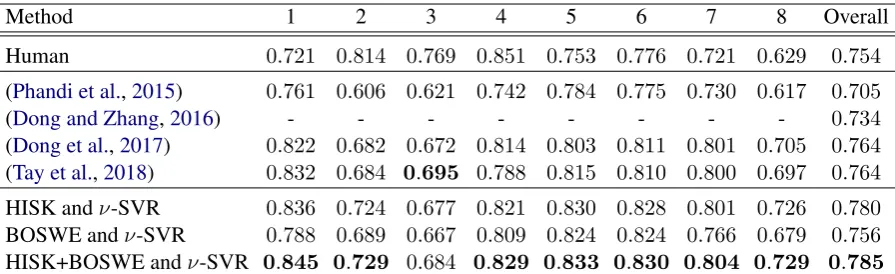
Method 1 2 3 4 5 6 7 8 Overall
Human 0.721 0.814 0.769 0.851 0.753 0.776 0.721 0.629 0.754
[image:4.595.75.523.61.198.2](Phandi et al.,2015) 0.761 0.606 0.621 0.742 0.784 0.775 0.730 0.617 0.705 (Dong and Zhang,2016) - - - 0.734 (Dong et al.,2017) 0.822 0.682 0.672 0.814 0.803 0.811 0.801 0.705 0.764 (Tay et al.,2018) 0.832 0.684 0.695 0.788 0.815 0.810 0.800 0.697 0.764 HISK andν-SVR 0.836 0.724 0.677 0.821 0.830 0.828 0.801 0.726 0.780 BOSWE andν-SVR 0.788 0.689 0.667 0.809 0.824 0.824 0.766 0.679 0.756 HISK+BOSWE andν-SVR 0.845 0.729 0.684 0.829 0.833 0.830 0.804 0.729 0.785
Table 2: In-domain automatic essay scoring results of our approach versus several state-of-the-art meth-ods (Phandi et al.,2015;Dong and Zhang,2016;Dong et al.,2017;Tay et al.,2018). Results are reported in terms of the quadratic weighted kappa (QWK) measure, using 5-fold cross-validation. The best QWK score (among the machine learning systems) for each prompt is highlighted in bold.
computing the BOSWE representation, we apply the L1-normalized intersection kernel. We
com-bine HISK and BOSWE in the dual form by sum-ming up the two corresponding matrices. For the learning phase, we employ the dual implementa-tion of ν-SVR available in LibSVM (Chang and Lin,2011). We set its regularization parameter to
c= 103andν = 10−1 in all our experiments. In-domain results. The results for the in-domain automatic essay scoring task are presented in Ta-ble2. In our empirical study, we also include fea-ture ablation results. We report the QWK mea-sure on each prompt as well as the overall av-erage. We first note that the histogram intersec-tion string kernel alone reaches better overall per-formance (0.780) than all previous works (Phandi et al.,2015;Dong and Zhang,2016;Dong et al., 2017; Tay et al., 2018). Remarkably, the over-all performance of the HISK is also higher than the inter-human agreement (0.754). Although the BOSWE model can be regarded as a shallow ap-proach, its overall results are comparable to those of deep learning approaches (Dong and Zhang, 2016;Dong et al.,2017;Tay et al.,2018). When we combine the two models (HISK and BOSWE), we obtain even better results. Indeed, the combi-nation of string kernels and word embeddings at-tains the best performance on 7 out of 8 prompts. The average QWK score of HISK and BOSWE (0.785) is more than2%better the average scores of the best-performing state-of-the-art approaches (Dong et al.,2017;Tay et al.,2018).
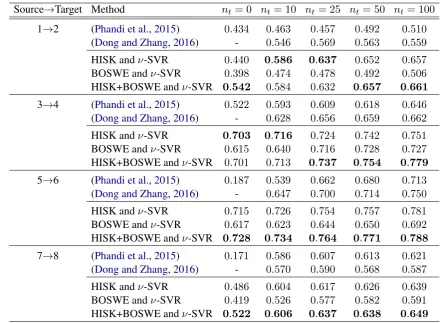
Cross-domain results. The results for the cross-domain automatic essay scoring task are presented in Table3. For each and every source→target pair, we report better results than both state-of-the-art
methods (Phandi et al., 2015; Dong and Zhang, 2016). We observe that the difference between our best QWK scores and the other approaches are sometimes much higher in the cross-domain setting than in the in-domain setting. We par-ticularly notice that the difference from (Phandi et al., 2015) whennt = 0 is always higher than 10%. Our highest improvement (more than54%, from0.187to0.728) over (Phandi et al.,2015) is recorded for the pair 5→6, when nt = 0. Our score in this case (0.728) is even higher than both scores ofPhandi et al.(2015) andDong and Zhang (2016) when they use nt = 50. Different from the in-domain setting, we note that the combina-tion of string kernels and word embeddings does not always provide better results than string ker-nels alone, particularly when the number of target samples (nt) added into the training set is less or equal to 25.
Discussion. It is worth noting that in a set of pre-liminary experiments (not included in the paper), we actually considered another approach based on word embeddings. We tried to obtain a document embedding by averaging the word vectors for each document. We computed the average as well as the standard deviation for each component of the word vectors, resulting in a total of 600features, since the word vectors are 300-dimensional. We ap-plied this method in the in-domain setting and we obtained a surprisingly low overall QWK score, around 0.251. We concluded that this simple ap-proach is not useful, and decided to use BOSWE (Butnaru and Ionescu,2017) instead.
Unfortu-Source→Target Method nt= 0 nt= 10 nt= 25 nt= 50 nt= 100
1→2 (Phandi et al.,2015) 0.434 0.463 0.457 0.492 0.510 (Dong and Zhang,2016) - 0.546 0.569 0.563 0.559 HISK andν-SVR 0.440 0.586 0.637 0.652 0.657 BOSWE andν-SVR 0.398 0.474 0.478 0.492 0.506 HISK+BOSWE andν-SVR 0.542 0.584 0.632 0.657 0.661
3→4 (Phandi et al.,2015) 0.522 0.593 0.609 0.618 0.646 (Dong and Zhang,2016) - 0.628 0.656 0.659 0.662 HISK andν-SVR 0.703 0.716 0.724 0.742 0.751 BOSWE andν-SVR 0.615 0.640 0.716 0.728 0.727 HISK+BOSWE andν-SVR 0.701 0.713 0.737 0.754 0.779
5→6 (Phandi et al.,2015) 0.187 0.539 0.662 0.680 0.713 (Dong and Zhang,2016) - 0.647 0.700 0.714 0.750 HISK andν-SVR 0.715 0.726 0.754 0.757 0.781 BOSWE andν-SVR 0.617 0.623 0.644 0.650 0.692 HISK+BOSWE andν-SVR 0.728 0.734 0.764 0.771 0.788
[image:5.595.74.516.60.383.2]7→8 (Phandi et al.,2015) 0.171 0.586 0.607 0.613 0.621 (Dong and Zhang,2016) - 0.570 0.590 0.568 0.587 HISK andν-SVR 0.486 0.604 0.617 0.626 0.639 BOSWE andν-SVR 0.419 0.526 0.577 0.582 0.591 HISK+BOSWE andν-SVR 0.522 0.606 0.637 0.638 0.649
Table 3: Corss-domain automatic essay scoring results of our approach versus two state-of-the-art meth-ods (Phandi et al.,2015;Dong and Zhang,2016). Results are reported in terms of the quadratic weighted kappa (QWK) measure, using the same evaluation procedure as (Phandi et al.,2015;Dong and Zhang, 2016). The best QWK scores for each source→target domain pair are highlighted in bold.
nately, this is not possible because our approach works in the dual space and we cannot transform the dual weights into primal weights, as long as the histogram intersection kernel does not have an explicit embedding map associated to it. In future work, however, we aim to replace the histogram intersection kernel with the presence bits kernel, which will enable us to perform an error analysis based on the overused or underused patterns, as described byIonescu et al.(2016).
4 Conclusion
In this paper, we described an approach based on combining string kernels and word embeddings for automatic essay scoring. We compared our approach on the Automated Student Assessment Prize data set, in both in-domain and cross-domain settings, with several state-of-the-art approaches (Phandi et al.,2015;Dong and Zhang,2016;Dong et al., 2017; Tay et al., 2018). Overall, the in-domain and the cross-in-domain comparative studies indicate that string kernels, both alone and in com-bination with word embeddings, attain the best
performance on the automatic essay scoring task. Using a shallow approach, we report better re-sults compared to recent deep learning approaches (Dong and Zhang, 2016; Dong et al., 2017; Tay et al.,2018).
Acknowledgments
We thank the reviewers for their useful comments. The work of Radu Tudor Ionescu was partially supported through project grant PN-III-P1-1.1-PD-2016-0787.
References
Dimitrios Alikaniotis, Helen Yannakoudakis, and Marek Rei. 2016. Automatic text scoring using neu-ral networks. In Proceedings of ACL. pages 715– 725.
Yigal Attali and Jill Burstein. 2006. Automated essay scoring with e-rater v. 2.0. Journal of Technology,
Learning, and Assessment4(3):1–30.
Lan-guage Model. Journal of Machine Learning
Re-search3:1137–1155.
Andrei Butnaru and Radu Tudor Ionescu. 2017. From Image to Text Classification: A Novel Approach based on Clustering Word Embeddings. In Proceed-ings of KES. page 17841793.
Chih-Chung Chang and Chih-Jen Lin. 2011. LibSVM: A Library for Support Vector Machines. ACM Transactions on Intelligent Systems and Technol-ogy2:27:1–27:27. Software available athttp://
www.csie.ntu.edu.tw/˜cjlin/libsvm.
Hongbo Chen and Ben He. 2013. Automated essay scoring by maximizing human-machine agreement.
InProceedings of EMNLP. pages 1741–1752.
Ronan Collobert and Jason Weston. 2008. A Uni-fied Architecture for Natural Language Processing: Deep Neural Networks with Multitask Learning. In
Proceedings of ICML. pages 160–167.
Gabriella Csurka, Christopher R. Dance, Lixin Fan, Jutta Willamowski, and Cdric Bray. 2004. Visual categorization with bags of keypoints. In Workshop on Statistical Learning in Computer Vision, ECCV
pages 1–22.
Semire Dikli. 2006. An Overview of Automated Scor-ing of Essays.Journal of Technology, Learning, and
Assessment5(1):1–35.
Fei Dong and Yue Zhang. 2016. Automatic Features for Essay Scoring – An Empirical Study. In
Pro-ceedings of EMNLP. pages 1072–1077.
Fei Dong, Yue Zhang, and Jie Yang. 2017. Attention-based Recurrent Convolutional Neural Network for Automatic Essay Scoring. In Proceedings of
CONLL. pages 153–162.
Peter W. Foltz, Darrell Laham, and Thomas K Lan-dauer. 1999. Automated essay scoring: Applica-tions to educational technology. In Proceedings of
EdMedia. pages 40–64.
Rosa M. Gim´enez-P´erez, Marc Franco-Salvador, and Paolo Rosso. 2017. Single and Cross-domain Polar-ity Classification using String Kernels. In
Proceed-ings of EACL. pages 558–563.
Radu Tudor Ionescu. 2015. A Fast Algorithm for Local Rank Distance: Application to Arabic Native Lan-guage Identification. In Proceedings of ICONIP. volume 9490, pages 390–400.
Radu Tudor Ionescu and Andrei Butnaru. 2017. Learn-ing to Identify Arabic and German Dialects usLearn-ing Multiple Kernels. InProceedings of VarDial
Work-shop of EACL. pages 200–209.
Radu Tudor Ionescu and Marius Popescu. 2016. UnibucKernel: An Approach for Arabic Dialect Identification based on Multiple String Kernels.
In Proceedings of VarDial Workshop of COLING.
pages 135–144.
Radu Tudor Ionescu and Marius Popescu. 2017. Can string kernels pass the test of time in native language identification? InProceedings of the 12th Workshop on Innovative Use of NLP for Building Educational Applications. pages 224–234.
Radu Tudor Ionescu, Marius Popescu, and Aoife Cahill. 2014. Can characters reveal your native lan-guage? a language-independent approach to native language identification. InProceedings of EMNLP. pages 1363–1373.
Radu Tudor Ionescu, Marius Popescu, and Aoife Cahill. 2016. String kernels for native language identification: Insights from behind the curtains.
Computational Linguistics42(3):491–525.
Leah S. Larkey. 1998. Automatic essay grading using text categorization techniques. InProceedings of SI-GIR. pages 90–95.
Thomas Leung and Jitendra Malik. 2001. Representing and Recognizing the Visual Appearance of Materi-als using Three-dimensional Textons. International
Journal of Computer Vision43(1):29–44.
Huma Lodhi, Craig Saunders, John Shawe-Taylor, Nello Cristianini, and Christopher J. C. H. Watkins. 2002. Text classification using string kernels.
Jour-nal of Machine Learning Research2:419–444.
David G. Lowe. 2004. Distinctive Image Features from Scale-Invariant Keypoints. International Journal of
Computer Vision60(2):91–110.
Tomas Mikolov, Ilya Sutskever, Kai Chen, Gregory S. Corrado, and Jeffrey Dean. 2013. Distributed Rep-resentations of Words and Phrases and their Com-positionality. InProceedings of NIPS. pages 3111– 3119.
Peter Phandi, Kian Ming A. Chai, and Hwee Tou Ng. 2015. Flexible Domain Adaptation for Automated Essay Scoring Using Correlated Linear Regression.
InProceedings of EMNLP. pages 431–439.
James Philbin, Ondrej Chum, Michael Isard, Josef Sivic, and Andrew Zisserman. 2007. Object re-trieval with large vocabularies and fast spatial matching. InProceedings of CVPR. pages 1–8.
Marius Popescu and Cristian Grozea. 2012. Ker-nel methods and string kerKer-nels for authorship anal-ysis. In Proceedings of CLEF (Online Working
Notes/Labs/Workshop).
Marius Popescu, Cristian Grozea, and Radu Tudor Ionescu. 2017. HASKER: An efficient algorithm for string kernels. Application to polarity classification in various languages. InProceedings of KES. pages 1755–1763.
Marius Popescu and Radu Tudor Ionescu. 2013. The Story of the Characters, the DNA and the Native Language. Proceedings of the Eighth Workshop on Innovative Use of NLP for Building Educational
John Shawe-Taylor and Nello Cristianini. 2004.
Ker-nel Methods for Pattern Analysis. Cambridge
Uni-versity Press.
Swapna Somasundaran, Jill Burstein, and Martin Chodorow. 2014. Lexical Chaining for Measuring Discourse Coherence Quality in Test-taker Essays.
InProceedings of COLING. pages 950–961.
Wei Song, Dong Wang, Ruiji Fu, Lizhen Liu, Ting Liu, and Guoping Hu. 2017. Discourse Mode Identifica-tion in Essays. InProceedings of ACL. pages 112– 122.
J. A. K. Suykens and J. Vandewalle. 1999. Least Squares Support Vector Machine Classifiers. Neu-ral Processing Letters9(3):293–300.
Kaveh Taghipour and Hwee Tou Ng. 2016. A neural approach to automated essay scoring. In
Proceed-ings of EMNLP. pages 1882–1891.
Yi Tay, Minh C. Phan, Luu Anh Tuan, and Siu Cheung Hui. 2018. SkipFlow: Incorporating Neural Coher-ence Features for End-to-End Automatic Text Scor-ing. InProceedings of AAAI. pages 1–8.
Andrea Vedaldi and B. Fulkerson. 2008. VLFeat: An Open and Portable Library of Computer Vision Al-gorithms. http://www.vlfeat.org/.
Jinhao Wang and Michelle Stallone Brown. 2008. Au-tomated essay scoring versus human scoring: A cor-relational study. Contemporary Issues in
Technol-ogy and Teacher Education8(4):310–325.