2830
Categorizing and Inferring the Relationship between
the Text and Image of Twitter Posts
Alakananda Vempala
Bloomberg LP
Daniel Preot¸iuc-Pietro
Bloomberg LP
Abstract
Text in social media posts is frequently accom-panied by images in order to provide content, supply context, or to express feelings. This pa-per studies how the meaning of the entire tweet is composed through the relationship between its textual content and its image. We build and release a data set of image tweets anno-tated with four classes which express whether the text or the image provides additional in-formation to the other modality. We show that by combining the text and image infor-mation, we can build a machine learning ap-proach that accurately distinguishes between the relationship types. Further, we derive in-sights into how these relationships are mate-rialized through text and image content anal-ysis and how they are impacted by user de-mographic traits. These methods can be used in several downstream applications including pre-training image tagging models, collecting distantly supervised data for image captioning, and can be directly used in end-user applica-tions to optimize screen estate.
1 Introduction
Social media sites have traditionally been cen-tered around publishing textual content. Recently, posting images on social media has become a very popular way of expressing content and feel-ings especially due to the wide availability of mo-bile devices and connectivity. Images are cur-rently present in a significant fraction of tweets and tweets with images get double the engagement of those without (Buffer,2016). Thus, in addition to text, images have become key components of tweets.
However, little is known about how textual con-tent is related to the images with which they ap-pear. For example, concepts or feelings mentioned in text could be illustrated or strengthened by im-ages, text can point to the content of an image or
This is what happens when you lock your bike to a sign
Awesome!
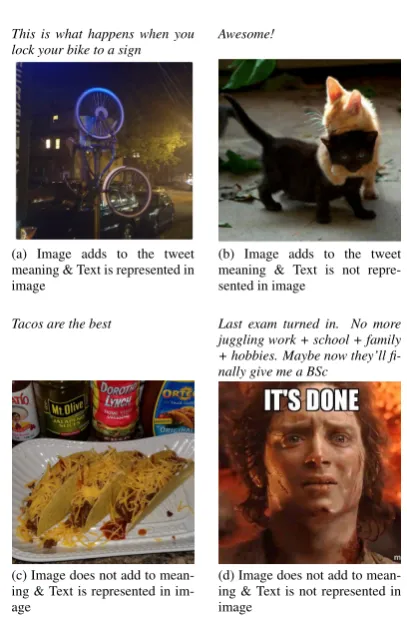
(a) Image adds to the tweet meaning & Text is represented in image
(b) Image adds to the tweet meaning & Text is not repre-sented in image
Tacos are the best Last exam turned in. No more juggling work + school + family + hobbies. Maybe now they’ll fi-nally give me a BSc
(c) Image does not add to mean-ing & Text is represented in im-age
[image:1.595.313.517.209.520.2](d) Image does not add to mean-ing & Text is not represented in image
Figure 1: Examples of the four types of text-image re-lationship from this study.
can just provide commentary on the image con-tent. Formalizing and understanding the relation-ship between the two modalities – text and images – is useful in several areas:
a) for NLP and computer vision research, where image and text data from tweets are used to de-veloping data sets and methods for image cap-tioning (Mitchell et al.,2012) or object recogni-tion (Mahajan et al.,2018);
b) for social scientists and psychologists trying to understand social media use;
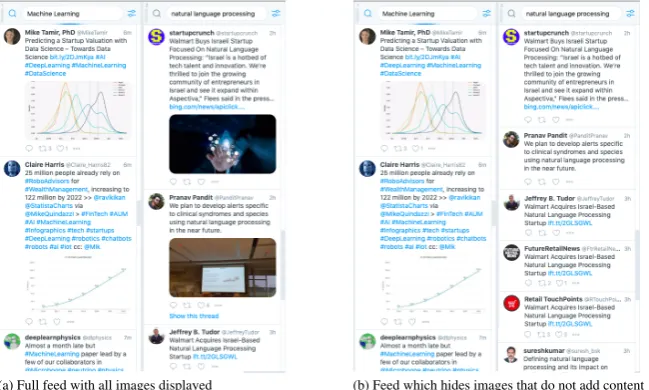
op-timize screen space (see Figure2).
Figure1illustrates four different ways in which the text and image of the same tweet can be re-lated:
• Figures 1(a,b) show how the image can add to the semantics of the tweet, by either providing more information than the text (Figure1a) or by providing the context for understanding the text (Figure1b);
• In Figures 1(c,d), the image only illustrates what is expressed through text, without provid-ing any additional information. Hence, in both of these cases, the text alone is sufficient to un-derstanding the tweet’s key message;
• Figures 1(a,c) show examples of tweets where there is a semantic overlap between the content of the text and image:bikeandsignin Figure1a andtacosin Figure1c;
• In Figures1(b,d), the textual content is not rep-resented in the image, with the text being either a comment on the image’s content (Figure 1b) or the image illustrating a feeling related to the text’s content.
In this paper, we present a comprehensive anal-ysis that focuses on the types of relationships be-tween the text and image in a tweet. Our contribu-tions include:
• Defining the types of relationships between the text and the image of a social media post;
• Building a data set of tweets annotated with text - image relationship type;1
• Machine learning methods that use both text and image content to predict the relationship be-tween the two modalities;
• An analysis into the author’s demographic traits that are related to usage preference of text-image relationship types;
• An analysis of the textual features which char-acterize each relationship type.
2 Related Work
Task. The relationship between a text and its as-sociated image was researched in a few prior studies. For general web pages, Marsh and Do-mas White(2003) propose a taxonomy of 49 rela-tionship grouped in three major categories based on how similar is the image to the text ranging from little relation to going beyond the text, which forms the basis of one of our relationship
dimen-1Data set is available at: https://github.com/ danielpreotiuc/text-image-relationship/
sions. Martinec and Salway (2005) aim to cate-gorize text-image relationships in scientific arti-cles from two perspectives: the relative impor-tance of one modality compared to the other and the logico-semantic overlap. Alikhani and Stone
(2018) argue that understanding multimodal text-image presentation requires studying the coher-ence relations that organize the content. Even when a single relationship is used, such as cap-tioning, it can be expressed in multiple forms such as telic, atelic or stative (Alikhani and Stone,
2019).Wang et al.(2014) use the intuition that text and images from microposts can be associated or not or depend on one another and use this intu-ition in a topic model that learns topics and im-age tags jointly. Jas and Parikh(2015) study the concept of image specificity through how simi-lar to each other are multiple descriptions of that image. However, none of these studies propose any predictive methods for text-image relationship types. Alikhani et al. (2019) annotate and train models on a recipe data set (Yagcioglu et al.,2018) for the relationships between instructional text and images around the following dimensions: tempo-ral, logical and incidental detail.Chen et al.(2013) study text-image relationships using social media data focusing on the distinction between images that are overall visually relevant or non-relevant to the textual content. They build models using the text and image content that predict the relationship type (Chen et al.,2015). We build on this research and define an annotation scheme that focuses on each of the two modalities separately and look at both their semantic overlap and contribution to the meaning of the whole tweet.
Applications. Several applications require to be able to automatically predict the semantic text-image relationship in the data. Models for au-tomatically generating image descriptions (Feng and Lapata, 2010;Ordonez et al.,2011;Mitchell et al.,2012;Vinyals et al.,2015;Lu et al.,2017) or predicting tags (Mahajan et al.,2018) are built using large training data sets of noisy image-text pairs from sources such as tweets. Multi-modal named entity disambiguation leverages vi-sual context vectors from social media images to aid named entity disambiguation (Moon et al.,
(a) Full feed with all images displayed (b) Feed which hides images that do not add content
Figure 2: Example of application using the image task classifier. Automatically collapsing images that do not add content beyond text optimizes screen real estate and allows users to view more tweets in their feed view. The end-user could open hidden images individually.
with descriptive captions are available, which can be used to build similarity metrics and joint se-mantic spaces for text and images (Young et al.,
2014). However, all these assume that the text an image represent similar concepts which, as we show in this paper, is not true in Twitter. Being able to classify this relationship can be useful for all above-mentioned applications.
3 Categorizing Text-Image Relationships
We define the types of semantic relationships that can exist between the content of the text and the image by splitting them into two tasks for simplic-ity. The first task is centered on the role of the text to the tweet’s semantics, while the second focuses on the image’s role.
The first task – referred to as thetext taskin the rest of the paper – focuses on identifying if there is semantic overlap between the context of the text and the image.
This task is the defined using the following guidelines:
1. Some or all of the content words in the text are represented in the image (Text is represented) 2. None of the content words in the text are
repre-sented in the image (Text is not represented):
• None of the content words are represented in the image, or
• The text is only a comment about the content of the image, or
• The text expresses a feeling or emotion about the content of the image, or
• The text only makes a reference to something shown in the image, or
• The text is unrelated to the image
Examples for this task can be seen in Figure 1
by comparing Figures1(a,c) (Text is represented) with Figures1(b,d) (Text is not represented).
The second task – referred to as theimage task
in the rest of the paper – focuses on the role of the image to the semantics of the tweet and aims to identify if the image’s content contributes with additional information to the meaning of the tweet beyond the text, as judged by an independent third party. This task is defined and annotated using the following guidelines:
1. Image has additional content that represents the meaning of the text and the image (Image adds):
• Image contains other text that adds additional meaning to the text, or
• Image depicts something that adds informa-tion to the text or
• Image contains other entities that are refer-enced by the text.
2. Image does not add additional content that rep-resents the meaning of text+image (Image does not add).
Examples for the image task can be seen in Fig-ure 1 by comparing Figures 1(a,b) (Image adds) with Figures1(c,d) (Image does not add).
4 Data Set
To study the relationship between the text and im-age in the same social media post, we define a new annotation schema and collect a new anno-tated corpus. To the best of our knowledge, no such corpus exists in prior research.
4.1 Data Sampling
We use Twitter as the source of our data, as this source contains a high level of expression of thoughts, opinions and emotions (Java et al.,2007;
Kouloumpis et al.,2011). It represents a platform for observing written interactions and conversa-tions between users (Ritter et al.,2010).
The tweets were deliberately randomly sam-pled tweets from a list of users for which several of their socio-demographic traits are known, in-troduced in past research (Preot¸iuc-Pietro et al.,
2017). This will enable us to explore if the fre-quency of posting tweets with a certain text-image relationship is different across socio-demographic groups.
We downloaded as many tweets as we could from these users using the Twitter API (up to 3,200 tweets/user per API limits). We decided to anno-tate only tweets from within the same time range (2016) in order to reduce the influence of poten-tial platform usage changes with time. We filter out tweets that are not written in English using the langid.py tool (Lui and Baldwin,2012).
In total, 2,263 users (out of the initial 4,132) have posted tweets with at least one image in the year 2016 and were included in our analysis. Our final data set contains 4,471 tweets.
4.2 Demographic Variables
The Twitter users from the data set we sam-pled have self-reported the following demographic variables through a survey: gender, age, education level and annual income. All users solicited for data collection were from the United States in or-der to limit cultural variation.
• Gender was considered binary2and coded with Female – 1 and Male – 0. All other variables are treated as ordinal variables.
• Age is represented as a integer value in the 13– 90 year old interval.
2We asked users to report gender as either ‘Female’,
‘Male’ or an open-ended field, and removed the few users which did not select ‘Male’ or ‘Female’
• Education level is coded as an ordinal variable with 6 values representing the highest degree obtained, with the lowest being ‘No high school degree’ (coded as 1) and the highest being ‘Ad-vanced Degree (e.g., PhD)’ (coded as 6).
• Income level is coded as on ordinal variable with 8 values representing the annual income of the person, ranging from ‘< $20,000’ to ‘>$200,000’).
For a full description of the user recruitment and quality control processes, we refer the interested reader to (Preot¸iuc-Pietro et al.,2017).
4.3 Annotation
We have collected annotations for text-image pairs from 4,471 tweets using the Figure Eight platform (formerly CrowdFlower). We annotate all tweets containing both text and image using two indepen-dent annotation tasks in order to simplify the task and not to prime annotators use the outcome of one task as a indicator for the outcome of the other.
For quality control, 10% of annotations were test questions annotated by the authors. Annotators had to maintain a minimum accuracy on test ques-tions of 85% for the image task and 75% for the text task for their annotations to be valid.
5 Methods
Our goal is to develop methods that are capable of automatically classifying the text-image relation-ship in tweets. We experiment with several meth-ods which use information of four different types: demographics of the user posting the tweet, meta-data from the tweet, the text of the tweet or the image of the tweet; plus a combination of them. The methods we use are described in this section.
5.1 User Demographics
User demographic features are the survey-based demographic information we have available for all users that posted the annotated tweets. The use of these traits is based on the intuition that different demographic groups have different posting pref-erences (Pennacchiotti and Popescu,2011; Kosin-ski et al., 2013). We use this approach for com-parison reasons only, as in practical use cases we would normally not have access to the author’s de-mographic traits.
We code the gender, age, education level and in-come level of the user as features and use them in a logistic regression classifier to classify the text-image relationship.
5.2 Tweet Metadata
We experiment with using the tweet metadata as features. These code if a tweet is a reply, tweet, like or neither. We also add as features the tweet like count, the number of followers, friends and posts of the post’s author and include them all in a logistic regression classifier.
These features are all available at tweet publish-ing time and we build a model uspublish-ing them to es-tablish a more solid baseline for content based ap-proaches.
5.3 Text-based Methods
We use the textual content of the tweet alone to build models for predicting the text-image rela-tionship. We expect that certain textual cues will be specific to relationships even without consider-ing the image content. For example, tweets end-ing in an ellipsis or short comments will likely be predictive of the text not being represented in the image.
Surface Features. We first use a range of surface features which capture more of the shallow stylis-tic content of the tweet. We extract number of to-kens, uppercase toto-kens, exclamations, questions,
ellipsis, hashtags, @ mentions, quotes and URLs from the tweet and use them as features in a logis-tic regression classifier.
Bag of Words. The most common approach for building a text-based model is using bag-of-words features. Here, we extract unigram and bi-gram features and use them in a logistic regression classifier with elastic net regularization (Zou and Hastie,2005).
LSTM. Finally, based on recent results in text classification, we also experiment with a neural network approach which uses a Long-Short Term Memory (LSTM) (Hochreiter and Schmidhuber,
1997) network. The LSTM network processes the tweet sequentially, where each word is represented by its embedding (E = 200) followed by a dense hidden layer (D= 64) and by a a ReLU activation function and dropout (0.4) The model is trained by minimizing cross entropy using the Adam op-timizer (Kingma and Ba,2014). The network uses in-domain Twitter GloVe embeddings pre-trained on 2 billion tweets (Pennington et al.,2014).
5.4 Image-based Methods
We use the content of the tweet image alone to build models for predicting the text-image rela-tionship. Similar to text, we expect that certain image content will be predictive of text-image re-lationships even without considering the text con-tent. For example, images of people may be more likely to have in the text the names of those per-sons.
To analyze image content, we make use of large pre-trained neural networks for the task of object recognition on the ImageNet data set. ImageNet (Deng et al., 2009) is a visual database devel-oped for object recognition research and consists of 1000 object types. In particular, we use the popular pre-trained InceptionNet model (Szegedy et al.,2015), which achieved the best performance at the ImageNet Large Scale Visual Recognition Challenge 2014 to build the following two image-based models.
ImageNet Classes.First, we represent each image in a tweet with the probability distribution over the 1,000 ImageNet classes obtained from Inception-Net. Then, we pass those features to a logistic re-gression classifier which is trained on our task. In this setup, the network parameters remain fixed, while only the ImageNet class weights are learned in the logistic regression classifier.
the InceptionNet network to directly predict our tasks by using the multinomial logistic loss with softmax as the final layer for our task to replace the 1,000 ImageNet classes. Then, we loaded the pre-trained network from (Szegedy et al., 2015) and fine-tuned the final fully-connected layer with the modified loss layers. We perform this in order to directly predict our task, while also overcom-ing the necessity of re-extractovercom-ing the entire model weights from our restricted set of images.
The two approaches to classification using im-age content based on pre-trained model on Im-ageNet have been used successfully in past re-search (Cinar et al.,2015).
5.5 Joint Text-Image Methods
Finally, we combine the textual and image infor-mation in a single model to classify the text-image relationship type, as we expect both types of con-tent and their interaction to be useful to the task.
Ensemble. A simple method for combining the information from both modalities is to build an ensemble classifier. This is done with a logistic regression model with two features: the Bag of Words text model’s predicted class probability and the Tuned InceptionNet model’s predicted class probability. The parameters of the model are tuned by cross validation on the training data and similar splits as the individual models.
LSTM + InceptionNet. We also build a joint ap-proach by concatenating the features from the fi-nal layers of our LSTM and InceptionNet models and passing them through a fully-connected (FC) feed forward neural network with one hidden layer (64 nodes). The final output is our text-image re-lationship type. We use the Adam optimizer to fine tune this network. The LSTM model has the same parameters as in the text-only approach, while the InceptionNet model is initialized with the pre-trained model on the ImageNet data set.
6 Predicting Text-Image Relationship
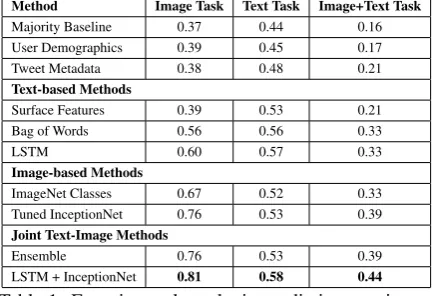
We split our data into a 80% train (3,576 tweets) and 20% test (895 tweets) stratified sample for all of our experiments. Parameters were tuned using 10-fold cross-validation with the training set, and results are reported on the test set. Table1presents the weighted F1-scores for the text task, the image task and the image+text task with all the methods described in Section5. The weighted F1 score is the weighted average of the class-level F1 scores,
Method Image Task Text Task Image+Text Task
Majority Baseline 0.37 0.44 0.16
User Demographics 0.39 0.45 0.17
Tweet Metadata 0.38 0.48 0.21
Text-based Methods
Surface Features 0.39 0.53 0.21
Bag of Words 0.56 0.56 0.33
LSTM 0.60 0.57 0.33
Image-based Methods
ImageNet Classes 0.67 0.52 0.33
Tuned InceptionNet 0.76 0.53 0.39
Joint Text-Image Methods
Ensemble 0.76 0.53 0.39
[image:6.595.308.525.65.213.2]LSTM + InceptionNet 0.81 0.58 0.44
Table 1: Experimental results in predicting text-image relationship with different methods and grouped by modalities used in prediction. Results are presented in weighted F1 score.
where the weight is the number of items in each class.
The majority baseline always predicts the most frequent class in each task, namely: Image does not addfor the image task,Text is not represented
for the text task andImage does not add & Text is not representedfor the Image + Text task.
The models using user demographics and tweet metadata show minor improvements over the ma-jority class baseline for both tasks. When the two tasks are combined, both feature types offer only a slight increase over the baseline. This shows that user factors mildly impact the frequency with which relationship types are used, which will be explored further in the analysis section.
The models that use tweet text as features show consistent improvements over the baseline for all three tasks. The two models that use the tweet’s topical content (Bag of Words and LSTM) ob-tain higher predictive performance over the sur-face features. Both content based models obtain relatively similar performance, with the LSTM performing better on the image task.
The models which use information extracted from the image alone also consistently outper-form the baseline on all three tasks. Re-tuning the neural network performs substantially better than building a model directly from the ImageNet classes on the image task and narrowly outper-forms the other method on the text task. This is somewhat expected, as the retuning is performed on this domain specific task.
bet-ter performance on the text task. This is some-what natural, as the focus of each annotation task is on one modality and methods relying on content from that modality are more predictive alone as to what ultimately represents the text-image relation-ship type.
Our naive ensemble approach does not yield substantially better results than the best perform-ing methods usperform-ing a sperform-ingle modality. However, by jointly modelling both modalities, we are able to obtain improvements – especially on the im-age task. This shows that both types of informa-tion and their interacinforma-tion are important to this task. Methods that exploit more heavily the interaction and semantic similarity between the text and the image are left for future work.
We also observe that the predictive methods we described are better at classifying the image task. The analysis section below will allow us to un-cover more about what type of content character-izes each relationship type.
7 Analysis
In this section, we aim to gain a better understand-ing of the type of content specific of the four text-image relationship types and about user type pref-erences in their usage.
7.1 User Analysis
Socio-demographic traits of the authors of posts are known to be correlated with several social media behaviors including text (Rao et al.,2010;
Pennacchiotti and Popescu,2011;Schwartz et al.,
2013;Volkova et al.,2014;Lampos et al., 2014;
Preot¸iuc-Pietro et al., 2015a,b, 2016; Preot¸iuc-Pietro et al., 2017; Preot¸iuc-Pietro and Ungar,
2018) and images (Alowibdi et al., 2013; You et al., 2014;Farseev et al., 2015;Skowron et al.,
2016; Liu et al., 2016; Guntuku et al., 2017;
Samani et al.,2018;Guntuku et al.,2019). We hy-pothesize that socio-demographic traits also play a role in the types of text-image relationships em-ployed on Twitter.
To measure this, we use partial Pearson corre-lation where the dependent variables are one of four socio-demographic traits described in Sec-tion 4.2. The independent variables indicate the average times with which the user employed a cer-tain relationship type. We code this using six dif-ferent variables: two representing the two broader tasks – the percentage of tweets where image adds
information and the percentage of tweets where the text is represented in the image – and four en-coding each combination between the two tasks.
In addition, for all analyses we consider gen-der and age as basic human traits and control for data skew by introducing both variables as controls in partial correlation, as done in prior work (Schwartz et al.,2013;Preot¸iuc-Pietro et al.,
2017;Holgate et al., 2018). When studying age and gender, we only use the other trait as the control. Because we are running several statisti-cal tests at once (24) without predefined hypothe-ses, we use Bonferroni correction to counteract the problem of multiple comparisons. The results are presented in Table2.
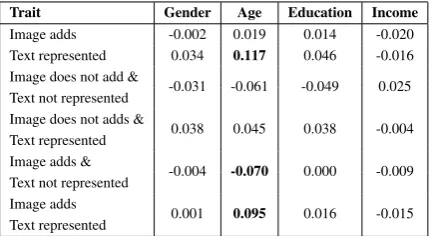
We observe that age is the only user demo-graphic trait that is significantly correlated to text-image relationship preference after control-ling for multiple comparisons and other demo-graphic traits. The text-image relationship where the text is represented in the image, at least par-tially, is positively correlated with age (r = 0.117).
Further analyzing the four individual text-image relationship types reveals that older users espe-cially prefer tweets where there is a semantic over-lap between the concepts present in the text and the image, but the image contributes with addi-tional information to the meaning of the tweet. This is arguably the most conventional usage of images, where they illustrate the text and provide more details than the text could.
Younger users prefer most tweets where the im-age adds information to the meaning of the tweet, but this has no semantic overlap with the text. These are usually tweets where the text represents merely a comment or a feeling expressed with the image providing the context. This represents a more image-centric approach to the meaning of the tweet that is specific to younger users. These correlations are controlled for gender.
Education was also correlated with images where the text was represented in the image (r =
0.076, p < .01, Bonferroni corrected), but this
Trait Gender Age Education Income Image adds -0.002 0.019 0.014 -0.020 Text represented 0.034 0.117 0.046 -0.016 Image does not add &
-0.031 -0.061 -0.049 0.025 Text not represented
Image does not adds &
0.038 0.045 0.038 -0.004 Text represented
Image adds &
-0.004 -0.070 0.000 -0.009 Text not represented
Image adds
[image:8.595.317.526.60.173.2]0.001 0.095 0.016 -0.015 Text represented
Table 2: Pearson correlation between user demo-graphic traits and usage of the different text-image re-lationship types. All correlations in bold are significant at p < .01, two-tailed t-test, Bonferroni corrected for multiple comparisons. Results for gender are con-trolled for age and vice versa. Results for education and income are controlled for age and gender.
7.2 Tweet Metadata Analysis
We adapt a similar approach to uncover potential relationships between the text-image relationship expressed in the tweet and tweet metadata features described in Section5.2. However, after control-ling for multiple comparisons, we are left with no significant correlations atp < 0.01level. Hence, we refrain from presenting and discussing any re-sults using this feature group as significant.
7.3 Text Analysis
Finally, we aim to identify the text and image fea-tures that characterize the four types of text-image relationship.
We use univariate Pearson correlation where the independent variable is each feature’s normalized value in a tweet and the dependent variables are two binary indicators for the text and image tasks respectively. When performed using text features, this technique was coined Differential Language Analysis (Schwartz et al.,2013,2017). The results when using unigrams as features are presented in Figure3,4and5.
Results for the image task (Figure3) show that the image adds to the meaning of the tweet if words such asthis,it,why,needsorwantare used. These words can appear in texts with the role of referencing or pointing to an entity which is only present in the image.
Conversely, the image does not add to the mean-ing of the tweet when words indicative of objects that are also described in the image are present (cat, baby,eyesorface), thus resulting in the im-age not adding to the meaning of the tweet. A spe-cial case are tweets with birthday wishes, where a person is mentioned in text and also displayed in
relative frequency
a a
a
correlation strength
[image:8.595.74.291.62.180.2](a) Image adds (b) Image does not add Figure 3: Words specific of each of the two classes from the image task when compared to the other.
(a) Text is represented (b) Text is not represented Figure 4: Words specific of each of the two classes from the text task when compared to the other.
(a) Image does not add & Text not represented
(b) Image does not add & Text represented
(c) Image adds & Text not represented
(d) Image adds & Text rep-resented
Figure 5: Words that are specific of each of the four classes compared to all other three classes. Font size is proportional to the Pearson correlation between each relationship type and word frequency. Color is propor-tional to the word frequency (see legend above the fig-ures for reference).
an image. Finally, thetbtkeyword and hashtag is a popular social media trend where users post nos-talgic pictures of their past accompanied by their textual description.
The comparison between the two outcomes of the text task is presented in Figure 4. When the text and image semantically overlap, we ob-serve words indicative of actions (i’ve), posses-sions (your) or qualitative statements (congrats,
presiden-tial elections took place). Analyzing this outcome jointly with the text task, we uncover a prominent theme consisting of words describing first person actions (congrats, thank, i’ve, saw, tell) present when the image provides facets not covered by text (Figure5d). Several keywords from text (cat,
game, winter) show types of content which are present in both image and text, but the image is merely an illustrating these concepts without adding additional information (Figure5a).
In contrast, the text is not represented in the image when it contains words specific of com-ments (when, lmao), questions (do, was), refer-ences (this) or ellipsis (’...’), all often referencing the content of the image as identified through data inspection. References to self, objects and per-sonal states (i,me) and feelings (miss) are also ex-pressed in text about items or things not appear-ing the image from the same tweet. Further ex-ploring this result though the image task outcome, we see that the latter category of feelings about persons of objects (Figure5a) – miss, happy, lit,
like) are specific of when the image does not add additional information. Through manual inspec-tion of these images, they often display a meme (as in Figure 1d) or unrelated expressions to the text’s content. The image adds information when the text is not represented (Figure5c) if the latter includes personal feelings, (me,i,i’m,want), com-ments (lol,lmao) and references (this,it), usually related to the image content as identified through an analysis of the data.
8 Conclusions
We defined and analyzed quantitatively and qual-itatively the semantic relationships between the text and the image of the same tweet using a novel annotated data set. The frequency of use is influ-enced by the age of the poster, with younger users employing images with a more prominent role in the tweet, rather than just being redundant to the text or as a means of illustrating it. We studied the correlation between the content in the text and relation with the image, highlighting a differentia-tion between reladifferentia-tionship types, even if only using the text of the tweet alone. We developed models that use both text and image features to classify the text-image relationship, with especially high performance (F1 = 0.81) in identifying if the im-age is redundant, which is immediately useful for downstream applications that maximize screen
es-tate for users.
Future work will look deeper into using the silarity between the content of the text and im-age (Leong and Mihalcea,2011), as the text task results showed room for improvements. We en-vision that our data, task and classifiers will be useful as a preprocessing step in collecting data for training large scale models for image caption-ing (Feng and Lapata, 2010) or tagging ( Maha-jan et al., 2018) or for improving recommenda-tions (Chen et al., 2016) by filtering out tweets where the text and image have no semantic overlap or can enable new tasks such as identifying tweets that contain creative descriptions for images.
Acknowledgements
We like to thank our colleague Austin Ray for dis-cussing the idea that originated this paper. We thank Ravneet Arora, Luka Bradesko, Prabhanjan Kambadur, Amanda Stent, Umut Topkara and the other members of the Bloomberg AI group who provided invaluable feedback on the experiments and paper. We also thank Eduardo Blanco for sup-porting the collaboration and feedback.
References
Malihe Alikhani, Sreyasi Nag Chowdhury, Gerard de Melo, and Matthew Stone. 2019. CITE: A Corpus of Image-Text Discourse Relations. InProceedings of the 2019 Conference of the North American Chap-ter of the Association for Computational Linguistics, NAACL, pages 570–575.
Malihe Alikhani and Matthew Stone. 2018. Explor-ing Coherence in Visual Explanations. In2018 IEEE Conference on Multimedia Information Processing and Retrieval, the First International Workshop on Multimedia Pragmatics, MIPR, pages 272–277.
Malihe Alikhani and Matthew Stone. 2019. ‘Caption’ as a Coherence Relation: Evidence and Implications. In Proceedings of the Second Workshop on Short-comings in Vision and Language, NAACL, pages 58– 67.
Jalal S. Alowibdi, Ugo A. Buy, and Philip Yu. 2013. Language Independent Gender Classification on Twitter. ASONAM.
Ron Artstein and Massimo Poesio. 2008. Inter-coder agreement for computational linguistics. Computa-tional Linguistics, 34(4):555–596.
Tao Chen, Xiangnan He, and Min-Yen Kan. 2016. Context-aware Image Tweet Modelling and Recom-mendation. MM, pages 1018–1027.
Tao Chen, Dongyuan Lu, Min-Yen Kan, and Peng Cui. 2013. Understanding and classifying image tweets. MM, pages 781–784.
Tao Chen, Hany M SalahEldeen, Xiangnan He, Min-Yen Kan, and Dongyuan Lu. 2015. Velda: Relating an image tweet’s text and images. AAAI, pages 30– 36.
Yagmur Gizem Cinar, Susana Zoghbi, and Marie-Francine Moens. 2015. Inferring User Interests on
Social Media From Text and Images. In SoMeRa
Workshop, ICDM.
Jia Deng, Wei Dong, Richard Socher, Li-Jia Li, Kai Li, and Li Fei-Fei. 2009. Imagenet: A Large-Scale Hi-erarchical Image Database. CVPR, pages 248–255.
Aleksandr Farseev, Liqiang Nie, Mohammad Akbari,
and Tat-Seng Chua. 2015. Harvesting Multiple
Sources for User Profile Learning: A Big Data Study. ICMR, pages 235–242.
Yansong Feng and Mirella Lapata. 2010. How many Words is a Picture Worth? Automatic Caption Gen-eration for News Images. ACL, pages 1239–1249.
Sharath Chandra Guntuku, Weisi Lin, Jordan Car-penter, Wee Keong Ng, Lyle H Ungar, and Daniel Preot¸iuc-Pietro. 2017. Studying Personality through the Content of Posted and Liked Images on Twitter. Web Science, pages 223–227.
Sharath Chandra Guntuku, Daniel Preotiuc-Pietro, Jo-hannes C Eichstaedt, and Lyle H Ungar. 2019. What Twitter Profile and Posted Images Reveal About De-pression and Anxiety. ICWSM.
Sepp Hochreiter and J¨urgen Schmidhuber. 1997.
Long Short-Term Memory. Neural computation,
9(8):1735–1780.
Eric Holgate, Isabel Cachola, Daniel Preot¸iuc-Pietro, and Junyi Jessy Li. 2018. Why Swear? Analyzing and Inferring the Intentions of Vulgar Expressions. EMNLP, pages 4405–4414.
Mainak Jas and Devi Parikh. 2015. Image specificity. CVPR, pages 2727–2736.
Akshay Java, Xiaodan Song, Tim Finin, and Belle Tseng. 2007. Why we twitter: understanding mi-croblogging usage and communities. InProceedings of the 9th WebKDD and 1st SNA-KDD 2007 work-shop on Web mining and social network analysis, pages 56–65.
Diederik P Kingma and Jimmy Ba. 2014. Adam: A method for stochastic optimization. arXiv preprint arXiv:1412.6980.
Michal Kosinski, David Stillwell, and Thore Graepel. 2013. Private Traits and Attributes are Predictable from Digital Records of Human Behavior. PNAS, 110(15).
Efthymios Kouloumpis, Theresa Wilson, and Jo-hanna D Moore. 2011. Twitter Sentiment Analysis: The Good the Bad and the OMG! ICWSM, pages 538–541.
Vasileios Lampos, Nikolaos Aletras, Daniel Preot¸iuc-Pietro, and Trevor Cohn. 2014. Predicting and Char-acterising User Impact on Twitter. EACL, pages 405–413.
Chee Wee Leong and Rada Mihalcea. 2011. Measuring the semantic relatedness between words and images. InProceedings of the Ninth International Conference on Computational Semantics, ACL, pages 185–194.
Leqi Liu, Daniel Preot¸iuc-Pietro, Zahra Riahi, Mohsen E. Moghaddam, and Lyle Ungar. 2016. An-alyzing Personality through Social Media Profile Pic-ture Choice. ICWSM, pages 211–220.
Jiasen Lu, Caiming Xiong, Devi Parikh, and Richard Socher. 2017. Knowing when to Look: Adaptive At-tention via a Visual Sentinel for Image Captioning. CVPR, pages 375–383.
Marco Lui and Timothy Baldwin. 2012. langid.py: An off-the-shelf Language Identification Tool. ACL, pages 25–30.
Dhruv Mahajan, Ross Girshick, Vignesh Ramanathan, Kaiming He, Manohar Paluri, Yixuan Li, Ashwin Bharambe, and Laurens van der Maaten. 2018. Ex-ploring the Limits of Weakly Supervised Pretraining. ECCV, pages 185–201.
Emily E Marsh and Marilyn Domas White. 2003. A Taxonomy of Relationships between Images and Text.Journal of Documentation, 59(6):647–672.
Radan Martinec and Andrew Salway. 2005. A System for Image–Text Relations in New (and Old) Media. Visual Communication, 4(3):337–371.
Margaret Mitchell, Xufeng Han, Jesse Dodge, Alyssa Mensch, Amit Goyal, Alex Berg, Kota Yamaguchi, Tamara Berg, Karl Stratos, and Hal Daum´e III. 2012. Midge: Generating Image Descriptions from Com-puter Vision Detections. EACL, pages 747–756.
Seungwhan Moon, Leonardo Neves, and Vitor Car-valho. 2018. Multimodal Named Entity Disambigua-tion for Noisy Social Media Posts. ACL, pages 2000–2008.
Vicente Ordonez, Girish Kulkarni, and Tamara L Berg. 2011. Im2text: Describing images using 1 million captioned photographs. NIPS, pages 1143–1151.
Jeffrey Pennington, Richard Socher, and Christopher Manning. 2014. Glove: Global vectors for word rep-resentation. EMNLP, pages 1532–1543.
Daniel Preot¸iuc-Pietro, Jordan Carpenter, Salvatore Giorgi, and Lyle Ungar. 2016. Studying the Dark Triad of Personality using Twitter Behavior. CIKM, pages 761–770.
Daniel Preot¸iuc-Pietro, Vasileios Lampos, and Niko-laos Aletras. 2015a. An Analysis of the User Occu-pational Class through Twitter Content. ACL, pages 1754–1764.
Daniel Preot¸iuc-Pietro, Svitlana Volkova, Vasileios Lampos, Yoram Bachrach, and Nikolaos Aletras. 2015b. Studying User Income through Language, Behaviour and Affect in Social Media.PLoS ONE.
Daniel Preot¸iuc-Pietro, Ye Liu, Daniel Hopkins, and Lyle Ungar. 2017. Beyond Binary Labels: Political Ideology Prediction of Twitter Users. ACL, pages 729–740.
Daniel Preot¸iuc-Pietro and Lyle Ungar. 2018. Devel-oping User-Level Race and Ethnicity Predictors from Twitter Text. COLING, pages 1534–1545.
Delip Rao, David Yarowsky, Abhishek Shreevats, and Manaswi Gupta. 2010. Classifying Latent User At-tributes in Twitter. SMUC.
Alan Ritter, Colin Cherry, and Bill Dolan. 2010. Unsupervised Modeling of Twitter Conversations. NAACL, pages 172–180.
Zahra Riahi Samani, Sharath Chandra Guntuku,
Mohsen Ebrahimi Moghaddam, Daniel Preot¸iuc-Pietro, and Lyle H Ungar. 2018. Cross-platform and Cross-interaction Study of User Personality based on Images on Twitter and Flickr.PloS ONE, 13(7).
H Andrew Schwartz, Johannes C Eichstaedt, Mar-garet L Kern, Lukasz Dziurzynski, Stephanie M Ra-mones, Megha Agrawal, Achal Shah, Michal Kosin-ski, David Stillwell, and Martin EP Seligman. 2013. Personality, Gender, and Age in the Language of So-cial Media: The Open-vocabulary Approach. PloS ONE, 8(9).
H. Andrew Schwartz, Salvatore Giorgi, Maarten Sap, Patrick Crutchley, Johannes Eichstaedt, and Lyle Un-gar. 2017. Dlatk: Differential language analysis toolkit. EMNLP, pages 55–60.
Marcin Skowron, Marko Tkalˇciˇc, Bruce Ferwerda, and Markus Schedl. 2016. Fusing Social Media Cues: Personality Prediction from Twitter and Instagram. WWW Companion.
Ionut Sorodoc, Jey Han Lau, Nikolaos Aletras, and Timothy Baldwin. 2017. Multimodal topic labelling. volume 2 ofEACL, pages 701–706.
Christian Szegedy, Wei Liu, Yangqing Jia, Pierre Ser-manet, Scott Reed, Dragomir Anguelov, Dumitru Er-han, Vincent Vanhoucke, and Andrew Rabinovich.
2015. Going Deeper with Convolutions. CVPR,
pages 1–9.
Oriol Vinyals, Alexander Toshev, Samy Bengio, and Dumitru Erhan. 2015. Show and tell: A neural image caption generator. CVPR, pages 3156–3164.
Svitlana Volkova, Glen Coppersmith, and Benjamin Van Durme. 2014. Inferring User Political Prefer-ences from Streaming Communications. ACL, pages 186–196.
Zhiyu Wang, Peng Cui, Lexing Xie, Wenwu Zhu, Yong Rui, and Shiqiang Yang. 2014. Bilateral Correspon-dence Model for Words-and-Pictures Association in Multimedia-Rich Microblogs. ACM Transactions on Multimedia Computing, Communications, and Ap-plications, 10(4):34:1–34:21.
Semih Yagcioglu, Aykut Erdem, Erkut Erdem, and Na-zli Ikizler-Cinbis. 2018. RecipeQA: A Challenge Dataset for Multimodal Comprehension of Cooking Recipes. InProceedings of the 2018 Conference on Empirical Methods in Natural Language Processing, EMNLP, pages 1358–1368.
Quanzeng You, Sumit Bhatia, Tong Sun, and Jiebo Luo. 2014. The Eyes of the Beholder: Gender Pre-diction using Images Posted in Online Social Net-works. ICDM.
Peter Young, Alice Lai, Micah Hodosh, and Julia Hockenmaier. 2014. From image descriptions to vi-sual denotations: New similarity metrics for seman-tic inference over event descriptions.Transactions of the Association for Computational Linguistics, 2:67– 78.