Proceedings of the 57th Annual Meeting of the Association for Computational Linguistics, pages 2273–2284 2273
Multi-Style Generative Reading Comprehension
Kyosuke Nishida1, Itsumi Saito1, Kosuke Nishida1,
Kazutoshi Shinoda2∗,Atsushi Otsuka1,Hisako Asano1,Junji Tomita1 1NTT Media Intelligence Laboratory, NTT Corporation 2The University of Tokyo
Abstract
This study tackles generative reading compre-hension (RC), which consists of answering questions based on textual evidence and nat-ural language generation (NLG). We propose a multi-style abstractive summarization model for question answering, called Masque. The proposed model has two key characteristics. First, unlike most studies on RC that have fo-cused on extracting an answer span from the provided passages, our model instead focuses on generating a summary from the question and multiple passages. This serves to cover various answer styles required for real-world applications. Second, whereas previous stud-ies built a specific model for each answer style because of the difficulty of acquiring one gen-eral model, our approach learns multi-style an-swers within a model to improve the NLG ca-pability for all styles involved. This also en-ables our model to give an answer in the tar-get style. Experiments show that our model achieves state-of-the-art performance on the Q&A task and the Q&A + NLG task of MS MARCO 2.1 and the summary task of Nar-rativeQA. We observe that the transfer of the style-independent NLG capability to the target style is the key to its success.
1 Introduction
Question answering has been a long-standing re-search problem. Recently, reading comprehension (RC), a challenge to answer a question given tex-tual evidence provided in a document set, has re-ceived much attention. Current mainstream stud-ies have treated RC as a process of extracting an answer span from one passage (Rajpurkar et al., 2016, 2018) or multiple passages (Joshi et al., 2017; Yang et al., 2018), which is usually done by predicting the start and end positions of the an-swer (Yu et al.,2018;Devlin et al.,2018).
∗
Work done during an internship at NTT.
0 1
0 1
10 weeks</s>
it takes10 weeksto get new york statetax refund. </s>
Question: “how long to get nys tax refund”
Generate from Voc. Copy from Question Copy from Passages
Mi
xt
u
re
w
e
ig
h
ts
[NLG]
[image:1.595.308.527.222.302.2][Q&A]
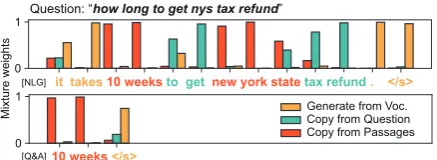
Figure 1: Visualization of how our model generates an answer on MS MARCO. Given an answer style (top: NLG, bottom: Q&A), the model controls the mixture of three distributions for generating words from a vocabulary and copying words from the ques-tion and multiple passages at each decoding step.
The demand for answering questions in natural language is increasing rapidly, and this has led to the development of smart devices such as Alexa. In comparison with answer span extraction, how-ever, the natural language generation (NLG) capa-bility for RC has been less studied. While datasets such as MS MARCO (Bajaj et al.,2018) and Nar-rativeQA (Kocisk´y et al., 2018) have been pro-posed for providing abstractive answers, the state-of-the-art methods for these datasets are based on answer span extraction (Wu et al.,2018;Hu et al., 2018). Generative models suffer from a dearth of training data to cover open-domain questions.
Moreover, to satisfy various information needs, intelligent agents should be capable of answer-ingonequestion in multiplestyles, such as well-formed sentences, which make sense even without the context of the question and passages, and con-cise phrases. These capabilities complement each other, but previous studies cannot use and control different styles within a model.
contri-butions of this study are as follows.
Multi-source abstractive summarization. We introduce the pointer-generator mechanism (See et al.,2017) for generating an abstractive answer from the question and multiple passages, which covers various answer styles. We extend the mech-anism to a Transformer (Vaswani et al., 2017) based one that allows words to be generated from a vocabulary and to be copied from the question and passages.
Multi-style learning for style control and trans-fer. We introduce multi-style learning that en-ables our model to control answer styles and im-proves RC for all styles involved. We also ex-tend the pointer-generator to a conditional decoder by introducing an artificial token corresponding to each style, as in (Johnson et al.,2017). For each decoding step, it controls the mixture weights over three distributions with the given style (Figure1).
2 Problem Formulation
This paper considers the following task:
PROBLEM1. Given a question withJwordsxq =
{xq1, . . . , xqJ}, a set of K passages, where the k-th passage is composed of L words xpk =
{xpk
1 , . . . , x
pk
L}, and an answer style labels, an RC
model outputs an answery={y1, . . . , yT}
condi-tioned on the style.
In short, given a 3-tuple(xq,{xpk}, s), the sys-tem predicts P(y). The training data is a set of 6-tuples: (xq,{xpk}, s, y, a,{rpk}), wherea and
{rpk}are optional. Here,ais1if the question is answerable with the provided passages and0 oth-erwise, andrpk is1if thek-th passage is required to formulate the answer and0otherwise.
3 Proposed Model
We propose a Multi-style Abstractive Summa-rization model for QUEstion answering, called
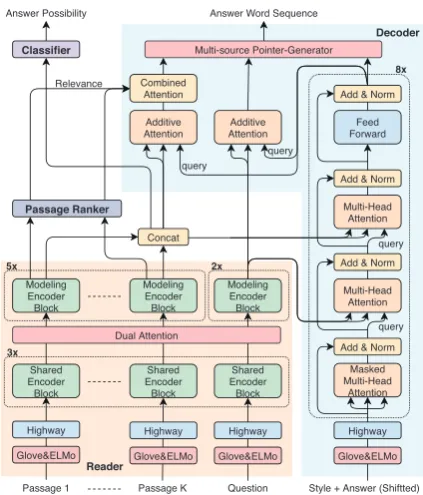
Masque. Masque directly models the conditional probability p(y|xq,{xpk}, s). As shown in Fig-ure2, it consists of the following modules.
1. The question-passages reader (§3.1) models interactions between the question and passages.
2. Thepassage ranker(§3.2) finds passages rele-vant to the question.
3. Theanswer possibility classifier(§3.3) identi-fies answerable questions.
Masked Multi-Head
Attention Shared
Encoder Block
Shared Encoder Block
Shared Encoder Block Modeling
Encoder Block
Modeling Encoder Block
Modeling Encoder
Block
Multi-Head Attention Multi-Head
Attention Add & Norm
Feed Forward Add & Norm
Highway
Glove&ELMo Add & Norm Dual Attention
Concat
Add & Norm
Highway
Glove&ELMo Highway
Glove&ELMo
Highway
Glove&ELMo Additive
Attention
Additive Attention Combined
Attention
Multi-source Pointer-Generator
Passage 1 Passage K Question Style + Answer (Shiftted)
8x
3x
5x 2x
Answer Possibility Answer Word Sequence
Passage Ranker Classifier
query query query
query
Decoder
Reader
[image:2.595.310.522.61.309.2]Relevance
Figure 2: Masque model architecture.
4. The answer sentence decoder (§3.4) outputs an answer sentence conditioned on the target style.
Our model is based on multi-source abstractive summarization: the answer that it generates can be viewed as a summary from the question and pas-sages. The model also learns multi-style answers together. With these two characteristics, we aim to acquire the style-independent NLG ability and transfer it to the target style. In addition, to im-prove natural language understanding in the reader module, our model considers RC, passage rank-ing, and answer possibility classification together as multi-task learning.
3.1 Question-Passages Reader
The reader module is shared among multiple an-swer styles and the three task-specific modules.
3.1.1 Word Embedding Layer
Letxq andxpk represent one-hot vectors (of size V) for words in the question and the k-th pas-sage. First, this layer projects each of the vec-tors to a dword-dimensional vector with a
con-textualized vectors is passed to a two-layer high-way network (Srivastava et al.,2015) to fuse the two types of embeddings, as in (Seo et al.,2017). The highway network is shared by the question and passages.
3.1.2 Shared Encoder Layer
This layer uses a stack of Transformer blocks, which are shared by the question and passages, on top of the embeddings provided by the word embedding layer. The input of the first block is immediately mapped to a d-dimensional vector by a linear transformation. The outputs of this layer areEpk ∈Rd×Lfor eachk-th passage, and Eq∈Rd×J for the question.
Transformer encoder block. The block con-sists of two sub-layers: a self-attention layer and a position-wise feed-forward network. For the self-attention layer, we adopt the multi-head atten-tion mechanism (Vaswani et al.,2017). Following GPT (Radford et al.,2018), the feed-forward net-work consists of two linear transformations with a GELU (Hendrycks and Gimpel, 2016) activation function in between. Each sub-layer is placed in-side a residual block (He et al.,2016). For an in-putxand a given sub-layer functionf, the output is LN(f(x) + x), where LN indicates the layer normalization (Ba et al.,2016). To facilitate these residual connections, all sub-layers produce a se-quence of d-dimensional vectors. Note that our model does not use any position embeddings in this block because ELMo gives the positional in-formation of the words in each sequence.
3.1.3 Dual Attention Layer
This layer uses a dual attention mechanism to fuse information from the question to the passages as well as from the passages to the question.
It first computes a similarity matrix Upk ∈
RL×J between the question and thek-th passage, as done in (Seo et al.,2017), where
Upk
lj =w a>[Epk
l ;E q j;E
pk
l E q j]
indicates the similarity between the l-th word of thek-th passage and thej-th question word. The wa ∈
R3d are learnable parameters. The operator denotes the Hadamard product, and the
[; ] operator denotes vector concatenation across the rows. Next, the layer obtains the row and column normalized similarity matrices Apk =
softmaxj(Upk>) andBpk = softmaxl(Upk). It
then uses DCN (Xiong et al.,2017) to obtain dual attention representations, Gq→pk ∈ R5d×L and Gp→q∈R5d×J:
Gq→pk = [Epk; ¯Apk; ¯A¯pk;EpkA¯pk;Epk A¯¯pk]
Gp→q= [Eq; ¯B; ¯B¯;EqB¯;EqB¯¯].
Here, A¯pk = EqApk, B¯pk = EpkBpk, A¯¯pk =
¯
BpkApk, B¯¯pk = ¯ApkBpk,B¯ = max
k( ¯Bpk), and
¯ ¯
B = maxk( ¯B¯pk).
3.1.4 Modeling Encoder Layer
This layer uses a stack of the Transformer en-coder blocks for question representations and ob-tains Mq ∈ Rd×J from Gp→q. It also uses
an-other stack for passage representations and obtains Mpk ∈
Rd×L from Gq→pk for each k-th pas-sage. The outputs of this layer,Mq and{Mpk}, are passed on to the answer sentence decoder; the
{Mpk} are also passed on to the passage ranker and the answer possibility classifier.
3.2 Passage Ranker
The ranker maps the output of the modeling layer,
{Mpk}, to the relevance score of each passage. It takes the output for the first word, Mpk
1 , which
corresponds to the beginning-of-sentence token, to obtain the aggregate representation of each pas-sage sequence. Given wr ∈ Rd as learnable pa-rameters, it calculates the relevance of each k-th passage to the question as
βpk = sigmoid(wr>Mpk
1 ).
3.3 Answer Possibility Classifier
The classifier maps the output of the modeling layer to a probability for the answer possibility. It also takes the output for the first word,Mpk
1 , for all
passages and concatenates them. Givenwc∈RKd as learnable parameters, it calculates the answer possibility for the question as
P(a) = sigmoid(wc>[Mp1
1 ;. . .;M
pK
1 ]).
3.4 Answer Sentence Decoder
3.4.1 Word Embedding Layer
Letyrepresent one-hot vectors of the words in the answer. This layer has the same components as the word embedding layer of the reader module, except that it uses a unidirectional ELMo to ensure that the predictions for positiontdepend only on the known outputs at positions previous tot.
Artificial tokens. To be able to use multiple an-swer styles within a single system, our model in-troduces an artificial token corresponding to the style at the beginning of the answer (y1), as done
in (Johnson et al.,2017;Takeno et al.,2017). At test time, the user can specify the first token to control the style. This modification does not re-quire any changes to the model architecture. Note that introducing the token at the decoder prevents the reader module from depending on the answer style.
3.4.2 Attentional Decoder Layer
This layer uses a stack of Transformer decoder blocks on top of the embeddings provided by the word embedding layer. The input is immedi-ately mapped to ad-dimensional vector by a lin-ear transformation, and the output is a sequence of d-dimensional vectors:{s1, . . . , sT}.
Transformer decoder block. In addition to the encoder block, this block consists of the second and third sub-layers after the self-attention block and before the feed-forward network, as shown in Figure 2. As in (Vaswani et al., 2017), the self-attention sub-layer uses a sub-sequent mask to pre-vent positions from attending to subsequent posi-tions. The second and third sub-layers perform the multi-head attention overMq andMpall, respec-tively. The Mpall is the concatenated outputs of the encoder stack for the passages,
Mpall = [Mp1, . . . , MpK]∈
Rd×KL.
Here, the[,]operator denotes vector concatenation across the columns. This attention for the concate-nated passages produces attention weights that are comparable between passages.
3.4.3 Multi-source Pointer-Generator
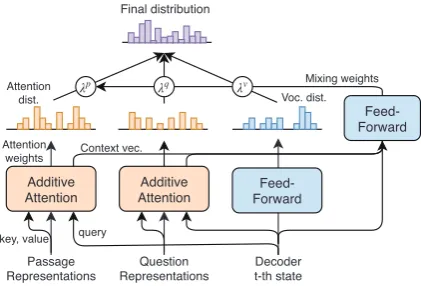
Our extended mechanism allows both words to be generated from a vocabulary and words to be copied from both the question and multiple pas-sages (Figure 3). We expect that the capability of copying words will be shared among answer styles.
Additive Attention
Additive Attention
Final distribution
Mixing weights
Feed- Forward
Feed- Forward
Context vec. Attention
weights
Voc. dist.
Passage Representations
Question Representations
Decoder t-th state
Attention dist.
[image:4.595.312.523.63.206.2]query key,Êvalue
Figure 3: Multi-source pointer-generator mechanism. For each decoding stept, mixture weightsλv, λq, λp
for the probability of generating words from the vo-cabulary and copying words from the question and the passages are calculated. The three distributions are weighted and summed to obtain the final distribution.
Extended vocabulary distribution. Let the ex-tended vocabulary,Vext, be the union of the
com-mon words (a small subset of the full vocabulary, V, defined by the input-side word embedding ma-trix) and all words appearing in the input question and passages.Pv then denotes the probability dis-tribution of thet-th answer word,yt, over the
ex-tended vocabulary. It is defined as:
Pv(yt) = softmax(W2
>
(W1st+b1)),
where the output embeddingW2∈Rdword×Vextis tied with the corresponding part of the input em-bedding (Inan et al., 2017), and W1 ∈
Rdword×d andb1 ∈Rdword are learnable parameters.Pv(y
t)
is zero ifytis an out-of-vocabulary word forV.
Copy distributions. A recent Transformer-based pointer-generator randomly chooses one of the attention-heads to form a copy distribution; that approach gave no significant improvements in text summarization (Gehrmann et al.,2018).
In contrast, our model uses an additional atten-tion layer for each copy distribuatten-tion on top of the decoder stack. For the passages, the layer takesst
as the query and outputsαpt ∈ RKL as the
atten-tion weights andcpt ∈Rdas the context vectors:
epk
l =w p>
tanh(WpmMpk
l +W pss
t+bp),
αpt = softmax([ep1;. . .;epK]), (1) cpt =P
lα p tlM
pall
l ,
where wp, bp ∈ Rd andWpm, Wps ∈
uses another identical layer and obtainsαqt ∈ RJ
andcqt ∈Rd. As a result,PqandPpare the copy distributions over the extended vocabulary:
Pq(yt) =Pj:xqj=ytα
q tj,
Pp(yt) =Pl:xpk(l)
l =yt αptl,
where k(l) means the passage index correspond-ing to thel-th word in the concatenated passages.
Final distribution. The final distribution ofytis
defined as a mixture of the three distributions:
P(yt) =λvPv(yt) +λqPq(yt) +λpPp(yt),
λv, λq, λp= softmax(Wm[st;cqt;c p
t] +bm),
whereWm ∈
R3×3dandbm ∈ R3 are learnable parameters.
3.4.4 Combined Attention
In order not to attend words in irrelevant passages, our model introduces a combined attention. While the original technique combined word and sen-tence level attentions (Hsu et al.,2018), our model combines the word and passage level attentions. The word attention, Eq.1, is re-defined as
αptl = α
p tlβ
pk(l) P
l0αptl0βpk(l 0).
3.5 Loss Function
We define the training loss as the sum of losses via
L(θ) =Ldec+γrankLrank+γclsLcls
whereθis the set of all learnable parameters, and γrankandγclsare balancing parameters.
The loss of the decoder, Ldec, is the negative
log likelihood of the whole target answer sentence averaged overNableanswerable examples:
Ldec =−
1
Nable
X
(a,y)∈D
a T
X
t
logP(yt),
whereDis the training dataset. The losses of the passage ranker, Lrank, and the answer possibility
classifier, Lcls, are the binary cross entropy
be-tween the true and predicted values averaged over allN examples:
Lrank=−
1 N K
X
k
X
rpk∈D
rpklogβpk+
(1−rpk) log(1−βpk)
,
Lcls=−
1 N
X
a∈D
alogP(a)+
(1−a) log(1−P(a))
.
Dataset Subset Train Dev. Eval.
ALL 808,731 101,093 101,092
MS MARCO ANS 503,370 55,636 –
NLG 153,725 12,467 –
[image:5.595.311.524.61.115.2]NarrativeQA Summary 32,747 3,461 10,557
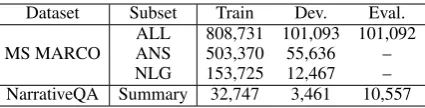
Table 1: Numbers of questions used in the experiments.
4 Experiments on MS MARCO 2.1
We evaluated our model on MS MARCO 2.1 ( Ba-jaj et al.,2018). It is the sole dataset providing ab-stractive answers with multiple styles and serves as a great test bed for building open-domain QA agents with the NLG capability that can be used in smart devices. The details of our setup and output examples are in the supplementary material.
4.1 Setup
Datasets. MS MARCO 2.1 provides two tasks for generative open-domain QA: the Q&A task and the Q&A + Natural Language Generation (NLG) task. Both tasks consist of questions sub-mitted to Bing by real users, and each question refers to ten passages. The dataset also includes annotations on the relevant passages, which were selected by humans to form the final answers, and on whether there was no answer in the passages.
Answer styles. We associated the two tasks with two answer styles. The NLG task requires a well-formed answer that is an abstractive summary of the question and passages, averaging 16.6 words. The Q&A task also requires an abstractive answer but prefers it to be more concise than in the NLG task, averaging 13.1 words, and many of the an-swers do not contain the context of the question. For the question “tablespoon in cup”, a reference answer in the Q&A task is “16,” while that in the NLG task is “There are 16 tablespoons in a cup.”
Subsets. In addition to theALLdataset, we pre-pared two subsets for ablation tests as listed in Ta-ble1. TheANSset consisted of answerable ques-tions, and theNLGset consisted of the answerable questions and well-formed answers, so that NLG
⊂ANS⊂ALL. We note that multi-style learning enables our model to learn from different answer styles of data (i.e., the ANS set), and multi-task learning with the answer possibility classifier en-ables our model to learn from both answerable and unanswerable data (i.e., the ALL set).
an-NLG Q&A
Model R-L B-1 R-L B-1
BiDAFa 16.91 9.30 23.96 10.64
Deep Cascade QAb 35.14 37.35 52.01 54.64
S-Net+CES2Sc 45.04 40.62 44.96 46.36
BERT+Multi-PGNetd 47.37 45.09 48.14 52.03
Selector+CCGe 47.39 45.26 50.63 52.03
VNETf 48.37 46.75 51.63 54.37
Masque (NLG; single) 49.19 49.63 48.42 48.68
Masque (NLG; ensemble) 49.61 50.13 48.92 48.75
Masque (Q&A; single) 25.66 36.62 50.93 42.37
Masque (Q&A; ensemble) 28.53 39.87 52.20 43.77
[image:6.595.307.526.60.135.2]Human Performance 63.21 53.03 53.87 48.50
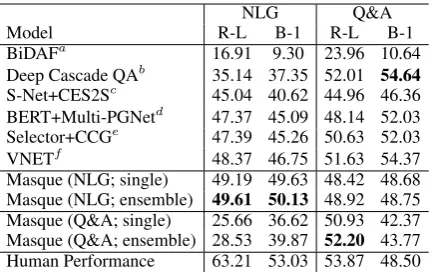
Table 2: Performance of our and competing models on the MS MARCO V2 leaderboard (4 March 2019).aSeo et al.(2017);bYan et al.(2019);cShao (unpublished), a variant ofTan et al.(2018);dLi (unpublished), a model usingDevlin et al.(2018) andSee et al.(2017);eQian (unpublished);fWu et al.(2018). Whether the compet-ing models are ensemble models or not is unreported.
swers that were randomly sampled. We used a greedy decoding algorithm and did not use any beam search or random sampling, because they did not provide any improvements.
Evaluation metrics and baselines. ROUGE-L and BLEU-1 were used to evaluate the models’ RC performance, where ROUGE-L is the main metric on the official leaderboard. We used the reported scores of extractive (Seo et al.,2017;Yan et al.,2019;Wu et al.,2018), generative (Tan et al., 2018), and unpublished RC models at the submis-sion time.
In addition, to evaluate the individual contribu-tions of our modules, we used MAP and MRR for the ranker andF1for the classifier, where the
pos-itive class was the answerable questions.
4.2 Results
Does our model achieve state-of-the-art on the two tasks with different styles? Table2shows the performance of our model and competing models on the leaderboard. Our ensemble model of six training runs, where each model was trained with the two answer styles, achieved state-of-the-art performance on both tasks in terms of ROUGE-L. In particular, for the NLG task, our single model outperformed competing models in terms of both ROUGE-L and BLEU-1.
Does multi-style learning improve the NLG performance? Table3lists the results of an ab-lation test for our single model (controlled with
Model Train R-L B-1
Masque (NLG style; single) ALL 69.77 65.56
w/o multi-style learning (§3.4.2) NLG 68.20 63.95
,→w/o Transformer (§3.1.2,§3.4.2) NLG 67.13 62.96
w/o passage ranker (§3.2) NLG 68.05 63.82
w/o possibility classifier (§3.3) ANS 69.64 65.41
[image:6.595.73.291.61.197.2]Masque w/ gold passage ranker ALL 78.70 78.14
Table 3: Ablation test results on the NLG dev. set. The models were trained with the subset listed in “Train”.
Model Train MAP MRR
Bing (initial ranking) - 34.62 35.00
Masque (single) ALL 69.51 69.96
w/o answer decoder (§3.4) ALL 67.03 67.49
w/o multi-style learning (§3.4.2) NLG 65.51 65.59
w/o possibility classifier (§3.3) ANS 69.08 69.54
Table 4: Passage ranking results on the ANS dev. set.
the NLG style) on the NLG dev. set1. Our model trained with both styles outperformed the model trained with the single NLG style. Multi-style learning enabled our model to improve its NLG performance by also using non-sentence answers.
Does the Transformer-based pointer-generator improve the NLG performance? Table 3 shows that our model also outperformed the model that used RNNs and self-attentions instead of Transformer blocks as in MCAN (McCann et al., 2018). Our deep decoder captured the multi-hop interaction among the question, the passages, and the answer better than a single-layer LSTM de-coder could.
Does joint learning with the ranker and classi-fier improve NLG performance? Furthermore, Table3shows that our model (jointly trained with the passage ranker and answer possibility classi-fier) outperformed the model that did not use the ranker and classifier. Joint learning thus had a reg-ularization effect on the question-passages reader. We also confirmed that the gold passage ranker, which can perfectly predict the relevance of pas-sages, significantly improved the RC performance. Passage ranking will be a key to developing a sys-tem that can outperform humans.
Does joint learning improve the passage rank-ing performance? Table 4 lists the passage ranking performance on the ANS dev. set2. The
1We confirmed with the organizer that the dev. results
were much better than the test results, but there was no prob-lem.
2This evaluation requires our ranker to re-rank 10
1.0
0.9
0.8
0.7
0.6
0.5
0.4
Pre
ci
si
o
n
0.0 0.2 0.4 0.6 0.8 1.0
Recall
F1=0.9
0.7
0.5 0.3
[image:7.595.101.263.61.170.2]0.1
Figure 4: Precision-recall curve for answer possibility classification on the ALL dev. set.
0 5 10 15 20 25 30
yesno which when who where all how what other why
Prediction (Q&A) Reference (Q&A)
Prediction (NLG) Reference (NLG)
L
e
n
g
th
Figure 5: Lengths of answers generated by Masque broken down by the answer style and query type on the NLG dev. set. The error bars indicate standard errors.
ranker shares the question-passages reader with the answer decoder, and this sharing contributed to improvements over the ranker trained without the answer decoder. Also, our ranker outperformed the initial ranking provided by Bing by a signifi-cant margin.
Does our model accurately identify answerable questions? Figure 4 shows the precision-recall curve for answer possibility classification on the ALL dev. set. Our model identified the answer-able questions well. The maximumF1 score was
0.7893, where the threshold of answer possibility was0.4411. This is the first report on answer pos-sibility classification with MS MARCO 2.1.
Does our model control answer lengths with different styles? Figure5shows the lengths of the answers generated by our model broken down by the answer style and query type. The generated answers were relatively shorter than the reference answers, especially for the Q&A task, but well controlled with the target style for every query type. The short answers degraded our model’s BLEU scores in the Q&A task (Table2) because of BLEU’s brevity penalty (Papineni et al.,2002).
5 Experiments on NarrativeQA
Next, we evaluated our model on Narra-tiveQA (Kocisk´y et al.,2018). It requires under-standing the underlying narrative rather than re-lying on shallow pattern matching. Our detailed setup and output examples are in the supplemen-tary material.
5.1 Setup
We only describe the settings specific to this ex-periment.
Datasets. Following previous studies, we used the summary setting for the comparisons with the reported baselines, where each question refers to one summary (averaging 659 words), and there is no unanswerable questions. Our model therefore did not use the passage ranker and answer possi-bility classifier.
Answer styles. The NarrativeQA dataset does not explicitly provide multiple answer styles. In order to evaluate the effectiveness of multi-style learning, we used the NLG subset of MS MARCO as additional training data. We associated the NarrativeQA and NLG datasets with two answer styles. The answer style of NarrativeQA (NQA) is different from that of MS MARCO (NLG) in that the answers are short (averaging 4.73 words) and contained frequently pronouns. For instance, for the question “Who is Mark Hunter?”, a reference is “He is a high school student in Phoenix.”
Evaluation metrics and baselines. BLEU-1 and 4, METEOR, and ROUGE-L were used in accordance with the evaluation in the dataset pa-per (Kocisk´y et al., 2018). We used the reports of top-performing extractive (Seo et al.,2017;Tay et al.,2018;Hu et al.,2018) and generative (Bauer et al.,2018;Indurthi et al.,2018) models.
5.2 Results
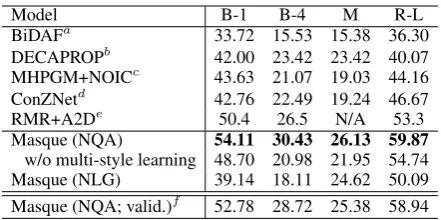
[image:7.595.75.290.228.325.2]architec-Model B-1 B-4 M R-L
BiDAFa 33.72 15.53 15.38 36.30
DECAPROPb 42.00 23.42 23.42 40.07
MHPGM+NOICc 43.63 21.07 19.03 44.16
ConZNetd 42.76 22.49 19.24 46.67
RMR+A2De 50.4 26.5 N/A 53.3
Masque (NQA) 54.11 30.43 26.13 59.87
w/o multi-style learning 48.70 20.98 21.95 54.74
Masque (NLG) 39.14 18.11 24.62 50.09
[image:8.595.71.292.60.170.2]Masque (NQA; valid.)f 52.78 28.72 25.38 58.94
Table 5: Performance of our and competing models on the NarrativeQA test set.aSeo et al.(2017);bTay et al.
(2018); cBauer et al. (2018); dIndurthi et al.(2018);
eHu et al.(2018).fResults on the NarrativeQA
valida-tion set.
ture itself is powerful for natural language under-standing in RC.
6 Related Work and Discussion
Transfer and multi-task learning in RC. Re-cent breakthroughs in transfer learning demon-strate that pre-trained language models perform well on RC with minimal modifications (Peters et al., 2018; Devlin et al., 2018; Radford et al., 2018, 2019). In addition, our model also uses ELMo (Peters et al.,2018) for contextualized em-beddings.
Multi-task learning is a transfer mechanism to improve generalization performance (Caruana, 1997), and it is generally applied by sharing the hidden layers between all tasks, while keep-ing task-specific layers. Wang et al. (2018) and Nishida et al.(2018) reported that the sharing of the hidden layers between the multi-passage RC and passage ranking tasks was effective. Our re-sults also showed the effectiveness of the sharing of the question-passages reader module among the RC, passage ranking, and answer possibility clas-sification tasks.
In multi-task learning without task-specific lay-ers, Devlin et al. (2018) and Chen et al. (2017) improved RC performance by learning multiple datasets from the same extractive RC setting. Mc-Cann et al.(2018) andYogatama et al.(2019) in-vestigated multi-task and curriculum learning on many different NLP tasks; their results were below task-specific RC models. Our multi-style learning does not use style-specific layers; instead uses a style-conditional decoder.
Generative RC. S-Net (Tan et al., 2018) used an extraction-then-synthesis mechanism for
multi-passage RC. The models proposed by McCann et al. (2018), Bauer et al. (2018), and Indurthi et al.(2018) used an RNN-based pointer-generator mechanism for single-passage RC. Although these mechanisms can alleviate the lack of training data, large amounts of data are still required. Our multi-style learning will be a key technique enabling learning from many RC datasets with different styles.
In addition to MS MARCO and NarrativeQA, there are other datasets that provide abstractive answers. DuReader (He et al., 2018), a Chinese multi-document RC dataset, provides longer doc-uments and answers than those of MS MARCO. DuoRC (Saha et al., 2018) and CoQA (Reddy et al.,2018) contain abstractive answers; most of the answers are short phrases.
Controllable text generation. Many studies have been carried out in the framework of style transfer, which is the task of rephrasing a text so that it contains specific styles such as sentiment. Recent studies have used artificial tokens ( Sen-nrich et al., 2016; Johnson et al., 2017), varia-tional auto-encoders (Hu et al., 2017), or adver-sarial training (Fu et al., 2018; Tsvetkov et al., 2018) to separate the content and style on the en-coder side. On the deen-coder side, conditional lan-guage modeling has been used to generate out-put sentences with the target style. In addition, output length control with conditional language modeling has been well studied (Kikuchi et al., 2016;Takeno et al.,2017;Fan et al.,2018). Our style-controllable RC relies on conditional lan-guage modeling in the decoder.
RC with unanswerable question identification.
The previous work of (Levy et al.,2017;Clark and Gardner, 2018) outputted a no-answer score de-pending on the probability of all answer spans.Hu et al.(2019) proposed an answer verifier to com-pare an answer with the question.Sun et al.(2018) jointly learned an RC model and an answer veri-fier. Our model introduces a classifier on top of the question-passages reader, which is not dependent on the generated answer.
Abstractive summarization. Current state-of-the-art models use the pointer-generator mecha-nism (See et al., 2017). In particular, content se-lection approaches, which decide what to sum-marize, have recently been used with abstractive models. Most methods select content at the sen-tence level (Hsu et al., 2018; Chen and Bansal, 2018) or the word level (Pasunuru and Bansal, 2018;Li et al.,2018;Gehrmann et al.,2018). Our model incorporates content selection at the pas-sage level in the combined attention.
Query-based summarization has rarely been studied because of a lack of datasets. Nema et al. (2017) proposed an attentional encoder-decoder model; however, Saha et al.(2018) reported that it performed worse than BiDAF on DuoRC. Has-selqvist et al.(2017) proposed a pointer-generator based model; however, it does not consider copy-ing words from the question.
7 Conclusion
This study sheds light on multi-style generative RC. Our proposed model, Masque, is based on multi-source abstractive summarization and learns multi-style answers together. It achieved state-of-the-art performance on the Q&A task and the Q&A + NLG task of MS MARCO 2.1 and the summary task of NarrativeQA. The key to its success is transferring the style-independent NLG capability to the target style by use of the question-passages reader and the conditional pointer-generator decoder. In particular, the capa-bility of copying words from the question and pas-sages can be shared among the styles, while the capability of controlling the mixture weights for the generative and copy distributions can be ac-quired for each style. Our future work will involve exploring the potential of our multi-style learning towards natural language understanding.
References
Lei Jimmy Ba, Ryan Kiros, and Geoffrey E. Hinton. 2016. Layer normalization. Computing Research Repository (CoRR), arXiv:1607.06450. Version 1.
Payal Bajaj, Daniel Campos, Nick Craswell, Li Deng, Jianfeng Gao, Xiaodong Liu, Rangan Majumder, Andrew McNamara, Bhaskar Mitra, Tri Nguyen, Mir Rosenberg, Xia Song, Alina Stoica, Saurabh Tiwary, and Tong Wang. 2018. MS MARCO: A human generated machine reading comprehension dataset. Computing Research Repository (CoRR), arXiv:1611.09268. Version 3.
Lisa Bauer, Yicheng Wang, and Mohit Bansal. 2018.
Commonsense for generative multi-hop question an-swering tasks. In Empirical Methods in Natural Language Processing (EMNLP), pages 4220–4230.
Richard Caruana. 1997. Multitask learning. Machine Learning, 28(1):41–75.
Danqi Chen, Adam Fisch, Jason Weston, and Antoine Bordes. 2017. Reading wikipedia to answer open-domain questions. In Association for Computa-tional Linguistics (ACL), pages 1870–1879.
Yen-Chun Chen and Mohit Bansal. 2018. Fast abstrac-tive summarization with reinforce-selected sentence rewriting. In Association for Computational Lin-guistics (ACL), pages 675–686.
Christopher Clark and Matt Gardner. 2018. Simple and effective multi-paragraph reading comprehen-sion. InAssociation for Computational Linguistics (ACL), pages 845–855.
Jacob Devlin, Ming-Wei Chang, Kenton Lee, and Kristina Toutanova. 2018. BERT: pre-training of deep bidirectional transformers for language under-standing. Computing Research Repository (CoRR), arXiv:1810.04805. Version 1.
Angela Fan, David Grangier, and Michael Auli. 2018.
Controllable abstractive summarization. In Work-shop on Neural Machine Translation and Genera-tion (NMT@ACL), pages 45–54.
Zhenxin Fu, Xiaoye Tan, Nanyun Peng, Dongyan Zhao, and Rui Yan. 2018. Style transfer in text: Exploration and evaluation. In Association for the Advancement of Artificial Intelligence (AAAI), pages 663–670.
Sebastian Gehrmann, Yuntian Deng, and Alexander M. Rush. 2018. Bottom-up abstractive summarization. InEmpirical Methods in Natural Language Process-ing (EMNLP), pages 4098–4109.
Alex Graves. 2013. Generating sequences with recur-rent neural networks. Computing Research Reposi-tory (CoRR), arXiv:1308.0850. Version 5.
Kaiming He, Xiangyu Zhang, Shaoqing Ren, and Jian Sun. 2016. Deep residual learning for image recog-nition. InComputer Vision and Pattern Recognition (CVPR), pages 770–778.
Wei He, Kai Liu, Jing Liu, Yajuan Lyu, Shiqi Zhao, Xinyan Xiao, Yuan Liu, Yizhong Wang, Hua Wu, Qiaoqiao She, Xuan Liu, Tian Wu, and Haifeng Wang. 2018. DuReader: a chinese machine read-ing comprehension dataset from real-world applica-tions. InWorkshop on Machine Reading for Ques-tion Answering (MRQA@ACL), pages 37–46.
Dan Hendrycks and Kevin Gimpel. 2016. Bridging nonlinearities and stochastic regularizers with gaus-sian error linear units. Computing Research Reposi-tory (CoRR), arXiv:1606.08415. Version 2.
Wan-Ting Hsu, Chieh-Kai Lin, Ming-Ying Lee, Kerui Min, Jing Tang, and Min Sun. 2018. A unified model for extractive and abstractive summarization using inconsistency loss. InAssociation for Compu-tational Linguistics (ACL), pages 132–141.
Minghao Hu, Yuxing Peng, Furu Wei, Zhen Huang, Dongsheng Li, Nan Yang, and Ming Zhou. 2018.
Attention-guided answer distillation for machine reading comprehension. In Empirical Methods in Natural Language Processing (EMNLP), pages 2077–2086.
Minghao Hu, Furu Wei, Yuxing Peng, Zhen Huang, Nan Yang, and Ming Zhou. 2019. Read + Verify: Machine reading comprehension with unanswerable questions. In Association for the Advancement of Artificial Intelligence (AAAI).
Zhiting Hu, Zichao Yang, Xiaodan Liang, Ruslan Salakhutdinov, and Eric P. Xing. 2017. Toward con-trolled generation of text. In International Con-ference on Machine Learning (ICML), pages 1587– 1596.
Hakan Inan, Khashayar Khosravi, and Richard Socher. 2017. Tying word vectors and word classifiers: A loss framework for language modeling. In Inter-national Conference on Learning Representations (ICLR).
Sathish Reddy Indurthi, Seunghak Yu, Seohyun Back, and Heriberto Cuay´ahuitl. 2018. Cut to the chase: A context zoom-in network for reading comprehen-sion. In Empirical Methods in Natural Language Processing (EMNLP), pages 570–575.
Melvin Johnson, Mike Schuster, Quoc V. Le, Maxim Krikun, Yonghui Wu, Zhifeng Chen, Nikhil Tho-rat, Fernanda B. Vi´egas, Martin Wattenberg, Greg Corrado, Macduff Hughes, and Jeffrey Dean. 2017.
Google’s multilingual neural machine translation system: Enabling zero-shot translation. Transac-tions of the Association for Computational Linguis-tic (TACL), 5:339–351.
Mandar Joshi, Eunsol Choi, Daniel S. Weld, and Luke Zettlemoyer. 2017. TriviaQA: A large scale dis-tantly supervised challenge dataset for reading com-prehension. InAssociation for Computational Lin-guistics (ACL), pages 1601–1611.
Yuta Kikuchi, Graham Neubig, Ryohei Sasano, Hiroya Takamura, and Manabu Okumura. 2016. Control-ling output length in neural encoder-decoders. In
Empirical Methods in Natural Language Processing (EMNLP), pages 1328–1338.
Tom´as Kocisk´y, Jonathan Schwarz, Phil Blunsom, Chris Dyer, Karl Moritz Hermann, G´abor Melis, and Edward Grefenstette. 2018. The NarrativeQA read-ing comprehension challenge. Transactions of the Association for Computational Linguistic (TACL), 6:317–328.
Omer Levy, Minjoon Seo, Eunsol Choi, and Luke Zettlemoyer. 2017. Zero-shot relation extraction via reading comprehension. InComputational Natural Language Learning (CoNLL), pages 333–342.
Chenliang Li, Weiran Xu, Si Li, and Sheng Gao. 2018. Guiding generation for abstractive text sum-marization based on key information guide network. In North American Chapter of the Association for Computational Linguistics: Human Language Tech-nologies (NAACL-HLT), pages 55–60.
Bryan McCann, Nitish Shirish Keskar, Caiming Xiong, and Richard Socher. 2018. The natural language decathlon: Multitask learning as question answer-ing. Computing Research Repository (CoRR), arXiv:1806.08730. Version 1.
Sewon Min, Victor Zhong, Richard Socher, and Caim-ing Xiong. 2018. Efficient and robust question an-swering from minimal context over documents. In
Association for Computational Linguistics (ACL), pages 1725–1735.
Preksha Nema, Mitesh M. Khapra, Anirban Laha, and Balaraman Ravindran. 2017.Diversity driven atten-tion model for query-based abstractive summariza-tion. InAssociation for Computational Linguistics (ACL), pages 1063–1072.
Kyosuke Nishida, Itsumi Saito, Atsushi Otsuka, Hisako Asano, and Junji Tomita. 2018. Retrieve-and-read: Multi-task learning of information retrieval and reading comprehension. In Conference on Information and Knowledge Management (CIKM), pages 647–656.
Kishore Papineni, Salim Roukos, Todd Ward, and Wei-Jing Zhu. 2002. Bleu: a method for automatic eval-uation of machine translation. In Association for Computational Linguistics (ACL), pages 311–318.
Jeffrey Pennington, Richard Socher, and Christo-pher D. Manning. 2014. Glove: Global vectors for word representation. InEmpirical Methods in Nat-ural Language Processing (EMNLP), pages 1532– 1543.
Matthew E. Peters, Mark Neumann, Mohit Iyyer, Matt Gardner, Christopher Clark, Kenton Lee, and Luke Zettlemoyer. 2018. Deep contextualized word repre-sentations. InNorth American Chapter of the Asso-ciation for Computational Linguistics: Human Lan-guage Technologies (NAACL-HLT), pages 2227– 2237.
Alec Radford, Karthik Narasimhan, Tim Salimans, and Ilya Sutskever. 2018. Improving language under-standing by generative ptraining. Technical re-port, OpenAI.
Alec Radford, Jeffrey Wu, Rewon Child, David Luan, Dario Amodei, and Ilya Sutskever. 2019. Language models are unsupervised multitask learners. Techni-cal report, OpenAI.
Pranav Rajpurkar, Robin Jia, and Percy Liang. 2018.
Know what you don’t know: Unanswerable ques-tions for SQuAD. InAssociation for Computational Linguistics (ACL), pages 784–789.
Pranav Rajpurkar, Jian Zhang, Konstantin Lopyrev, and Percy Liang. 2016. SQuAD: 100,000+ ques-tions for machine comprehension of text. In Em-pirical Methods in Natural Language Processing (EMNLP), pages 2383–2392.
Siva Reddy, Danqi Chen, and Christopher D. Manning. 2018. CoQA: A conversational question answering challenge. Computing Research Repository (CoRR), arXiv:1808.07042. Version 1.
Amrita Saha, Rahul Aralikatte, Mitesh M. Khapra, and Karthik Sankaranarayanan. 2018. DuoRC: Towards complex language understanding with paraphrased reading comprehension. InAssociation for Compu-tational Linguistics (ACL), pages 1683–1693.
Abigail See, Peter J. Liu, and Christopher D. Manning. 2017.Get to the point: Summarization with pointer-generator networks. In Association for Computa-tional Linguistics (ACL), pages 1073–1083.
Rico Sennrich, Barry Haddow, and Alexandra Birch. 2016. Controlling politeness in neural machine translation via side constraints. InNorth American Chapter of the Association for Computational Lin-guistics: Human Language Technologies (NAACL-HLT), pages 35–40.
Minjoon Seo, Aniruddha Kembhavi, Ali Farhadi, and Hannaneh Hajishirzi. 2017. Bidirectional attention flow for machine comprehension. In International Conference on Learning Representations (ICLR).
Rupesh Kumar Srivastava, Klaus Greff, and J¨urgen Schmidhuber. 2015. Highway net-works. Computing Research Repository (CoRR), arXiv:1505.00387. Version 2.
Fu Sun, Linyang Li, Xipeng Qiu, and Yang Liu. 2018. U-Net: Machine reading comprehension with unan-swerable questions. Computing Research Reposi-tory (CoRR), arXiv:1810.06638. Version 1.
Shunsuke Takeno, Masaaki Nagata, and Kazuhide Ya-mamoto. 2017. Controlling target features in neural machine translation via prefix constraints. In Work-shop on Asian Translation (WAT@IJCNLP), pages 55–63.
Chuanqi Tan, Furu Wei, Nan Yang, Bowen Du, Weifeng Lv, and Ming Zhou. 2018. S-Net: From answer extraction to answer synthesis for machine reading comprehension. InAssociation for the Ad-vancement of Artificial Intelligence (AAAI), pages 5940–5947.
Yi Tay, Anh Tuan Luu, Siu Cheung Hui, and Jian Su. 2018. Densely connected attention propagation for reading comprehension. InAdvances in Neural Information Processing Systems (NeurIPS), pages 4911–4922.
Yulia Tsvetkov, Alan W. Black, Ruslan Salakhutdi-nov, and Shrimai Prabhumoye. 2018. Style transfer through back-translation. InAssociation for Com-putational Linguistics (ACL), pages 866–876.
Ashish Vaswani, Noam Shazeer, Niki Parmar, Jakob Uszkoreit, Llion Jones, Aidan N. Gomez, Lukasz Kaiser, and Illia Polosukhin. 2017. Attention is all you need. InAdvances in Neural Information Pro-cessing Systems (NIPS), pages 6000–6010.
Shuohang Wang, Mo Yu, Xiaoxiao Guo, Zhiguo Wang, Tim Klinger, Wei Zhang, Shiyu Chang, Gerald Tesauro, Bowen Zhou, and Jing Jiang. 2018. R3: Reinforced reader-ranker for open-domain question answering. InAssociation for the Advancement of Artificial Intelligence (AAAI), pages 5981–5988.
Wenhui Wang, Nan Yang, Furu Wei, Baobao Chang, and Ming Zhou. 2017. Gated self-matching net-works for reading comprehension and question an-swering. InAssociation for Computational Linguis-tics (ACL), pages 189–198.
Hua Wu, Haifeng Wang, Sujian Li, Wei He, Yizhong Wang, Jing Liu, Kai Liu, and Yajuan Lyu. 2018.
Multi-passage machine reading comprehension with cross-passage answer verification. In Association for Computational Linguistics (ACL), pages 1918– 1927.
Caiming Xiong, Victor Zhong, and Richard Socher. 2017. Dynamic coattention networks for question answering. InInternational Conference on Learn-ing Representations (ICLR).
Zhilin Yang, Peng Qi, Saizheng Zhang, Yoshua Ben-gio, William W. Cohen, Ruslan Salakhutdinov, and Christopher D. Manning. 2018. HotpotQA: A dataset for diverse, explainable multi-hop question answering. InEmpirical Methods in Natural Lan-guage Processing (EMNLP), pages 2369–2380.
Dani Yogatama, Cyprien de Masson d’Autume, Jerome Connor, Tom´as Kocisk´y, Mike Chrzanowski, Ling-peng Kong, Angeliki Lazaridou, Wang Ling, Lei Yu, Chris Dyer, and Phil Blunsom. 2019. Learning and evaluating general linguistic intelli-gence. Computing Research Repository (CoRR), arXiv:1901.11373. Version 1.