Proceedings of the 55th Annual Meeting of the Association for Computational Linguistics, pages 688–697 Vancouver, Canada, July 30 - August 4, 2017. c2017 Association for Computational Linguistics Proceedings of the 55th Annual Meeting of the Association for Computational Linguistics, pages 688–697
Vancouver, Canada, July 30 - August 4, 2017. c2017 Association for Computational Linguistics
Modeling Source Syntax for Neural Machine Translation
Junhui Li† Deyi Xiong† Zhaopeng Tu‡∗
Muhua Zhu‡ Min Zhang† Guodong Zhou† †School of Computer Science and Technology,
Soochow University, Suzhou, China
{lijunhui, dyxiong, minzhang, gdzhou}@suda.edu.cn
‡Tencent AI Lab, Shenzhen, China
[email protected], [email protected]
Abstract
Even though a linguistics-free sequence to sequence model in neural machine trans-lation (NMT) has certain capability of im-plicitly learning syntactic information of source sentences, this paper shows that source syntax can be explicitly incorpo-rated into NMT effectively to provide fur-ther improvements. Specifically, we lin-earize parse trees of source sentences to obtain structural label sequences. On the basis, we propose three different sorts of encoders to incorporate source syntax into NMT: 1)Parallel RNNencoder that learns word and label annotation vectors paral-lelly; 2) Hierarchical RNN encoder that learns word and label annotation vectors in a two-level hierarchy; and 3)Mixed RNN
encoder that stitchingly learns word and label annotation vectors over sequences where words and labels are mixed. Exper-imentation on Chinese-to-English transla-tion demonstrates that all the three pro-posed syntactic encoders are able to im-prove translation accuracy. It is interesting to note that the simplest RNN encoder, i.e.,
Mixed RNNencoder yields the best perfor-mance with an significant improvement of 1.4 BLEU points. Moreover, an in-depth analysis from several perspectives is pro-vided to reveal how source syntax benefits NMT.
1 Introduction
Recently the sequence to sequence model (seq2seq) in neural machine translation (NMT) has achieved certain success over the state-of-the-art of statistical machine translation (SMT)
∗Work done at Huawei Noah’s Ark Lab, HongKong.
NP2
NP1 VV
tokoyo stock exchange approves newlistingbank
input:
output:
reference: tokyo exchange approves shinsei bank 's application for listing
(a). An example of discontinuous translation
,
NP
they came from six families with two girls and two girls .
they came from six families and two girls are without parents .
(b). An example of over translation input:
output:
reference:
Figure 1: Examples of NMT translation that fail to respect source syntax.
on various language pairs (Bahdanau et al.,2015;
Jean et al., 2015;Luong et al.,2015;Luong and
Manning, 2015). However, Shi et al. (2016)
show that the seq2seq model still fails to capture a lot of deep structural details, even though it is capable of learning certain implicit source syntax from sentence-aligned parallel corpus. Moreover, it requires an additional parsing-task-specific training mechanism to recover the hidden syntax in NMT. As a result, in the absence of explicit linguistic knowledge, the seq2seq model in NMT tends to produce translations that fail to well respect syntax. In this paper, we show that syntax can be well exploited in NMT explicitly by taking advantage of source-side syntax to improve the translation accuracy.
In principle, syntax is a promising avenue for translation modeling. This has been verified by tremendous encouraging studies on syntax-based SMT that substantially improves translation by integrating various kinds of syntactic knowl-edge (Liu et al.,2006;Marton and Resnik,2008;
Shen et al.,2008;Li et al.,2013). While it is yet to be seen how syntax can benefit NMT effectively, we find that translations of NMT sometimes fail to well respect source syntax. Figure1(a) shows a Chinese-to-English translation example of NMT. In this example, the NMT seq2seq model incor-rectly translates the Chinese noun phrase (i.e.,新 生/xinsheng 银行/yinhang) into a discontinuous
phrase in English (i.e., new ... bank) due to the failure of capturing the internal syntactic structure in the input Chinese sentence. Statistics on our de-velopment set show that one forth of Chinese noun phrases are translated into discontinuous phrases in English, indicating the substantial disrespect of syntax in NMT translation.1 Figure 1 (b) shows
another example with over translation, where the noun phrase 两/liang 个/ge 女孩/nvhai is
trans-lated twice in English. Similar to discontinuous translation, over translation usually happens along with the disrespect of syntax which results in the repeated translation of the same source words in multiple positions of the target sentence.
In this paper we are not aiming at solving any particular issue, either the discontinuous transla-tion or the over translatransla-tion. Alternatively, we ad-dress how to incorporate explicitly the source syn-tax to improve the NMT translation accuracy with the expectation of alleviating the issues above in general. Specifically, rather than directly assign-ing each source word with manually designed syn-tactic labels, asSennrich and Haddow(2016) do, we linearize a phrase parse tree into a structural label sequence and let the model automatically learn useful syntactic information. On the basis, we systematically propose and compare several different approaches to incorporating the label se-quence into the seq2seq NMT model. Experimen-tation on Chinese-to-English translation demon-strates that all proposed approaches are able to im-prove the translation accuracy.
2 Attention-based NMT
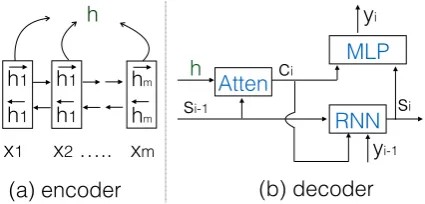
As a background and a baseline, in this section, we briefly describe the NMT model with an atten-tion mechanism by Bahdanau et al.(2015), which mainly consists of an encoder and a decoder, as shown in Figure2.
EncoderThe encoding of a source sentence is
for-1Manually examining 200 random such discontinuously
translated noun phrases, we find that 90% of them should be continuously translated according to the reference translation.
h1
h1
h1
h1
hm
hm x1 x2 ….. xm
h
Atten h
si-1
ci
RNN MLP
yi
yi-1 si
[image:2.595.310.523.67.169.2](a) encoder (b) decoder
Figure 2: Attention-based NMT model.
mulated using a pair of neural networks, i.e., two recurrent neural networks (denoted bi-RNN): one reads an input sequencex= (x1, ..., xm)from left
to right and outputs a forward sequence of hid-den states (−h→1, ...,−→hm), while the other operates
from right to left and outputs a backward sequence
(←h−1, ...,←−hm). Each source wordxj is represented
ashj (also referred to as word annotation vector):
the concatenation of hidden states−→hjand←h−j. Such
bi-RNN encodes not only the word itself but also its left and right context, which can provide impor-tant evidence for its translation.
Decoder The decoder is also an RNN that pre-dicts a target sequencey = (y1, ..., yn). Each
tar-get wordyi is predicted via a multi-layer
percep-tron (MLP) component which is based on a recur-rent hidden state si, the previous predicted word
yi−1, and a source-side context vector ci. Here,
ciis calculated as a weighted sum over source
an-notation vectors (h1, ..., hm). The weight vector
αi ∈ Rm over source annotation vectors is
ob-tained by an attention model, which captures the correspondences between the source and the target languages. The attention weightαij is computed
based on the previous recurrent hidden statesi−1
and source annotation vectorhj.
3 NMT with Source Syntax
I love dogs
w1 w2 w3
(a) word sequence
S
NP
PRN
VP
VBP NP
NNS
I love
dogs
(b) phrase parse tree
S NP PRN VP VBP NP NNS
l1 l2 l3 l4 l5 l6 l7
[image:3.595.311.519.58.407.2](c) structural label sequence
Figure 3: An example of an input sentence (a), its parse tree (b), and the parse tree’s sequential form (c).
only the information of words and their surround-ings, but also structural context in the parse tree. In the rest of this section, we use English sentences as examples to explain our methods.
3.1 Syntax Representation
To obtain the structural context of a word in its parse tree, ideally the model should not only cap-ture and remember the whole parse tree struccap-ture, but also discriminate the contexts of any two dif-ferent words. However, considering the lack of efficient way to directly model structural informa-tion, an alternative way is to linearize the phrase parse tree into a sequence of structural labels and learn the structural context through the sequence. For example, Figure 3(c) shows the structural la-bel sequence of Figure3(b) in a simple way fol-lowing a depth-first traversal order. Note that lin-earizing a parse tree in a depth-first traversal or-der into a sequence of structural labels has also been widely adopted in recent advances in neural syntactic parsing (Vinyals et al., 2015;Choe and
Charniak,2016), suggesting that the linearized
se-quence can be viewed as an alternative to its tree structure.2
2We have also tried to include the ending brackets in the
structural label sequence, as what (Vinyals et al.,2015;Choe
hw1
hw1
hw2
hw2
hw3
hw3
I love dogs S NP PRN VP VBP NP NNS
hl1
hl1
… …
hl7
hl7
…
… …
… …
… …
…
(a) Parallel RNN encoder
+ + +
word RNN structural label RNN
hw1
hw1
hl3
hl3
hw2
hw2
hl5
hl5
hw3
hw3
hl7
hl7
word RNN
S NP PRN VP VBP NP NNS
hl1
hl1
… …
hl7
hl7
…
… …
… …
… …
… hw1
hw1
hw2
hw2
hw3
hw3
ew1
+
ew2
+
ew3
+
I Iove dogs
structural label RNN
[image:3.595.112.250.58.329.2](b) Hierarchical RNN encoder
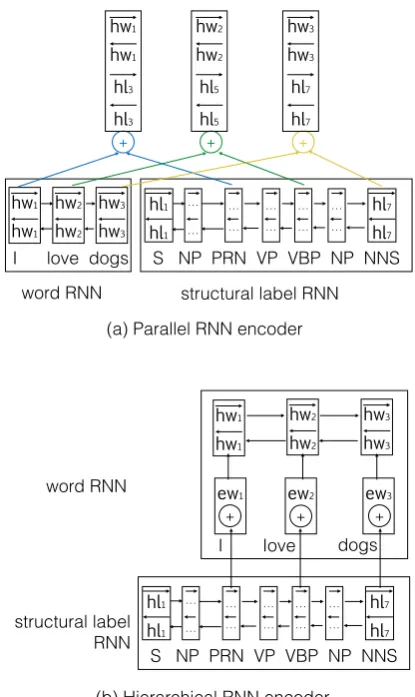
Figure 4: The graphical illustration of theParallel RNN encoder (a) and the Hierarchical RNN en-coder (b). Here,−−→hwjand←−−hwj are the forward and
backward hidden states for wordwj, −hl→i and←hl−i
are for structural labelli,ewj is the word
embed-ding for wordwj, andLis for concatenation
op-erator.
There is no doubt that the structural label se-quence is much longer than its word sese-quence. In order to obtain the structural label annotation vector for wi in word sequence, we simply look
forwi’s part-of-speech (POS) tag in the label
se-quence and view the tag’s annotation vector as
wi’s label annotation vector. This is becausewi’s
POS tag location can also representwi’s location
in the parse tree. For example, in Figure3, word
w1in (a) maps tol3 in (c) sincel3is the POS tag
ofw1. Likewise,w2 maps tol5andw3tol7. That
is to say, we usel3’s learned annotation vector as w1’s label annotation vector.
3.2 RNN Encoders with Source Syntax
In the next, we first propose two different encoders to augment word annotation vector with its corre-sponding label annotation vector, each of which consists of two RNNs 3: in one encoder, the two
RNNs work independently (i.e.,Parallel RNN En-coder) while in another encoder the two RNNs work in a hierarchical way (i.e.,Hierarchical RNN Encoder). The difference between the two en-coders lies in how the two RNNs interact. Then, we propose the third encoder with a single RNN, which learns word and label annotation vectors stitchingly (i.e.,Mixed RNN Encoder). Since any of the above three approaches focuses only on the encoder as to generate source annotation vectors along with structural information, we keep the rest part of the NMT models unchanged.
Parallel RNN Encoder Figure 4 (a) illustrates our Parallel RNN encoder, which includes two parallel RNNs: i.e., a word RNN and a structural label RNN. On the one hand, the word RNN, as in conventional NMT models, takes a word sequence as input and output a word annotation vector for each word. On the other hand, the structural label RNN takes the structural label sequence of the word sequence as input and obtains a label annotation vector for each label. Besides, we concatenate each word’s word annotation vector and its POS tag’s label annotation vector as the final annotation vector for the word. For example, the final annotation vector for word love in Figure4(a) is[−−→hw2;←−−hw2;−→hl5;←−hl5], where the first
two subitems[−−→hw2;←−−hw2]are the word annotation
vector and the rest two subitems[−→hl5;←−hl5]are its
POS tagVBP’s label annotation vector.
Hierarchical RNN Encoder Partially inspired by the model architecture of GNMT (Wu et al.,
2016) which consists of multiple layers of LSTM RNNs, we propose a two-layer model architec-ture in which the lower layer is the structural label RNN while the upper layer is the word RNN, as shown in Figure4 (b). We put the word RNN in the upper layer because each item in the word se-quence can map into an item in the structural label sequence, while this does not hold if the order of the two RNNs is reversed. As shown in Figure4
(b), for example, the POS tagVBP’s label anno-tation vector[−→hl5,←−hl5]is concatenated with word
3Hereafter, we simplify bi-RNN as RNN.
S NP PRN I VP VBP love NP NNS dogs h1
h1 h2
h2 h3
h3 h4
h4
h5
h5 h6
h6 h7
h7
h8
h8 h9
h9 h10
[image:4.595.309.520.60.129.2]h10
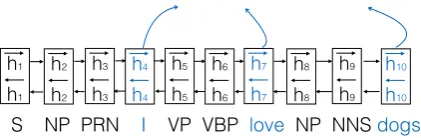
Figure 5: The graphical illustration of theMixed RNNencoder. Here,−→hjand←h−jare the forward and
backward hidden annotation vectors forj-th item, which can be either a word or a structural label.
love’s word embeddingew2to feed as the input to
the word RNN.
Mixed RNN Encoder Figure 5 presents our
Mixed RNN encoder. Similarly, the sequence of input is the linearization of its parse tree (as in Figure3 (b)) following a depth-first traversal or-der, but being mixed with both words and struc-tural labels in a stitching way. It shows that the RNN learns annotation vectors for both the words and the structural labels, though only the annota-tion vectors of words are further fed to decoding (e.g.,([−→h4,h←−4],[−→h7,←h−7],[−→h10,←−h10])). Even though
the annotation vectors of structural labels are not directly fed forward for decoding, the error signal is back propagated along the word sequence and allows the annotation vectors of structural labels being updated accordingly.
3.3 Comparison of RNN Encoders with Source Syntax
Though all the three encoders model both word sequence and structural label sequence, the dif-ferences lie in their respective model architecture with respect to the degree of coupling the two se-quences:
• In theParallel RNNencoder, the word RNN
and structural label RNN work in a parallel way. That is to say, the error signal back propagated from the word sequence would not affect the structural label RNN, and vice versa. In contrast, in theHierarchical RNN
label sequences in these three encoders are like this: Mixed RNN encoder>
Hierarchi-cal RNNencoder>Parallel RNNencoder.
• Figure4and Figure5suggest that theMixed
RNN encoder is the simplest. Moreover, comparing to conventional NMT encoders, the difference lies only in the length of the in-put sequence. Statistics on our training data reveal that theMixed RNNencoder approxi-mately triples the input sequence length com-pared to conventional NMT encoders.
4 Experimentation
We have presented our approaches to incorporat-ing the source syntax into NMT encoders. In this section, we evaluate their effectiveness on Chinese-to-English translation.
4.1 Experimental Settings
Our training data for the translation task consists of 1.25M sentence pairs extracted from LDC cor-pora, with 27.9M Chinese words and 34.5M En-glish words respectively.4 We choose NIST MT
06 dataset (1664 sentence pairs) as our develop-ment set, and NIST MT 02, 03, 04, and 05 datasets (878, 919, 1788 and 1082 sentence pairs, respec-tively) as our test sets.5 To get the source
syn-tax for sentences on the source-side, we parse the Chinese sentences with Berkeley Parser6(Petrov
and Klein, 2007) trained on Chinese TreeBank
7.0 (Xue et al.,2005). We use the case insensitive 4-gram NIST BLEU score (Papineni et al.,2002) for the translation task.
For efficient training of neural networks, we limit the maximum sentence length on both source and target sides to 50. We also limit both the source and target vocabularies to the most frequent 16K words in Chinese and English, covering ap-proximately 95.8% and 98.2% of the two corpora respectively. All the out-of-vocabulary words are mapped to a special tokenUNK. Besides, the word embedding dimension is 620 and the size of a hid-den layer is 1000. All the other settings are the same as inBahdanau et al.(2015).
4The corpora include LDC2002E18, LDC2003E07,
LDC2003E14, Hansards portion of LDC2004T07, LDC2004T08 and LDC2005T06.
5http://www.itl.nist.gov/iad/mig/
tests/mt/
6https://github.com/slavpetrov/
berkeleyparser
The inventory of structural labels includes 16 phrase labels and 32 POS tags. In both our Paral-lel RNN encoder andHierarchical RNN encoder, we set the embedding dimension of these labels as 100 and the size of a hidden layer as 100. Besides, the maximum structural label sequence length is set to 100. In ourMixed RNN encoder, since we only have one input sequence, we equally treat the structural labels and words (i.e., a structural label is also initialized with 620 dimension embedding). Compared to the baseline NMT model, the only different setting is that we increase the maximum sentence length on source-side from 50 to 150.
We compare our method with two state-of-the-art models of SMT and NMT:
• cdec (Dyer et al.,2010): an open source hi-erarchical phrase-based SMT system ( Chi-ang, 2007) with default configuration and a 4-gram language model trained on the target portion of the training data.7
• RNNSearch: a re-implementation of the
at-tentional NMT system (Bahdanau et al.,
2015) with slight changes taken from dl4mt tutorial.8 For the activation function f of an
RNN, RNNSearch uses the gated recurrent unit (GRU) recently proposed by (Cho et al.,
2014b). It incorporates dropout (Hinton
et al.,2012) on the output layer and improves
the attention model by feeding the lastly gen-erated word. We use AdaDelta (Zeiler,2012) to optimize model parameters in training with the mini-batch size of 80. For translation, a beam search with size 10 is employed.
4.2 Experiment Results
Table1 shows the translation performances mea-sured in BLEU score. Clearly, all the proposed NMT models with source syntax improve the translation accuracy over all test sets, although there exist considerable differences among differ-ent variants.
ParametersThe three proposed models introduce new parameters in different ways. As a baseline model, RNNSearch has 60.6M parameters. Due to the infrastructure similarity, theParallel RNN sys-tem and the Hierarchical RNN system introduce
7https://github.com/redpony/cdec 8https://github.com/nyu-dl/
# System #Params Time MT06 MT02 MT03 MT04 MT05 All
1 cdec - - 33.4 34.8 33.0 35.7 32.1 34.2
2 RNNSearch 60.6M 153m 34.0 36.9 33.7 37.0 34.1 35.6
3 Parallel RNN +1.1M +9m 34.8† 37.8‡ 34.2 38.3‡ 34.6 36.6‡
4 Hierarchical RNN +1.2M +9m 35.2‡ 37.2 34.7† 38.7‡ 34.7† 36.7‡
[image:6.595.79.522.62.146.2]5 Mixed RNN +0 +40m 35.6‡ 37.7† 34.9‡ 38.6‡ 35.5‡ 37.0‡
Table 1: Evaluation of the translation performance. †and‡: significant over RNNSearch at 0.05/0.01,
tested by bootstrap resampling (Koehn,2004).“+”is the additional number of parameters or training time on the top of the baseline system RNNSearch. ColumnTimeindicates the training time in minutes per epoch for different NMT models
the similar size of additional parameters, result-ing from the RNN model for structural label se-quences (about 0.1M parameters) and catering ei-ther the augmented annotation vectors (as shown in Figure 4 (a)) or the augmented word embed-dings (as shown in Figure4 (b)) (the remain pa-rameters). It is not surprising that theMixed RNN
system does not require any additional parameters since though the input sequence becomes longer, we keep the vocabulary size unchanged, resulting in no additional parameters.
Speed Introducing the source syntax slightly slows down the training speed. When running on a single GPU GeForce GTX 1080, the baseline model speeds 153 minutes per epoch with 14K updates while the proposed structural label RNNs in bothParallel RNNandHierarchical RNN sys-tems only increases the training time by about 6% (thanks to the small size of structural label embed-dings and annotation vectors), and theMixed RNN
system spends 26% more training time to cater the triple sized input sequence.
Comparison with the baseline NMT model (RNNSearch)While all the three proposed NMT models outperform RNNSearch, theParallel RNN
system and theHierarchical RNNsystem achieve similar accuracy (e.g., 36.6 v.s. 36.7). Besides, the Mixed RNN system achieves the best accu-racy overall test sets with the only exception of NIST MT 02. Over all test sets, it outperforms RNNSearch by 1.4 BLEU points and outperforms the other two improved NMT models by 0.3∼0.4
BLEU points, suggesting the benefits of high de-gree of coupling the word sequence and the struc-tural label sequence. This is very encouraging since the Mixed RNN encoder is the simplest, without introducing new parameters and with only slight additional training time.
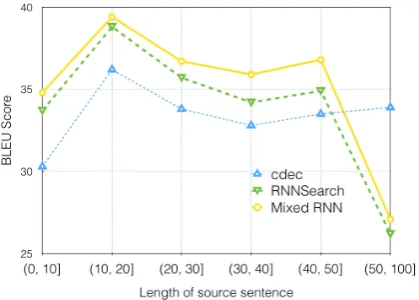
Figure 6: Performance of the generated transla-tions with respect to the lengths of the input sen-tences.
Comparison with the SMT model (cdec) Ta-ble 1 also shows that all NMT systems outper-form the SMT system. This is very consistent with other studies on Chinese-to-English transla-tion (Mi et al.,2016;Tu et al.,2017b;Wang et al.,
2017).
5 Analysis
As the proposed Mixed RNN system achieves the best performance, we further look at the RNNSearch system and theMixed RNNsystem to explore more on how syntactic information helps in translation.
5.1 Effects on Long Sentences
[image:6.595.314.524.237.387.2]System AER
RNNSearch 50.1 Mixed RNN 47.9
Table 2: Evaluation of alignment quality. The lower the score, the better the alignment quality.
when the length of input sentences increases. This performance trend over the length is consistent with the findings in (Cho et al.,2014a;Tu et al.,
2016,2017a). We also observe that the NMT
sys-tems perform surprisingly bad on sentences over 50 in length, especially compared to the perfor-mance of SMT system (i.e., cdec). We think that the bad behavior of NMT systems towards long sentences (e.g., length of 50) is due to the fol-lowing two reasons: (1) the maximum source sen-tence length limit is set as 50 in training,9making
the learned models not ready to translate sentences over the maximum length limit; (2) NMT systems tend to stop early for long input sentences.
5.2 Analysis on Word Alignment
Due to the capability of carrying syntactic infor-mation in source annotation vectors, we conjec-ture that our model with source syntax is also beneficial for alignment. To test this hypothe-sis, we carry out experiments of the word align-ment task on the evaluation dataset fromLiu and Sun(2015), which contains 900 manually aligned Chinese-English sentence pairs. We force the de-coder to output reference translations, as to get au-tomatic alignments between input sentences and their reference translations. To evaluate alignment performance, we report the alignment error rate (AER) (Och and Ney,2003) in Table2.
Table 2 shows that source syntax information improves the attention model as expected by main-taining an annotation vector summarizing struc-tural information on each source word.
5.3 Analysis on Phrase Alignment
The above subsection examines the alignment per-formance at the word level. In this subsection, we turn to phrase alignment analysis by moving from word unit to phrase unit. Given a source phrase
XP, we use word alignments to examine if the phrase is translated continuously (Cont.), or
dis-9Though the maximum source length limit inMixed RNN
system is set to 150, it approximately contains 50 words in maximum.
System XP Cont. Dis. Un.
RNNSearch
PP 57.3 33.6 9.1 NP 59.8 25.5 14.7 CP 47.3 44.6 8.1 QP 54.0 22.2 23.8 ALL 58.1 27.1 14.8
Mixed RNN
PP 63.3 27.5 9.2 NP 63.1 23.1 13.8 CP 54.5 36.6 8.9 QP 56.2 19.7 24.1 ALL 60.4 25.0 14.6
Table 3: Percentages (%) of syntactic phrases in our test sets being translated continuously, discon-tinuously, or not being translated. Here PP is for prepositional phrase, NP for noun phrase, CP for clause headed by a complementizer, QP for quain-ter phrase.
continuously (Dis.), or if it is not translated at all (Un.).
There are some phrases, such as noun phrases (NPs), prepositional phrases (PPs) that we usu-ally expect to have a continuous translation. With respect to several such types of phrases, Table 3
shows how these phrases are translated. From the table, we see that translations of RNNSearch system do not respect source syntax very well. For example, in RNNSearch translations, 57.3%, 33.6%, and 9.1% of PPs are translated continu-ously, discontinucontinu-ously, and untranslated, respec-tively. Fortunately, our Mixed RNN system is able to have more continuous translation for those phrases. Table 3 also suggests that there is still much room for NMT to show more respect to syn-tax.
5.4 Analysis on Over Translation
To estimate the over translation generated by NMT, we proposeratio of over translation (ROT):
ROT =
P
wit(wi)
|w| (1)
where |w| is the number of words in consider-ation, t(wi) is the times of over translation for
word wi. Given a word w and its translation
e=e1e2. . . en, we have:
t(w) =|e| − |uniq(e)| (2)
where|e|is the number of words inw’s
[image:7.595.131.233.61.109.2] [image:7.595.314.519.62.215.2]System POS ROT (%)
RNNSearch
NR 15.7
CD 7.4
DT 4.9
NN 8.0
ALL 5.5
Mixed RNN
NR 12.3
CD 5.1
DT 2.4
NN 6.8
ALL 4.5
Table 4: Ratio of over translation (ROT) on test sets. Here NR is for proper noun, CD for cardi-nal number, DT for determiner, and NN for nouns except proper nouns and temporal nouns.
港/xiangkang is translated as hong kong hong
kong, we say it being over translated2times. Table4presents ROT grouped by some typical POS tags. It is not surprising that RNNSearch sys-tem has high ROT with respect to POS tags of NR (proper noun) and CD (cardinal number): this is due to the fact that the two POS tags include high percentage of unknown words which tend to be translated multiple times in translation. Words of DT (determiner) are another source of over trans-lation since they are usually translated to multiple
thein English. It also shows that by introducing source syntax, Mixed RNN system alleviates the over translation issue by 18%: ROT drops from 5.5% to 4.5%.
5.5 Analysis on Rare Word Translation
We analyze the translation of source-side rare words that are mapped to a special token UNK. Given a rare wordw, we examine if it is translated into anon-UNKword (non-UNK),UNK(UNK), or if it is not translated at all (Un.).
Table 5 shows how source-side rare words are translated. The four POS tags listed in the table account for about 90% of all rare words in the test sets. It shows that inMixed RNNsystem is more likely to translate source-side rare words intoUNK
on the target side. This is reasonable since the source side rare words tends to be translated into rare words in the target side. Moreover, it is hard to obtain its correct non-UNK translation when a source-side rare word is replaced asUNK.
Note that our approach is compatible with with approaches of open vocabulary. Taking the
sub-System POS non-UNK UNK Un.
RNNSearch
NN 27.2 40.4 32.4
NR 22.9 58.5 18.6
VV 34.5 32.9 32.7
CD 10.7 63.4 25.9
ALL 27.2 40.4 32.4
Mixed RNN
NN 24.8 41.4 33.8
NR 17.0 64.5 18.6
VV 33.6 34.0 32.3
CD 9.6 68.7 21.7
[image:8.595.102.261.61.215.2]ALL 23.9 47.5 28.7
Table 5: Percentages (%) of rare words in our test sets being translated into anon-UNK word ( non-UNK),UNK(UNK), or if it is not translated at all (Un.).
word approach (Sennrich et al.,2016) as an exam-ple, for a word on the source side which is divided into several subword units, we can synthesize sub-POS nodes that cover these units. For example, if
misunderstand/VBis divided into units ofmisand
understand, we construct substructure(VB (VB-F mis) (VB-I understand)).
6 Related Work
While there has been substantial work on lin-guistically motivated SMT, approaches that lever-age syntax for NMT start to shed light very re-cently. Generally speaking, NMT can provide a flexible mechanism for adding linguistic knowl-edge, thanks to its strong capability of automati-cally learning feature representations.
Eriguchi et al. (2016) propose a
tree-to-sequence model that learns annotation vectors not only for terminal words, but also for non-terminal nodes. They also allow the attention model to align target words to non-terminal nodes. Our ap-proach is similar to theirs by using source-side phrase parse tree. However, ourMixed RNN sys-tem, for example, incorporates syntax informa-tion by learning annotainforma-tion vectors of syntactic la-bels and words stitchingly, but is still a sequence-to-sequence model, with no extra parameters and with less increased training time.
Sennrich and Haddow (2016) define a few
[image:8.595.307.533.62.217.2]em-beddings into the NMT encoder. On the contrast, we do not specify any feature, but let the model implicitly learn useful information from the struc-tural label sequence.
Shi et al.(2016) design a few experiments to in-vestigate if the NMT system without external lin-guistic input is capable of learning syntactic infor-mation on the source-side as a by-product of train-ing. However, their work is not focusing on im-proving NMT with linguistic input. Moreover, we analyze what syntax is disrespected in translation from several new perspectives.
Garc´ıa-Mart´ınez et al. (2016) generalize NMT
outputs as lemmas and morphological factors in order to alleviate the issues of large vocabulary and out-of-vocabulary word translation. The lem-mas and corresponding factors are then used to generate final words in target language. Though they use linguistic input on the target side, they are limited to the word level features. Phrase level, or even sentence level linguistic features are harder to obtain for a generation task such as machine translation, since this would require incremental parsing of the hypotheses at test time.
7 Conclusion
In this paper, we have investigated whether and how source syntax can explicitly help NMT to im-prove its translation accuracy.
To obtain syntactic knowledge, we linearize a parse tree into a structural label sequence and let the model automatically learn useful infor-mation through it. Specifically, we have de-scribed three different models to capture the syn-tax knowledge, i.e., Parallel RNN, Hierarchi-cal RNN, and Mixed RNN. Experimentation on Chinese-to-English translation shows that all pro-posed models yield improvements over a state-of-the-art baseline NMT system. It is also interesting to note that the simplest model (i.e.,Mixed RNN) achieves the best performance, resulting in obtain-ing significant improvements of 1.4 BLEU points on NIST MT 02 to 05.
In this paper, we have also analyzed the transla-tion behavior of our improved system against the state-of-the-art NMT baseline system from several perspectives. Our analysis shows that there is still much room for NMT translation to be consistent with source syntax. In our future work, we expect several developments that will shed more light on utilizing source syntax, e.g., designing novel
syn-tactic features (e.g., features showing the synsyn-tactic role that a word is playing) for NMT, and employ-ing the source syntax to constrain and guild the attention models.
Acknowledgments
The authors would like to thank three anony-mous reviewers for providing helpful comments, and also acknowledge Xing Wang, Xiangyu Duan, Zhengxian Gong for useful discussions. This work was supported by National Natural Science Foun-dation of China (Grant No. 61525205, 61331011, 61401295).
References
Dzmitry Bahdanau, Kyunghyun Cho, and Yoshua Ben-gio. 2015. Neural machine translation by jointly learning to align and translate. In Proceedings of ICLR 2015.
David Chiang. 2007. Hierarchical phrase-based trans-lation.Computational Linguistics33(2):201–228.
Kyunghyun Cho, Bart van Merrienboer, Dzmitry Bah-danau, and Yoshua Bengio. 2014a. On the proper-ties of neural machinetranslation: Encoder-decoder approaches. In Proceedings of SSST 2014. pages 103–111.
Kyunghyun Cho, Bart van Merrienboer, Caglar Gul-cehre, Dzmitry Bahdanau, Fethi Bougares, Holger Schwenk, and Yoshua Bengio. 2014b. Learning phrase representations using rnn encoder-decoder for statistical machine translation. In Proceedings of EMNLP 2014. pages 1724–1734.
Do Kook Choe and Eugene Charniak. 2016. Parsing as language modeling. In Proceedings of EMNLP 2016. pages 2331–2336.
Chris Dyer, Adam Lopez, Juri Ganitkevitch, Jonathan Weese, Ferhan Ture, Phil Blunsom, Hendra Seti-awan, Vladimir Eidelman, and Philip Resnik. 2010. cdec: A decoder, alignment, and learning framework for finite-state and context-free translation models. In Proceedings of ACL 2010 System Demonstra-tions. pages 7–12.
Akiko Eriguchi, Kazuma Hashimoto, and Yoshimasa Tsuruoka. 2016. Tree-to-sequence attentional neu-ral machine translation. In Proceedings of ACL 2016. pages 823–833.
Mercedes Garc´ıa-Mart´ınez, Loic Barrault, and Fethi Bougares. 2016. Factored neural machine transla-tion. InarXiv:1609.04621.
preventing co-adaptation of feature detectors. In arXiv:1207.0580.
S´ebastien Jean, Orhan Firat, Kyunghyun Cho, Roland Memisevic, and Yoshua Bengio. 2015. Montreal neural machine translation systems for wmt’15. In Proceedings of WMT 2015. pages 134–140.
Philipp Koehn. 2004. Statistical significance tests for machine translation evaluation. In Proceedings of EMNLP 2004. pages 388–395.
Junhui Li, Philip Resnik, and Hal Daum´e III. 2013. Modeling syntactic and semantic structures in hier-archical phrase-based translation. InProceedings of HLT-NAACL 2013. pages 540–549.
Yang Liu, Qun Liu, and Shouxun Lin. 2006. Tree-to-string alignment template for statistical machine translation. InProceedings of ACL-COLING 2006. pages 609–616.
Yang Liu and Maosong Sun. 2015. Contrastive unsu-pervised word alignment with non-local features. In Proceedings of AAAI 2015. pages 857–868.
Minh-Thang Luong and Christopher D. Manning. 2015. Stanford neural machine translation systems for spoken language domains. In Proceedings of IWSLT 2015. pages 76–79.
Minh-Thang Luong, Hieu Pham, and Christopher D. Manning. 2015. Effective approaches to attention-based neural machine translation. InProceedings of EMNLP 2015. pages 1412–1421.
Yuval Marton and Philip Resnik. 2008. Soft syntac-tic constraints for hierarchical phrased-based trans-lation. In Proceedings of ACL-HLT 2008. pages 1003–1011.
Haitao Mi, Zhiguo Wang, and Abe Ittycheriah. 2016. Supervised attentions for neural machine translation. InProceedings of EMNLP 2016. pages 2283–2288.
Franz J. Och and Hermann Ney. 2003. A systematic comparison of various statistical alignment models. Computational Linguistics29(1):19–51.
Kishore Papineni, Salim Roukos, Todd Ward, and Wei-Jing Zhu. 2002. BLEU: A method for automatic evaluation of machine translation. In Proceedings of ACL 2002. pages 311–318.
Slav Petrov and Dan Klein. 2007. Improved inference for unlexicalized parsing. In Proceedings of HLT-NAACL 2007. pages 404–411.
Rico Sennrich and Barry Haddow. 2016. Linguistic input features improve neural machine translation. InProceedings of the First Conference on Machine Translation. pages 83–91.
Rico Sennrich, Barry Haddow, and Alexandra Birch. 2016. Neural machine translation of rare words with subword units. InProceedings of ACL 2016. pages 1715–1725.
Libin Shen, Jinxi Xu, and Ralph Weischedel. 2008. A new string-to-dependency machine translation algo-rithm with a target dependency language model. In Proceedings of ACL-HLT 2008. pages 577–585.
Xing Shi, Inkit Padhi, and Kevin Knight. 2016. Does string-based neural MT learn source syntax? In Pro-ceedings of EMNLP 2016. pages 1526–1534.
Zhaopeng Tu, Yang Liu, Zhengdong Lu, Xiaohua Liu, and Hang Li. 2017a. Context gates for neural ma-chine translation. Transactions of the Association for Computational Linguistics5:87–99.
Zhaopeng Tu, Yang Liu, Lifeng Shang, Xiaohua Liu, and Hang Li. 2017b. Neural machine translation with reconstruction. InProceedings of AAAI 2017. pages 3097–3103.
Zhaopeng Tu, Zhengdong Lu, Yang Liu, Xiaohua Liu, and Hang Li. 2016. Modeling coverage for neural machine translation. In Proceedings of ACL 2016. pages 76–85.
Oriol Vinyals, Lukasz Kaiser, Terry Koo, Slav Petrov, Ilya Sutskever, and Geoffrey Hinton. 2015. Gram-mar as a foreign language. InProceedings of NIPS 2015.
Xing Wang, Zhengdong Lu, Zhaopeng Tu, Hang Li, Deyi Xiong, and Min Zhang. 2017. Neural machine translation advised by statistical machine transla-tion. In Proceedings of AAAI 2017. pages 3330– 3336.
Yonghui Wu, Mike Schuster, Zhifeng Chen, Quoc V. Le, Mohammad Norouzi, Wolfgang Macherey, Maxim Krikun, Yuan Cao, Qin Gao, Klaus Macherey, Jeff Klingner, Apurva Shah, Melvin Johnson, Xiaobing Liu, Lukasz Kaiser, Stephan Gouws, Yoshikiyo Kato, Taku Kudo, Hideto Kazawa, Keith Stevens, George Kurian, Nishant Patil, Wei Wang, Cliff Young, Jason Smith, Jason Riesa, Alex Rudnick, Oriol Vinyals, Greg Corrado, Macduff Hughes, and Jeffrey Dean. 2016. Google’s neural machine translation system: Bridging the gap between human and machine translation. InarXiv preprint arXiv:1609.08144.
Nianwen Xue, Fei Xia, Fu-Dong Chiou, and Martha Palmer. 2005. The Penn Chinese Treebank: Phrase structure annotation of a large corpus. Natural Lan-guage Engineering11(2):207–238.