
68
Semi-Supervised Learning with Auxiliary Evaluation Component for
Large Scale e-Commerce Text Classification
Mingkuan Liu, Musen Wen, Selcuk Kopru, Xianjing Liu, Alan Lu
eBay Inc.,
2145 Hamilton Avenue, San Jose, CA, 95032, USA
{mingkliu,mwen,skopru,xianjliu,alalu}@ebay.com
Abstract
The lack of high-quality labeled training data has been one of the critical challenges facing many industrial machine learning tasks. To tackle this challenge, in this pa-per, we propose a semi-supervised learn-ing method to utilize unlabeled data and user feedback signals to improve the per-formance of ML models. The method employs a primary model M ain and an auxiliary evaluation model Eval, where
M ain and Eval models are trained it-eratively by automatically generating la-beled data from unlala-beled data and/or users feedback signals. The proposed ap-proach is applied to different text classi-fication tasks. We report results on both the publicly available Yahoo! Answers dataset and our e-commerce product clas-sification dataset. The experimental sults show that the proposed method re-duces the classification error rate by 4% and up to 15% across various experimen-tal setups and datasets. A detailed compar-ison with other semi-supervised learning approaches is also presented later in the paper. The results from various text classi-fication tasks demonstrate that our method outperforms those developed in previous related studies.
1 Introduction
There are many ways to improve the performance of a machine learning model. Improving the train-ing data is one such method. Obtaining high-quality training data, such as human labeled data, is usually expensive and time-consuming. Many machine learning systems use unlabeled data or a mixture of labeled and unlabeled data for
train-ing because it is cheaper and easier to collect enormous amounts of unlabeled data. Industry-deployed machine learning systems that serve mil-lions of users generate vast amounts of unlabeled data and noisy user feedback signals every day. Those data and signals are very important and can be utilized in the training of real-world machine learning systems.
In this paper, we propose a new semi-supervised learning method with a feedback loop to leverage vast amounts of unlabeled data and feedback sig-nals. In particular, we train two machine learn-ing models iteratively. The main model, which is represented as M ain, performs the main task at runtime. The auxiliary model, which is repre-sented asEval, works offline and it estimates the correctness of theM ain models output. The in-formation available to the auxiliary modelEvalis much richer than the run-time modelM ain. Ex-tra data, such as user feed-back data and session context information, can be used when training the auxiliary model. The idea is to control the false positive rate ofEval to produce high-quality, au-tomatically labeled data from unlabeled data. The entire process runs iteratively and the performance of both models is improved in an iterative man-ner. The assumption of run-time M ain model has much fewer available information is due to the business logic flow and/or UX design constraints which limit the run-time M ainmodel to collect richer features in some industry setups.
In this paper, we use text classification experi-ments to illustrate the proposed approach. How-ever, this semi-supervised learning approach can also be applied to other machine learning tasks, such as machine translation and search relevance.
Cohn et al. (1996). Experimental results on the public Yahoo! Answers dataset and on a new public e-commerce dataset for product classifica-tion demonstrate the advantages and potential of the proposed framework compared with previous work.
The contributions of this work are as follows:
• A new semi-supervised learning method with the introducing of an auxiliary evaluation component, and
• A scalable, cost-effective and efficient way to convert vast amounts of unlabeled data into high quality labeled data for supervised train-ing purposes.
In section 2, we present the details of the pro-posed semi-supervised learning approach in the context of text classification tasks. In section 3, the theoretical analysis of the proposed method is provided. Next, we give an overview of related works and highlight their differences compared to our approach. Section 5 defines various experi-mental setups and presents the results for two dif-ferent datasets. Finally, we present the papers con-clusions in section6.
2 Proposed Method
2.1 Modeling Approach
The suggested method is based on a few observa-tions from real-world machine learning systems.
• The main model M ain that serves online users may have limited information avail-able at prediction time due to the business logic flow or UX design constraints in indus-try setups. Therefore, the predictions from theM aincomponent may contain errors and cannot be used directly as labeled data for model training purposes.
• The evaluation model Eval runs offline. Hence, it can access much richer information than the main task component without those constraints. User feedback data, user behav-ioral data, prior and post task session history data, and the knowledge base about the users main task constitute richer offline informa-tion. All those data helps the Eval model to reliably estimate whether Mains output is acceptable or not.
• Large-scale supervised machine learning methods typically need a larger amount of la-beled training data for a good performance. However, in reality, it is very expensive to manually label millions of training data. On the other hand, large scale machine learning systems serving millions of users are generat-ing millions of unlabeled data and user feed-back signals every day that is not effectively utilized.
The main idea of the proposed approach is to train and deploy two parallel machine learning models. The first model M ain is used to serve live user requests for the main task. The second machine learning model Eval is used as an of-fline model to estimate the accuracy of M ains prediction. The Eval model utilizes additional signals, such as user feedback signals, system logs that are related to user sessions, the output confi-dence scores from Main, etc. An EM-style iter-ative process is applied to trainM ain andEval
in a repeated manner. High-quality, automatically labeled data are extracted from unlabeled data by controlling the false positive rate and the false neg-ative rate in Eval. Mathematical analysis (sec-tion 3) and experiments (section 5) on different datasets show that after multiple iterations, the ac-curacy of Main can be improved substantially.
Algorithm 1shows the details of the proposed semi-supervised learning algorithm. The input to the algorithm is an initial small set of labeled data L, a large set of unlabeled data U and an optional set of user feedback data F. The al-gorithm leverages the auxiliary evaluation model
Evaland the optional user feedback dataFto pro-duce high-quality, automatically labeled dataAL
from a large amount of unlabeled data U. Once the labeled dataALis extracted and added to the training corpus C, we use a shallow neural net-work1to train modelM ainfor the text classifica-tion tasks.
2.2 Auxiliary Evaluation Model
The auxiliary evaluation model Eval is a binary classifier that predicts whether the automatic la-bel is correct or not. It is trained using gradient boosting2. If the false positive rate of the
eval-1
We use the FastText libraryJoulin et al.(2016) for the shallow neural network implementation.
2We use the XGboost libraryChen and Guestrin(2016)
Algorithm 1Proposed Algorithm Given:
Labeled datasetL:{li}
Unlabeled datasetU :{ui}
Optional feedback dataF :{fi}
M ain= trainMainModel(L)
f pRate= false positive rate threshold fork= 1toM axIterdo
Eval= trainEvalModel(M ain,L,F)
AL= emptyList() foruiinU do
P Ci= predClass(M,ui)
Score(P Ci)= evalScore(E,ui,fi,P Ci)
if Score(P Ci)>(1−f pRate) then
AL.append(ui,P Ci) end if
end for
C=L+AL
M= trainMainModel(C) end for
uation model Eval is controlled at a low thresh-old, vast amounts of high-quality, automatically labeled data can be extracted from the unlabeled data.
For text classification tasks, the evaluation modelEval leverages a variety of features. The confidence score of the main model M ains pre-diction, the n-gram language model related rank-ing, the input sentence probability scores evalu-ated by the language model fromM ains predicted class and the optional noisy user feedback sig-nal aboutM ains output are the features used by
Eval. The language model related ranking and input sentence probability scores are based on the assumption that sentences belonging to the same class are more similar than sentences belonging to different classes. Thus, we train a language model SLMi for each CLASSi using sentences
belonging to that class. If a sentence belongs to
CLASSi, its sentence probability that is evaluated with SLMi should be higher than the sentence
probability evaluated withCLASSj, wherei6=j.
We use the trigram statistical language model3 to trainSLMifor eachCLASSi.
Details on how to train the auxiliary evaluation model Eval are described in Algorithm 2. The input to the algorithm is theM ainmodel, the la-beled dataLand the optional set of user feedback
3We use KenLM library Heafield (2011) to build and
query SLMs.
data F. For each example inL, based on lis
la-beled class, we create one positive training sam-ple with the correct class and one negative train-ing sample with a wrong class that is chosen ran-domly. The features can be generated using the aforementioned multiple signal sources, such as
Ms prediction confidence scores, the SLM rank-ing scores and the optional user feedback.
Algorithm 2Train Auxiliary Evaluation Model Given:
M ainmodel
Labeled dataL:{li}
Optional feedback dataF :{fi}
forljinL do
CLASSi= class label oflj
Appendlj toSLM Corpusi
end for
foriinAllClasses do
SLMi= trainSLM(SLM Corpusi)
end for
Corpusxgb= emptyList()
forljinL do
CLASSi= class label oflj
XgbSample+ = getXgbFeatures(lj,fj, M, SLM s,CLASSi)
XgbSample− = getXgbFeatures(lj,fj, M,
SLM s,CLASSkwherek6=i) Corpusxgb.append(+,XgbSample+) Corpusxgb.append(−,XgbSample−)
end for
Eval= trainXgbModel(Corpusxgb)
3 Theoretical Analysis
The EM-like semi-supervised learning approach with an auxiliary evaluation component is de-signed to tackle large scale ML problems. In sec-tion5, we will demonstrate that our framework has a superior and consistently better performance in various real-world machine learning tasks based on the empirical results. In this section, we will first analyze and highlight some mathematical as-pects of this dual-player, semi-supervised learning approach, and illustrate its deep connection to the Expectation-Maximization algorithm.
purpose, according toJoulin et al.(2016), we want to minimize the negative log-likelihood
−1
N N
X
1
ynlog(f(BAxn)) (1)
wherexnis the normalized bag of features of the
nthtext,ynis the category labels, andAandBare
the weight matrices. As part of the auxiliary evalu-ation componentEval, we established a machine learning system with richer context compared to
M ain. The task ofEvalis to estimate the prob-ability that the given input text belongs to the cat-egory predicted byM ain. This probability is de-fined asptexti,cj.
ptexti,cj =P(Cj|texti) (2)
Notice that the entire purpose of the evaluation system is to select newly labeled data to enrich the training set of the main machine learning sys-tem. Thus, the Eval model estimates the con-fidence score of this prediction for each sample. The whole learning process ofM ain→ Eval it-erates as described in the previous sections. The dual system runs iteratively. We stress that it has a close connection to the popular Expectation-Maximization algorithm Dempster et al. (1977) via the following result.
Theory 1. Given a two-player machine learning system comprised of Main and Eval, the Main model converges to the local minima of the neg-ative log-likelihood with the controlled false posi-tive rate given enough capacity.
Proof. Given a set of training dataS(0) = (xi, yi),
i= 1,· · ·, N, which are the observed features and labels, let us denote a hidden variablezi ∈ {0,1}
that is a variable indicating the quality of the ob-servation. zi takes a value of1if the label for the corresponding instance is correct or relevant, and
0 otherwise. Without the loss of generality, sup-pose that theM ainmodel is trained to maximize the log-likelihood function:
`(Θ|X,Y) (3)
Using equation (1), equation (3) can be rewritten as
`(Θ|X,Y) = logp(X,Y|Θ)
= logX z
p(x, y, z|Θ)
= logX z
p(z)p(x, y, z|Θ) p(z)
≥X
z
p(z) logp(x, y, z|Θ) p(z)
=Ep(z)logp(p(x, y, z|Θ)
+Entropy[p(z)]
=L(p,Θ;X,Y)
(4)
where the inequality is obtained by Jensen’s in-equality. The equality holds if and only if
p(z) =p(z|X, y,Θ)
The termEp(z)logp(p(x, y, z|Θ)is the expected complete log-likelihood (or, Q-function). The two machine learning systems then iterate through the following two steps. From a set of noisy data,
Evalperforms similarly in the E-step of the EM algorithm. Fornthstep,(n= 1,2,· · ·):
p(z)(n)= arg max p
Lp,Θ(n−1);X,Y
=p(z|X, y,Θ(n−1))
(5)
Notice that the conditional distribution of the hid-den variablezis not necessarily fully predictable by the machine learning model even if the ob-served data and the models parameters are given. The evaluation system mainly provides a confi-dence score of the correctness or conficonfi-dence of the prediction, which is defined by equation (5). By properly controlling the false positive rate, we se-lect only those new training examples with a good estimate ofp(z)(n) by theEval model. This re-sults in a set of filtered samplesS(n) to be added to our M ain system for the next iteration. The main system then performs the maximization step role in the EM algorithm framework, which is the M-step that follows:
Θ(n+1)= arg max
Θ
Lp(n),Θ;X,Y
= arg max
Θ
Ep(z)(n)logp(x, y, z|Θ)
(6)
property of the generalized EM algorithm, given enough capacity, the M ain system would even-tually converge to its local optimum after enough iterations.
In the e-commerce scenario, we have more in-formative features in the offlineEvalsystem, and thus the evaluation system can have a very high ac-curacy. According to the proof, the main machine learning system eventually reaches a stable state.
4 Related Work
Various semi-supervised learning approaches have been proposed to leverage unsupervised data to improve the performance of machine learning sys-temsTriguero et al.(2015).
Active learningCohn et al.(1996);Nigam et al. (1998);Beygelzimer et al.(2009), which is a spe-cial kind of semi-supervised learning, provides ways to actively select the most informative data samples from a vast amount of unlabeled data. The selected samples are then labeled by humans. In this way, the total amount of data needed for man-ual labeling is reduced to save resources. How to handle the problem of label quality is one of the active areas of active learning research.Zhang and Chaudhuri (2015) studied the problem of active learning where labels were obtained from strong and weak labelers. In addition to the standard ac-tive learning setting, they consider the problem where they have extra weaker labelers that may provide incorrect labels. Yan et al. (2016) stud-ies the adaptive active learning problem where the labeler can return incorrect labels and also abstain from labeling.
Although active learning can significantly duce the amount of manual labeling, it still re-quires extra human labeling, which is costly and time consuming. Compared with active learning, our approach does not require any additional man-ual labeling effort.
The self-labeled technique is another type of semi-supervised approach to boost the models per-formance by iteratively labeling parts of the un-labeled data. This approach aims to obtain an enlarged labeled set, which is based on its most confident predictions, to classify unlabeled data. Zhu and Goldberg(2009) divides the self-labeled methods into self-training and co-training.
In the self-training process Triguero et al. (2014);Yarowsky(1995), a model is trained with
an initially small number of human labeled exam-ples that aim to predict unlabeled data. Then, it is retrained with its most confident predictions, thus enlarging its labeled training set. The process iter-ates in the same manner.
In the co-training process Blum and Mitchell (1998); Chen et al. (2011), two learning models are trained separately to provide distinct views of the data set by using different feature sets of the data. These two models are initially trained with a small amount of human labeled data, and then the most confident predictions of one model on the un-labeled data are used to construct the training data for the other model. This process is repeated itera-tively. Similar to our proposed approach, the self-labeled method uses the EM-based iterative pro-cess to boost the models accuracy and also does not need any further manual labeling efforts.
The major difference between the self-labeled approach and our approach is as follows. In the self-labeled method, with either self-training or co-training, all the models are main task machine learning models. In our proposed approach, there exists only one main-task model and another aux-iliary evaluation model that runs offline. Using an offline auxiliary evaluation model has the benefit of utilizing offline information that is not avail-able at prediction time. Thus, the auxiliary evalu-ation model has a better estimevalu-ation capability than the main model regarding whether Mains output is correct or not.
pro-posed an alternative method to address this chal-lenge using the Gumbel-softmax distribution.
One of the differences between our approach and GAN is that our approach relies on real un-labeled data while the GAN generates plausible data with random inputs. Another major differ-ence is that the evaluation component in our ap-proach tries to evaluate whether the main model results are correct or not. Meanwhile, in the GAN approach, the adversarial component learns to tell whether the current data sample is real or fake.
5 Experiments
To illustrate the effectiveness of the proposed semi-supervised learning method, we evaluate it with different text classification tasks. We com-pare the new method with a few other bench-mark semi-supervised approaches using the pub-lic Yahoo! Answers topic classification dataset Zhang et al. (2015); Joulin et al. (2016) and our e-commerce product categorization dataset.
5.1 Yahoo! Answers Dataset Experiments
The Yahoo! Answers topic classification dataset contains 10 classes. Each class contains 140K training samples and 6K testing samples. In this dataset, the total number of training instances is 1.4M and total number of test instances is 60K Zhang et al.(2015). We shuffle and split the orig-inal 1.4 M labeled training data into two sets. The first set contains 100K instances with labels and is used as the initial labeled dataset L. The sec-ond set contains 1.3 M instances and the labels are deleted to form the unlabeled datasetU. The 60K test samples are untouched as the blind test setT.
5.1.1 Results
Using the initial 100K labeled dataset L and 1.3 M unlabeled datasetU, we compare our approach to the three benchmark approaches: supervised learning, co-training and active-learning. In all ex-periments, once the labeled training corpus for the main model is derived, we use the shallow neural network classifier described inJoulin et al.(2016) to trainM ain.
1. 1.4M Supervised Learning: Use the entire Yahoo! dataset and build a model similar to Joulin et al.(2016). The accuracy is reported as 72.3%. This is the theoretical upper bound for a semi-supervised learning training. Any
pro-posed method with less labeled data tries ap-proach this accuracy.
2. 100K Supervised Learning: Use L dataset and build a model similar toJoulin et al.(2016). The accuracy for this model is 65.9%. This is the lower bound result. Any proposed method to leverage unlabeled data should outperform this number as much as possible.
3. Co-Training:UseLto build two initial models and useUdata in a co-training setup to enhance the initial models. The system converged to an accuracy of 69.03% after 40 iterations.
4. Self-Training: Use Lto train an initial model and use this initial model to predict the labels ofU. In the next step, mixL andU with its predictions to train a new model. Keep iter-ating the predicting labels for U, mixing cor-pus and training the classifier until the system converges. In our experiments, the self-labeled baseline converged after 30 iterations to an ac-curacy of 67.5%.
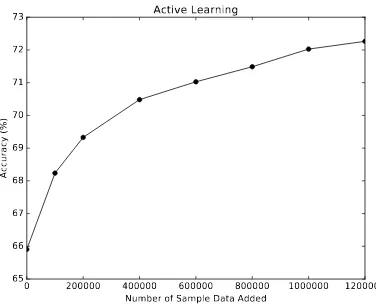
5. Active Learning: Train the initial classifierL, use it to evaluate and select the most informa-tive samples from U and reveal their ground truth labels. Then, update the classifier with the mixed corpus ofLand reveal the label samples. As more samples get selected, the performance of the active-learning algorithm improves. Fig 1shows the improvements in the accuracy with the increasing amount of manual labeling data.
0 200000 400000 600000 800000 1000000 1200000 Number of Sample Data Added
65 66 67 68 69 70 71 72 73
Ac
cu
rac
y (
%)
[image:6.595.321.509.539.692.2]Active Learning
6. EMAEC without Enriched Data: UseLand
U and apply Algorithm 1 and Algorithm2 to iteratively train M ain and Eval. After ap-proximately 20 iterations, M ain can achieve an accuracy of 70.42%. TheEvalmodel yields 92.8% precision with 83.5% recall. At the convergence stage, the system generated labels for 1.12M instances inU with a false positive rate of <8%. This approach automatically la-bels the majority (>86%) of theU dataset with high-quality (error rate<8%).
7. EMAEC with Enriched Data: The Yahoo! dataset does not contain any additional user session feedback data. To simulate the sce-nario where user-provided feedback data is un-reliable to produce 100% correct automatic la-bels, we assume that user feedback data can be simulated by randomly introducing noises to the original ground truth labels in the dataset. Thus, we first reveal all the ground truth labels inU, and then randomly selectx%ofU. Next, we randomly flip their correct labels into wrong labels and then mix them with the remaining instances inU. We call the mixed and blurred dataset asB which is theU dataset with noisy labels. We use theB dataset to simulate user noisy feedback signals. In this experiment, we useL, B, Algorithm 1and Algorithm 2 to it-eratively trainM ainandEval. As expected, the higher that the level of blurring is, the worse that the system performs. The theoretical upper bound for this experiment would be a classifier trained with 100K + (1−x%) * 1.3M ground truth labeled data. Figure 2 demonstrates the varying system performance varying with dif-ferent noise level x%. We can see that user feedback loop data can further improve the sys-tem’s performance even if we introduce 50% noise toB.
5.1.2 Discussion
The experimental results on the Yahoo! Answers topic classification dataset are summarized in Ta-ble1. The results demonstrate that by starting with only 100K labeled data and 1.3 M unlabeled data, and by using an auxiliary evaluation component, the systems accuracy can be increased from 65.9% to 70.4%. Active learning can reach the same per-formance only after adding another 400K manu-ally labeled data.
0 10 20 30 40 50 60 70
Noise Added (%) 64
65 66 67 68 69 70 71 72
A
cc
ur
ac
y
(%
)
1.4M_SL EMAECwEnrich_UBound
EMAECwEnrich EMAECwoEnrich
CoTrain SelfLabel
[image:7.595.323.507.60.207.2]100K_SL
Figure 2: EMAEC with enriched data at different noise levels and the comparison with other base-lines.
Approach Accuracy Error Reduction
[%] [%]
100K Supervised Learning 65.90 0.000
Self-Training 67.57 4.888
Active Learning (extra 100K labeled) 68.23 6.85
Co-Training 69.04 9.208
Active Learning (extra 400K labeled) 70.48 13.436
EMAEC w/o Enriched Data 70.49 13.456
EMAEC w/ Enriched Data (20% noise) 71.33 15.913
Supervised Learning with 20% noise 57.8 -12.29 1.4M Supervised Learning 72.40 19.062
Table 1: Test accuracy and error reduction rate [%] on the Yahoo! Answers dataset. The method pro-posed in this study is printed in bold.
Moreover, the proposed approach can automat-ically generate high-quality labels for over 86% of the unlabeled data with an error rate less than 8%. The results also show that by adding simu-lated user feedback loop signals into the evalu-ation component, the final system accuracy can be further improved. Even with 50% label noise, the system achieves 71.33% accuracy. The ac-tive learning system can achieve the same accu-racy only after adding extra 800K manually la-beled data. It’s also worth noting that with the same noisy blurred label dataset, the supervised learning approach has much worse performance. Its classifier accuracy significantly drops to 57.8% with 100K golden label and 1.3M blurred labels at 20% noise level.
5.2 E-commerce Product Categorization Dataset Experiments
[image:7.595.307.547.280.387.2]we significantly lacked high-quality labeled data for these problems. For example, the e-commerce product categorization dataset contains product ti-tles and 600 different categories for the product titles. This dataset contains four different parts: the product category description data for 600 cate-gories, a 6K observation manually labeled initial training dataset L, a 28K observation manually labeled blind test setT, and a 3.5 million obser-vation unlabeled datasetU that included rich user feedback session dataF. The main task here is to predict the product category as soon as the online user enters the product title. For example, the user might enter a product title, such as green coach bag to describe a product. The system should clas-sify this input title into the most relevant product category, such as ”women’s purse & bag”. The 3.5 million unlabeled user behavior dataset contains a seller chosen category and a category suggested by a machine learning model. We consider these data to be unlabeled since the seller chosen cate-gory has a greater than 30% error rate according to our evaluations. The reason for this high error rate is due to the fact that the users are not famil-iar with the category tree or they just intentionally select the wrong category to increase the chance of selling their product. Note that for the main-task system that runs online, only the product title information is available to main-task model.
5.2.1 Results
With the initial 6K labeled datasetL, the 3.5M un-labeled datasetU and the 3.5M feedback session datasetF, we compare our proposed EMAEC ap-proach with the auxiliary evaluation component to a weak supervised learning baseline and co-training baseline as described below. Similar to the previous set of experiments, once the labeled training corpus for the main model is derived, we use the shallow neural network classifier described inJoulin et al.(2016) to trainM ain.
1. Supervised Learning with Small Labeled Data: We train a supervised baseline model with the 6K labeled datasetL. This is the weak baseline model. Any proposed method that leverages unlabeled dataU and session dataF
should outperform this number.
2. Supervised Learning with Noisy Data: We treat the 3.5M seller-chosen category as the cor-rect labeled data fromF, and then mix it with the 6K labeled datasetL to train a supervised
Model Error Reduction Rate [%]
Supervised Learning with 6K Label Data 0.00 Supervised Learning with Noisy Data 12.30
Co-Training 15.20
EMAEC 19.23
Table 2: EMAEC gain in error reduction rate [%] compared to the co-training baseline on the e-commerce dataset
model. Total error reduction rate by adding seller-chosen labels is 12.3%
3. Co-Training: UseLto build two initial mod-els and useU data in a co-training setup to en-hance the initial models. Different feature sets fromF are used to train two different models. After approximately 30 iterations, the system will converge to best performance. Total error reduction rate for co-training is 15.2%.
4. EMAEC with Enriched Data: Build the ini-tial classifierM ainusingLandF. Apply Al-gorithm1 and Algorithm 2 to iteratively train the M ain and Eval models. After approx-imately 20 iterations, the main task classifier
M ainconverges to its best performance. To-tal error reduction for our approach is 19.23%.
5.2.2 Discussions
The experiment results on the e-commerce prod-uct categorization dataset are summarized in ta-ble2. The results demonstrate that our proposed approach with the auxiliary evaluation compo-nent outperforms the co-training approach sub-stantially. The classification error rate is reduced by 5%. This improvement is well aligned with the results on the public Yahoo! Answers dataset.
6 Conclusions
In this paper, we proposed a semi-supervised learning approach to tackle the challenge of lack-ing high-quality labeled data. The experimental results in text classification tasks with both open source Yahoo! Answer data and our e-commerce data show the effectiveness of the proposed ap-proach. This general dual player machine learning framework can also be applied to other machine learning tasks, such as search ranking, speech recognition, machine translation, etc.
demonstrated in text classification tasks in that it can automatically extract fairly high-quality pre-dicted labeled data from massive unlabeled data. Thus, it can further improve prediction accuracy by adding those automatically enriched labeled data into the original training corpus.
On the other side, a potential drawback could be that its effectiveness may be limited by the prediction performance of the auxiliary evaluation model. If the auxiliary evaluation model is not able to generate many labeled samples with low false positive rate, the automatically enriched la-beled data might not be well distributed to reflect the real problems underlying data distribution. To overcome this, we must rely on vast amounts of real-world unlabeled data.
At last, we know that the GAN based approach Goodfellow et al. (2014); Yu et al. (2017); and Kusner and Hern´andez-Lobato (2016) can auto-matically generate infinite amounts of fake data. Combining the advantages of the GAN framework and the proposed approach is a very interesting re-search direction for us in the future.
References
Alina Beygelzimer, Sanjoy Dasgupta, and John Lang-ford. 2009. Importance weighted active learning. In
Proceedings of the 26th annual international confer-ence on machine learning, pages 49–56. ACM.
Avrim Blum and Tom Mitchell. 1998. Combining
la-beled and unlala-beled data with co-training. In
Pro-ceedings of the eleventh annual conference on Com-putational learning theory, pages 92–100. ACM.
Minmin Chen, Kilian Q Weinberger, and John Blitzer.
2011. Co-training for domain adaptation. In
Ad-vances in neural information processing systems, pages 2456–2464.
Tianqi Chen and Carlos Guestrin. 2016. Xgboost: A
scalable tree boosting system. In Proceedings of
the 22Nd ACM SIGKDD International Conference on Knowledge Discovery and Data Mining, pages 785–794. ACM.
David A Cohn, Zoubin Ghahramani, and Michael I Jor-dan. 1996. Active learning with statistical models.
NIPS.
A. P. Dempster, N. M. Laird, and D. B. Rubin. 1977. Maximum likelihood from incomplete data via the
em algorithm. JOURNAL OF THE ROYAL
STATIS-TICAL SOCIETY, SERIES B, 39(1):1–38.
I. Goodfellow, J. Pouget-Abadie, M. Mirza, B. Xu, D. Warde-Farley, S. Ozair, A. Courville, and Y. Ben-gio. 2014. Generative adversarial nets. Advances in
neural information processing systems, pages 2672– 2680.
Kenneth Heafield. 2011. KenLM: faster and smaller
language model queries. In Proceedings of the EMNLP 2011 Sixth Workshop on Statistical Ma-chine Translation, pages 187–197, Edinburgh, Scot-land, United Kingdom.
A. Joulin, E. Grave, P. Bojanowski, and T. Mikolov. 2016. Bag of tricks for efficient text classification.
arXiv:1607.01759.
Matt J Kusner and Jos´e Miguel Hern´andez-Lobato. 2016. Gans for sequences of discrete elements with
the gumbel-softmax distribution. arXiv preprint
arXiv:1611.04051.
Kamal Nigam, Andrew McCallum, Sebastian Thrun, Tom Mitchell, et al. 1998. Learning to classify text
from labeled and unlabeled documents. AAAI/IAAI,
792.
Isaac Triguero, Salvador Garca, and Francisco Herrera. 2015. Self-labeled techniques for semi-supervised learning: Taxonomy, software and empirical study.
Knowledge and Information Systems.
Isaac Triguero, Jos´e A S´aez, Juli´an Luengo, Salvador Garc´ıa, and Francisco Herrera. 2014. On the char-acterization of noise filters for self-training semi-supervised in nearest neighbor classification. Neu-rocomputing, 132:30–41.
Karl Weiss, Taghi M Khoshgoftaar, and DingDing
Wang. 2016. A survey of transfer learning.
Jour-nal of Big Data, 3(1):1–40.
Songbai Yan, Kamalika Chaudhuri, and Tara Javidi. 2016. Active learning from imperfect labelers. In
Advances in Neural Information Processing
Sys-tems, pages 2128–2136.
David Yarowsky. 1995. Unsupervised word sense
dis-ambiguation rivaling supervised methods. In
Pro-ceedings of the 33rd annual meeting on Association for Computational Linguistics, pages 189–196. As-sociation for Computational Linguistics.
Lantao Yu, Weinan Zhang, Jun Wang, and Yong Yu. 2017. Seqgan: Sequence generative adversarial nets with policy gradient. InAAAI, pages 2852–2858.
Chicheng Zhang and Kamalika Chaudhuri. 2015. Ac-tive learning from weak and strong labelers. In Ad-vances in Neural Information Processing Systems, pages 703–711.
Xiang Zhang, Junbo Zhao, and Yann LeCun. 2015. Character-level convolutional networks for text clas-sification.NIPS.
Xiaojin Zhu and Andrew B Goldberg. 2009.
![Table 1: Test accuracy and error reduction rate [%]on the Yahoo! Answers dataset. The method pro-posed in this study is printed in bold.](https://thumb-us.123doks.com/thumbv2/123dok_us/183480.516646/7.595.323.507.60.207/table-accuracy-reduction-yahoo-answers-dataset-method-printed.webp)