Original Article
Nursing Section
The Effect of Inhalation Aromatherapy with
Lavender Essential oil on Pain Severity of
Patients After Coronary Artery Bypass Surgery:
A Single-blind Randomised Clinical Trial
Zahra Seifi1, ali Bikmoradi2, mohammad-rafi BaZrafShaN3, Jalal PoorolaJal4, malihe araghchiaN5, Seyyed haNNaN kaShfi6, eSmaeil kavi7, moZhgaN Jokar8
ABSTRACT
Introduction: Pain control and management are the most important issues of human basic needs and healthcare. The use of aromatherapy to relieve pain has grown substantially compared with other supplementary therapies. Aroma molecules convert to nervous signals in the olfactory bulb, amygdala and the limbic system and produce therapeutic effects by causing the release of a variety of neurotransmitters such as encephalin, endorphins and serotonin.
Aim: This study aimed to investigate the effects of inhalation aromatherapy with lavender essential oil on pain severity of patients after coronary artery bypass surgery.
Materials and Methods: A single-blinded randomised clinical trial was conducted with 60 patients after coronary artery bypass surgeries that were recruited during 2013 from Ekbatan Therapeutic Center of Hamadan, Iran. The intervention continued for two days for pain management. The intervention
group inhaled two drops of 2% lavender essential oil, while the control group used the same amount of distilled water for 20 minutes on the second and third postoperative days. Pain was measured at baseline and 5, 30, and 60 minutes following the intervention via vital sign tests and Visual Analogue Scale (VAS). Independent t-test and ANOVA were performed to measure continuous variables, while chi-square was conducted for the analysis of categorical variables, using stata version 11.0.
Results: The mean chest pain score decreased significantly in both groups after surgery however, there were significant differences between the aromatherapy and control groups before and after intervention only at the 30th minute (p=0.001)
and 60th minute (p=0.012) on the second day after surgery. Conclusion: Inhalational aromatherapy with lavender essential oil could relief pain of patients in the first days following coronary artery bypass surgery.
InTROduCTIOn
Coronary Artery Bypass Grafting (CABG) is a surgical approach for the management of coronary stenosis. Over 73 million CABG surgeries are carried out every year in the United States alone [1]. Despite the technical success of this surgery, postoperative complications such as gastrointestinal bleeding, dysrhythmia, delirium, severe stress, cardiogenic shock, pain, and vital sign changes are common among CABG patients [2-4]. Chest pain is among the most frequent post CABG complication, which developes within 24 to 72 hours after surgery [5]. Severe pain occurs on the first day after open-heart surgery, followed by a decline after 2 or 3 days [6].
Pain can interfere with circulation of blood in vessels and improve the risk of myocardial infarction [7]. Tachypnea, hypothermia, high blood pressure, and arterial vasoconstriction are also associated with pain [8]. In addition, pain and vital sign changes can indirectly lead to an increase in the use of analgesics, reduce resistance to infection, delay wound healing after surgery, and prolong the hospital stay [9].
There are different ways to relieve pain. The use of narcotic and non-narcotic drugs may be among the most simple and common pain alleviation methods [10]. Nevertheless, different complications, including nausea, respiratory depression, and bleeding may occur due to the use of different pain medicines, particularly Non Steroidal Anti-Inflammatory Drugs (NSAIDs) [11]. Considering these side effects, use of non pharmacological approaches is suggested to reduce drug use [12].
Complementary and Alternative Medicine (CAM) treatments are less risky in comparison with pharmacological methods and
are associated with fewer side-effects [13]. Aromatherapy is an approach, which uses natural essential oil for therapeutic purposes. Different approaches including massage and inhalation are applied in aromatherapy. Recently, this approach has been extensively applied for therapeutic purposes [14,15]. Moreover, in inhalation aromatherapy, essential oils are used to improve the vital signs and reduce pain, stress, and depression [16-19].
The use of lavender, which has shown antibacterial, antispasmodic, antidepressant and analgesic effects, has been recommended to reduce stress and pain in aromatherapy [19,20]. For instance, migraine and insomnia can be treated with this plant [21,22]. According to previous studies on lavender aromatherapy, linalyl acetate and linalool (constituents of lavender) can trigger the parasympathetic system. Furthermore, linalool can act as a sedative, while linalyl acetate induces narcotic effects [15].
According to the literature, lavender can act as a circulatory stimulant, which improves cardiac function. Moreover, it has positive effects on the coronary blood flow [22]. Based on previous studies, inhalation aromatherapy with lavender can help reduce depressive moods, pain, and stress in patients undergoing dental procedures or abdominal surgeries, as well as women undergoing cesarean section [14,23]. CABG is a surgical procedure for coronary stenosis. This procedure normally results in pain for patients, thereby highlighting the significance of pain relief and vital sign stabilisation [24]. Intensive care nurses play a major role in pain assessment, modification of vital signs, With this concept in mind, we conducted the present study with the aim to examine the efficacy of inhalation aromatherapy with lavender in pain alleviation among patients undergoing CABG.
MATeRIAlS And MeThOdS
A total of 60 CABG patients were recruited in this single-blind randomised clinical trial from Ekbatan Therapeutic Center (Hamadan, Iran) during 2013. The objectives and methods were explained, and consent was were obtained from the patients. The inclusion criteria were lack of chronic respiratory disorders, absence of alcohol abuse or addiction to narcotics, history of convulsion or head trauma. On the other hand, the exclusion criteria were eczema or allergy to lavender, intubation for >24 hours, reduced consciousness, haemodynamic instability and damaged sense of smell while filling out the scales.
[image:2.595.30.288.615.792.2]The patients were randomly allocated to the aromatherapy and control groups using balanced block randomisation with blocks of four. The aromatherapy and control groups were assigned randomly to letters A and B. Thus, for each block of four patients, two were allocated in a random order to each treatment. Six sheets of paper were used to cover all possible states: AABB, ABAB, ABBA, BBAA, BABA, and BAAB. The assignments were then selected using a table of random numbers.
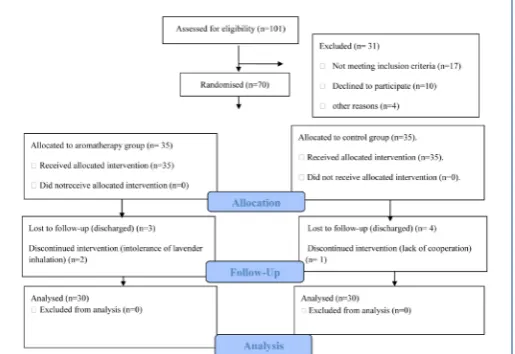
A total of 70 patients were categorised into the aromatherapy and control groups (35 patients per group). The follow-up of respectively three and four patients from the aromatherapy and control groups was not possible, as they were discharged three days after surgery. Also, the intervention was discontinued for two subjects in the aromatherapy group, given their intolerance and one subject from the control group owing to his unwillingness to continue the study. Finally, 30 patients were allocated to each group.
For data collection, questionnaires were completed, interviews were conducted, and vital signs were recorded. A self developed questionnaire and a checklist (with two sections) were used in this study. The self developed questionnaire consisted of demographic information, such as age, gender, education, and Body Mass Index (BMI). Familial histories of open heart surgery and hospital stay, as well as duration of surgery and ICU admission, were documented. Content validity was applied to assess the validity of this section of the questionnaire.
In addition, a checklist was applied (first part) to document vital signs, i.e., heart rate, respiratory rate, Systolic and Diastolic Blood Pressure (SBP and DBP), and temperature (using a monitoring device, SAIRAN Co., Iran). The second part of the checklist consisted of a recording of analgesic use by nurse (drug name, frequency of consumption, and total amount of drug consumed). In addition, we used the VAS to record pain severity in patients. VAS is a standard scale graded from 0 to 10 in which the patient is asked to select a number based on his/her severity of pain [25].
The sample size was calculated 30 cases per group according to a single-blind study by Hadi N and Hanid A, (p=0.05, power=90%)
[26]. In total, 30 patients were allocated to each group (totally 60), and information was collected according to the trial profile [Table/Fig-1].
On day 2, 3 of surgery, the patients in the aromatherapy group inhaled two drops of 2% lavender essential oil mixed in distilled water, produced by Barij Esans Co. Iran (Kashan), using an absorbable patch attached to an oxygen mask over 20 minutes [27]. On the other hand, the controls simultaneously received two drops of distilled water using a similar mask.
To prevent the inductive effect of intervention, the statistical analyst was blind to the type of treatment. Moreover, one researcher gave the aromatherapy to the patients, while another researcher independently assessed the treatment efficacy. For the assessment of pain severity, VAS was applied at baseline and 5, 30, and 60 minutes after the intervention [28]. In addition, by using a monitoring device, the vital signs were examined at baseline and 5, 30, and 60 minutes following the intervention [29].
Stata version 11 (Stata Corp., TX, USA) was used for data analysis (CI, 0.05). Independent t test was carried out to determine associations between dependent and independent variables and continuous variables. Also, for the assessment of categorical variables, chi-square was used. For the comparison of vital signs, ANOVA test was utilised.
ReSulTS
Overall, 63% of the patients in the aromatherapy group and 76.7% of those in the control group were males. In the aromatherapy and control groups, the mean ages (years) were 65.13±9.76 and 65.63±10.81, respectively, and 96.7% and 90% were married respectively. Most of the patients were illiterate in both the aromatherapy and control groups. 26 (86.7%) patients in the aromatherapy group and 23 (76.7%) control group had no history of hospitalisation. In both groups, the patients had no family history of cardiac surgery. The mean BMI in the aromatherapy group was 26.5±3.67 and that in the control group was 25.32±3.43, which did not differ significantly. The mean number days of hospitalisation in the aromatherapy and control groups were 3.27±0.74 and 3.3±0.65 respectively. Moreover, the groups were not significantly different
variables aromatherapy group, n (%) control group, n (%) p-value
gender
Male 19 (63%) 23 (76.7%)
0.260 Female 11 (37%) 7 (23.3%)
marital status
Single 1 (3.3%) 0 (0%)
0.237 Married 29 (96.7%) 27 (90%)
Widowed 0 (0%) 3 (10%)
education level
Illiterate 25 (83.4%) 25 (83.4%)
0.075 Secondary 3 (10%) 4 (13.3%)
Higher education 2 (6.6%) 1 (0.3%)
history of hospitalisation
Yes 4 (13.3%) 7 (23.3%)
0.317 No 26 (86.7%) 23 (76.7%)
family history of cardiac surgery
Yes 3 (10%) 3 (10%)
0.665
No 27 (90%) 27 (90%)
Age (years) 65.13±9.76 65.63±10.81 0.852 Body mass index 26.50±3.67 25.32±3.43 0.202
Days of hospitalisation 3.27±0.74 3.3±0.65 0.573
[Table/Fig-2]: Distribution of individual characteristics of the patients in aromatherapy and control groups.
regarding the demographic characteristics with possible effects on treatment [Table/Fig-2].
The mean chest pain scores showed based on VAS in the [Table/ Fig-3]. On the second day after surgery, the mean chest pain score before intervention in the aromatherapy group was 4.06±1.9 and that in the control group was 3.3±1.5, however, after intervention the scores reduced to 2.2±1.3 and 1.5±1.6 after 60 minutes respectively [Table/Fig-3].
Thus, the mean chest pain score decreased significantly after surgery in both groups but there were significant differences between the aromatherapy and control groups before and after intervention only at the 30th minute (p=0.001) and 60th minute (p=0.012) on the
second days after surgery. In contrast, there were no significant differences between both groups before and after intervention on the third day after surgery.
The groups were not significantly different regarding the vital signs, except DBP at third day after surgery (p=0.027) and SBP at third day following surgery (p=0.004, p=0.005) [Table/Fig-4].
dISCuSSIOn
According to several studies, pain severity varies among men and women [30]. Nevertheless, we found no major gender differences in the mean pain scores; in accordance with the present study, Setayeshi K et al., reported similar findings [30]. Overall, undergoing CABG can be a painful experience for patients. According to some previous studies, these patients normally experience postoperative pain [5].
In the present study, both groups had chest pain partially much at the baseline in 2th and 3rd days after surgery, while pain severity
was significantly reduced on the second day and partially on the third day after surgery respectively. Nevertheless, the groups had no significantly different about chest pain severity on the third day after surgery.
In this regard, according to study by Milgrom LB et al., severe pain occurred during the first days after cardiac surgery, followed by a decline within two and three days after surgery [6]. In consistence with the present findings, in the study of Hadi N and Hanid A, lavender aromatherapy reduced the pain severity of patients as compared with patients in the control group [26]. Moreover, in another study by Sheikhan F et al., lavender also could reduce significantly discomfort and pain of the patients after episiotomy rather than control group on the second, fourth and fifth days after surgery [31].
Moreover, according to a study by Kim S et al., lavender aromatherapy could not decrease significantly the pain level; although, the intervention group was more satisfied, which is not in line with the present findings on the second postoperative day [17].
However, the results of the study by Kim S et al., is in line with the results of the present study for 3rd day after surgery.
In their study, patients received oxygen in the control group, while in the current study, patients received distilled water. Furthermore, in a study by Lim EJ and Lee KY, lavender aromatherapy failed to reduce pain after tonsillectomy, which is consistent with the present study results on the third postoperative day [32].
Pain is a subjective sensation, arising from physical stimuli or motivational/affective components. It is associated with cultural factors, experience of pain, stress, and depression. Consequently, evaluation of the contribution of a specific mechanism to the experience of pain is challenging. On the other hand, aromatherapy can improve mood and anxiety in patients and reduce sympathetic triggers [33,34].
intervention periods
aromathera-py (n=30) control (n=30) difference
p-value
mean Sd mean Sd differencemean Se
chest pain (vaS) in 2nd day
Before intervention 4.07 1.9 3.3 1.5 0.73 0.44 0.05 After 5 min 3.2 1.8 2.9 1.7 0.43 0.23 0.059
After 30 min 2.5 1.6 2.8 1.8 1.07 0.31 0.001 After 60 min 2.2 1.3 1.5 1.6 0.97 0.37 0.012
chest pain (vaS) in 3rd day
Before intervention 3.7 1.9 3.5 1.6 0.17 0.47 0.36
After 5 min 3.03 2.04 2.83 1.83 0.03 0.18 0.857 After 30 min 2.8 1.8 2.7 1.7 0.10 0.26 0.697 After 60 min 2.3 1.51 2.47 1.61 0.30 0.28 0.293
[Table/Fig-3]: Comparison of the mean difference of chest pain with baseline in 2nd and 3rd days in aromatherapy and control groups using independent t-test.
variables aromatherapy group (n=30) control group (n=30)
mean±Sd p-value mean±Sd p-value
Temperature (°c) 2nd day
After 5 minutes 0.003±0.018 0.656 0.007±0.037 0.845 After 30 minutes 0.003±0.13 1.000 0.003±0.081 0.989
After 60 minutes 0.127±0.427 0.707 0.173±0.923 0.869
Temperature (°c) 3rd day
After 5 minutes 0.003±0.041 0.430 0.030±0.226 0.653 After 30 minutes 0.010±0.066 0.353 0.057±0.265 0.487 After 60 minutes 0.040±0.679 0.195 0.227±0.385 0.324
respiratory rate (Breath/min) 2nd day
After 5 minutes 1.4±8.517 0.054 0.20±6.424 0.123 After 30 minutes 0.7±10.195 0.843 0.233±7.745 0.891 After 60 minutes 1.1±6.451 0.083 2.50±9.108 0.135
respiratory rate (Breath/min) 3rd day
After 5 minutes 1.367±8.381 0.641 0.467±6.334 0.832 After 30 minutes 0.6±6.078 0.950 0.70±6.314 0.983 After 60 minutes 0.933±6.091 0.912 0.30±8.238 0.986
heart rate (Beat/min) 2nd day
After 5 minutes 1.067±5.589 0.782 1.467±5.532 0.884 After 30 minutes 0.667±6.461 0.686 0.067±7.46 0.768 After 60 minutes 1.333±6.348 0.279 0.567±7.093 0.453
heart rate (Beat/min) 3rd day
After 5 minutes 1.4±4.039 0.334 2.9±23.82 0.468 After 30 minutes 2.46±7.816 0.694 4.133±21.75 0.784 After 60 minutes 0.5±7.597 0.22 4.8±22.25 0.461
Systolic blood pressure (mmhg) 2nd day
After 5 minutes 0.667±12.96 0.203 3.067±20.71 0.431 After 30 minutes 1.2±13.976 0.200 2.667±20.70 0.453 After 60 minutes 0.70±15.764 0.58 1.4±10.578 0.453
Systolic blood pressure (mmhg) 3rd day
After 5 minutes 4.50±10.741 0.005 2.8±10.81 0.059 After 30 minutes 8.133±11.023 0.004 0.667±13.78 0.074 After 60 minutes 4.33±13.565 0.145 0.733±12.57 0.347
diastolic blood pressure (mmhg) 2nd day
After 5 minutes 1.23±7.152 0.757 0.10±7.54 0.855 After 30 minutes 0.10±7.014 0.855 1.933±7.69 0.557 After 60 minutes 1.433±7.33 0.712 0.30±8.23 0.073
diastolic blood pressure (mmhg) 3rd day
After 5 minutes 1.467±7.964 0.027 2.733±8.52 0.086
After 30 minutes 4.60±9.978 0.050 0.267±10.17 0.058 After 60 minutes 1.167±7.130 0.429 0.70±12.42 0.654
According to the literature, treatment with lavender could lead to substantial antinociception in animals [35]. Based on the conducted clinical trials, aroma essential oils can reduce anxiety of pain and increase comfort among hospitalised patients [34]. Nevertheless, the mechanism of pain relief or perception of pain remains vague in aromatherapy. Also, there is inadequate information about aromatherapy in postoperative pain management and mechanism of action as well [15].
Smells can trigger memories and remind people of certain events or feelings. In the present study, the smell of lavender caused decentralisation of patients to pain and decreased pain in the aromatherapy group. In the present study, aromatherapy with lavender essential oil for postoperative pain management resulted in pain relief among patients.
In the present study, lavender essential oil did not majorly affect the vital signs, with the exception of SBP and DBP. In line with the present study, Hwang JH evaluated the association between lavender aromatherapy and blood pressure and reported a major reduction in blood pressure by using lavender (p<0.05) [36]. Conversely, in a study by Shiina Y et al., lavender did not induce significant effects on blood pressure [23]. The inconsistency between the findings might be attributed to differences in lavender dosage in these studies. Moreover, in a study by Rho KH et al., respiratory rate was not influenced by aromatherapy, similar to the present study [37].
lIMITATIOn
The present study had some shortcomings such as small sample size and the placebo effect could not be discarded. The application of an actual placebo was troublesome given the odor of essence. In fact, the use of different aromas may have favourable impacts on pain perception. Moreover, stress hormones or essence components in the plasma (or other physiological changes induced by pain) were not examined in present study. Overall, these limitations are related to the association between smell and memory, as certain smells can trigger certain feelings or memories. Therefore, if the odor of an essence is linked to bad memories for an individual, it may produce negative outcomes.
COnCluSIOn
The pain reduction is not a long term effect of lavender. Inhalation aromatherapy with lavender essential oil could effect chest pain in CABG patients at the first few days after surgery, without causing significant changes in the vital signs. Studies with bigger sample size using multicenteric design on lavender essential oil on pain relief should be conducted.
ACKnOwledgeMenTS
The authors would like to thank all research participants who contributed to the study.
ReFeRenCeS
[1] Centers for Disease Control and Prevention. Fast stats. Atlanta: CDC; 2013; [updated 24 October 2011; cited 13 June 2013]; Available from: http://www. cdc.gov/nchs/fastats.
Bauer BA, Cutshall SM, Wentworth LJ, Engen D, Messner PK, Wood CM.
[2]
Effect of massage therapy on pain, anxiety, and tension after cardiac surgery: a randomized study. Complement Ther Clin Pract. 2010;16(2):70-75.
Geissler HJ, Fischer UM, Grunert S, Kuhn-Régnier F, Hoelscher A, Schwinger
[3]
RH, et al. Incidence and outcome of gastrointestinal complications after cardiopulmonary bypass. Interact Cardiovasc Thorac Surg. 2006; 5(3):239-42. Nalysnyk L, Fahrbach K, Reynolds MW, Zhao SZ, Ross S. Adverse events in
[4]
coronary artery bypass graft (CABG) trials: a systematic review and analysis. Heart. 2003;89(7):767-72.
Apfelbaum JL, Chen C, Mehta SS, Gan TJ. Postoperative pain experience:
[5]
result from a national survey suggest postoperative pain continuous to be undermanaged. Anesth Analg. 2003;97(2):534-40.
[6] Milgrom LB, Brooks JA, Qi R, Bunnell K, Wuestefeld S, Beckman D. Pain levels experienced with activites after cardiac surgery. Am J Crit Care. 2004;13(2):116-25. Gurbet A, Goren S, Sahin S, Uckunkaya N, Korfali G. Comparison of analgesic
[7]
effects of morphine, fentanyl, and remifentanil with intravenous patient-controlled analgesia after cardiac surgery. J Cardiothorac Vasc Anesth. 2004;18(6):755-8.
Barker R, Kober A, Hoerauf K, Latzke D, Adel S, Kain Z. Out-of-hospital auricular
[8]
acupressure in elder patients with hip fracture: a randomized double-blinded trial. Acad Emerg Med. 2006;13(1):19-23.
Kalkman CJ, Visser K, Moen J, Bonsel GJ, Grobbee DE, Moons KG. Preoperative
[9]
prediction of sever postoperative pain. Pain. 2003;105(3):415-23. Koltzenburg M, Tracey I, Turk D. Wall and melzack's textbook of pain. 6
[10] th ed.
London: Elsevier limited, Oxford; 2013.
Kim JT, Wajda M, Cuff G, Serota D, Schlame M, Axelrod DM. Evaluation
[11]
of aromatherapy in treating postoperative pain: pilot study. Pain Pract. 2006;6(4):273-77.
Layzell M. Improving the management of postoperatve pain. Nurs Times.
[12]
2005;101(26):34-36.
Beikmoradi A, Najafi F, Roshanaei Gh, Pour Esmaeil Z, Khatibian M, Ahmadi A,
[13]
Acupressure and anxiety in cancer patients. Iran Red Crescent Med J. 2015; 17(3): e25919.
Kutlu AK, Yılmaz E, Çeçen D. Effects of aroma inhalation on examination anxiety.
[14]
Teaching and Learning in Nursing. 2008;3(4):125-30.
Fayazi S, Babashahi M, Rezaei M. The effect of inhalation aromatherapy on
[15]
anxiety level of patients in preoperative period. Iran J Nurs Midwifery Res. 2011;16:278-83.
Hur MH, Lee M, Kim C, Ernst E. Aromatherapy for treatment of hypertension: a
[16]
systematic review. J Eval Clin Pract. 2012;18(1):37-41.
Kim S, Kim HJ, Yeo JS, Hong SJ, Lee JM, Jeon Y. The effect of lavender oil on
[17]
stress, bispectral index values, and needle insertion pain in volunteers. J Altern Complement Med. 2011;17(9):823-26.
Boehm K, Büssing A, Ostermann T. Aromatherapy as an adjuvant treatment in
[18]
cancer care: a descriptive systematic review. Afr J Tradit Complement Altern Med. 2012;9:503-18.
[19] Bikmoradi A, Seifi Z, Poorolajal J, Araghchian M, Safiaryan R, Oshvandi K. Effect of inhalation aromatherapy with Lavender essential oil on stress and vital signs in patients undergoing coronary artery bypass surgery: a single-blinded randomized clinical trial. Complement Ther in Med. 2014; 23(3): 331-38. Bikmoradi A, Khaleghverdi M, Seddighi I, Moradkhani S, Soltanian A, Cheraghi F.
[20]
Effect of inhalation aromatherapy with Lavender essence on pain associated with intravenous catheter insertion in preschool children: a quasi-experimental study. Complement Ther in Clin Prac. 2017;28:85-91.
Kerachian N, Alaee H, Gharavi-Naini M, Pilevarian Aa, Moghimi A. Effects of
[21]
alcoholic extract of Avena sativa, Hypericum perforatum, Passiflora incarnata and Lavandula officinalis on symptoms of morphine withdrawal syndrome in rats. Physiol Pharmacol. 2007;10(4):313-21.
Pirali Kheirabadi K, Teixeri Da Silva JA. Lavandula angustifolia essential oil as
[22]
a novel and promising natural candidate for tick (Rhipicephalus (Boophilus) annulatus) control. Exp Parasitol. 2010;126(2):184-86.
Shiina Y, Funabashi N, Lee K, Toyoda T, Sekine T, Honjo S, et al. Relaxation
[23]
effects of lavender aromatherapy improve coronary flow velocity reserve in healthy men evaluated by transthoracic Doppler echocardiography. Int J Cardiol. 2008;129:193-97.
Lee SO, Hwang JH. Effects of aroma inhalation method on subjective quality
[24]
of sleep, state anxiety, and depression in mothers following cesarean section delivery. J Korean Acad Fundam Nurs. 2011;18(1):54-62.
Johnson C. Measuring pain. visual analog scale versus numeric pain scale; what
[25]
is the difference? J ChiroprMed. 2005;4:43-44.
Hadi N, Hanid A. Lavender essence for post-cesarean pain. Pak J Biol Sci.
[26]
2011;14(11):664-67.
Buckle J. Aromatherapy:does it matter which lavender essential oil is used?
[27]
Nursing Times. 1993;89:32-35.
Cho MY, Min ES, Hur MH, Lee MS. Effects of aromatherapy on the anxiety,
[28]
vital signs, and sleep quality of percutaneous coronary intervention patients in intensive care units. Evid Based Complement Alternat Med.2013;2013:381381. Cooke B. Aromatherapy: a systematic review. Br J Gen Pract. 2000;50:493-96.
[29]
Setayeshi K, Heidari MB, Sorkheh AG, Mohammadi N, Najafi F. Comparison of
[30]
analgesic effects of marcaine subcutaneous and subfascial administration on inguinal hernia surgery. Behbood. 2010;14(1):20-26.
Sheikhana F, Jahdi F, Khoei EM, Shamsalizadeh N, Sheikhan M, Haghani H.
[31]
Episiotomy pain relief: use of lavender oil essence in primiparous iranian women. Complement Ther in Clin Pract. 2012;18(1):66-70.
Lim EJ, Lee KY. Effects of aroma inhalation therapy on pain in patients following
[32]
a tonsillectomy. J Korean Acad Fundam Nurs. 2011;18(1):63-70.
Moss M, Cook J, Wesnes K. Aromas of Rosmary and Lavender essential oils
[33]
differentially affest cognition and mood in healthy adults. Intern J Neuro Scienc. 2002;113:15-38.
Kim JT, Ren CJ, Fielding GA, Pitti A, Kasumi T, Wajda M. Treatment with lavender
[34]
morbidly obese patients undergoing laparoscopic adjustable gastric banding. Obes Surg. 2007;17(7):920-25.
Barocelli E, Calcina F, Chiavarini M. Antinociceptive and gastroprotective effects
[35]
of inhaled and orally administered Lavandula hybrida Reverchon “Grosso” essential oil. Life Sciences. 2004;76:213-23.
Hwang JH. The effects of the inhalation method using essential oils on blood
[36]
pressure and stress responses of clients with essential hypertension. Taehan Kanho Hakhoe Chi. 2006;36(7):1123-34.
Rho KH, Hall SH, Kim K. Effect of aromatherapy massage on anxiety and self
[37]
-esteem in Korean elderly women. Int J Neuro Science. 2006;776(72):1446-55.
ParTicUlarS of coNTriBUTorS:
1. Instructor, Department of Nursing, School of Nursing, Larestan University of Medical Sciences, Larestan, Iran.
2. Associate Professor, Department of Health Economic and Management, School of Public Health, Hamadan University of Medical Sciences, Hamadan, Iran. 3. Assistant Professor, Department of Nursing, School of Nursing, Larestan University of Medical Sciences, Larestan, Iran.
4. Professor, Modeling of No communicable Diseases Research Center, Department of Epidemiology and Biostatistics, School of Public Health, Hamadan University of Medical Sciences, Hamadan, Iran.
5. Assistant Professor, Department of Pharmacology, School of Medicine, Hamadan University of Medical Sciences, Hamadan, Iran. 6. Instructor, Department of Nursing, School of Nursing, Larestan University of Medical Sciences, Larestan, Iran.
7. Instructor, Department of Nursing, School of Nursing, Larestan University of Medical Sciences, Larestan, Iran.
8. Instructor, Department of Operating Room, School of Nursing and Midwifery, Isfahan University of Medical Sciences, Isfahan, Iran.
Name, addreSS, e-mail id of The correSPoNdiNg aUThor:
Dr. Mozhgan Jokar,
Instructor, Department of Operating Room, School of Nursing and Midwifery, Isfahan University of Medical Sciences, Isfahan, Iran.
E-mail: [email protected]
fiNaNcial or oTher comPeTiNg iNTereSTS: None.
Date of Submission: Nov 19, 2017
Date of Peer Review: Jan 18, 2018
Date of Acceptance: apr 21, 2018