Proceedings of the 55th Annual Meeting of the Association for Computational Linguistics, pages 355–365 Vancouver, Canada, July 30 - August 4, 2017. c2017 Association for Computational Linguistics Proceedings of the 55th Annual Meeting of the Association for Computational Linguistics, pages 355–365
Vancouver, Canada, July 30 - August 4, 2017. c2017 Association for Computational Linguistics
Topically Driven Neural Language Model
Jey Han Lau1,2 Timothy Baldwin2 Trevor Cohn2 1IBM Research
2School of Computing and Information Systems,
The University of Melbourne
[email protected],[email protected],[email protected]
Abstract
Language models are typically applied at the sentence level, without access to the broader document context. We present a neural language model that incorporates document context in the form of a topic model-like architecture, thus providing a succinct representation of the broader document context outside of the current sentence. Experiments over a range of datasets demonstrate that our model out-performs a pure sentence-based model in terms of language model perplexity, and leads to topics that are potentially more co-herent than those produced by a standard LDA topic model. Our model also has the ability to generate related sentences for a topic, providing another way to interpret topics.
1 Introduction
Topic models provide a powerful tool for extract-ing the macro-level content structure of a docu-ment collection in the form of the latent topics (usually in the form of multinomial distributions over terms), with a plethora of applications in NLP (Hall et al., 2008; Newman et al., 2010a; Wang and McCallum, 2006). A myriad of variants of
the classical LDA method (Blei et al.,2003) have
been proposed, including recent work on neural
topic models (Cao et al.,2015;Wan et al.,2012;
Larochelle and Lauly,2012;Hinton and Salakhut-dinov,2009).
Separately, language models have long been a foundational component of any NLP task involv-ing generation or textual normalisation of a noisy input (including speech, OCR and the processing of social media text). The primary purpose of a language model is to predict the probability of a
span of text, traditionally at the sentence level, un-der the assumption that sentences are independent of one another, although recent work has started using broader local context such as the preceding
sentences (Wang and Cho,2016;Ji et al.,2016).
In this paper, we combine the benefits of a topic model and language model in proposing a topically-driven language model, whereby we jointly learn topics and word sequence informa-tion. This allows us to both sensitise the predic-tions of the language model to the larger docu-ment narrative using topics, and to generate topics which are better sensitised to local context and are hence more coherent and interpretable.
Our model has two components: a language model and a topic model. We implement both components using neural networks, and train them jointly by treating each component as a sub-task in a multi-task learning setting. We show that our model is superior to other language models that leverage additional context, and that the generated topics are potentially more coherent than LDA topics. The architecture of the model provides an extra dimensionality of topic interpretability, in supporting the generation of sentences from a topic (or mix of topics). It is also highly flex-ible, in its ability to be supervised and incor-porate side information, which we show to fur-ther improve language model performance. An open source implementation of our model is
avail-able at: https://github.com/jhlau/
topically-driven-language-model.
2 Related Work
Griffiths et al.(2004) propose a model that learns topics and word dependencies using a Bayesian framework. Word generation is driven by either LDA or an HMM. For LDA, a word is generated based on a sampled topic in the document. For the
Document context (n x e)
Topic input A (k x a)
Topic output B (k x b) Softmax
Convolutional Max-over-time pooling
Fully connected with softmax output
Attention distribution p
Topic model output Document-topic
representation s
neural Language model output
Modern
network
approach
network
Language model
Topic model
x
g lstm
lstm
lstm Neural
Networks are a computational approach which is based
[image:2.595.75.527.65.359.2]on Document vector d
Figure 1: Architecture oftdlm. Scope of the models are denoted by dotted lines: blue line denotes the
scope of the topic model, red the language model.
HMM, a word is conditioned on previous words. A key difference over our model is that their lan-guage model is driven by an HMM, which uses a fixed window and is therefore unable to track long-range dependencies.
Cao et al. (2015) relate the topic model view of documents and words — documents having a multinomial distribution over topics and top-ics having a multinomial distributional over words — from a neural network perspective by embed-ding these relationships in differentiable functions. With that, the model lost the stochasticity and Bayesian inference of LDA but gained non-linear complex representations. The authors further pro-pose extensions to the model to do supervised learning where document labels are given.
Wang and Cho (2016) and Ji et al. (2016) re-lax the sentence independence assumption in lan-guage modelling, and use preceeding sentences as additional context. By treating words in
preceed-ing sentences as a bag of words, Wang and Cho
(2016) use an attentional mechanism to focus on
these words when predicting the next word. The authors show that the incorporation of additional
context helps language models.
3 Architecture
The architecture of the proposed topically-driven
language model (henceforth “tdlm”) is illustrated
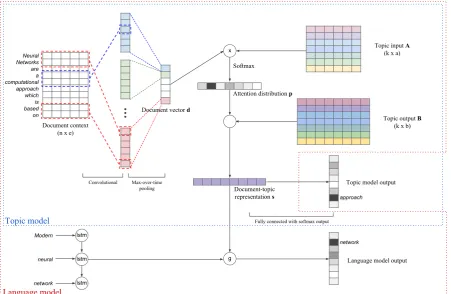
in Figure1. There are two components intdlm: a
language model and a topic model. The language model is designed to capture word relations in sen-tences, while the topic model learns topical infor-mation in documents. The topic model works like an auto-encoder, where it is given the document words as input and optimised to predict them.
The topic model takes in word embeddings of a document and generates a document vector us-ing a convolutional network. Given the document vector, we associate it with the topics via an atten-tion scheme to compute a weighted mean of topic vectors, which is then used to predict a word in the document.
The language model is a standard LSTM
lan-guage model (Hochreiter and Schmidhuber,1997;
Marrying the language and topic models allows the language model to be topically driven, i.e. it models not just word contexts but also the doc-ument context where the sentence occurs, in the form of topics.
3.1 Topic Model Component
Letxi ∈Rebe thee-dimensional word vector for
thei-th word in the document. A document ofn
words is represented as a concatenation of its word vectors:
x1:n=x1⊕x2⊕...⊕xn
where⊕denotes the concatenation operator. We
use a number of convolutional filters to process the word vectors, but for clarity we will explain the network with one filter.
Let wv ∈ Reh be a convolutional filter which
we apply to a window ofhwords to generate a
fea-ture. A featureci for a window of wordsxi:i+h−1
is given as follows:
ci =I(w|vxi:i+h−1+bv)
wherebv is a bias term andI is the identity
func-tion.1 A feature mapc is a collection of features
computed from all windows of words:
c= [c1, c2, ..., cn−h+1]
wherec ∈ Rn−h+1. To capture the most salient
features in c, we apply a max-over-time
pool-ing operation (Collobert et al., 2011), yielding a
scalar:
d= max i ci
In the case where we use a filters, we have
d ∈ Ra, and this constitutes the vector
represen-tation of the document generated by the convolu-tional and max-over-time pooling network.
The topic vectors are stored in two lookup tables
A ∈ Rk×a(input vector) andB ∈ Rk×b (output
vector), wherekis the number of topics, andaand
bare the dimensions of the topic vectors.
To align the document vectordwith the topics,
we compute an attention vector which is used to
1A non-linear function is typically used here, but
prelimi-nary experiments suggest that the identity function works best fortdlm.
compute a document-topic representation:2
p=softmax(Ad) (1)
s=B|p (2)
where p ∈ Rk and s ∈ Rb. Intuitively, s is a
weighted mean of topic vectors, with the
weight-ing given by the attentionp. This is inspired by the
generative process of LDA, whereby documents are defined as having a multinomial distribution over topics.
Finallysis connected to a dense layer with
soft-max output to predict each word in the document, where each word is generated independently as a unigram bag-of-words, and the model is optimised using categorical cross-entropy loss. In practice, to improve efficiency we compute loss for
pre-dicting a sequence ofm1 words in the document,
wherem1 is a hyper-parameter.
3.2 Language Model Component
The language model is implemented using LSTM
units (Hochreiter and Schmidhuber,1997):
it=σ(Wivt+Uiht−1+bi)
ft=σ(Wfvt+Ufht−1+bf)
ot=σ(Wovt+Uoht−1+bi) ˆ
ct=tanh(Wcvt+Ucht−1+bc)
ct=ftct−1+itˆct
ht=ottanh(ct)
wheredenotes element-wise product; it, ft, ot
are the input, forget and output activations
respec-tively at time stept; andvt,htandctare the
in-put word embedding, LSTM hidden state, and cell
state, respectively. Hereinafter W, U andb are
used to refer to the model parameters.
Traditionally, a language model operates at the sentence level, predicting the next word given its history of words in the sentence. The language
model of tdlm incorporates topical information
by assimilating the document-topic representation
(s) with the hidden output of the LSTM (ht) at
each time stept. To preventtdlmfrom
memoris-ing the next word via the topic model network, we exclude the current sentence from the document context.
2The attention mechanism was inspired by memory
We use a gating unit similar to a GRU (Cho et al., 2014; Chung et al., 2014) to allow tdlm
to learn the degree of influence of topical informa-tion on the language model:
zt=σ(Wzs+Uzht+bz)
rt=σ(Wrs+Urht+br) ˆ
ht=tanh(Whs+Uh(rtht) +bh)
h0t= (1−zt)ht+zthˆt
(3)
whereztandrtare the update and reset gate
acti-vations respectively at timestept. The new hidden
stateh0tis connected to a dense layer with linear
transformation and softmax output to predict the next word, and the model is optimised using stan-dard categorical cross-entropy loss.
3.3 Training and Regularisation
tdlmis trained using minibatches and SGD.3For
the language model, a minibatch consists of a batch of sentences, while for the topic model it is a batch of documents (each predicting a sequence
ofm1words).
We treat the language and topic models as sub-tasks in a multi-task learning setting, and train them jointly using categorical cross-entropy loss. Most parameters in the topic model are shared by the language model, as illustrated by their scopes
(dotted lines) in Figure1.
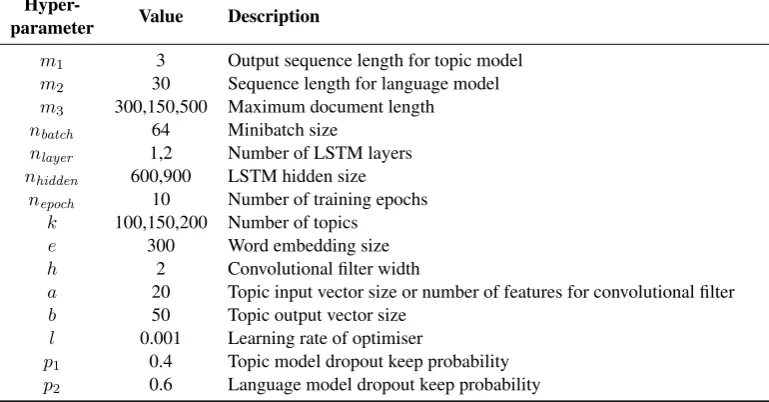
Hyper-parameters of tdlm are detailed in
Ta-ble1. Word embeddings for the topic model and
language model components are not shared,
al-though their dimensions are the same (e).4 For
m1, m2 and m3, sequences/documents shorter
than these thresholds are padded. Sentences
longer than m2 are broken into multiple
se-quences, and documents longer thanm3 are
trun-cated. Optimal hyper-parameter settings are tuned using the development set; the presented values
are used for experiments in Sections4and5.
To regularisetdlm, we use dropout
regularisa-tion (Srivastava et al.,2014). We apply dropout to
dandsin the topic model, and to the input word
embedding and hidden output of the LSTM in the
language model (Pham et al.,2013;Zaremba et al.,
2014).
4 Language Model Evaluation
We use standard language model perplexity as the evaluation metric. In terms of dataset, we use doc-3We use Adam as the optimiser (Kingma and Ba,2014). 4Word embeddings are updated during training.
ument collections from 3 sources:APNEWS,IMDB
and BNC. APNEWS is a collection of Associated
Press5 news articles from 2009 to 2016. IMDBis
a set of movie reviews collected by Maas et al.
(2011). BNC is the written portion of the British
National Corpus (BNC Consortium,2007), which
contains excerpts from journals, books, letters, es-says, memoranda, news and other types of text. ForAPNEWSandBNC, we randomly sub-sample a
set of documents for our experiments.
For preprocessing, we tokenise words and
sen-tences using Stanford CoreNLP (Klein and
Man-ning,2003). We lowercase all word tokens, filter
word types that occur less than 10 times, and
ex-clude the top 0.1% most frequent word types.6 We
additionally remove stopwords for the topic model
document context.7 All datasets are partitioned
into training, development and test sets;
prepro-cessed dataset statistics are presented in Table2.
We tune hyper-parameters of tdlm based on
development set language model perplexity. In general, we find that optimal settings are fairly
ro-bust across collections, with the exception ofm3,
as document length is collection dependent;
opti-mal hyper-parameter values are given in Table1.
In terms of LSTM size, we explore 2 settings: a small model with 1 LSTM layer and 600 hidden units, and a large model with 2 layers and 900
hidden units.8 For the topic number, we
experi-ment with 50, 100 and 150 topics. Word
embed-dings are pre-trained 300-dimension word2vec
Google News vectors.9
For comparison, we comparetdlmwith:10
vanilla-lstm: A standard LSTM language
model, using the same tdlm hyper-parameters
where applicable. This is the baseline model.
lclm: A larger context language model that
incorporates context from preceding sentences (Wang and Cho, 2016), by treating the preced-ing sentence as a bag of words, and uspreced-ing an
5https://www.ap.org/en-gb/.
6For the topic model, we remove word tokens that
corre-spond to these filtered word types; for the language model we represent them ashunkitokens (as for unseen words in test).
7We use Mallet’s stopword list: https://github. com/mimno/Mallet/tree/master/stoplists.
8Multi-layer LSTMs are vanilla stacked LSTMs without
skip connections (Gers and Schmidhuber, 2000) or depth-gating (Yao et al.,2015).
9https://code.google.com/archive/p/ word2vec/.
10Note that all models use the same pre-trained
Hyper- Value Description parameter
m1 3 Output sequence length for topic model
m2 30 Sequence length for language model
m3 300,150,500 Maximum document length
nbatch 64 Minibatch size
nlayer 1,2 Number of LSTM layers
nhidden 600,900 LSTM hidden size
nepoch 10 Number of training epochs
k 100,150,200 Number of topics
e 300 Word embedding size
h 2 Convolutional filter width
a 20 Topic input vector size or number of features for convolutional filter
b 50 Topic output vector size l 0.001 Learning rate of optimiser
p1 0.4 Topic model dropout keep probability
[image:5.595.106.491.69.270.2]p2 0.6 Language model dropout keep probability
Table 1: tdlmhyper-parameters; we experiment with 2 LSTM settings and 3 topic numbers, and m3
varies across the three domains (APNEWS,IMDB, andBNC).
Collection Training Development Test
#Docs #Tokens #Docs #Tokens #Docs #Tokens
APNEWS 50K 15M 2K 0.6M 2K 0.6M
IMDB 75K 20M 12.5K 0.3M 12.5K 0.3M
BNC 15K 18M 1K 1M 1K 1M
Table 2: Preprocessed dataset statistics.
attentional mechanism when predicting the next
word. An additional hyper-parameter inlclmis
the number of preceeding sentences to incorpo-rate, which we tune based on a development set (to 4 sentences in each case). All other
hyper-parameters (such asnbatch, e, nepoch, k2) are the
same astdlm.
lstm+lda: A standard LSTM language model
that incorporates LDA topic information. We first
train an LDA model (Blei et al., 2003; Griffiths
and Steyvers,2004) to learn 50/100/150 topics for
APNEWS, IMDBandBNC.11 For a document, the
LSTM incorporates the LDA topic distribution (q)
by concatenating it with the output hidden state
(ht) to predict the next word (i.e.h0t = ht⊕q).
That is, it incorporates topical information into the
language model, but unlike tdlm the language
model and topic model are trained separately. We present language model perplexity
perfor-mance in Table3. All models outperform the
base-linevanilla-lstm, withtdlmperforming the
11Based on Gibbs sampling;α= 0.1,β= 0.01.
best across all collections. lclm is competitive
over theBNC, although the superiority oftdlmfor
the other collections is substantial. lstm+lda
performs relatively well overAPNEWSandIMDB,
but very poorly overBNC.
The strong performance of tdlm over lclm
suggests that compressing document context into topics benefits language modelling more than
us-ing extra context words directly.12 Overall, our
re-sults show that topical information can help lan-guage modelling and that joint inference of topic and language model produces the best results.
5 Topic Model Evaluation
We saw that tdlm performs well as a language
model, but it is also a topic model, and like LDA it produces: (1) a probability distribution over topics
for each document (Equation (1)); and (2) a
prob-ability distribution over word types for each topic.
12The context size oflclm (4 sentences) is technically
[image:5.595.162.437.324.396.2]Domain LSTM Size vanilla- lclm lstm+lda tdlm
lstm 50 100 150 50 100 150
APNEWS small 64.13 54.18 57.05 55.52 54.83 53.00 52.75 52.65
large 58.89 50.63 52.72 50.75 50.17 48.96 48.97 48.21
IMDB small 72.14 67.78 69.58 69.64 69.62 63.67 63.45 63.82
large 66.47 67.86 63.48 63.04 62.78 58.99 59.04 58.59
BNC small 102.89 87.47 96.42 96.50 96.38 87.42 85.99 86.43
[image:6.595.91.502.247.361.2]large 94.23 80.68 88.42 87.77 87.28 82.62 81.83 80.58
Table 3: Language model perplexity performance of all models overAPNEWS,IMDBandBNC. Boldface
indicates best performance in each row.
lda ntm tdlm-small tdlm-large 0.05
0.00 0.05 0.10 0.15 0.20 0.25 0.30 0.35
(a)APNEWS
lda ntm tdlm-small tdlm-large 0.05
0.00 0.05 0.10 0.15 0.20 0.25 0.30 0.35
(b)IMDB
lda ntm tdlm-small tdlm-large 0.05
0.00 0.05 0.10 0.15 0.20 0.25 0.30 0.35
(c)BNC
Figure 2: Boxplots of topic coherence of all models; number of topics= 100.
Recall that s is a weighted mean of topic
vec-tors for a document (Equation (2)). Generating
the vocabulary distribution for a particular topic is
therefore trivial: we can do so by treatingsas
hav-ing maximum weight (1.0) for the topic of interest,
and no weight (0.0) for all other topics. LetBt
de-note the topic output vector for thet-th topic. To
generate the multinomial distribution over word
types for thet-th topic, we replaces withBt
be-fore computing the softmax over the vocabulary. Topic models are traditionally evaluated using model perplexity. There are various ways to
es-timate test perplexity (Wallach et al., 2009), but
Chang et al.(2009) show that perplexity does not correlate with the coherence of the generated top-ics. Newman et al.(2010b);Mimno et al.(2011); Aletras and Stevenson (2013) propose automatic
approaches to computing topic coherence, andLau
et al.(2014) summarises these methods to under-stand their differences. We propose using auto-matic topic coherence as a means to evaluate the
topic model aspect oftdlm.
Following Lau et al. (2014), we compute
topic coherence using normalised PMI (“NPMI”)
scores. Given the top-n words of a topic,
co-herence is computed based on the sum of
pair-wise NPMI scores between topic words, where the word probabilities used in the NPMI calculation are based on co-occurrence statistics mined from
English Wikipedia with a sliding window (
New-man et al.,2010b;Lau et al.,2014).13
Based on the findings of Lau and Baldwin
(2016), we average topic coherence over the
top-5/10/15/20 topic words. To aggregate topic coher-ence scores for a model, we calculate the mean coherence over topics.
In terms of datasets, we use the same document
collections (APNEWS,IMDBandBNC) as the
lan-guage model experiments (Section4). We use the
same hyper-parameter settings for tdlm and do
not tune them.
For comparison, we use the following topic models:
lda: We use a LDA model as a baseline topic
model. We use the same LDA models as were
used to learn topic distributions for lstm+lda
(Section4).
13We use this toolkit to compute topic
Topic No. System APNEWSCoherenceIMDB BNC
50
lda .125 .084 .106
ntm .075 .064 .081 tdlm-small .149 .104 .102 tdlm-large .130 .088 .095
100
lda .136 .092 .119
ntm .085 .071 .070 tdlm-small .152 .087 .106 tdlm-large .142 .097 .101
150
lda .134 .094 .119
[image:7.595.348.486.63.114.2]ntm .078 .075 .072 tdlm-small .147 .085 .100 tdlm-large .145 .091 .104
Table 4: Mean topic coherence of all models over
APNEWS,IMDBandBNC. Boldface indicates the
best performance for each dataset and topic set-ting.
ntm: ntm is a neural topic model proposed by
Cao et al.(2015). The document-topic and topic-word multinomials are expressed from a neu-ral network perspective using differentiable func-tions. Model hyper-parameters are tuned using de-velopment loss.
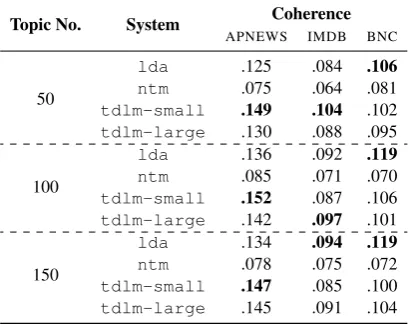
Topic model performance is presented in
Ta-ble 4. There are two models of tdlm
(tdlm-smallandtdlm-large), which
spec-ify the size of its LSTM model (1 layer+600
hidden vs. 2 layers+900 hidden; see Section 4).
tdlm achieves encouraging results: it has the
best performance over APNEWS, and is
compet-itive over IMDB. lda, however, produces more
coherent topics over BNC. Interestingly,
coher-ence appears to increase as the topic number
in-creases forlda, but the trend is less pronounced
fortdlm. ntm performs the worst of the 3 topic
models, and manual inspection reveals that topics are in general not very interpretable. Overall, the
results suggest thattdlm topics are competitive:
at best they are more coherent than lda topics,
and at worst they are as good asldatopics.
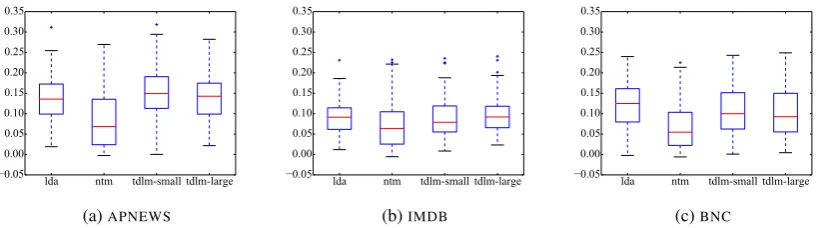
To better understand the spread of coherence scores and impact of outliers, we present box plots
for all models (number of topics= 100) over the 3
domains in Figure2. Across all domains,ntmhas
poor performance and larger spread of scores. The
difference betweenldaandtdlmis small (tdlm
> lda in APNEWS, but lda < tdlm in BNC),
which is consistent with our previous observation
thattdlmtopics are competitive withldatopics.
Partition #Docs #Tokens
Training 9314 2.6M Development 2000 0.5M
[image:7.595.79.286.64.226.2]Test 7532 1.7M
Table 5: 20NEWSpreprocessed statistics.
6 Extensions
One strength of tdlm is its flexibility, owing to
it taking the form of a neural network. To show-case this flexibility, we explore two simple
ex-tensions of tdlm, where we: (1) build a
super-vised model using document labels (Section6.1);
and (2) incorporate additional document metadata (Section6.2).
6.1 Supervised Model
In datasets where document labels are known, su-pervised topic model extensions are designed to leverage the additional information to improve modelling quality. The supervised setting also has an additional advantage in that model evaluation is simpler, since models can be quantitatively as-sessed via classification accuracy.
To incorporate supervised document labels, we treat document classification as another sub-task
intdlm. Given a document and its label, we feed
the document through the topic model network to
generate the document-topic representations, and
connect it to another dense layer with softmax out-put to generate the probability distribution over classes.
During training, we have additional minibatches for the documents. We start the document classifi-cation training after the topic and language models have completed training in each epoch.
We use 20NEWSin this experiment, which is a
popular dataset for text classification. 20NEWSis
a collection of forum-like messages from 20 news-groups categories. We use the “bydate” version of the dataset, where the train and test partition is separated by a specific date. We sample 2K doc-uments from the training set to create the devel-opment set. For preprocessing we tokenise words
and sentence using Stanford CoreNLP (Klein and
Manning, 2003), and lowercase all words. As
with previous experiments (Section 4) we
addi-tionally filter low/high frequency word types and stopwords. Preprocessed dataset statistics are
pre-sented in Table5.
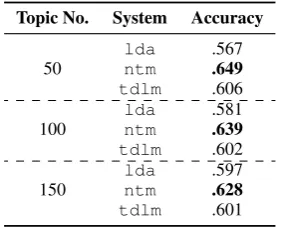
Topic No. System Accuracy
50 ldantm .567.649
tdlm .606 100 ldantm .581.639
tdlm .602 150 ldantm .597.628
tdlm .601
Table 6: 20NEWS classification accuracy. All
models are supervised extensions of the original models. Boldface indicates the best performance for each topic setting.
Topic No. Metadata Coherence Perplexity
50 YesNo .128 52.45
.131 51.80
100 YesNo .142.139 52.14
51.76
150 YesNo .135 52.25
.143 51.58
Table 7: Topic coherence and language model
per-plexity by incorporating classification tags onAP
-NEWS. Boldface indicates optimal coherence and
perplexity performance for each topic setting.
models as in Section 5: ntm and lda. Both
ntm andlda have natural supervised extensions
(Cao et al., 2015; McAuliffe and Blei,2008) for incorporating document labels. For this task, we tune the model hyper-parameters based on
devel-opment accuracy.14 Classification accuracy for all
models is presented in Table6. We presenttdlm
results using only the small setting of LSTM (1
layer + 600 hidden), as we found there is little
gain when using a larger LSTM.
ntm performs very strongly, outperforming
both lda and tdlm by a substantial margin.
Comparing lda and tdlm, tdlm achieves
bet-ter performance, especially when there is a smaller number of topics. Upon inspection of the topics
we found thatntmtopics are much less coherent
than those ofldaandtdlm, consistent with our
observations from Section5.
14Most hyper-parameter values for tdlm are similar to
those used in the language and topic model experiments; the only exceptions are: a = 80, b = 100, nepoch = 20,
m3= 150. The increase in parameters is unsurprising, as the
additional supervision provides more constraint to the model.
Figure 3: Scatter plots of tag embeddings
(model=150 topics)
6.2 Incorporating Document Metadata
In APNEWS, each news article contains
addi-tional document metadata, including subject clas-sification tags, such as “General News”, “Acci-dents and Disasters”, and “Military and Defense”. We present an extension to incorporate document
metadata intdlmto demonstrate its flexibility in
integrating this additional information.
As some of the documents in our original AP
-NEWS sample were missing tags, we re-sampled
a set of APNEWSarticles of the same size as our
original, all of which have tags. In total, approxi-mately 1500 unique tags can be found among the training articles.
To incorporate these tags, we represent each of them as a learnable vector and concatenate it with the document vector before computing the
attention distribution. Let zi ∈ Rf denote the
f-dimension vector for thei-th tag. For thej-th
document, we sum up all tags associated with it:
e= nXtags
i=1
I(i, j)zi
wherentagsis the total number of unique tags, and
functionI(i, j)returns 1 is thei-th tag is in thej-th
document or 0 otherwise. We computedas before
(Section3.1), and concatenate it with the summed
tag vector:d0=d⊕e.
We train two versions oftdlmon the newAP
-NEWSdataset: (1) the vanilla version that ignores
the tag information; and (2) the extended version
which incorporates tag information.15 We
exper-15Model hyper-parameters are the same as the ones used in
[image:8.595.111.252.62.176.2]Topic Generated Sentences protesters suspect gunman
officers occupy gun arrests suspects shooting officer
•police say a suspect in the shooting was shot in the chest and later shot and killed by a police officer .
•a police officer shot her in the chest and the man was killed .
•police have said four men have been killed in a shooting in suburban london . film awards actress comedy
music actor album show nominations movie
•it ’s like it ’s not fair to keep a star in a light , ” he says .
•but james , a four-time star , is just ahunki.
•ahunkiadaptation of the movie ” the dark knight rises ” won best picture and he was nominated for best drama for best director of ”hunki, ” which will be presented sunday night .
storm snow weather inches flooding rain service winds tornado forecasters
•temperatures are forecast to remain above freezing enough to reach a tropical storm or heaviest temperatures .
•snowfall totals were one of the busiest in the country .
•forecasters say tornado irene ’s strong winds could ease visibility and funnel clouds of snow from snow monday to the mountains .
virus nile flu vaccine disease outbreak infected symptoms cough tested
•he says the disease was transmitted by an infected person .
• hunkisays the man ’s symptoms are spread away from the heat .
•meanwhile in thehunki, the virus has been common in the mojave desert .
Table 8: Generated sentences forAPNEWStopics.
imented with a few values for the tag vector size
(f) and find that a small value works well; in the
following experiments we use f = 5. We
evalu-ate the models based on language model perplex-ity and topic model coherence, and present the re-sults in Table7.16
In terms of language model perplexity, we see a consistent improvement over different topic set-tings, suggesting that the incorporation of tags improves modelling. In terms of topic coher-ence, there is a small but encouraging improve-ment (with one exception).
To investigate whether the vectors learnt for
these tags are meaningful, we plot the top-14most
frequent tags in Figure3.17 The plot seems
reason-able: there are a few related tags that are close to each other, e.g. “State government” and “Govern-ment and politics”; “Crime” and “Violent Crime”; and “Social issues” and “Social affairs”.
7 Discussion
Topics generated by topic models are typically
in-terpreted by way of their top-N highest
probabil-ity words. Intdlm, we can additionally generate
sentences related to the topic, providing another way to understand the topics. To do this, we can constrain the topic vector for the language model to be the topic output vector of a particular topic (Equation (3)).
We present 4 topics from a APNEWS model
(k = 100; LSTM size = “large”) and 3
ran-domly generated sentences conditioned on each
16As the vanilla tdlm is trained on the new APNEWS
dataset, the numbers are slightly different to those in Tables3
and4.
17The 5-dimensional vectors are compressed using PCA.
topic in Table8.18 The generated sentences
high-light the content of the topics, providing another interpretable aspect for the topics. These results also reinforce that the language model is driven by topics.
8 Conclusion
We proposetdlm, a topically driven neural
lan-guage model. tdlmhas two components: a
lan-guage model and a topic model, which are jointly trained using a neural network. We demonstrate
thattdlmoutperforms a state-of-the-art language
model that incorporates larger context, and that its topics are potentially more coherent than LDA topics. We additionally propose simple extensions
oftdlmto incorporate information such as
docu-ment labels and metadata, and achieved encourag-ing results.
Acknowledgments
We thank the anonymous reviewers for their in-sightful comments and valuable suggestions. This work was funded in part by the Australian Re-search Council.
References
Nikos Aletras and Mark Stevenson. 2013. Evaluat-ing topic coherence usEvaluat-ing distributional semantics. InProceedings of the Tenth International Workshop on Computational Semantics (IWCS-10). Potsdam, Germany, pages 13–22.
18Words are sampled with temperature= 0.75. Generation
David M. Blei, Andrew Y. Ng, and Michael I. Jordan. 2003. Latent Dirichlet allocation. Journal of Ma-chine Learning Research3:993–1022.
BNC Consortium. 2007. The British National Corpus, version 3 (BNC XML Edition). Distributed by Ox-ford University Computing Services on behalf of the BNC Consortium. http://www.natcorp.ox.ac.uk/.
Ziqiang Cao, Sujian Li, Yang Liu, Wenjie Li, and Heng Ji. 2015. A novel neural topic model and its su-pervised extension. InProceedings of the 29th An-nual Conference on Artificial Intelligence (AAAI-15). Austin, Texas, pages 2210–2216.
Jonathan Chang, Sean Gerrish, Chong Wang, Jordan L. Boyd-Graber, and David M. Blei. 2009. Reading tea leaves: How humans interpret topic models. In
Advances in Neural Information Processing Systems 21 (NIPS-09). Vancouver, Canada, pages 288–296.
Kyunghyun Cho, Bart van Merrienboer, Dzmitry Bah-danau, and Yoshua Bengio. 2014. On the properties of neural machine translation: Encoder–decoder ap-proaches. InProceedings of SSST-8, Eighth Work-shop on Syntax, Semantics and Structure in Statisti-cal Translation. Doha, Qatar, pages 103–111.
Junyoung Chung, Caglar Gulcehre, KyungHyun Cho, and Yoshua Bengio. 2014. Empirical evaluation of gated recurrent neural networks on sequence mod-eling. InNIPS Deep Learning and Representation Learning Workshop. Montreal, Canada, pages 103– 111.
Ronan Collobert, Jason Weston, L´eon Bottou, Michael Karlen, Koray Kavukcuoglu, and Pavel Kuksa. 2011. Natural language processing (almost) from scratch. Journal of Machine Learning Research
12:2493–2537.
Felix A. Gers and J¨urgen Schmidhuber. 2000. Recur-rent nets that time and count. InProceedings of the International Joint Conference on Neural Networks (IJCNN’2000). Como, Italy, pages 198–194.
Alex Graves, Greg Wayne, and Ivo Danihelka. 2014. Neural turing machines. CoRRabs/1410.5401.
Thomas L. Griffiths and Mark Steyvers. 2004. Find-ing scientific topics. Proceedings of the National Academy of Sciences101:5228–5235.
Thomas L. Griffiths, Mark Steyvers, David M. Blei, and Joshua B. Tenenbaum. 2004. Integrating topics and syntax. InAdvances in Neural Information Pro-cessing Systems 17 (NIPS-05). Vancouver, Canada, pages 537–544.
David Hall, Daniel Jurafsky, and Christopher D. Man-ning. 2008. Studying the history of ideas using topic models. InProceedings of the 2008 Conference on Empirical Methods in Natural Language Processing (EMNLP 2008). Honolulu, USA, pages 363–371.
Geoffrey E. Hinton and Ruslan R. Salakhutdinov. 2009. Replicated softmax: an undirected topic model. In
Advances in Neural Information Processing Systems 21 (NIPS-09). Vancouver, Canada, pages 1607– 1614.
Sepp Hochreiter and J¨urgen Schmidhuber. 1997. Long short-term memory. Neural Computation9:1735– 1780.
Yangfeng Ji, Trevor Cohn, Lingpeng Kong, Chris Dyer, and Jacob Eisenstein. 2016. Document context lan-guage models. In Proceedings of ICLR-16 Work-shop, 2016. Toulon, France.
Diederik P. Kingma and Jimmy Ba. 2014. Adam: A method for stochastic optimization. CoRR
abs/1412.6980.
Dan Klein and Christopher D. Manning. 2003. Accu-rate unlexicalized parsing. In Proceedings of the 41st Annual Meeting of the Association for Com-putational Linguistics (ACL 2003). Sapporo, Japan, pages 423–430.
Hugo Larochelle and Stanislas Lauly. 2012. A neu-ral autoregressive topic model. InAdvances in Neu-ral Information Processing Systems 25. pages 2708– 2716.
Jey Han Lau and Timothy Baldwin. 2016. The sensitiv-ity of topic coherence evaluation to topic cardinalsensitiv-ity. InProceedings of the 2016 Conference of the North American Chapter of the Association for Computa-tional Linguistics — Human Language Technologies (NAACL HLT 2016). San Diego, USA, pages 483– 487.
Jey Han Lau, David Newman, and Timothy Baldwin. 2014. Machine reading tea leaves: Automatically evaluating topic coherence and topic model quality. InProceedings of the 14th Conference of the EACL (EACL 2014). Gothenburg, Sweden, pages 530–539.
Andrew L. Maas, Raymond E. Daly, Peter T. Pham, Dan Huang, Andrew Y. Ng, and Christopher Potts. 2011. Learning word vectors for sentiment analysis. In Proceedings of the 49th Annual Meeting of the Association for Computational Linguistics: Human Language Technologies (ACL HLT 2011). Portland, Oregon, USA, pages 142–150.
Jon D. McAuliffe and David M. Blei. 2008. Super-vised topic models. InAdvances in Neural Informa-tion Processing Systems 20 (NIPS-08). Vancouver, Canada, pages 121–128.
David Mimno, Hanna Wallach, Edmund Talley, Miriam Leenders, and Andrew McCallum. 2011. Optimizing semantic coherence in topic models. In
Proceedings of the 2011 Conference on Empirical Methods in Natural Language Processing (EMNLP 2011). Edinburgh, UK, pages 262–272.
David Newman, Timothy Baldwin, Lawrence Cave-don, Sarvnaz Karimi, David Martinez, and Justin Zobel. 2010a. Visualizing document collections and search results using topic mapping. Journal of Web Semantics8(2–3):169–175.
David Newman, Jey Han Lau, Karl Grieser, and Tim-othy Baldwin. 2010b. Automatic evaluation of topic coherence. In Proceedings of Human Lan-guage Technologies: The 11th Annual Conference of the North American Chapter of the Association for Computational Linguistics (NAACL HLT 2010). Los Angeles, USA, pages 100–108.
Vu Pham, Christopher Kermorvant, and J´erˆome Louradour. 2013. Dropout improves recurrent neu-ral networks for handwriting recognition. CoRR
abs/1312.4569.
Nitish Srivastava, Geoffrey Hinton, Alex Krizhevsky, Ilya Sutskever, and Ruslan Salakhutdinov. 2014. Dropout: A simple way to prevent neural networks from overfitting. Journal of Machine Learning Re-search15:1929–1958.
Sainbayar Sukhbaatar, Arthur Szlam, Jason Weston, and Rob Fergus. 2015. End-to-end memory net-works. InAdvances in Neural Information Process-ing Systems 28 (NIPS-15). Montreal, Canada, pages 2440–2448.
Ke Tran, Arianna Bisazza, and Christof Monz. 2016. Recurrent memory networks for language modeling. InProceedings of the 2016 Conference of the North American Chapter of the Association for Computa-tional Linguistics — Human Language Technologies (NAACL HLT 2016). San Diego, California, pages 321–331.
Hanna M. Wallach, Iain Murray, Ruslan Salakhutdinov, and David Mimno. 2009. Evaluation methods for topic models. In Proceedings of the 26th Interna-tional Conference on Machine Learning (ICML-09). Montreal, Canada, pages 1105–1112.
Li Wan, Leo Zhu, and Rob Fergus. 2012. A hybrid neu-ral network-latent topic model. In Proceedings of the Fifteenth International Conference on Artificial Intelligence and Statistics (AISTATS-12). La Palma, Canary Islands, pages 1287–1294.
Tian Wang and Kyunghyun Cho. 2016.
Larger-context language modelling with recurrent neural network. InProceedings of the 54th Annual Meet-ing of the Association for Computational LMeet-inguistics (ACL 2016). Berlin, Germany, pages 1319–1329.
Xuerui Wang and Andrew McCallum. 2006. Topics over time: a non-Markov continuous-time model of topical trends. In Proceedings of the 12th ACM SIGKDD International Conference on Knowledge Discovery and Data Mining. Philadelphia, USA, pages 424–433.
Jason Weston, Sumit Chopra, and Antoine Bordes. 2014. Memory networks.CoRRabs/1410.3916.
Kaisheng Yao, Trevor Cohn, Katerina Vylomova, Kevin Duh, and Chris Dyer. 2015. Depth-gated LSTM.CoRRabs/1508.03790.
Wojciech Zaremba, Ilya Sutskever, and Oriol Vinyals. 2014. Recurrent neural network regularization.