Machine Comprehension with Discourse Relations
Karthik Narasimhan CSAIL, MIT
Regina Barzilay CSAIL, MIT
Abstract
This paper proposes a novel approach for incorporating discourse information into machine comprehension applications. Traditionally, such information is com-puted using off-the-shelf discourse analyz-ers. This design provides limited oppor-tunities for guiding the discourse parser based on the requirements of the target task. In contrast, our model induces re-lations between sentences while optimiz-ing a task-specific objective. This ap-proach enables the model to benefit from discourse information without relying on explicit annotations of discourse structure during training. The model jointly iden-tifies relevant sentences, establishes rela-tions between them and predicts an an-swer. We implement this idea in a discrim-inative framework with hidden variables that capture relevant sentences and rela-tions unobserved during training. Our ex-periments demonstrate that the discourse aware model outperforms state-of-the-art machine comprehension systems.1
1 Introduction
The task of machine comprehension concerns the automatic extraction of answers from a given pas-sage. Often, the relevant information required to answer a question is distributed across multiple sentences. Understanding the relation(s) between these sentences is key to finding the correct an-swer. Consider the example in fig. 1. To answer the question aboutwhy Sally put on her shoes, we need to infer that She put on her shoes and She went outside to walkare connected by a causality relation.
1Code and data are available at http://people.
csail.mit.edu/karthikn/mcdr.
Sally liked going outside. She put on her shoes. She went outside to walk. [...] Missy the cat meowed to Sally. Sally waved to Missy the cat. [...] Sally hears her name. ”Sally, Sally, come home”, Sally’s mom calls out. Sally runs home to her Mom. Sally liked going outside.
Why did Sally put on her shoes? A) To wave to Missy the cat B) To hear her name
C)Because she wanted to go outside D) To come home
Figure 1: Sample story excerpt from a passage in the MCTest dataset.2 Correct answer is in italics.
Prior work has demonstrated the value of dis-course relations in related applications such as question answering (Jansen et al., 2014). Tradi-tionally, however, these approaches rely on out-puts from off-the-shelf discourse analyzers, us-ing them as features for target applications. Such pipeline designs provide limited opportunities for guiding the discourse parser based on the require-ments of the end task. Given a wide spectrum of discourse frameworks (Mann and Thompson, 1988; Prasad et al., 2008; Wolf and Gibson, 2005), it is not clear a priori what the optimal set of dis-course annotations is for the task. Moreover, a generic discourse parser may introduce additional errors due to the mismatch between its training corpus and a dataset used in an application. In fact, the largest discourse treebanks are based on news-paper corpora (Prasad et al., 2008; Carlson et al., 2002), which differ significantly in style from text used in machine comprehension corpora (Richard-son et al., 2013).
In this paper, we propose a novel approach for incorporating discourse structure into machine
2http://research.microsoft.com/en-us/
um/redmond/projects/mctest/
comprehension applications. Rather than using a standalone parser that is trained on external su-pervised data to annotate discourse relations, the model induces relations between sentences while optimizing a task-specific objective. This design biases the model to learn relations at a granu-larity optimized for the machine comprehension task. In contrast to a generic discourse analyzer, our method can also utilize additional information available in the machine comprehension context. For instance, question types provide valuable cues for determining discourse relations, and thus can facilitate learning.
We implement these ideas in a discrimina-tive log-linear model with hidden variables. The model jointly identifies relevant sentences, estab-lishes relations between them and predicts an an-swer. Since the same set of sentences can give rise to multiple questions, we do not limit the model to a single discourse relation, but rather model a distribution over possible relations. During train-ing, we only have access to questions and gold answers. Since relevant sentences and their rela-tions are not known, we model them as hidden variables. To guide the model towards linguisti-cally plausible discourse relations, we add a few seed markers that are typical of each relation. The model predicts relations not only based on the sen-tences, but also incorporates information about the question. By decomposing the dependencies be-tween model components, we can effectively train the model using a standard gradient descent ap-proach.
We evaluate our model using a recently re-leased machine comprehension dataset (Richard-son et al., 2013). In this corpus, roughly half of the questions rely on multiple sentences in the pas-sage to generate the correct answer. For baselines, we use the best published results on this dataset. Our results demonstrate that our relation-aware model outperforms the individual baselines by up to 5.7% and rivals the performance of a state-of-the-art combination system. Moreover, we show that the discourse relations it predicts for sentence pairs exhibit considerable overlap with relations identified by human annotators.
2 Related Work
Machine Comprehension Following traditional methods in question answering, most approaches to machine comprehension focus on analyzing the
connection between the question, candidate an-swer and the document. For instance, Richardson et al. (2013) show that using word overlap alone provides a good starting point for the task. Using textual entailment output (Stern and Dagan, 2011) and embedding-based representations (Iyyer et al., 2014) further improves the result. Even though these methods operate at a paragraph level, they do not model relations between sentences. For in-stance, in their work on factoid question answer-ing usanswer-ing recursive neural networks, Iyyer et al. (2014) average the sentence vectors element-wise when considering more than one sentence.
A notable exception is the approach proposed by Berant et al. (2014). Their approach builds on a semantic representation that encodes a number of inter-event relations, such ascauseandenable. These relations straddle the boundary between dis-course and semantic connections, since most of them are specific to the domain of interest. These relations are identified in a supervised fashion us-ing a significant amount of manual annotations. In contrast, we are interested in extracting discourse relations with minimal additional annotation, re-lying primarily on the available question-answer pairs. As a result, we look at a smaller set of ba-sic relations that can be learned without explicit annotations.
Discourse analysis for Question Answering Prior work has established the value of domain-independent discourse relations in question an-swering applications (Verberne et al., 2007; Jansen et al., 2014; Chai and Jin, 2004). For instance, Verberne et al. (2007) propose an answer extrac-tion technique that treats quesextrac-tion topics and an-swers as siblings in a Rhetorical Structure The-ory (RST) tree, significantly improving perfor-mance onwhy-questions. Chai and Jin (2004) ar-gue that incorporating discourse processing can significantly help context question answering, a task in which subsequent questions may refer to entities or concepts in previous questions. Jansen et al. (2014) utilize discourse information to im-prove reranking of human-written answers for non-factoid questions. They experiment with both shallow discourse markers and deep representa-tions based on RST parsers to rerank answers for howandwhy-type questions3.
terms of their design, they incorporate discourse information in a similar fashion, adding it as fea-tures to a supervised model. The discourse in-formation is typically computed using discourse parsers based on frameworks like RST (Feng and Hirst, 2014) or PDTB (Lin et al., 2014), trained using supervised data. In contrast, our goal is to learn discourse relations driven by the task objec-tive. The set of these relations does not capture the richness of discourse representations consid-ered in traditional discourse theories (Mann and Thompson, 1988; Prasad et al., 2008). However, we learn them without explicit annotations of dis-course structure, and demonstrate that they im-prove model performance.
3 Task Description and Approach
We focus on the task of machine comprehension, which involves answering questions based on a passage of text. Concretely, let us consider a pas-sagepi ={Zi,Qi}to consist of a set of sentences
Zi = {zin} and a set of questions Qi = {qij}, with each question also having a set of answer choicesAij ={aijk}. We denote the correct an-swer choice for a questionqij asa∗ij. Given a set of training passagesPtrain with questions annotated with the correct answer choice, the task is to be able to answer questions accurately in a different set of passagesPtest.
Figure 1 shows an example of a passage, along with a question and answer choices. The only (weak) source of supervision available is the cor-rect answer choice for each question in training. We do not use any extra annotations during train-ing. We propose joint probabilistic models to ad-dress this task, that can learn to identify single or multiple relevant sentences given a question, es-tablish a relation between them and score the an-swer choices.
We explore three different discriminative mod-els, ranging from a simple one that answers ques-tions using a single sentence in the passage, to one that infers relations between multiple sentences to score answer choices. We defer the description of the features used in our models to section 3.1.
Model 1 In our first model, we assume that each question can be answered using a single sentence from the passage. Treating the sentence as a hid-den variable, we define a joint model for a sen-tencez ∈ Z and an answer choicea∈ Aj, given
a questionqj.
(1)
P(a, z|qj) =P(z|qj)·P(a|z, qj) We define the joint probability as a product of two distributions. The first is the conditional distribu-tion of sentences in the paragraph given the ques-tion. This is to help identify the right sentence re-quired to answer the question. The second compo-nent models the conditional probability of an an-swer given the question q and a sentence z. For both component probabilities, we use distributions from the exponential family with features and as-sociated weights:
P(z|q)∝eθ1·φ1(q,z) P(a|z, q)∝eθ2·φ2(q,a,z)
whereφs are the feature functions andθs are the corresponding weight vectors.
We cast the learning problem as estimation of the parameter weights to maximize the likelihood of the correct answers in the training data. We con-sider soft assignments toz and marginalize over all its values to get the likelihood of an answer choice:
(3)
P(ajk |qj) =
X
n
P(ajk, zn|qj)
This results in the following regularized likeli-hood objective to maximize:
(4)
L1(θ;Ptrain)
= log
|PXtrain|
i=1
|Qi|
X
j=1
P(a∗
ij |qij)−λ||θ||2
Model 2 We now propose a model for the multi-sentence case where we make use of more than a single relevant sentence pertaining to a question. Considering that a majority of the questions in the dataset can be answered using two sentences, we restrict ourselves to sentence pairs for purposes of computational tractability. We define the new joint model as:
(5)
P(a, z1, z2|q) =P(z1|q)·P(z2 |z1, q)
·P(a|z1, z2, q)
where the new components are also exponential-family distributions:
P(z2|z1, q)∝eθ3·φ3(q,z1,z2)
Here, we have three components: the condi-tional probability of a sentencez1givenq, of a
sec-ond sentencez2givenqandz1, and of the answer
agivenqand the sentences.4 Ideally, we would be
able to consider all possible pairs of sentences in a given paragraph. However, to reduce computation costs in practice, we use a sentence windowkand consider only sentences that are at most k away from each other.5 We hence maximize:
(7)
L2(θ;Ptrain) =
log
|PtrainX|,|Qi|,|Zi|
i=1,j=1,m=1
X
n∈[m−k,m+k]
P(a∗
ij, zim, zin |qij)
−λ||θ||2
Model 3 In our next model, we aim to cap-ture important relations between sentences. This model has two novel aspects. First, we consider a distribution over relations between sentence pairs as opposed to a single relation. Second, we utilize the cues from the question as context to resolve ambiguities in sentences pairs with multiple plau-sible relations.
We add in a hidden variabler ∈ Rto represent the relation type. We incorporate features that tie in the question type with the relation type, and that connect the type of relation to the lexical and syn-tactic similarities between sentences. Our relation setRconsists of the following relations:
• Causal: Causes of events or reasons for facts.
• Temporal: Time-ordering of events
• Explanation: Predominantly dealing withhow -type questions.
• Other: A relation other than the above6
We can now modify the joint probability from (5) by adding in relation typerto get:
(8)
P(a, r, z1, z2|q) =P(z1|q)·P(r|q)
·P(z2 |z1, r, q)·P(a|z1, z2, r, q)
where
P(r|q)∝eθ4·φ4(q,r) (9a)
P(z2 |z1, r, q)∝eθ3·φ3(q,r,z1,z2) (9b)
P(a|z1, z2, r, q)∝eθ2·φ2(q,r,a,z1,z2) (9c)
The extra component P(r | q) is the conditional distribution of the relation typerdepending on the 4Since this component replaces the second component in model 1, we use the same subscript 2 for its feature setφ.
5Including the case wherez 1=z2. 6This includes the no-relation cases
question. This is to encourage the model to learn, for instance, thatwhy-questions correspond to the causalrelation. We also add in extra features to
P(z2 |z1, r), that help select a sentence pair
con-ditioned on a relation. The likelihood objective to maximize is:
(10)
L3(θ;Ptrain)
= log X
i,j,m,r∈R
X
n∈[m−k,m+k]
P(a∗
ij, zim, zin, r|qij)
−λ||θ||2
We maximize the likelihood objectives using LBFGS-B (Byrd et al., 1995). We compute the gradients required using Automatic Differentia-tion (Corliss, 2002).
To predict an answer for a test question qj, we simply marginalize over all the hidden vari-ables and choose the answer that maximizes
P(ajk |qj):
ˆ
aj =argmax
k P(ajk|qj)
3.1 Features
We use a variety of lexical and syntactic features in our model. We employ the Stanford CoreNLP tool (Manning et al., 2014) to pre-process the data. Other than commonly used features in Q&A sys-tems such as unigram and bigram matches, part-of-speech tags, syntactic features, we also add in features specific to our model.
We first define some terms used in our descrip-tion. Entities are coreference-resolved nouns or pronouns. Actionsrefer to verbs other than aux-iliary ones such asis, are, wasandwere. An en-tity graphis a graph between entities present in a sentence. We create an entity graph by collapsing nodes in the dependency graph and storing the in-termediate nodes between any two entity nodes in the edge between the nodes. We refer to the words in a questionqasq-words and similarly to words in an answeraasa-words and those in a sentence
zasz-words. Figure 2 shows an example of an en-tity graph constructed from the dependency graph of a sentence.
We divide the features into 4 sets (φ1−4),
My dog also likes spicy sausage poss
nsubj advmod
dobj amod root
[image:5.595.305.526.61.122.2]dog sausage likes
Figure 2: Top: Dependency graph,Bottom: En-tity graph for an example sentence. Entities are in bold, actions are in italics.
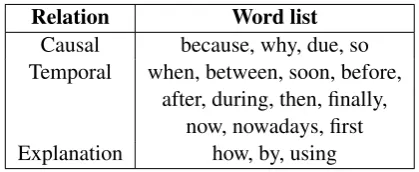
Relation Word list Causal because, why, due, so Temporal when, between, soon, before,
after, during, then, finally, now, nowadays, first
[image:5.595.77.284.62.162.2]Explanation how, by, using
Table 1: Seed marker words for relations used by the model.
Type 1 (φ1) These features are primarily
in-tended to help the model select the most relevant sentence from the passage for a question. We add commonly used features such as unigram and bi-gram matches, syntactic root match, entity and ac-tion matches, missed entities/acac-tions (inqbut ab-sent inz) and fractional coverage ofq-words inz. In addition, we use matches between the edges of the entity graph ofqandz. We also have second-order features that are a cross of each feature men-tioned above with the question word (how, what, when, etc.).
Type 2 (φ2) Features in φ2 capture interactions
between the answera, questionqand sentence(s) (z1, z2 in models 2,3 or z in model 1). For
the first-order features, we use ones similar to those in φ1 for lexical, syntactic, entity and
ac-tion matches/misses betweenaandz. In addition, we add in aneighbor matchfeature, which checks for matches between the neighborhood of a word fromathat occurs inz, andq-words. Another fea-ture we employ is thejoint matchbetweenz-words and the union ofa-words andq-words. Finally, we add in a sliding window (SW) feature, computing its value as in Richardson et al. (2013).
Type 3 (φ3) The next set of features are
spe-cific to only models 2 and 3, used to connect sen-tencesz1andz2(and a relationrin model 3 only).
Split MC160 MC500
Passages Questions Passages Questions
Train 70 280 300 1200
Dev 30 120 50 200
[image:5.595.76.286.227.313.2]Test 60 240 150 600
Table 2: Dataset Statistics
We use features like the inter-sentence distance and the presence of relation-specific markers in the sentences. We also cross the latter features withentityandactionmatches betweenz1andz2.
For the relation-specific words for each relation (except Other), we use words (see Table 1) de-rived mainly from Marcu (1997)’s list of discourse markers.
Type 4 (φ4) The final set of features (used only
in model 3) are present to help the model learn connections between the words in the question and the relation typer. Specifically, we check if the interrogative word in the question matches the class represented byr. For instance, the wordwhy matches theCausalrelation.
For the match-type features of all four types, we use the match count as the feature value if the count is non-zero. If the count is zero, we instead set a correspondingzerofeature7to 1.
4 Experimental setup
Data and Setup We run our experiments on a recently compiled dataset for machine comprehen-sion: MCTest (Richardson et al., 2013). The data consists of two distinct sets: MC160 and MC500, which are of different sizes. Table 2 gives details on the data splits for each dataset. Each passage has 4 questions, with 4 answer choices each. The questions are also annotated into 2 types: single, if the question can be answered using a single sen-tence in the passage, ormultiotherwise. We do not use the type information in our learning; we only use it for categorizing accuracy during evaluation. We report final results on all our models trained withλ= 0.1, tuned using the Dev sets.
Model dev MC160 test dev MC500 test
Single Multi All Single Multi All Single Multi All Single Multi All SWD 67.92 50.74 58.33 75.89 60.15 67.5 63.95 54.38 58.5 63.23 57.62 60.16 RTE 64.15 53.73 58.33 57.14 59.37 58.33 58.13 47.36 52 70.22 42.37 55 RTE+SWD 71.69 59.6 65 76.78 62.5 69.16 73.25 57.89 64.5 68.01 59.45 63.33
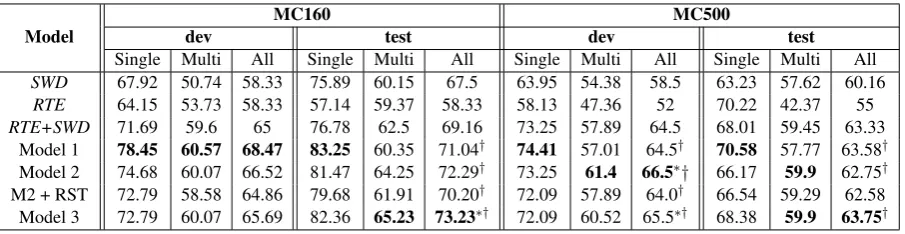
[image:6.595.73.526.61.178.2]Model 1 78.45 60.57 68.47 83.25 60.35 71.04† 74.41 57.01 64.5† 70.58 57.77 63.58† Model 2 74.68 60.07 66.52 81.47 64.25 72.29† 73.25 61.4 66.5∗† 66.17 59.9 62.75† M2 + RST 72.79 58.58 64.86 79.68 61.91 70.20† 72.09 57.89 64.0† 66.54 59.29 62.58 Model 3 72.79 60.07 65.69 82.36 65.23 73.23∗† 72.09 60.52 65.5∗† 68.38 59.9 63.75† Table 3: Accuracy (%) of the different baselines (in italics) and our models. Single: questions requiring single sentence to answer;Multi: questions requiring multiple sentences to answer. Sentence window (k) = 4 for models 2 and 3. Best scores are shown in bold. Statistical significance (shown only forAll columns) ofp <0.05using two-tailed paired t-test:∗vsSWD,†vsRTE.
scheme to assign partial credit. So, if three an-swers (including the correct one) tie for the highest score, the system gains 1/3 points.
Baselines We use the systems proposed by Richardson et al. (2013) as our baselines. These systems have the best reported scores on this dataset. The first baseline, SWD, uses a sliding window to count matches between the passage words and the words in the answer. This is then combined with a score representing the average distance between answer and question words in the passage. The second baseline, RTE, uses a textual entailment recognizer (Stern and Dagan, 2011) to determine if the answer (turned into a statement along with the question) is entailed by the passage. The third system, RTE+SWD, is a weighted combination of the first two baselines and achieves the highest accuracy on the dataset.
5 Results
Comprehension accuracy Table 3 shows that our relation-aware model 3 outperforms individ-ual baselines on both test sets. On the MC160 test set, the model achieves the best performance of 73.23% accuracy, outperforming the SWD base-line by 5.7% and theRTE+SWDcombination by 4.07%. The major gains of model 3, which uti-lizes inter-sentential relations, over model 1 can be seen in the accuracy ofmultitype questions with a jump of almost 5% absolute in accuracy (statis-tically significant withp <0.05). On the MC500 test set, we again find that model 3, with a score of 63.75%, provides a gain of 3.5% overSWDand is comparable to the performance of RTE+SWD (63.33%)
The importance of utilizing multiple relevant
sentences to score answers is evident from the higher scores of models 2 and 3 on multi type questions in both test sets. However, model 1, which retrieves only a single relevant sentence for each question, achieves the best scores on the sin-gletype questions up to 83.25% on MC160 test. One reason for this could be the larger search space for model 3 over pairs of sentences com-pared to just single sentences for model 1.
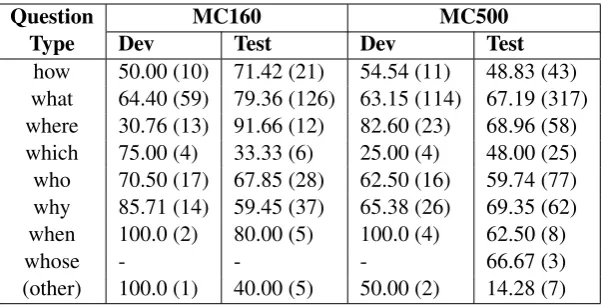
Table 4 shows the variation of our model’s accu-racy with the question type. We see that the model deals well withwhat, where and why type ques-tions in MC500, achieving almost 67-69% accu-racy.8 The major errors (in MC500) seem to come
from thehow-questions, where the model’s accu-racy is low (48%). In MC160, the accuaccu-racy is even higher forwhat-questions (almost 80%). On the other hand, the model does slightly worse onwhy -questions, with only 60% accuracy.
RST augmented model Further, we experiment with adding in relations extracted by a publicly available RST parser (Feng and Hirst, 2012). The parser extracts a tree with the passage sentences as its leaves and relations as interior nodes in the tree. From this tree, we compute the relation be-tween a pair of sentences as their lowest common ancestor. If one of the sentences is broken down into clauses, we use them all to gather multiple re-lations. We add in features that combine the RST-predicted relation with the interrogation word of the question, and with entity and action matches between sentence pairs.
We can see from Table 3 that adding in RST features to model 2 (M2+RST) does not give the
Question MC160 MC500
Type Dev Test Dev Test
how 50.00 (10) 71.42 (21) 54.54 (11) 48.83 (43) what 64.40 (59) 79.36 (126) 63.15 (114) 67.19 (317) where 30.76 (13) 91.66 (12) 82.60 (23) 68.96 (58)
which 75.00 (4) 33.33 (6) 25.00 (4) 48.00 (25)
who 70.50 (17) 67.85 (28) 62.50 (16) 59.74 (77) why 85.71 (14) 59.45 (37) 65.38 (26) 69.35 (62)
when 100.0 (2) 80.00 (5) 100.0 (4) 62.50 (8)
whose - - - 66.67 (3)
[image:7.595.149.450.61.215.2](other) 100.0 (1) 40.00 (5) 50.00 (2) 14.28 (7)
Table 4: Accuracy (%) of model 3 by question type for question in MC160 and MC500 dev and test sets. Numbers in parentheses indicate the number of questions of each type.
same performance as model 3. In fact, the model performs slightly worse than model 2, which does not utilize inter-sentential relations. Our analysis of the RST trees reveals that for a vast majority of sentence pairs (77%), the RST algorithm predicts theelaborationrelation which does not provide an informative distinction.
5.1 Analysis
To gain further insight into the workings of our model, we perform several analyses on model 3 using human judgements. We annotate 240 ques-tions from the test set of MC160 with the most relevant sentences9 in the passage for each
ques-tion. In addition, if they chose more than a sin-gle relevant sentence, we also asked the annota-tors to mark the most appropriate relation (from our set of relations used in model 3) between the sentence pairs.10 We find that 146 question
anno-tations contain a single relevant sentence and 94 contain multiple sentences.11 We obtain 103
sen-tence pairs with annotated relations.
Annotation statistics We select a random sub-set of 134 questions from this data to annotate twice and compute inter-annotator agreement. The second annotator agreed completely with the sen-tence predictions of the first annotator in 76.11% cases and both annotators agreed on at least one sentence in 94.77% of the questions. The agree-ment on relations annotated over common
sen-9The annotators are native English speakers.
10If there were more thantworelevant sentences, we asked them to mark relations between all pairs. This was a very rare occurrence though.
11We found that some of themultiplequestions did not re-quire multiple sentences to answer and conversely, some sin-glequestions required more than one sentence to answer.
tence pairs is 68.6%, with κ = 0.462. We find that out of the 103 annotated sentence pairs, 67 are next to each other in the passage while 27 are at a distance of two and 9 pairs are at a distance of three or more.
It has been well documented that identifying discourse relations without explicit markers is sig-nificantly harder than with markers (Pitler et al., 2008; Lin et al., 2009; Park and Cardie, 2012). We compute statistics on the presence of discourse markers anywhere in the manually picked sen-tence(s) for each question. We find that only 33.89% of these pairs have a relevant discourse marker present in either sentence. We consider a discourse marker as relevant if it occurs in our marker list for the annotated relation. Further, if we only consider markers occurring at the begin-ning or end of the sentences, this number drops to 9.23% of sentences. Since we consider relations between sentence pairs, most explicit markers that could help identify these relations would occur at an extremity of either sentence. We point out that these numbers are an over-estimation since many of the markers occur in syntactic roles as opposed to discourse in the sentences (ex. soinThis is so good compared to So, he decided to ...). These statistics reflect the difficulty of the problem since operating over implicit relations is much harder. Sentence Retrieval We analyze our models’ ability to predict relevant sentences given only the question. For each question, we order the pairs scored by a model in descending order of their probability according to P(z1, z2 | q) and
com-pare them to the annotated pairs, reporting recall at various thresholds.
Question R @ 1 R @ 2 R @ 5
Type(#) Freq M1 M2 M3 Freq M1 M2 M3 Freq M1 M2 M3
how (21) 9.67 29.03 32.25 35.48 9.67 32.25 45.16 48.38 19.35 51.61 58.06 64.51 what (126) 3.64 37.85 35.59 35.02 9.37 39.54 47.45 45.76 21.81 53.67 63.84 63.27 where (12) 13.63 50.00 50.00 56.25 13.63 50.00 68.75 62.5 45.45 68.75 75.00 81.25 which (6) 0.0 21.42 21.42 14.28 9.09 21.42 21.42 14.28 9.09 21.42 35.71 42.85 who (28) 2.12 45.45 45.45 42.42 4.25 45.45 60.60 57.57 23.40 63.63 72.72 75.75 why (37) 9.09 34.32 31.34 34.32 2.27 35.82 40.29 40.29 38.63 44.77 53.73 52.23 when (5) 0.0 57.14 57.14 57.14 0.0 57.14 71.42 71.42 25.00 85.71 100.0 85.71 (other) (5) 0.0 42.85 28.57 42.85 0.0 42.85 57.14 57.14 100.0 71.42 71.42 71.42
Single(146) 6.84 56.16 53.42 51.36 11.64 58.21 66.43 63.69 33.56 72.60 80.13 80.82
Multi(94) 3.88 24.27 23.30 25.72 9.70 25.24 34.46 33.98 29.61 39.32 50.00 50.48
[image:8.595.71.526.61.218.2]Overall(240) 5.11 37.5 35.79 36.36 10.51 38.92 47.72 46.30 31.25 53.12 62.5 63.06
Table 5: Recall (%) of relevant sentence(s) in the ranking by models 1, 2 and 3 compared with a match-frequency baseline (Freq) at various thresholds, for different question types in MC160. Question fre-quencies are in parentheses. Bold numbers represent best scores.
two reasons. First, we do not use the candidate answers in selecting relevant sentences. Second, on the machine comprehension task, the model predicts answers by marginalizing over the sen-tences/sentence pairs. Hence, the model can score answers correctly even if the relevant sentence(s) are not at the top of its sentence distribution calcu-lated here. We compute the distribution over sen-tence pairs as:
P(z1, z2|q) =Pr∈RP(z1|q)·P(r|q)·P(z2|z1, r, q)
[image:8.595.332.500.546.632.2]For comparison, we add in a baseline (Freq) that orders sentences using the sum of unigram and bigram matches with the question (in descending frequency).
Table 5 shows that our models perform signifi-cantly better than the Freq baseline over all ques-tion types. For the single-question case, we ob-serve that model 3 ranks the annotated sentence at the top of its distribution around 51% of the time and 80% of the time in the top 5. Formulti -sentences, these recall numbers drop to around 25% (@1) and 50% (@5). We also observe that models 2 and 3 perform better than model 1 on the multi-sentence cases. The similar sentence recall of models 2 and 3 also point to the fact that the gains from model 3 on comprehension accuracy are due to its ability to utilize relations between the sentences.
We observe thatwhere, whenandwhoquestions have the highest recalls. This is likely because these questions often have characteristic words oc-curring in the sentences (such as here, there, af-ter, before, him, her). In contrast, questions asking how, whichandwhyhave lower recalls since they
often involve reasoning over multiple sentences. What-questions are somewhere in between since their complexity varies from question to question. Relation Retrieval We examine how well our model can predict relations between given sen-tence pairs. For each annotated pair of sensen-tences, we calculate the relation distribution and compute the relation recall at various thresholds of the rank-ing by probability. The relation distribution is computed as:
P(r|z1, z2, q) = P P(r |q)·P(z2|z1, r, q) r0∈RP(r0 |q)·P(z2|z1, r0, q)
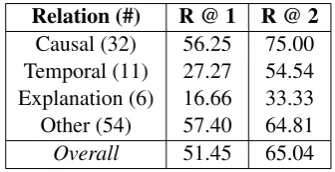
From table 6, we observe that our model’s top prediction matches the manual annotations (over-all) 51% of the time. The model predicts causal andotherrelations more accurately than the other two.
Relation (#) R @ 1 R @ 2
Causal (32) 56.25 75.00
Temporal (11) 27.27 54.54 Explanation (6) 16.66 33.33
Other (54) 57.40 64.81
Overall 51.45 65.04
Table 6: Recall of annotated relations at various thresholds in the ordered relation distribution pre-dicted by model 3. Relation frequencies are in parentheses.
6 Conclusions
comprehension applications. The key idea is to implant discourse analysis into a joint model for comprehension. Our results demonstrate that the discourse-aware model outperforms state-of-the-art standalone systems, and rivals the performance of a system combination. We also find that fea-tures derived from an off-the-shelf parser do not improve performance of the model. Our analysis also demonstrates that the model accuracy varies significantly according to the question type. Fi-nally, we show that the predicted discourse rela-tions exhibit considerable overlap with relarela-tions identified by human annotators.
Acknowledgements
We thank Lyla Fischer, Rushi Ganmukhi, Hrishikesh Joshi and Deepak Narayanan for helping with annotating the MC160 test set. We also thank the anonymous ACL reviewers and members of MIT’s NLP group for their insightful comments and suggestions. This research is developed in a collaboration of MIT with the Arabic Language Technologies (ALT) group at Qatar Computing Research Institute (QCRI) within the Interactive sYstems for Answer Search (IYAS) project.
References
[Berant et al.2014] Jonathan Berant, Vivek Srikumar, Pei-Chun Chen, Abby Vander Linden, Brittany Harding, Brad Huang, Peter Clark, and Christo-pher D. Manning. 2014. Modeling biological processes for reading comprehension. In Proceed-ings of the 2014 Conference on Empirical Methods in Natural Language Processing (EMNLP), pages 1499–1510, Doha, Qatar, October. Association for Computational Linguistics.
[Blunsom et al.2006] Phil Blunsom, Krystle Kocik, and James R Curran. 2006. Question classification with log-linear models. InProceedings of the 29th an-nual international ACM SIGIR conference on Re-search and development in information retrieval, pages 615–616. ACM.
[Byrd et al.1995] Richard H Byrd, Peihuang Lu, Jorge Nocedal, and Ciyou Zhu. 1995. A limited mem-ory algorithm for bound constrained optimization.
SIAM Journal on Scientific Computing, 16(5):1190– 1208.
[Carlson et al.2002] Lynn Carlson, Mary Ellen Okurowski, Daniel Marcu, Linguistic Data Consortium, et al. 2002. RST discourse tree-bank. Linguistic Data Consortium, University of Pennsylvania.
[Chai and Jin2004] Joyce Y Chai and Rong Jin. 2004. Discourse structure for context question answering. In Proceedings of the Workshop on Pragmatics of Question Answering at HLT-NAACL, volume 2004, pages 23–30. Citeseer.
[Corliss2002] George Corliss. 2002. Automatic dif-ferentiation of algorithms: from simulation to op-timization, volume 1. Springer Science & Business Media.
[Feng and Hirst2012] Vanessa Wei Feng and Graeme Hirst. 2012. Text-level discourse parsing with rich linguistic features. InProceedings of the 50th An-nual Meeting of the Association for Computational Linguistics: Long Papers-Volume 1, pages 60–68. Association for Computational Linguistics.
[Feng and Hirst2014] Vanessa Wei Feng and Graeme Hirst. 2014. A linear-time bottom-up discourse parser with constraints and post-editing. In Proceed-ings of the 52nd Annual Meeting of the Association for Computational Linguistics (Volume 1: Long Pa-pers), pages 511–521, Baltimore, Maryland, June. Association for Computational Linguistics.
[Iyyer et al.2014] Mohit Iyyer, Jordan Boyd-Graber, Leonardo Claudino, Richard Socher, and Hal Daum´e III. 2014. A neural network for factoid question answering over paragraphs. In Empirical Methods in Natural Language Processing.
[Jansen et al.2014] Peter Jansen, Mihai Surdeanu, and Peter Clark. 2014. Discourse complements lexi-cal semantics for non-factoid answer reranking. In
Proceedings of the 52nd Annual Meeting of the As-sociation for Computational Linguistics (Volume 1: Long Papers), pages 977–986, Baltimore, Maryland, June. Association for Computational Linguistics.
[Lin et al.2009] Ziheng Lin, Min-Yen Kan, and Hwee Tou Ng. 2009. Recognizing implicit dis-course relations in the penn disdis-course treebank. In
Proceedings of the 2009 Conference on Empirical Methods in Natural Language Processing: Vol-ume 1-VolVol-ume 1, pages 343–351. Association for Computational Linguistics.
[Lin et al.2014] Ziheng Lin, Hwee Tou Ng, and Min-Yen Kan. 2014. A pdtb-styled end-to-end discourse parser. Natural Language Engineering, pages 1–34.
[Mann and Thompson1988] William C Mann and San-dra A Thompson. 1988. Rhetorical structure the-ory: Toward a functional theory of text organization.
Text, 8(3):243–281.
[Manning et al.2014] Christopher D. Manning, Mihai Surdeanu, John Bauer, Jenny Finkel, Steven J. Bethard, and David McClosky. 2014. The Stanford CoreNLP natural language processing toolkit. In
[Marcu1997] Daniel Marcu. 1997. The Rhetorical Parsing, Summarization and Generation of Natural Language Texts. Ph.D. thesis, University of Toronto. [Park and Cardie2012] Joonsuk Park and Claire Cardie. 2012. Improving implicit discourse relation recog-nition through feature set optimization. In Proceed-ings of the 13th Annual Meeting of the Special Inter-est Group on Discourse and Dialogue, pages 108– 112. Association for Computational Linguistics. [Pitler et al.2008] Emily Pitler, Mridhula Raghupathy,
Hena Mehta, Ani Nenkova, Alan Lee, and Ar-avind K Joshi. 2008. Easily identifiable discourse relations.
[Prasad et al.2008] Rashmi Prasad, Nikhil Dinesh, Alan Lee, Eleni Miltsakaki, Livio Robaldo, Aravind K Joshi, and Bonnie L Webber. 2008. The penn dis-course treebank 2.0. InLREC. Citeseer.
[Richardson et al.2013] Matthew Richardson, Christo-pher JC Burges, and Erin Renshaw. 2013. Mctest: A challenge dataset for the open-domain machine comprehension of text. InEMNLP, pages 193–203. [Stern and Dagan2011] Asher Stern and Ido Dagan.
2011. A confidence model for syntactically-motivated entailment proofs. InProceedings of the International Conference Recent Advances in Nat-ural Language Processing 2011, pages 455–462, Hissar, Bulgaria, September. RANLP 2011 Organ-ising Committee.
[Verberne et al.2007] Suzan Verberne, Lou Boves, Nelleke Oostdijk, and Peter-Arno Coppen. 2007. Evaluating discourse-based answer extraction for why-question answering. InProceedings of the 30th annual international ACM SIGIR conference on Re-search and development in information retrieval, pages 735–736. ACM.