Encoding Distributional Semantics into Triple-Based Knowledge Ranking
for Document Enrichment
Muyu Zhang1∗, Bing Qin1, Mao Zheng1, Graeme Hirst2, and Ting Liu1 1Research Center for Social Computing and Information Retrieval
Harbin Institute of Technology, Harbin, China
2Department of Computer Science, University of Toronto, Toronto, ON, Canada {myzhang,qinb,mzheng,tliu}@ir.hit.edu.cn
Abstract
Document enrichment focuses on retriev-ing relevant knowledge from external re-sources, which is essential because text is generally replete with gaps. Since conven-tional work primarily relies on special re-sources, we instead use triples ofSubject, Predicate, Object as knowledge and in-corporate distributional semantics to rank them. Our model first extracts these triples automatically from raw text and converts them into real-valued vectors based on the word semantics captured by Latent Dirich-let Allocation. We then represent these triples, together with the source document that is to be enriched, as a graph of triples, and adopt a global iterative algorithm to propagate relevance weight from source document to these triples so as to select the most relevant ones. Evaluated as a rank-ing problem, our model significantly out-performs multiple strong baselines. More-over, we conduct a task-based evaluation by incorporating these triples as additional features into document classification and enhances the performance by 3.02%.
1 Introduction
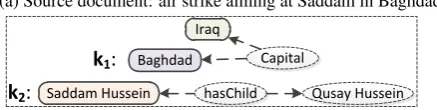
Document enrichmentis the task of acquiring rel-evant background knowledge from external re-sources for a given document. This task is essen-tial because, during the writing of text, some ba-sic but well-known information is usually omitted by the author to make the document more concise. For example, Baghdad is the capital of Iraq is omitted in Figure 1a. A human will fill these gaps automatically with the background knowledge in his mind. However, the machine lacks both the ∗This work was partly done while the first author was
visiting University of Toronto.
necessary background knowledge and the ability to select. The task of document enrichment is pro-posed to tackle this problem, and has been proved helpful in many NLP tasks such as web search (Pantel and Fuxman, 2011), coreference resolu-tion (Bryl et al., 2010), document cluster (Hu et al., 2009) and entity disambiguation (Sen, 2012).
We can classify previous work into two classes according to the resources they rely on. The first line of work usesWikipedia, the largest on-line en-cyclopedia, as a resource and introduces the con-tent of Wikipedia pages as external knowledge (Cucerzan, 2007; Kataria et al., 2011; He et al., 2013). Most research in this area relies on the text similarity (Zheng et al., 2010; Hoffart et al., 2011) and structure information (Kulkarni et al., 2009; Sen, 2012; He et al., 2013) between the mention and the Wikipedia page. Despite the apparent suc-cess of these methods, most Wikipedia pages con-tain too much information, most of which is not relevant enough to the source document, and this causes a noise problem. Another line of work tries to improve the accuracy by introducing ontolo-gies (Fodeh et al., 2011; Kumar and Salim, 2012) and structured knowledge bases such as WordNet (Nastase et al., 2010), which provide semantic in-formation about words such as synonym (Sun et al., 2011) and antonym (Sansonnet and Bouchet, 2010). However, these methods primarily rely on special resources constructed with supervision or even manually, which are difficult to expand and in turn limit their applications in practice.
In contrast, we wish to seek the benefits of both coverage and accuracy from a better representa-tion of background knowledge: triples ofSubject, Predicate, Object(SPO). According to Hoffart et al. (2013), these triples, such as LeonardCohen, wasBornIn, Montreal, can be extracted automat-ically from Wikipedia and other sources, which is compatible with the RDF data model (Staab and Studer, 2009). Moreover, by extracting these
S1: Coalition may never know if Iraqi president Saddam Hussein survived a U.S. air strike yesterday.
S2: A B-1 bomber dropped four 2,000-pound bombs on a building in a residential area of Baghdad .
S3: They had got an intelligence reports senior officials were meeting there, possibly including Saddam Hussein and his sons .
Baghdad Iraqi hasCapital
Saddam Hussein diedIn
Qusay Hussein Saddam Hussein hasChild
Kadhimiya k1: k2: k3: Global Ranking
(a) Source document (b) Top-3 background knowledge
S1: Coalition may never know if Iraqi president Saddam Hussein survived a U.S. air strike yesterday.
S2: A B-1 bomber dropped four 2,000-pound bombs on a building in a residential area of Baghdad .
S3: They had got an intelligence reports senior officials were meeting there, possibly including Saddam Hussein and his sons .
(a) Source document (b) Two relevant background knowledge Iraq
Baghdad
Saddam Hussein
Captain
Died In Kadhimiya
Global
Ranking k1:
k2:
S1: Coalition may never know if Iraqi president Saddam Hussein survived a U.S. air strike yesterday.
S2: A B-1 bomber dropped four 2,000-pound bombs on a building in a residential area of Baghdad .
S3: They had got an intelligence reports senior officials were meeting there, possibly including Saddam Hussein and his sons .
Baghdad Iraqi hasCapital
Saddam Hussein diedIn
Qusay Hussein Saddam Hussein hasChild
Kadhimiya k1: k2: k3: Global Ranking (a) Source document
(b) Top-3 background knowledge
S1: Coalition may never know if Iraqi president Saddam Hussein survived a U.S. air strike yesterday.
S2: A B-1 bomber dropped four 2,000-pound bombs on a building in a residential area of Baghdad .
S3: They had got an intelligence reports senior officials were meeting there, possibly including Saddam Hussein and his sons .
(a) Source document
(b) Two relevant background knowledge Iraq
Baghdad
Saddam Hussein
Captain
Died In Kadhimiya
Global Ranking
k1:
k2:
S1: The coalition may never know if Iraqi president Saddam Hussein survived a U.S. air strike yesterday.
S2: A B-1 bomber dropped four 2,000-pound bombs on a building in a residential area of Baghdad .
S3: They had received intelligence reports that senior officials were meeting there, possibly including Saddam Hussein and his sons .
Iraq Baghdad Saddam Hussein
Capital
hasChild Qusay Hussein
k1:
k2:
(a) Source document: air strike aiming at Saddam in Baghdad
S1: Coalition may never know if Iraqi president Saddam
Hussein survived a U.S. air strike yesterday.
S2: A B-1 bomber dropped four 2,000-pound bombs on a building
in a residential area of Baghdad .
S3: They had got an intelligence reports senior officials were
meeting there, possibly including Saddam Hussein and his sons .
Baghdad Iraqi hasCapital
Saddam Hussein diedIn
Qusay Hussein Saddam Hussein hasChild
Kadhimiya
k1:
k2:
k3:
Global Ranking
(a) Source document (b) Top-3 background knowledge
S1: Coalition may never know if Iraqi president Saddam Hussein
survived a U.S. air strike yesterday.
S2: A B-1 bomber dropped four 2,000-pound bombs on a building
in a residential area of Baghdad .
S3: They had got an intelligence reports senior officials were
meeting there, possibly including Saddam Hussein and his sons .
(a) Source document (b) Two relevant background knowledge
Iraq
Baghdad
Saddam Hussein
Captain
Died In Kadhimiya
Global
Ranking k1:
k2:
S1: Coalition may never know if Iraqi president Saddam
Hussein survived a U.S. air strike yesterday.
S2: A B-1 bomber dropped four 2,000-pound bombs on a building
in a residential area of Baghdad .
S3: They had got an intelligence reports senior officials were
meeting there, possibly including Saddam Hussein and his sons .
Baghdad Iraqi hasCapital
Saddam Hussein diedIn
Qusay Hussein Saddam Hussein hasChild
Kadhimiya
k1:
k2:
k3:
Global Ranking (a) Source document
(b) Top-3 background knowledge
S1: Coalition may never know if Iraqi president Saddam Hussein
survived a U.S. air strike yesterday.
S2: A B-1 bomber dropped four 2,000-pound bombs on a building
in a residential area of Baghdad .
S3: They had got an intelligence reports senior officials were
meeting there, possibly including Saddam Hussein and his sons .
(a) Source document
(b) Two relevant background knowledge Iraq
Baghdad
Saddam Hussein
Captain
Died In Kadhimiya
Global Ranking
k1:
k2:
S1: The coalition may never know if Iraqi president Saddam
Hussein survived a U.S. air strike yesterday.
S2: A B-1 bomber dropped four 2,000-pound bombs on a building
in a residential area of Baghdad .
S3: They had received intelligence reports that senior officials were
meeting there, possibly including Saddam Hussein and his sons .
Iraq
Baghdad
Saddam Hussein
Capital
hasChild Qusay Hussein k1:
k2:
[image:2.595.75.294.146.201.2](b) Two omitted relevant pieces of background knowledge Figure 1: An example of document enrichment: A source document about a U.S. air strike omit-ting two important pieces of background knowl-edge which are acquired by our framework.
triples from multiple sources, we also get better coverage. Therefore, one can expect that this rep-resentation is helpful for better document enrich-ment by incorporating both accuracy and cover-age. In fact, there is already evidence that this representation is helpful. Zhang et al. (2014) pro-posed a triple-based document enrichment frame-work which uses triples of SPO as background knowledge. They first proposed a search engine– based method to evaluate the relatedness between every pair of triples, and then an iterative propa-gation algorithm was introduced to select the most relevant triples to a given source document (see Section 2), which achieved a good performance.
However, to evaluate the semantic relatedness between two triples, Zhang et al. (2014) primar-ily relied on the text of triples and used search engines, which makes their method difficult to re-implement and in turn limits its application in practice. Moreover, they did not carry out any task-based evaluation, which makes it uncertain whether their method will be helpful in real appli-cations. Therefore, we instead use topic models, especially Latent Dirichlet Allocation (LDA), to encode distributional semantics of words and con-vert every triple into a real-valued vector, which is then used to evaluate the relatedness between a pair of triples. We then incorporate these triples into the given source document and represent them together as a graph of triples. Then a modified it-erative propagation is carried out over the entire graph to select the most relevant triples of back-ground knowledge to the given source document.
To evaluate our model, we conduct two series of
experiments: (1) evaluation as a ranking problem, and (2) task-based evaluation. We first treat this task as a ranking problem which inputs one doc-ument and outputs the top N most-relevant triples of background knowledge. Second, we carry out a task-based evaluation by incorporating these rele-vant triples acquired by our model into the origi-nal model of document classification as additioorigi-nal features. We then perform a direct comparison be-tween the classification models with and without these triples, to determine whether they are help-ful or not. On the first series of experiments, we achieve aMAPof 0.6494 and aP@Nof 0.5597 in the best situation, which outperforms the strongest baseline by 5.87% and 17.21%. In the task-based evaluation, the enriched model derived from the triples of background knowledge performs better by 3.02%, which demonstrates the effectiveness of our framework in real NLP applications.
2 Background
The most closely related work in this area is our own (Zhang et al., 2014), which used the triples ofSPOas background knowledge. In that work, we first proposed a triple graph to represent the source document and then used a search engine– based iterative algorithm to rank all the triples. We describe this work in detail below.
Triple graph Zhang et al. (2014) proposed the
Relevance evaluation To compute the weight of a edge, Zhang et al. (2014) evaluate the seman-tic relatedness between two nodes with a search engine–based method. They first convert every node, which is a triple of SPO, into a query by combining the text ofSubjectandObjecttogether. Then for every pair of nodesti andtj, they
con-struct three queries: p,q, andp∩q, which corre-spond to the queries ofti,tj, andtj∩tj, the
com-bination ofti andtj. All these queries are put into
a search engine to getH(p),H(q), andH(p∩q), the numbers of returned pages for queryp,p, and
p∩q. Then theWebJaccard Coefficient(Bollegala et al., 2007) is used to evaluater(i,j), the related-ness betweentiandtj, according to Formula 1.
r(i,j) =WebJaccard(p,q) =
0 ifH(p∩q)≤C
H(p∩q)
H(p) +H(q)−H(p∩q) otherwise.
(1)
Usingr(i,j), Zhang et al. (2014) further define
p(i,j), the probability of ti andtj propagating to
each other, as shown in Formula 2. Here N is the set of all nodes, and δ(i,j) denotes whether an edge exists between two nodes or not.
p(i,j) = r(i,j)×δ(i,j)
∑n∈Nr(n,j)×δ(n,j) (2)
Iterative propagation Considering that the source document D is represented as a graph of sd-nodes, so the relevance of background knowl-edgetbtoDis naturally converted into that oftbto
the graph of sd-nodes. Zhang et al. (2014) evalu-ate this relevance by propagating relevance weight from sd-nodes totbiteratively. After convergence,
the relevance weight oftbwill be treated as the
fi-nal relevance toD. There are in total n×n pairs of nodes, and theirp(i,j)are stored in a matrixP. Zhang et al. (2014) useW~ = (w1,w2,...,wn)to
de-note the relevance weights of nodes, wherewi
in-dicates the relevance oftitoD. At the beginning,
each wi of bk-nodes is initialized to 0, and each
that of sd-nodes is initialized to its importance to
D. ThenW~ is updated toW~ 0 after every iteration according to Formula 3. They keep updating the weights of both sd-nodes and bk-nodes until
con-vergence and do not distinguish them explicitly.
~
W0 =W~ ×P
=W~ ×
p(1,1) p(1,2) ... p(1,n) p(2,1) p(2,2) ... p(2,n)
... ... ... ...
p(n,1) p(n,2) ... p(n,n) (3)
3 Methodology
The key idea behind this work is that every doc-ument is composed of several units of informa-tion, which can be extracted into triples automat-ically. For every unit of background knowledge
b, the more units that are relevant to b and the more relevant they are, the more relevant b will be to the source document. Based on this intu-ition, we first present both source document infor-mation and background knowledge together as a document-level triple graph as illustrated in Sec-tion 2. Then we use LDA to capture the distribu-tional semantics of a triple by representing it as a vector of distributional probabilities overktopics and evaluate the relatedness between two triples with cosine-similarity. Finally, we propose a mod-ified iterative process to propagate the relevance score from the source document information to the background knowledge and select the top n rele-vant ones.
3.1 Encoding distributional semantics
LDA LDA is a popular generative probabilistic model, which was first introduced by Blei et al. (2003). LDA views every document as a mixture over underlying topics, and each topic as a distri-bution over words. Both the document-topic and the topic-word distributions are assumed to have a
Dirichlet prior. Given a set of documents and a number of topics, the model returnsθd, the topic
distribution for each documentd, andφz, the word
distribution for every topicz.
LDA assumes the following generative process for each document in a corpusD:
1. ChooseN∼Poisson(ξ). 2. Chooseθ∼Dir(α).
(a) Choose a topiczn∼Multinomial(θ).
(b) Choose a wordwnfromp(wn|zn,β)
con-ditioned on the topiczn.
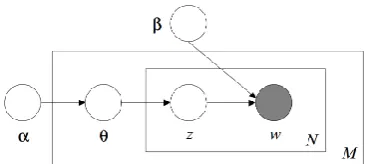
vari-Figure 2: Graphical representation of LDA. The boxes represents replicates, where the inner box represents the repeated choice of N topics and words within a document, while the outer one rep-resents the repeated generation ofMdocuments.
ablez) is assumed to be known and fixed;θis ak -dimensional Dirichlet random variable, where the parameterαis ak-vector with componentsαi>0;
and the β indicates the word probabilities over topics, which is a matrix withβi j=p(wj=1|zi=
1). Figure 2 shows the representation of LDA as a probabilistic graphical model with three levels. There are two corpus-level parametersα andβ , which are assumed to be sampled once in the pro-cess of generating a corpus; one document-level variableθd, which is sampled once per document;
and two word-level variables zdn andwdn, which
are sampled once for each word in each document. We employ the publicly available implementa-tion of LDA, JGibbLDA21 (Phan et al., 2008),
which has two main execution methods: param-eter estimation (model building) and inference for new data (classification of a new document).
Relevance evaluation Given a set of documents and the number of topics k, LDA will returnφz,
the word distribution over the topicz. So for every wordwn, we getkdistributional probabilities over
k topics. We use pwnzi to denote the probability
thatwnappears in theithtopiczi, wherei≤k,zi∈
Z, the set of k topics. Then we combine these k
possibilities together as a real-valued vector~vwn to
representwnas shown in Formula 4.
~vwn = (pwnz1,pwnz2,...,pwnzk) (4)
After getting the vectors of words, we employ an intuitive method to compute the vector of a triple t, by accumulating all the corresponding vectors of words appearing int according to For-mula 5. Considering that the elements of this newly generated vector indicate the distributional probabilities oftoverktopics, we then normalize
1http://jgibblda.sourceforge.net/
it according to Formula 6 so that its elements sum to 1. This gives us~vt, the real-valued vector of
triplet, which captures its distributional probabil-ities overk topics. Heret corresponds to a triple of background knowledge or of source document,
ptziindicates the possibility oftto appear in theith
topiczi, andwn∈tmeans thatwnappears int.
ptzi=
∑
wn∈t
pwnzi (5)
~vt=(ptz1,ptz2,...,ptzk)
∑ki=1ptzi
(6)
Using the vectors of triples, we can easily com-pute the semantic relatedness between a pair of triples as their cosine-similarity according to For-mula 7. Here A, Bcorrespond to the real-valued vectors of two triples, r(A,B) denotes their se-mantic relatedness, andkis the number of topics, which is also the length ofA(orB). A high value ofr(A,B)usually indicates a close relatedness be-tween A and B, and thus a higher probability of propagating to each other in the following modi-fied iterative propagation illustrated in Section 3.2.
r(A,B) =cos(A,B) = AB
kAkkBk
=q ∑ki=1AiBi
∑ki=1(Ai)2
q
∑ki=1(Bi)2
(7)
3.2 Modified iterative propagation
In this part, we propose a modified iterative prop-agation based ranking model to select the most-relevant triples of background knowledge. There are three primary modifications to the original model of Zhang et al. (2014), all of which are shown more powerful in our experiments.
[image:4.595.89.275.61.143.2]John Lennon Yoko Ono
??
Beatles
sd-node
[image:5.595.81.281.66.115.2]bk-node bk-node
Figure 3: The edge between two bk-nodes helps in the better evaluation of relatedness between the bk-nodeYoko Onoand the sd-nodeBeatles.
over all nodes accordingly. In our experiments, we tried different ratios and finally chose 10:1, with sd-nodes corresponding to 10 and bk-nodes to 1, which achieved the best performance.
In addition, we also modify the triple graph, the representation of a document illustrated in Section 2, by connecting every pair of bk-nodes with an edge, which is not allowed in the original model. This modification was motivated by the intuition that the relatedness between bk-nodes also con-tributes to the better evaluation of relevance to the source document, because the bk-nodes can serve as the intermediate nodes during the iterative prop-agation over the entire graph. Figure 3 shows an example, where the bk-nodeJohn Lennonis close to both the sd-node Beatles and to another bk-node Yoko Ono, so the relatedness between two bk-nodesJohn LennonandYoko Onohelps in bet-ter evaluation of the relatedness between the bk-nodeYoko Onoand the sd-nodeBeatles.
We also modify the definition of p(i,j), the probability of two nodes ti andtj propagating to
each other. Zhang et al. (2014) compute this prob-ability according to Formula 2, which highlights the number of neighbors, but weakens the related-ness between nodes, due to the normalization. For instance, if a nodetx has only one neighborty, no
matter how low their relatedness is, their p(x,y)
will still be equal to 1 in the original model, while another node with two equally but closely related neighbors will only get a probability of 0.5 for each neighbor. We modify this setup by removing the normalization process and computingp(i,j)as the relatedness betweentiandtj directly, which is
evaluated according to Formula 1 .
4 Encoding background knowledge into document classification
In this part, we demonstrate that the introduction of relevant knowledge could be helpful to real NLP applications. In particular, we choose the
document classification task as a demonstration,
which aims to classify documents into predefined categories automatically (Sebastiani, 2002). We choose this task for two reasons: (1) This task has witnessed a booming interest in the last 20 years, due to the increased availability of docu-ments in digital form and the ensuing need to orga-nize them, so it is important in both research and application. (2) The state-of-the-art performance of this task is achieved by a series of topic model– based methods, which rely on the same model as we do, but make use of source document informa-tion only. However, there is always some omitted information and relevant knowledge, which can-not be captured from the source document. In-tuitively, the recovery of this information will be helpful. If we can improve the performance by in-troducing extra background knowledge into exist-ing framework of document classification, we can inference naturally that the improvement benefits from the introduction of this knowledge.
Traditional methods primarily use topic models to represent a document as a topic vector. Then a
SVM classifier takes this vector as input and out-puts the class of the document. In this work, we propose a new framework for document classifica-tion to incorporate extra knowledge. Given a doc-ument to be classified, we select the topN most-relevant triples of background knowledge with our model introduced in Section 3, all of which are represented as vectors of~vt= (ptz1,ptz2,...,ptzk).
Then we combine these N triples as a new vec-tor~vt0, which is then incorporated into the original framework of document classification. Another
SVMclassifier takes~vt0, together with the original features extracted from the source document, as input and outputs the category of the source doc-ument. To combine N triples as one, we employ an intuitive method by computing the average of N corresponding vectors in every dimension.
5 Experiments
To evaluate our model, we conduct two series of experiments: (1) We first treat this task as a ranking problem, which takes a document as in-put and outin-puts the ranked triples of background knowledge, and evaluate the ranking performance by computing the scores of MAP and P@N. (2) We also conduct a task-based evaluation, where document classification (see Section 4) is chosen as a demonstration, by enriching the background knowledge to the original framework as additional features and performing a direct comparison.
5.1 Evaluation as a ranking problem
Data preparation The data is composed of two parts: source documents and background knowl-edge. For source documents, we use a publicly available Chinese corpus which consists of 17,199 documents and 13,719,428 tokens extracted from Internet news2 including 9 topics: Finance, IT, Health, Sports, Travel, Education, Jobs, Art, Mil-itary. We then randomly but equally select 600 articles as the set of source documents from 9 top-ics without data bias. We use all the other 16,599 documents of the same corpus as the source of background knowledge, and then introduce a well-known Chinese open source tool (Che et al., 2010) to extract the triples of background knowledge from the raw text automatically. So the back-ground knowledge also distributes evenly across the same 9 topics. We use the same tool to extract the triples of source documents too.
Baseline systems As Zhang et al. (2014) argued, it is difficult to use the methods in traditional ranking tasks, such as information retrieval (Man-ning et al., 2008) and entity linking (Han et al., 2011; Sen, 2012), as baselines in this task, because our model takes triples as basic input and thus lacks some crucial information such as link struc-ture. For better comparison, we implement three methods as baselines, which have been proved ef-fective in relevance evaluation: (1) Vector Space Model (VSM), (2) Word Embedding (WE), and (3) Latent Dirichlet Allocation(LDA). Note that our model captures the distributional semantics of triples with LDA, while WE serves as a baseline only, where the word embeddings are acquired over the same corpus mentioned previously with
2http://www.sogou.com/labs/dl/c.html
the publicly available toolword2vec3.
Here we use ti, D, and wi to denote a triple of
background knowledge, a source document, and the relevance of ti to D. For VSM, we represent
both ti and D with a tf-idf scheme first (Salton
and McGill, 1986) and computewias their
cosine-similarity. ForWE, we first convert bothti and the
triples extracted from D into real-valued vectors with WE and then computewiby accumulating all
the cosine-similarities betweenti and every triple
fromD. ForLDA, we representti as a vector with
our model introduced in Section 3.1 and get the vector ofDdirectly with LDA. Then we evaluate their relevance oftitoDby computing the
cosine-similarity of two corresponding vectors.
Moreover, to determine whether our modified iterative propagation is helpful or not, we also compare our full model (Ours) against a simpli-fied version without iterative propagation( Ours-S). InOurs-S, we represent bothti and the triples
extracted from Das real-valued vectors with our model introduced in Section 3.1. Then we com-putewiby accumulating all the cosine-similarities
betweentiand the triples extracted fromD. For all
the baselines, we rank the triples of background knowledge according towi, their relevance toD.
Experimental setup Previous research relies on manual annotation to evaluate the ranking perfor-mance (Zhang et al., 2014), which costs a lot, and in which it is difficult to get high consistency. In this paper, we carry out an automatic evalua-tion. The corpus we used consists of 9 different classes, from which we extract triples of back-ground knowledge. So correspondingly, there will be 9 sets of triples too. Then we randomly select 200 triples from every class and mix 200×9=
1800 triples together as S, the set of triples of background knowledge. For every document D
to be enriched, our model selects the top N most-relevant triples from S and returns them to D as enrichments. We treat a tripleti selected by our
model as positive only ifti is extracted from the
same class asD. We evaluate the performance of our model with two well-known criteria in ranking problem: MAPandP@N(Voorhees et al., 2005). Statistically significant differences of performance are determined using the two-tailed paired t-test computed at a 95% confidence level based on the average performance per source document.
Model MAP 5 P@5 MAP 10 P@10
VSM 0.4968 0.3435 0.4752 0.3841
WE 0.4356 0.3354 0.4624 0.3841
LDA 0.6134 0.4775 0.6071 0.5295
Ours-S 0.5325 0.3762 0.5012 0.4054
[image:7.595.315.518.60.176.2]Ours 0.6494 0.5597 0.6338 0.5502
Table 1: The performance evaluated as a ranking task. Here Ours corresponds to our full model, whileOurs-Sis a simplified version of our model withoutiterative propagation(see Section 3.2).
Results The performance of multiple models is shown in Table 1. Overall, our full model Ours
outperforms all the baseline systems significantly in every metric. When evaluating the top 10 triples with the highest relevance weight, our framework outperforms the best baseline LDA by 4.4% in
MAPand by 3.91% inP@N. When evaluating the top 5 triples, our framework performs even better and significantly outperforms the best baseline by 5.87% inMAPand by 17.21% inP@N.
To analyze the results further,Ours-S, the sim-plified version of our model without iterative propagation, outperforms two strong baselines
VSM and WE, which indicates the effectiveness of encoding distributional semantics. However, the performance of this simplified model is not as good as that ofLDA, becauseOurs-Sevaluates the relevance with simple accumulation, which fails to capture the relatedness between multiple triples from the source document. We tackle this prob-lem by incorporating the modified iterative propa-gation over the entire triple graph intoOurs, which achieves the best performance. One possible prob-lem is whyWEhas a poor performance, the reason of which lies in the setup of our evaluation, where we label positive and negative instances according to the class information of triples and documents. This is better fit for topic model–based methods.
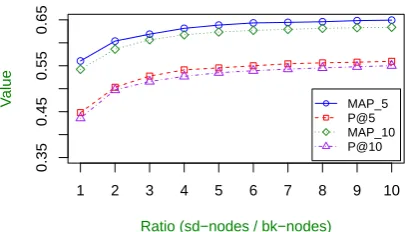
Discussion We further analyze the impact of the three modifications we made to the original model (see Section 3.2). We first focus on the impact of decreasing the relevance weight of bk-nodes and increasing that of sd-nodes after every itera-tion. As mentioned previously, we change their relevance weight according to a fixed ratio, which is important to the performance. Figure 4 shows the performance of models with different ratios. With any increase of the ratio, our model improves its performance in every metric, which shows the
●
● ●
● ● ● ● ● ● ●
1 2 3 4 5 6 7 8 9 10
0.35
0.45
0.55
0.65
Ratio (sd−nodes / bk−nodes)
V
alue
● MAP_5
[image:7.595.74.298.62.146.2]P@5 MAP_10 P@10
Figure 4: The performance of our model with dif-ferent ratios between sd-nodes and bk-nodes.
effectiveness of this setup. The performance re-mains stable from the value of 10:1, which is thus chosen as the final value in our experiments. We then turn to the other two modifications about the edges between bk-nodes and the setup of propaga-tion probability. Table 2 shows the performance of our full model and the simplified models without these two modifications. With the edges between bk-nodes, our model improves the performance by 1.48% inMAP 5and by 1.82% inP@5. With the modified iterative propagation, we achieve a even greater improvement of 13.99% in MAP 5 and 24.27% inP@5. All these improvements are sta-tistically significant, which indicates the effective-ness of these modifications to the original model.
Model MAP 5 P@5 MAP 10 P@10
Full 0.6494 0.5597 0.6338 0.5502
Full−bb 0.6399 0.5497 0.6254 0.5404
Full−p 0.5697 0.4504 0.5485 0.4409
Table 2: The performance of our full model (Full) and two simplified models without modifications: (1) without edges between bk-nodes (Full−bb), (2) without the newly proposed definition of prop-agation probability between nodes (Full−p).
5.2 Task-based evaluation
Model P R F
VSM+one-hot 0.8214 0.8146 0.8168
VSM+tf-idf 0.8381 0.8333 0.8336
LDA+SVM 0.8512 0.8422 0.8436
LDA+SVM+Ours-S 0.8584 0.8489 0.8501
[image:8.595.316.517.61.175.2]LDA+SVM+Ours 0.8748 0.8689 0.8691
Table 3: The performance of document classifica-tion with (LDA+SVM+Ours-S,LDA+SVM+Ours) and without (others) background knowledge.
without background knowledge to evaluate the im-pact of introducing background knowledge.
Baseline systems We first illustrate two base-lines without background knowledge based on VSM and LDA. For VSM, the test document D
is represented as a bag of words, where the word distribution over candidate topics is trained on the same corpus mentioned previously. Then we evaluate the similarity between D and a candi-date topic with cosine-similarity directly, where the topic with the highest similarity will be chosen as the final class. We use two setups: (1) VSM-one-hot represents a word as 1 if it appears in a document or topic, or 0 if not. (2)VSM-tf-idf rep-resents a word as the value of tf-idf. For LDA, we re-implement the state-of-the-art system as an-other baseline, which representsDas a topic vec-tor~vd in the parameter estimation step, and then
introduces a SVM classifier to take~vdas input and
decide the final class in the inference step.
We also evaluate the impact of knowledge qual-ity by proposing two different models to introduce background knowledge: our full model introduced in Section 3 (Ours), and a simplified version of our model without iterative propagation (Ours-S). They have different performances on introducing background knowledge as shown in previous ex-periments (see Section 5.1). We then conduct a di-rect comparison between the document classifica-tion models with these condiclassifica-tions, whose differing performances demonstrates the impact of different qualities of background knowledge on this task.
Results Table 3 shows the results. We use P, R, F to evaluate the performance, which are computed as the micro-average over 9 topics. Both models with background knowledge ( LDA+SVM+Ours-S,LDA+SVM+Ours) outperform systems without knowledge, which shows that the introduction of background knowledge helps in better
classifica-●
● ● ● ● ● ● ● ● ●
●
6.0 6.2 6.4 6.6 6.8 7.0
0.85
0.86
0.87
Threshold of relevance weight
V
alue
● P
[image:8.595.75.300.61.146.2]R F
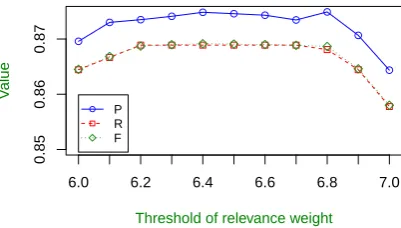
Figure 5: The performance of document classifica-tion models with different thresholds. The knowl-edge whose relevance weight to the source docu-ment exceeds the threshold will be introduced as background knowledge.
tion of documents. The system with the simpli-fied version of our model without iterative prop-agation (LDA+SVM+Ours-S) achieves a F-value of 0.8501, which outperforms the other baselines without knowledge too. Moreover, the system with our full model (LDA+SVM+Ours) achieves the best performance, a F-value of 0.8691, and outperforms the best baseline LDA+SVM signif-icantly. This shows that introducing better qual-ity of background knowledge is helpful to the bet-ter classification of documents. Statistical signif-icance is also verified using the two-tailed paired t-test computed at a 95% confidence level based on the results of classification over the test set.
Discussion One important question here is how much background knowledge to include. As men-tioned in Section 4, we have tried two different solutions: (1) introducing a fixed amount of back-ground knowledge for every document, and (2) setting a threshold and selecting knowledge whose relevance weight exceeds the threshold. The re-sults are shown in Table 4, where the systems with threshold outperform that with fixed amount, which shows that the threshold helps in better in-troduction of background knowledge.
Model P R F
Ours-S+Top5 0.8522 0.8444 0.8456
Ours-S+ThreD 0.8584 0.8489 0.8501
Ours+Top5 0.8769 0.8667 0.8677
Ours+ThreD 0.8748 0.8689 0.8691
[image:8.595.311.520.643.713.2]We also evaluate the impact of different thresh-olds as shown in Figure 5. The performance keeps improving as the threshold increases up to 6.4 and becomes steady from 6.4 to 6.7, while it begins to decline sharply from 6.7. This is reasonable be-cause at the beginning, as the threshold increases, we recall more background knowledge and pro-vide more information. However, with the further increase of the threshold, we introduce more noise, which decreases the performance. In our experi-ments, we choose 6.4 as the final threshold.
6 Conclusion and Future Work
This study encodes distributional semantics into the triple-based background knowledge ranking model (Zhang et al., 2014) for better document enrichment. We first use LDA to represent ev-ery triple as a real-valued vector, which is used to evaluate the relatedness between triples, and then propose a modified iterative propagation model to rank all the triples of background knowledge. For evaluation, we conduct two series of experiments: (1) evaluation as ranking problem, and (2) task-based evaluation, especially for document classifi-cation. In the first set of experiments, our model outperforms multiple strong baselines based on VSM, LDA, and WE. In the second set of exper-iments, our full model with background knowl-edge outperforms the state-of-the-art systems sig-nificantly. Moreover, we also explore the impact of knowledge quality and show its importance.
In our future work, we wish to explore a better way to encode distributional semantics by propos-ing a modified LDA for better triples representa-tion. In addition, we also want to explore the ef-fect of introducing background knowledge in con-junction with other NLP tasks, especially with dis-course parsing (Marcu, 2000; Pitler et al., 2009).
Acknowledgments
We would like to thank our colleagues for their great help. This work was partly sup-ported by National Natural Science Foundation of China via grant 61133012, the National 863 Leading Technology Research Project via grant 2015AA015407, and the National Natural Science Foundation of China Surface Project via grant 61273321.
References
David M Blei, Andrew Y Ng, and Michael I Jordan. 2003. Latent Dirichlet allocation. Journal of Ma-chine Learning Research, 3:993–1022.
Danushka Bollegala, Yutaka Matsuo, and Mitsuru Ishizuka. 2007. Measuring semantic similarity be-tween words using web search engines. Proceedings of the 16th International Conference on World Wide Web, 7:757–766.
Volha Bryl, Claudio Giuliano, Luciano Serafini, and Kateryna Tymoshenko. 2010. Using background knowledge to support coreference resolution. In
Proceedings of the 2010 Conference on ECAI 2010: 19th European Conference on Artificial Intelligence, volume 10, pages 759–764.
Wanxiang Che, Zhenghua Li, and Ting Liu. 2010. Ltp: A Chinese language technology platform. In Pro-ceedings of the 23rd International Conference on Computational Linguistics: Demonstrations, pages 13–16. Association for Computational Linguistics. Silviu Cucerzan. 2007. Large-scale named entity
disambiguation based on Wikipedia data. In Pro-ceedings of the 2007 Joint Conference on Empirical Methods in Natural Language Processing and Com-putational Natural Language Learning, volume 7, pages 708–716.
Oren Etzioni, Anthony Fader, Janara Christensen, Stephen Soderland, and Mausam Mausam. 2011. Open information extraction: The second genera-tion. In Proceedings of the Twenty-Second inter-national joint conference on Artificial Intelligence-Volume Intelligence-Volume One, pages 3–10. AAAI Press.
Samah Fodeh, Bill Punch, and Pang-Ning Tan. 2011. On ontology-driven document clustering using core semantic features. Knowledge and Information Sys-tems, 28(2):395–421.
Xianpei Han, Le Sun, and Jun Zhao. 2011. Collective entity linking in web text: a graph-based method. In
Proceedings of the 34th international ACM SIGIR conference on Research and development in Infor-mation Retrieval, pages 765–774. ACM.
Zhengyan He, Shujie Liu, Mu Li, Ming Zhou, Longkai Zhang, and Houfeng Wang. 2013. Learning entity representation for entity disambiguation. Proceed-ings of the 51st Annual Meeting of the Association for Computational Linguistics (Volume 2: Short Pa-pers), August.
Johannes Hoffart, Fabian M Suchanek, Klaus Berberich, and Gerhard Weikum. 2013. Yago2: a spatially and temporally enhanced knowledge base from Wikipedia. Artificial Intelligence, 194:28–61. Xiaohua Hu, Xiaodan Zhang, Caimei Lu, Eun K Park,
and Xiaohua Zhou. 2009. Exploiting Wikipedia as external knowledge for document clustering. In
Proceedings of the 15th International Conference on Knowledge Discovery and Data Mining, pages 389– 396. ACM.
Saurabh S Kataria, Krishnan S Kumar, Rajeev R Ras-togi, Prithviraj Sen, and Srinivasan H Sengamedu. 2011. Entity disambiguation with hierarchical topic models. In Proceedings of the 17th International Conference on Knowledge Discovery and Data Min-ing, pages 1037–1045. ACM.
Sayali Kulkarni, Amit Singh, Ganesh Ramakrishnan, and Soumen Chakrabarti. 2009. Collective annota-tion of Wikipedia entities in web text. In Proceed-ings of the 15th International Conference on Knowl-edge Discovery and Data Mining, pages 457–466. ACM.
Yogan Jaya Kumar and Naomie Salim. 2012. Au-tomatic multi document summarization approaches.
Journal of Computer Science, 8(1).
Christopher D Manning, Prabhakar Raghavan, and Hinrich Sch¨utze. 2008. Introduction to information retrieval, volume 1. Cambridge University Press Cambridge.
Daniel Marcu. 2000. The rhetorical parsing of unre-stricted texts: A surface-based approach. Computa-tional Linguistics, 26(3):395–448.
Vivi Nastase, Michael Strube, Benjamin B¨orschinger, C¨acilia Zirn, and Anas Elghafari. 2010. Wikinet: A very large scale multi-lingual concept network. In
Proceeding of the 7th International Conference on Language Resources and Evaluation.
Patrick Pantel and Ariel Fuxman. 2011. Jigs and lures: Associating web queries with structured entities. In
Proceedings of the 49th Annual Meeting of the Asso-ciation for Computational Linguistics: Human Lan-guage Technologies-Volume 1, pages 83–92. Associ-ation for ComputAssoci-ational Linguistics.
Xuan-Hieu Phan, Le-Minh Nguyen, and Susumu Horiguchi. 2008. Learning to classify short and sparse text & web with hidden topics from large-scale data collections. In Proceedings of the 17th International Conference on World Wide Web, pages 91–100. ACM.
Emily Pitler, Annie Louis, and Ani Nenkova. 2009. Automatic sense prediction for implicit discourse re-lations in text. InProceedings of the Joint Confer-ence of the 47th Annual Meeting of the ACL and the 4th International Joint Conference on Natural Lan-guage Processing of the AFNLP: Volume 2-Volume 2, pages 683–691. Association for Computational Linguistics.
Gerard Salton and Michael J. McGill. 1986. Intro-duction to Modern Information Retrieval. McGraw-Hill, Inc., New York, NY, USA.
Jean-Paul Sansonnet and Franc¸ois Bouchet. 2010. Extraction of agent psychological behaviors from glosses of WordNet personality adjectives. InProc. of the 8th European Workshop on Multi-Agent Sys-tems (EUMAS10).
Fabrizio Sebastiani. 2002. Machine learning in au-tomated text categorization. ACM Computing Sur-veys, 34(1):1–47, March.
Prithviraj Sen. 2012. Collective context-aware topic models for entity disambiguation. In Proceedings of the 21st International Conference on World Wide Web, pages 729–738. ACM.
Steffen Staab and Rudi Studer. 2009. Handbook on Ontologies. Springer Publishing Company, Incor-porated, 2nd edition.
Koun-Tem Sun, Yueh-Min Huang, and Ming-Chi Liu. 2011. A WordNet-based near-synonyms and similar-looking word learning system. Educational Technology & Society, 14(1):121–134.
Ellen M Voorhees, Donna K Harman, et al. 2005.
TREC: Experiment and evaluation in information retrieval, volume 63. MIT press Cambridge. Muyu Zhang, Bing Qin, Ting Liu, and Mao Zheng.
2014. Triple based background knowledge ranking for document enrichment. InProceedings of COL-ING 2014, the 25th International Conference on Computational Linguistics: Technical Papers, pages 917–927, Dublin, Ireland, August. Dublin City Uni-versity and Association for Computational Linguis-tics.