Theoretical Study with Rovibrational and Dipole Moment
Calculation of the SiO Molecule
Khalil Badreddine1, Nayla El-Kork2, Mahmoud Korek1*
1Faculty of Science, Beirut Arab University, Beirut, Lebanon 2Khalifa University, Sharjah, UAE
Email: *[email protected]
Received October 20, 2012; revised November 21, 2012; accepted November 30, 2012
ABSTRACT
Via CASSCF/MRCI and RSPT2 calculations (single and double excitation with Davidson correction) the potential en- ergy curves of 20 electronic states in the representation 2S 1( ) of the molecule SiO have been calculated. By fitting
these potential energy curves to a polynomial around the equilibrium internuclear distance re, the harmonic frequency
ωe, the rotational constant Be, and the electronic energy with respect to the ground state Te have been calculated. For the
considered electronic states the permanent dipole moment μ have been plotted versus the internuclear distance r. Based on the canonical functions approach, the eigenvalues Ev, the rotational constant Bv and the abscissas of the turning
points rmin and rmax have been calculated. The comparison of these values to the experimental and theoretical results
available in the literature is presented. In the present work 8 higher electronic states have been studied theoretically for the first time.
Keywords:Ab Initio Calculation; SiO Molecule; Potential Energy Curves; Spectroscopic Constants; Dipole Moment;
Rovibrational Calculation
1. Introduction
The silicon monoxide SiO molecule is of considerable astrophysical interest, it is detected in the interstellar me- dium and in a variety of astrophysical objects which are mostly associated with warm, dense, and shocked gas [1]. Because of the interaction between high velocities jets emerging from a young star and the surrounding mo- lecular environment a large fraction of the silicon mon- oxide relative to hydrogen molecule are found in the high velocity gas components of molecular outflows [2]. This abundance of SiO comes from the sputtering of dust grains in shocked regions and the subsequent release of Si-bearing material into the gas phase [3-7].
In recent years silica nanoparticles has attracted con- siderable attention due to their potential applications in many fields including ceramics, chromatography, cataly- sis and chemical mechanical polishing [8], nanodevices and mesoscopic research [9]. Altman et al. [9] probed the behavior of light absorption of silica nanoparticles at high temperatures in the Urbach region, and compare it with that in bulk materials. They assumed that, the SiO vapor emission does not contribute significantly to the flame radiation in visible. This can be easily justified by considering that the lower state of a SiO molecule in-
volved in transitions in visible light is not a ground state of the SiO molecule, but a highly excited one [10].
By studying the published data in literature on the molecule SiO, one can notice the large discrepancy be- tween these values either theoretical or experimental. The values of the electronic transition energy Te with
respect to the ground state X1Σ+ vary as
1 1
24115 cm Te 24031 cm
1 1
25509 cm Te 24031.82 cm
,
1 1
32978.9 cm T 45135 cm
[12],
and e [12] respectively
for the electronic states (1)3Σ+, (1)3Σ+, (2)3Σ. Similar data
can be found for different spectroscopic constants of dif- ferent electronic states. Stimulated by these discrepancies, the important connection between energy relations of solids and molecules [13], and based on our previous theoretical calculation [14-23], we performed an ab initio
study of the low-lying electronic states of the molecule SiO below 132,500 cm–1. In this work, we investigate the
potential energy curves (PECs), the electric dipole mo- ment and spectroscopic constants for the 20 2S+1Λ± low-
constant Bv and the abscissas of the turning points rmin
and rmax have been calculated up to the vibrational level v =
52.
2. Computational Approach
2.1. Ab Initio Calculation
The PECs of the lowest-lying electronic states of SiO molecule have been investigated via CASSCF method. MRCI and RSPT2 calculations (single and double exci- tations with Davidson corrections) were performed. Sili- con atom is treated in all electron schemes where the 14 electrons of the silicon atom are considered using the cc-PVTZ basis set including s, p, d and f functions [27]. The oxygen atom is treated in all electron schemes where the 8 electrons of the oxygen atom are considered using the DGauss-a2-Xfit basis set including s, p and d func-
tions [28]. Among the 22 electrons explicitly considered for the SiO molecule (14 electrons for Si and 8 for O), 18 inner electrons were frozen in subsequent calculations so that 4 valence electrons were explicitly treated. This cal- culation has been performed via the computational che- mistry program MOLPRO [29] taking advantage of the graphical user interface GABEDIT [30].
The PECs for the 20 electronic states in the represen- tation 2S+1Λ(±) obtained from MRCI calculation have been
obtained for 222 internuclear distances in the range 1.06 Å ≤r ≤ 4.00 Å. These potential energy curves for the singlet, triplet and quintet electronic states in the dif- fe
s an excellent agree- ment with the relative differences
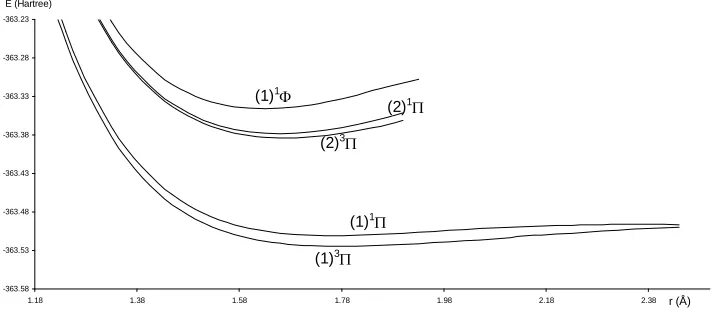
rent symmetries are given, respectively in Figures 1-3. The spectroscopic constants such as the vibration harmonic constants ωe and ωexe, the internuclear distance
at equilibrium re, the rotational constant Be, and the elec-
tronic transition energy with respect to the ground state
Te have been calculated by fitting the energy values
[image:2.595.117.476.383.534.2]around the equilibrium position to a polynomial in terms of the internuclear distance. These values are given in
Table 1 together with the available values in the litera-
ture either theoretical or experimental. The comparison of our MRCI calculated values of reωe, and Be for the
ground state X1Σ+ with those given in literature, either
theoretical or experimental, show
Fit SCF
0.05% Ref. 6 e 2.9% Ref. 35 e
r r
,
MSCF30
MP2_1
0.6% Ref. 35 e 10.7% Ref. 33 e
,
-363.8 -363.75 -363.7 -363.65 -363.6 -363.55 -363.5 -363.45 -363.4 -363.35
1 1.5 2 2.5 3 3.5 4
(1)1
(2)1+
(1)1+ (1)3+
(1)3 (1)3
-(3)1+ E (Hartree)
[image:2.595.117.476.563.719.2]r (Å)
Figure 1. Potential energy curves of the lowest singlet and triplet Σ and ∆-states of the molecule SiO.
-363.58 -363.53 -363.48 -363.43 -363.28 -363.23
1.18 1.38 1.58 1.78 1.98 2.18 2.38
-363.38 -363.33
E (Hartree)
(1)3
(1)1
(2)3
(2)1
(1)1
r (Å)
Figure 3. Potential energy curves of the lowest quintet states of the molecule SiO. Table 1. Spectroscopic constants for the electronic states of the molecule SiO.
States Te(cm–1) ∆Te/Te% re(Å) ∆re/re% ωe(cm ) –1 ∆ωe/ωe% Be(cm ) –1 ∆Be/Be% ωexe(cm–1) ∆ωexe/ωexe%
1.5237a1
2.
0.7124a1 5.07a1 1.5328a2
1270.03a1 1230.75a2 1241.6b 1216.3c1 1245.4c2 1240.5c3 1179.9c4 1176.0c5 1181.8c6
2 4.2 1.9 2.3 7.1 7.4 6.9
0.7041a2 2.26a2
1.5098b,d 0.91 0.727b,d 2.0 5.97b,d 17.7
1.479 h2
1.
0.72358m 1.
1 12 4p 0 .726752p 2. 974370p 1
X1Σ+ 0.
0. 5. ad
(1)3Σ+ 3006 93a1
19 8 66 r1 23.7
1.70s2 0. 0. s2 2
33630b 1 790b 8.
a3Σ+
1
3 7 0.565584ad 0. 4.08181ad
1242b,d 2.2 1.5273e1
1.5230e2 0.24 0.05 1231 e1
1154e2 3.0 9.1 0.709 e1
0.713e2 0.5 0.1 8.00 e1
6.34e2 58 25 1.4811f1
1.5055f2 1.5192f3
2.8 1.2 0.3
1406.9f1 1309.2f2 1240.7f3
10.7 3.1 2.3
5.02f1 5.17f2 5.85f3
5.1 2.0 5.0
1.496g 1.8 1247.9g 1.6 5.97g 17.7
h1 1.514 1.515h3
2.9 0.64 0.64
1400h1 1262h2 1241.7h3
10.2 0.6 2.2
5.0h1 5.7h2 5.84h3
1.4 12.4 15.2 5097i,j,k 0.92 1241.5i,j,k 2.2 5.97i,j,k 17.7
1.5130m 0.70 1242.4m 2.2 6
1.521n 0.18 1216n 4.2
.509739p 0.92 41.5439 2.2 0 5. 7.7
1.509733ac 0.92 1241.54304ac 2.2 0 .726752ac 2.0 5.973907ac 17.7 0
1.5166q 0.46 1242.1q 2.2 0.720q 1.1 6.9q 36.1
1.5100ad 0.89 1238.98ad 2.44 726482ad 2.0 96702 17.7 5.
25968.19a2 1.7103 a1
1.6945a2 866.86
a1 0.565a1
0.5760a2
24115.85r1 . 1.86r1 8.7 1 0.56r1 0.9
37827.19r2 25.8 1.74r2 1.7 0.65r2 15.0
32324.65x 7.5 1.70x 0.6 0.65x 15.0
35810.82s1 19.1
6 68 0.3
1.8 1.70b 0.6 9
33 568n 11.6 .7081n 0.1 821n 5.3
[image:3.595.65.535.286.737.2]Co inu
32857.67a1 1.7192a1 844.56a1 0.560a1
nt ed (1)3Δ
30729.55r1 6 2 1
3653 .72v 1 761v 1 0. v 1.
1.717n 0. d3Δ
(1)3∑− 3481 56a1 1.7298a 7 0.553a
5 2
0
718v 1 e3 −
3543 8a1 1.7265a1 0.5544a1
1. 70 3g
3484 96r1 1. 0.4 r1 1
740v 0. v 2.
(1)1∑–
3860 70ad 8. 1.7314ad 0. 7 5. 0.553 78ad 0.
(1)1Δ
0 1 2
780v 1 D1Δ
.5 1.88r1 9.3 625r1 6.0 0.48r1 4.3
25809.60r2 21.4 1.76r2 2.4 0.55r2 1.8
35084.92x 6.8 1.71x 0.5 0.57x 1.8
1.71u 0.5
6 1.2 0.0 57 8
36880n 12.2 1 797n 5.6
36487b 11.0 1.715b 0.2 767b 5.6
863w 2.2
9. 99.37a
32987.90r1 .3 1.90r1 9.8 596r1 5.4 0.16r1
43473.05r2 24.8 1.78r2 2.9 0.32r2
36536.72x 4.9 1.78x 2.9 0.55x .5
38311.13v 10.0 1.72v 0.6 0.2 0.56v 1.3
37848n 8.7 1.738n 0.5 785n 18.0
38309b 10.0 1.726b 0.2 748b 6.4
∑
803w 0.4
3.
1.746g 1 3.
2. 7 1.96r1 13.5 513r1 8 3.4
44924.84r2 26.8 1.83r2 5.6 0.49r2 11.6
37343.26x 5.4 1.77x 2.5
38633.75v 9.0 1.75v 1.4 54 3
37920n 7.0 1.743n 0.9 725n
38624b 9.0 1.727b 0.0 740b
735w
6. 2 3 43.72ad 7 1 22
35637.35a1
34580.78a2 1.7289
a1
1.7190a2 938.37
a1
887.47a2 0.5527
a1 0.5598a2
35407.54r1 .6 1.98r1 4.5 0.42r1 4.0
46457.28r2 36.4 1.85r2 7.0 0.48r2 13.1
37181.96x 4.3 1.79x 3.5 0.52x 5.9
38795.05v 8.9 1.78v 2.9 6.9
38955n 9.3 1.744n 0.9 723n 22.9
38823b 8.9 1.729b 0.0 730b 22.2
Continued
57708.29a1 1.7683a1 583.90a1 0.5286a1 3∏
65007.93x 1 1
3∏(III)
482z 1
(2)1∑+
65311.28a2 11.6499a2 9947.04a2 0.0.6076a2
13 7 4
1934x 4
F1∑+
1
(1)1∏
58794.03a2 11.8160a2 491.22a2 00.5010a2
43863n 2 A1∏
4 ad
2 0. r1
2 G1∏
(2)3Δ 2. 4 0.
1.779g 3.9 620.0g
a1 1 8
2.6 1.64x 7.3 0.61x 5.4
59604.05z 3.3 1. 70z 3.9 7.4 0.57z 7.8
60430.60a1 .6544a1 35.16a1 6049a1
68718.06r1 . 2.29r1 38. 0.32r1
63878.76x 5.7 1.62x 2.1 0.63x .1
68395.44ab 13.2 1.60ab 3.3 1105ab 8.2 0.64ab 5.8
60679.12a1 .7500a1 750.77a1 .5392a1
1.644g 6.1 813.5g 8.3
7.7 1.650n 5.7 813n 8.3
42835.4b 29.4 1.6206b 7.4 852.8b 13.4
2961.96ad 7.3 1.6229ad 851.99ad 0.63ad 5.73
62668.94r1 3.3 2.10r1 0.0 803r1 6.9 37
65169.24x 7.4 1.59x 9.1 733x 2.4 0.66x 2.4
69443.96y 14.4 1.62y 7.4 863y 14.9 0.63y 16.8
65452.41a2 2928a2 44.52a2 3143a2
(1)3Γ 65602.38a2 2.3971a2 583.8a2 0.2878a2 (1)1Γ 76322.36a2 3.7182a2 187.11a2 0.1195a2
(3)1Γ 82511.00a 1.8508a2 1338.96a2 0.4829a2
(3)3∏ 88538.96 .6667 a1 87.135 a1 0.5958 a1
(2)1∏ 89827.23a1 1.6592 a1 873.72 a1 0.6015 a1 (1)1Ф 96905.19 a1 1.6286 a1 1003.01a1 0.6237a1 (2)5∏ 113278.88a1 2.1573 a1 484.12 a1 0.3554 a1 (1)5∑− 122498.94a1 2.5163 a1 340.09 a1 0.2612 a1 (1)5Δ 123876.23a1 2.9340 a1 148.81 a1 0.1922 a1 (2)5∑ 132432.98a1 2.6970 a1 128.29 a1 0.2254 a1
a1Fo t work wi lation; a2Fo present T2 c culation; b (experimental)R ]; c2(B 31]; c3(B3-L 2)Ref.[31]; c4(BP8 Ref.[31]; c5(MP2_1Ref.[31]; 2_2)Ref.[31]; dRef.[32]; Ref.[6]; e2(Fit)Ref.[6]; Ref.[33]; f2(CI-S )Ref.[33]; f3 Ref.[33]; g(SCF+CI)Ref.[34];
r presen
6) th MRCI calcu) c6(MP r work with RSPe1(MRCI+Q) al Ref.[10]; c1
f1(SCF) ef. [31D
3-LYP1)Ref.[ CEPA-1)
YP
h1(SCF)Ref.[35]; h2(MCSCF30)Ref.[35]; h3(MCSCF-CI)Ref.[35]SCF; i(exp)Ref.[36]; j(exp)Ref.[37]; k(exp)Ref.[38]; mRef.[39]; nRef.[40]; pRef.[44]; r1Ref.[11]; r2Ref.[11]; s1Ref.[45]; s2Ref.[45]; tRef.[46]; uRef.[47]; vRef.[48]; wRef.[49]; xRef.[50]; yRef.[51]; zRef.[52]; qRef.[53]; abRef.[54]; acRef.[55]; adRef.[56];N.B experimental value c1 (Ref.[ 31]) is in solid methane.
% Refs. 10, 32, 44, 55
e
B
Fit Ref. 6 Be 2.0
0.1% .
The agreement becomes less by comparing our calcu lated value of ωexe with the experimental values of
lit
-erature [10,32,36-38,44,55] where the relative differ-
ence e 17.7%
e
. One can notice that, the theoretical
value ished in literature varies between 5.0
–1 of ωexe publ
cm and 8.0 cm–1 for the ground state [6,33-35]. The
comparison of our calculated values by using the RSPT2 and MRCI techniques with those available in literature for the spectroscopic constants re, ωe and Be shows the
average values MRCI , 0.97% e e r r
re RSPT2
1.54%
e r , MRCI 4.0% , e e RSPT2 3.0% , e e MRCI 1.33% , e e B B RSPT2 2.37% .
From theseresults one c find that, the RSPT2
tech-nique may gives better value for ωe while MRCI
tech-ni
, (1)Σ, (2)Σ with those ob-ta e e B B an
que gives better values for re and Be for the ground
state of the molecule SiO.
By comparing our calculated values of Te for the states
(1)3Σ+, (1)3Σ, (1)3Σ–, (1)1Σ– 1 1
ined experimentally in literature one can find an overall acceptable agreement with relative difference
8.9% e 11.8% e
T T
in Refs.[10,36] and larger relative
difference for the states (1)3Σ+, (2)1Σgiven in Refs.[33,
39,43] with relative difference13.2% e 19.1%
e
T
T .
son of our calculate value of Te, for the considered electronic states, with
One can notice that, the compari d
those calculated in literature shows an excellent agree- ment by using one technique of calculation with
0.6% e e T T
(Ref.[11]) and disagreement by using an-
other technique with Te 36% (Ref.[11]) for the
e
T
ning the as
culated value of the Σ state, it is in good agreement with
The comparison of our calculated values of re, ωe, and
ent for all the investigated st
11.9% and 8.2% respectively.
same state (1)1Σ. Concer signment of our cal-
1
the calculated values of G1Σ state [32,38] and acceptable
agreement with the experimental value given in Ref.[39]. The comparison of our values of Te with the newly pub-
lished theoretical work by using the MRCI approach [56] shows an acceptable agreement for the 2 excited elec- tronic states (1)3Σ+ and (1)1Σ– with relative differences
Be, for the excited states, with those given in literature
experimentally [10,48,51,54] shows that, our values of re
and Be are in very good agreem
ates with
0.0% Ref. 10 e 7.4% Ref. 51 e
r r
and
8
2.3% Ref. 48
e
B
except the
value of Be for the state G1 where 1.3% Ref. 4 Be
16.8% e e B B
. Our
values of ωe are also in very good agre he
experimental values for the electronic states with ement with t
1 35434 cm
e
T and becomes la other i
vestigated electronic states with
rger for the n-
14.9% Ref. 51 e 22.2% Ref. 10 e
.
Similarly, by comparing our calculated values of reωe,
and Be with those calculated in literature, one can notice
that an excellent agreement by using one echnique of
calculation with
t
relative differences 0.1%
e
r for th
state (1)3Σ+ (Ref.[40]),
e r e 2.2% e
e for the state (1)3Σ
(Ref.[49]), and 0.5%
B for the state (1)
3Σ (Ref.
y using ano
e
B
–
e
[50]) and disagreement b ther technique with
38.41% e
r for the Σ (Ref.[11]),
e
r
state (2)1 +
26.0% e
e for the state (1)3Σ (Ref.[11]), and
24.0% e e B B
for the state (1)Σ (Ref.[11]). These dis-
crepancies in d to the
basis used in this calculation, the number of valence electron, the
state ….etc. W
1
the theoretical results can be referre
software used, the bad assignment of a hile the comparison with the recent results of Ref.[56] for the 2 states (1)3Σ+ and (1)1Σ– by using an
approach similar to that we used in the present work shows an excellent agreement for the values of re and Be
and good agreement for ωe. For the state 1Σ, there is an
excellent agreement with the value of ωe and good
agreement with the values of re and Be. The SiO mole-
have shown the critical value of the dipole moment re-quired to support a DBS to be 2.5 D. The electric dipole moment is also of great utility in the construction of mo-lecular orbital based models of bonding and helping in the search for an understanding of the macroscopic prop-erties of imperfect gases, liquids and solids. The expecta-tion value of this operator is sensitive to the valence electrons and the general predictive quality of the com-putational methodology.
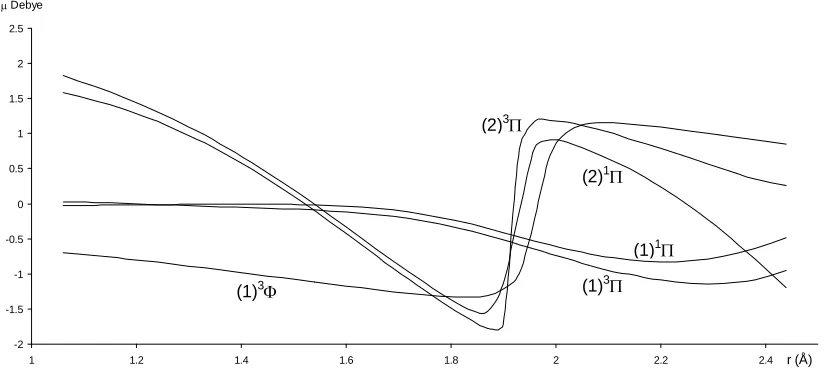
For the investigated electronic states, we calculated in the present work the permanent dipole μ(r) for 1.2 Å ≤r
≤ 4 Å (Figures 4 and 5). Each time an adiabatic state loses its ionic character, it becomes again neutral and the corre-sponding dipole moment tends towards zero.
2.2. The Vibration-Rotation Calculation
Within the Born-Oppenheimer approximation, the vibra-
tion rotation motion of a diatomic molecule in a given electronic state is governed by the radial Schrödinger equation
2
2 2 2
d 2 0
dr EvJ U r r vJ r
(1)
where r is the internuclear distance, v and J are respec- tively the vibrational and rotational quantum numbers,
1
J J
, EvJ and vJ are respectively the ei-
genvalue and the eigenfunction of this equation. In the perturbation theory these functions can be expanded as
0 n
vJ n
n
E e
0
n
vJ n
n
r r
(2)
(3)with e0 = Ev, e1 = Bv, e2 = –Dv···, 0 is the pure vibration
0.0 1.0
-5.0 -4.0 -3.0 -2.0 -1.0
1 1.5 2 2.5 3 3.5 4
2.0
Debye
r (Å) (1)1
(2)1 (3)1+ (1)3 -(1)3
(1)1+
[image:7.595.91.506.312.503.2](1)3+
Figure 4. Permanent dipole moment curves of the lowest singlet and triplet and ∆-states of the molecule SiO.
-2 -1.5 -1 -0.5 0 0.5 1 1.5 2 2.5
1 1.2 1.4 1.6 1.8 2 2.2 2.4
Debye
r (Å)
(1)3 (1)3
(1)1 (2)1 (2)3
[image:7.595.93.505.534.722.2]wave function and n its rotational corrections. By re-
placing Equations (2) and (3) into Equation (1) and since this equation is satisfied for any value of , one can write [24-26]
r 0 r 0 (4)
1R r 0 r
(5-1)
0 0 2 0 2 1 1 0 1
1
e e
r
(6-2)
1
0 0 0 2 1 0
1
1 n
n n m n m
m
e e
r
0 r e0U
1 r e0 U r 1 r e
2 0
1 1
r e U
e R r
2 2 0
r r
r e r
(5-2)
1
n n
n n m n m
m
U r r
e r
(5-n)
0
1
r e
R r
where R r
1r2, the first equation is the pure vibra-tional Schrödinger equation and the remaining equations are called the rotational Schrödinger equations. One may project Equations (7) onto 0 and find
0 0 e1 0 2 0
1
r
(6-1)
(6-n)Once e0 is calculated from Equation (4), e e e1, , ,2 3
can be obtained by using alternatively Equations (5) and
(6). By using the canonical functions approach [24-26]
and the cubic spline interpolation between each two con- secutive points of the PECs obtained from the abinitio
calculation of the SiO molecule, the eigenvalue Ev, the
rotational constant Bv, the distortion constant Dv, and the
abscissas of the turning point rmin and rmax have been
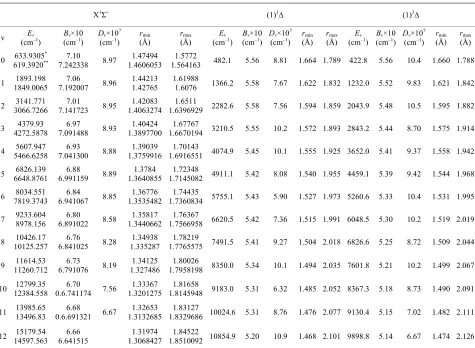
calculated up to the vibration level v = 52. These values for the state X1Σ+, (1)1∆, (1)3Σ, (1)3Π, (2)3Π a d (2)1Π
(as illustration) are given in Table 2.The comp rison of he ex- perimental data of Ref.[55] for the
shows an excellent agreement for the
brational levels. Similar results are obtained by compar- ing our calculated values of Bv with the calcu
[image:8.595.61.536.381.729.2]al. [56] for the considered states.
Table 2. Values of Ev, rmi
1Σ+
n a our calculated values of Ev, Bv, rmin and rmax with t
ground state X1Σ+
35 considered vi-
lated Shi et
Bv, Dv and n and rmax of the SiO molecule.
(1)1∆ (1)3∆
X
v Ev
(cm–1) (cmBv×10 –1) Dv×10 7
(cm–1) r(Å) min r(Å) max (cmE v–1) B(cmv×10–1) Dv×10 7
(cm–1) r(Å)min r(Å)max (cmEv–1) (cmBv×10 –1) Dv×10 7
(cm–1) r(Å)min r(Å)max
0 619.3920** 7.242338 8.97 1.5772 482.1
1 1849.0065 1893.198 7.192007 7.06 8.96 1.42765 1.6076 1366.2
1.771 7.0
4 5466.6258 7.041300 8.88 1.70143 4074.9
5 6648.8761 6826.139 6.991159 6.88 8.89 1.3640855 1.7145082 4911.1 .39 9.42 1.544 1.968
6 7819.3743 8034.551 6.941067 6.84 8. 5.33 10.4 1.531 1.995
7 9233.604 8978.156 6.891022 6.80 8 1.3440662 1.35817 1.75669581.76367 6620.5 5.42 1.515 1.991 6048.5 5.30 1.519 2.019
104
1 6.
1. 8 1.3
1. 9
1.7 5 2
1 1.
633.9305* 7.10 1.47494
1.4606053 1.564163 1.44213 1.61988
5.56 8.81 1.664 1.789 422.8 5.56 10.4 1.660 1.788
5.58 7.67 1.622 1.832 1232.0 5.52 9.83 1.621 1.842
5.58 7.56 1.594 1.859 2043.9 5.48 10.5 1.595 1.882
5.55 10.2 1.572 1.893 2843.2 5.44 8.70 1.575 1.914
5.45 10.1 1.555 1.925 3652.0 5.41 9.37 1.558 1.942
5.42 8.08 1.540 1.955 4459.1 5 2 3066.7266 314 7.141723 1 8.95 1.4063274 1.42083 1.63969291.6511 2282.6
3 4272.5878 4379.93 7.091488 6.97 8.93 1.3897700 1.40424 1.66701941.67767 3210.5
5607.947 6.93 1.39039
1.3759916 1.6916551 1.3784 1.72348
85 1.3535482 1.36776 1.73608341.74435 5755.1 5.43 5.90 1.527 1.973 5260.6
8.5 7.36 10.2
8 0125.25726.17 8410256.76 8.28 349335287 782176557 7491.5 5.41 9.27 1.504 .018 6826.6 5.25 8.72 1.509 2.044
9 11260.712 11614.53 6.791076 6.73 8.19 1.327486 1.34125 1.79581981.80026 8350.0 5.34 10.1 1.494 2.035 7601.8 5.21 10.2 1.499 2.067
10 12384.558 12799.35 0.6.741174 6.70 7.56 1.33367 .3201275 1.816588145948 9183.0 5.31 6.32 1.485 2.052 8367.3 5.18 8.73 1.490 2.091
11 13985.65 13496.83 0.6.691321 6.68 6.67 1.3132685 1.32653 1.83296861.83127 10024.6 5.31 8.76 1.476 2.077 9130.4 5.15 7.02 1.482 2.111
C nt
13 6. 6.90 1. 11623.8 5.10 7.34 1.461 2.123 10675.0 5.14 6.24 1.467 2.141 o inued
16376.97 15686.793
6.64 591756
1.31328 3007972
1.85926 1.8687714
14 6. 8.35 1. 12392.8 5.13 5.26 1.454 2.146 11457.1 5.11 11.1 1.459 2.164
15 6. 10.2 1. 13170.2 5.06 10.6 1.447 2.168 12221.1 5.02 17.1 1.453 2.187
16 6. 11.6 1. 13915.0 5.00 7.12 1.441 2.189 12946.6 4.94 9.50 1.447 2.207
17 11.3 1. 14659.1 4.99 9.25 1.435 2.210 13663.4 4.93 4.39 1.441 2.228
18 6. 8.96 1. 15395.5 4.92 10.1 1.430 2.231 14389.7 4.90 12.8 1.435 2.249
19 6. 1. 16118.8 4.89 8.64 1.425 2.252 15098.4 4.83 11.1 1.430 2.270
20 6. 8.05 1. 16836.7 485 9.91 1.419 2.272 15794.0 4.80 6.02 1.425 2.290
6.195408 8.66 1.2621465 2.0050237 17544.8 4.81 8.87 1.415 2.292 16491.2 4.77 11.6 1.420 2.310
5
9.
37 10.4 28046.1 4.25 1.42 1.356 2.591 26702.2 4.20 10.1 1.361 2.618
38 10.5 28644.7 4.22 3.26 1.353 2.609 27285.6 4.15 10.6 1.358 2.638
41 42335 5.26 10.9 1.218 2.296 30438.3 4.12 9.22 1.345 2.666 28964.6 3.97 1.350 2.707 17564.86
16764.556
6.59 542046
1.30717 2950884
1.87471 1.8862999 18729.64
17830.887
6.51 492383
1.30145 2896807
1.89247 1.9036325 19863.12
18885.821
6.44 442768
1.29612 2845439
1.90996 1.920801 20969.76
19929.395
6.38 6.3932
1.2911 2796526
1.92678 1.9378326 22064.93
20961.645
6.34 343681
1.28632 2749849
1.94447 1.954751 23154.06
21982.604
6.30 294209
1.28172 2705220
1.96044 1.9715771 24234.74
22992.31
6.27 244785
1.2773 2662473
1.97363 1.9883291
21 23990.798 25315.7 6.25 1.27302 1.98686
22 24978.102 26398.66 6.14608 6.22 6.90 1.2582069 1.26886 2.02167542.00346 18246.1 4.77 9.82 1.410 2.312 17176.0 4.72 9.20 1.415 2.330
23 27464.85 25954.26 6.096799 6.15 6.28 1.254417 1.26487 2.03829792.02082 18939.0 4.73 9.20 1.406 2.332 17853.6 4.69 8.03 1.411 2.350
24 26919.306 28503.02 6.047566 6.08 10.0 1.2507669 1.2611 2.05490332.0345 19624.4 4.69 8.90 1.401 2.352 18526.7 4.65 10.1 1.406 2.370
25 27873.277 29530.92 5.99838 6.06 12.7 1.2472474 1.25746 2.07150292.0478 20302.9 4.66 9.37 1.397 2.372 19191.0 4.62 8.71 1.402 2.389
26 28816.207 30563.92 .9492436.04 8.91 1.2438503 1.25389 2.08810732.06412 20974.0 4.62 9.34 1.393 2.391 19849.8 4.58 9.20 1.398 2.409
27 29748.132 31582.14 5.900153 5.95 5.12 1.2405603 1.25045 2.10472622.08297 21637.9 4.58 8.83 1.389 2.411 20501.7 4.54 8.40 1.394 2.428
28 30669.088 32558.73 5.851111 5.84 66 1.2373947 1.24723 2.12136872.10038 22295.2 4.55 8.87 1.385 2.430 21148.1 4.51 9.21 1.390 2.447
29 31579.111 33508.62 5.802116 5.80 16.7 1.2343233 1.24416 2.13804352.11734 22945.8 4.51 8.98 1.382 2.450 21788.2 4.48 8.77 1.387 2.466
30 32478.235 34457.86 5.753169 5.77 13.3 1.2313484 1.24116 2.15475882.13487 23590.2 4.48 8.54 1.378 2.469 22422.4 4.44 8.45 1.383 2.485
31 33366.498 35394.39 5.704270 5.70 5.98 1.2284650 1.23825 2.17152242.15252 24229.3 4.45 7.09 1.375 2.490 23051.1 4.41 8.32 1.380 2.504
32 34243.933 36308.34 5.655419 5.63 9.95 1.2256683 1.23547 2.18834162.17001 24866.1 4.43 5.56 1.372 2.506 23674.5 4.38 8.83 1.376 2.523
33 35110.577 37209.82 5.606616 5.59 13.0 1.2229539 1.23277 2.20522392.18763 25504.3 4.42 4.20 1.368 2.518 24292.2 4.34 8.58 1.373 2.542
34 35966.466 38099.68 5.55786 5.53 9.68 1.2203178 1.23016 2.22217602.20541 26147.4 4.42 4.69 1.365 2.532 24904.2 4.31 8.51 1.370 2.560
35 36811.635 38973.71 5.509152 5.48 9.69 1.2177562 1.22763 2.23920482.22325 26793.2 4.40 9.08 1.362 2.552 25510.3 4.27 8.73 1.367 2.579
36 38100 5.53 11.3 1.230 2.205 27430.7 4.34 10.6 1.359 2.572 26110.0 4.24 9.57 1.364 2.598
38974 5.48 1.228 2.223
39834 5.42 1.225 2.241
39 40682 5.37 10.9 1.223 2.259 29247.1 4.23 4.92 1.350 2.628 27858.8 4.10 11.7 1.355 2.659
C ti
42 4314 5. 1.216 4.11 4.67 1.342 2.685 29488.0 3.87 1.348 2.735
on nued
2 20 10.9 2.315 31019.3
43 43935 5. 21 1. 9. 1. 2.
5. 1 8 1. 1 5
5.0 .4 10 3 1. 5 0
46 4.9 .5 1.208 3.98 9.57 1.333 2.761
47 4. 1.20 3.95 7.67 1.330 2.779
4.85 204 3440 37 1.
49 48400 4.79 1.203 2.453 34956.0 3.89 7.90 1.326 2.817
4.73 201 3549 76 1.
4.66 99 7
4.60 98 9
(1)3 (2)3 (2)1
9.
8.
8.
1
3
1.
15 11.1 1. 4 2.334 31600.6 4.08 10.0 340 2.704 2997 2 3.72 346 771
44 44714 09 11.1 1.2 2 2.353 32173.2 4.04 8. 3 337 2.723 304 5.2 3.4 1.344 2.828
45 45480 3 11 1.2 2.372 32739.0 4.01 6. 4 335 2.742 307 6.4 3.0 1.342 2.922
46231 7 11 2.392 33302.0
46969 91 11.7 6 2.412 33858.0
48 47692 1. 2.432 9.1 3.92 7. 328 2.798
50 49093 1. 2.475 7.9 3.87 6. 324 2.836
51 49770 1.1 2.49
52 50432 1.1 2.51
0 263.3 5.17 20.6 1.707 1.868 440.6 5.93 10.0 1.610 1.731 444.7 5.99 90 1.601 1.721
1 775.3 5.08 18.3 1.662 1.938 1374.6 5.96 90 1.564 1.769
2 1290.2 5.01 20.1 1.635 1.995 2322.9 5.94 95 1.539 1.804
3 1787.5 4.89 21.6 1.614 2.047
4 2264.3 4.81 16.5 1.598 2.097
5 2740.5 4.74 17.6 1.584 2.130
6 3211.3 4.68 9.6 1.572 2.175
7 3666.0 4.53 1.6 1.561 2.222
8 4082.1 4.41 68 1.552 2.267
* e p wor **Se try 1,54].
3
o
io
In the present wor ab initio investigation for the 20
lo -ly g d let electro ate he
molecule has been performed via CAS-SCF/MRCI me-
th . T te e a mom nt curv
have te e n t ros c co
-stants T, r, ω, ωex and the rotational constant Be for
th lo in c T par on of our
r lt e n d , with hose o
-tained experimentally in literature shows an overall very
g d en i a ent with the theoretical
d d e ni f ation By usi
the canonical functions approach [24-26], the eigenvalue
E th o o t d cissas of t
tu in n have bee ate up to t
vibrational level v = 52 with an excellent agreement by re. Eight electronic states have been investigated in the present
rk r the ese newl obtained results
ybe confirmed by the investig of new
experi-mental works on this molecule.
R
E
E
R. Wilson, A nz . ff r
and P. Thaddeus, “Discovery of Interstellar licon Mo- noxide,” The Astrophysical Journal 971, pp. L -L100
First entry for th resent k; cond en Refs. [5
. C nclus n
k, the
w ing sin let an trip nic st s of t SiO
od he po ntial nergy nd the dipole e es
been de rmin d alo g with he spect copi n
e e
west-ly g elee tronice
e states. he com is
esu s, for th grou d and excite states t b
oo agreem t, wh le the greem
ata epends on th tech que o calcul . ng
v, e rotati nal c nstan Bv, an the abs he
rn g points rmin a d rmax n calcul d he
comparing with the available results in literatu
wo fo first time. Th y
ma ation
EFER NC S
[1] W. . A. Pe ias, K B. Je erts, M. Kutne Si
, Vol. 167, 1 97 . doi:10.1086/180769
[2] J. Martin-Pintado, R. Bachiller and A. Fuente, “SiO Emission as a Trace hocked Gas in M ular Out-flows,” Astronomy and Astrophysics,Vol. 254, No. FEB (I), 1992, pp. 315-326.
D. R. Flower and G. . des Forêt, “Non-Therm l Sputtering of Interstellar Grains in Magnetohydrodynamic Shocks,”
Monthly Notices of the Roya tronomical Society, Vol. 275, No. 4, 1995, pp. 1049-1056.
[4] P. Schilke, C. M. Walmsley, G. P. des Forêts and D. R. Flower, “SiO Production in Interstellar Shocks,”
Astron-r of S olec
[3] P a
omy and Astrophysics, Vol. 321, No. FEB (I), 1997, pp.
rd, A. Canosa, G. P. des Forêts, C. Re
doi:10.1016/j.jms.2007.11.012
. R. Allou- 293-304.
[5] S. D. Le Pica
-brion-Rowe and B. R. Rowe, “The Si(3P
J)+O2 Reaction: A Fast Source of SiO at Very Low Temperature; CRESU Measurements and Interstellar Consequences,” Astron-omy and Astrophysics, Vol. 372, No. 3, 2001, pp. 1064- 1070.
[6] F. Dayou and A. Spielfiedel, “Ab Initio Calculation of the Ground (1A’) Potential Energy Surface and Theoretical Rate Constant for the Si+O2\SiO+O Reaction,” Journal of
Chemical Physics, Vol. 119, No. 8, 2003, pp. 4237-4250. doi:10.1063/1.1594172
[7] I. Jiménez-Serra, J. Martin-Pintado, A. Rodriguez-Franco and S. Martin, “Grain Evolution across the Shocks in the L1448-mm Outflow,” The Astrophysical Journal Letters, Vol. 627, No. 2, 2005, 2005, pp. L121-L124.
[8] N. T. X. Huynh, V.V. Hoang and H. Zung, “Evolution of Structure of SiO2 Nanoparticles upon Cooling from the Melt,” PMC Physics B, 2008, Article ID: 16.
doi:10.1186/1754-0429-1-16
[9] I. S. Altman, D. Lee, J. D. Chung, J. Song and M. Choi1, “Light Absorption of Silica Nanoparticles,” Physical Re-view B, Vol. 63, No. 16, 2001, pp. 161402(R)-161402(R). [10] K. P. Huber and G. Herzberg, “Constants of Diatomic
Molecules,” Van Nostrand, Reinhold, 1979.
[11] T. G. Heil and tial Curves for the Valence—Excited States of S. H. Schaefer, “Poten Silicon Monoxide. A Theo-retical Study,” Journal of Chemical Physics, Vol. 56, No. 2, 1972, pp. 958-969. doi:10.1063/1.1677254
[12] H. Varambhia, M. Gupta, A. Faure, K. L. Baluja and J. Tennyson, “Electron Collision with the Silicon Monoxide (SiO) Molecule Using the R-Matrix Method,” Journal of Physics B: Atomic, Molecular and Optical Physics, Vol. 42, No. 9, 2009, Article ID: 095204.
doi:10.1088/0953-4075/42/9/095204
[13] J. R. Smith, H. Schlosser, W. Leaf, J. Ferrante, J. H. Rose, “Connection between Energy Relations of Solids and Molecules,” Physical Review A, Vol. 39, No. 2, 1989, pp. 514-517. doi:10.1103/PhysRevA.39.514
[14] S. Abdul-Al, M. Korek and A. R. Allouche, “Theoretical Electronic Structure of the Lowest-Lying States of the YI Molecule,” Chemical Physics, Vol. 308, No. 1-2, 2005, pp. 1-6. doi:10.1016/j.chemphys.2004.07.032
[15] M. Korek, Y. A. Moghrabi and A. R. Allouche, “Theo-retical Calculation of the Excited States of the KCs Molecule Including the Spin-Orbit Interaction,” Journal of Chemical Physics, Vol. 124, No. 9, 2006, Article ID: 094309. doi:10.1063/1.2173239
[16] M. Korek, S. Bleik and A. R. Allouche, “Theoretical Cal- culation of the Low Laying Electronic States of the Molecule NaCs with Spin-Orbit Effect,” Journal of Che- mical Physics, Vol. 126, No. 12, 2007, Article ID: 124313. doi:10.1063/1.2710257
[17] F. Taher-Mansour, A. R. Allouche, M. Korek, “Theore- tical Electronic Structure of the Lowest-Lying States of ScCl Molecule below 22,500 cm−1,” Journal of Mo-
lecular Spectroscopy,Vol. 248, No. 1, 2008, pp. 61-65.
[18] M. Korek, S. Kontar, F. Taher-Mansour and A
che, “Theoretical Electronic Structure of the Molecule ScI,” International Journal of Quantum Chemistry, Vol. 109, No. 2, 2009, pp. 236-242. doi:10.1002/qua.21779 [19] M. Korek, S. Al-Shawa and G. Younes, “Theoretical
Calculation of the Electronic Structure of the Molecule LiRb Including the Spin-Orbit Interaction,” Journal of Molecular Structure: THEOCHEM, Vol. 899, No. 1-3, 2009, pp. 25-31. doi:10.1016/j.theochem.2008.12.006 [20] M. Korek and S. N. Abdul-Al, “Rovibrational Study and
Dipole Moment Calculation of the Molecule YF with Spin-Orbit Interaction,” Chemical Physics, Vol. 355, No. 2-3, 2009, pp. 130-134.
doi:10.1016/j.chemphys.2008.11.022
[21] A. Hamdan and M. Korek, “Theoretical Calculation of the Low-Lying Sextet Electronic States of CrF Mole-cule,” Chemical Physics, Vol. 369, No. 1, 2010, pp. 13-18. doi:10.1016/j.chemphys.2010.01.023
[22] A. Hamdan and M. Korek, “Theoretical Calculation of the Low-Lying Quartet States of the CrF Mole
nadian Journal of Chemistry, Vol. 89
cule,”
Ca-, No. 10Ca-, 2011Ca-, pp. 1304-1311. doi:10.1139/v11-082
[23] A. Hamdan and M. Korek, “Theoretical Study with Vibration-Rotation and Dipole Moment Calculations of Quartet States of the CrCl Molecule,” International Jour- nal of Quantum Chemistry, Vol. 111, No. 12, 2011, pp. 2960-2965. doi:10.1002/qua.22602
[24] H. Kobeissi, M. Korek and M. Dagher, “On the Compu-tation of Diatomic Centrifugal Distortion Constants: Ex-act Solutions for Initial Value Problems,” Journal of Mo-lecular Spectroscopy, Vol. 138, No. 1, 1989, pp. 1-12. doi:10.1016/0022-2852(89)90092-1
[25] M. Korek and H. Kobeissi, “Highly Accurate Diatomic Centrifugal Distortion Constants for High Orders and High Levels,” Journal of Computational Chemistry, Vol. 13, No. 9, 1992, pp. 1103-1108.
doi:10.1002/jcc.540130909
[26] M. Korek, “A One Directional Shooting Method for the Computation of Diatomic Centrifugal Distortion Con-stants,” Computer Physics Communications, Vol. 119, No. 2-3, 1999, pp. 169-178.
doi:10.1016/S0010-4655(98)00180-5
[27] T. H. Dunning, “Gaussian Basis Sets for Use in Corre lated Molecular Calculations. I.
-The Atoms Boron through Neon and Hydrogen,” Journal of Chemical Physics, Vol. 90, No. 2, 1989, pp. 1007-1024. doi:10.1063/1.456153 [28] N. Godbout, D. R. Salahub, J. Andzelm and E. Wimmer,
“Optimization of Gaussian-Type Basis Sets for Local Spin Density Functional Calculations. Part I. Boron through Neon, Optimization Technique and Validation,”
Canadian Journal of Chemistry, Vol. 70, No. 2, 1992, pp. 560-571. doi:10.1139/v92-079
[29] H. J. Werner, P. J. Knowles, R. Lindh, F. R. Manby, M.
on, “MOLPR
Journal of Comp
J. Stone, R. Tarroni and T. Thorsteinss O Is a Package of Ab Initio Programs,” 2008.
http://www.molpro.net/info/molpro2006.1/molpro_manual [30] A. R. Allouche, “Gabedit—A Graphical User Interface for
Computational Chemistry Softwares,” u- tational Chemistry, Vol. 32, No. 1, 2011, pp. 174-182. doi:10.1002/jcc.21600
[31] M. Friesen, M. Junker, A. Zumbusch and H. Schnöckel, “Raman-Spectroscopy of Oligomeric SiO Species Iso-lated in Solid Methane,” Journal of Chemical Physics, Vol. 111, No. 17, 1999, pp. 7881-7888.
doi:10.1063/1.480123
[32] C. E. Moore, “Atomic Energy Levels,” National Bureau of Standards Circular, Washington DC, 1949.
[33] P. Botschwina and P. Rosmus, “An AbInitio Calculation of Spectroscopic Properties of SiO and HOSi+,” Journal
of Chemical Physics, Vol. 82, No. 3, 1985, pp. 1420-1427. doi:10.1063/1.448465
[34] S. R. Langhoff and J. O. Arnold, “Theoretical Study of the X1+, A1, C1−, and E1+ States of the SiO Molecule,”
Journal of Chemical Physics, Vol. 70, No. 2, 1979, pp. 852-863. doi:10.1063/1.437491
[35] H. J. Werner, P. Rosmus and M.
culations of Radiative Transition Probabilities in the X Grimm, “Ab Initio Cal-1σ+ State of SiO and the X2σ+ and A2 Π states of SiO+,”
Chemical Physics, Vol. 73, No. 1-2, 1982, pp. 169-178. doi:10.1016/0301-0104(82)85158-6
[36] T. Törring, Zeitschrift für Naturfors
1968, pp. 777-778. chung, Vol. 23A, [37] E. L. Manson Jr., W. W. Clark, F. C. Delucia and W. Gordy, “Millimeter Spectrum and Molecular Constants of Silicon Monoxide,” Physical Review A, Vol. 15, No. 1, 1977, pp. 223-226. doi:10.1103/PhysRevA.15.223 [38] F. J. Lovas, A. G. Maki and W. B. Olson, “The Infrared
Spectrum of SiO near 1240 cm−1 and Its Relation to the Circumstellar SiO Maser,” Journal of Molecular Spec- troscopy, Vol. 87, No. 2, 1981, pp. 449-458.
doi:10.1016/0022-2852(81)90416-1
[39] G. L. Gutsev, P. Jena and R. J. Bartlett, “Two Thermo- Dynamically Stable States in SiO− and PN−,” Physical
Review A, Vol. 58, No. 6, 1998, pp. 4972-4974. doi:10.1103/PhysRevA.58.4972
[40] S. Chattopadhyaya, A. Chattopadhyaya and K. Kummar Das, “Configuration Interaction Study of the Low-Lying Electronic States of Silicon Monoxide,” The Journal of Physical Chemistry A, Vol. 107, No. 1,
doi:10.1021/jp021845v 2003, pp. 148-158. [41] J. W. Raymonda, J. S. Muenter and W. A. Klemperer, “Electric Dipole Moment of SiO and GeO,” Journal of Chemical Physics, Vol. 52, No. 7, 1970, pp. 3458-3462. doi:10.1063/1.1673510
[42] G. L. Gutsev and L. Adamowicz, “Electronic and Geo-metrical Structure of Dipole-Bound Anions Formed by Polar Molecules,” Journal of Chemical Physics, Vol. 99, No. 36, 1995, pp. 13412-13421.
doi:10.1021/j100036a015
ional Jour-
[43] C. Desfrançois, H. Abdoul-Carime and J. P. Schermann, “Ground-State Dipole-Bound Anions,” Internat
nal of Modern Physics B, Vol. 10, No. 12, 1996, pp. 1339- 1395. doi:10.1142/S0217979296000520
[44] M. E. Sanz, M. C. McCarthy and P. Thaddeus, “Rota-tional Transitions of SO, SiO, and SiS Excited by a
Dis-2003, pp. 11715-11727. charge in a Supersonic Molecular Beam: Vibrational Temperatures, Dunham Coefficients, Born-Oppenheimer Breakdown, and Hyperfine Structure,” Journal of Che- mical Physics, Vol. 119, No. 22,
doi:10.1063/1.1612481
[45] G. Hager, R. Harris and S. G. Hadley, “The a3Σ+→X1Σ+ and b3Π→X1Σ+ Band Systems of SiO and the a3Σ+→X1Σ+ Band System of GeO Observed in Chemiluminescence,”
Journal of Chemical Physics, Vol. 63, No. 7, 1975, pp. 2810-2821. doi:10.1063/1.431713
[46] H. Bredohl, R. Cornet, I. Dubois and F. Remy, “The a3Π
j-X1B+ transition of SiO,” Journal of Physics B: Ato-
mic and Molecular Physics, Vol. 7, No. 3, 1974, pp. L66- L69. doi:10.1088/0022-3700/7/3/019
[47] S. Nagaraj and R. D. Verma, “A3Σ-3Π Transition of the SiO Molecule,” Canadian Journal of Physics, Vol. 48, No. 12, 1970, pp. 1436-1440. doi:10.1139/p70-181 [48] R. Field, A. Lagerqvist and I. Renhorn, “The Spectrum of
Si18O in the Vacuum Ultraviolet Region,”
Molecular Spectroscopy, Vol. 49, N
Journal of
o. 1, 1974, pp. 157- 166. doi:10.1016/0022-2852(74)90104-0
[49] D. L. Hildenbrand, “The Gaseous Equilibrium Ge + SiO = GeO + Si and the Dissociation Energy of SiO
Temperature Science, Vol. 4, 1972, pp
,” High
. 244-245.
[50] J. Oddershede and N. Elander, “Spectroscopic Constants and Radiative Lifetimes for Valence Excited Bound States in SiO,” Journal of Chemical Physics, Vol. 65, No. 9, 1976, pp. 3495-3505. doi:10.1063/1.433577
[51] A. Lagerqvist, I. Renhorn and N. Elander, “The Spectrum of SiO in the Vacuum Ultraviolet Region,” Journal of Molecular Spectroscopy, Vol. 46, No. 2, 1973, pp. 285- 315. doi:10.1016/0022-2852(73)90043-X
[52] N. Elander and A. Lagerqvist, “On the E1Σ+-X1Σ+ System of SiO in the Vacuum Ultraviolet Region,” Physica Scripta, Vol. 3, No. 6, 1971, pp. 267-271.
doi:10.1088/0031-8949/3/6/005 [53] J. Klache, “Trends in Ground an
Affinities of Group 14, 15, and 16 Mixed Diatomic Ani-d Excited State Electron ons: A Computational Study,” Physical Chemistry Che- mical Physics, Vol. 4, No. 14, 2002, pp. 3311-3317. doi:10.1039/b201498j
[54] A. Lagerqvist, I. Renhorn and N. Elander, “The Spectrum of Si18O in the Vacuum Ultraviolet Region,” Journal of
Molecular Spectroscopy, Vol. 49, No. 1, 1974, pp. 157- 166. doi:10.1016/0022-2852(74)90104-0
[55] R. Tipping and C. Chakerian Jr., “Vibration-Rotation Inten- sities of SiO,” Journal of Molecular Spectroscopy, Vol. 88, No. 2, 1981, pp. 352-363.
doi:10.1016/0022-2852(81)90185-5
17