1324
Global Textual Relation Embedding for Relational Understanding
Zhiyu Chen1,Hanwen Zha1,Honglei Liu1,Wenhu Chen1,Xifeng Yan1, andYu Su2 1University of California, Santa Barbara, CA, USA
2The Ohio State University, OH, USA
{zhiyuchen, hwzha, honglei, wenhuchen, xyan}@cs.ucsb.edu, [email protected]
Abstract
Pre-trained embeddings such as word embed-dings and sentence embedembed-dings are fundamen-tal tools facilitating a wide range of down-stream NLP tasks. In this work, we investigate how to learn a general-purpose embedding of textual relations, defined as the shortest de-pendency path between entities. Textual rela-tion embedding provides a level of knowledge between word/phrase level and sentence level, and we show that it can facilitate downstream tasks requiring relational understanding of the text. To learn such an embedding, we cre-ate the largest distant supervision dataset by linking the entire English ClueWeb09 corpus to Freebase. We use global co-occurrence statistics between textual and knowledge base relations as the supervision signal to train the embedding. Evaluation on two relational understanding tasks demonstrates the useful-ness of the learned textual relation embed-ding. The data and code can be found at https://github.com/czyssrs/GloREPlus
1 Introduction
Pre-trained embeddings such as word embeddings
(Mikolov et al., 2013; Pennington et al., 2014;
Peters et al., 2018; Devlin et al., 2018) and sen-tence embeddings (Le and Mikolov, 2014;Kiros
et al.,2015) have become fundamental NLP tools.
Learned with large-scale (e.g., up to 800 billion to-kens (Pennington et al.,2014)) open-domain cor-pora, such embeddings serve as a good prior for a wide range of downstream tasks by endowing task-specific models with general lexical, syntac-tic, and semantic knowledge.
Inspecting the spectrum of granularity, a repre-sentation between lexical (and phrasal) level and sentence level is missing. Many tasks require rela-tional understanding of the entities mentioned in the text, e.g., relation extraction and knowledge base completion. Textual relation (Bunescu and
Mooney, 2005), defined as the shortest path
be-tween two entities in the dependency parse tree of a sentence, has been widely shown to be the main bearer of relational information in text and proved effective in relation extraction tasks (Xu
et al., 2015; Su et al., 2018). If we can learn a
general-purpose embedding for textual relations, it may facilitate many downstream relational un-derstanding tasks by providing general relational knowledge.
Similar to language modeling for learning general-purpose word embeddings, distant super-vision (Mintz et al., 2009) is a promising way to acquire supervision, at no cost, for training general-purpose embedding of textual relations. Recently Su et al. (2018) propose to lever-age global co-occurrence statistics of textual and KB relations to learn embeddings of textual re-lations, and show that it can effectively combat the wrong labeling problem of distant supervision (see Figure1 for example). While their method, named GloRE, achieves the state-of-the-art per-formance on the popular New York Times (NYT) dataset (Riedel et al., 2010), the scope of their study is limited to relation extraction with small-scale in-domain training data.
Henry_Ford founded Ford_Motor_Company
Ford_Motor_Company, named after Henry_Ford
nsubj dobj
acl nmod:after
Textual Relations Knowledge Base Relations
Ford_Motor_Company Henry_Ford
founder
Ford_Motor_Company Henry_Ford
named after
dobj
←−−f ounded−−−→nsubj −acl−→named−−−−−−−→nmod:af ter
founder 2468.0 24.0
named after 305.0 347.0
[image:2.595.79.524.62.116.2]... ... ...
Figure 1:Left:The wrong labeling problem of distant supervision. The Ford Motor Company is both founded by and named after Henry Ford. The KB relationfounderandnamed afterare thus both mapped to all of the sentences containing the entity pair, resulting in many wrong labels (red dashed arrows). Right: Global co-occurrence statistics from our distant supervision dataset, which clearly distinguishes the two textual relations.
dataset in a way similar to (Su et al., 2018), but using Transformer (Vaswani et al.,2017) instead of vanilla RNN as the encoder for better training efficiency.
To demonstrate the usefulness of the learned textual relation embedding, we experiment on two relational understanding tasks, relation ex-traction and knowledge base completion. For re-lation extraction, we use the embedding to aug-ment PCNN+ATT (Lin et al.,2016) and improve the precision for top 1000 predictions from 83.9% to 89.8%. For knowledge base completion, we replace the neural network in (Toutanova et al.,
2015) with our pre-trained embedding followed by a simple projection layer, and gain improvements on both MRR and HITS@10 measures. Our major contributions are summarized as following:
• We propose the novel task of learning general-purpose embedding of textual rela-tions, which has the potential to facilitate a wide range of relational understanding tasks.
• To learn such an embedding, we create the largest distant supervision dataset by linking the entire English ClueWeb09 corpus to Free-base. The dataset is publicly available1.
• Based on the global co-occurrence statistics of textual and KB relations, we learn a textual relation embedding on the collected dataset and demonstrate its usefulness on relational understanding tasks.
2 Related Work
Distant supervision methods (Mintz et al., 2009) for relation extraction have been studied by a num-ber of works (Riedel et al.,2010;Hoffmann et al.,
2011;Surdeanu et al.,2012;Zeng et al.,2015;Lin et al.,2016;Ji et al.,2017;Wu et al.,2017). (Su et al.,2018) use global co-occurrence statistics of
1https://github.com/czyssrs/GloREPlus
textual and KB relations to effectively combat the wrong labeling problem. But the global statistics in their work is limited to NYT dataset, capturing domain-specific distributions.
Another line of research that relates to ours is the universal schema (Riedel et al., 2013) for re-lation extraction, KB completion, as well as its extensions (Toutanova et al., 2015; Verga et al.,
2016). Wrong labeling problem still exists since their embedding is learned based on individual re-lation facts. In contrast, we use the global co-occurrence statistics as explicit supervision signal.
3 Textual Relation Embedding
In this section, we describe how to collect large-scale data via distant supervision (§3.1) and train the textual relation embedding (§3.2).
3.1 Global Co-Occurrence Statistics from Distant Supervision
To construct a large-scale distant supervision dataset, we first get the English ClueWeb09 corpus (Callan et al., 2009), which contains 500 million web documents. We employ the FACC1 dataset (Gabrilovich et al.,2013) to map ClueWeb09 to Freebase. We identify over 5 billion entity mentions in ClueWeb09 and link them to Freebase entities. From the linked documents, we extract 155 million sentences containing at least two entity mentions. We then use the Stanford Parser (Chen and Manning, 2014) with universal dependencies to extract textual relations (short-est dependency paths) between each pair of en-tity mentions2, leading to 788 million relational triples (subject, textual relation, object), of which 451 million are unique.
Following (Su et al.,2018), we then collect the global co-occurrence statistics of textual and KB relations. More specifically, for a relational triple
(e1, t, e2)with textual relationt, if(e1, r, e2)with
KB relation r exists in the KB, then we count it as a co-occurrence of tand r. We count the to-tal number of co-occurrences of each pair of tex-tual and KB relation across the entire corpus. We then normalize the global co-occurrence statistics such that each textual relation has a valid proba-bility distribution over all the KB relations, which presumably captures the semantics of the textual relation. In the end, a bipartite relation graph is constructed, with one node set being the textual re-lations, the other node set being the KB rere-lations, and the weighted edges representing the normal-ized global co-occurrence statistics.
Filtering. When aligning the text corpus with the KB, we apply a number of filters to ensure data quality and training efficiency: (1) We only use the KB relations in Freebase Commons, 70 do-mains that are manually verified to be of release quality. (2) Only textual relations with the num-ber of tokens (including both lexical tokens and dependency relations) less than or equal to 10 are kept. (3) Only non-symmetric textual relations are kept, because symmetric ones are typically from conjunctions like ”and” or ”or”, which are less of interest. (4) Only textual relations with at least two occurrences are kept. After filtering, we end up with a relation graph with 5,559,176 unique tex-tual relations, 1,925 knowledge base (KB) rela-tions, and8,825,731 edges with non-zero weight. It is worth noting that these filters are very conser-vative, and we can easily increase the scale of data by relaxing some of the filters.
3.2 Embedding Training
Considering both effectiveness and efficiency, we employ the Transformer encoder (Vaswani et al.,
2017) to learn the textual relation embedding. It has been shown to excel at learning general-purpose representations (Devlin et al.,2018).
The embedded textual relation token sequence is fed as input. For example, for the textual
rela-tion ←−−dobj f ounded −−−→nsubj , the input is the
em-bedded sequence of {< −dobj >, f ounded, <
nsubj >}. We project the output of the encoder
to a vector z as the result embedding. Given a textual relation ti and its embedding zi, denote
{r1, r2, ..., rn}as all KB relations, andp˜(rj|ti)as
the global co-occurrence distribution, the weight of the edge between textual relationtiand KB
re-lationrj in the relation graph. The training
objec-tive is to minimize the cross-entropy loss:
L=−X
i,j
˜
p(rj|ti)log(p(rj|ti)), (1)
Where
p(rj|ti) = (sof tmax(W zi+b))j. (2)
W andbare trainable parameters.
We use the filtered relation graph in§3.1as our training data. To guarantee that the model gen-eralizes to unseen textual relations, we take 5% of the training data as validation set. Word em-beddings are initialized with the GloVe (
Penning-ton et al., 2014) vectors3. Dependency relation
embeddings are initialized randomly. For the Transformer model, we use 6 layers and 6 atten-tion heads for each layer. We use the Adam opti-mizer (Kingma and Ba,2015) with parameter set-tings suggested by the original Transformer pa-per (Vaswani et al., 2017). We train a maximum number of 200 epochs and take the checkpoint with minimum validation loss for the result.
We also compare with using vanilla RNN in GloRE (Su et al., 2018). Denote the embedding trained with Tranformer asGloRE++, standing for both new data and different model, and with RNN as GloRE+, standing for new data. We observe that, in the early stage of training, the validation loss of RNN decreases faster than Transformer. However, it starts to overfit soon.
4 Experiments
In this section, we evaluate the usefulness of the learned textual relation embedding on two popu-lar relational understanding tasks, relation extrac-tion and knowledge base compleextrac-tion. We do not fine-tune the embedding, and only use in-domain data to train a single feedforward layer to project the embedding to the target relations of the do-main. We compare this with models that are specifically designed for those tasks and trained using in-domain data. If we can achieve com-parable or better results, it demonstrates that the general-purpose embedding captures useful infor-mation for downstream tasks.
4.1 Relation Extraction
We experiment on the popular New York Times (NYT) relation extraction dataset (Riedel et al.,
2010). Following GloRE (Su et al.,2018), we aim at augmenting existing relation extractors with the textual relation embeddings. We first average the
Precision@N 100 300 500 700 900 1000
PCNN+ATT 97.0 93.7 92.8 89.1 85.2 83.9 PCNN+ATT+GloRE 97.0 97.3 94.6 93.3 90.1 89.3
PCNN+ATT+GloRE+ 98.0 98.7 96.6 93.1 89.9 88.8 PCNN+ATT+GloRE++ 98.0 97.3 96.0 93.6 91.0 89.8
Table 1: Relation extraction manual evaluation results: Precision of top 1000 predictions.
textual relation embeddings of all contextual sen-tences of an entity pair, and project the average embedding to the target KB relations. We then construct an ensemble model by a weighted com-bination of predictions from the base model and the textual relation embedding.
Same as (Su et al.,2018), we use PCNN+ATT
(Lin et al., 2016) as our base model. GloRE++
improves its bestF1-score from 42.7% to 45.2%, slightly outperforming the previous state-of-the-art (GloRE, 44.7%). As shown in previous work (Su et al.,2018), on NYT dataset, due to a signif-icant amount of false negatives, the PR curve on the held-out set may not be an accurate measure of performance. Therefore, we mainly employ manual evaluation. We invite graduate students to check top 1000 predictions of each method. They are present with the entity pair, the predic-tion, and all the contextual sentences of the entity pair. Each prediction is examined by two students until reaching an agreement after discussion. Be-sides, the students are not aware of the source of the predictions. Table 1 shows the manual eval-uation results. Both GloRE+ and GloRE++ get improvements over GloRE. GloRE++ obtains the best results for top 700, 900 and 1000 predictions.
4.2 Knowledge Base Completion
We experiment on another relational understand-ing task, knowledge base (KB) completion, on the popular FB15k-237 dataset (Toutanova et al.,
2015). The goal is to predict missing relation facts based on a set of known entities, KB relations, and textual mentions. (Toutanova et al., 2015) use a convolutional neural network (CNN) to model tex-tual relations. We replace their CNN with our pre-trained embedding followed by one simple feed-forward projection layer.
As in (Toutanova et al.,2015), we use the best performing DISTMULTand E+DISTMULTas the base models. DISTMULT (Yang et al., 2015) learns latent vectors for the entities and each re-lation type, while model E (Riedel et al., 2013)
learns two latent vectors for each relation type, as-sociated with its subject and object entities respec-tively. E+DISTMULTis a combination model that ensembles the predictions from individual models, and is trained jointly. We conduct experiments us-ing only KB relations (KB only), usus-ing their CNN to model textual relations (Conv), and using our embedding to model textual relations (Emb).
[image:4.595.314.525.364.607.2]The models are tested on predicting the object entities of a set of KB triples disjoint from the training set, given the subject entity and the rela-tion type. Table2 shows the performances of all models measured by mean reciprocal rank (MRR) of the correct entity, and HITS@10 (the percent-age of test instances for which the correct en-tity is ranked within the top 10 predictions). We also show the performances on the two subsets of the test set, with and without textual mentions. The pre-trained embedding achieves comparable or better results to the CNN model trained with in-domain data.
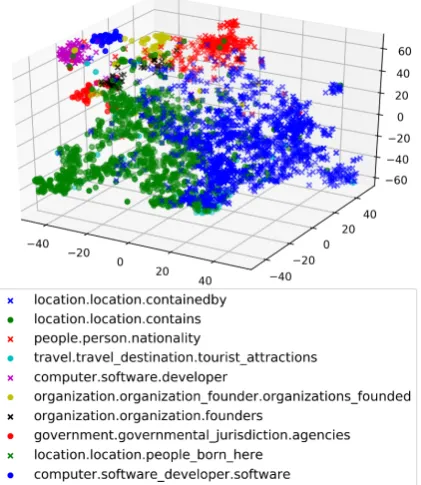
Figure 2: t-SNE visualization of our textual relation embeddings on ClueWeb validation data
5 Analysis
t-SNE visualization To measure the intrinsic property of the learned textual relation embedding,
Model Overall With mentions Without mentions MRR HITS@10 MRR HITS@10 MRR HITS@10
DISTMULT(KB only) 35.8 51.8 27.3 39.5 39 56.3
Conv-DISTMULT 36.5 52.5 28.5 41.4 39.4 56.5
Emb-DISTMULT(GloRE+) 36.4 52.6 28.8 41.8 39.3 56.7 Emb-DISTMULT(GloRE++) 36.6 53.0 28.0 40.8 39.8 57.1
E+DISTMULT(KB only) 37.8 53.5 29.5 43 40.9 57.3
[image:5.595.142.458.62.166.2]Conv-E+Conv-DISTMULT 38.7 54.4 30.0 43.8 41.9 58.2 Emb-E+Emb-DISTMULT(GloRE+) 38.8 54.2 30.0 43.3 42.0 58.2 Emb-E+Emb-DISTMULT(GloRE++) 38.9 54.4 30.0 43.5 42.1 58.3
Table 2: Results of KB completion on FB15k-237 dataset4, measured by MRR and HITS@10 (Both scaled by
100).
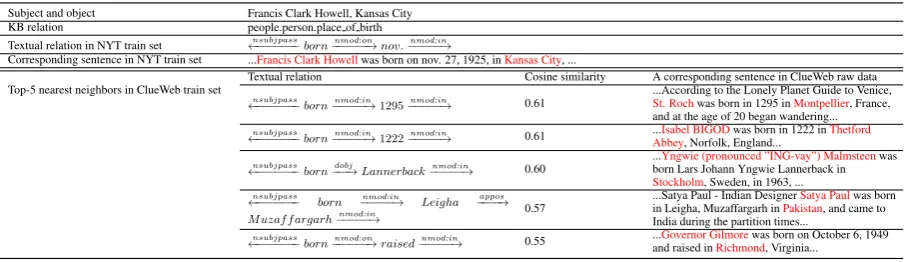
Subject and object Francis Clark Howell, Kansas City KB relation people.person.place of birth
Textual relation in NYT train set ←nsubjpass−−−−−−−born−nmod:on−−−−−→nov.−−−−−→nmod:in
Corresponding sentence in NYT train set ...Francis Clark Howellwas born on nov. 27, 1925, inKansas City, ...
Top-5 nearest neighbors in ClueWeb train set
Textual relation Cosine similarity A corresponding sentence in ClueWeb raw data
nsubjpass
←−−−−−−−born−−−−−→nmod:in 1295−−−−−→nmod:in 0.61
...According to the Lonely Planet Guide to Venice, St. Rochwas born in 1295 inMontpellier, France, and at the age of 20 began wandering...
nsubjpass
←−−−−−−−born−−−−−→nmod:in 1222−−−−−→nmod:in 0.61 ...Isabel BIGODwas born in 1222 inThetford Abbey, Norfolk, England...
nsubjpass
←−−−−−−−born−dobj−−→Lannerback−−−−−→nmod:in 0.60
...Yngwie (pronounced ”ING-vay”) Malmsteenwas born Lars Johann Yngwie Lannerback in Stockholm, Sweden, in 1963, ...
nsubjpass
←−−−−−−− born −−−−−→nmod:in Leigha −appos−−−→
M uzaf f argarh−−−−−→nmod:in 0.57
...Satya Paul - Indian DesignerSatya Paulwas born in Leigha, Muzaffargarh inPakistan, and came to India during the partition times...
nsubjpass
←−−−−−−−born−nmod:on−−−−−→raised−−−−−→nmod:in 0.55 ...Governor Gilmorewas born on October 6, 1949 and raised inRichmond, Virginia...
Table 3: Case study: Textual relation embedding model can well generalize to unseen textual relations via capturing common shared sub-structures.
we apply t-SNE visualization (Maaten and Hinton,
2008) on the learned embedding of ClueWeb vali-dation set.
We filter out infrequent textual relations and as-sign labels to the textual relations when they co-occur more than half of the times with a KB rela-tion. The visualization result of GloRE++ embed-ding associating with the top-10 frequent KB rela-tions is shown in Figure 2. As we can see, sim-ilar textual relations are grouped together while dissimilar ones are separated. This implies that the embedding model can well generate textual re-lation representation for unseen textual rere-lations, and can potentially serve as relational features to help tasks in unsupervised setting.
Case Study To show that the embedding model generalizes to unseen textual relations via captur-ing crucial textual sub-patterns, we randomly pick some textual relations in NYT train set but not in ClueWeb train set, and compare with its top-5 nearest neighbors in ClueWeb train set, based on the similarity of the learned embedding. A case study is shown in Table 3. We can see that the KB relationplace of birthoften collocates with a prepositionin indicating the object fits into a lo-cation type, and some key words like born.
To-gether, the sub-structureborn inserves as a strong indicator forplace of birth relation. There is al-most always some redundant information in the textual relations, for example in the textual
rela-tion←−−−−−−nsubjpass born −−−−−→nmod:on nov.−−−−−→nmod:in , the sub-structure−−−−−→nmod:on nov.does not carry crucial information indicating the target relation. A good textual relation embedding model should be capa-ble of learning to attend to the crucial semantic patterns.
Acknowledgment
[image:5.595.72.532.216.347.2]References
Kurt Bollacker, Colin Evans, Praveen Paritosh, Tim Sturge, and Jamie Taylor. 2008. Freebase: a col-laboratively created graph database for structuring human knowledge. InProceedings of the ACM SIG-MOD International conference on Management of data, pages 1247–1250. ACM.
Razvan C Bunescu and Raymond J Mooney. 2005. A shortest path dependency kernel for relation ex-traction. InProceedings of Conference on Empiri-cal Methods in Natural Language Processing, pages 724–731. Association for Computational Linguis-tics.
Jamie Callan, Mark Hoy, Changkuk Yoo, and Le Zhao. 2009. Clueweb09 data set.
Danqi Chen and Christopher D Manning. 2014. A fast and accurate dependency parser using neural net-works. In Proceedings of Conference on Empiri-cal Methods in Natural Language Processing, pages 740–750. Association for Computational Linguis-tics.
Jacob Devlin, Ming-Wei Chang, Kenton Lee, and Kristina Toutanova. 2018. Bert: Pre-training of deep bidirectional transformers for language understand-ing. arXiv preprint arXiv:1810.04805.
Evgeniy Gabrilovich, Michael Ringgaard, and Amar-nag Subramanya. 2013. FACC1: Freebase anno-tation of ClueWeb corpora, version 1 (release date 2013-06-26, format version 1, correction level 0).
http://lemurproject.org/clueweb09/.
Raphael Hoffmann, Congle Zhang, Xiao Ling, Luke Zettlemoyer, and Daniel S Weld. 2011. Knowledge-based weak supervision for information extraction of overlapping relations. InProceedings of the An-nual Meeting of the Association for Computational Linguistics, pages 541–550. Association for Com-putational Linguistics.
Guoliang Ji, Kang Liu, Shizhu He, Jun Zhao, et al. 2017. Distant supervision for relation extraction with sentence-level attention and entity descriptions. InProceedings of the AAAI Conference on Artificial Intelligence.
Diederik Kingma and Jimmy Ba. 2015. Adam: A method for stochastic optimization. InProceedings of the International Conference on Learning Repre-sentations.
Ryan Kiros, Yukun Zhu, Ruslan R Salakhutdinov, Richard Zemel, Raquel Urtasun, Antonio Torralba, and Sanja Fidler. 2015. Skip-thought vectors. In
Advances in neural information processing systems, pages 3294–3302.
Quoc Le and Tomas Mikolov. 2014. Distributed repre-sentations of sentences and documents. In Proceed-ings of the International Conference on Machine Learning, pages 1188–1196.
Yankai Lin, Shiqi Shen, Zhiyuan Liu, Huanbo Luan, and Maosong Sun. 2016. Neural relation extraction with selective attention over instances. In Proceed-ings of the Annual Meeting of the Association for Computational Linguistics, pages 2124–2133. Asso-ciation for Computational Linguistics.
Laurens van der Maaten and Geoffrey Hinton. 2008. Visualizing data using t-sne. Journal of machine learning research, 9(Nov):2579–2605.
Tomas Mikolov, Ilya Sutskever, Kai Chen, Greg S Cor-rado, and Jeff Dean. 2013. Distributed representa-tions of words and phrases and their composition-ality. In Proceedings of the Annual Conference on Neural Information Processing Systems, pages 3111–3119.
Mike Mintz, Steven Bills, Rion Snow, and Dan Juraf-sky. 2009. Distant supervision for relation extrac-tion without labeled data. InProceedings of the An-nual Meeting of the Association for Computational Linguistics, pages 1003–1011. Association for Com-putational Linguistics.
Jeffrey Pennington, Richard Socher, and Christopher Manning. 2014. Glove: Global vectors for word representation. In Proceedings of Conference on Empirical Methods in Natural Language Process-ing, pages 1532–1543.
Matthew E Peters, Mark Neumann, Mohit Iyyer, Matt Gardner, Christopher Clark, Kenton Lee, and Luke Zettlemoyer. 2018. Deep contextualized word rep-resentations. InProceedings of the Annual Confer-ence of the North American Chapter of the Associa-tion for ComputaAssocia-tional Linguistics.
Sebastian Riedel, Limin Yao, and Andrew McCallum. 2010. Modeling relations and their mentions with-out labeled text. In Joint European Conference on Machine Learning and Knowledge Discovery in Databases, pages 148–163. Springer.
Sebastian Riedel, Limin Yao, Andrew McCallum, and Benjamin M Marlin. 2013. Relation extraction with matrix factorization and universal schemas. In Pro-ceedings of the Annual Conference of the North American Chapter of the Association for Computa-tional Linguistics.
Yu Su, Honglei Liu, Semih Yavuz, Izzeddin Gur, Huan Sun, and Xifeng Yan. 2018. Global relation embed-ding for relation extraction. In Proceedings of the Annual Conference of the North American Chapter of the Association for Computational Linguistics.
Kristina Toutanova, Danqi Chen, Patrick Pantel, Hoi-fung Poon, Pallavi Choudhury, and Michael Gamon. 2015. Representing text for joint embedding of text and knowledge bases. In Proceedings of Confer-ence on Empirical Methods in Natural Language Processing.
Ashish Vaswani, Noam Shazeer, Niki Parmar, Jakob Uszkoreit, Llion Jones, Aidan N Gomez, Łukasz Kaiser, and Illia Polosukhin. 2017. Attention is all you need. InProceedings of the Annual Conference on Neural Information Processing Systems, pages 6000–6010.
Patrick Verga, David Belanger, Emma Strubell, Ben-jamin Roth, and Andrew McCallum. 2016. Multi-lingual relation extraction using compositional uni-versal schema. InProceedings of the Annual Con-ference of the North American Chapter of the Asso-ciation for Computational Linguistics.
Yi Wu, David Bamman, and Stuart Russell. 2017. Ad-versarial training for relation extraction. In Proceed-ings of Conference on Empirical Methods in Natural Language Processing.
Yan Xu, Lili Mou, Ge Li, Yunchuan Chen, Hao Peng, and Zhi Jin. 2015. Classifying relations via long short term memory networks along shortest depen-dency paths. InProceedings of Conference on Em-pirical Methods in Natural Language Processing, pages 1785–1794. Association for Computational Linguistics.
Bishan Yang, Wen-tau Yih, Xiaodong He, Jianfeng Gao, and Li Deng. 2015. Embedding entities and relations for learning and inference in knowledge bases. InProceedings of the International Confer-ence on Learning Representations.
Daojian Zeng, Kang Liu, Yubo Chen, and Jun Zhao. 2015. Distant supervision for relation extraction via piecewise convolutional neural networks. In