http://www.scirp.org/journal/ait ISSN Online: 2161-6825
ISSN Print: 2161-6817
DOI: 10.4236/ait.2017.74008 Sep. 27, 2017 112 Advances in Internet of Things
Major Existing Classification Matrices and
Future Directions for Internet of Things
Kedir Mamo Basher, Juan-Ivan Nieto-Hipolito, Maria De Los Angeles Cosio Leon,
Mabel Vazquez-Briseno, Juan de Dios Sánchez López, Raymundo Buenrostro Mariscal
Facultad de Ingeniería, Arquitectura y Diseño UABC, Ensenada, México
Abstract
Classification method is a formula, logical description generalizing characte-ristics of objects of related area. Nowadays, billions of smart objects are im-mersed in the environment, sensing, interacting, and cooperating with each other to enable efficient services. When we think about IoT, classification is a major challenge particularly if our technology is international level applicable. So, this limitation needs clear and deep analysis of the existing classification matrixes and gives some future directions depending on the different re-searches in the area. The paper surveys the current state-of-art in the classifi-cation of IoT. First, we try to explain commonly existing classificlassifi-cation ma-trixes; Second, cooperation of different methods defending on classification matrixes used. Then analyses challenges that IoT faced from classification an-gle and finally we give some direction for future IoT classification.
Keywords
Internet of Things, Classification of IoT, IoT Overview, Future of IoT, Smart Objects
1. Introduction
It has been estimated that the Internet of Things (IoT) will contain 26 billion de-vices by 2020 (according to Gartner, Inc.), As a result, recent problems and challenges arise spanning classification of this newly fast developing technology. The major reason is that Classic classification matrixes are not sufficient to solve this unprecedented issue, and need to be revised to address the complex re-quirements imposed by IoT. This problem, classification matrix, led us to ana-lyses how the current IoT can be classified. If someone develops a new IoT How to cite this paper: Basher, K.M.,
Nieto-Hipolito, J.-I., De Los Angeles Cosio Leon, M., Vazquez-Briseno, M., de Dios Sánchez López, J. and Mariscal, R.B. (2017) Major Existing Classification Matrices and Future Directions for Internet of Things. Advances in Internet of Things, 7, 112-120. https://doi.org/10.4236/ait.2017.74008
Received: July 5, 2017 Accepted: September 24, 2017 Published: September 27, 2017
Copyright © 2017 by authors and Scientific Research Publishing Inc. This work is licensed under the Creative Commons Attribution International License (CC BY 4.0).
DOI: 10.4236/ait.2017.74008 113 Advances in Internet of Things
technology then how he/she can classify, what are the existing classification ma-trix and how they are effective.
The reason why we interested to do this analysis is as we believe solving classi-fication problem will result in big solution for problems IoT technology’s suf-fering nowadays; like, problems in terms of resource capabilities, lifespan and communication technologies, new standard design if needed in the future and security.
This paper surveys IoT classification matrix and classification related issues nowadays IoT faced. To summarize, this paper address the following main points:
• Discusses various classification matrixes which are in use now a day.
• Explains state-of-art of classification technics which are very important in internet of things world.
• Discuses in between currently used IoT classification matrices.
• Current major problems in IoT world because of classification reasons are explained.
• Finally, we end by suggesting our basic classification matrix. For simplification, we divided this paper in to five various parts:
Part one is introduction which is explained above, Part two different classifi-cation methods used, Section three discuses and comparison among the IoT Classifications in Table 1, in Section four and five discuses some challenges IoT facing due to classification and future consideration during classification stan-dard is design.
2. Existing Classification Methods
For doing this research we searched in different publications and ended up with limited number of literatures about IoT classification [1][2][3][4][5], which is indeed still in its inception phase. This is very important because understanding the existing classification method result in understanding the problems with the existing once and give directions how to solve. This section deals with higher level classification matrixes only.
Different scientific community have different view on classification of IoT generally but as our study indicate that there are two major IoT classification ways are used today’s world, namely, the classic (based on history of IoT) and systematically analyzed and studded (factor dependent classification).
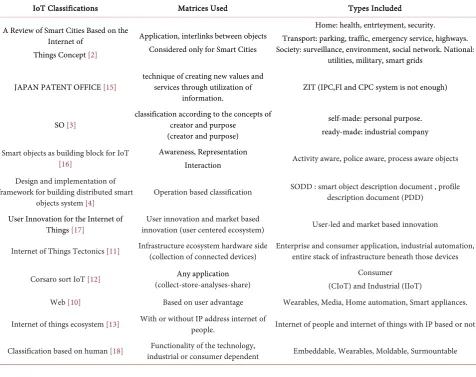
DOI: 10.4236/ait.2017.74008 114 Advances in Internet of Things Table 1. Major existing IoT classifications and their matrices.
IoT Classifications Matrices Used Types Included
A Review of Smart Cities Based on the Internet of
Things Concept [2]
Application, interlinks between objects Considered only for Smart Cities
Home: health, entrteyment, security.
Transport: parking, traffic, emergency service, highways. Society: surveillance, environment, social network. National:
utilities, military, smart grids
JAPAN PATENT OFFICE [15] technique of creating new values and services through utilization of
information. ZIT (IPC,FI and CPC system is not enough)
SO [3] classification according to the concepts of creator and purpose (creator and purpose)
self-made: personal purpose. ready-made: industrial company
Smart objects as building block for IoT [16]
Awareness, Representation
Interaction Activity aware, police aware, process aware objects Design and implementation of
framework for building distributed smart
objects system [4] Operation based classification
SODD : smart object description document , profile description document (PDD)
User Innovation for the Internet of
Things [17] innovation (user centered ecosystem) User innovation and market based User-led and market based innovation
Internet of Things Tectonics [11] Infrastructure ecosystem hardware side (collection of connected devices) Enterprise and consumer application, industrial automation, entire stack of infrastructure beneath those devices
Corsaro sort IoT [12] (collect-store-analyses-share)Any application Consumer
(CIoT) and Industrial (IIoT)
Web [10] Based on user advantage Wearables, Media, Home automation, Smart appliances.
Internet of things ecosystem [13] With or without IP address internet of people. Internet of people and internet of things with IP based or not
Classification based on human [18] industrial or consumer dependent Functionality of the technology, Embeddable, Wearables, Moldable, Surmountable
single specific factor. But, most of the difficulty’s facing this classification me-thod are: 1) until today there is no specifically documented material so that every developer can refer before classifying its product. 2) even the existing once are designed by specific organization (industries) to meet only their requirements which is very difficult to use as worldwide. It is known that there are several classification methods, but here only two of the above are considered.
1) Classical or Traditional Way
A type of classification depends on the historical definition of internet of things and limited specifically on single matrix. Which, the concept of a network of internet of things is considered as smart devices early in 1980’s. The develop-ers named IoT as “smart” to indicate operation of the technology without hu-man intervention “Smart”: Smartphones Smart cars. Smart homes. Smart cities. A smart world. These notions have been espoused for many years. So commonly used classification under this category are:
A. Smart city: if the IoT technology is used for city modernization. B. Smart farm: IoT technologies for farming
DOI: 10.4236/ait.2017.74008 115 Advances in Internet of Things
D.Smart transport: IoT technologies in transport.
E. Smart service: protocols or new techniques which advance use of IoT. F. Smart object: any device from any classifications described above.
We all agree that using such naming is not the problem. The problem arises when we think about what are the specific classification matrices, in this case just only application area. And more now a day’s millions of new IoT technology immersing the market and this kind of classification not support from different angle.
2) Factor Dependent Classification
A IoT classification method where experts in the area follow some specific matrices to classify their technology. These specific matrices are designed for specific organization or deigned for international use by international industries in the area. The widespread problem that most of this classification method sparring is highly depending on the classic classification method and every or-ganization have its own matrixes. There are different views on the Internet of Things paradigm coming from various scientific communities. Below we try to analysis Common ones:
2.1. SO (Smart Object) Classification Model
Which is also known as IoT management architectures, it is a type of classifica-tion of IoT s depending specific matrix called smartness. Here classificaclassifica-tion is only depending on the traditional way of classification which accept the logic IoT is synonym to smart object. Under this classification there are dozens of dif-ferent classification methods used.
DOI: 10.4236/ait.2017.74008 116 Advances in Internet of Things
2.2. From Today’s Intranet of Things to a Future Internet of
Things [9]
The authors classified from wireless- and mobility-related view. IoT is technol-ogy where integrate and worldwide connect smart city, smart grid, building au-tomation system body sensors. With this classification the facts like social, polit-ical, and technological impacts are not considered.
2.3. Consumer Internet of Things [10]
It is a type of classification for Consumer Internet of Things only. With the op-tion of constructor should chose the users advantage, what most wanted to adopt a category that relates. We think the categories are solid. also mixing the genus of his classifications. We do like the identification of power source and connectivity styles/patterns the thing is there is no classification matrix of devic-es and device typdevic-es. For example, wearabldevic-es are really a subcategory of “portabldevic-es or moveable’s”, some devices will be “static”, some will be read, only some will have visual/audio sensors and output.
2.4. The Center Electric Story [11]
Classification based on ecosystem (Internet of Things Tectonics). IoT as ecosys-tem of connected and non-connected devices. Enterprise and consumer applica-tion, industrial automaapplica-tion, entire stack. Infrastructure ecosystem (routing/ processing, connectivity, power, storage, security) and hardware ecosystem (de-sign, manufacturing, component hardware, supply-chain, protocol).
2.5. Right Message and Data Sharing Standard for IoT [12]
Classification factor based on devices used, amount of data, and level of safety the technology applications use divided in to two 1) consumer, CIOT: group of consumer oriented applications where data volumes are low. All devices, in communication, are represented as smart. 2) Industrial IoT: group of industrial oriented applications where data amount is bigger. Devices like machines oper-ating in industry, energy medical or transport technology’s.
2.6. Internet of Things—Challenges and Opportunities beyond the
Hype
Classification based on ecosystem of internet of things (IP based ecosystem). The author Das [13] divided as 1) internet of peoples: involves billions of smart ob-jects which communicate directly over internet, without human intervention. and internet of things with or without IP address. When it is with IP address or devices communicating with out like standardized RFID, active RID, real time location system, mush sensor network.
2.7. Creating a Taxonomy for the Internet of Things
tax-DOI: 10.4236/ait.2017.74008 117 Advances in Internet of Things
onomy with the human at center of all. 1) Embeddable: things in the user. 2) Wearables: things on user. 3) Holdables: things near user. 4) Surroundables: things around user.
2.8. Power Source for Internet-of-Things [14]
Classification factor based on technology applications. Type of classification based on available technology’s and standards.
Communication: (infrared, Bluetooth, radio frequency identification, ZigBee, high speed LAN) Identification: (biometry and object tracking) Location tracing (advancement in RFID and GPS) Sensor (control of temperature, MEMS, mo-tion sensor and image sensor)Devices: (RFID tagging, mobile phone and em-bedded portable electronic devices)
To generalize, as mentioned by many studs when we come to types or classi-fication matrices of IoT everyone has mixed feelings which by itself make diffi-cult the way how to classify and name the term “Internet of Things”. Some of the developers describe the term “everything and nothing” [10] because of no de-fined criteria used for classifying. Even if we had many types of IoT just using classic way of classification the problem is most of classifications are mixed and repeated.
3. Comparison among the Major Existing IoT Classifications
Below in table-I, we have comparison between some major IoT classification methods and matrixes used for classification now a day. Most companies and organizations have their own classification methods which resulted in current IoT classification problems what we faced, like, no common standard to classify newly developing IoT technology’s, every developing company have its own ma-trices even if the technology is designed for different organizations which don’t have same classification matrix as a developer had.
4. Future Directions to Be Considered When Developing or
Designing IoT Classification Factors
As we believe that system’s complexity doesn’t matter in IoT. The important as-pect that identifies an object is its capability to connect to the network and ex-change information without any defect. But the reality now a day is far different. As described in our study the solution is beside the above factors we should think about:
1) Security: global connectedness is a key reason for security threats. It is known that in IoT world everything connected affect everything. In fact highly se-cure islands of very sensitive information are typically not connected at all to IoT world [19].
DOI: 10.4236/ait.2017.74008 118 Advances in Internet of Things
physical parts and dangerous to people or for environment.
3) Reliability: some of the technology will not consider this factor but it is very important, providing service at run time. The reasons may be design error, hardware or environmental error.
4) Timing: all about linking physical system. The amount of available energy, external devices communication load must be considered.
5) Energy efficiency: classifying technologies which generate energy by them-selves to other types of technologies which does not have the ability should be different.
6) Social infects: the overall impact on human society is largely unknown. It must be considered.
7) Legal issues: different components with different legal entity, then who owns the communication as well who will take the risk when there is damage. 8) Heterogeneity and dynamic: components designed for different
communica-tion protocol by different companies.
9) Multidisciplinary: some issues need knowledge from different disciplines, now a day’s communication engineering is linked to computer and electrical engineering.
10)Number of sensors connected: number of communicating devices/sensors in the technology also affect many things so it must be considered.
11)Common design constraints: devices transmit mass amount of data fre-quently, device size constrained, transmit data over long distance, device op-erate for a day, weeks, months without stopping, consumer trust.
12)Market: how an open market place for IoT might be realized that enables people with minimum technical skills to create, distribute, and monetarize. Or how can we give ordinary persons a voice? How can we insure that IoT allows for user-led innovation?
5. Lesson Learned and Open Issues
It is known that internet of things is a big idea full of complex technologies. That’s why we need a common ground to classify these complex technologies to do so every company working in the area must come up with common ground used for classification.
Some of open issues are:
• Many products play role in multiple categories. For a given technology it is important to ask a user what am I buying this instead of? What does it sit next to on the shelf? Most of us being very market focused.
• IoT technologies have Lack of the environment that Clear Strategy in Be-coming Smarter. One key obstacle is citizens themselves, who don’t see the value in them.
DOI: 10.4236/ait.2017.74008 119 Advances in Internet of Things • Find a way of describing things in such a way that developers don’t have to
know about the details or underlying communication patterns. developers looking to answer [20]: How do I publish a Thing? How do I access a Thing? What is the lifecycle of a Thing? How do I add a new property to a Thing? • It seems like there are as many standardizations and bodies focusing on IoT
protocols as there are IoT protocols. But, we should come together and to have a common worldwide standard.
• Get a look at the science behind wireless IoT communication and the benefits and constraints of using wireless communication in IoT technologies.
6. Conclusions
Nowadays, the common way of classifying depends on the way group of prod-ucts that compete, cooperate, share technology, partner, shared distribution or manufacturing expertise. Some other groups believe strongly naming should replicate type of connectivity rather than describing the things which are in it. We agree with both ideas but the thing is beside the above factors we should consider more and more than making common ground for international use. As we shown in our study, nowadays classification of IoT technology is based on factors of specific organization, technology developer. Which, resulted a prob-lem like, same product in various categories, no international level classification method where every developing company can depend on, resulted in difficulty of technology chose from user side, difficult for companies, newly entering into the business of future IoT technology development.
In this paper, a survey of classification of internet of things which are in use nowadays were explained. The paper began by introducing the difficulties caused by classification matrixes. To efficiently address the problem, classification of IoT and matrixes were described. Finally, some suggestions to be considered in the future IoT classification matrices.
Competing Interests
We author(s) declare that we have no competing interests.
References
[1] Pavel Smutný Department of Control Systems and Instrumentation, FME VŠB- Technical University of Ostrava Ostrava, Czech Republic. Different Perspectives on Classification of the Internet of Things. 2016 17th International Carpathian Control Conference (ICCC).
[2] Tommasetti, A., Talari, S., Shafie-Khah, M., Siano, P., Loiaand João, V. and Catalão, P.S. (2017) A Review of Smart Cities Based on the Internet of Things Concept. [3] Uckelmann, D., Harrison, M. and Michahelles, F., Eds. (2011) Architecting the
In-ternet of Things. Springer. https://doi.org/10.1007/978-3-642-19157-2
DOI: 10.4236/ait.2017.74008 120 Advances in Internet of Things
[5] Lakovic, M. and Trun_o, P. (2014) A Service-Oriented Discovery Framework for Cooperating Smart Objects. Springer Series on the Internet of Things: Technology, Communications and Computing, Vol. 1, Springer.
[6] Fortino, G., Guerrieri, A., Russo, W. and Savaglio, C. (2014) Middlewares for Smart Objects and Smart Environments: Overview and Comparison, Springer Series on the Internet of Things: Technology. Communications and Computing, 1.
[7] Fortino, G., Lackovic, M., Russo, W. and Trun_o, P. (2013) A Discovery Service for Smart Objects over an Agent-Based Middleware. Internet and Distributed Compu-ting Systems (IDCS), 281-293.
[8] Fortino, G., Rovella, A., Russo, W. and Savaglio, C. On the Classification of Cyber-physical Smart Objects in the Internet of Things. University of Calabria via P. Bucci 41c, 87036.
[9] Zorzi, M., Gluhak, A., Lange, S. and Bassi, A. (2010) From Today’s Intranet of Things to a Future Internet of Things: A Wireless- and Mobility-Related View. IEEE of Wireless Communications, 17, 44-51.
[10] Smutný, P. (2017) Different Perspectives on Classification of the Internet of Things. International Carpathian Control Conference (ICCC).
[11] Center Electric (2015) Internet of Things Tectonics. http://cen.vc/story/
[12] Corsaro, A. (2014) What Is the Right Messaging and Data Sharing Standard for the Internet of Things.
[13] Das, R. (2014) The Internet of Things—Challenges and Opportunities beyond the Hype. https://www.slideshare.net/IT2Industry/id-tech-exelectronica
[14] Research and Markets (2014) Power Sources for the Internet-of-Things: Markets and Strategies.
http://www.researchandmarkets.com/research/x2xjwf/power_sources_for
[15] Japan Patent Office (2017) Establishment of a New Classification regarding IoT (Internet of Things).
[16] Kortuem, G., Kawsar, F., Fitton, D. and Sundramoorthy, V. (2010) Smart Objects as Building Blocks for the Internet of Things. Internet Computing, 14, 44-51.
[17] Kortuem, G. and Kawsar, F. (2010) User Innovation for the Internet of Things. Computing Department, Lancaster University.
[18] Morgan, S. (2015) Creating a Taxonomy for the Internet of Things.
https://www.intouchsol.com/blog/creating-ataxonomy-for-the-internet-of-things
[19] Guerrieri, A., valerialoscriannarovella and Fortino, G. (2016) Management of Cyber Physical Objects in the Future Internet of Things.
[20] https://dzone.com/articles/understanding-iot-security-part-2-of-3-iot-cyber-securit