A Parallel-Hierarchical Model for Machine Comprehension on Sparse
Data
Adam Trischler∗
adam.trischler Zheng Ye
∗
jeff.ye Xingdi Yuaneric.yuan
Jing He
jing.he phil.bachmanPhilip Bachman Maluuba Research Montreal, Qu´ebec, Canada
Kaheer Suleman [email protected]
Abstract
Understanding unstructured text is a ma-jor goal within natural language process-ing. Comprehension tests pose questions based on short text passages to evaluate such understanding. In this work, we in-vestigate machine comprehension on the challenging MCTest benchmark. Partly because of its limited size, prior work on MCTest has focused mainly on engi-neering better features. We tackle the dataset with a neural approach, harness-ing simple neural networks arranged in a parallel hierarchy. The parallel hierarchy enables our model to compare the pas-sage, question, and answer from a vari-ety of trainable perspectives, as opposed to using a manually designed, rigid fea-ture set. Perspectives range from the word level to sentence fragments to sequences of sentences; the networks operate only on word-embedding representations of text. When trained with a methodology de-signed to help cope with limited training data, our Parallel-Hierarchical model sets a new state of the art forMCTest, outper-forming previous feature-engineered proaches slightly and previous neural ap-proaches by a significant margin (over 15 percentage points).
1 Introduction
Humans learn in a variety of ways—by communi-cation with each other and by study, the reading of text. Comprehension of unstructured text by machines, at a near-human level, is a major goal for natural language processing. It has garnered
∗A. Trischler and Z. Ye contributed equally to this work.
significant attention from the machine learning re-search community in recent years.
Machine comprehension (MC) is evaluated by posing a set of questions based on a text pas-sage (akin to the reading tests we all took in school). Such tests are objectively gradable and can be used to assess a range of abilities, from basic understanding to causal reasoning to infer-ence (Richardson et al., 2013). Given a text pas-sage and a question about its content, a system is tested on its ability to determine the correct an-swer (Sachan et al., 2015). In this work, we focus on MCTest, a complex but data-limited compre-hension benchmark, whose multiple-choice ques-tions require not only extraction but also infer-ence and limited reasoning (Richardson et al., 2013). Inference and reasoning are important hu-man skills that apply broadly, beyond language.
We present a parallel-hierarchical approach to machine comprehension designed to work well in a data-limited setting. There are many use-cases in which comprehension over limited data would be handy: for example, user manuals, internal doc-umentation, legal contracts, and so on. More-over, work towards more efficient learning from any quantity of data is important in its own right, for bringing machines more in line with the way humans learn. Typically, artificial neural networks require numerous parameters to capture complex patterns, and the more parameters, the more train-ing data is required to tune them. Likewise, deep models learn to extract their own features, but this is a data-intensive process. Our model learns to comprehend at a high level even when data is sparse.
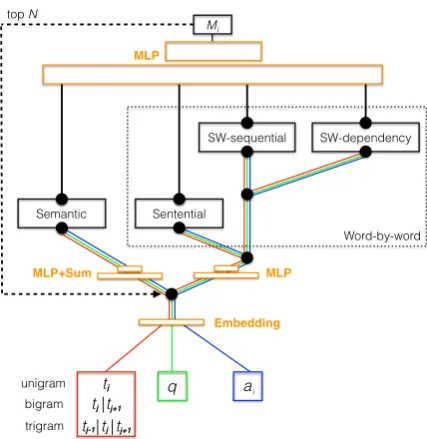
The key to our model is that it compares the question and answer candidates to the text using several distinct perspectives. We refer to a ques-tion combined with one of its answer candidates as ahypothesis(to be detailed below). The
tic perspective compares the hypothesis to sen-tences in the text viewed as single, self-contained thoughts; these are represented using a sum and transformation of word embedding vectors, sim-ilarly to Weston et al. (2014). Theword-by-word perspective focuses on similarity matches between individual words from hypothesis and text, at var-ious scales. As in the semantic perspective, we consider matches over complete sentences. We also use a sliding window acting on a subsentential scale (inspired by the work of Hill et al. (2015)), which implicitly considers the linear distance be-tween matched words. Finally, this word-level sliding window operates on two different views of story sentences: the sequential view, where words appear in their natural order, and the depen-dencyview, where words are reordered based on a linearization of the sentence’s dependency graph. Words are represented throughout by embedding vectors (Bengio et al., 2000; Mikolov et al., 2013). These distinct perspectives naturally form a chy that we depict in Figure 1. Language is hierar-chical, so it makes sense that comprehension relies on hierarchical levels of understanding.
The perspectives of our model can be consid-ered a type of feature. However, they are im-plemented by parametric differentiable functions. This is in contrast to most previous efforts on MCTest, whose numerous hand-engineered fea-tures cannot be trained. Our model, significantly, can be trained end-to-end with backpropagation. To facilitate learning with limited data, we also develop a unique training scheme. We initialize the model’s neural networks to perform specific heuristic functions that yield decent (though not impressive) performance on the dataset. Thus, the training scheme gives the model a safe, reasonable baseline from which to start learning. We call this techniquetraining wheels.
Computational models that comprehend (inso-far as they perform well on MC datasets) have been developed contemporaneously in several re-search groups (Weston et al., 2014; Sukhbaatar et al., 2015; Hill et al., 2015; Hermann et al., 2015; Kumar et al., 2015). Models designed specifi-cally for MCTest include those of Richardson et al. (2013), and more recently Sachan et al. (2015), Wang et al. (2015), and Yin et al. (2016). In exper-iments, ourParallel-Hierarchicalmodel achieves state-of-the-art accuracy onMCTest, outperform-ing these existoutperform-ing methods.
Below we describe related work, the mathemat-ical details of our model, and our experiments, then analyze our results.
2 The Problem
In this section, we borrow from Sachan et al. (2015), who laid out the MC problem nicely. Ma-chine comprehension requires maMa-chines to answer questions based on unstructured text. This can be viewed as selecting the best answer from a set of candidates. In the multiple-choice case, cdidate answers are predefined, but cancdidate an-swers may also be undefined yet restricted (e.g., to
yes,no, or any noun phrase in the text) (Sachan et al., 2015).
For each question q, letT be the unstructured text and A = {ai} the set of candidate answers
toq. The machine comprehension task reduces to selecting the answer that has the highest evidence givenT. As in Sachan et al. (2015), we combine an answer and a question into ahypothesis,hi = f(q, ai). To facilitate comparisons of the text with
the hypotheses, we also break down the passage into sentences tj, T = {tj}. In our setting, q, ai, andtjeach represent a sequence of embedding
vectors, one for each word and punctuation mark in the respective item.
3 Related Work
Machine comprehension is currently a hot topic within the machine learning community. In this section we will focus on the best-performing mod-els applied specifically toMCTest, since it is some-what unique among MC datasets (see Section 5). Generally, models can be divided into two cate-gories: those that use fixed, engineered features, and neural models. The bulk of the work on MCTestfalls into the former category.
3.1 Feature-engineering models
Sachan et al. (2015) treatedMCTestas a structured prediction problem, searching for a latent answer-entailing structure connecting question, answer, and text. This structure corresponds to the best latent alignment of a hypothesis with appropri-ate snippets of the text. The process of (lappropri-atently) selecting text snippets is related to the attention mechanisms typically used in deep networks de-signed for MC and machine translation (Bahdanau et al., 2014; Weston et al., 2014; Hill et al., 2015; Hermann et al., 2015). The model uses event and entity coreference links across sentences along with a host of other features. These include specifically trained word vectors for synonymy; antonymy and class-inclusion relations from ex-ternal database sources; dependencies and seman-tic role labels. The model is trained using a latent structural SVM extended to a multitask setting, so that questions are first classified using a pretrained top-level classifier. This enables the system to use different processing strategies for different ques-tion categories. The model also combines quesques-tion and answer into a well-formed statement using the rules of Cucerzan and Agichtein (2005).
Our model is simpler than that of Sachan et al. (2015) in terms of the features it takes in, the training procedure (stochastic gradient descentvs. alternating minimization), question classification (we use none), and question-answer combination (simple concatenation or meanvs.a set of rules).
Wang et al. (2015) augmented the baseline ture set from Richardson et al. (2013) with fea-tures for syntax, frame semantics, coreference chains, and word embeddings. They combined features using a linear latent-variable classifier trained to minimize a max-margin loss function. As in Sachan et al. (2015), questions and answers are combined using a set of manually written rules. The method of Wang et al. (2015) achieved the previous state of the art, but has significant com-plexity in terms of the feature set.
Space does not permit a full description of all models in this category, but we refer the reader to the contributions of Smith et al. (2015) and Narasimhan and Barzilay (2015) as well.
Despite its relative lack of features, the Parallel-Hierarchical model improves upon the feature-engineered state of the art for MCTestby a small amount (about 1% absolute) as detailed in Sec-tion 5.
3.2 Neural models
Neural models have, to date, performed relatively poorly on MCTest. This is because the dataset is sparse and complex.
Yin et al. (2016) investigated deep-learning approaches concurrently with the present work. They measured the performance of the Attentive Reader (Hermann et al., 2015) and the Neural Rea-soner (Peng et al., 2015), both deep, end-to-end recurrent models with attention mechanisms, and also developed an attention-based convolutional network, the HABCNN. Their network operates on a hierarchy similar to our own, providing fur-ther evidence of the promise of hierarchical per-spectives. Specifically, the HABCNN processes text at the sentence level and the snippet level, where the latter combines adjacent sentences (as we do through ann-gram input). Embedding vec-tors for the question and the answer candidates are combined and encoded by a convolutional net-work. This encoding modulates attention over sen-tence and snippet encodings, followed by max-pooling to determine the best matches between question, answer, and text. As in the present work, matching scores are given by cosine similarity. The HABCNN also makes use of a question clas-sifier.
Despite the conceptual overlap between the HABCNN and our approach, the Parallel-Hierarchical model performs significantly better on MCTest(more than 15% absolute) as detailed in Section 5. Other neural models tested in Yin et al. (2016) fare even worse.
4 The Parallel-Hierarchical Model
Let us now define our machine comprehension model in full. We first describe each of the per-spectives separately, then describe how they are combined. Below, we use subscripts to index el-ements of sequences, like word vectors, and su-perscripts to indicate whether elements come from the text, question, or answer. In particular, we use the subscriptsk, m, n, pto index sequences from the text, question, answer, and hypothesis, respec-tively, and superscripts t, q, a, h. We depict the model schematically in Figure 1.
4.1 Semantic Perspective
sen-Semantic Sentential
SW-sequential SW-dependency
MLP
Word-by-word top N
tj
tj|tj+1
unigram bigram
tj|tj+1
tj-1|
trigram
MLP+Sum MLP
Embedding
q ai
[image:4.595.74.288.61.281.2]Mi
Figure 1: Schematic of the Parallel-Hierarchical model. SW stands for “sliding window.” MLP represents a fully connected neural network.
tence of the text is a sequence of d-dimensional word vectors: tj = {tk},tk ∈ Rd. The semantic
vectorstis computed by embedding the word
vec-tors into aD-dimensional space using a two-layer network that implements weighted sum followed by an affine tranformation and a nonlinearity;i.e.,
st=f AtX k
ωktk+btA !
. (1)
The matrix At ∈ RD×d, the bias vector bt A ∈ RD, and for f we use the leaky ReLU function.
The scalar ωk is a trainable weight associated
with each word in the vocabulary. These scalar weights implement a kind ofexogenousor bottom-up attention that depends only on the input stimu-lus (Mayer et al., 2004). They can, for example, learn to perform the function of stopword lists in a soft, trainable way, to nullify the contribution of unimportant filler words.
The semantic representation of a hypothesis is formed analogously, except that we concatenate the question word vectors qm and answer word
vectorsanas a single sequence{hp}={qm,an}.
For semantic vectorsh of the hypothesis, we use
a unique transformation matrixAh ∈ RD×d and
bias vectorbh
A∈RD.
These transformations map a text sentence and a hypothesis into a common space where they can be compared. We compute the semantic match
be-tween text sentence and hypothesis using the co-sine similarity,
Msem = cos(st,sh). (2)
4.2 Word-by-Word Perspective
The first step in building the word-by-word per-spective is to transform word vectors from a text sentence, question, and answer through re-spective neural functions. For the text, ˜tk = f Btt
k+btB
, where Bt ∈ RD×d, bt
B ∈ RD
andf is again theleaky ReLU. We transform the question and the answer toq˜mand˜ananalogously
using distinct matrices and bias vectors. In con-trast to the semantic perspective, we keep the ques-tion and answer candidates separate in the word-by-word perspective. This is because matches to answer words are inherently more important than matches to question words, and we want our model to learn to use this property.
4.2.1 Sentential
Inspired by the work of Wang and Jiang (2015) in paraphrase detection, we compute matches be-tween hypotheses and text sentences at the word level. This computation uses the cosine similarity as before:
cqkm = cos(˜tk,˜qm), (3) ca
kn= cos(˜tk,˜an). (4)
The word-by-word match between a text sen-tence and question is determined by taking the maximum over k(finding the text word that best matches each question word) and then taking a weighted mean overm(finding the average match over the full question):
Mq = Z1 X
m
ωmmax
k c q
km. (5)
Here,ωmis the word weight for the question word
andZnormalizes these weights to sum to one over the question. We define the match between a sen-tence and answer candidate,Ma, analogously.
Fi-nally, we combine the matches to question and an-swer according to
Mword =α1Mq+α2Ma+α3MqMa. (6)
4.2.2 Sequential Sliding Window
The sequential sliding window is related to the original MCTest baseline by Richardson et al. (2013). Our sliding window decays from its focus word according to a Gaussian distribution, which we extend by assigning a trainable weight to each location in the window. This modification en-ables the window to use information about the dis-tance between word matches; the original base-line (Richardson et al., 2013) used distance infor-mation through a predefined function.
The sliding window scans over the words of the text as one continuous sequence, without tence breaks. Each window is treated like a sen-tence in the previous subsection, but we include a location-based weightλ(k). This weight is based on a word’s position in the window, which, given a window, depends on its global position k. The cosine similarity is adapted as
sqkm=λ(k) cos(˜tk,q˜m), (7)
for the question and analogously for the answer. We initialize the location weights with a Gaus-sian and fine-tune them during training. The final matching score, denoted asMsws, is computed as in (5) and (6) withsqkmreplacingcqkm.
4.2.3 Dependency Sliding Window
The dependency sliding window operates identi-cally to the linear sliding window, but on a differ-ent view of the text passage. The output of this component isMswdand is formed analogously to
Msws.
The dependency perspective uses the Stanford Dependency Parser (Chen and Manning, 2014) as an auxiliary tool. Thus, the dependency graph can be considered a fixed feature. Moreover, lineariza-tion of the dependency graph, because it relies on an eigendecomposition, is not differentiable. However, we handle the linearization in data pre-processing so that the model sees only reordered word-vector inputs.
Specifically, we run the Stanford Dependency Parser on each text sentence to build a dependency graph. This graph has nw vertices, one for each
word in the sentence. From the dependency graph we form the Laplacian matrix L ∈ Rnw×nw and
determine its eigenvectors. The second eigenvec-tor u2 of the Laplacian is known as the Fiedler
vector. It is the solution to the minimization
minimize
g
N X
i,j=1
ηij(g(vi)−g(vj))2, (8)
where vi are the vertices of the graph andηij is
the weight of the edge from vertex i to vertex
j(Golub and Van Loan, 2012). The Fiedler vector maps a weighted graph onto a line such that con-nected nodes stay close, modulated by the connec-tion weights.1This enables us to reorder the words of a sentence based on their proximity in the de-pendency graph. The reordering of the words is given by the ordered index set
I = arg sort(u2). (9)
To give an example of how this works, con-sider the following sentence fromMCTestand its dependency-based reordering:
Jenny, Mrs. Mustard ’s helper, called the police.
the police, called Jenny helper, Mrs. ’s Mustard.
Sliding-window-based matching on the original sentence will answer the questionWho called the police? withMrs. Mustard. The dependency re-ordering enables the window to determine the cor-rect answer,Jenny.
4.3 Combining Distributed Evidence
It is important in comprehension to synthesize in-formation found throughout a document. MCTest was explicitly designed to ensure that it could not be solved by lexical techniques alone, but would instead require some form of inference or limited reasoning (Richardson et al., 2013). It therefore includes questions where the evidence for an an-swer spans several sentences.
To perform synthesis, our model also takes inn -grams of sentences,i.e., sentence pairs and triples strung together. The model treats these exactly as it treats single sentences, applying all func-tions detailed above. A later pooling operation combines scores across alln-grams (including the single-sentence input). This is described in the next subsection.
With n-grams, the model can combine infor-mation distributed across contiguous sentences. In some cases, however, the required evidence is spread across distant sentences. To give our model some capacity to deal with this scenario, we take the topN sentences as scored by all the preced-ing functions, and then repeat the scorpreced-ing compu-tations, viewing these topN as a single sentence.
The reasoning behind these approaches can be explained well in a probabilistic setting. If we con-sider our similarity scores to model the likelihood of a text sentence given a hypothesis, p(tj | hi),
then the n-gram and top N approaches model a joint probabilityp(tj1, tj2, . . . , tjk | hi). We
can-not model the joint probability as a product of in-dividual terms (score values) because distributed pieces of evidence are likely not independent. 4.4 Combining Perspectives
We use a multilayer perceptron (MLP) to combine
Msem, Mword, Mswd, and Msws, as well as the scores for separate n-grams, as a final matching score Mi for each answer candidate. This MLP
has multiple layers of staged input, because the distinct scores have different dimensionality: there is one Msem and one Mword for each story sen-tence, and oneMswdand oneMswsfor each appli-cation of the sliding window. The MLP’s activa-tion funcactiva-tion is linear.
Our overall training objective is to minimize the ranking loss
L(T, q, A) = max(0, µ+ max
i Mi6=i∗−Mi∗),
(10) whereµis a constant margin, i∗ indexes the cor-rect answer. We take the maximum overiso that we are ranking the correct answer over the best-ranked incorrect answer (of which there are three). This approach worked better than comparing the correct answer to the incorrect answers individu-ally as in Wang et al. (2015).
Our implementation of the Parallel-Hierarchical model, built inTheano(Bergstra et al., 2010) us-ing theKerasframework (Chollet, 2015), is avail-able onGithub.2
4.5 Training Wheels
Before training, we initialized the neural-network components of our model to perform sensible heuristic functions. Training did not converge on the smallMCTestwithout this vital approach.
2https://github.com/Maluuba/mctest-model
Empirically, we found that we could achieve above 50% accuracy on MCTest using a simple sum of word vectors followed by a dot product be-tween the story-sentence sum and the hypothesis sum. Therefore, we initialized the network for the semantic perspective to perform this sum, by ini-tializingAx as the identity matrix and bx
A as the
zero vector,x ∈ {t, h}. Recall that the activation function is aReLUso that positive outputs are un-changed.
We also found basic word-matching scores to be helpful, so we initialized the word-by-word networks likewise. The network for perspective-combination was initialized to perform a sum of individual scores, using a zero bias-vector and a weight matrix ofones, since we found that each perspective contributed positively to the overall re-sult.
This training wheels approach is related to other techniques from the literature. For in-stance, Socher et al. (2013) proposed the identity-matrix initialization in the context of parsing, and Le et al. (2015) proposed it in the context of recurrent neural networks (to preserve the er-ror signal through backpropagation). In residual networks (He et al., 2015), shortcut connections bypass certain layers in the network so that a sim-pler function can be trained in conjunction with the full model.
5 Experiments 5.1 The Dataset
MCTest is a collection of 660 elementary-level children’s stories and associated questions, writ-ten by human subjects. The stories are fictional, ensuring that the answer must be found in the text itself, and carefully limited to what a young child can understand (Richardson et al., 2013).
The more challenging variant consists of 500 stories with four multiple-choice questions each. Despite the elementary level, stories and questions are more natural and more complex than those found in synthetic MC datasets likebAbI(Weston et al., 2014) andCNN(Hermann et al., 2015).
5.2 Training and Model Details
In this section we describe important details of the training procedure and model setup. For a com-plete list of hyperparameter settings, our stopword list, and other minutiæ, we refer interested readers to ourGithubrepository.
For word vectors we use Google’s publicly available embeddings, trained withword2vecon the 100-billion-wordNews corpus(Mikolov et al., 2013). These vectors are kept fixed throughout training, since we found that training them was not helpful (likely because ofMCTest’s size). The vectors are 300-dimensional (d= 300).
We do not use a stopword list for the text pas-sage, instead relying on the trainable word weights to ascribe global importance ratings to words. These weights are initialized with the inverse doc-ument frequency (IDF) statistic computed over the MCTestcorpus.3However, we do use a short stop-word list for questions. This list nullifies query words such as {who, what, when, where, how}, along with conjugations of the verbsto do andto be.
Following earlier methods, we use a heuris-tic to improve performance on negation ques-tions (Sachan et al., 2015; Wang et al., 2015). When a question contains the words which and
not, we negate the hypothesis ranking scores so that the minimum becomes the maximum. This heuristic leads to an improvement around 6% on the validation set.
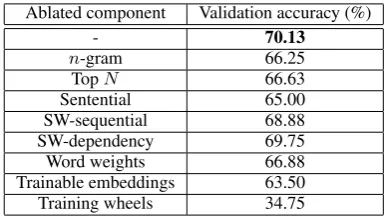
The most important technique for training the model was the training wheels approach. With-out this, training was not effective at all (see the ablation study in Table 2). The identity initializa-tion requires that the network weight matrices are square (d=D).
We founddropout(Srivastava et al., 2014) to be particularly effective at improving generalization from the training to the test set, and used 0.5 as the dropout probability. Dropout occurs after all neural-network transformations, if those transfor-mations are allowed to change with training. Our best performing model held networks at the word-by-word level fixed.
For combining distributed evidence, we used up to trigrams over sentences and our best-performing model reiterated over the top two sen-tences (N = 2).
3We override the IDF initialization for words like not, which are frequent but highly informative.
We used theAdamoptimizer with the standard settings (Kingma and Ba, 2014) and a learning rate of 0.003. To determine the best hyperpa-rameters we performed a search over 150 settings based on validation-set accuracy. MCTest’s orig-inal validation set is too small for reliable hy-perparameter tuning, so, following Wang et al. (2015), we merged the training and validation sets of MCTest-160 andMCTest-500, then split them randomly into a 250-story training set and a 200-story validation set. This repartition of the data did not affect overall performance per se; rather, the larger validation set made it easier to choose hyperparameters because validation results were more consistent.
5.3 Results
Table 1 presents the performance of feature-engineered and neural methods on theMCTesttest set. Accuracy scores are divided among questions whose evidence lies in a single sentence (single) and across multiple sentences (multi), and among the two variants. Clearly,MCTest-160 is easier.
The first three rows represent feature-engineered methods. Richardson et al. (2013) + RTE is the best-performing variant of the original baseline published along with MCTest. It uses a lexical sliding window and distance-based mea-sure, augmented with rules for recognizing textual entailment. We described the methods of Sachan et al. (2015) and Wang et al. (2015) in Section 3. On MCTest-500, the Parallel Hierarchical model significantly outperforms these methods onsingle questions (>2%) and slightly outperforms the latter two onmultiquestions (≈0.3%) and overall (≈1%). The method of Wang et al. (2015) achieves the best overall result on MCTest-160. We suspect this is because our neural method suffered from the relative lack of training data.
Method Single (112)MCTest-160 accuracy (%)Multiple (128) All Single (272)MCTest-500 accuracy (%)Multiple (328) All Richardson et al. (2013) + RTE 76.78 62.50 69.16 68.01 59.45 63.33
Sachan et al. (2015) - - - 67.65 67.99 67.83
Wang et al. (2015) 84.22 67.85 75.27 72.05 67.94 69.94
Attentive Reader 48.1 44.7 46.3 44.4 39.5 41.9
Neural Reasoner 48.4 46.8 47.6 45.7 45.6 45.6
HABCNN-TE 63.3 62.9 63.1 54.2 51.7 52.9
[image:8.595.83.519.62.156.2]Parallel-Hierarchical 79.46 70.31 74.58 74.26 68.29 71.00
Table 1: Experimental results onMCTest.
Ablated component Validation accuracy (%)
- 70.13
n-gram 66.25
TopN 66.63
Sentential 65.00
SW-sequential 68.88
SW-dependency 69.75
Word weights 66.88
Trainable embeddings 63.50 Training wheels 34.75
Table 2: Ablation study onMCTest-500 (all).
HABCNN, we hypothesize that the performance difference is attributable to the greater simplicity of our model and our training wheels methodol-ogy.
6 Analysis and Discussion
We measure the contribution of each component of the model by ablating it. Results on the vali-dation set are given in Table 2. Not surprisingly, the n-gram functionality is important, contribut-ing almost 4% accuracy improvement. Without this, the model has almost no means for synthe-sizing distributed evidence. The top N function contributes similarly to the overall performance, suggesting that there is a nonnegligible number of multi questions that have their evidence dis-tributed across noncontiguous sentences. Ablating the sentential component made a significant differ-ence, reducing performance by about 5%. Sim-ple word-by-word matching is obviously useful on MCTest. The sequential sliding window con-tributes about 1.3%, suggesting that word-distance measures are not overly important. Similarly, the dependency-based sliding window makes a very minor contribution. We found this surprising. It may be that linearization of the dependency graph removes too much of its information. The ex-ogenous word weights make a significant contri-bution of over 3%. Allowing the embeddings to change with training reduced performance fairly significantly, almost 8%. As discussed, this is a
case of having too many parameters for the avail-able training data. Finally, we see that the training wheels methodology had enormous impact. With-out heuristic-based initialization of the model’s various weight matrices, accuracy goes down to about 35%, which is only ten points over random chance.
Analysis reveals that most of our system’s test failures occur on questions about quantity (e.g.,
How many...?) and temporal order (e.g., Who was invited last?). Quantity questions make up 9.5% of our errors on the validation set, while or-der questions make up 10.3%. This weakness is not unexpected, since our architecture lacks any capacity for counting or tracking temporal order. Incorporating mechanisms for these forms of rea-soning is a priority for future work (in contrast, the Memory Network model (Weston et al., 2014) is quite good at temporal reasoning).
The Parallel-Hierarchical model is simple. It does no complex language or sequence modeling. Its simplicity is a response to the limited data of MCTest. Nevertheless, the model achieves state-of-the-art results on the multi questions, which (putatively) require some limited reasoning. Our model is able to handle them reasonably well just by stringing important sentences together. Thus, the model imitates reasoning with a heuristic. This suggests that, to learn true reasoning abilities, MCTest is too simple a dataset—and it is almost certainly too small for this goal.
[image:8.595.84.279.195.304.2]con-sidered a close analogue of the RTE task, at which our model becomes very adept even with less data. Incorporating the various views of our model amounts to encoding prior knowledge about the problem structure. This is similar to the purpose of feature engineering, except that the views can be fully trained. Encoding problem structure into the structure of neural networks is not new: as an-other example, the convolutional architecture has led to large gains in vision tasks.
7 Conclusion
We have presented the novel Parallel-Hierarchical model for machine comprehension, and evalu-ated it on the small but complex MCTest. Our model achieves state-of-the-art results, outper-forming several feature-engineered and neural ap-proaches.
Working with our model has emphasized to us the following (not necessarily novel) concepts, which we record here to promote further empirical validation.
• Good comprehension of language is sup-ported by hierarchical levels of understand-ing (cf.Hill et al. (2015)).
• Exogenous attention (the trainable word weights) may be broadly helpful for NLP.
• The training wheels approach, that is, ini-tializing neural networks to perform sensible heuristics, appears helpful for small datasets.
• Reasoningover language is challenging, but easily simulated in some cases.
References
Dzmitry Bahdanau, Kyunghyun Cho, and Yoshua Ben-gio. 2014. Neural machine translation by jointly learning to align and translate. arXiv preprint arXiv:1409.0473.
Yoshua Bengio, R´ejean Ducharme, and Pascal Vincent. 2000. A neural probabilistic language model. In Ad-vances in Neural Information Processing Systems, pages 932–938.
J. Bergstra, O. Breuleux, F. Bastien, P. Lamblin, R. Pas-canu, G. Desjardins, J. Turian, D. Warde-Farley, and Y. Bengio. 2010. Theano: a CPU and GPU math expression compiler. InIn Proc. of SciPy.
Danqi Chen and Christopher D Manning. 2014. A fast and accurate dependency parser using neural net-works. InEMNLP, pages 740–750.
Franc¸ois Chollet. 2015. keras. https://github.com/fchollet/keras. Silviu Cucerzan and Eugene Agichtein. 2005. Factoid
question answering over unstructured and structured web content. InTREC, volume 72, page 90. Gene H Golub and Charles F Van Loan. 2012. Matrix
computations, volume 3. JHU Press.
Kaiming He, Xiangyu Zhang, Shaoqing Ren, and Jian Sun. 2015. Deep residual learning for image recog-nition.arXiv preprint arXiv:1512.03385.
Karl Moritz Hermann, Tomas Kocisky, Edward Grefenstette, Lasse Espeholt, Will Kay, Mustafa Su-leyman, and Phil Blunsom. 2015. Teaching ma-chines to read and comprehend. InAdvances in Neu-ral Information Processing Systems, pages 1684– 1692.
Felix Hill, Antoine Bordes, Sumit Chopra, and Jason Weston. 2015. The goldilocks principle: Reading children’s books with explicit memory representa-tions.arXiv preprint arXiv:1511.02301.
Diederik Kingma and Jimmy Ba. 2014. Adam: A method for stochastic optimization. arXiv preprint arXiv:1412.6980.
Ankit Kumar, Ozan Irsoy, Jonathan Su, James Brad-bury, Robert English, Brian Pierce, Peter Ondruska, Ishaan Gulrajani, and Richard Socher. 2015. Ask me anything: Dynamic memory networks for natural language processing. arXiv preprint arXiv:1506.07285.
Quoc V Le, Navdeep Jaitly, and Geoffrey E Hin-ton. 2015. A simple way to initialize recurrent networks of rectified linear units. arXiv preprint arXiv:1504.00941.
Andrew R Mayer, Jill M Dorflinger, Stephen M Rao, and Michael Seidenberg. 2004. Neural networks underlying endogenous and exogenous visual–spatial orienting. Neuroimage, 23(2):534– 541.
Tomas Mikolov, Kai Chen, Greg Corrado, and Jef-frey Dean. 2013. Efficient estimation of word representations in vector space. arXiv preprint arXiv:1301.3781.
Karthik Narasimhan and Regina Barzilay. 2015. Ma-chine comprehension with discourse relations. In
53rd Annual Meeting of the Association for Com-putational Linguistics.
Baolin Peng, Zhengdong Lu, Hang Li, and Kam-Fai Wong. 2015. Towards neural network-based rea-soning.arXiv preprint arXiv:1508.05508.
Matthew Richardson, Christopher JC Burges, and Erin Renshaw. 2013. Mctest: A challenge dataset for the open-domain machine comprehension of text. In
Mrinmaya Sachan, Avinava Dubey, Eric P Xing, and Matthew Richardson. 2015. Learning answerentail-ing structures for machine comprehension. In Pro-ceedings of ACL.
Ellery Smith, Nicola Greco, Matko Bosnjak, and An-dreas Vlachos. 2015. A strong lexical matching method for the machine comprehension test. In Pro-ceedings of the 2015 Conference on Empirical Meth-ods in Natural Language Processing, pages 1693– 1698, Lisbon, Portugal, September. Association for Computational Linguistics.
Richard Socher, John Bauer, Christopher D Manning, and Andrew Y Ng. 2013. Parsing with composi-tional vector grammars. InACL (1), pages 455–465. Nitish Srivastava, Geoffrey Hinton, Alex Krizhevsky, Ilya Sutskever, and Ruslan Salakhutdinov. 2014. Dropout: A simple way to prevent neural networks from overfitting. The Journal of Machine Learning Research, 15(1):1929–1958.
Sainbayar Sukhbaatar, Jason Weston, Rob Fergus, et al. 2015. End-to-end memory networks. InAdvances in Neural Information Processing Systems, pages 2431–2439.
Shuohang Wang and Jing Jiang. 2015. Learning nat-ural language inference with lstm. arXiv preprint arXiv:1512.08849.
Hai Wang, Mohit Bansal, Kevin Gimpel, and David McAllester. 2015. Machine comprehension with syntax, frames, and semantics. In Proceedings of ACL, Volume 2: Short Papers, page 700.
Jason Weston, Sumit Chopra, and Antoine Bor-des. 2014. Memory networks. arXiv preprint arXiv:1410.3916.